
Judge, 1921-11-19 · page 13 of 36
Judge — November 19, 1921 — page 13: what you’re looking at
What you’re looking at
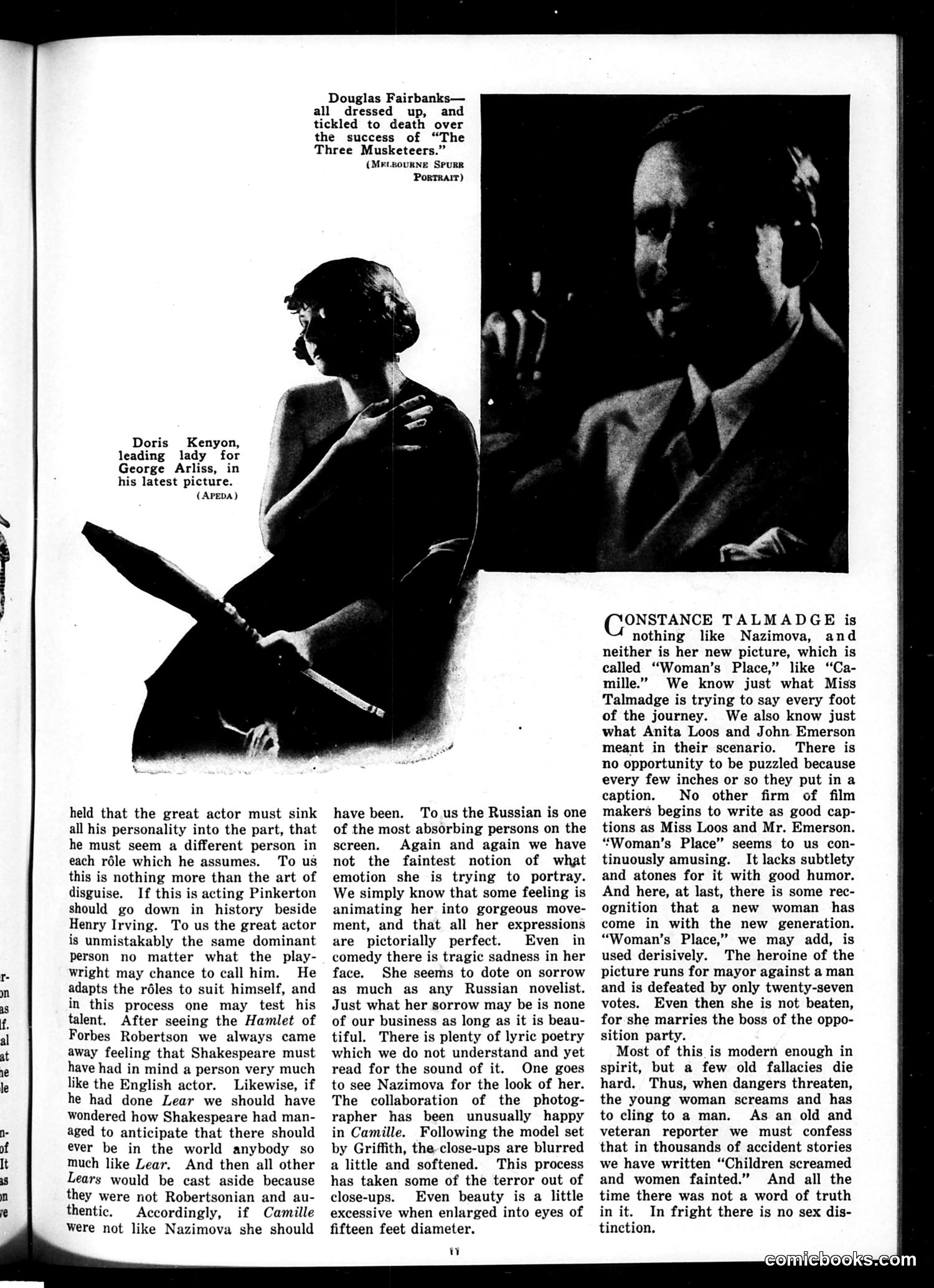
This page from *Judge* magazine reviews three contemporary silent films, using them to discuss acting styles and modern cinema. **The Reviews:** The text compares three actresses' approaches: **Nazimova** (in *Camille*), praised for her mysterious, pictorially perfect emotionalism that viewers don't fully understand but find beautiful; **Doris Kenyon** (with George Arliss); and **Constance Talmadge** (in *Woman's Place*), criticized for being overly explicit—her films include constant captions explaining every plot point, leaving nothing to interpretation. **The Satire:** The critic argues that great acting requires maintaining a dominant personality across roles, not disappearing into characters. Talmadge's film is deemed amusingly modern (its heroine runs for mayor), yet still relies on old clichés—namely, that women scream and faint in danger. The author, claiming experience as a "veteran reporter," notes this gendered trope is factually untrue. **For Modern Readers:** This reflects 1920s debates about acting realism versus stylization, and early feminist critiques of how cinema portrayed women's responses to crisis.
📄 Transcribed text from this page (OCR, searchable)
Machine-transcribed from the original scan — historical spelling and the odd misread are preserved.
Douglas Fairbanks— all dressed up, and tickled to death over the success of “The Three Musketeers.” Doris Kenyon, leading lady for George Arliss, in his latest picture. (APEDA) held that the great actor must sink all his personality into the part, that he must seem a different person in each réle which he assumes. To us this is nothing more than the art of disguise. If this is acting Pinkerton should go down in history beside Henry Irving. To us the great actor is unmistakably the same dominant person no matter what the play- wright may chance to call him. He adapts the réles to suit himself, and in this process one may test his talent. After seeing the Hamlet of Forbes Robertson we always came away feeling that Shakespeare must have had in mind a person very much like the English actor. Likewise, if he had done Lear we should have wondered how Shakespeare had man- aged to anticipate that there should ever be in the world anybody so much like Lear. And then all other Lears would be cast aside because they were not Robertsonian and au- thentic. Accordingly, if Camille Were not like Nazimova she should (Meteourne SPURR Portrait) have been. To us the Russian is one of the most absorbing persons on the screen. Again and again we have not the faintest notion of what emotion she is trying to portray. We simply know that some feeling is animating her into gorgeous move- ment, and that all her expressions are pictorially perfect. Even in comedy there is tragic sadness in her face. She seems to dote on sorrow as much as any Russian novelist. Just what her sorrow may be is none of our business as long as it is beau- tiful. There is plenty of lyric poetry which we do not understand and yet read for the sound of it. One goes to see Nazimova for the look of her. The collaboration of the photog- rapher has been unusually happy in Camille. Following the model set by Griffith, the close-ups are blurred a little and softened. This process has taken some of the terror out of close-ups. Even beauty is a little excessive when enlarged into eyes of fifteen feet diameter. W ONSTANCE TALMADGE is nothing like Nazimova, and neither is her new picture, which is called “Woman’s Place,” like “Ca- mille.” We know just what Miss Talmadge is trying to say every foot of the journey. We also know just what Anita Loos and John Emerson meant in their scenario. There is no opportunity to be puzzled because every few inches or so they put ina caption. No other firm of film makers begins to write as good cap- tions as Miss Loos and Mr. Emerson. “Woman’s Place” seems to us con- tinuously amusing. It lacks subtlety and atones for it with good humor. And here, at last, there is some rec- ognition that a new woman has come in with the new generation. “Woman’s Place,” we may add, is used derisively. The heroine of the picture runs for mayor against a man and is defeated by only twenty-seven votes. Even then she is not beaten, for she marries the boss of the oppo- sition party. Most of this is modern enough in spirit, but a few old fallacies die hard. Thus, when dangers threaten, the young woman screams and has to cling to a man. As an old and veteran reporter we must confess that in thousands of accident stories we have written “Children screamed and women fainted.” And all the time there was not a word of truth in it. In fright there is no sex dis- tinction.