
Judge, 1921-11-19 · page 17 of 36
Judge — November 19, 1921 — page 17: what you’re looking at
What you’re looking at
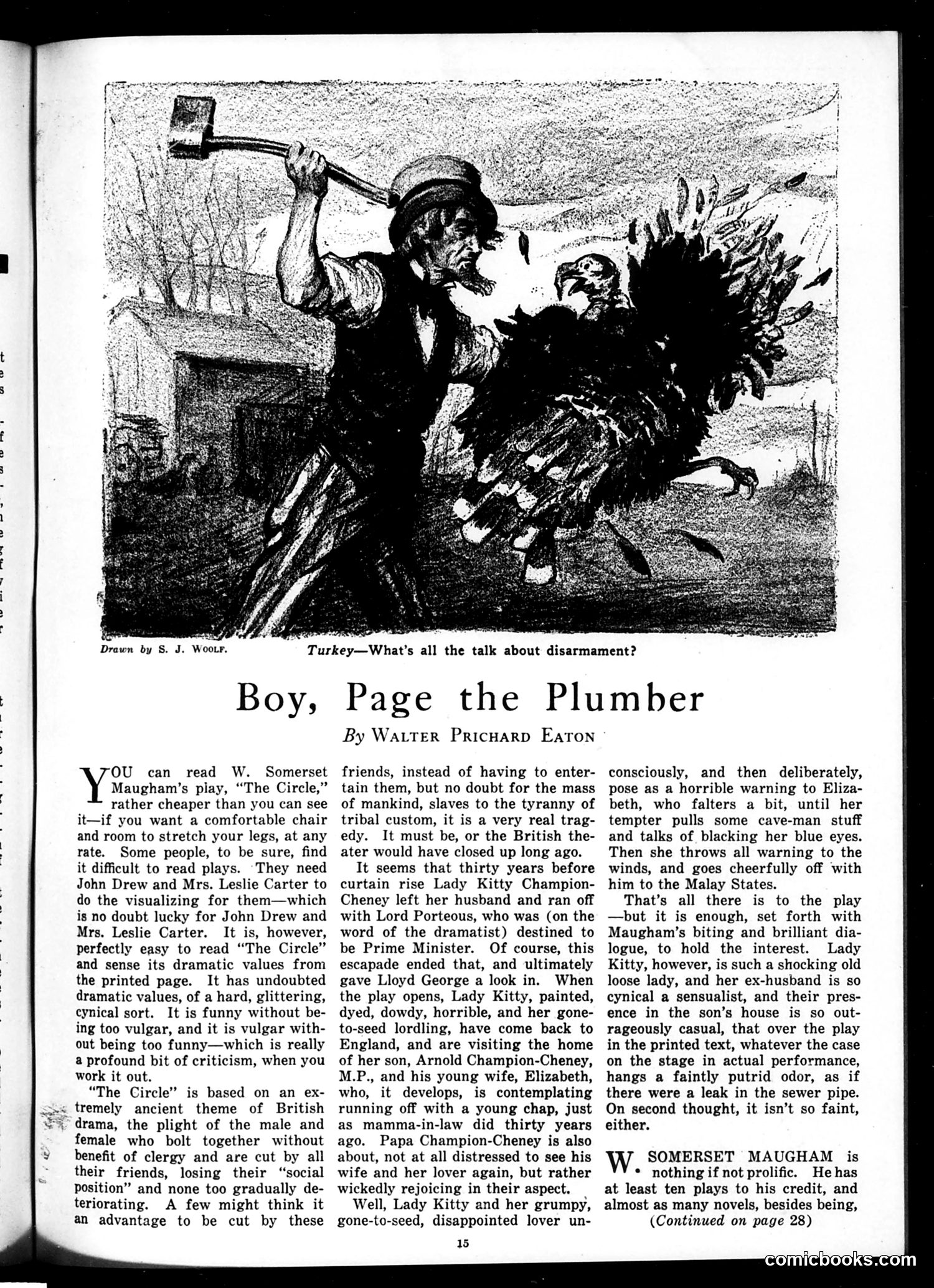
The cartoon at top, captioned "Turkey—What's all the talk about disarmament?", depicts a figure wielding an axe against what appears to be a bird or creature labeled as Turkey. The joke plays on the double meaning of "disarmament"—the political concept of reducing weapons versus literally disarming (removing limbs). Turkey, likely representing the Ottoman Empire or modern Turkey, is shown being violently attacked, satirizing post-World War I geopolitical tensions and the "Eastern Question" in European politics. The cartoon reflects anxiety about Turkish military power and territorial disputes following WWI's aftermath, when Turkey's role in the Middle East and Mediterranean remained contentious among Western powers. The page's main content is a theater review of W. Somerset Maugham's play "The Circle," unrelated to the political cartoon above it.
📄 Transcribed text from this page (OCR, searchable)
Machine-transcribed from the original scan — historical spelling and the odd misread are preserved.
Drawn by S. J. WOOLF. Turkey—What'’s all the talk about disarmament? Boy, Page the Plumber OU can read W. Somerset Y Mauchans play, “The Circle,” rather cheaper than you can see it—if you want a comfortable chair and room to stretch your legs, at any rate. Some people, to be sure, find it difficult to read plays. They need John Drew and Mrs. Leslie Carter to do the visualizing for them—which is no doubt lucky for John Drew and Mrs. Leslie Carter. It is, however, perfectly easy to read “The Circle” and sense its dramatic values from the printed page. It has undoubted dramatic values, of a hard, glittering, cynical sort. It is funny without be- ing too vulgar, and it is vulgar with- out being too funny—which is really a profound bit of criticism, when you work it out. “The Circle” is based on an ex- tremely ancient theme of British drama, the plight of the male and female who bolt together without benefit of clergy and are cut by all their friends, losing their “social Position” and none too gradually de- teriorating. A few might think it an advantage to be cut by these By WatterR Pricuarp Eaton friends, instead of having to enter- tain them, but no doubt for the mass of mankind, slaves to the tyranny of tribal custom, it is a very real trag- edy. It must be, or the British the- ater would have closed up long ago. It seems that thirty years before curtain rise Lady Kitty Champion- Cheney left her husband and ran off with Lord Porteous, who was (on the word of the dramatist) destined to be Prime Minister. Of course, this escapade ended that, and ultimately gave Lloyd George a look in. When the play opens, Lady Kitty, painted, dyed, dowdy, horrible, and her gone- to-seed lordling, have come back to England, and are visiting the home of her son, Arnold Champion-Cheney, M.P., and his young wife, Elizabeth, who, it develops, is contemplating running off with a young chap, just as mamma-in-law did thirty years ago. Papa Champion-Cheney is also about, not at all distressed to see his wife and her lover again, but rather wickedly rejoicing in their aspect. Well, Lady Kitty and her grumpy, gone-to-seed, disappointed lover un- 15 consciously, and then deliberately, pose as a horrible warning to Eliza- beth, who falters a bit, until her tempter pulls some cave-man stuff and talks of blacking her blue eyes. Then she throws all warning to the winds, and goes cheerfully off with him to the Malay States. That’s all there is to the play —but it is enough, set forth with Maugham’s biting and brilliant dia- logue, to hold the interest. Lady Kitty, however, is such a shocking old loose lady, and her ex-husband is so cynical a sensualist, and their pres- ence in the son’s house is so out- rageously casual, that over the play in the printed text, whatever the case on the stage in actual performance, hangs a faintly putrid odor, as if there were a leak in the sewer pipe. On second thought, it isn’t so faint, either. SOMERSET MAUGHAM is * nothing if not prolific. Hehas at least ten plays to his credit, and almost as many novels, besides being, (Continued on page 28)