
Judge, 1921-11-19 · page 20 of 36
Judge — November 19, 1921 — page 20: what you’re looking at
What you’re looking at
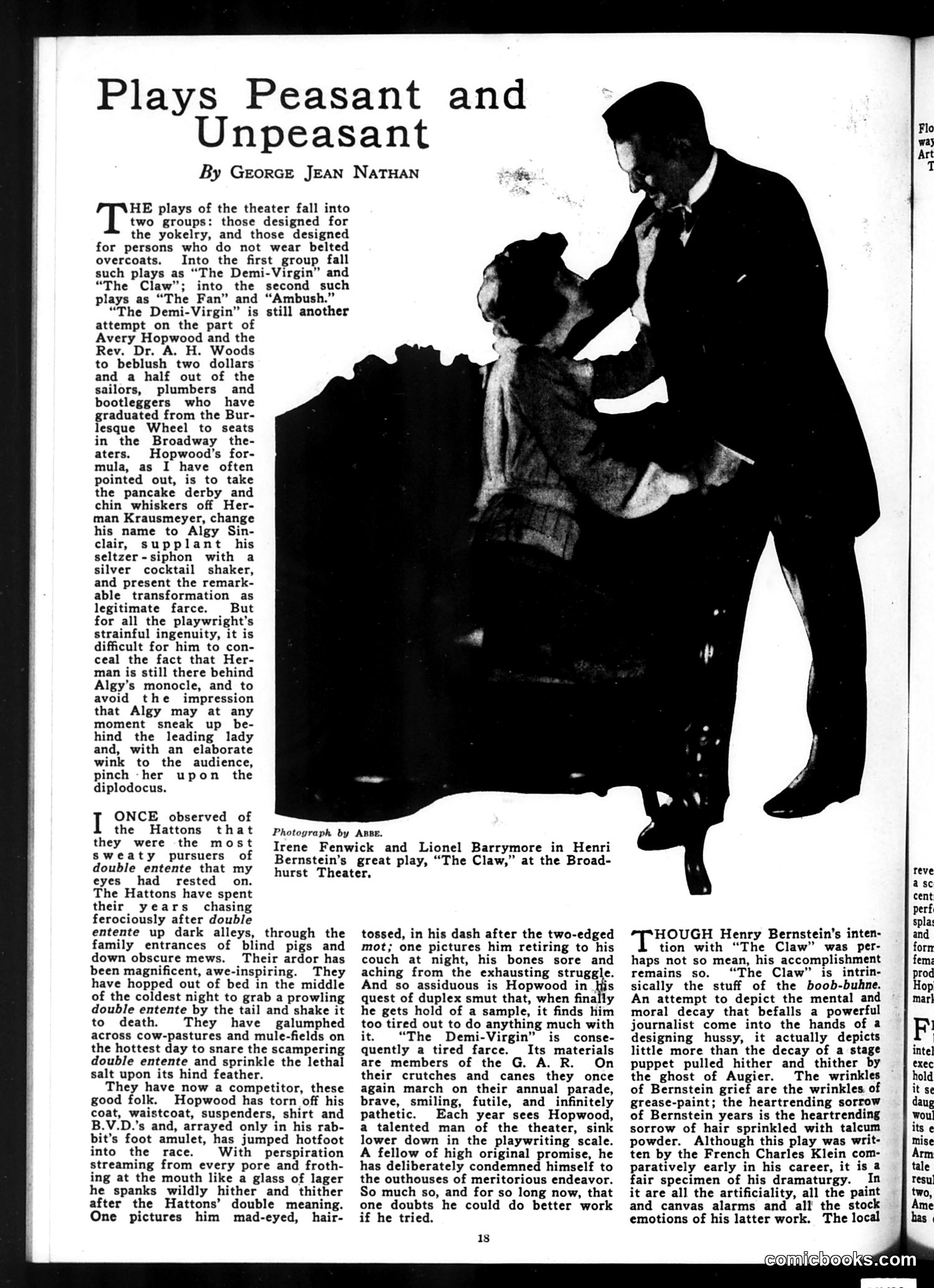
This is George Jean Nathan's theater review column critiquing Broadway plays. Nathan divides theatrical productions into two categories: those for "yokelry" (working-class audiences) and those for educated patrons. Nathan savagely attacks playwright Avery Hopwood's "The Demi-Virgin," claiming Hopwood merely dresses up lowbrow burlesque characters (like "Herman Krausmeyer") in fancy names and settings to sell tickets to sailors and plumbers seeking double entendres. He sarcastically describes Hopwood obsessively chasing after sexual innuendo like a desperate competitor. The photograph shows Irene Fenwick and Lionel Barrymore in "The Claw" by Henri Bernstein. Nathan similarly dismisses this play, arguing that despite pretensions of depicting moral decay in a journalist, it merely amounts to lowbrow material with theatrical veneer. Nathan's satire targets the gap between Broadway's artistic pretensions and its actual commercialism—selling smut to unsophisticated audiences under respectable guises.
📄 Transcribed text from this page (OCR, searchable)
Machine-transcribed from the original scan — historical spelling and the odd misread are preserved.
Plays Peasant and Unpeasant By Georce Jean NaTHAN HE plays of the theater fall into two groups: those designed for the yokelry, and those designed for persons who do not wear belted overcoats. Into the first group fall such plays as “The Demi-Virgin” and “The Claw”; into the second such plays as “The Fan” and “Ambush.” “The Demi-Virgin” is still another attempt on the part of Avery Hopwood and the Rev. Dr. A. H. Woods to beblush two dollars and a half out of the sailors, plumbers and bootleggers who have graduated from the Bur- lesque Wheel to seats in the Broadway the- aters. Hopwood’s for- mula, as I have often pointed out, is to take the pancake derby and chin whiskers off Her- man Krausmeyer, change his name to Algy Sin- clair, supplant his seltzer-siphon with a silver cocktail shaker, and present the remark- able transformation as legitimate farce. But for all the playwright’s strainful ingenuity, it is difficult for him to con- ceal the fact that Her- man is still there behind Algy’s monocle, and to avoid the impression that Algy may at any moment sneak up be- hind the leading lady and, with an elaborate wink to the audience, pinch -her upon the diplodocus. ONCE observed of the Hattons that they were the most sweaty pursuers of double entente that my eyes had rested on. The Hattons have spent their years chasing ferociously after double entente up dark alleys, through the family entrances of blind pigs and down obscure mews. Their ardor has been magnificent, awe-inspiring. They have hopped out of bed in the middle of the coldest night to grab a prowling double entente by the tail and shake it to death. They have galumphed across cow-pastures and mule-fields on the hottest day to snare the scampering double entente and sprinkle the lethal salt upon its hind feather. They have now a competitor, these good folk. Hopwood has torn off his coat, waistcoat, suspenders, shirt and B.V.D.’s and, arrayed only in his rab- bit’s foot amulet, has jumped hotfoot into the race. With perspiration streaming from every pore and froth- ing at the mouth like a glass of lager he spanks wildly hither and thither after the Hattons’ double meaning. One pictures him mad-eyed, hair- Photograph by ABBE. Irene Fenwick and Lionel Barrymore in Henri Bernstein’s great play, “The Claw,” at the Broad- hurst Theater, tossed, in his dash after the two-edged mot; one pictures him retiring to his couch at night, his bones sore and aching from the exhausting struggle. And so assiduous is Hopwood in his quest of duplex smut that, when finally he gets hold of a sample, it finds him too tired out to do anything much with it. “The Demi-Virgin” is conse- quently a tired farce. Its materials are members of the G. A. R. On their crutches and canes they once again march on their annual parade, brave, smiling, futile, and infinitely pathetic. Each year sees Hopwood, a talented man of the theater, sink lower down in the playwriting scale. A fellow of high original promise, he has deliberately condemned himself to the outhouses of meritorious endeavor. So much so, and for so long now, that one doubts he could do better work if he tried. 18 HOUGH Henry Bernstein’s inten- tion with “The Claw” was per- haps not so mean, his accomplishment remains so. “The Claw” is intrin- sically the stuff of the boob-buhne. An attempt to depict the mental and moral decay that befalls a powerful journalist come into the hands of a designing hussy, it actually depicts little more than the decay of a stage puppet pulled hither and thither by the ghost of Augier. The wrinkles of Bernstein grief are the wrinkles of grease-paint; the heartrending sorrow of Bernstein years is the heartrending sorrow of hair sprinkled with talcum powder. Although this play was writ- ten by the French Charles Klein com- paratively early in his career, it is a fair specimen of his dramaturgy. In it are all the artificiality, all the paint and canvas alarms and all the stock emotions of his latter work. The local