
Judge, 1921-11-19 · page 15 of 36
Judge — November 19, 1921 — page 15: what you’re looking at
What you’re looking at
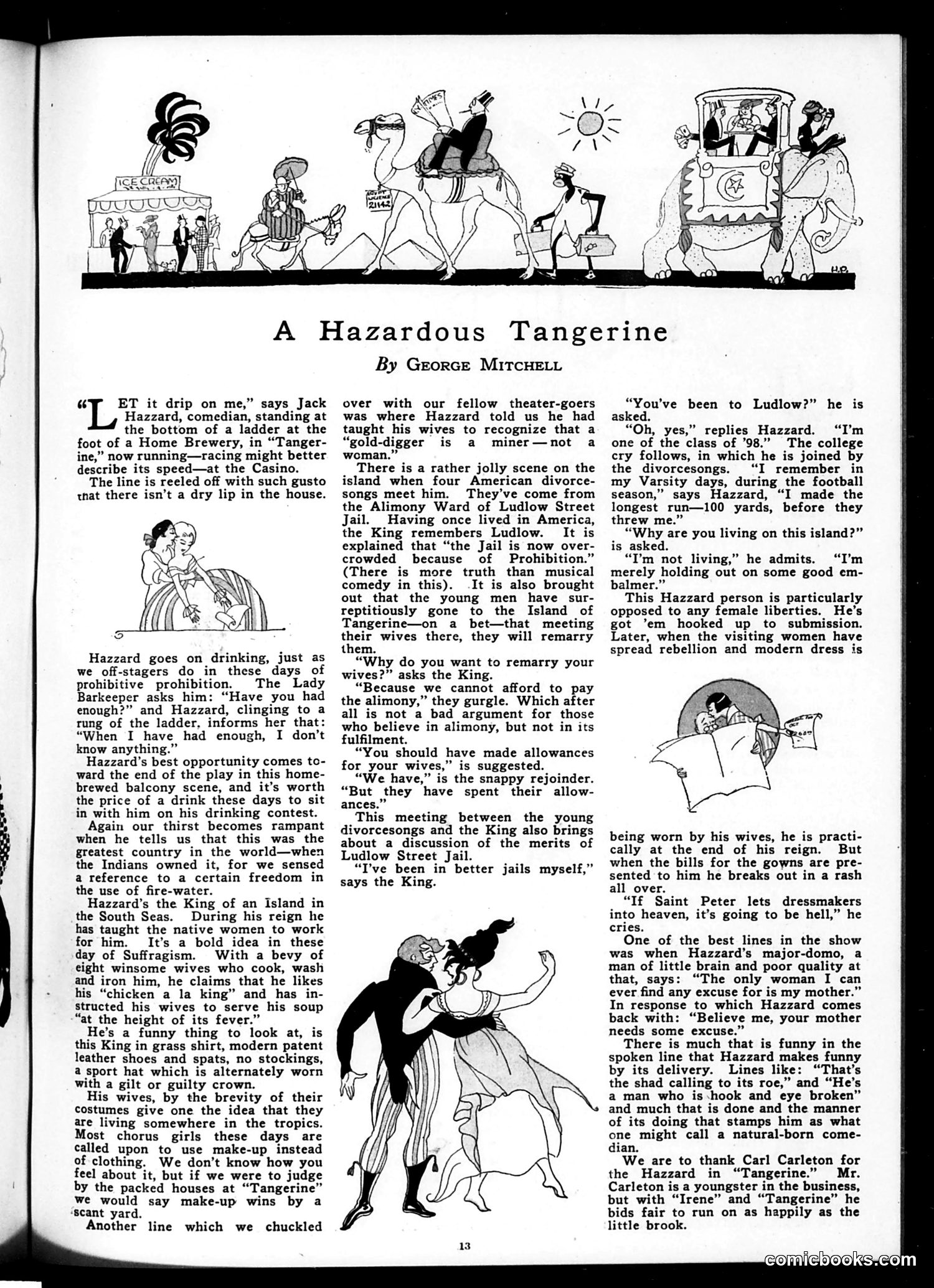
This is a theater review of a comedy play starring Jack Hazzard, performing at the Casino. The satire targets Prohibition-era attitudes and social hypocrisy. The review highlights comedic lines mocking Prohibition (characters drinking openly despite the law), divorce culture (four American divorcées meeting on a tropical island), and alimony disputes. One joke references Ludlow Street Jail being "overcrowded because of Prohibition"—suggesting the law's ineffectiveness. Hazzard plays a South Seas island king with eight wives, allowing satirical commentary on women's roles and suffragism. The reviewer notes the joke about "gold-diggers" being "miners—not women" and finds humor in the costumes' brevity, typical of 1920s chorus girls relying on "make-up" instead of clothing. The review is generally favorable, praising Hazzard's comedic delivery, particularly his "drinking contest" scene and his claim of making a "100-yard" football run before being thrown out.
📄 Transcribed text from this page (OCR, searchable)
Machine-transcribed from the original scan — historical spelling and the odd misread are preserved.
A Hazardous Tangerine By Grorce MircHeELL 6 ET it drip on me,” says Jack Hazzard, comedian, standing at the bottom of a ladder at the foot of a Home Brewery, in “Tanger- ine,” now running—racing might better describe its speed—at the Casino. The line is reeled off with such gusto that there isn’t a dry lip in the house. Hazzard goes on drinking, just as we off-stagers do in these days of prohibitive prohibition. The Lady Barkeeper asks him: “Have you had enough?” and Hazzard, clinging to a tung of the ladder, informs her that: “When I have had enough, I don’t know anything.” Hazzard’s best opportunity comes to- ward the end of the play in this home- brewed balcony scene, and it’s worth the price of a drink these days to sit in with him on his drinking contest. Again our thirst becomes rampant when he tells us that this was the greatest country in the world—when the Indians owned it, for we sensed a reference to a certain freedom in the use of fire-water. Hazzard’s the King of an island in the South Seas. During his reign he has taught the native women to work for him. It’s a bold idea in these day of Suffragism. With a bevy of eight winsome wives who cook, wash and iron him, he claims that he likes his “chicken a la king” and has in- structed his wives to serve his soup “at the height of its fever.” He’s a funny thing to look at, is this King in grass shirt, modern patent leather shoes and spats, no stockings, a sport hat which is alternately worn with a gilt or guilty crown. His wives, by the brevity of their costumes give one the idea that they are living somewhere in the tropics. Most chorus girls these days are called upon to use make-up instead of clothing. We don’t know how you feel about it, but if we were to judge by the packed houses at “Tangerine” we would say make-up wins by a “scant yard. Another line which we chuckled over with our fellow theater-goers was where Hazzard told us he had taught his wives to recognize that a “gold-digger is a miner—not a woman.” There is a rather jolly scene on the island when four American divorce- songs meet him. They’ve come from the Alimony Ward of Ludlow Street Jail. Having once lived in America, the King remembers Ludlow. It is explained that “the Jail is now over- crowded because of Prohibition.” (There is more truth than musical comedy in this). .It is also brought out that the young men have sur- reptitiously gone to the Island of Tangerine—on a bet—that meeting their wives there, they will remarry them. “Why do you want to remarry your wives?” asks the King. “Because we cannot afford to pay the alimony,” they gurgle. Which after all is not a bad argument for those who believe in alimony, but not in its fulfilment. “You should have made allowances for your wives,” is suggested. “We have,” is the snappy rejoinder. “But they have spent their allow- ances.” This meeting between the young divorcesongs and the King also brings about a discussion of the merits of Ludlow Street Jail. “T’ve been in better jails myself,” says the King. “You've been to Ludlow?” he is asked. “Oh, yes,” replies Hazzard. “I’m one of the class of ’98.” The college cry follows, in which he is joined by the divorcesongs. “I remember in my Varsity days, during the football season,” says Hazzard, “I made the longest run—100 yards, before they threw me.” “Why are you living on this island?” is asked. “I’m not living,” he admits. “I’m merely holding out on some good em- balmer.” This Hazzard person is particularly opposed to any female liberties. He’s got ’em hooked up to submission. Later, when the visiting women have spread rebellion and modern dress is being worn by his wives, he is practi- cally at the end of his reign. But when the bills for the gowns are pre- sented to him he breaks out in a rash all over. “If Saint Peter lets dressmakers into heaven, it’s going to be hell,” he cries. One of the best lines in the show was when Hazzard’s major-domo, a man of little brain and poor quality at that, says: “The only woman I can ever find any excuse for is my mother.” In response to which Hazzard comes back with: “Believe me, your mother needs some excuse.” There is much that is funny in the spoken line that Hazzard makes funny by its delivery. Lines like: “That’s the shad calling to its roe,” and “He’s a man who is.hook and eye broken” and much that is done and the manner of its doing that stamps him as what one might call a natural-born come- dian. We are to thank Carl Carleton for the Hazzard in “Tangerine.” Mr. Carleton is a youngster in the business, but with “Irene” and “Tangerine” he bids fair to run on as happily as the little brook.