
Judge, 1921-11-19 · page 5 of 36
Judge — November 19, 1921 — page 5: what you’re looking at
What you’re looking at
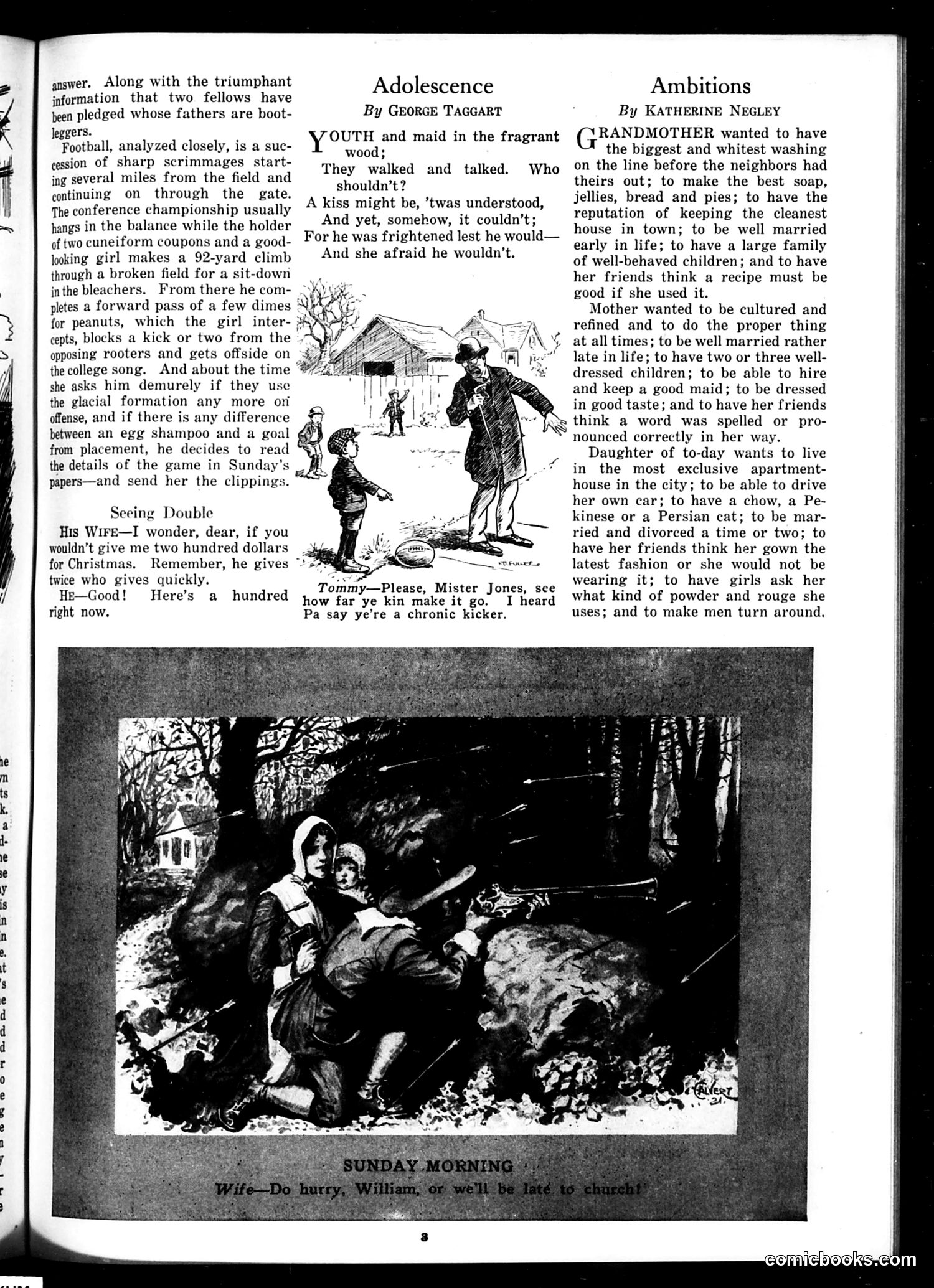
This page contains three distinct pieces: 1. **"Adolescence"** (poem by George Taggart): A sentimental poem about youth romance, accompanied by an illustration of two young people in a rural setting. 2. **"Ambitions"** (by Katherine Neeley): A humorous list cataloging the materialistic and social aspirations of women across generations—from grandmothers wanting domestic perfection to modern daughters desiring independence, fashion, cosmetics, and romantic variety. It satirizes evolving female ambitions. 3. **"Seeing Double" / "Sunday Morning"**: A brief comic dialogue and illustration about a husband requesting money for Christmas, followed by a domestic scene of a wife rushing her husband to church. The page reflects early 20th-century American attitudes toward gender roles, consumerism, and family dynamics, using humor to comment on women's changing social positions.
📄 Transcribed text from this page (OCR, searchable)
Machine-transcribed from the original scan — historical spelling and the odd misread are preserved.
answer. Along with the triumphant information that two fellows have been pledged whose fathers are boot- leggers. Football, analyzed closely, is a suc- cession of sharp scrimmages start- ing several miles from the field and continuing on through the gate. The conference championship usually hangs in the balance while the holder of two cuneiform coupons and a good- looking girl makes a 92-yard climb through a broken field for a sit-down inthe bleachers. From there he com- pletes a forward pass of a few dimes cepts, blocks a kick or two from the opposing rooters and gets offside on the college song. And about the time * she asks him demurely if they use the glacial formation any more ori offense, and if there is any difference between an egg shampoo and a goal from placement, he decides to read the details of the game in Sunday's papers—and send her the clippings. Seeing Double His Wire—I wonder, dear, if you wouldn’t give me two hundred dollars for Christmas. twice who gives quickly. He—Good! Here’s a hundred right now. Adolescence By GEORGE TAGGART Y OUTH and maid in the fragrant wood; They walked and talked. shouldn’t? A kiss might be, ’twas understood, And yet, somehow, it couldn’t; For he was frightened lest he would— And she afraid he wouldn’t. Who for peanuts, which the girl inter- + Ambitions By KATHERINE NEGLEY (GRANDMOTHER wanted to have the biggest and whitest washing on the line before the neighbors had theirs out; to make the best soap, jellies, bread and pies; to have the reputation of keeping the cleanest house in town; to be well married early in life; to have a large family of well-behaved children; and to have her friends think a recipe must be good if she used it. Mother wanted to be cultured and refined and to do the proper thing { at all times; to be well married rather Remember, he gives ~ Tommy—Please, Mister Jones, see how far ye kin make it go. I heard Pa say ye’re a chronic kicker. late in life; to have two or three well- dressed children; to be able to hire and keep a good maid; to be dressed in good taste; and to have her friends think a word was spelled or pro- ~ nounced correctly in her way. Daughter of to-day wants to live in the most exclusive apartment- house in the city; to be able to drive her own car; to have a chow, a Pe- kinese or a Persian cat; to be mar- ried and divorced a time or two; to have her friends think her gown the latest fashion or she would not be wearing it; to have girls ask her what kind of powder and rouge she uses; and to make men turn around.