
Judge, 1921-11-19 · page 21 of 36
Judge — November 19, 1921 — page 21: what you’re looking at
What you’re looking at
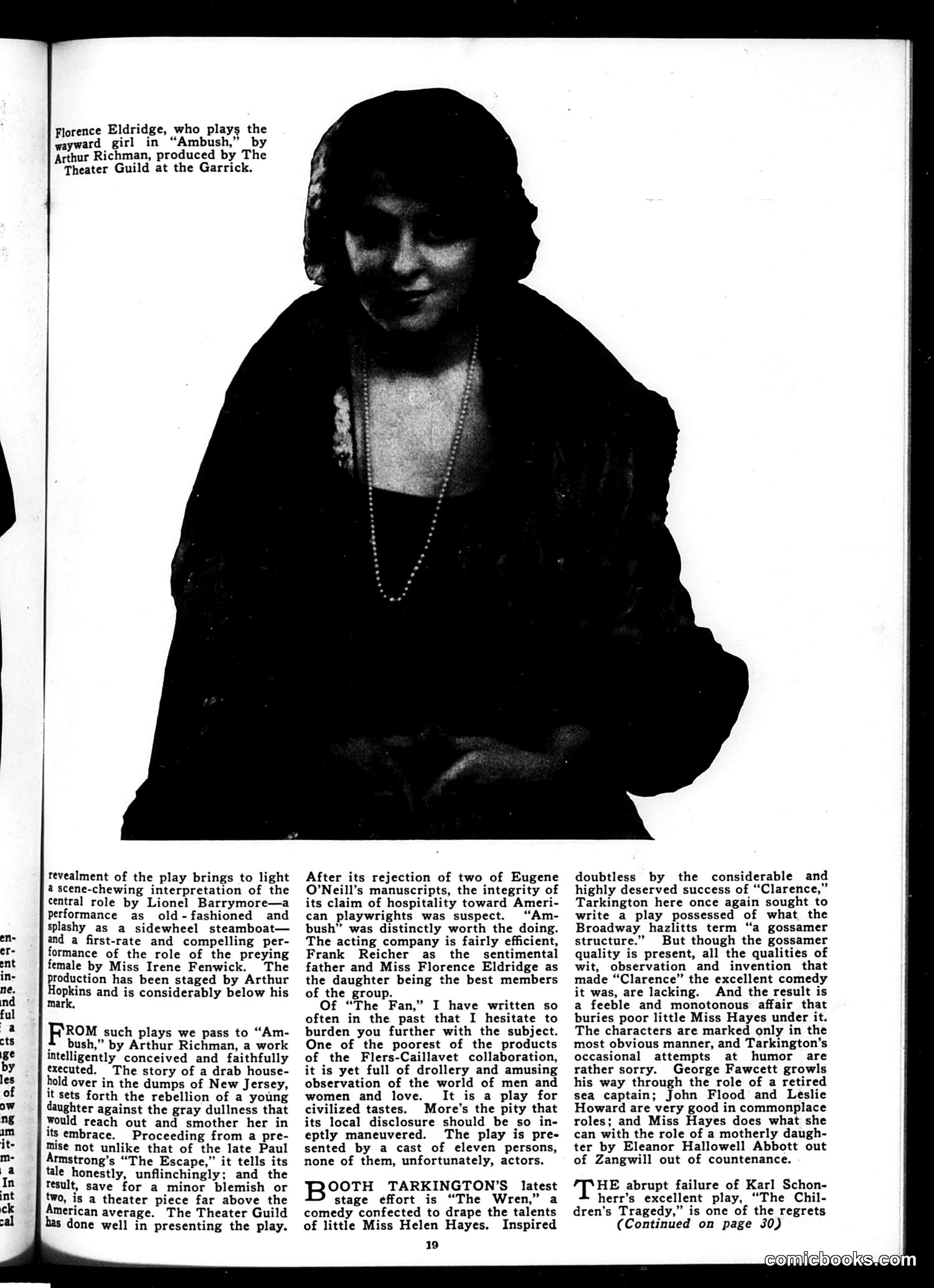
This is a theater criticism page from Judge magazine reviewing several Broadway productions. The central photograph shows **Florence Eldridge**, an actress in Arthur Richman's play "Ambush," produced by the Theater Guild. The reviews discuss: - **"Ambush"**: Praised as intelligently conceived, dealing with a New Jersey family's rebellion against drab domesticity. Eldridge and Frank Reicher are commended, though Lionel Barrymore's performance in another production is criticized as old-fashioned and overwrought. - **"The Fan"**: A Flers-Caillavet collaboration deemed poorly executed despite witty source material. - **"The Wren"**: Booth Tarkington's new comedy starring Helen Hayes. The critic finds it lacks the wit and observation of Tarkington's earlier success "Clarence," calling it "feeble and monotonous" that undermines Hayes's talent. The page represents typical 1920s theater criticism, evaluating scripts, direction, and individual performances by major actors of the era.
📄 Transcribed text from this page (OCR, searchable)
Machine-transcribed from the original scan — historical spelling and the odd misread are preserved.
Florence Eldridge, who plays the wayward girl in “Ambush,” by Arthur Richman, produced by The Theater Guild at the Garrick. tevealment of the play brings to light a scene-chewing interpretation of the central role by Lionel Barrymore—a performance as old-fashioned and splashy as a sidewheel steamboat— and a first-rate and compelling per- formance of the role of the preying female by Miss Irene Fenwick. The production has been staged by Arthur Hopkins and is considerably below his mark, From such plays we pass to “Am- * bush,” by Arthur Richman, a work intelligently conceived and faithfully executed. The story of a drab house- hold over in the dumps of New Jersey, it sets forth the rebellion of a young daughter against the gray dullness that Would reach out and smother her in its embrace. Proceeding from a pre- mise not unlike that of the late Paul rmstrong’s “The Escape,” it tells its tale honestly, unflinchingly; and the Tesult, save for a minor blemish or two, is a theater piece far above the merican average. The Theater Guild done well in presenting the play. After its rejection of two of Eugene O’Neill’s manuscripts, the integrity of its claim of hospitality toward Ameri- can playwrights was suspect. “Am- bush” was distinctly worth the doing. The acting company is fairly efficient, Frank Reicher as the sentimental father and Miss Florence Eldridge as the daughter being the best members of the group. Of “The Fan,” I have written so often in the past that I hesitate to burden you further with the subject. One of the poorest of the products of the Flers-Caillavet collaboration, it is yet full of drollery and amusing observation of the world of men and women and love. It is a play for civilized tastes. More’s the pity that its local disclosure should be so in- eptly maneuvered. The play is pre- sented by a cast of eleven persons, none of them, unfortunately, actors. OOTH TARKINGTON’S latest stage effort is “The Wren,” a comedy confected to drape the talents of little Miss Helen Hayes. Inspired 19 doubtless by the considerable and highly deserved success of “Clarence,” Tarkington here once again sought to write a play possessed of what the Broadway hazlitts term “a gossamer structure.” But though the gossamer quality is present, all the qualities of wit, observation and invention that made “Clarence” the excellent comedy it was, are lacking. And the result is a feeble and monotonous affair that buries poor little Miss Hayes under it. The characters are marked only in the most obvious manner, and Tarkington’s occasional attempts at humor are rather sorry. George Fawcett growls his way through the role of a retired sea captain; John Flood and Leslie Howard are very good in commonplace roles; and Miss Hayes does what she can with the role of a motherly daugh- ter by Eleanor Hallowell Abbott out of Zangwill out of countenance. ‘THE abrupt failure of Karl Schon- herr’s excellent play, “The Chil- dren’s Tragedy,” is one of the regrets (Continued on page 30)