
A complete issue · 36 pages · 1921
Judge — October 8, 1921
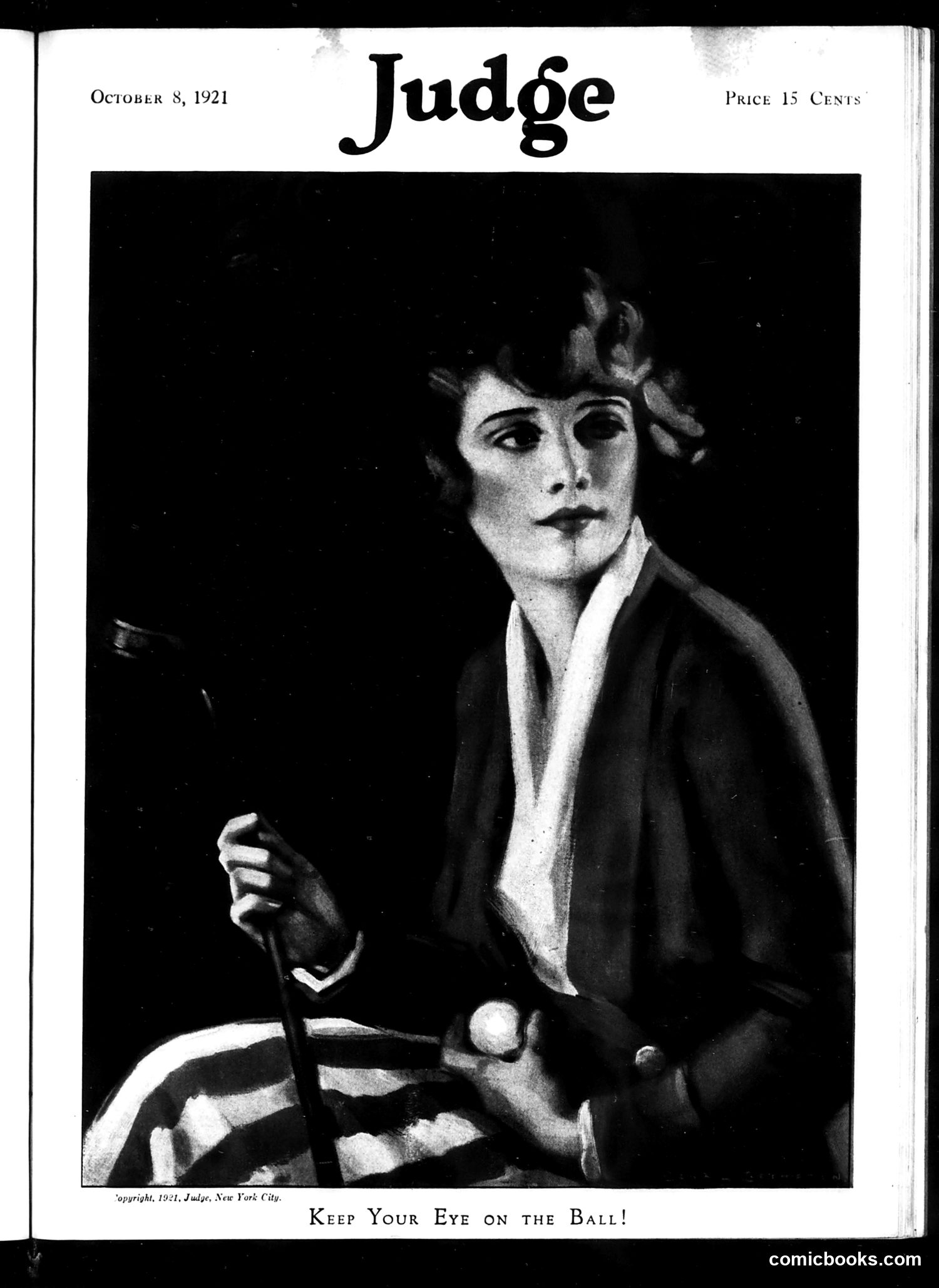
This cover features a portrait of a woman in 1920s attire holding a cane or walking stick, with the caption "Keep Your Eye on the Ball!" The image appears to be sports-related satire, likely referencing baseball given the circular object visible at the bottom of the frame. The exact subject remains unclear without additional context, but the composition suggests commentary on women's increasing visibility in public life during the 1920s—the era of women's suffrage (1920) and the "New Woman" cultural phenomenon. The caption's double meaning (literally watching a baseball, metaphorically staying focused) suggests the cartoon jokes about attention and contemporary concerns. The specific figure and satirical point require additional source material to identify with certainty.
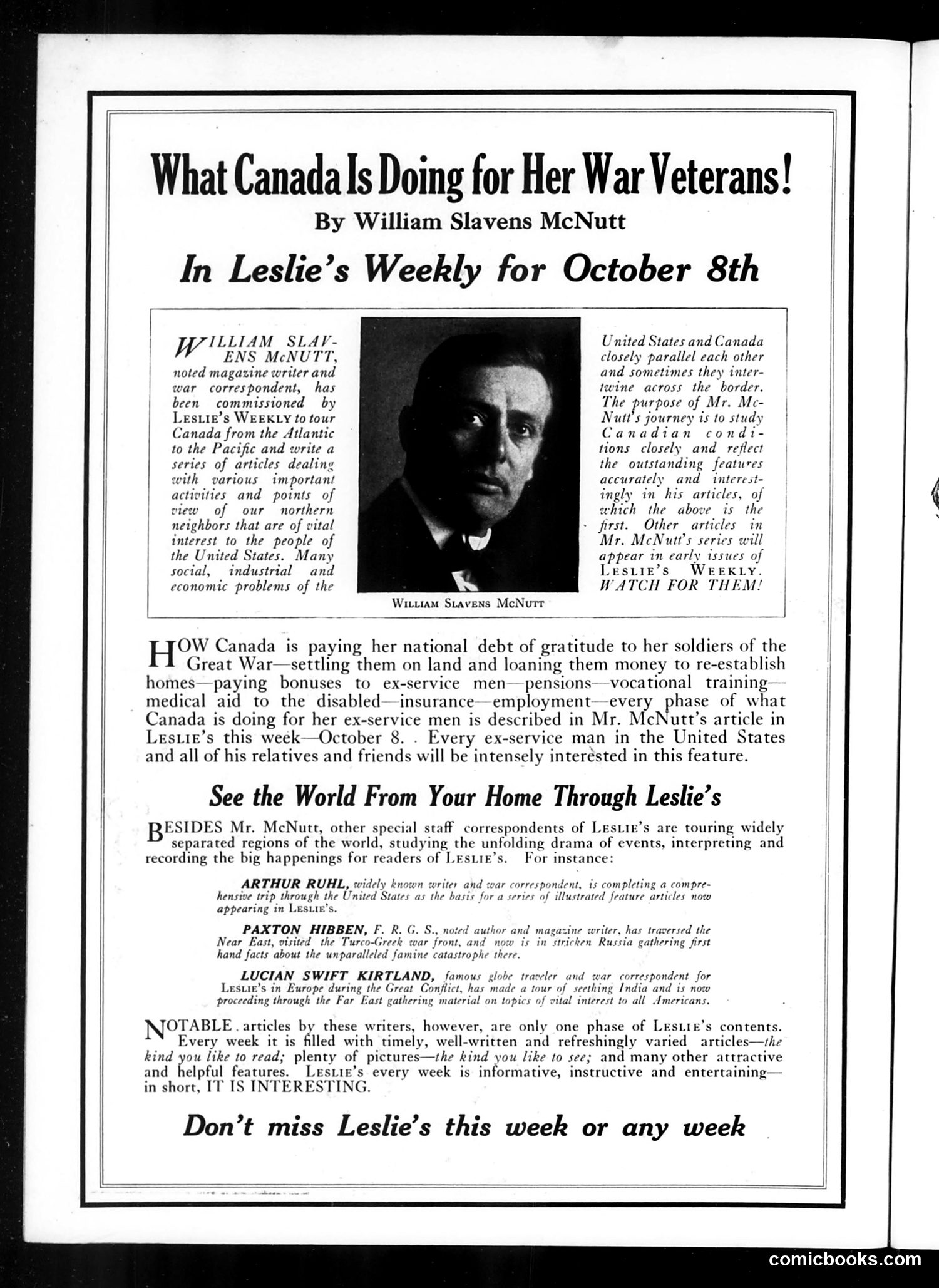
This is **not a cartoon or satire page**—it's a promotional advertisement for *Leslie's Weekly* magazine, disguised as editorial content. The page announces that writer **William Slavens McNutt** will contribute a series of articles to *Leslie's* about **Canada's treatment of World War I veterans**. The article, running October 8th, will cover Canadian programs: land settlement, bonuses, pensions, vocational training, medical aid, and employment assistance. The advertisement emphasizes that American readers should care about this neighboring country's veteran policies. It also highlights other *Leslie's* correspondents (Arthur Ruhl, Paxton Hibben, Lucian Swift Kirtland) reporting from various global locations. The bottom line urges readers: "Don't miss Leslie's this week or any week"—straightforward magazine promotion.
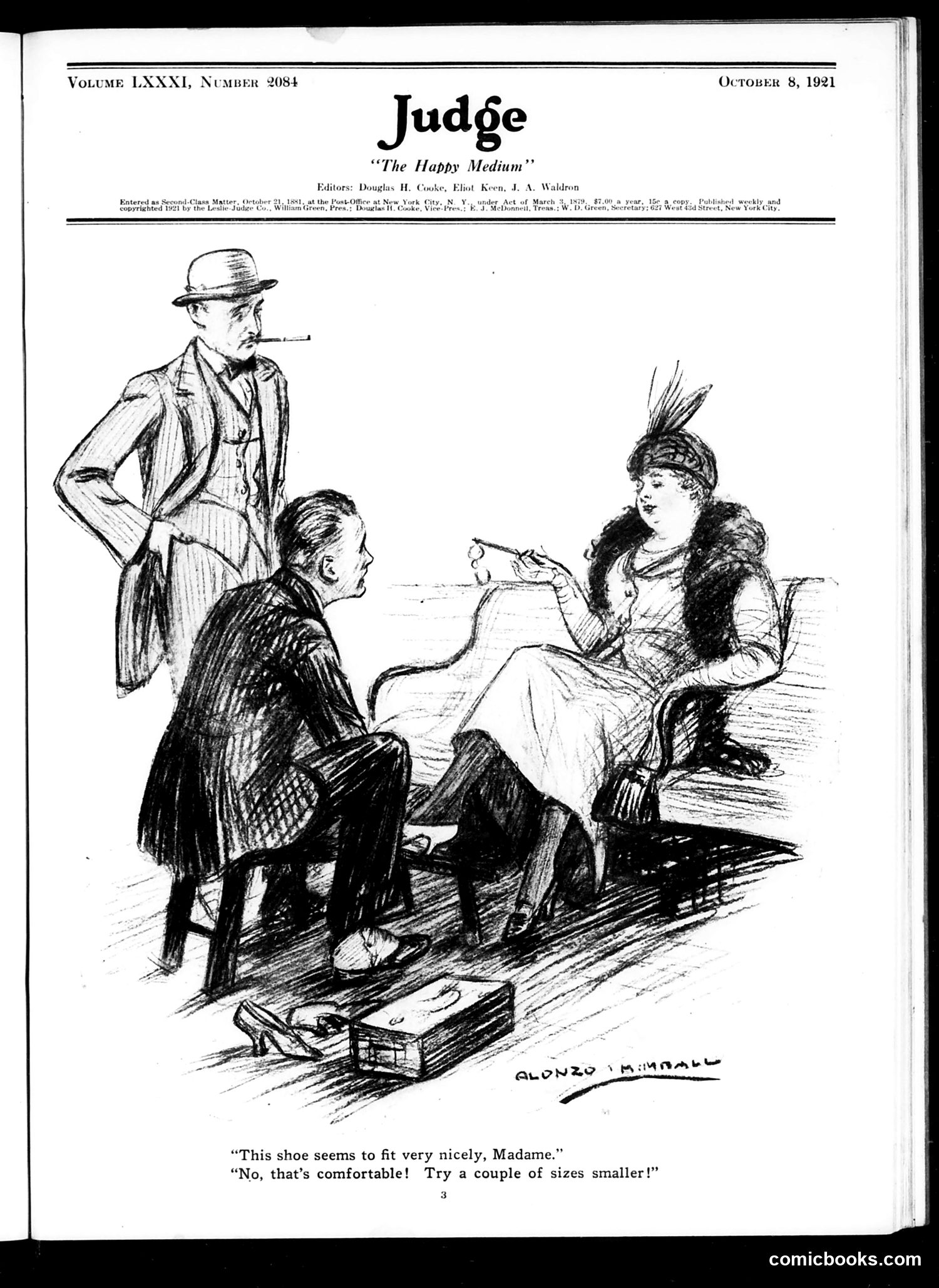
This cartoon depicts a shoe-shopping scene with satirical commentary on women's fashion and expectations. A well-dressed shoe salesman presents footwear to an elegantly dressed woman wearing a fashionable hat and fur stole, while a man in a bowler hat stands observing. The humor relies on a common domestic scenario: the woman finds shoes uncomfortable despite the salesman's assurance they fit well, demanding increasingly smaller sizes—an absurd request that suggests either vanity about foot size or unrealistic expectations. The satire likely mocks women's fashion obsessions and the lengths they'll go for appearance, a frequent target of Judge magazine's humor. The standing man's bemused expression underscores the ridiculousness of the woman's demands. This reflects early 1920s attitudes about gender and consumer culture.
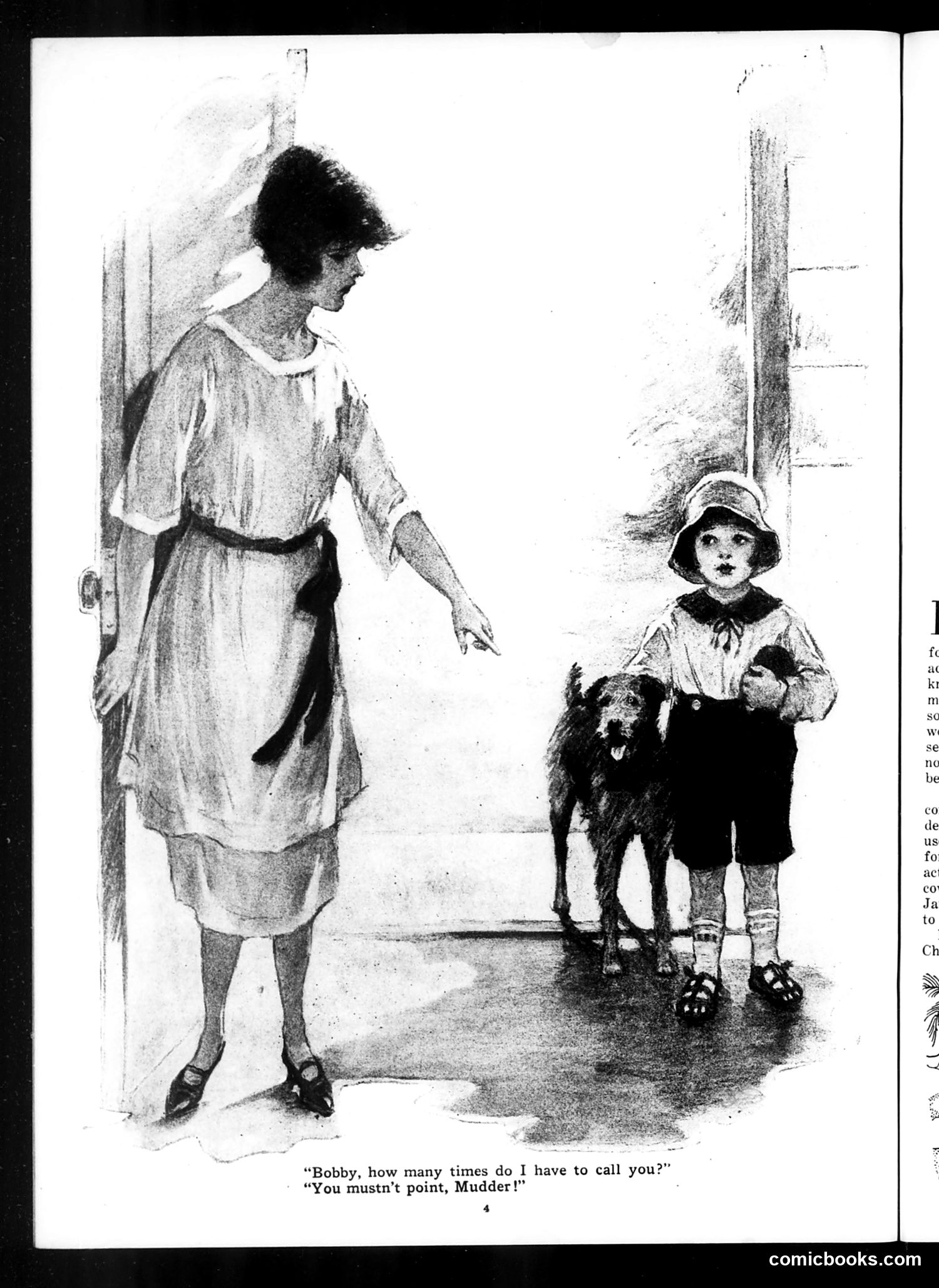
This illustration depicts a domestic scene with a humorous caption about a child's disobedience. An adult woman stands by a doorway while a small child in a hat holds a dog's leash, appearing reluctant to come inside. The caption reads: "Bobby, how many times do I have to call you?" "You mustn't point, Mudder!" The joke relies on the child's impudent, evasive response rather than obeying the summons. The phrase "You mustn't point" appears to reference Victorian-era etiquette rules emphasizing proper manners in children. The humor comes from the child's deflection—rather than apologizing or complying, the child corrects the adult's behavior, suggesting rudeness in being called repeatedly. This satirizes both childhood misbehavior and evolving attitudes toward parental authority in early 20th-century American culture.
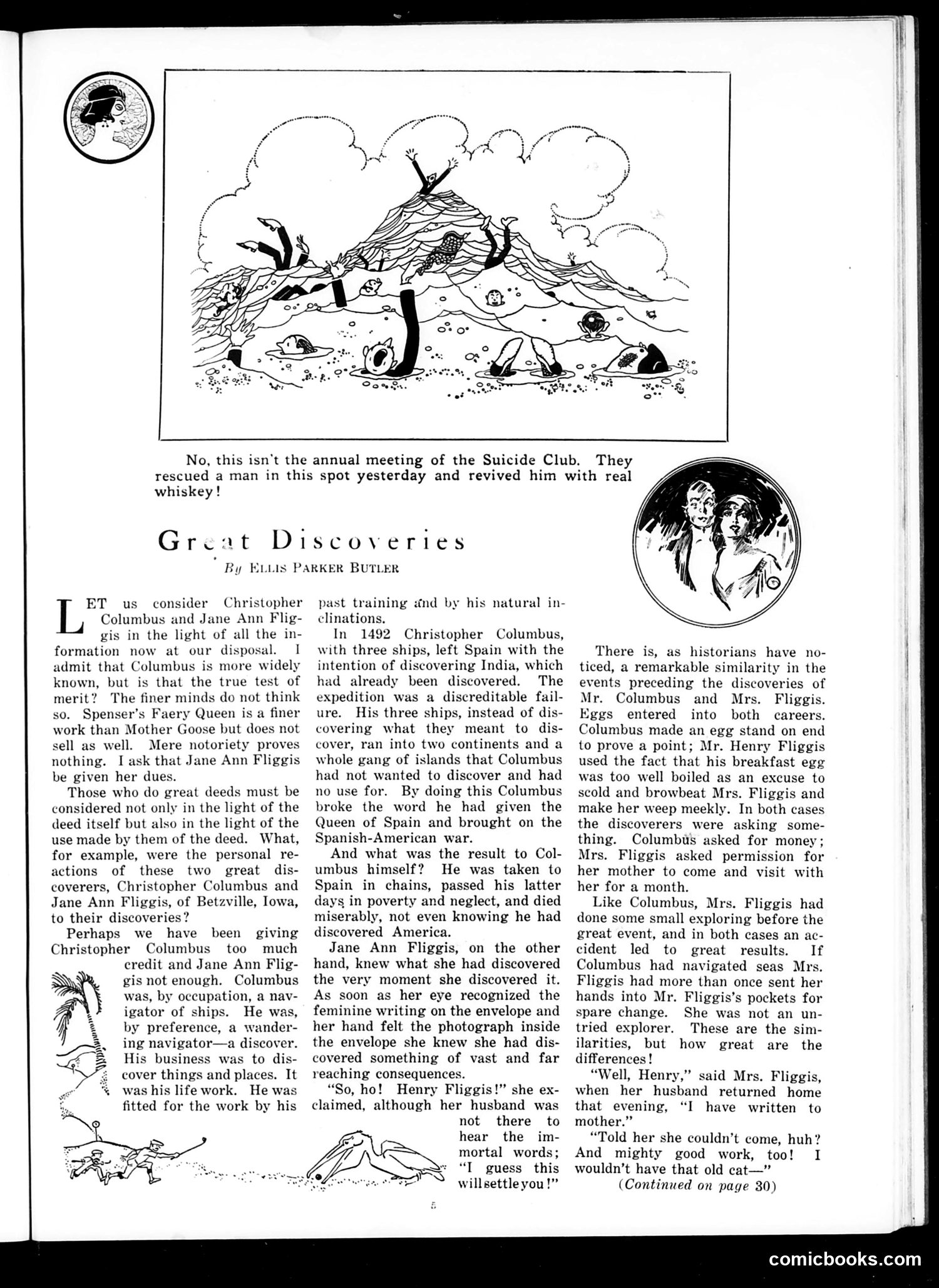
The top cartoon is a visual joke: figures emerge from a volcanic/mountainous landscape with tents below, captioned as NOT a "Suicide Club" meeting but rather a rescue scene where a man was revived with whiskey. The main article by Ellis Parker Butler compares Christopher Columbus and Jane Ann Fliggis as discoverers. The satire humorously elevates an obscure woman from Betzville, Iowa to historical significance equal with Columbus. The piece mocks how we mythologize famous explorers while ignoring ordinary people's achievements. It suggests Fliggis made comparable "discoveries" in her domestic life—finding egg stands, managing household economics—deserving equal historical recognition as Columbus's voyages. The joke deflates grand historical narratives through absurdist comparison.
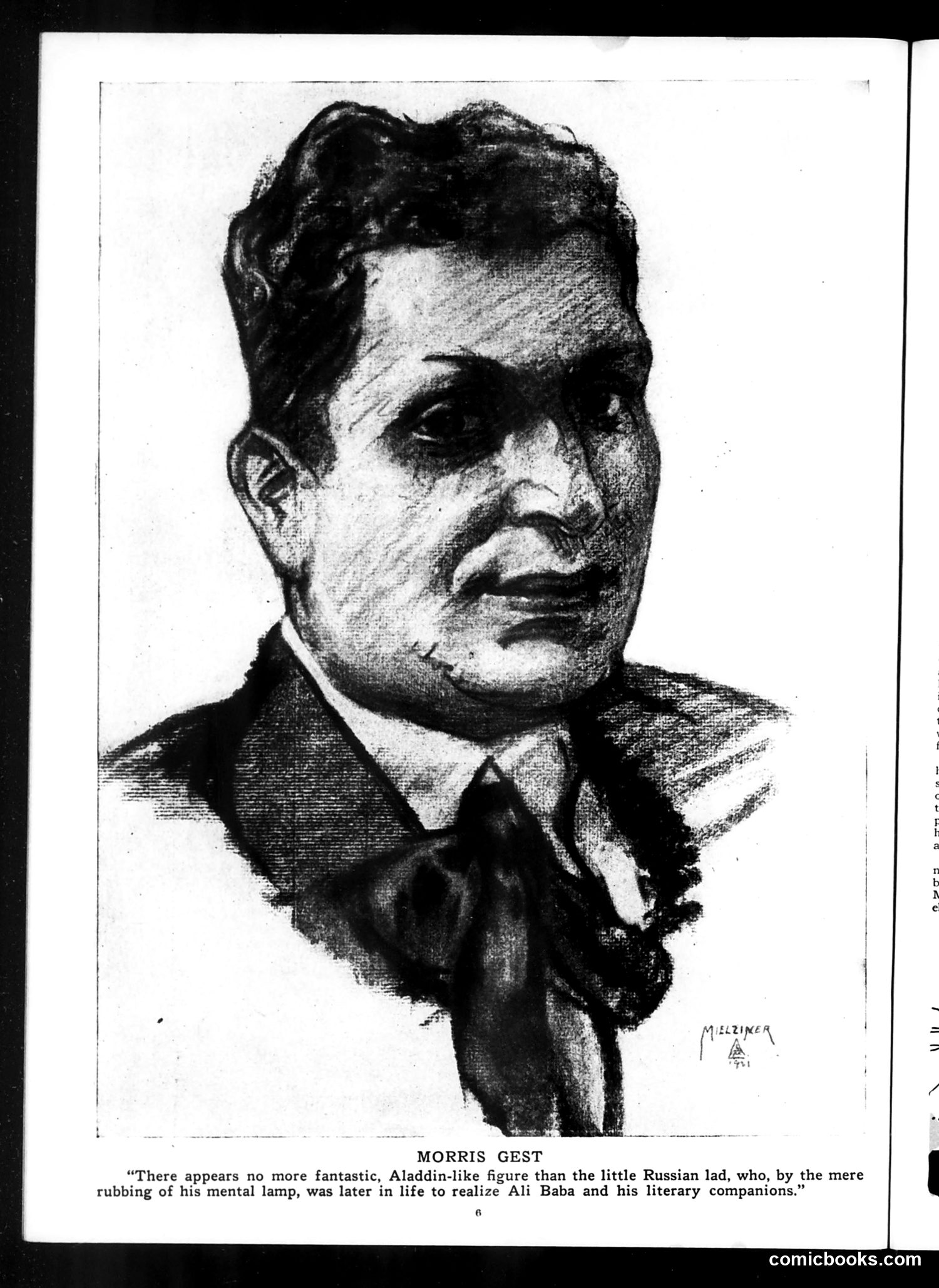
This is a portrait illustration of **Morris Gest**, a theatrical producer and impresario. The caption quotes a comparison to "the little Russian lad" who realized the Arabian Nights fantasy—referencing Gest's role in bringing extraordinary theatrical productions to American audiences, particularly Russian and international performances. The artist's signature "M. HERZINGER" and date "1921" appear at bottom. The satirical angle appears to celebrate Gest as a magician-like figure who made seemingly impossible artistic visions real through sheer determination and vision. The *Judge* magazine context suggests this was contemporary praise for his significant contributions to American theater during the early 1920s.
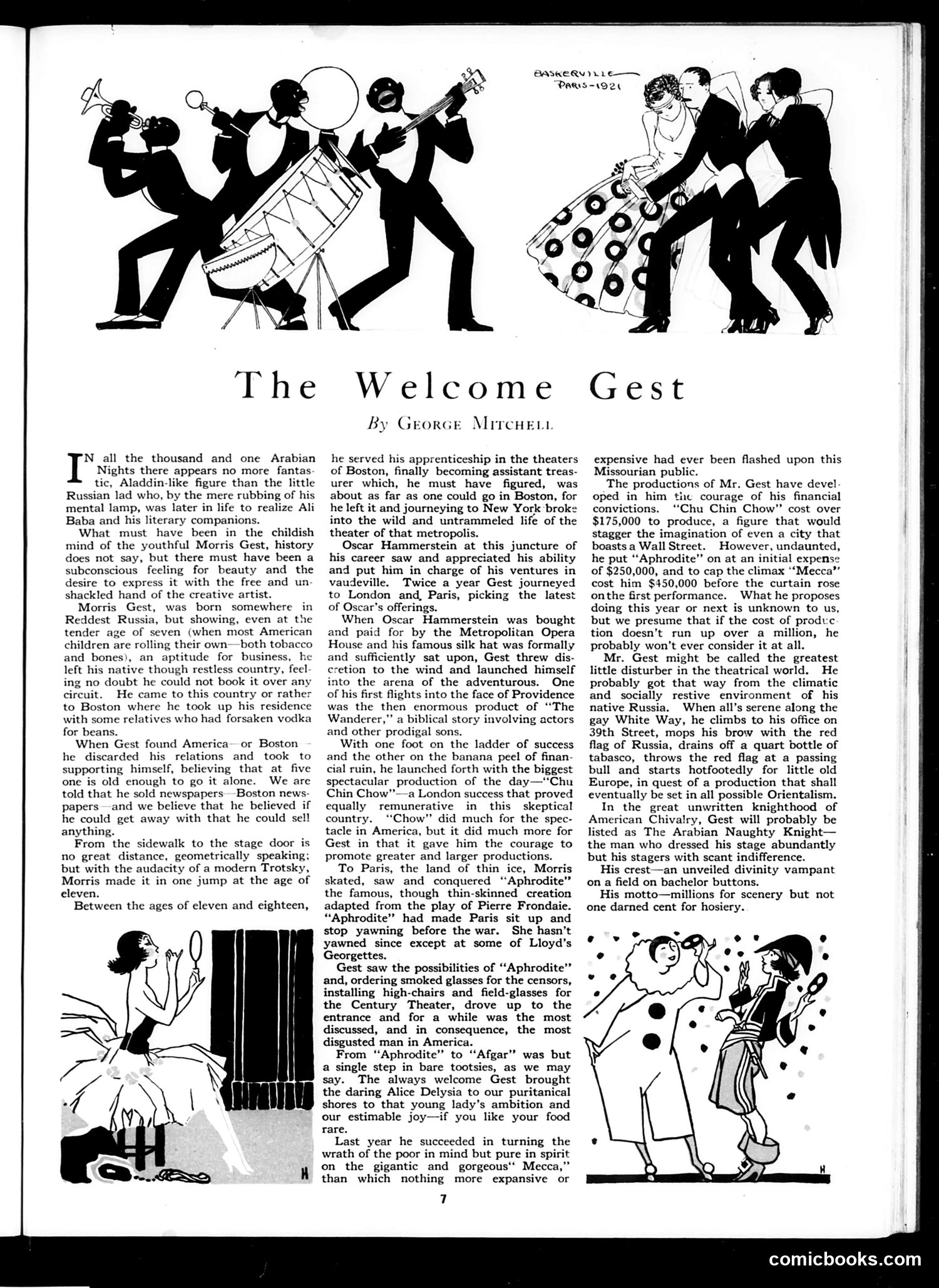
This is a biographical profile of **Morris Gest**, a Russian-born theatrical impresario who became a major Broadway producer in the 1920s. The article traces his rise from selling newspapers in Boston to becoming a celebrated theater entrepreneur. The satire centers on Gest's controversial productions featuring elaborate spectacle and sexual content. His staging of "Aphrodite" (adapted from a French play) caused scandal—the text notes he ordered "smoked glasses for the censors" and that it made him "the most disgusted man in America," suggesting prudish public outrage. He also produced "Chu Chin Chow," a major spectacle, and brought French actress Alice Delysia to American stages. The illustrations show musicians and dancers, reflecting Gest's reputation for grand, entertainment-focused productions. Judge's tone is gently mocking—comparing Gest's rise to Aladdin's, emphasizing his audacious ambition and willingness to challenge American moral conventions through imported European theatrical sophistication.
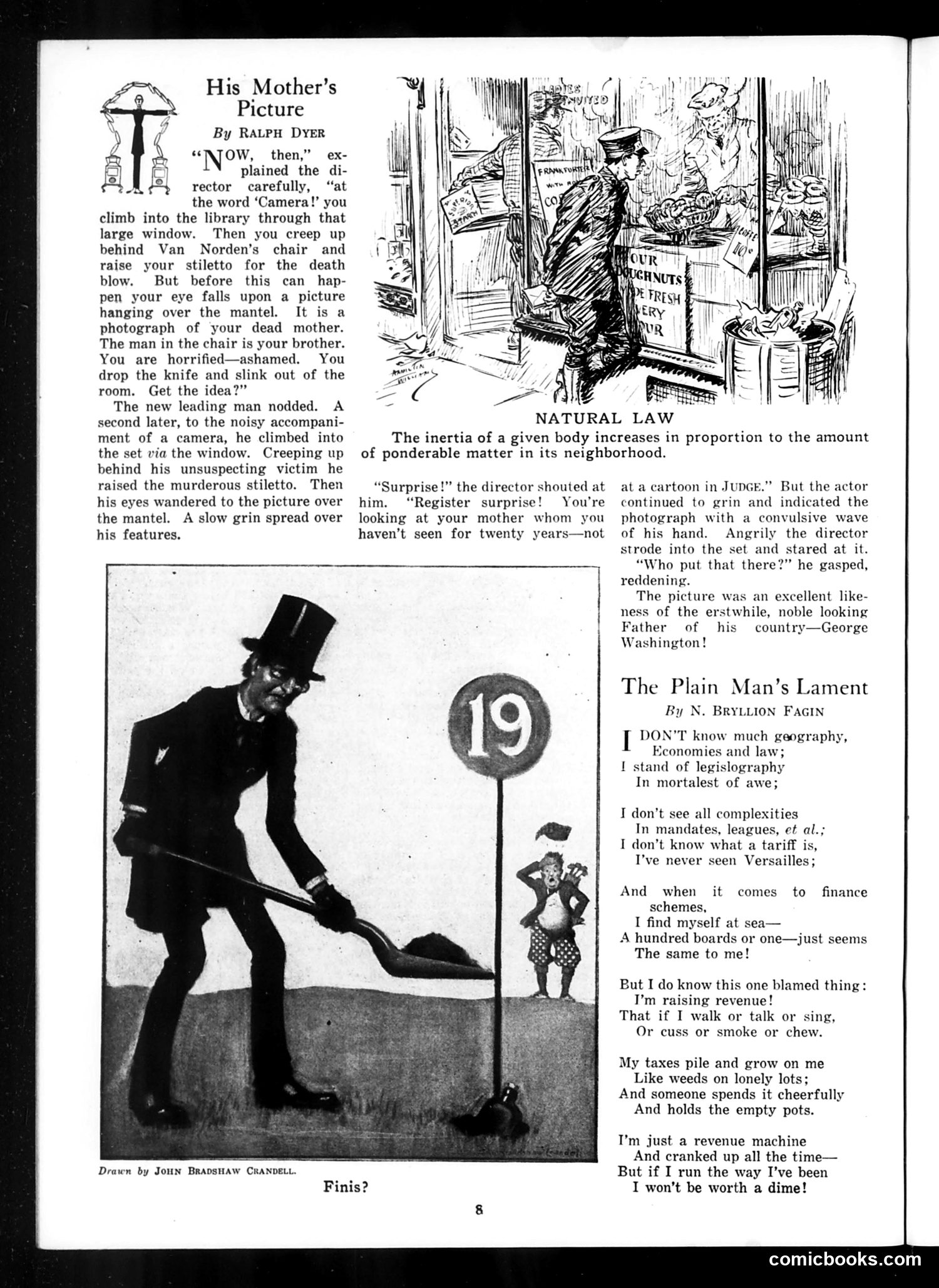
**"His Mother's Picture"** satirizes silent film melodrama. A director instructs an actor to murder his "brother" but be stopped by emotion upon seeing his dead mother's portrait. During filming, the actor grins at the photograph—revealing it's actually **George Washington**, not the mother. The joke mocks both the overwrought sentimentality of early cinema and perhaps the excessive patriotic reverence of the era. **"The Plain Man's Lament"** expresses working-class frustration with post-WWI taxation and government complexity. The speaker admits ignorance of economics, tariffs, and international affairs (Versailles Treaty reference), but knows one thing: he's constantly taxed for any activity—talking, singing, smoking—while government bureaucrats spend the money wastefully. It's a critique of expanding taxation and perceived governmental inefficiency, reflecting 1920s taxpayer resentment.
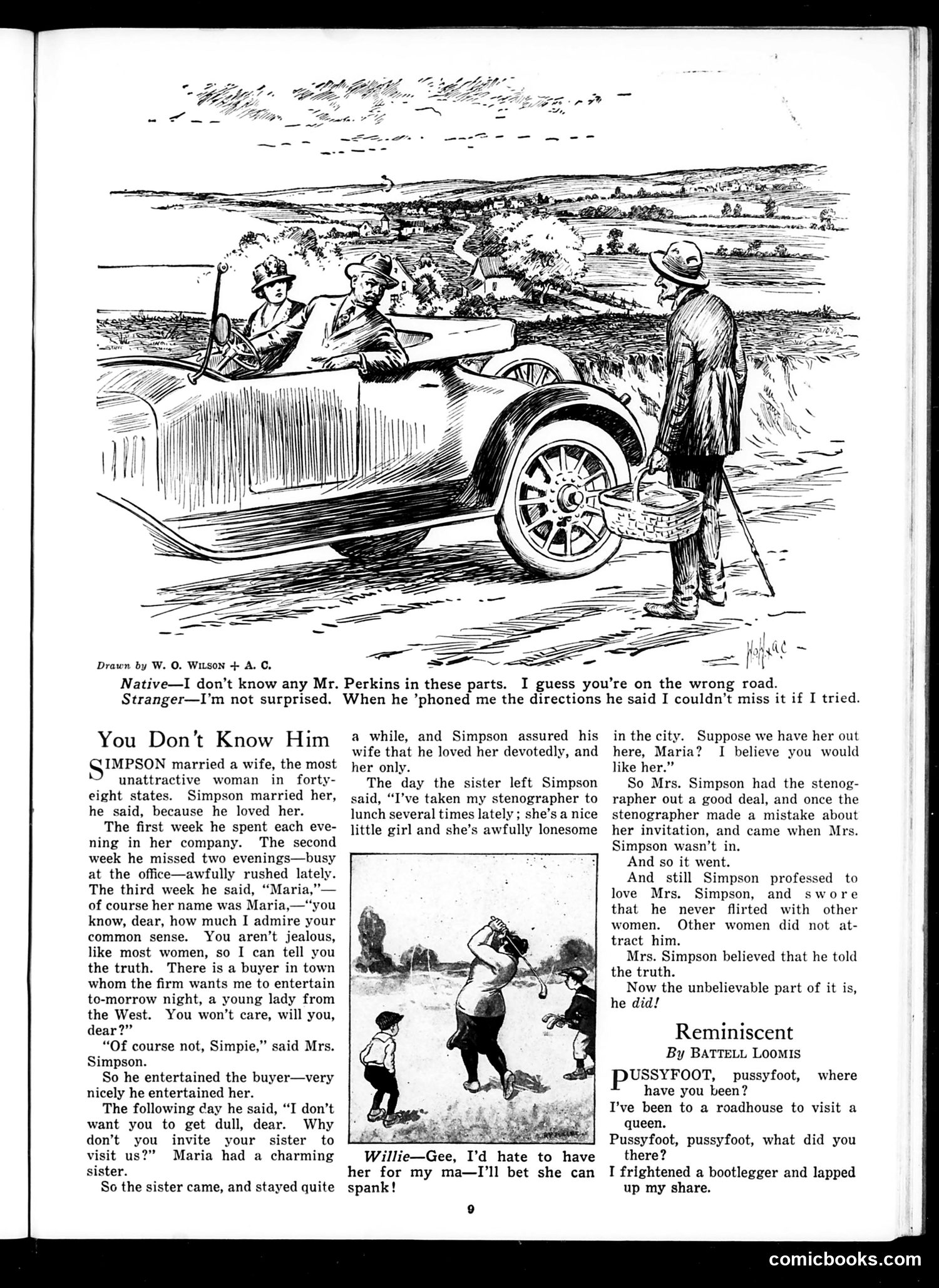
**"You Don't Know Him"** satirizes marital infidelity disguised as respectability. Simpson repeatedly asks his unattractive wife's permission to entertain other women—a "buyer from the West," her sister, his stenographer—each time framing it as innocent and praising his wife's "common sense" to avoid jealousy. The joke is that Simpson systematically exploits his wife's trust to pursue affairs while maintaining plausible deniability. The final twist—that he genuinely loves only his wife despite these encounters—suggests either self-delusion or that his infidelities are purely recreational, not emotional betrayals. **"Reminiscent"** references Prohibition-era speakeasies ("roadhouse") and bootleggers. "Pussyfoot" likely alludes to anti-alcohol activists (the term was used for prohibitionists), making the joke ironic: a pussyfoot visits illegal liquor establishments and steals from bootleggers—mocking the hypocrisy of Prohibition's moral crusaders.
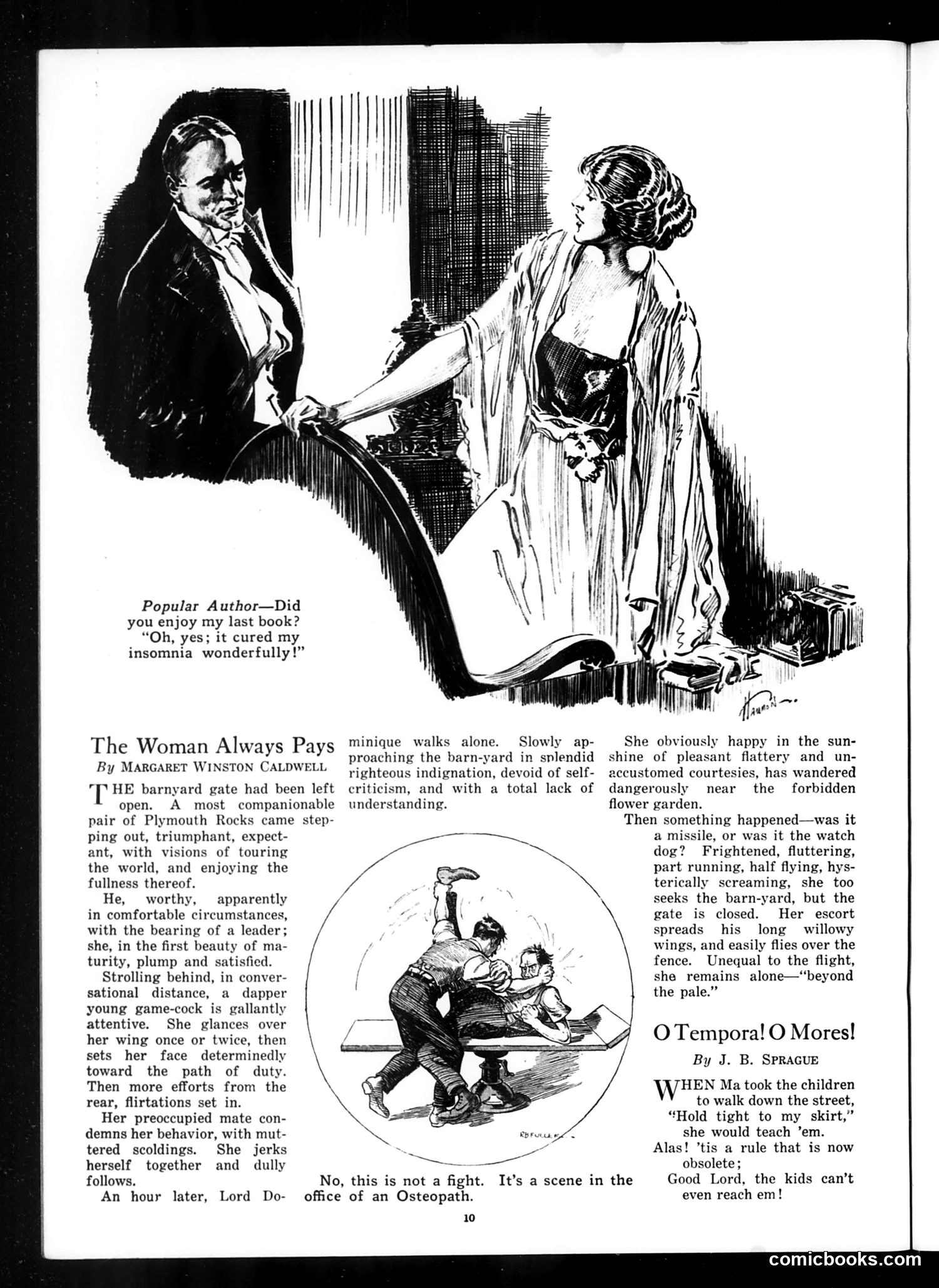
This page contains two satirical pieces from *Judge* magazine addressing early 20th-century social concerns: **"The Woman Always Pays"** uses chickens as characters to critique marital infidelity and double standards. A hen, tempted by a younger rooster's flirtations while her mate isn't watching, strays into forbidden territory. When discovered, she faces consequences (blocked gate, abandoned by her escort) while the younger rooster escapes unscathed. The title suggests women bear the social and practical costs of moral transgressions, while men face none—a commentary on the unequal moral judgment applied to men and women. **"O Tempora! O Mores!"** (Latin for "Oh the times! Oh the customs!") jokes about changing fashion. Mothers once instructed children to hold their skirts while walking, but modern women's skirts have become so short that children literally cannot reach them anymore. It's satirizing how dramatically women's hemlines had risen—a shocking development to traditionalists of that era. Both pieces use humor to critique social change and gender relations of the period.
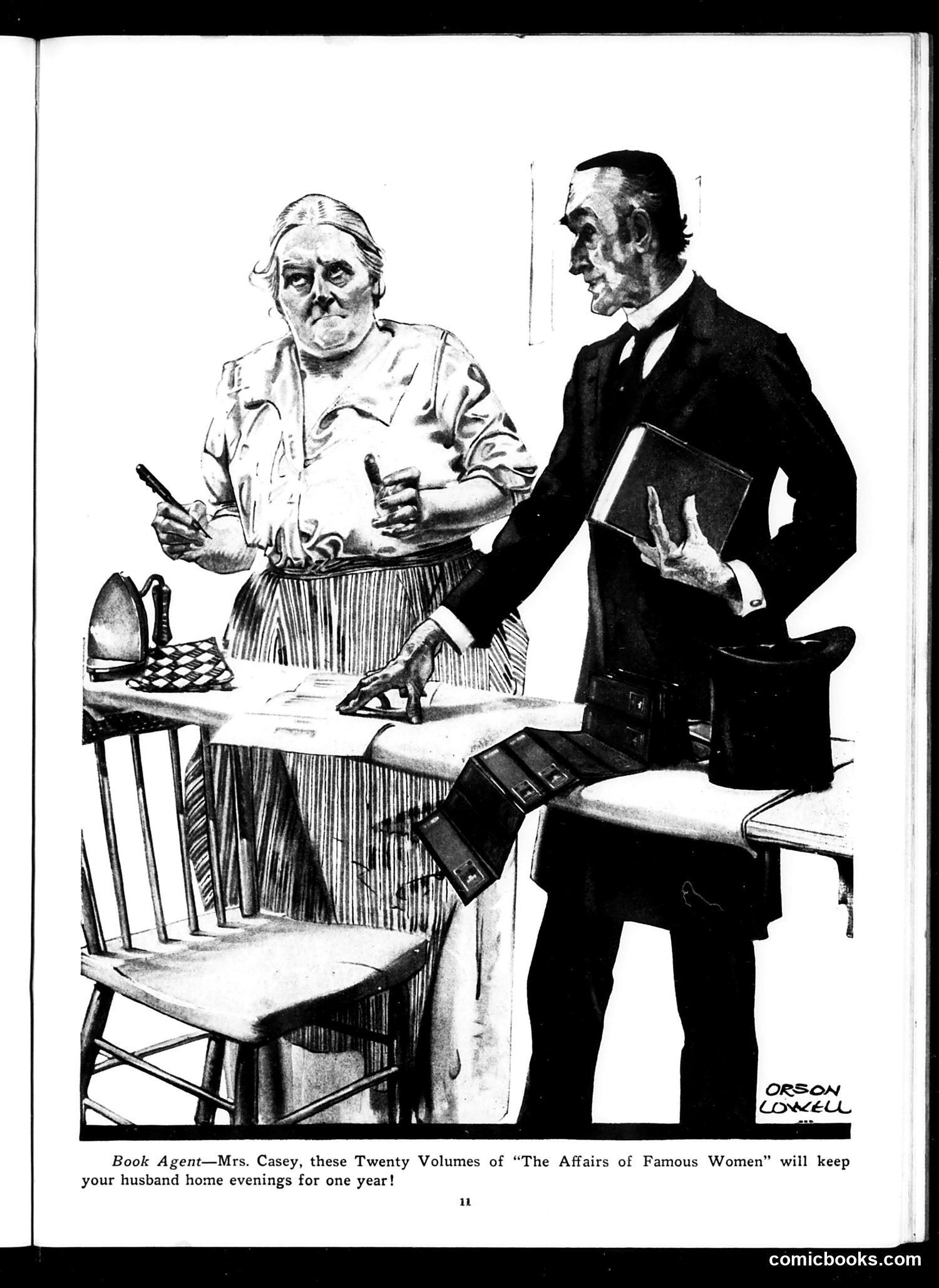
This is a sales pitch cartoon satirizing both book marketing and marriage dynamics. A slick male book agent pitches Mrs. Casey on a twenty-volume set titled "The Affairs of Famous Women," claiming it will keep her husband home in the evenings—implying the husband would otherwise be out carousing or socializing. The joke targets husbands' supposed wandering habits and the era's assumption that wives needed strategies to domesticate their spouses. It also mocks aggressive book-selling tactics, suggesting agents would pitch anything with dubious claims about marital benefits. The cartoon reflects early-20th-century gender stereotypes: wives as household managers responsible for controlling husbands' behavior, and men's leisure activities as potentially morally suspect. The agent's confident sales pitch satirizes commercial persuasion tactics of the period. Artist credit: Orson Lowell
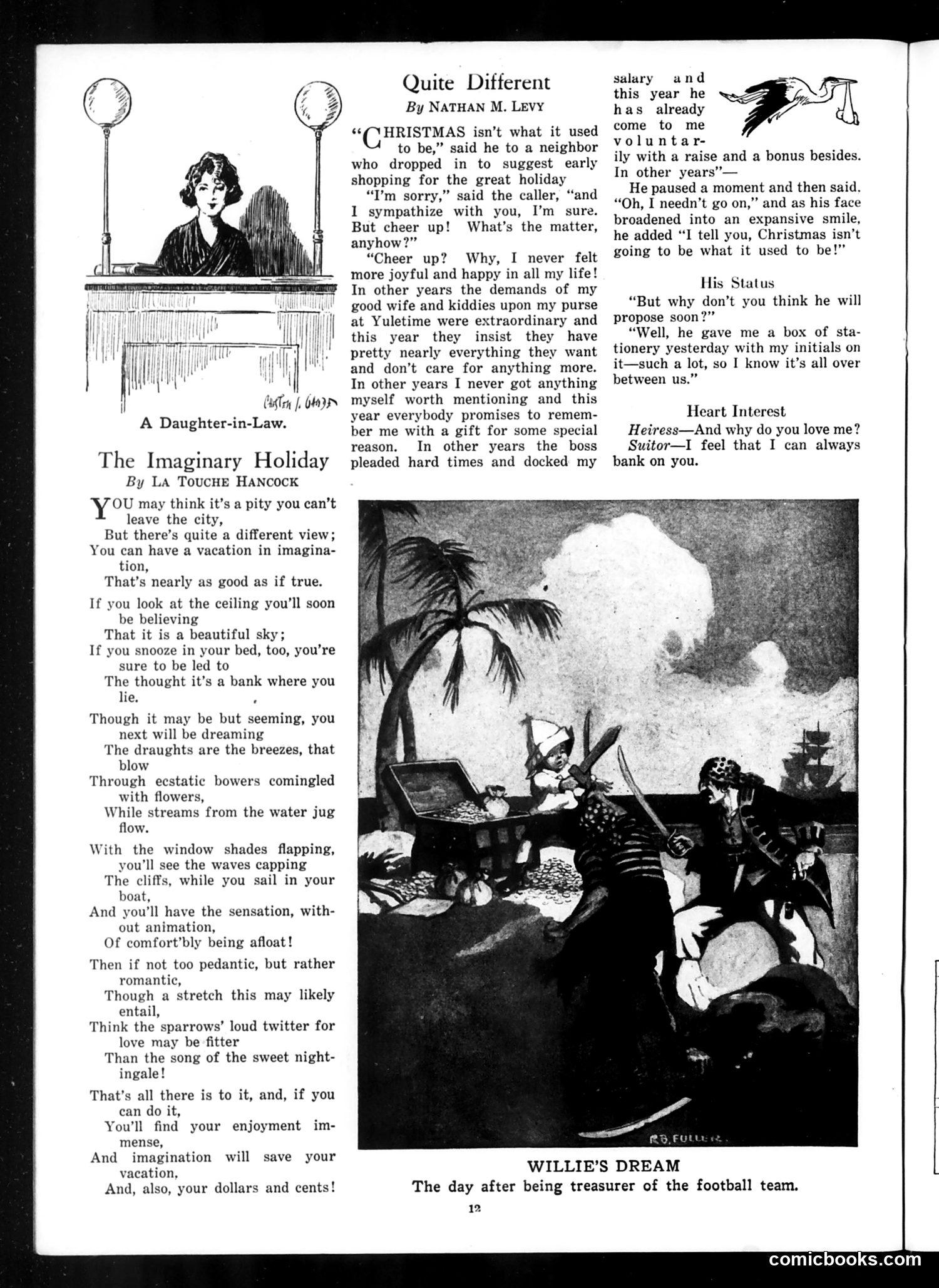
This page contains three distinct humor pieces typical of early 20th-century satirical magazines: **"Quite Different"** satirizes Christmas expectations. A man tells his neighbor that this year Christmas "isn't what it used to be"—but ironically means it positively. Traditionally, his family made excessive demands, he received nothing, and his boss cut his salary. Now, his family wants nothing extra, everyone promises him gifts, and his boss voluntarily gave him a raise and bonus. The joke inverts the expected complaint: he's actually *happier*, undermining the neighbor's sympathy. **"The Imaginary Holiday"** offers whimsical advice for vacationing without leaving the city—using imagination to transform one's bedroom into exotic locations (beaches, tropical settings). It's gentle escapism for financially constrained readers. **"Willie's Dream"** shows a boy fantasizing about being a football team treasurer, illustrated with a pirate/treasure adventure scene. The humor lies in a child's grandiose daydreams about minor responsibility. The "Heart Interest" section contains brief romantic jokes about materialism in courtship.
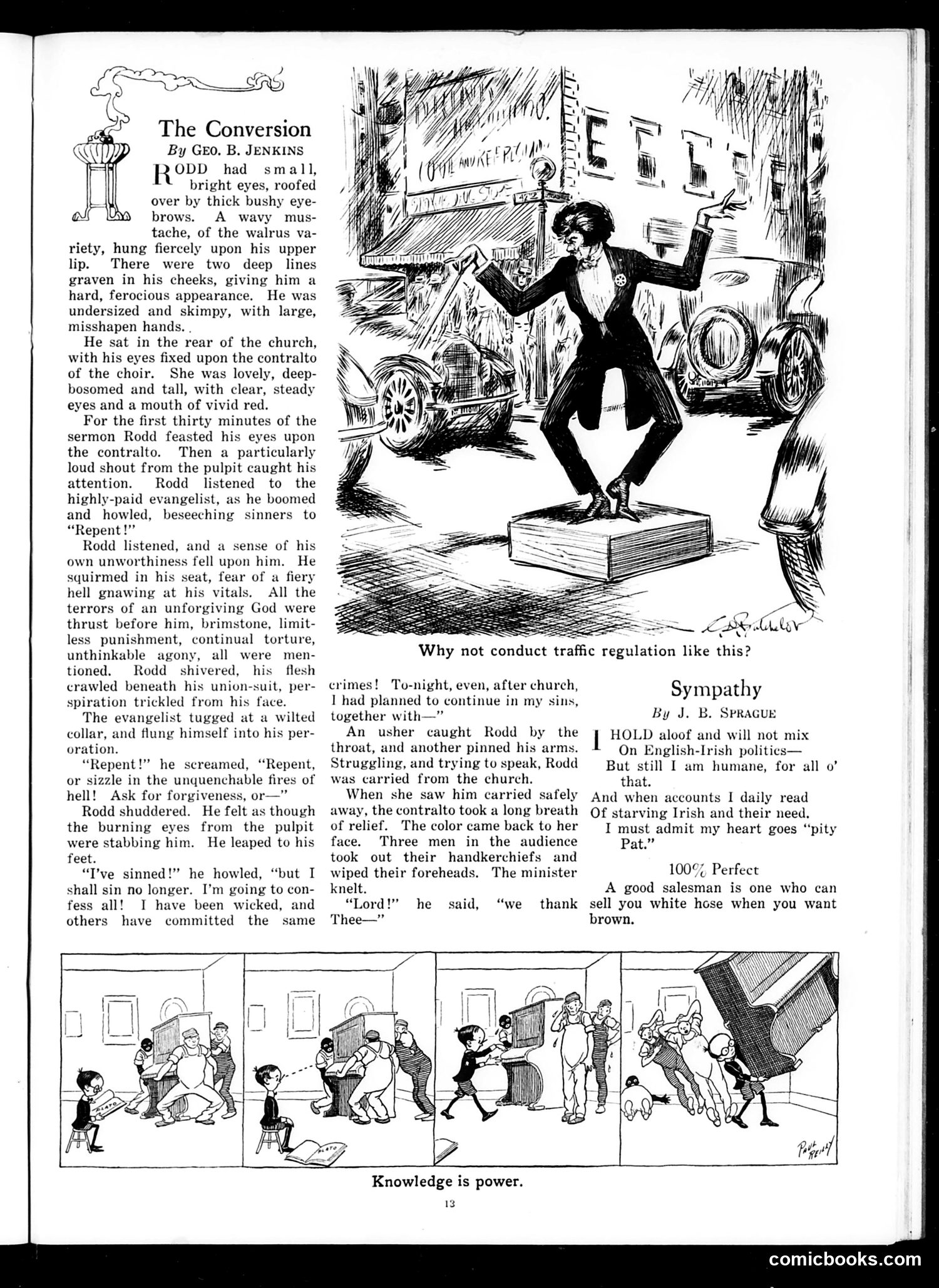
**Main Story:** "The Conversion" satirizes revival evangelism. Rodd, an unattractive man obsessed with a church choir singer, becomes emotionally overwhelmed by a hellfire-and-brimstone sermon. He publicly confesses sins and attempts to announce plans to continue sinning—but ushers forcibly remove him before he can speak. The joke: his "conversion" was really about the attractive woman; the other churchgoers are relieved he's silenced, not genuinely moved by his repentance. **Top Cartoon:** Mocks traffic regulation by showing a man directing cars like an evangelist directs sinners—suggesting both are performative authority figures. **"Sympathy" poem:** Gently mocks English observers who claim political neutrality on Irish issues yet still sentimentally pity Irish suffering—hollow sympathy without engagement. **Bottom comic strip:** "Knowledge is power"—appears to show escalating domestic chaos, likely satirizing the consequences of education or information-sharing.
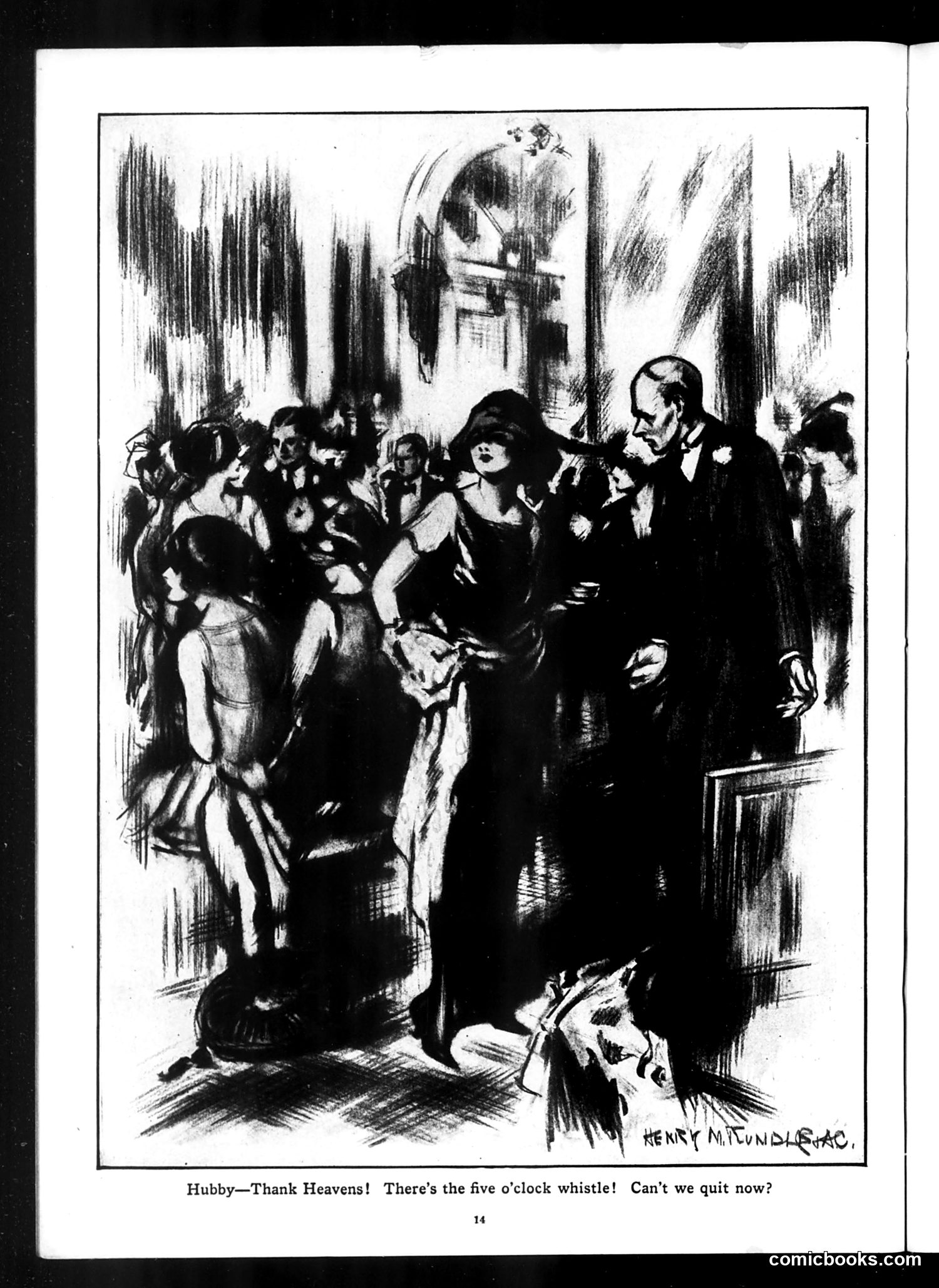
This cartoon satirizes workplace culture and marital dynamics in early 20th-century America. A man (the "hubby") expresses relief at the five o'clock factory whistle, asking his wife if they can leave work now. The humor plays on role reversal or confusion: the man speaks as though *both* are factory workers, when the woman appears to be a society lady at what looks like a social gathering or party. The satire likely critiques either: 1. Men's obsession with work schedules even during leisure time 2. The blurred boundaries between work and social life in modern society 3. Gender role confusion about who actually "works" The artist is Henry M. Tundergao (visible signature). The precise social commentary remains somewhat unclear without additional context about Judge magazine's 1920s-era concerns.
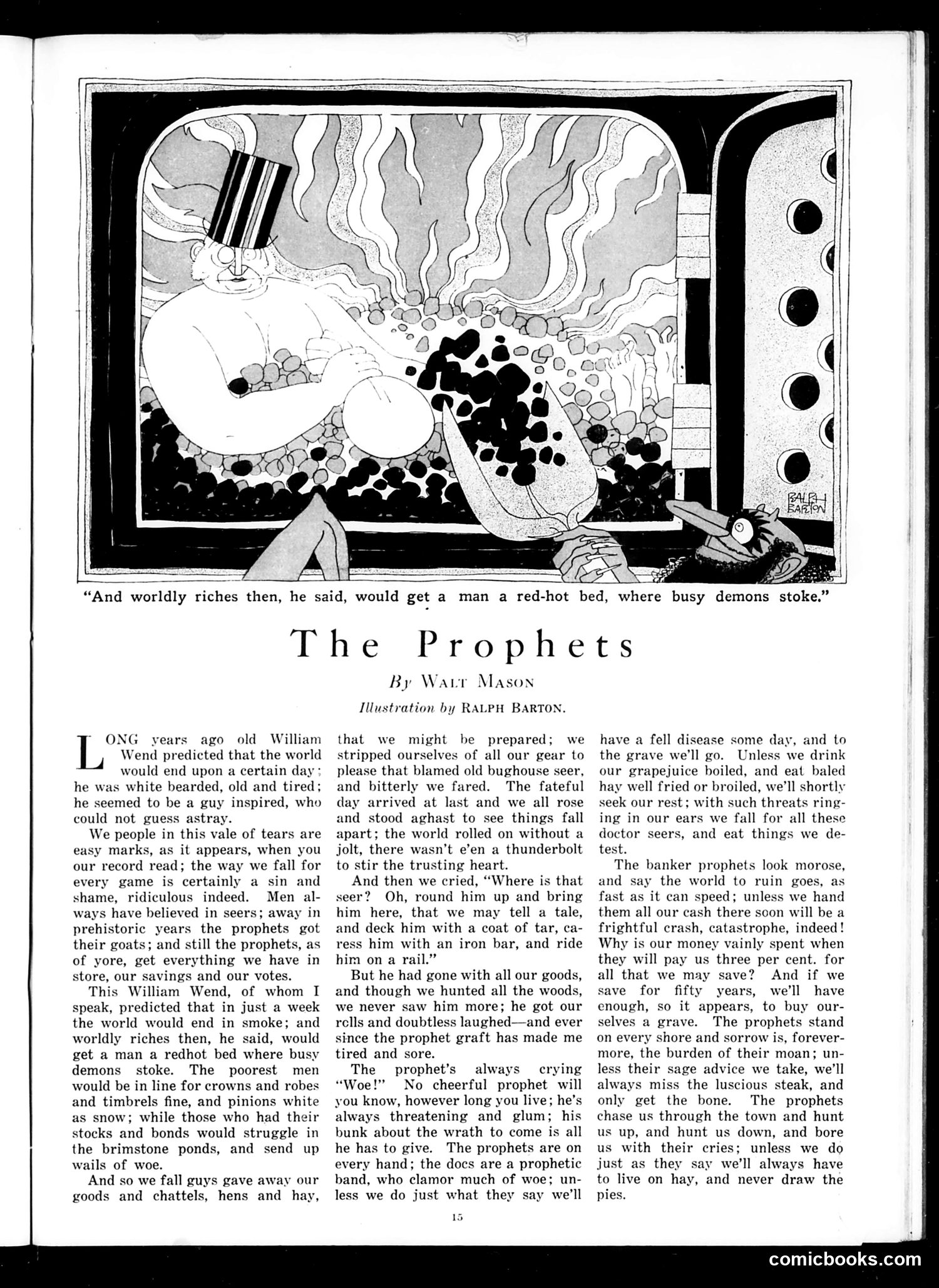
This is a satirical story (not a political cartoon) attacking false prophets and fear-mongering experts. The narrative describes William Wend, a bearded prophet who predicted the world would end in a week, convincing gullible people to surrender their possessions. When the prediction fails, the crowds turn on him, but he escapes with their goods. Mason then broadens the critique to attack various contemporary "prophets": doctors claiming disease will strike unless people follow strict health regimens; bankers warning of financial catastrophe unless citizens hand over savings; and religious doomsayers spreading constant gloom. The satire's point: ordinary people are susceptible to manipulation by self-interested "experts" who profit from fear and false predictions. Ralph Barton's illustration (top) depicts the fiery hell promised by such prophets—the false threat used to control the masses.
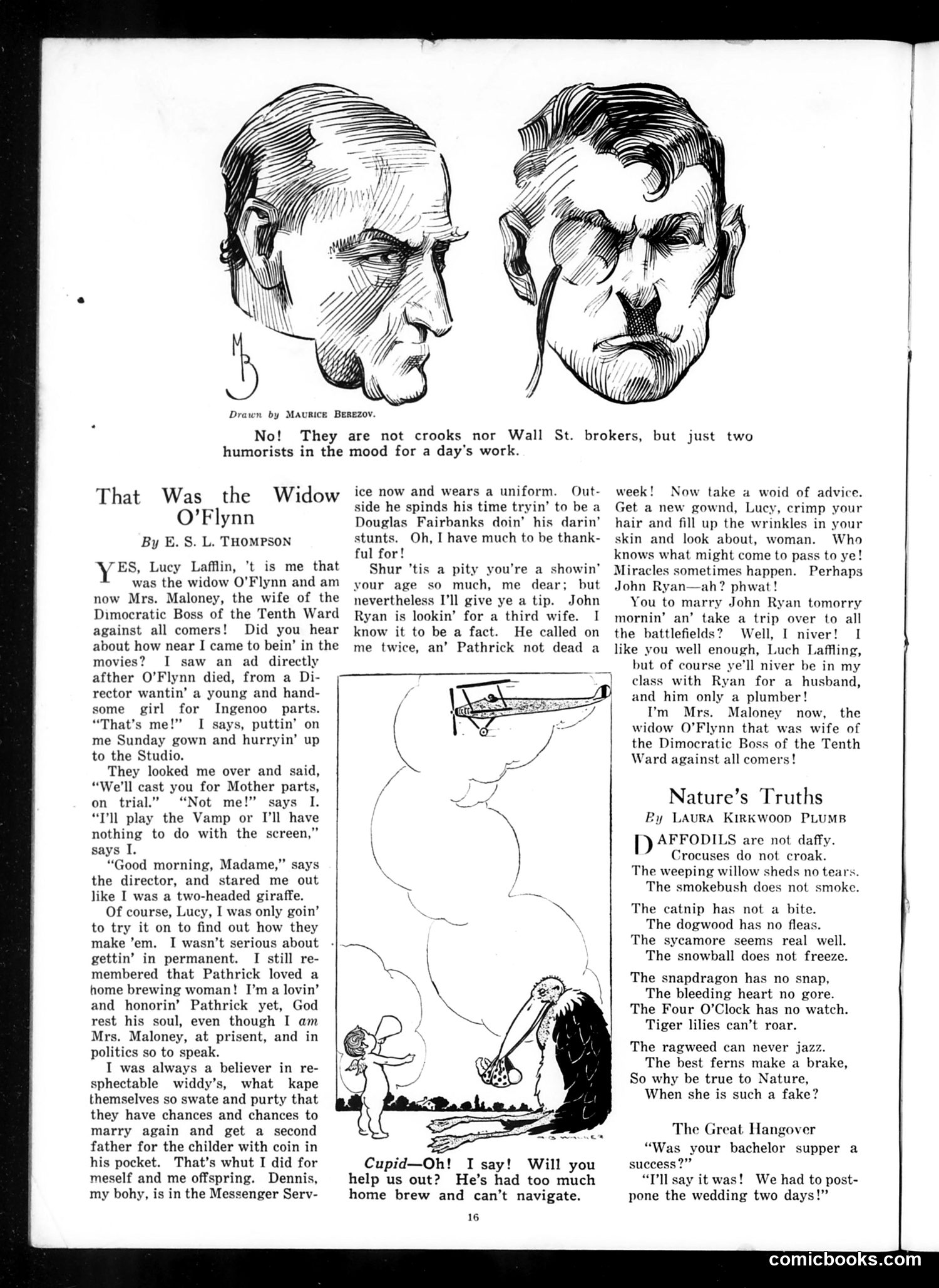
This page from *Judge* contains two distinct pieces: **"That Was the Widow O'Flynn"** is an Irish-dialect humor piece satirizing Irish-American urban politics and social aspiration. The narrator, now Mrs. Maloney (wife of a Democratic ward boss), recounts how she nearly became a movie actress but accepted "Mother" roles instead—poking fun at aging Irish widows reinventing themselves through remarriage. The satire targets both Irish ethnic stereotypes (heavy dialect, home-brewing culture) and the pretensions of ordinary people attracted to early cinema. **"Nature's Truths"** is a simple joke poem playing with plant names containing animal/action words (snapdragon, bleeding heart, ragweed) while claiming nature itself is a "fake" because these plants don't actually do what their names suggest. The page-top caricatures by Berezov appear unrelated—the caption suggests they're humorists or actors, though their specific identities aren't clear from context. The overall tone reflects *Judge's* characteristic mockery of immigrant communities and lowbrow entertainment culture.
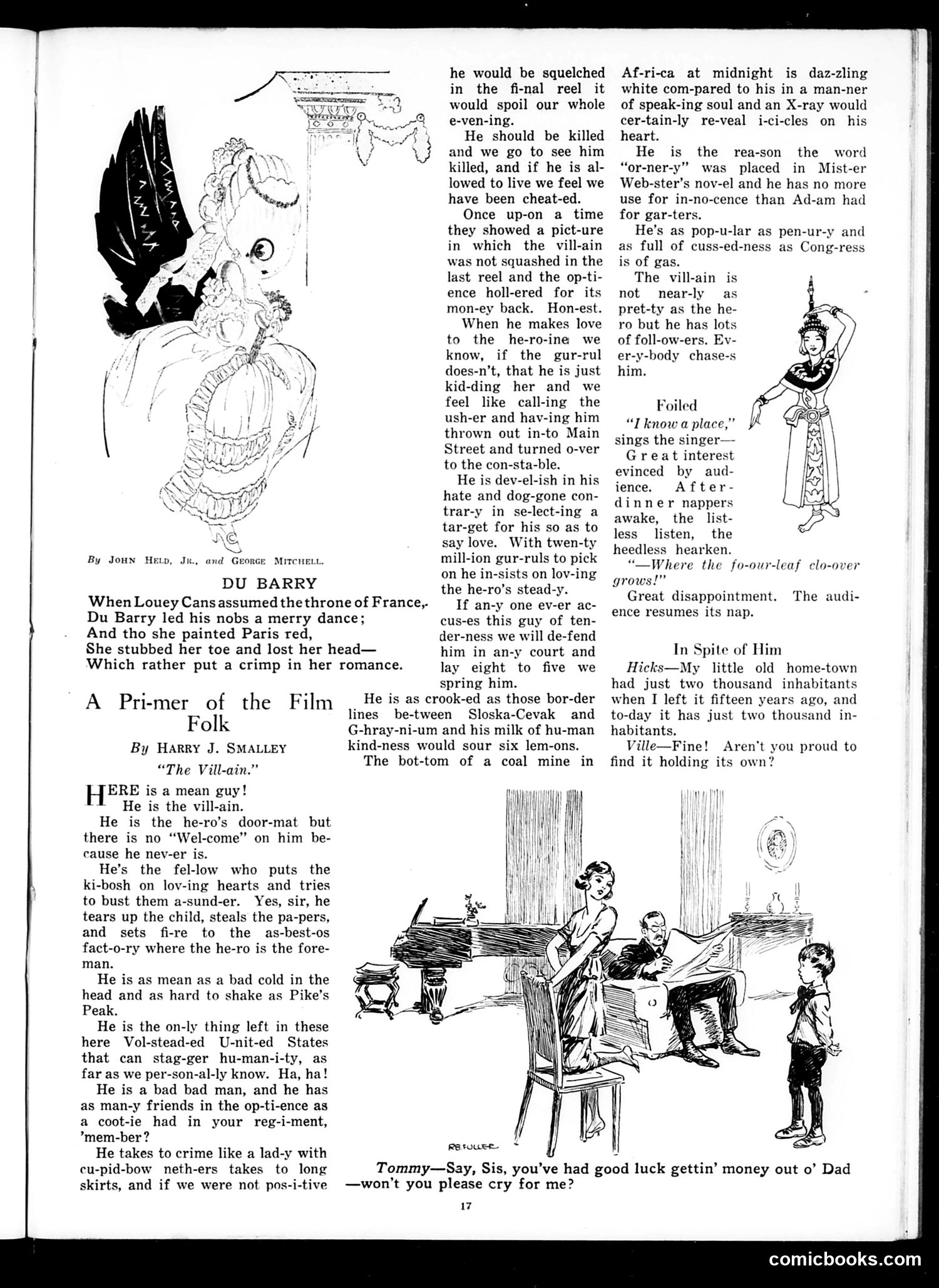
This Judge magazine page contains two distinct pieces of satire: **"Du Barry"** (top): A brief, punning poem mocking the historical French courtesan Madame du Barry, who famously lost her head during the French Revolution. The joke relies on wordplay ("stubbed her toe and lost her head") to mock both her scandalous reputation and her execution. **"A Primer of the Film Folk: The Villain"** (main article): A humorous essay written in deliberately fractured, hyphenated language that parodies how film villains were portrayed in silent movies. The villain is described as universally despicable—cruel, crooked, and deserving of death. The satire mocks both the stock character type and audiences' predictable emotional responses to him. A small illustration shows a child asking his sister to cry so he can extract money from their father—itself satirizing sentimental film manipulation. **Context**: This reflects 1920s cinema conventions where villains were one-dimensional and audiences expected violent justice in the final reel. The fractured language mimics how silent films used exaggerated title cards.
This page contains four separate satirical commentaries on American post-WWI society: **"The Doughboys of the Rhine"** mocks American sentimentality about soldiers stationed in Germany. Initially portrayed as tragic exiles, the public's sympathy evaporates upon learning they earn $20 daily—better than domestic wages—revealing American envy disguised as concern. **"Loaf or Labor Unanimously"** satirizes Henry Ford's claim that eliminating worker idleness boosts railroad profits. The author suggests this logic, if applied universally, would justify government standardization of citizens' lives—meals, holidays, haircuts—exposing the absurdity of totalitarian efficiency. **"Housing the Flivver"** critiques American priorities: while housing shortages persist, citizens eagerly build garages for automobiles. The satire highlights misplaced investment and cultural psychology—people prioritize protecting machines over securing homes. **"Who Bids for Glory?"** contrasts American and British attitudes toward historical sites. Britain sells Runnymede (birthplace of Magna Carta) as mere real estate, while Americans would never commercialize Independence Hall—suggesting differing national values regarding historical patrimony.
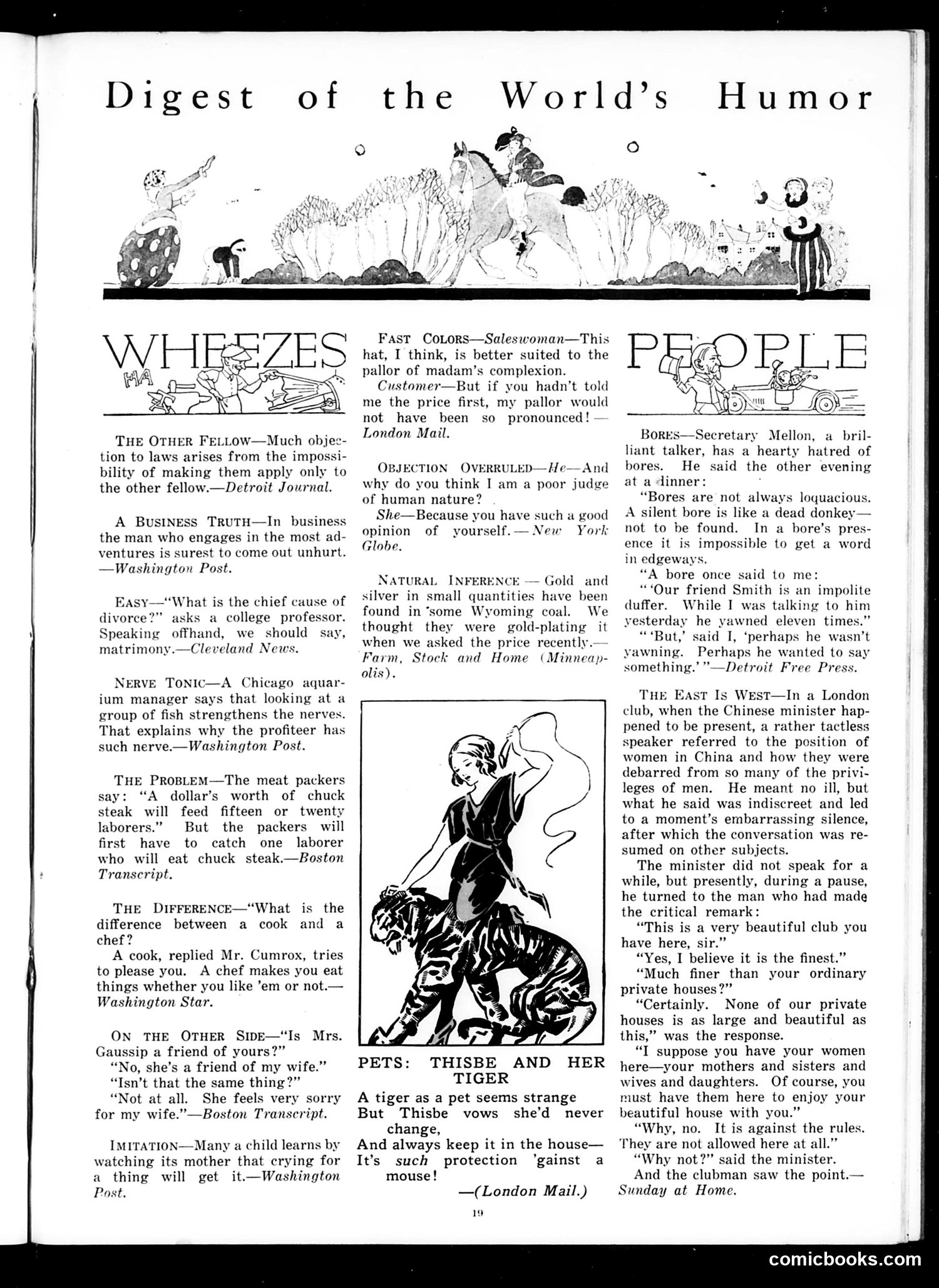
This page from *Judge* magazine contains brief humorous anecdotes and one illustrated cartoon. The content reflects early-20th-century American satirical commentary on social customs and class distinctions. **The main cartoon** depicts "Thisbe and Her Tiger"—a woman riding a tiger indoors. The joke is absurdist: she keeps the dangerous animal as a pet for protection "against a mouse," which is both impractical and ridiculous. **Notable anecdotes include:** - References to Secretary Mellon (Andrew Mellon, Treasury Secretary), criticizing boring conversationalists - A pointed joke about a Chinese diplomat at a London club: when a speaker boasts about excluding women from the club as "against the rules," the minister subtly highlights the hypocrisy by asking why women—mothers, sisters, wives—aren't allowed to enjoy this "beautiful house" The humor relies on class consciousness, gender commentary, and satirizing contemporary attitudes. The Chinese diplomat's comeback critiques Western exclusionary practices by exposing their illogic through polite questioning—a common rhetorical device in period satire.
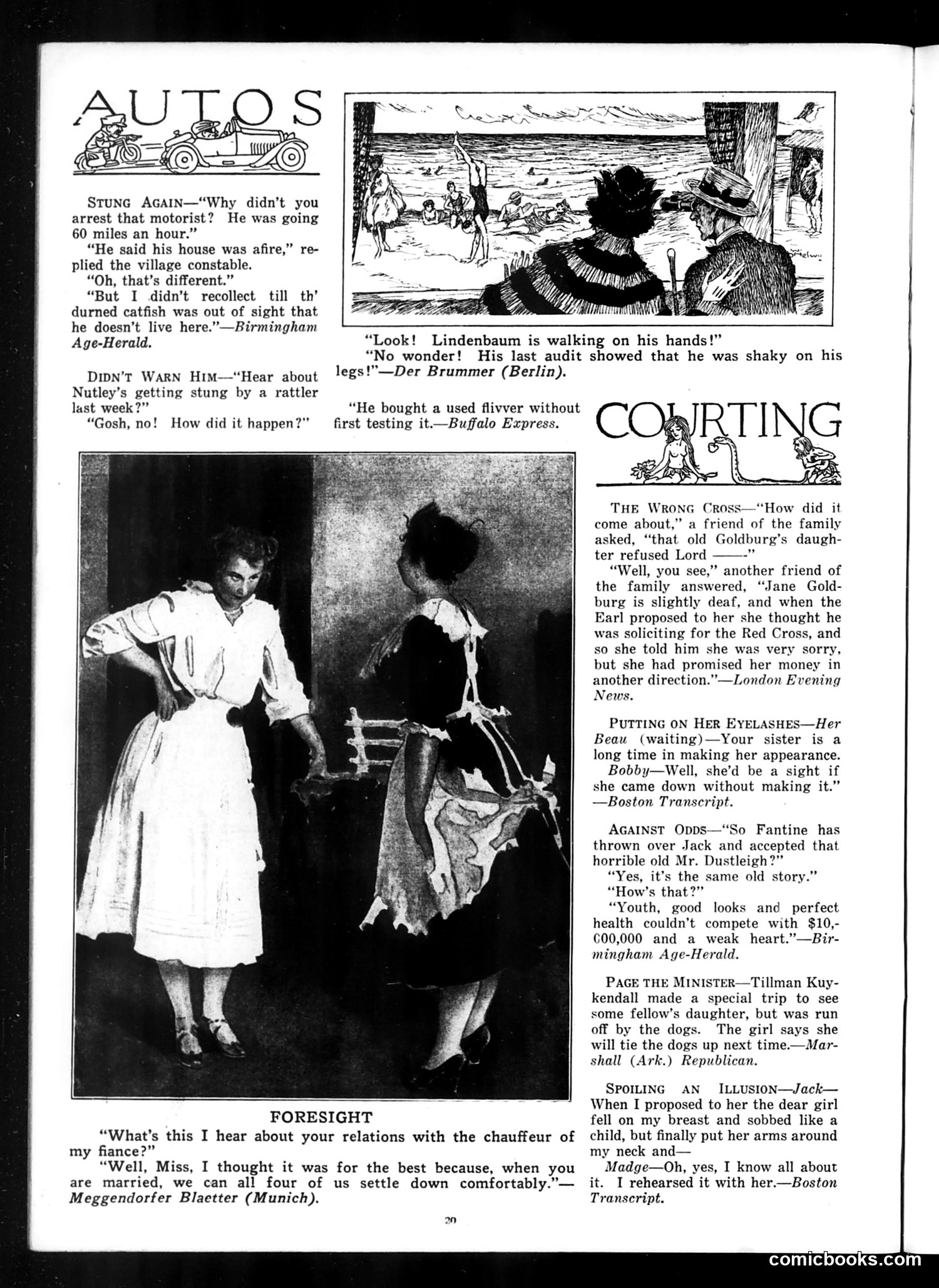
This page collects brief satirical jokes from various newspapers, typical of Judge's format. The humor reflects early 20th-century social anxieties: **"Stung Again"** mocks rural police incompetence—a constable lets a speeding motorist pass under false pretenses, then realizes the man doesn't even live in the area. **"Foresight"** satirizes class mobility: a man welcomes marrying into a family that includes a chauffeur, expecting comfortable communal living—suggesting both social climbing and questionable domestic arrangements. **The Lindenbaum cartoon** (from a German source) uses physical humor: a businessman walking on his hands implies his audit showed financial instability ("shaky on his legs"). **"Against Odds"** cynically notes that wealth trumps youth and health in marriage prospects—a critique of mercenary courtship. Other jokes target deafness, gullibility in charitable solicitation, and gender stereotypes about women's vanity. The humor is largely dismissive of women, lower classes, and Jewish names (Goldburg, Lindenbaum), reflecting the magazine's audience prejudices.
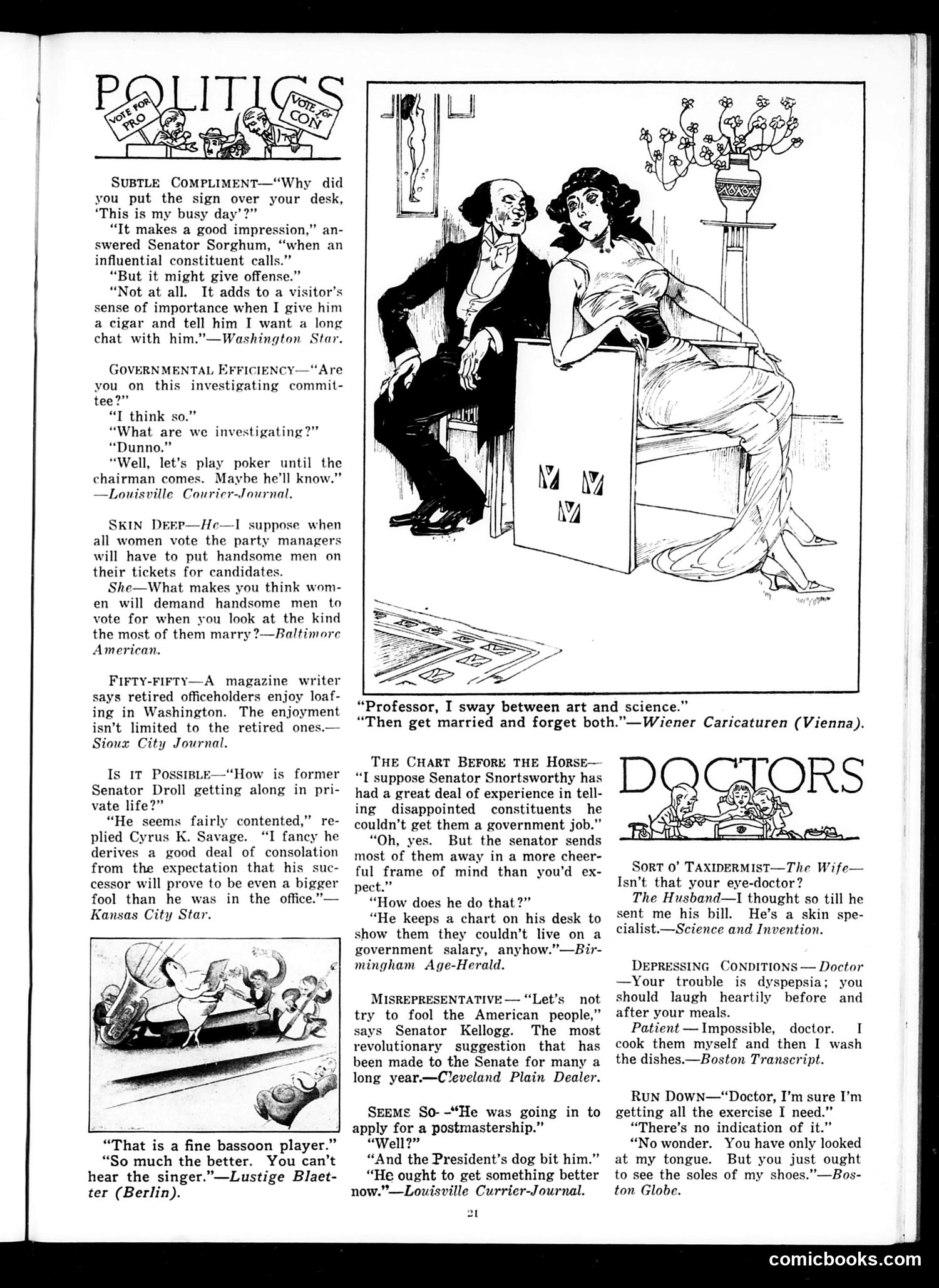
This page collects brief political and social jokes typical of early 20th-century American humor. Key satirical targets: **"Governmental Efficiency"** mocks Senate investigating committees as incompetent—members don't know what they're investigating and resort to playing poker while awaiting the chairman. **"Misrepresentative"** praises Senator Kellogg for suggesting the Senate stop deceiving the American people, treating honesty as shockingly radical. **"The Chart Before the Horse"** ridicules Senator Snortsworthy's technique: he shows disappointed job-seekers that government salaries are inadequate, making them feel better about rejection through depressing statistics. **"Skin Deep"** contains gender satire: a man assumes women voters will demand handsome candidates, but a woman counters that women marry unattractive men anyway, so attractiveness clearly doesn't matter to them. The remaining jokes target doctors, retired politicians, and personal vanity. The overall tone reflects Progressive Era skepticism toward government institutions and politicians' competence and honesty.
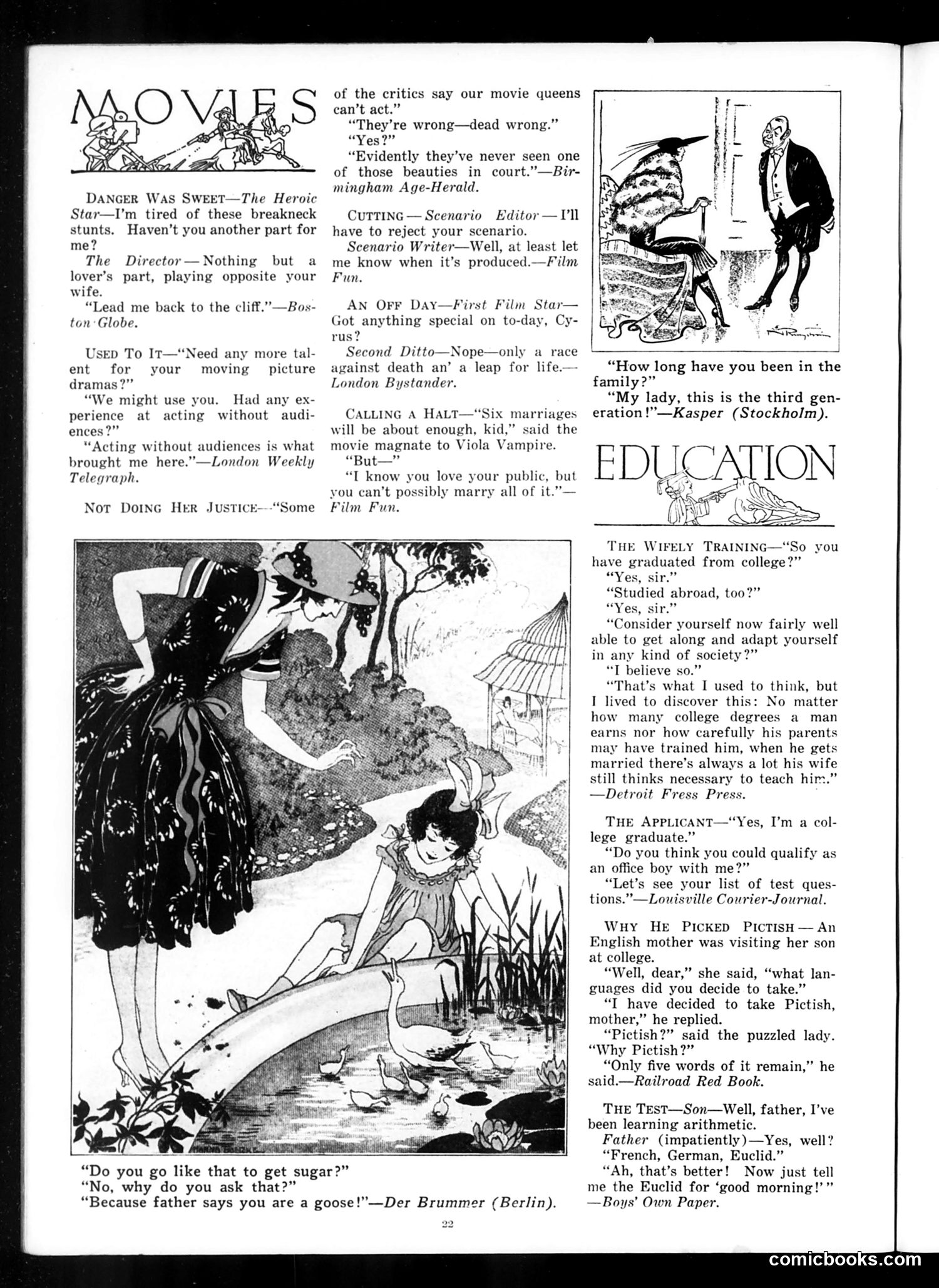
This page from *Judge* satirizes early 1900s cinema and education through brief comedic quips. The **movie industry jokes** mock silent film actors' dangerous stunts, questioning whether glamorous actresses can truly act (one quip suggests their "acting" in court proceedings proves their talent). There's commentary on scenario writers and contract disputes typical of early Hollywood. The **education section** ridicules college-educated men entering menial positions and the gap between academic training and practical life skills—particularly marriage, where wives supposedly must "teach" their husbands despite formal education. One joke mocks a student choosing to study "Pictish" (an extinct language) simply because few words remain, suggesting academic absurdity. The **illustration** depicts a woman in fashionable dress near water—likely representing the dangerous physical stunts actresses performed for early cinema. Overall, the page reflects early 20th-century skepticism about modern entertainment, higher education's practical value, and gender roles in both professional and domestic spheres.
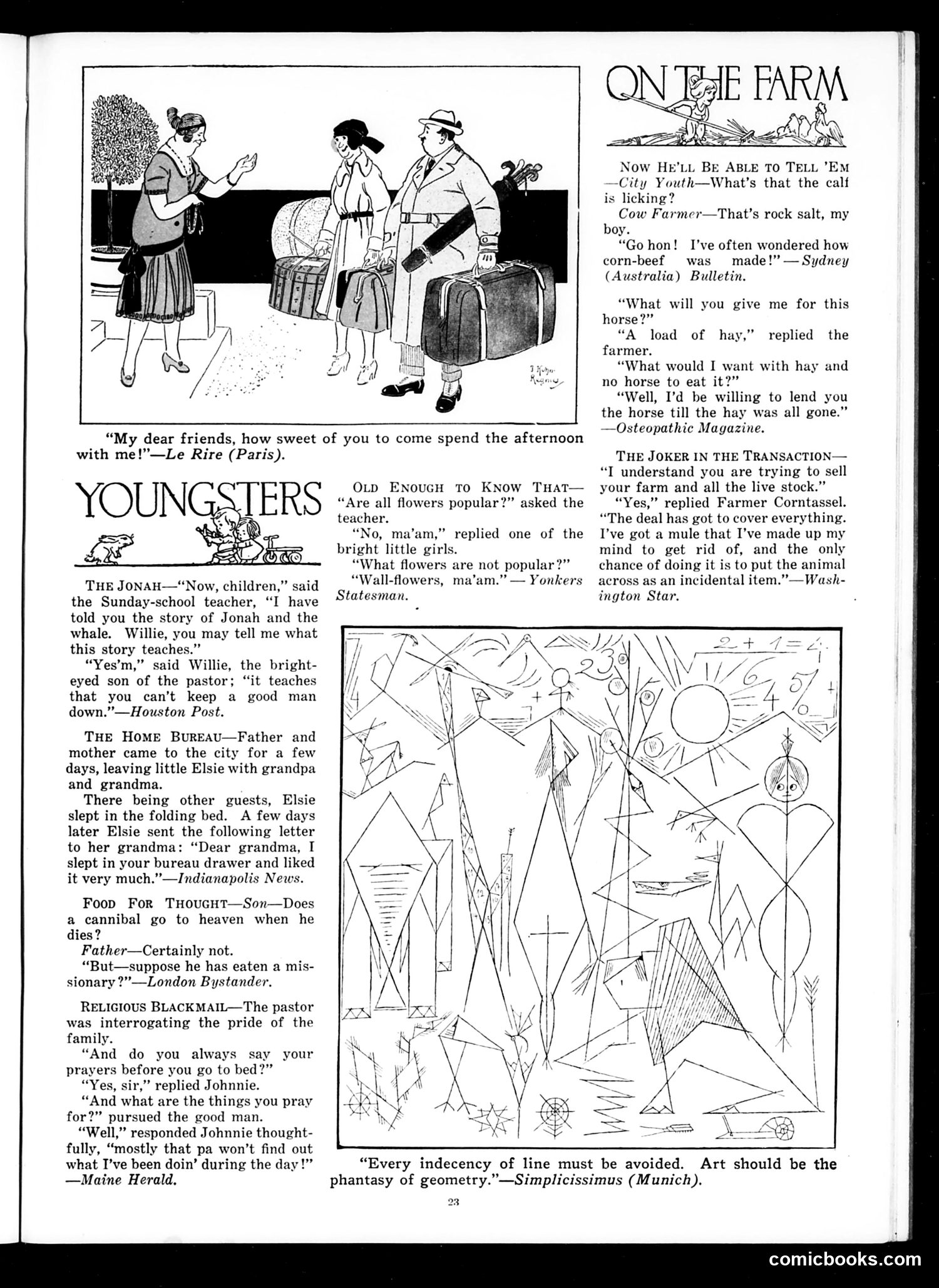
This page from **Judge** (a satirical American magazine) collects brief humorous anecdotes and jokes under the heading "Youngsters" and "On the Farm." The top cartoon shows three urban visitors arriving at a farm, captioned with a Parisian reference—likely satirizing affectation or urban pretension visiting rural settings. The text pieces are short jokes exploiting wordplay and naive logic: - A Sunday school boy misinterprets the Jonah story as teaching "you can't keep a good man down" - A child confuses a bureau drawer with bedding - Religious humor mocking a child's prayers about hiding misbehavior - Farm humor: a city youth doesn't understand rock salt; a farmer tries to unload a mule by bundling it with hay sale The geometric illustration at bottom appears decorative/artistic, with a caption about geometric purity in art. These pieces reflect early-20th-century American humor: gentle, family-friendly satire of rural/urban contrasts, childhood innocence, and religious hypocrisy—typical Judge fare targeting middle-class readers.
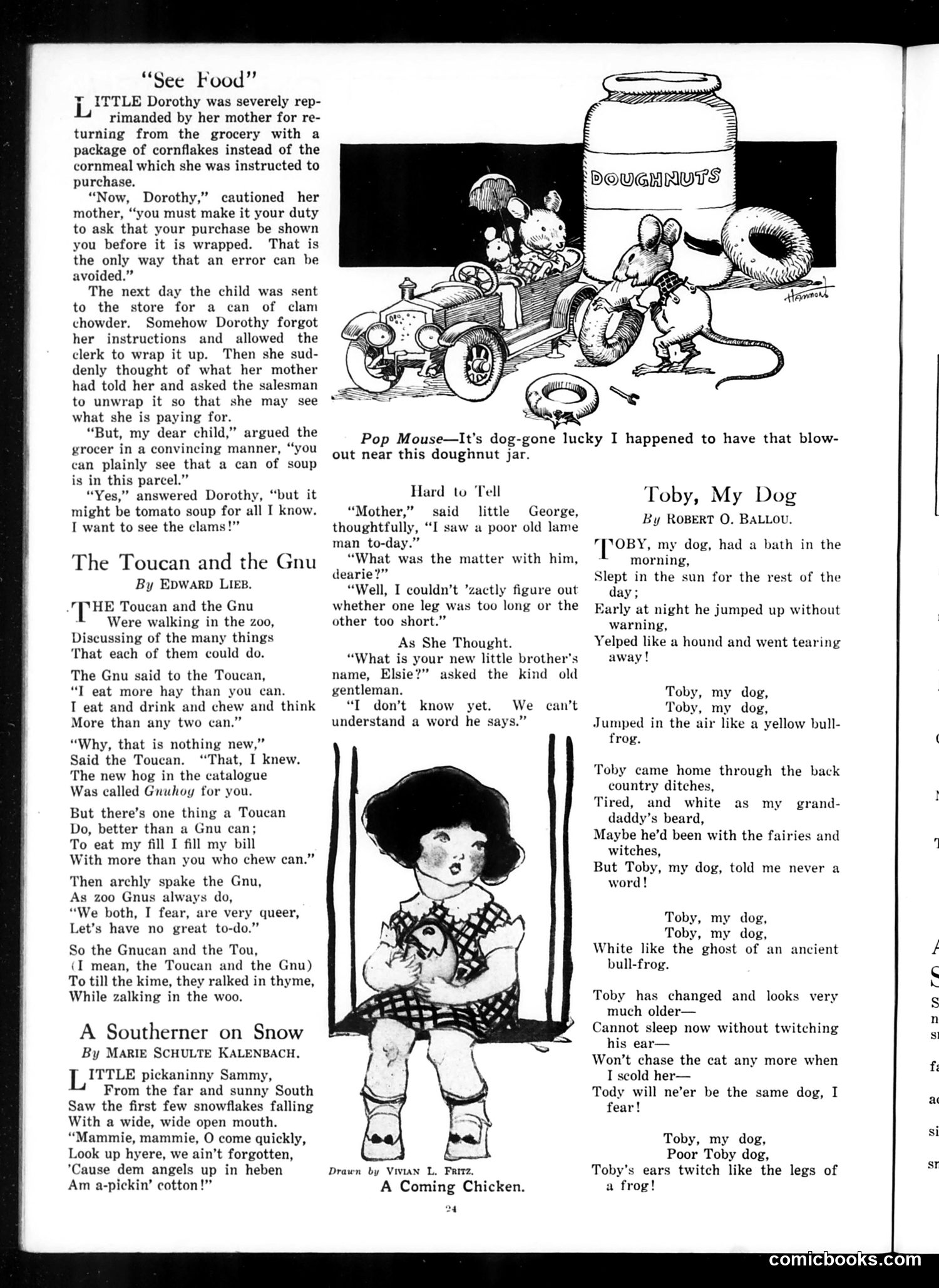
This page contains several light humorous pieces typical of early 20th-century American satire: **"See Food"** mocks a child's literal-mindedness. Dorothy takes her mother's advice to inspect purchases too literally—demanding to see the actual clams in a can of clam chowder, suspecting it might contain tomato soup instead. The joke plays on the phrase "see food" (homophone for "seafood") and pokes fun at both parental instruction and childhood logic. **"The Toucan and the Gnu"** is a playful nonsense poem using animal puns ("Gnuhoy," "Gnucan") with deliberate misspellings ("kime," "zalking") for comic effect. **"A Southerner on Snow"** employs period racial humor depicting a Black child's first encounter with snow, rendered in exaggerated dialect, interpreting snowflakes as angels "pickin' cotton." The remaining pieces—brief anecdotes and a poem about a dog named Toby—are gentle domestic humor without satirical intent. Overall, the page reflects early 20th-century editorial humor standards, mixing wordplay, children's situations, and racial caricature.
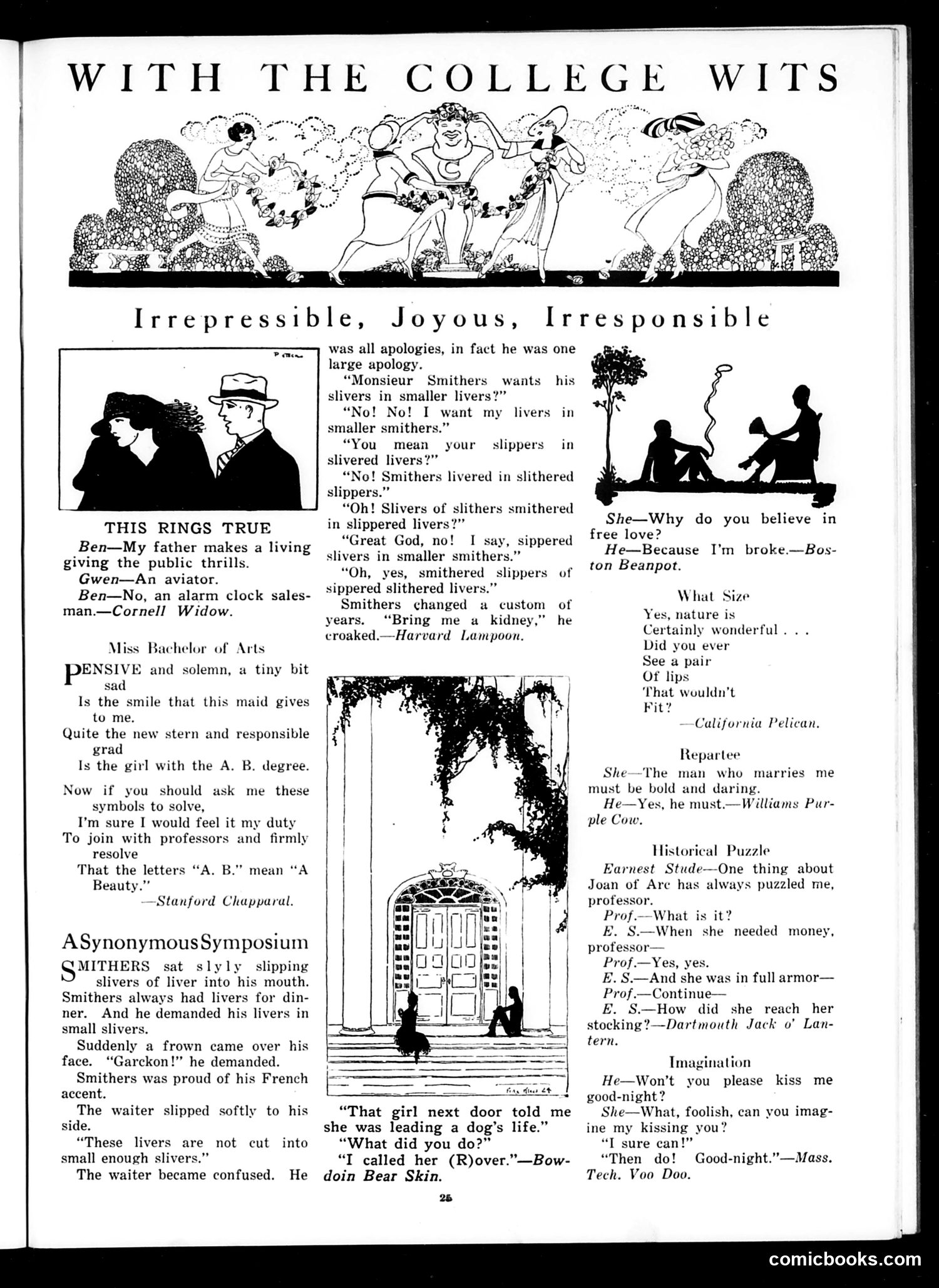
This page collects brief jokes and witticisms sourced from various college publications (Cornell Widow, Stanford Chaparral, Harvard Lampoon, etc.). The content targets college life and romantic relationships circa the 1920s-30s. Key pieces: "Miss Bachelor of Arts" mocks the new phenomenon of educated women graduates, suggesting their serious demeanor means the degree really stands for "A Beauty" rather than intellectual achievement. "A Synonymous Symposium" is absurdist wordplay about a fastidious diner obsessing over liver preparation, descending into tongue-twister nonsense. The romantic vignettes satirize dating conventions: economic anxiety ("broke" men supporting "free love"), courtship rituals, and gender dynamics. The "Joan of Arc stocking" joke relies on the irony of a woman in full armor unable to access her stockings—poking fun at historical anachronism in a schoolboy way. Overall, this represents collegiate humor of the era: clever but lightweight satire aimed at student audiences, emphasizing wordplay, romantic mishaps, and gentle mockery of academic pretension.
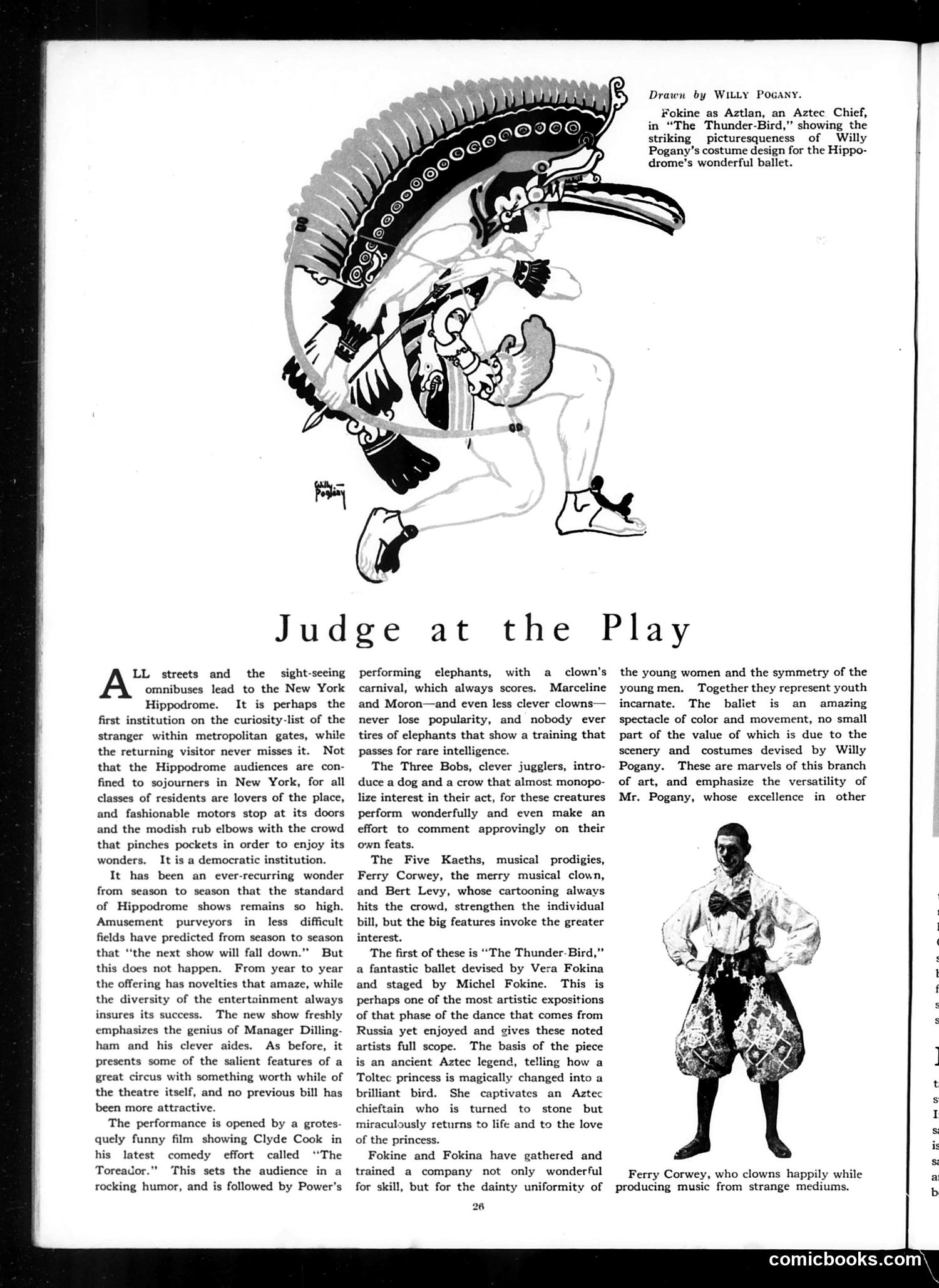
This is a theater review—not political satire—covering the New York Hippodrome's current show. The page celebrates the venue as a democratic institution drawing all social classes. The main illustration by Willy Pogany depicts a costume design for "The Thunder-Bird," a Russian ballet based on an Aztec legend about a princess transformed into a bird and an Aztec chieftain. The photograph shows Ferry Corwey, a musical clown performing at the theater. The review praises the Hippodrome's consistently high entertainment standards, highlighting various acts: comic films, performing elephants, jugglers, animal performers, and the featured ballet choreographed by Michel Fokine and starring Vera Fokina. The text emphasizes the production's artistic merit, particularly Pogany's scenic and costume design work, positioning the Hippodrome as serious entertainment despite its variety-show format.
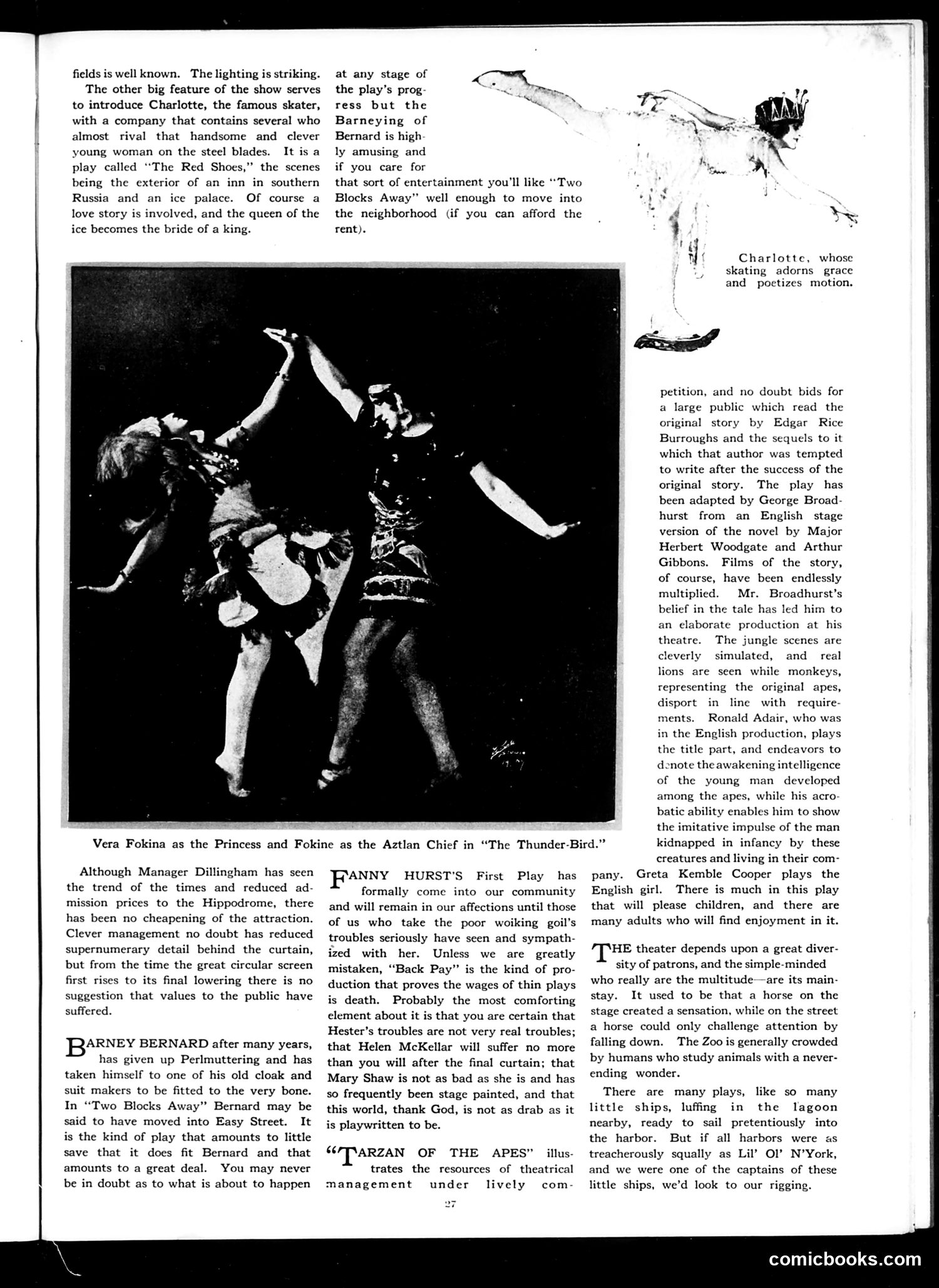
This page contains theater reviews from an early 20th-century issue of Judge. The content discusses several Broadway productions: **"The Red Shoes"** features famous ice skater Charlotte (likely Charlotte, a prominent performer of the era) in a romantic play set in Russia with an ice palace setting. **"Two Blocks Away"** stars Barney Bernard, a vaudeville-style comic known for "Perlmuttering" (Yiddish-inflected comedic patter). The review notes Bernard has aged into more genteel roles but his comedic "Barneying" remains the show's appeal. **"Back Pay"** by Fanny Hurst examines working-class struggles, though the reviewer suggests audiences needn't take the melodrama too seriously. **"Tarzan of the Apes"** adapts Edgar Rice Burroughs's popular novel with elaborate jungle sets, real lions, and acrobatic performers as apes—showcasing theatrical spectacle as competition against growing film adaptations. The reviews reflect early-1900s theatrical economics: star power, physical spectacle, and comedic talent drove attendance.
This article by Myron M. Stearns celebrates Douglas Fairbanks's film performance in *The Three Musketeers*. The author describes waiting to see the movie in Chicago and praises Fairbanks for breaking from his expected type—the acrobatic stuntman known for dangerous physical feats (leaping from church steeples onto galloping horses). The satire critiques Hollywood's formula-driven nature: stars like Mary Pickford succeed by remaining identical to audience expectations, while William S. Hart faces declining popularity for the same predictability. Fairbanks is lauded for successfully attempting a different role—a period costume drama with sword-fighting—proving he can reinvent himself without losing audience appeal. The article also notes American film's recent creative slump after productions like *Humoresque* and *Over the Hill*, presenting Fairbanks's versatility as a welcome departure from uninspired summer entertainment.
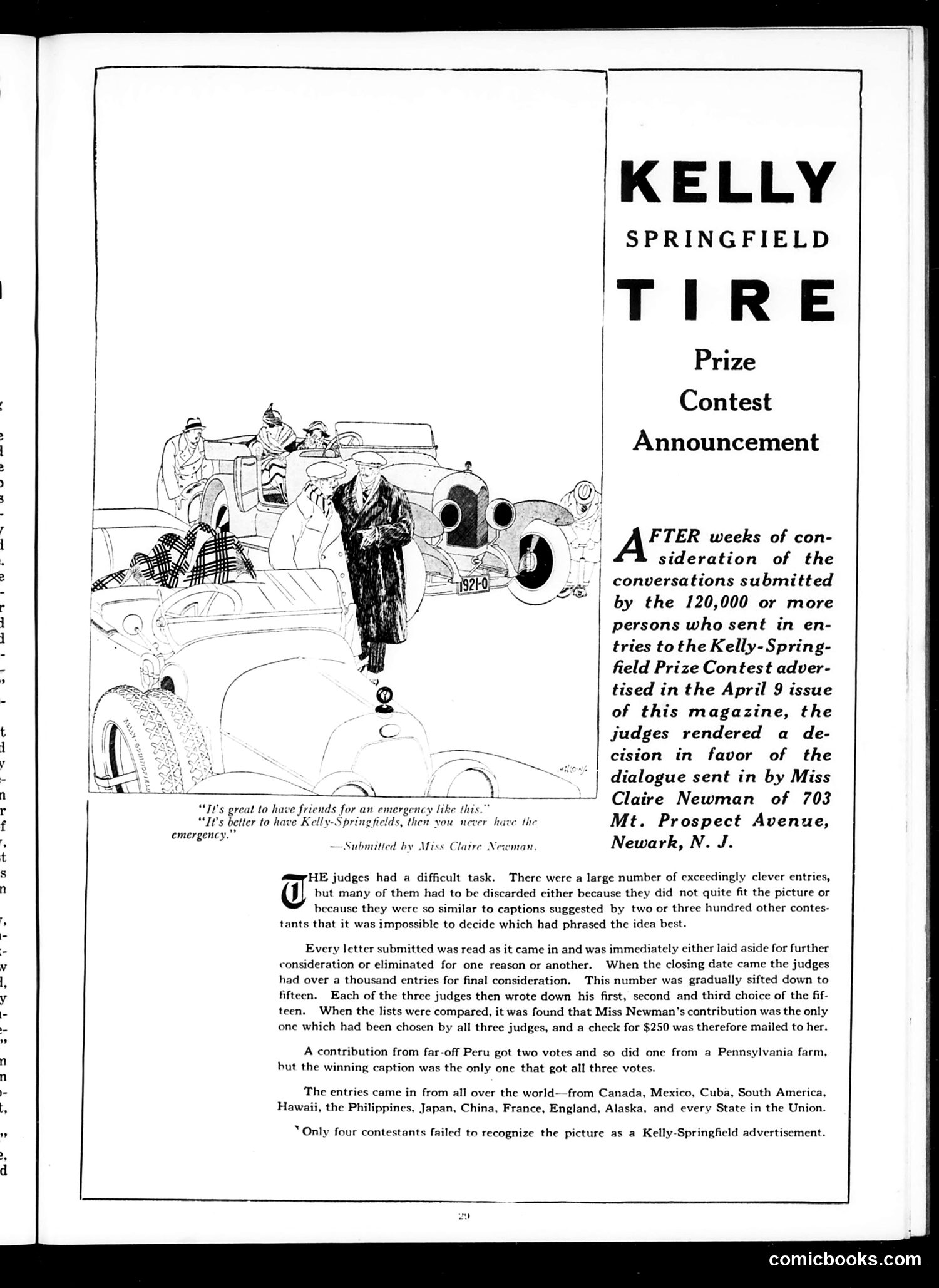
This page announces the winner of a caption-writing contest sponsored by Kelly-Springfield Tires in *Judge* magazine. The cartoon depicts a comedic car scene where multiple vehicles have broken down or collided, with figures examining the wreckage. The winning caption, submitted by Claire Newman of Newark, New Jersey, reads: "It's better to have Kelly-Springfields, then you never have the emergency"—a play on the saying "It's better to have friends for an emergency." The contest received 120,000+ entries from worldwide contestants. The judges selected Newman's entry because it was the only caption chosen by all three judges; she won $250. The page emphasizes the global reach of the contest and notes that only four contestants failed to recognize the image as a tire advertisement, underscoring the ad's effectiveness as a marketing vehicle disguised as entertainment.
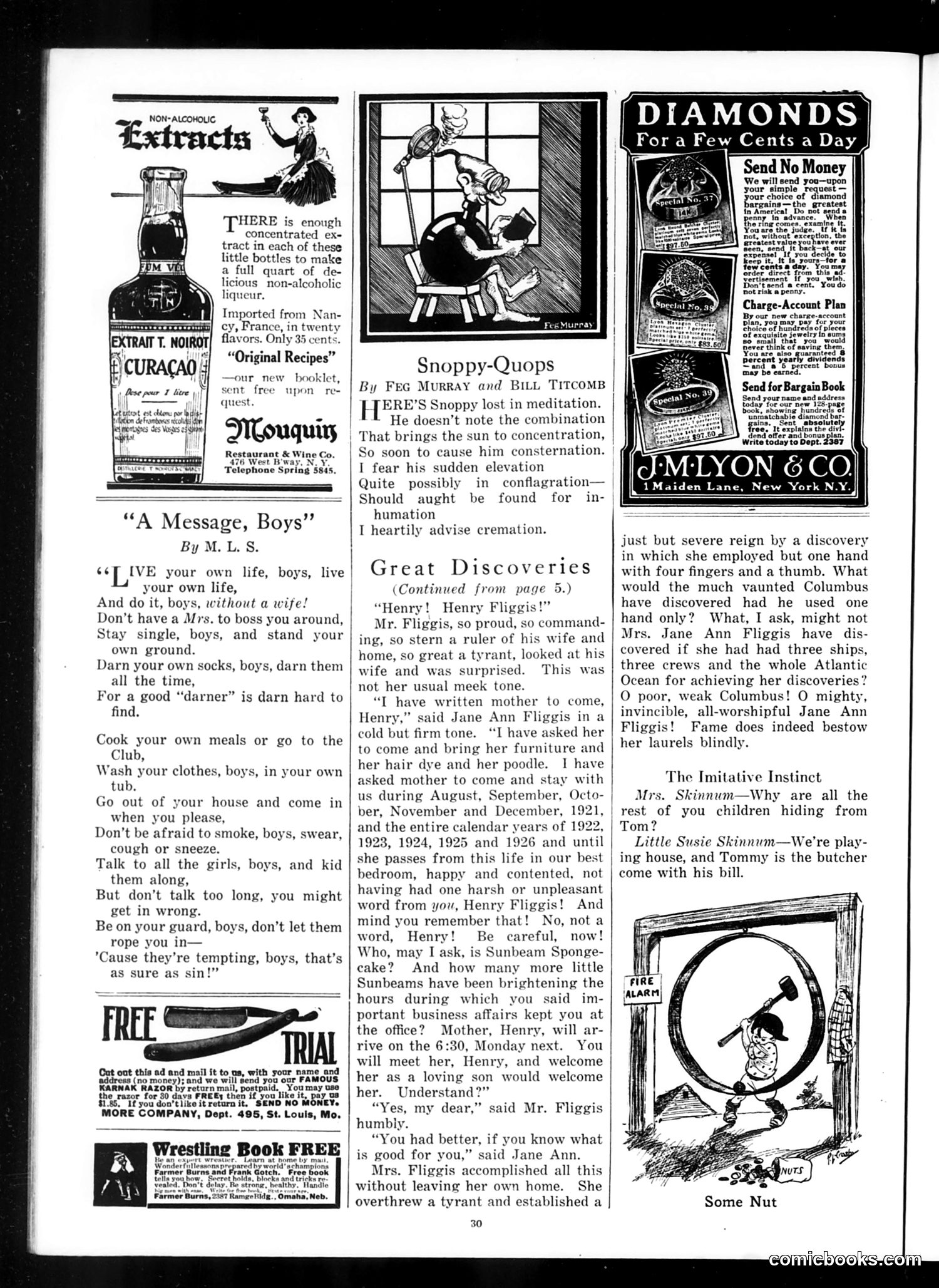
This page contains primarily **advertisements and satirical fiction** rather than political cartoons. The main satirical piece is "Great Discoveries," a domestic comedy about **marital power dynamics**. It depicts Mr. Fliggis, a tyrannical husband who controls his meek wife Jane Ann. The satire subverts expectations by showing Jane Ann discovering her power: she simply announces she's invited her mother to stay for years and demands he treat her respectfully. The piece mocks both the husband's patriarchal tyranny and humorously elevates Jane Ann's domestic rebellion to the level of Columbus's geographical discoveries—satirizing how women were confined to manipulating household circumstances rather than having genuine agency. The other content includes: a poem "A Message, Boys" (cynically advising bachelor independence), a comic strip "Snoppy-Quops," product advertisements (liqueur extract, razors, diamonds), and a cartoon titled "Some Nut" (meaning unclear without full context). The satire reflects early 1920s gender tensions and consumer culture.
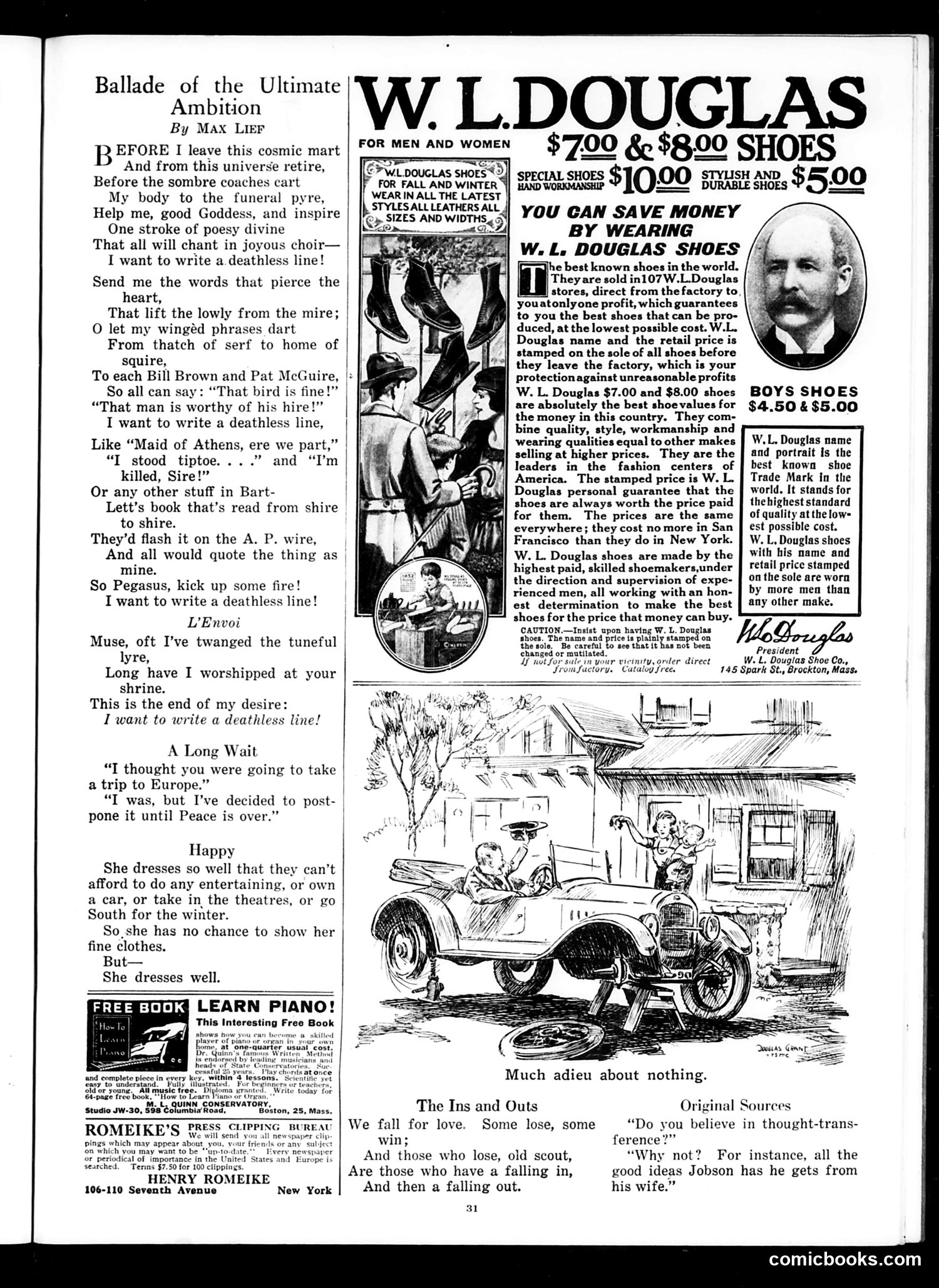
This page is predominantly **advertising**, not political satire. The dominant content is a W.L. Douglas shoe advertisement featuring the company president's portrait and extensive marketing copy about shoe quality and pricing. The left side contains poetry and humorous short pieces: - **"Ballade of the Ultimate Ambition"** by Max Lieff satirizes writers' pretensions—the speaker desperately wants to write "a deathless line," referencing famous literary quotations, imagining it circulated on the Associated Press wire. The satire mocks literary ambition itself. - **"A Long Wait"** makes a topical joke about postponing a European trip until "Peace is over"—likely referencing World War I (the U.S. entered in 1917). - **"Happy"** is a brief ironic piece about a woman who dresses expensively but cannot afford to actually go anywhere to display her fine clothes. The cartoon at bottom-right shows a casual domestic scene titled "Much adieu about nothing." Overall, this is a typical Judge issue blending light satirical commentary with substantial advertising revenue.
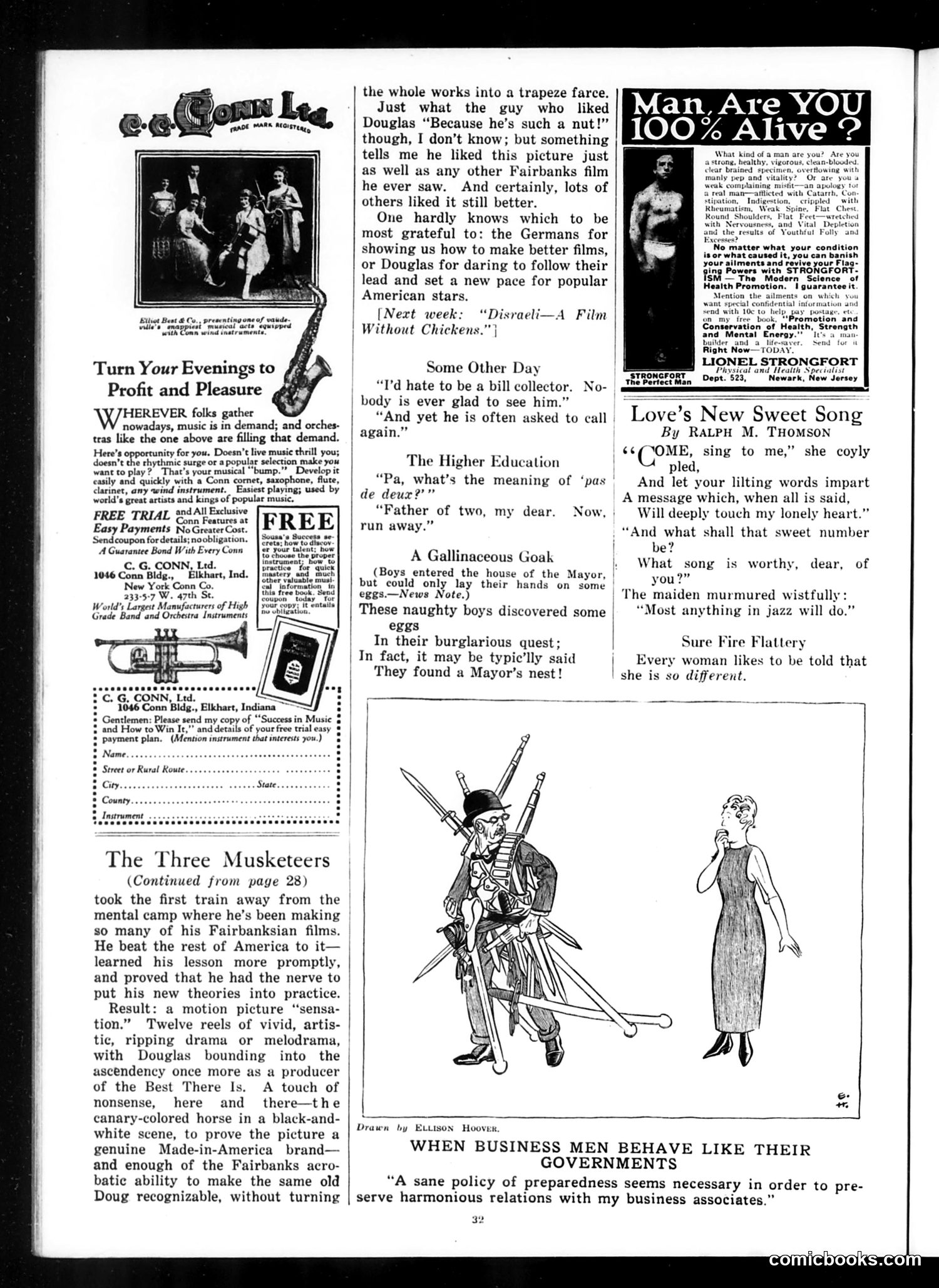
This page is primarily **advertising and light humor** rather than political satire. The main content includes: **Advertisements:** Conn musical instruments dominate the left side, promoting band instruments and offering free trial lessons. **Light Comic Pieces:** The page contains brief humorous items—"Some Other Day" (a joke about bill collectors), "The Higher Education" (a pun about "pas de deux"), and "A Gallinaceous Goak" (wordplay about boys finding eggs at a mayor's house, calling it a "Mayor's nest"). **Poetry/Song:** Ralph M. Thomson's "Love's New Sweet Song" is a sentimental romantic verse. **Cartoon:** Ellison Hoover's drawing shows a military figure with a woman, captioned "When Business Men Behave Like Their Governments." This appears to reference preparedness/military concerns (likely WWI-era). The page reflects early 20th-century magazine conventions: mixed entertainment, advertising, and gentle satire without deep political commentary. Most humor relies on puns and wordplay rather than social critique.
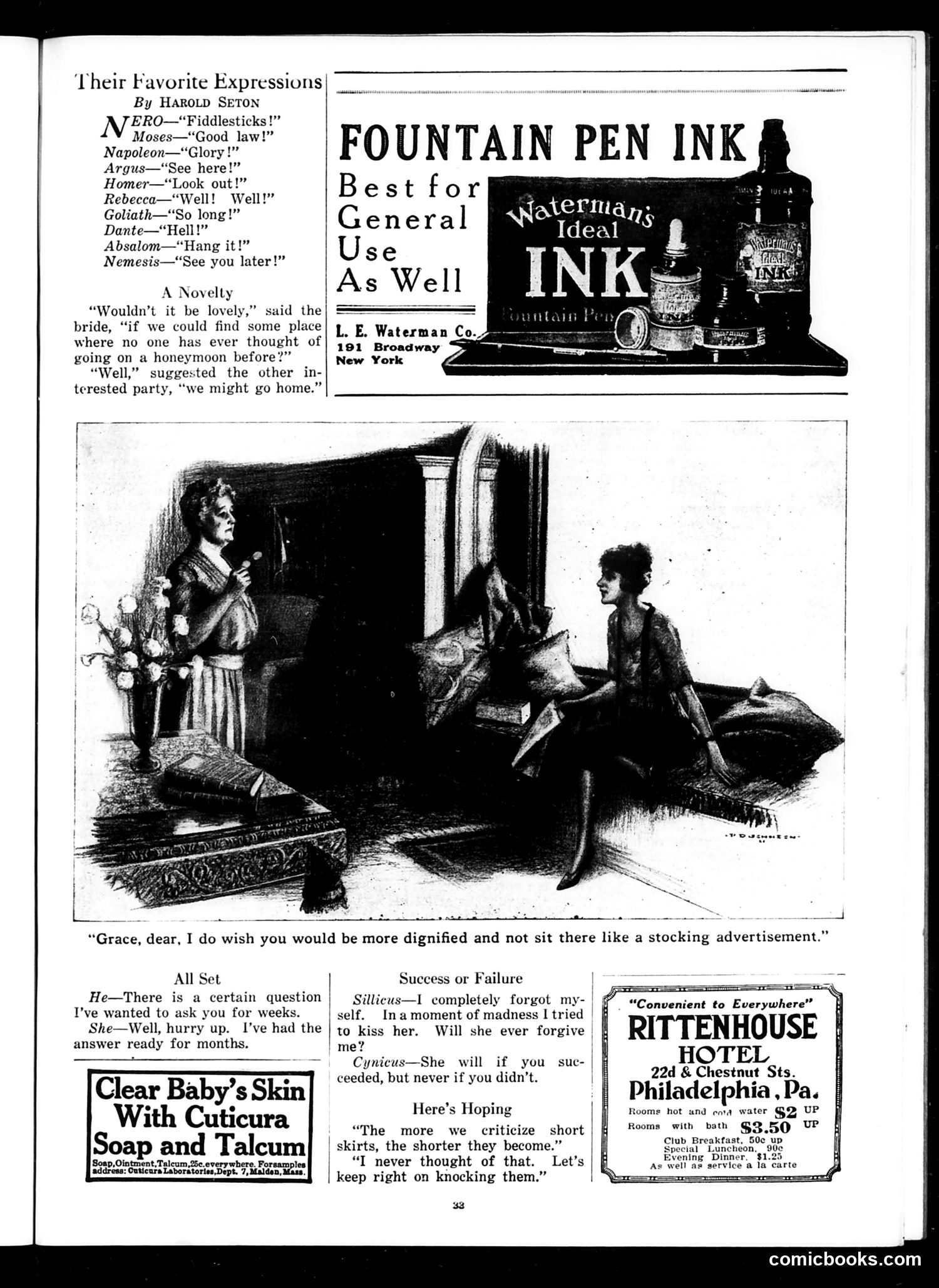
This page from Judge magazine combines humor pieces typical of early 20th-century satirical publishing. The main cartoon depicts a domestic scene where a wife criticizes her husband's companion (likely a female friend) for sitting in an undignified pose, comparing her to "a stocking advertisement"—a cutting insult implying she resembles a shop display or mannequin rather than a proper lady. The surrounding content includes brief comedy sketches on courtship and marriage, plus advertising. A recurring joke concerns short skirts: characters discuss how criticizing women's hemlines actually encourages them to wear shorter styles, creating an ironic cycle. The "Favorite Expressions" header catalogues famous figures' catchphrases, a common Judge feature offering wordplay and cultural references. The page reflects period anxieties about female propriety, fashion, and changing social norms regarding women's appearance and public behavior—themes Judge regularly mocked through both advertisement satire and social commentary.
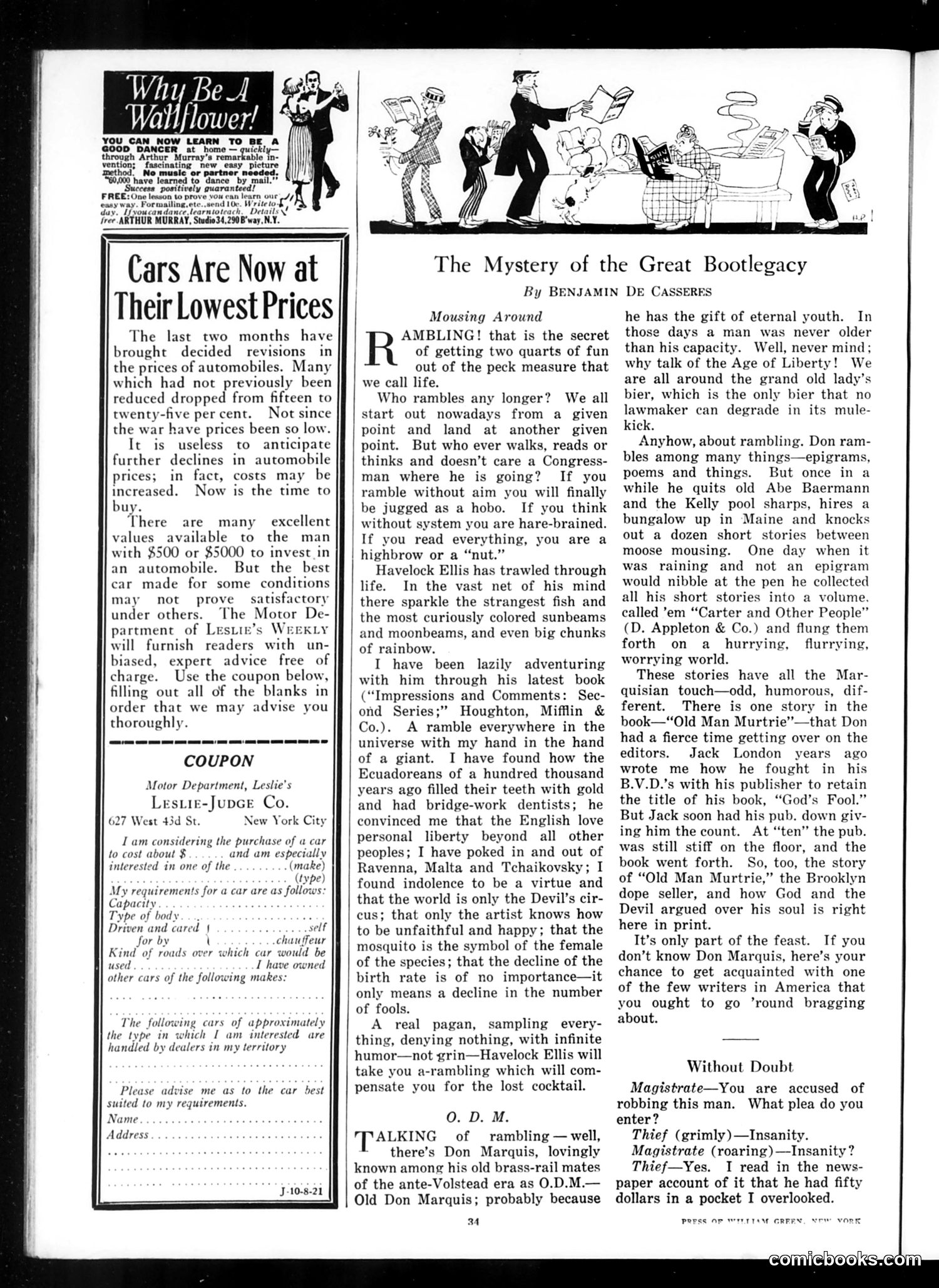
This page combines advertisements with literary commentary, typical of Judge's format. The top cartoon—untitled in visible text—depicts slapstick office chaos: men in suits frantically shuffling papers, throwing documents, and generally creating mayhem at desks. It satirizes workplace disorder and bureaucratic confusion, likely referencing post-WWI administrative dysfunction or business incompetence during the 1920s. The advertisements push Arthur Murray's correspondence dance lessons and discounted automobiles—both appealing to aspirational middle-class consumers seeking self-improvement and mobility. Benjamin De Casseres's essay "The Mystery of the Great Bootlegacy" discusses rambling and Havelock Ellis's philosophy of living without rigid systems. The title's reference to "bootlegacy" likely alludes to Prohibition-era illegality, though the essay itself focuses on philosophical wandering rather than bootlegging explicitly. The concluding "Without Doubt" humor section features brief wordplay jokes about accusations and insanity. The overall page reflects 1920s American consumer culture and intellectual discourse.
This is a full-page advertisement for *Film Fun*, a motion picture magazine, not a political cartoon. The ad promotes the October issue to potential readers. The text contrasts *Film Fun* favorably against other movie magazines of the era. It claims *Film Fun* offers complete, self-contained short stories (averaging 75 illustrated pages) rather than serialized narratives that drag across multiple issues. The dramatic "Murder!" heading satirizes other magazines' tendency to leave readers in suspenseful cliffhangers, forcing continued subscriptions. The appeal emphasizes entertainment value: the magazine is "artistic and amusing," curative for the mind, and designed for quick, satisfying consumption rather than protracted reading. The ad encourages newsstand purchases, positioning *Film Fun* as distinctly superior to "all the other motion picture monthlies" available in the 1920s-30s. This is essentially a competitive marketing pitch aimed at casual magazine browsers.
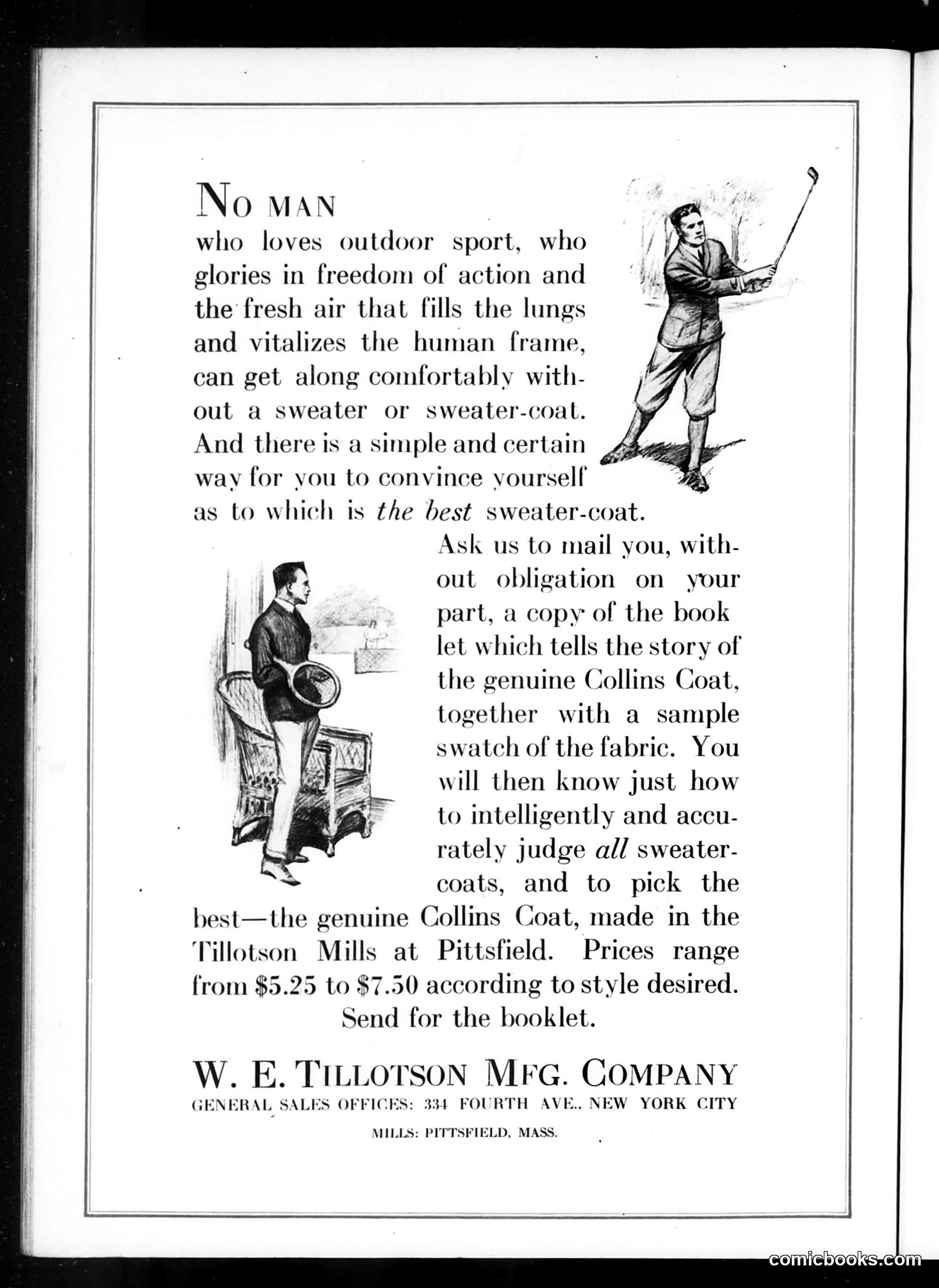
This page is **not a cartoon or satire**—it's a straightforward advertisement for Collins Coat sweaters, manufactured by W.E. Tillotson Mfg. Company. The illustrations show men engaged in outdoor activities (golf and hunting) to appeal to the "outdoor sport" enthusiast demographic. The ad uses typical early 20th-century marketing rhetoric: it positions the Collins Coat as essential for active men who value "freedom of action and fresh air." It offers free educational materials (a booklet and fabric sample) to help consumers evaluate quality—a common sales tactic of the era. The prices ($5.25–$7.50) and manufacturing location (Pittsfield, Massachusetts mills) suggest this was regional or national advertising in an upscale magazine like *Judge*. There is no political commentary or satire present; this is simply a period advertisement highlighting product features and availability.