
Judge, 1921-10-08 · page 23 of 36
Judge — October 8, 1921 — page 23: what you’re looking at
What you’re looking at
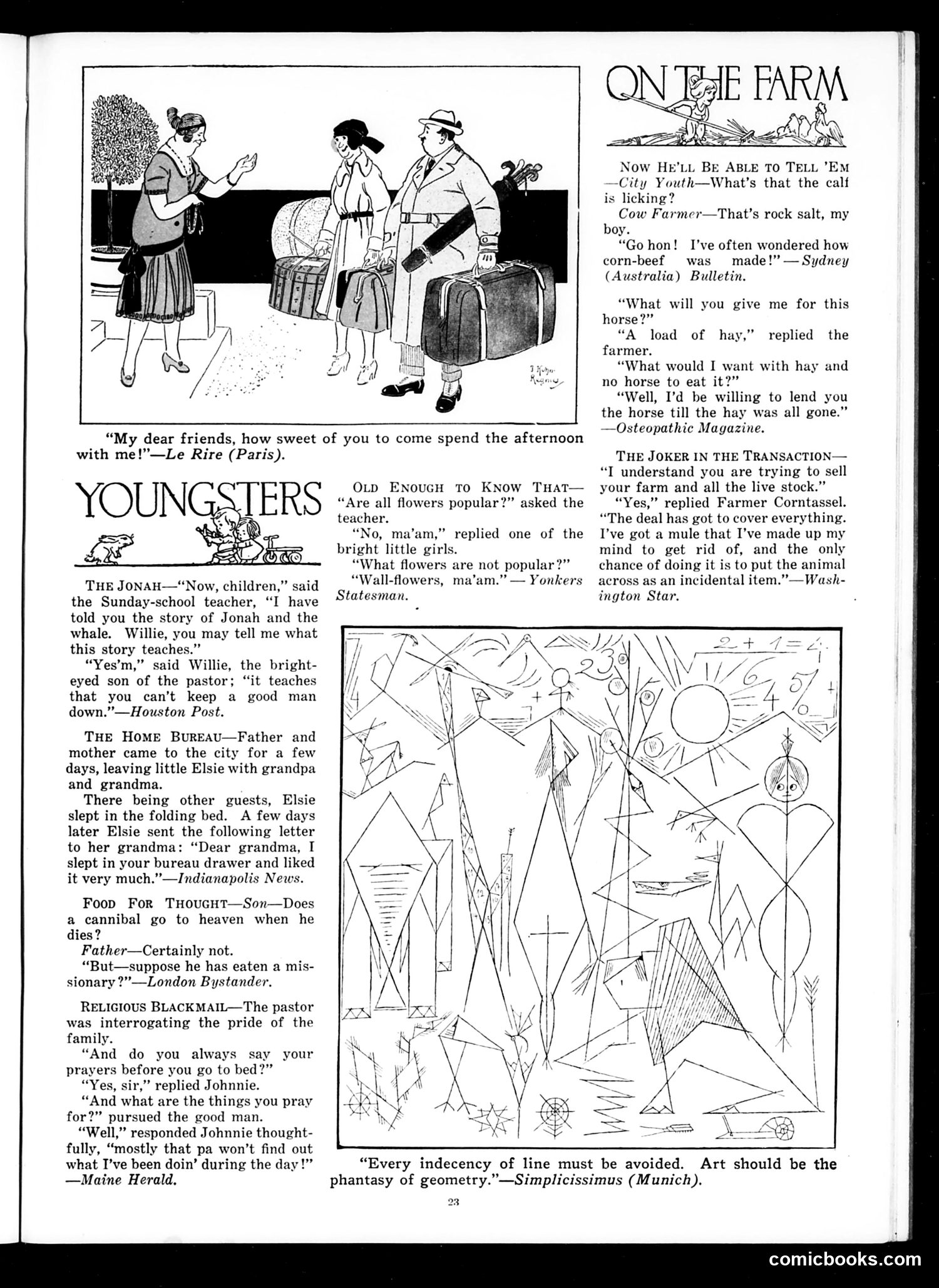
This page from **Judge** (a satirical American magazine) collects brief humorous anecdotes and jokes under the heading "Youngsters" and "On the Farm." The top cartoon shows three urban visitors arriving at a farm, captioned with a Parisian reference—likely satirizing affectation or urban pretension visiting rural settings. The text pieces are short jokes exploiting wordplay and naive logic: - A Sunday school boy misinterprets the Jonah story as teaching "you can't keep a good man down" - A child confuses a bureau drawer with bedding - Religious humor mocking a child's prayers about hiding misbehavior - Farm humor: a city youth doesn't understand rock salt; a farmer tries to unload a mule by bundling it with hay sale The geometric illustration at bottom appears decorative/artistic, with a caption about geometric purity in art. These pieces reflect early-20th-century American humor: gentle, family-friendly satire of rural/urban contrasts, childhood innocence, and religious hypocrisy—typical Judge fare targeting middle-class readers.
📄 Transcribed text from this page (OCR, searchable)
Machine-transcribed from the original scan — historical spelling and the odd misread are preserved.
“My dear friends, how sweet of you to come spend the afternoon with me!”—Le Rire (Paris). YOUN THE JONAH—“Now, children,” said the Sunday-school teacher, “I have told you the story of Jonah and the whale. Willie, you may tell me what this story teaches.” “Yes’m,” said Willie, the bright- eyed son of the pastor; “it teaches that you can’t keep a good man down.”—Houston Post. THE HOME BuREAU—Father and mother came to the city for a few days, leaving little Elsie with grandpa and grandma. There being other guests, Elsie slept in the folding bed. A few days later Elsie sent the following letter to her grandma: “Dear grandma, I slept in your bureau drawer and liked it very much.”—Indianapolis News. Foop For THOUGHT—Son—Does a cannibal go to heaven when he dies? Father—Certainly not. “But—suppose he has eaten a mis- sionary ?”—London Bystander. RELIGIOUS BLACKMAIL—The pastor was interrogating the pride of the family. “And do you always say your prayers before you go to bed?” “Yes, sir,” replied Johnnie. “And what are the things you pray for?” pursued the good man. “Well,” responded Johnnie thought- fully, “mostly that pa won’t find out what I’ve been doin’ during the day!” —Maine Herald. OLD ENOUGH TO KNow THAT— “Are all flowers popular?” asked the teacher. ‘No, ma’am,” replied one of the bright little girls. “What flowers are not popular?” “Wall-flowers, ma’am.” — Yonkers Statesman. Now He'LL BE ABLE TO TELL ’'EM y Youth—What’s that the calf icking? Cow Farmer—That’s rock salt, my boy. “Go hon! I’ve often wondered how corn-beef was made!” — Sydney (Australia) Bulletin. “What will you give me for this horse?” “A load farmer. “What would I want with hay and no horse to eat it?” “Well, I’d be willing to lend you the horse till the hay was all gone.” —Osteopathic Magazine. of hay,” replied the THE JOKER IN THE TRANSACTION— “I understand you are trying to sell your farm and all the live stock.” “Yes,” replied Farmer Corntassel. “The deal has got to cover everything. I’ve got a mule that I’ve made up my mind to get rid of, and the only chance of doing it is to put the animal across as an incidental item.”—Wash- ington Star. “Every indecency of line must be avoided. Art should be the phantasy of geometry.”—Simplicissimus (Munich). 23 comicbooks.com