
Judge, 1921-10-08 · page 17 of 36
Judge — October 8, 1921 — page 17: what you’re looking at
What you’re looking at
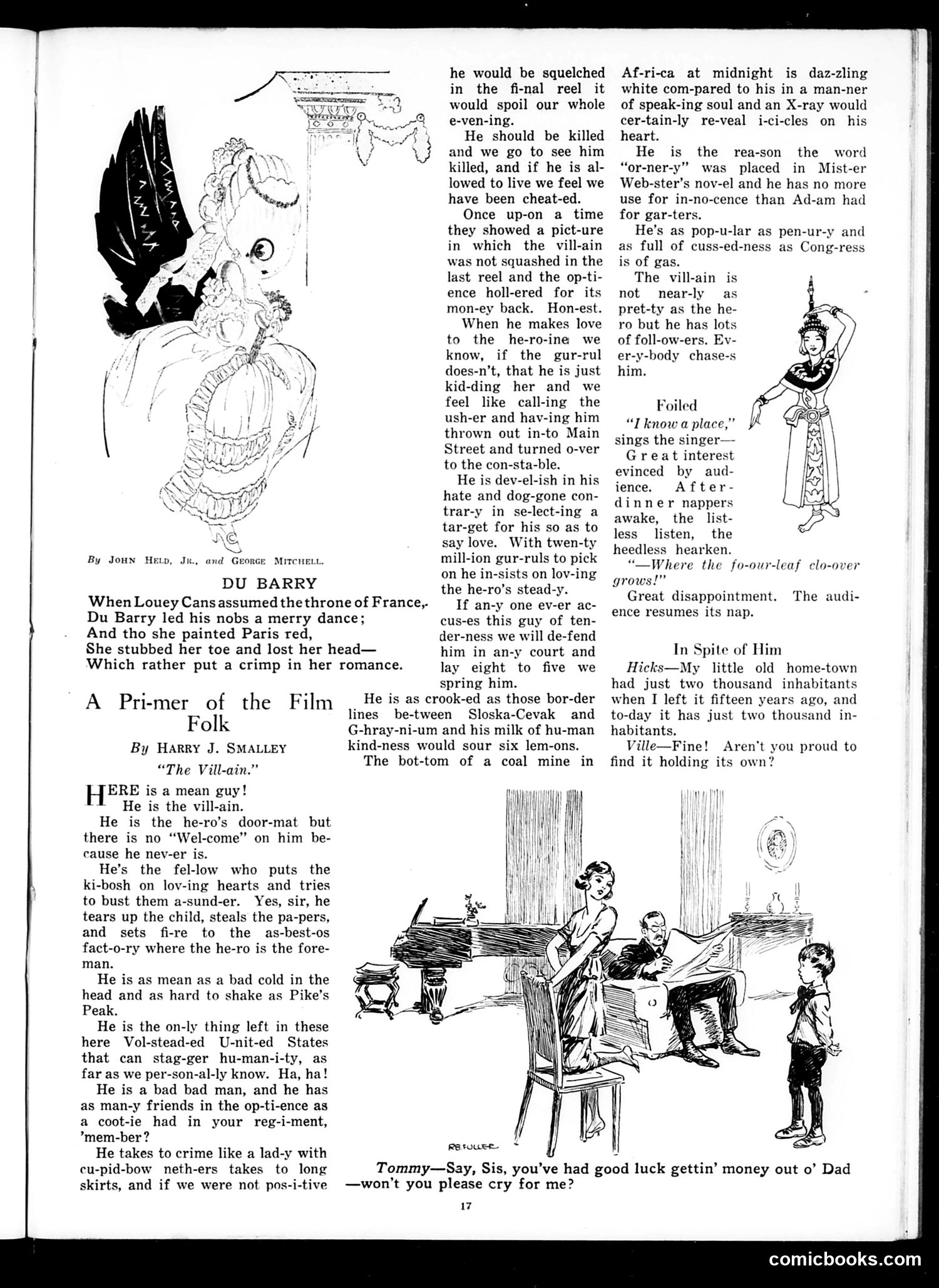
This Judge magazine page contains two distinct pieces of satire: **"Du Barry"** (top): A brief, punning poem mocking the historical French courtesan Madame du Barry, who famously lost her head during the French Revolution. The joke relies on wordplay ("stubbed her toe and lost her head") to mock both her scandalous reputation and her execution. **"A Primer of the Film Folk: The Villain"** (main article): A humorous essay written in deliberately fractured, hyphenated language that parodies how film villains were portrayed in silent movies. The villain is described as universally despicable—cruel, crooked, and deserving of death. The satire mocks both the stock character type and audiences' predictable emotional responses to him. A small illustration shows a child asking his sister to cry so he can extract money from their father—itself satirizing sentimental film manipulation. **Context**: This reflects 1920s cinema conventions where villains were one-dimensional and audiences expected violent justice in the final reel. The fractured language mimics how silent films used exaggerated title cards.
📄 Transcribed text from this page (OCR, searchable)
Machine-transcribed from the original scan — historical spelling and the odd misread are preserved.
By Joun Hetp, Ju, and Georce Mitcnet. DU BARRY When Louey Cansassumed the throne of France,. Du Barry led his nobs a merry dance; And tho she painted Paris red, She stubbed her toe and lost her head— Which rather put a crimp in her romance. A Pri-mer of the Film Folk By Harry J. SMALLEY “The Vill-ain.” HERE is a mean guy! He is the vill-ain. He is the he-ro’s door-mat but there is no “Wel-come” on him be- cause he nev-er is. He’s the fel-low who puts the ki-bosh on lov-ing hearts and tries to bust them a-sund-er. Yes, sir, he tears up the child, steals the pa-pers, and sets fi-re to the as-best-os fact-o-ry where the he-ro is the fore- man. He is as mean as a bad cold in the head and as hard to shake as Pike’s Peak. He is the on-ly thing left in these here Vol-stead-ed U-nit-ed States that can stag-ger hu-man-i-ty, as far as we per-son-al-ly know. Ha, ha! He is a bad bad man, and he has as man-y friends in the op-ti-ence as a coot-ie had in your reg-i-ment, ’mem-ber? He takes to crime like a lad-y with cu-pid-bow neth-ers takes to long skirts, and if we were not pos-i-tive he would be squelched in the fi-nal reel it would spoil our whole e-ven-ing. He should be killed and we go to see him killed, and if he is al- lowed to live we feel we have been cheat-ed. Once up-on a time they showed a pict-ure in which the vill-ain was not squashed in the last reel and the op-ti- ence holl-ered for its mon-ey back. Hon-est. When he makes love to the he-ro-ine we know, if the gur-rul does-n’t, that he is just kid-ding her and we feel like call-ing the ush-er and hav-ing him thrown out in-to Main Street and turned o-ver to the con-sta-ble. He is dev-el-ish in his hate and dog-gone con- trar-y in se-lect-ing a tar-get for his so as to say love. With twen-ty mill-ion gur-ruls to pick on he in-sists on lov-ing the he-ro’s stead-y. If an-y one ev-er ac- cus-es this guy of ten- der-ness we will de-fend him in an-y court and lay eight to five we spring him. He is as crook-ed as those bor-der lines be-tween Sloska-Cevak and G-hray-ni-um and his milk of hu-man kind-ness would sour six lem-ons. The bot-tom of a coal mine in Af-ri-ca at midnight is daz-zling white com-pared to his in a man-ner of speak-ing soul and an X-ray would cer-tain-ly re-veal i-ci-cles on his heart. He is the rea-son the word “or-ner-y” was placed in Mist-er Web-ster’s nov-el and he has no more use for in-no-cence than Ad-am had for gar-ters. He’s as pop-u-lar as pen-ur-y and as full of cuss-ed-ness as Cong-ress is of gas. The vill-ain is not near-ly as pret-ty as the he- ro but he has lots of foll-ow-ers. Ev- er-y-body chase-s him. Foiled “T know a place,” sings the singer— Great interest evinced by aud- ience. After- dinner nappers awake, the list- less listen, the heedless hearken. “—_Where the fo-our-leaf clo-over grows!” Great disappointment. ence resumes its nap. The audi- In Spite of Him Hicks—My little old home-town had just two thousand inhabitants when I left it fifteen years ago, and to-day it has just two thousand in- habitants. Ville—Fine! Aren't you proud to find it holding its own? Tommy—Say, Sis, you’ve had good luck gettin’ money out o’ Dad —won't you please cry for me? 17 comicbooks.com