
Judge, 1921-10-08 · page 27 of 36
Judge — October 8, 1921 — page 27: what you’re looking at
What you’re looking at
This page contains theater reviews from an early 20th-century issue of Judge. The content discusses several Broadway productions: **"The Red Shoes"** features famous ice skater Charlotte (likely Charlotte, a prominent performer of the era) in a romantic play set in Russia with an ice palace setting. **"Two Blocks Away"** stars Barney Bernard, a vaudeville-style comic known for "Perlmuttering" (Yiddish-inflected comedic patter). The review notes Bernard has aged into more genteel roles but his comedic "Barneying" remains the show's appeal. **"Back Pay"** by Fanny Hurst examines working-class struggles, though the reviewer suggests audiences needn't take the melodrama too seriously. **"Tarzan of the Apes"** adapts Edgar Rice Burroughs's popular novel with elaborate jungle sets, real lions, and acrobatic performers as apes—showcasing theatrical spectacle as competition against growing film adaptations. The reviews reflect early-1900s theatrical economics: star power, physical spectacle, and comedic talent drove attendance.
📄 Transcribed text from this page (OCR, searchable)
Machine-transcribed from the original scan — historical spelling and the odd misread are preserved.
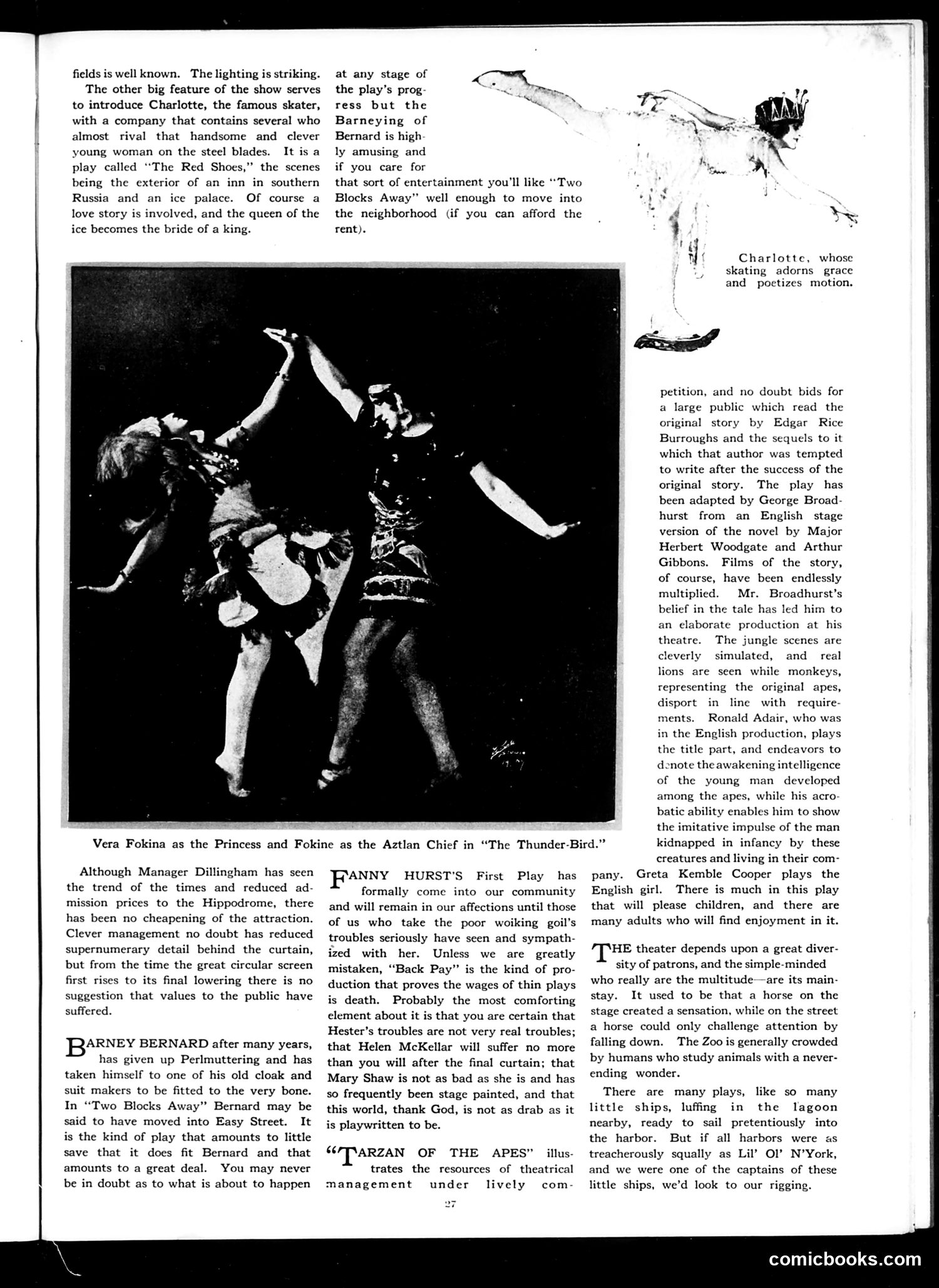
fields is well known. The lighting is striking. The other big feature of the show serves to introduce Charlotte, the famous skater, with a company that contains several who rival that handsome and clever It is a almost young woman on the steel blades. play called ‘‘The Red Shoes,” the scenes being the exterior of an inn in southern Russia and an ice palace. Of course a love story is involved, and the queen of the ice becomes the bride of a king. Vera Fokina as the Princess and Fokine as the Aztlan Chief in “The Thunder-Bird.” Although Manager Dillingham has seen the trend of the times and reduced ad- mission prices to the Hippodrome, there has been no cheapening of the attraction. Clever management no doubt has reduced supernumerary detail behind the curtain, but from the time the great circular screen first rises to its final lowering there is no suggestion that values to the public have suffered. Bé48NEY BERNARD after many years, has given up Perlmuttering and has taken himself to one of his old cloak and suit makers to be fitted to the very bone. In “Two Blocks Away” Bernard may be said to have moved into Easy Street. It is the kind of play that amounts to little save that it does fit Bernard and that amounts to a great deal. You may never be in doubt as to what is about to happen at any stage of the play’s prog- ress but the Barneying of Bernard is high ly amusing and if you care for that sort of entertainment you'll like “Two Blocks Away"’ well enough to move into the neighborhood (if you can afford the rent). FRAnny HURST'S First Play has formally come into our community and will remain in our affections until those of us who take the poor woiking goil’s troubles seriously have seen and sympath- ized with her. Unless we are greatly mistaken, “Back Pay” is the kind of pro- duction that proves the wages of thin plays is death. Probably the most comforting element about it is that you are certain that Hester’s troubles are not very real troubles; that Helen McKellar will suffer no more than you will after the final curtain; that Mary Shaw is not as bad as she is and has so frequently been stage painted, and that this world, thank God, is not as drab as it is playwritten to be. 6/TARZAN OF THE APES" illus- trates the resources of theatrical management under lively com- Charlotte, whose skating adorns grace and poetizes motion. petition, and no doubt bids for a large public which read the original story by Edgar Rice Burroughs and the sequels to it which that author was tempted to write after the success of the original story. The play has been adapted by George Broad- hurst from an English stage version of the novel by Major Herbert Woodgate and Arthur Gibbons. Films of the story, of course, have been endlessly multiplied. Mr. Broadhurst’s belief in the tale has led him to an elaborate production at his theatre. The jungle scenes are cleverly simulated, and lions are seen while monkeys, representing the original apes, disport in line with require- ments. Ronald Adair, who was in the English production, plays real the title part, and endeavors to denote theawakening intelligence of the young man developed among the apes, while his acro. batic ability enables him to show the imitative impulse of the man kidnapped in infancy by these creatures and living in their com- pany. Greta Kemble Cooper plays the English girl. There is much in this play that will please children, and there are many adults who will find enjoyment in it. ‘HE theater depends upon a great diver- sity of patrons, and the simple-minded who really are the multitude—are its main- stay. It used to be that a horse on the stage created a sensation, while on the street a horse could only challenge attention by falling down. The Zoo is generally crowded by humans who study animals with a never- ending wonder. There are many plays, like so many little ships, luffing in the lagoon nearby, ready to sail pretentiously into the harbor. But if all harbors were as treacherously squally as Lil’ Ol’ N’York, and we were one of the captains of these little ships, we'd look to our rigging. comicbooks.com