
Judge, 1921-10-08 · page 7 of 36
Judge — October 8, 1921 — page 7: what you’re looking at
What you’re looking at
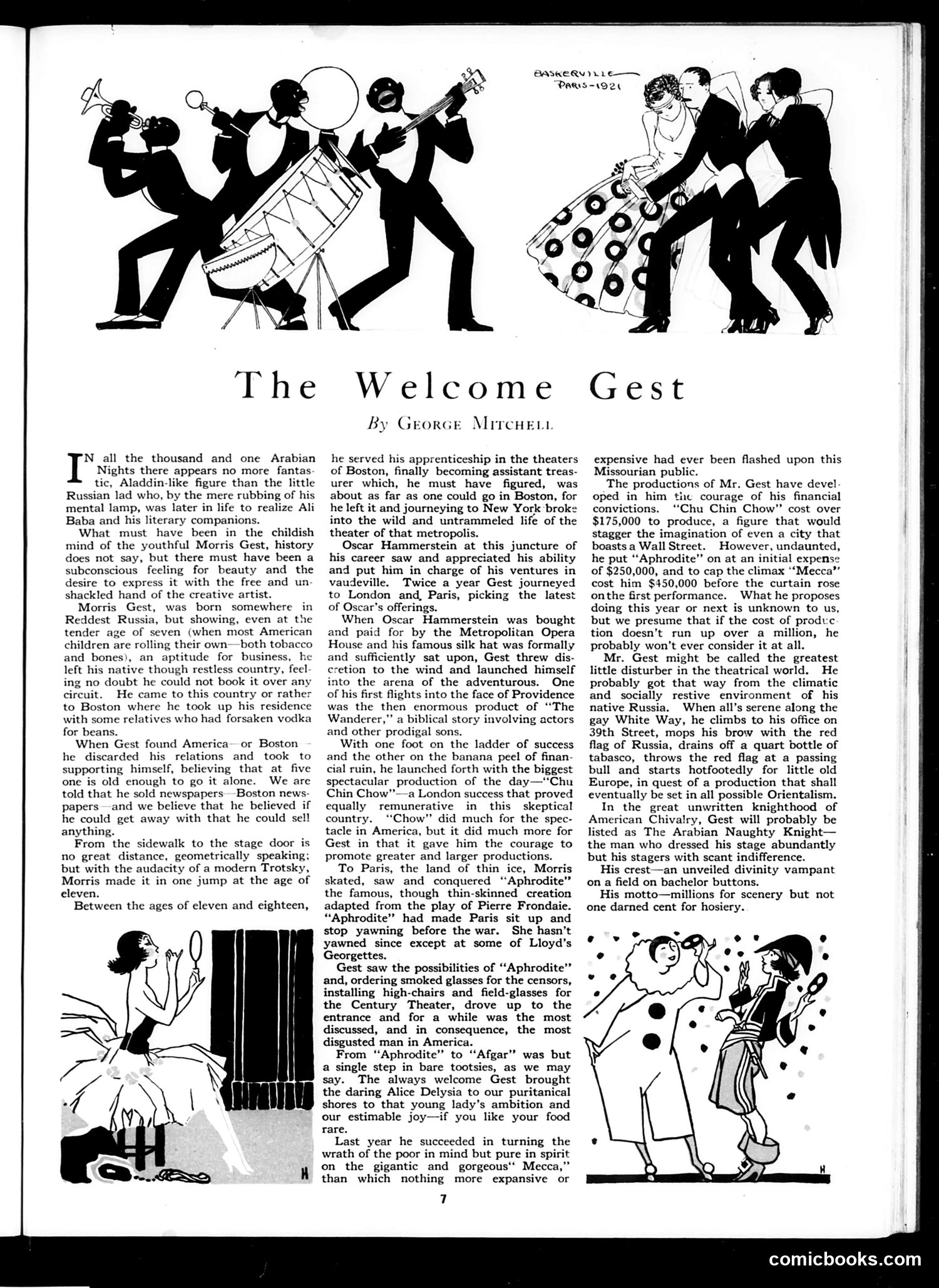
This is a biographical profile of **Morris Gest**, a Russian-born theatrical impresario who became a major Broadway producer in the 1920s. The article traces his rise from selling newspapers in Boston to becoming a celebrated theater entrepreneur. The satire centers on Gest's controversial productions featuring elaborate spectacle and sexual content. His staging of "Aphrodite" (adapted from a French play) caused scandal—the text notes he ordered "smoked glasses for the censors" and that it made him "the most disgusted man in America," suggesting prudish public outrage. He also produced "Chu Chin Chow," a major spectacle, and brought French actress Alice Delysia to American stages. The illustrations show musicians and dancers, reflecting Gest's reputation for grand, entertainment-focused productions. Judge's tone is gently mocking—comparing Gest's rise to Aladdin's, emphasizing his audacious ambition and willingness to challenge American moral conventions through imported European theatrical sophistication.
📄 Transcribed text from this page (OCR, searchable)
Machine-transcribed from the original scan — historical spelling and the odd misread are preserved.
BASKERY)L LES Pans -19 24 The Welcome Gest By Georce Mircueni 'N all the thousand and one Arabian Nights there appears no more fantas tic, Aladdin-like figure than the little Russian lad who, by the mere rubbing of his mental lamp, was later in life to realize Ali Baba and his literary companions. What must have been in the childish mind of the youthful Morris Gest, history does not say, but there must have been a subconscious feeling for beauty and the desire to express it with the free and un shackled hand of the creative artist. Morris Gest, was born somewhere in Reddest Russia, but showing, even at the tender age of seven (when most American children are rolling their own—both tobacco and bones), an aptitude for business, he left his native though restless country, feel ing no doubt he could not book it over any circuit. He came to this country or rath to Boston where he took up his residence with some relatives who had forsaken vodka for beans. When Gest found America— or Boston he discarded his relations and took to supporting himself, believing that at five one is old enough to go it alone. We are told that he sold newspapers-Boston news- papers and we believe that he believed if he could get away with that he could sel! anything. From the sidewalk to the stage door is no great distance, geometrically speaking; but with the audacity of a modern Trotsky, Morris made it in one jump at the age of eleven. Between the ages of eleven and eighteen, he served his apprenticeship in the theaters of Boston, finally becoming assistant treas- urer which, he must have figured, was about as far as one could go in Boston, for he left it and journeying to New York ‘broke into the wild and untrammeled life of the theater of that metropolis. Oscar Hammerstein at this juncture of his career saw and appreciated his ability and put him in charge of his ventures in vaudeville. Twice a year Gest journeyed to London and, Paris, picking the latest of Oscar’s offerings. When Oscar Hammerstein was bought and paid for by the Metropolitan Opera House and his famous silk hat was formally and sufficiently sat upon, Gest threw dis- cretion to the wind and launched himself into the arena of the adventurous. One of his first flights into the face of Providence was the then enormous product of “The Wanderer,” a biblical story involving actors and other prodigal sons. With one foot on the ladder of success and the other on the banana peel of finan- cial ruin, he launched forth with the biggest spectacular production of the day—‘*Chu Chin Chow’’—a London success that proved equally remunerative in this skeptical country. “Chow” did much for the spec- tacle in America, but it did much more for Gest in that it gave him the courage to promote greater and larger productions. To Paris, the land of thin ice, Morri: skated, saw and conquered ‘Aphrodite’ the famous, though thin-skinned creation adapted from the play of Pierre Frondaie. “Aphrodite” had made Paris sit up and stop yawning before the war. She hasn’t yawned since except at some of Lloyd's Georgettes. Gest saw the possibilities of ‘“‘Aphrodite”’ and, ordering smoked glasses for the censors, installing high-chairs and field-glasses for the Century Theater, drove up to the entrance and for a while was the most discussed, and in consequence, the most disgusted man in America. From “Aphrodite” to “Afgar” was but a single step in bare tootsies, as we may say. The always welcome Gest brought the daring Alice Delysia to our puritanical shores to that young lady’s ambition and our estimable joy—if you like your food rare. Last year he succeeded in turning the wrath of the poor in mind but pure in spirit on the gigantic and gorgeous‘t Mecca,” than which nothing more expansive or 7 expensive had ever been flashed upon this Missourian public. The productions of Mr. Gest have devel oped in him the courage of his financial convictions. ‘Chu Chin Chow” cost over $175,000 to produce, a figure that would stagger the imagination of even a city that boasts a Wall Street. However, undaunted, he put “Aphrodite” on at an initial expense of $250,000, and to cap the climax ‘“‘Mecca’’ cost him $450,000 before the curtain rose onthe first performance. What he proposes doing this year or next is unknown to us, but we presume that if the cost of produc tion doesn’t run up over a million, he probably won't ever consider it at all. Mr. Gest might be called the greatest little disturber in the theatrical world. He probably got that way from the climatic and socially restive environment of his native Russia. When all’s serene along the gay White Way, he climbs to his office on 39th Street, mops his brow with the red flag of Russia, drains off a quart bottle of tabasco, throws the red flag at a passing bull and starts hotfootedly for little old Europe, in quest of a production that shall eventually be set in all possible Orientalism. In the great unwritten knighthood of American Chivalry, Gest will probably be listed as The Arabian Naughty Knight— the man who dressed his stage abundantly but his stagers with scant indifference. His crest—an unveiled divinity vampant on a field on bachelor buttons. His motto—millions for scenery but not one darned cent for hosiery. comicbooks.com