
Judge, 1921-10-08 · page 5 of 36
Judge — October 8, 1921 — page 5: what you’re looking at
What you’re looking at
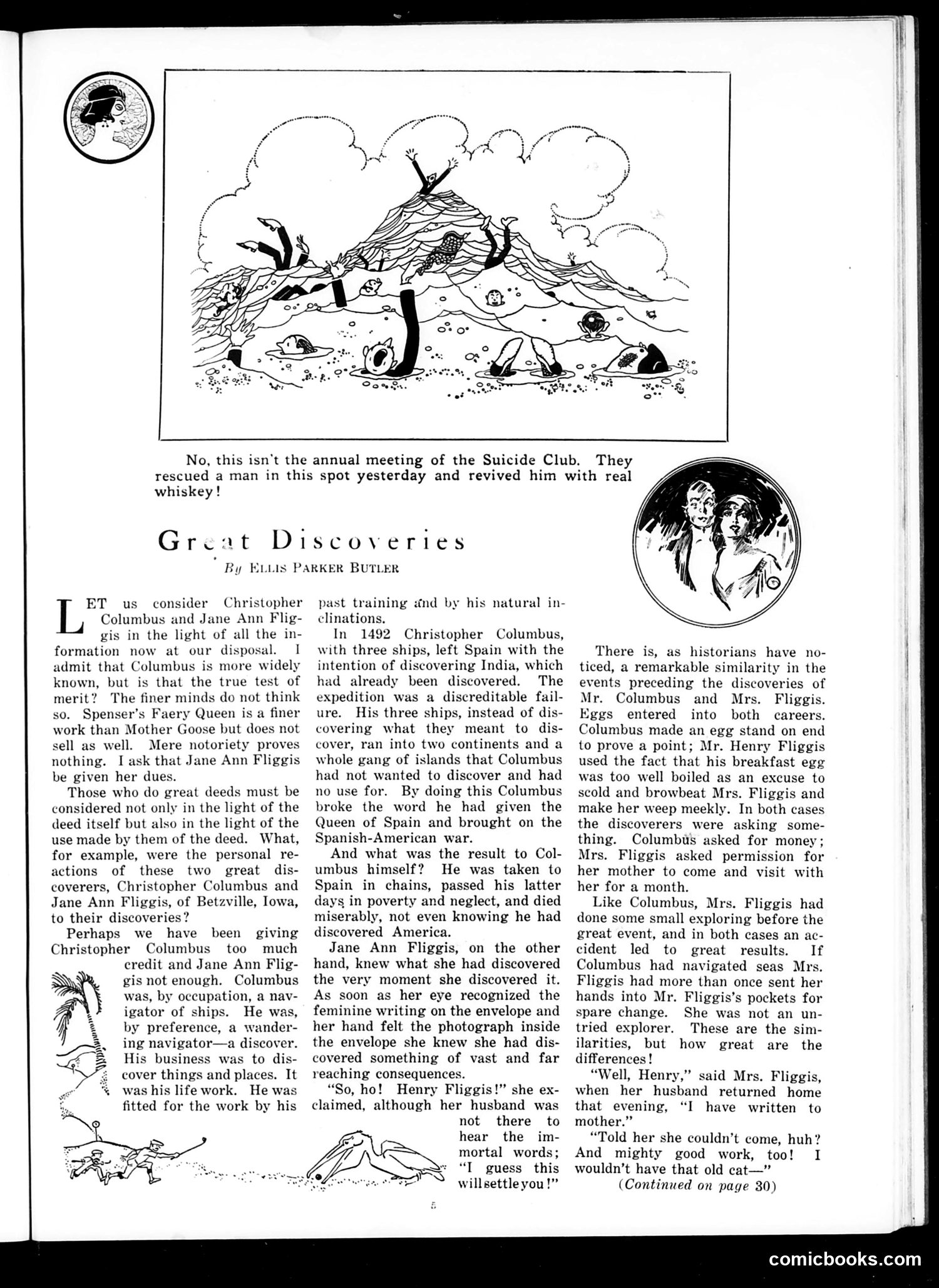
The top cartoon is a visual joke: figures emerge from a volcanic/mountainous landscape with tents below, captioned as NOT a "Suicide Club" meeting but rather a rescue scene where a man was revived with whiskey. The main article by Ellis Parker Butler compares Christopher Columbus and Jane Ann Fliggis as discoverers. The satire humorously elevates an obscure woman from Betzville, Iowa to historical significance equal with Columbus. The piece mocks how we mythologize famous explorers while ignoring ordinary people's achievements. It suggests Fliggis made comparable "discoveries" in her domestic life—finding egg stands, managing household economics—deserving equal historical recognition as Columbus's voyages. The joke deflates grand historical narratives through absurdist comparison.
📄 Transcribed text from this page (OCR, searchable)
Machine-transcribed from the original scan — historical spelling and the odd misread are preserved.
No, this isn't the annual meeting of the Suicide Club. They rescued a man in this spot yesterday and revived him with real whiskey! Great Discoveries By KLLis PARKER BUTLER ET us consider Christopher L Columbus and Jane Ann Flig- gis in the light of all the in- formation now at our disposal. | admit that Columbus is more widely known, but is that the true test of merit? The finer minds do not think so. Spenser’s Faery Queen is a finer work than Mother Goose but does not sell as well. Mere notoriety proves nothing. I ask that Jane Ann Fliggis be given her dues. Those who do great deeds must be considered not only in the light of the deed itself but also in the light of the use made by them of the deed. What, for example, were the personal re- actions of these two great dis- coverers, Christopher Columbus and Jane Ann Fliggis, of Betzville, Iowa, to their discoveries? Perhaps we have been giving Christopher Columbus too much credit and Jane Ann Flig- gis not enough. Columbus was, by occupation, a nav- igator of ships. He was, by preference, a wander- ing navigator—a discover. His business was to dis- cover things and places. It was his life work. He was fitted for the work by his past training dnd by his natural in- clinations, In 1492 Christopher Columbus, with three ships, left Spain with the intention of discovering India, which had already been discovered. The expedition was a discreditable fail- ure. His three ships, instead of dis- covering what they meant to dis- cover, ran into two continents and a whole gang of islands that Columbus had not wanted to discover and had no use for. By doing this Columbus broke the word he had given the Queen of Spain and brought on the Spanish-American war. And what was the result to Col- umbus himself? He was taken to Spain in chains, passed his latter days in poverty and neglect, and died miserably, not even knowing he had discovered America. Jane Ann Fliggis, on the other hand, knew what she had discovered the very moment she discovered it. As soon as her eye recognized the feminine writing on the envelope and her hand felt the photograph inside the envelope she knew she had dis- covered something of vast and far reaching consequences. “So, ho! Henry Fliggis!” she ex- claimed, although her husband was not there to hear the im- mortal words; “TI guess this willsettle you!” There is, as historians have no- ticed, a remarkable sim events preceding the dis Mr. Columbus and Mrs. Fliggis. Eggs entered into both careers. Columbus made an egg stand on end to prove a point; Mr. Henry Fliggis used the fact that his breakfast egg was too well boiled as an excuse to scold and browbeat Mrs. Fliggis and make her weep meekly. In both cases the discoverers were asking some- thing. Columbus asked for money; Mrs. Fliggis asked permission for her mother to come and visit with her for a month. Like Columbus, Mrs. Fliggis had done some small exploring before the great event, and in both cases an ac- cident led to great results. If Columbus had navigated seas Mrs. Fliggis had more than once sent her hands into Mr. Fliggis’s pockets for spare change. She was not an un- tried explorer. These are the sim- ilarities, but how great are the differences! “Well, Henry,” said Mrs. Fliggis, when her husband returned home that evening, “I have written to mother.” “Told her she couldn’t come, huh? And mighty good work, too! I wouldn’t have that old cat—” (Continued on page 30) comicbooks.com