
Judge, 1921-10-08 · page 26 of 36
Judge — October 8, 1921 — page 26: what you’re looking at
What you’re looking at
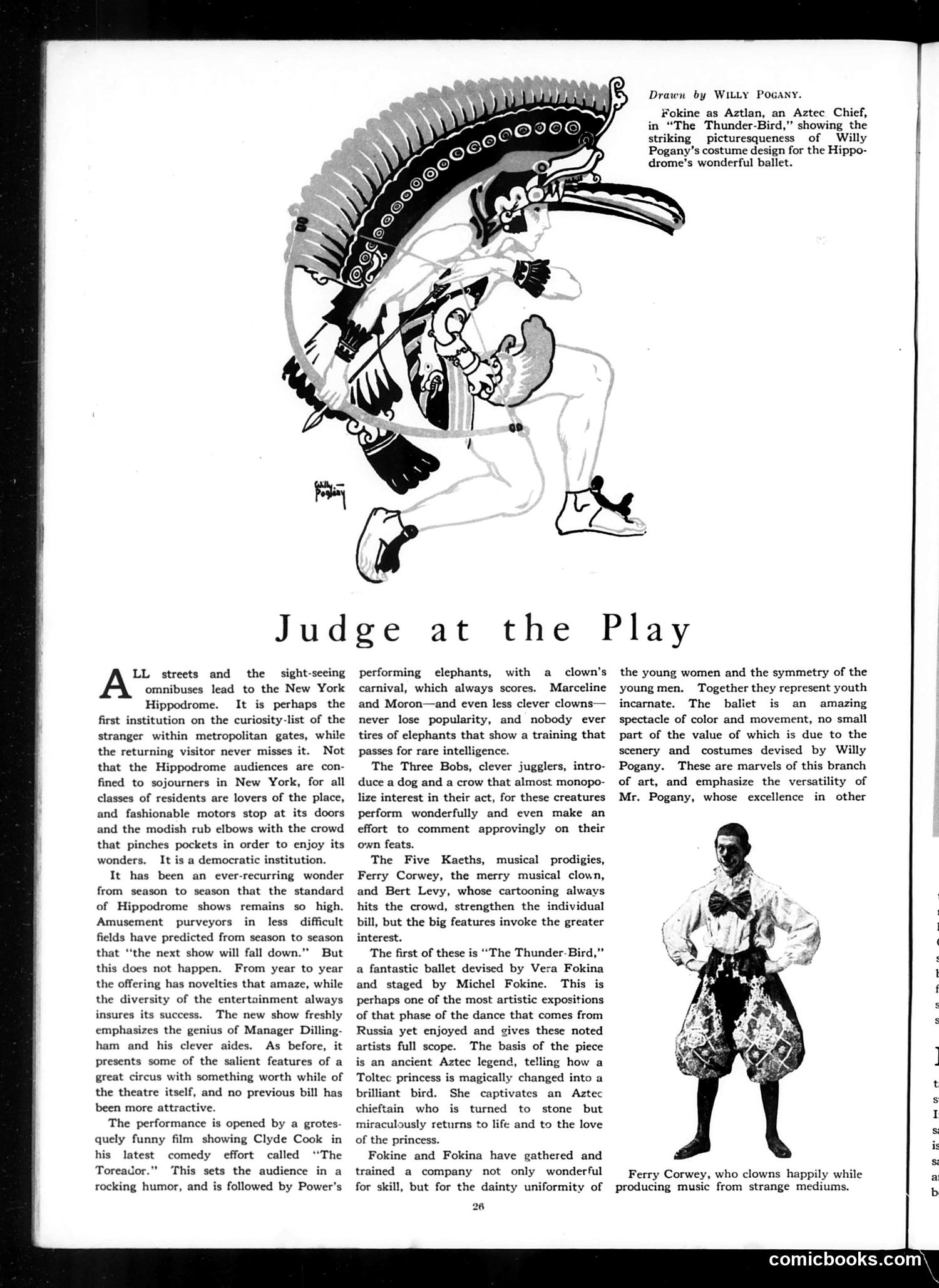
This is a theater review—not political satire—covering the New York Hippodrome's current show. The page celebrates the venue as a democratic institution drawing all social classes. The main illustration by Willy Pogany depicts a costume design for "The Thunder-Bird," a Russian ballet based on an Aztec legend about a princess transformed into a bird and an Aztec chieftain. The photograph shows Ferry Corwey, a musical clown performing at the theater. The review praises the Hippodrome's consistently high entertainment standards, highlighting various acts: comic films, performing elephants, jugglers, animal performers, and the featured ballet choreographed by Michel Fokine and starring Vera Fokina. The text emphasizes the production's artistic merit, particularly Pogany's scenic and costume design work, positioning the Hippodrome as serious entertainment despite its variety-show format.
📄 Transcribed text from this page (OCR, searchable)
Machine-transcribed from the original scan — historical spelling and the odd misread are preserved.
Jud LL streets and the sight-seeing omnibuses lead to the New York Hippodrome. It is perhaps the first institution on the curiosity-list of the stranger within metropolitan gates, while the returning visitor never misses it. Not that the Hippodrome audiences are con- fined to sojourners in New York, for all classes of residents are lovers of the place, and fashionable motors stop at its doors and the modish rub elbows with the crowd that pinches pockets in order to enjoy its wonders. It is a democratic institution. It has been an ever-recurring wonder from season to season that the standard of Hippodrome shows remains so high. Amusement purveyors in less difficult fields have predicted from season to season that ‘the next show will fall down.” But this does not happen. From year to year the offering has novelties that amaze, while the diversity of the entertainment always insures its success. The new show freshly emphasizes the genius of Manager Dilling- ham and his clever aides. As before, it presents some of the salient features of a great circus with something worth while of the theatre itself, and no previous bill has been more attractive. The performance is opened by a grotes: quely funny film showing Clyde Cook in his latest comedy effort called “The Toreador.” This sets the audience in a rocking humor, and is followed by Power’s Drawn by WILLY PoGaNy. Fokine as Aztlan, an Aztec Chief, in “The Thunder-Bird,” showing the striking picturesqueness of Willy Pogany’s costume design for the Hippo- drome’s wonderful ballet. ge at the Play performing elephants, with a clown’s carnival, which always scores. Marceline and Moron—and even less clever clowns— never lose popularity, and nobody ever tires of elephants that show a training that passes for rare intelligence. The Three Bobs, clever jugglers, intro- duce a dog and a crow that almost monopo- lize interest in their act, for these creatures perform wonderfully and even make an effort to comment approvingly on their own feats. The Five Kaeths, musical prodigies, Ferry Corwey, the merry musical clown, and Bert Levy, whose cartooning always hits the crowd, strengthen the individual bill, but the big features invoke the greater interest. The first of these is “The Thunder-Bird,” a fantastic ballet devised by Vera Fokina and staged by Michel Fokine. This is perhaps one of the most artistic expositions of that phase of the dance that comes from Russia yet enjoyed and gives these noted artists full scope. The basis of the piece is an ancient Aztec legend, telling how a Toltec princess is magically changed into a brilliant bird. She captivates an Aztec chieftain who is turned to stone but miraculously returns to life and to the love of the princess. Fokine and Fokina have gathered and trained a company not only wonderful for skill, but for the dainty uniformity of 26 the young women and the symmetry of the youngmen. Together they represent youth incarnate. The baliet is an amazing spectacle of color and movement, no small part of the value of which is due to the scenery and costumes devised by Willy Pogany. These are marvels of this branch of art, and emphasize the versatility of Mr. Pogany, whose excellence in other Ferry Corwey, who clowns happily while producing music from strange mediums. comicbooks.com ee pe op