
A complete issue · 36 pages · 1921
Judge — August 27, 1921
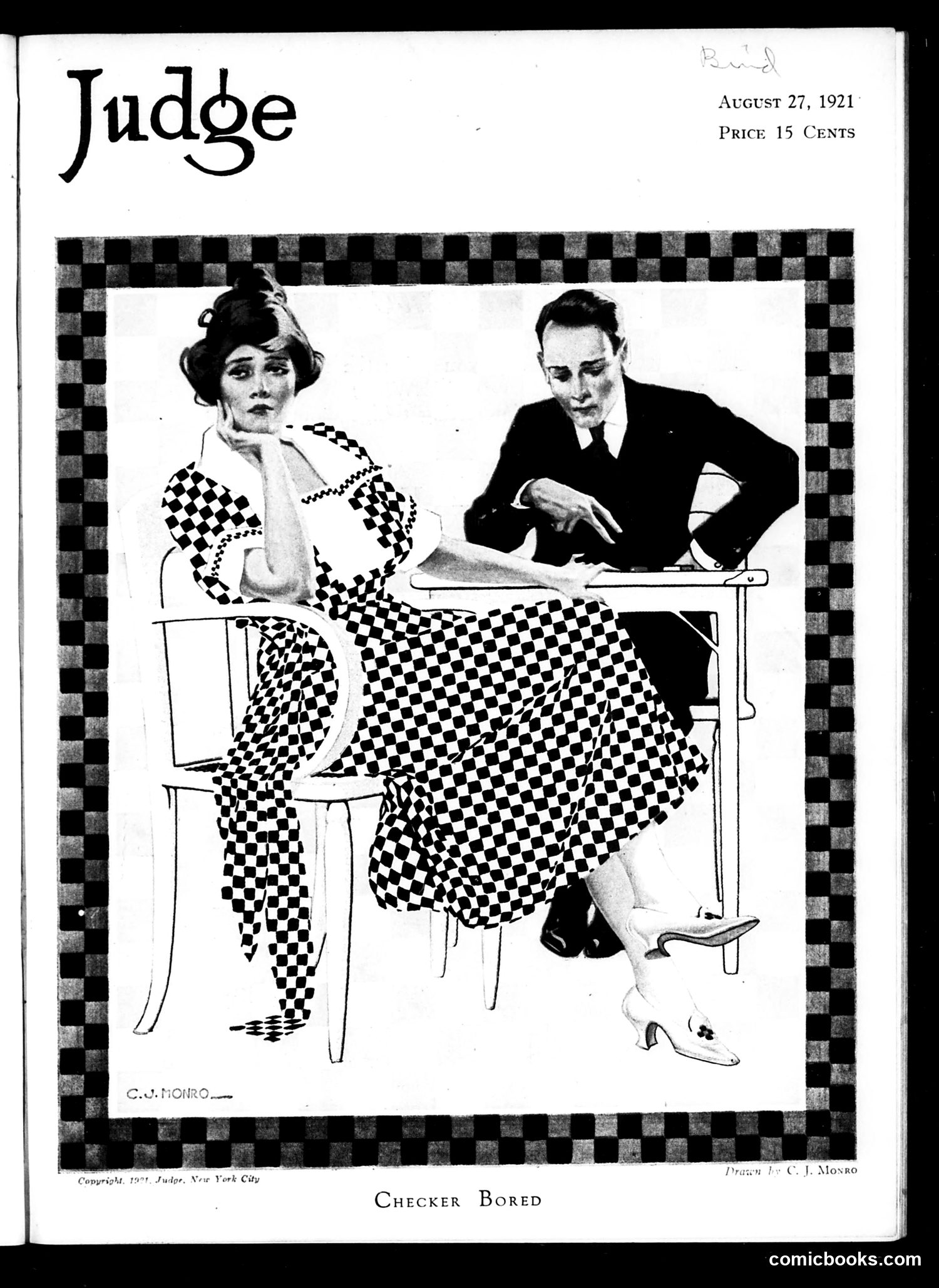
This 1921 Judge magazine cartoon plays on a visual pun with the title "Checker Bored"—the woman wears a black-and-white checkered dress that literally creates a checkerboard pattern. The joke satirizes marital tedium: a bored couple sits together, the woman gazing away listlessly while the man examines his fingernails with disinterest. Neither looks engaged with the other, suggesting monotonous domesticity. The checkerboard imagery reinforces the monotony through repetitive geometric patterns. This reflects 1920s anxieties about modern marriage as potentially dull routine rather than romantic partnership—a common theme in era's humor magazines targeting middle-class readers.
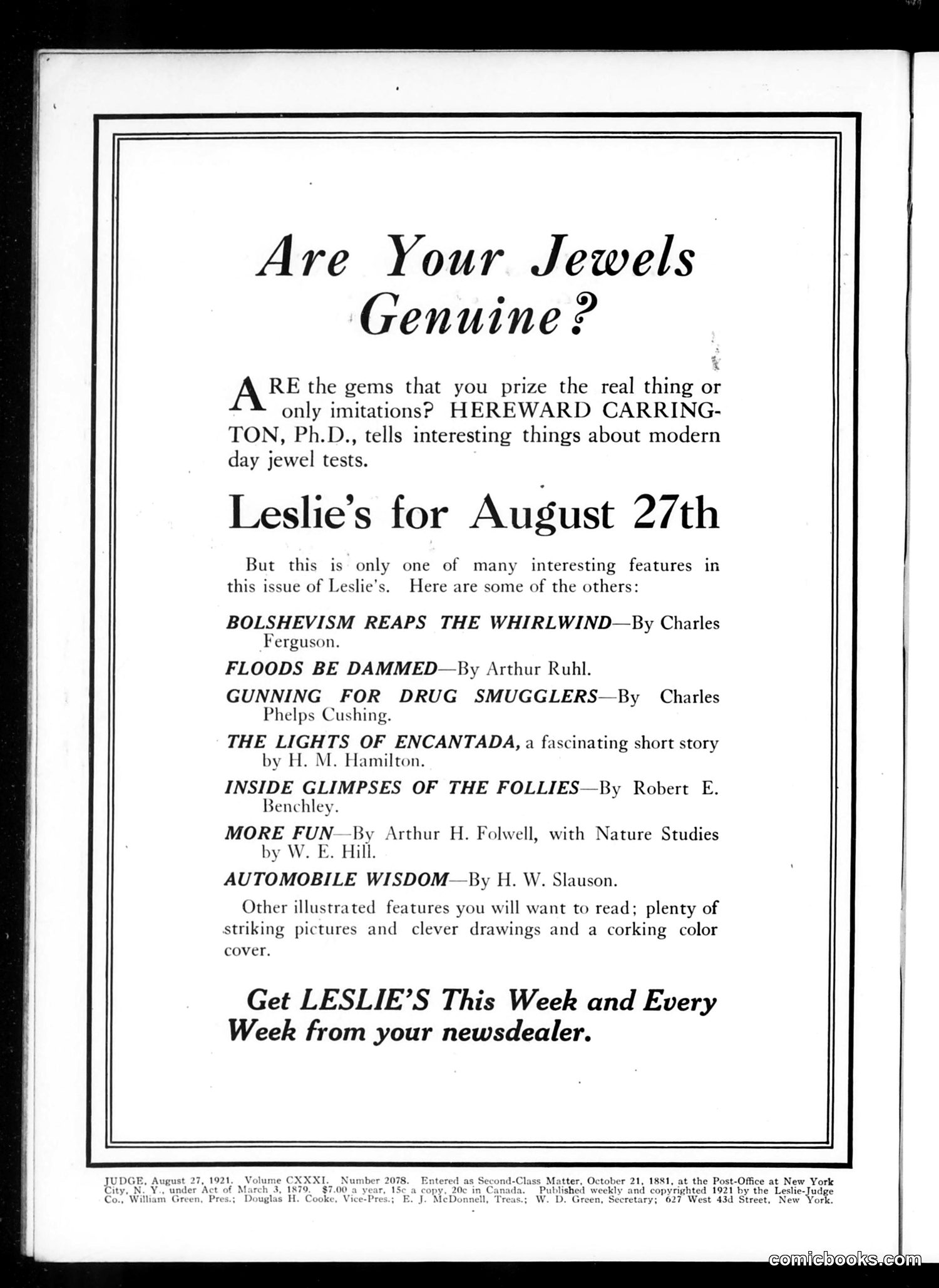
This page is primarily **advertising copy**, not a political cartoon. It's a full-page advertisement for *Leslie's* magazine (dated August 27th, likely 1921 based on the footer reference to "JUDGE, August 27, 1921"). The ad promotes upcoming articles including pieces by named contributors like Charles Ferguson and Arthur Ruhl, plus a short story titled "The Lights of Encantada." The headline "Are Your Jewels Genuine?" references an article by Hereward Carrington, Ph.D., about jewel authentication—a practical consumer topic rather than political satire. The ad emphasizes *Leslie's* weekly publication with "striking pictures and clever drawings and a corking color cover" to encourage newsstand purchases. This is straightforward magazine promotion, not satirical content.
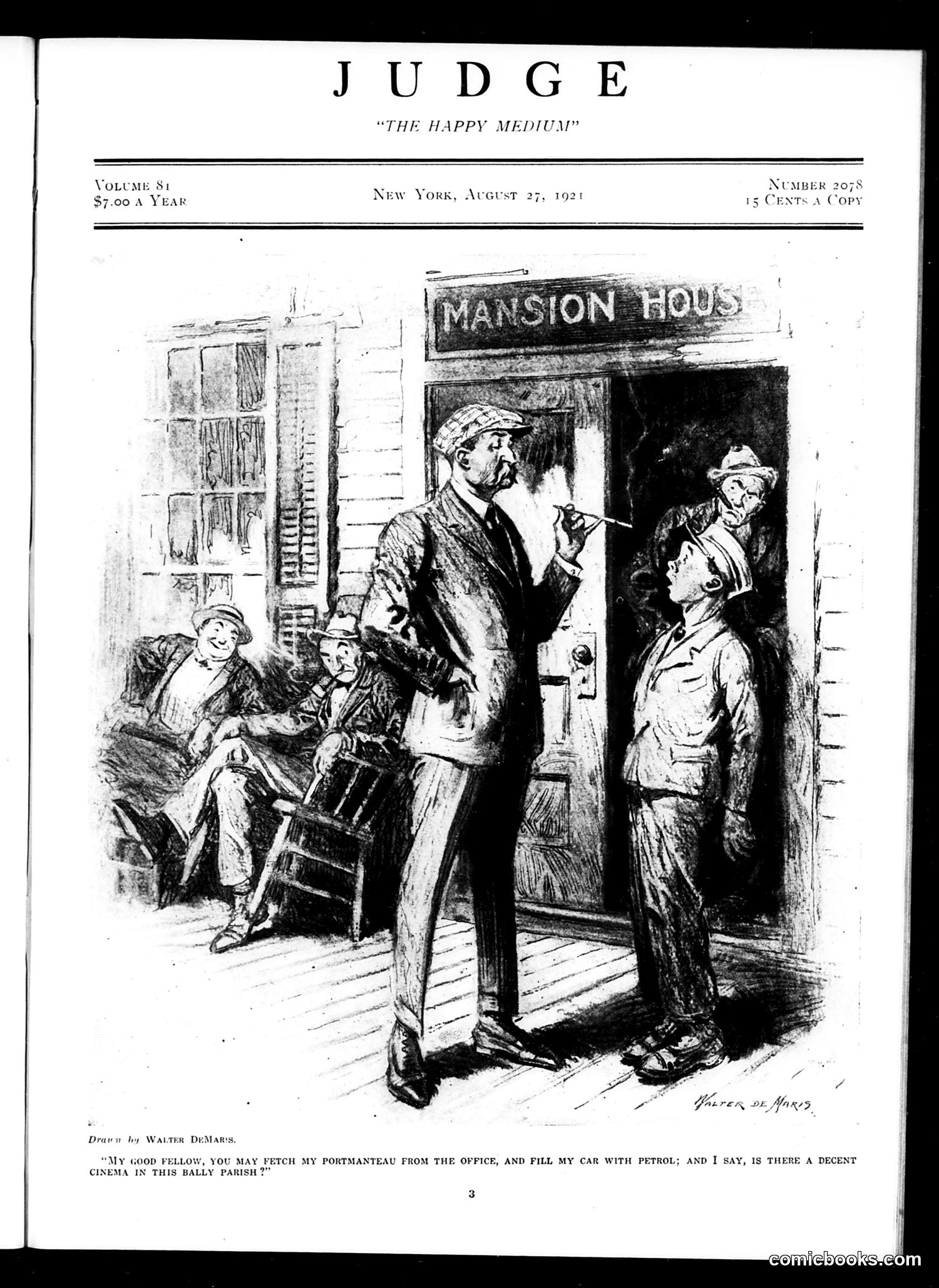
This cartoon depicts a well-dressed man at a mansion house entrance speaking to a working-class visitor. The dialogue reveals the joke's target: the man boasts of having a "portmanteau" (suitcase) from the office and asks if there's "a decent cinema in this rally parish." The satire mocks the pretensions of someone trying to appear wealthy and cultured—he uses fancy vocabulary ("portmanteau," "cinema," "parish") while discussing mundane matters (fetching luggage, filling a car with petrol). The humor lies in this clash between affected speech and ordinary circumstances, suggesting social climbing or false gentility among the aspiring middle class during the 1920s.
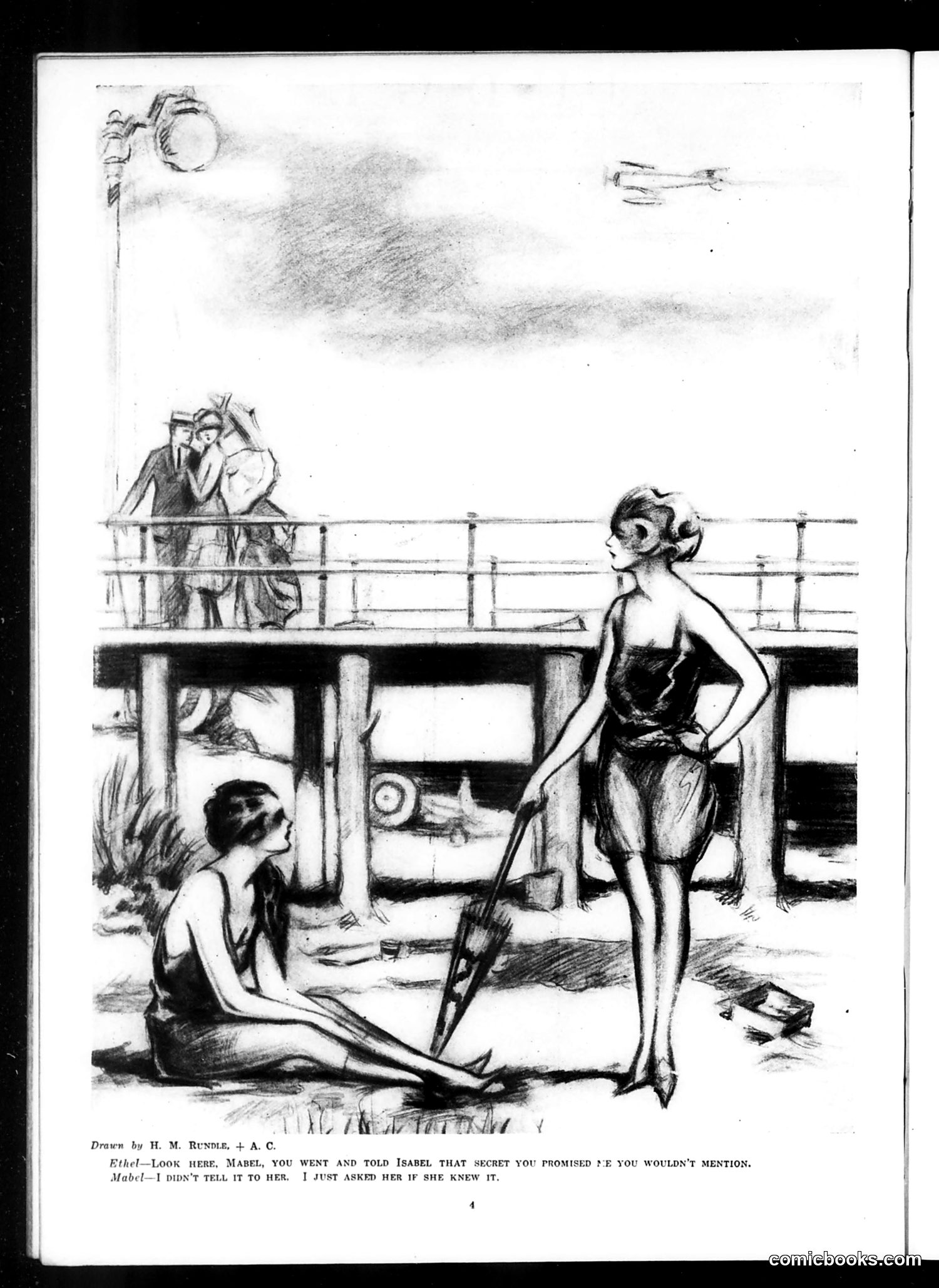
This is a single-panel cartoon by H. M. Bündel from *Judge* magazine. The scene depicts a beach setting with two women and observing men on a pier. The joke concerns a broken confidence. One woman, sitting, has apparently revealed a secret to her friend (standing), despite promising another person named Isabel she wouldn't mention it. The seated woman's excuse—"I didn't tell it to her, I just asked her if she knew it"—is a transparent rationalization meant to be humorous. The satire targets casual gossip and the sophistry people use to justify breaking promises. The beach setting and women's bathing attire suggest this is lighthearted social humor rather than political commentary. The cartoon pokes fun at human nature and the gap between our pledges and our actual behavior.
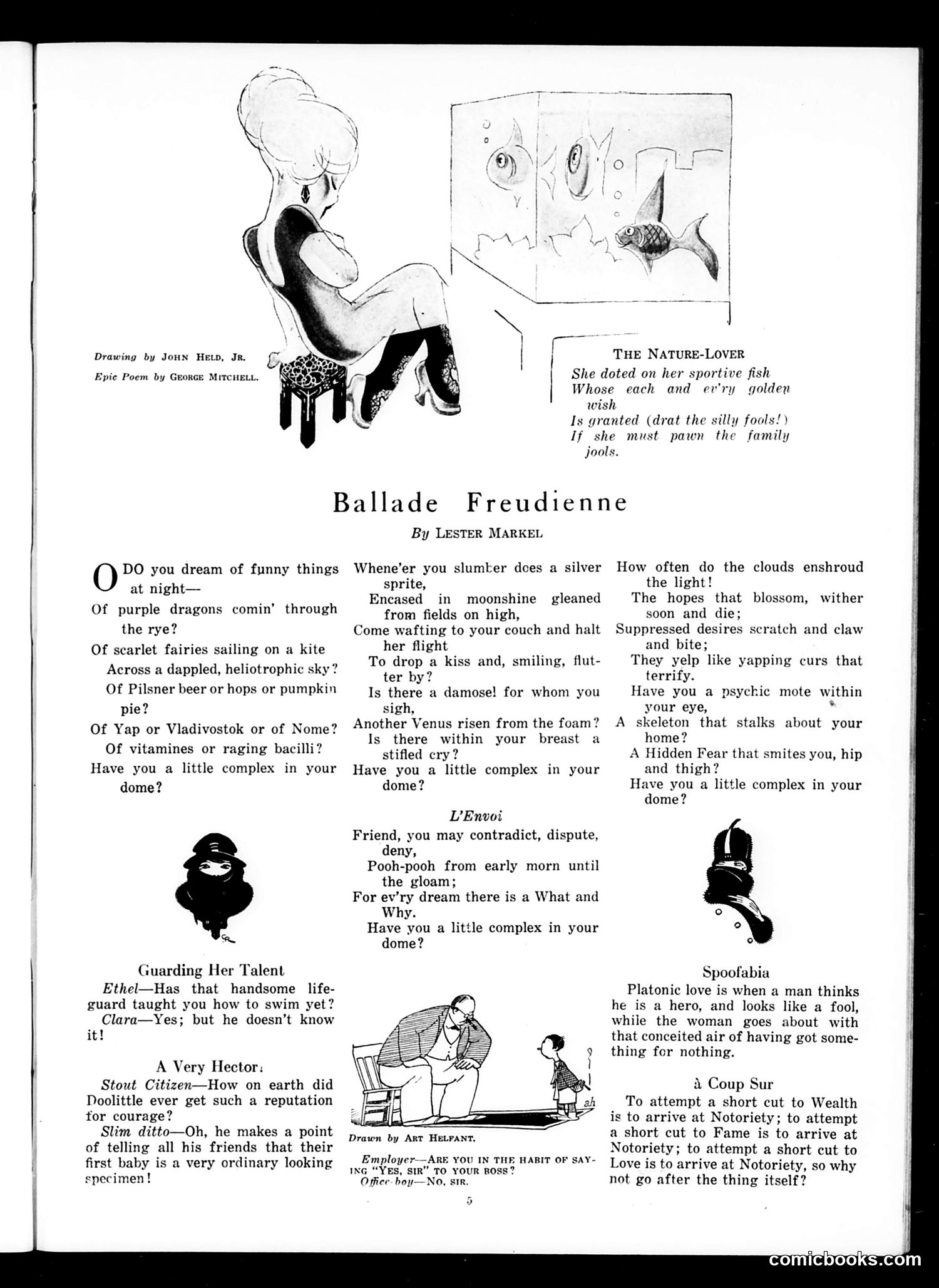
This satirical poem mocks Freudian psychology's popularity in 1920s American culture. The repeated refrain "Have you a little complex in your dome?" ridicules how Freudian terminology—particularly the concept of psychological "complexes"—had become trendy cocktail-party conversation. The poem catalogs absurd anxieties and phobias (Spoonabia, à Coup Sur) that wealthy society figures obsess over, suggesting that fashionable people were increasingly attributing every worry or character flaw to Freudian psychology rather than addressing real problems. The illustration of a woman gazing at her fish tank represents "The Nature-Lover," one example of the satirized personality types. Overall, the piece lampoons how psychoanalytic jargon had become intellectually fashionable shorthand for explaining human behavior among the upper classes.
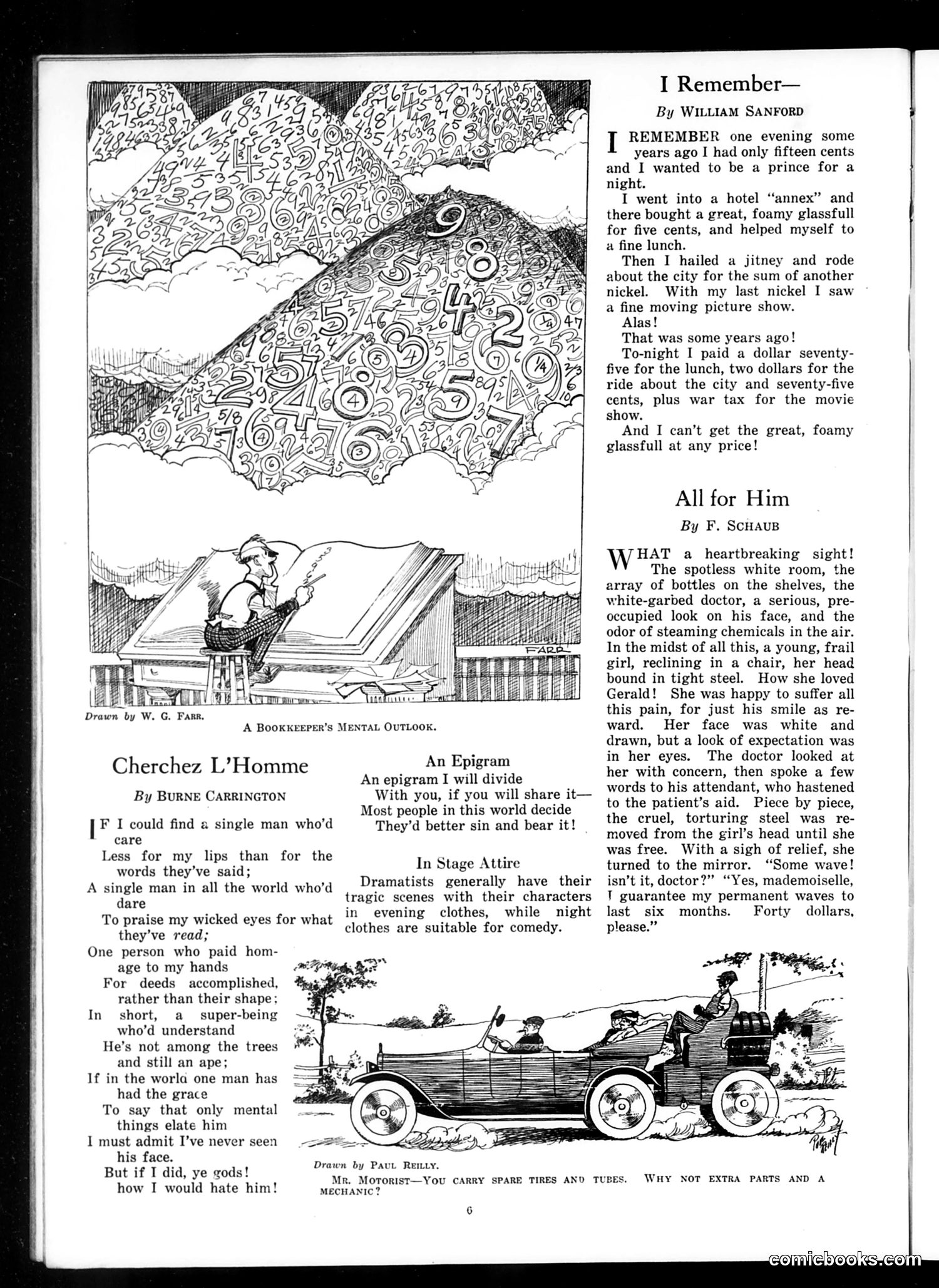
This page contains three separate pieces of satirical writing and illustrations, each with distinct subjects: 1. **"I Remember"** by William Sanford is nostalgic commentary on inflation. The author laments that what once cost fifteen cents (a foamy glass of beer, jitney ride, lunch, and entertainment) now costs several dollars, making past leisure activities unaffordable. 2. **"All for Him"** by F. Schaub depicts a heartbreaking hospital scene where a devoted woman visits her bedridden lover, enduring painful steel restraints while he remains bound. The doctor offers her permanent waves as compensation for her suffering. 3. **"Cherchez L'Homme"** by Burne Carrington is a poem praising hypothetical men of integrity and accomplishment—though the author admits never meeting such a man. The illustrations are unrelated to serious political commentary; they're general social humor.
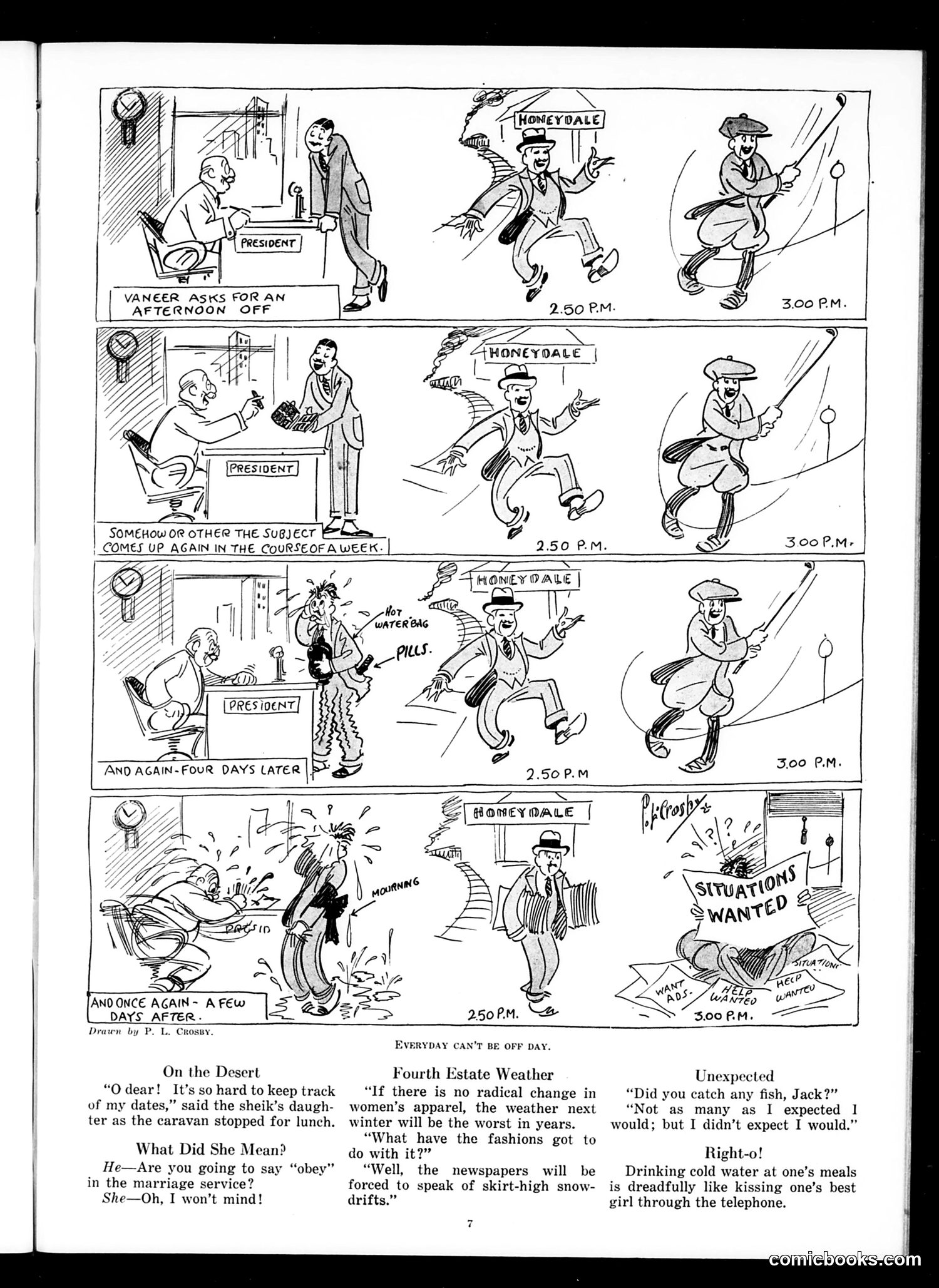
This comic strip satirizes the President's administrative challenges, likely referencing a historical executive repeatedly requesting time off. The recurring 2:50 P.M. to 3:00 P.M. sequence at Honeydale shows the same interruptions cycling—suggesting the President's day is perpetually disrupted by crises. The final panel depicts the President frantically reviewing "Situations Wanted" advertisements, implying he's considering resignation due to unrelenting demands. Below are unrelated humor items: Desert travelers, weather predictions (the joke being short skirts will make snow drifts appear higher in newspapers), and fishing anecdotes. The cartoon mocks executive exhaustion and the impossibility of any genuine rest, suggesting even brief respites are illusory for those in high office. It's political commentary on the relentless nature of presidential responsibility.
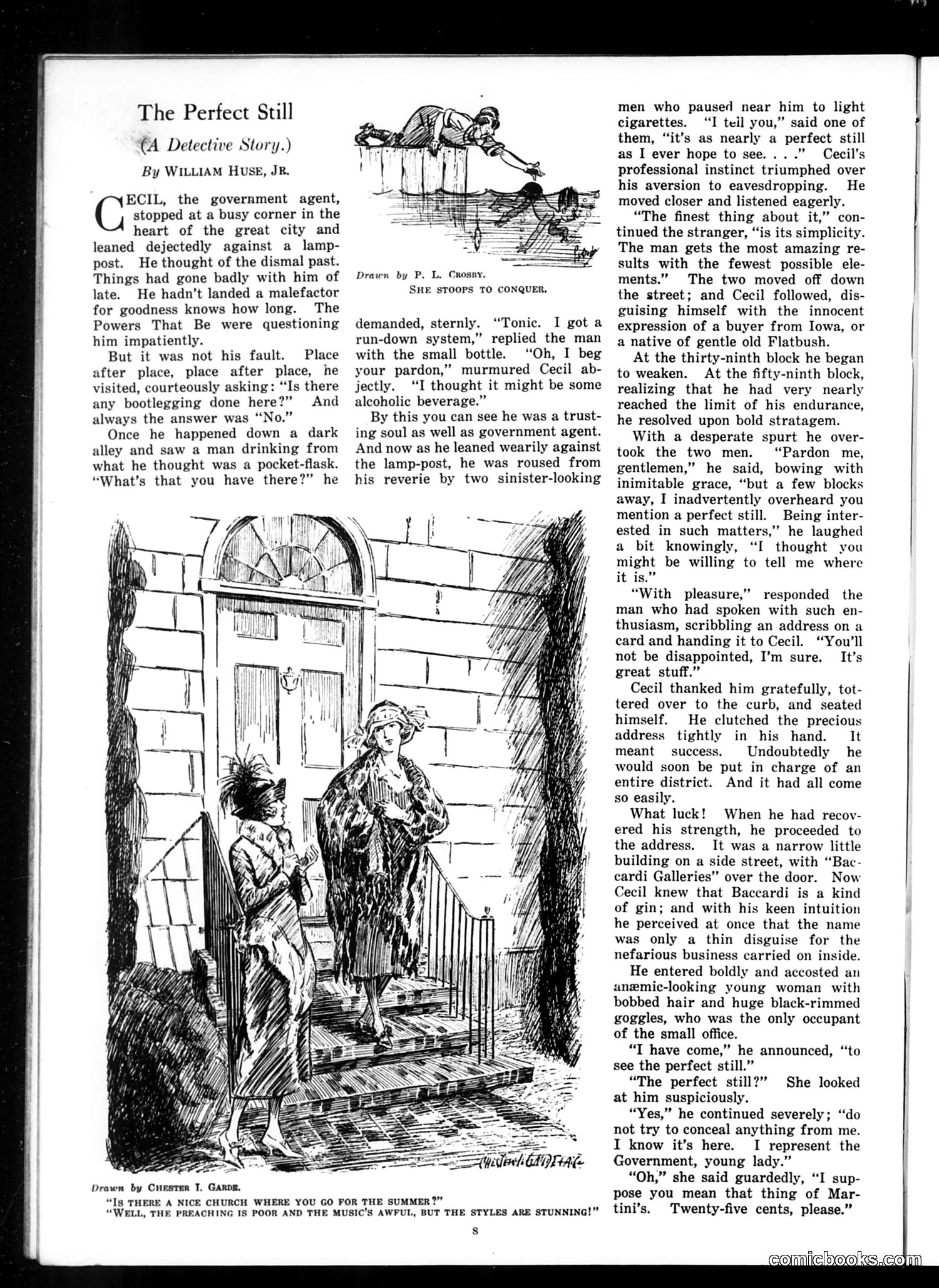
This is a humorous short story satirizing Prohibition enforcement during the 1920s-early 1930s. Cecil is an incompetent government agent tasked with finding illegal stills (apparatus for making bootleg liquor). He's so naive that when he sees a man drinking from a flask, he accepts "tonic for a run-down system" at face value. The joke culminates when Cecil overhears criminals discussing a "perfect still," pursues them obsessively, obtains an address, and discovers it leads to "Baccardi Galleries"—a legitimate liquor store (Bacardi is a known rum brand). The satire mocks both the government's hapless enforcement efforts and Prohibition's absurdity: the agent mistakes a legal business for an illegal operation, suggesting the law itself is confused or unenforceable. The accompanying cartoon about church styles adds lighter social commentary.
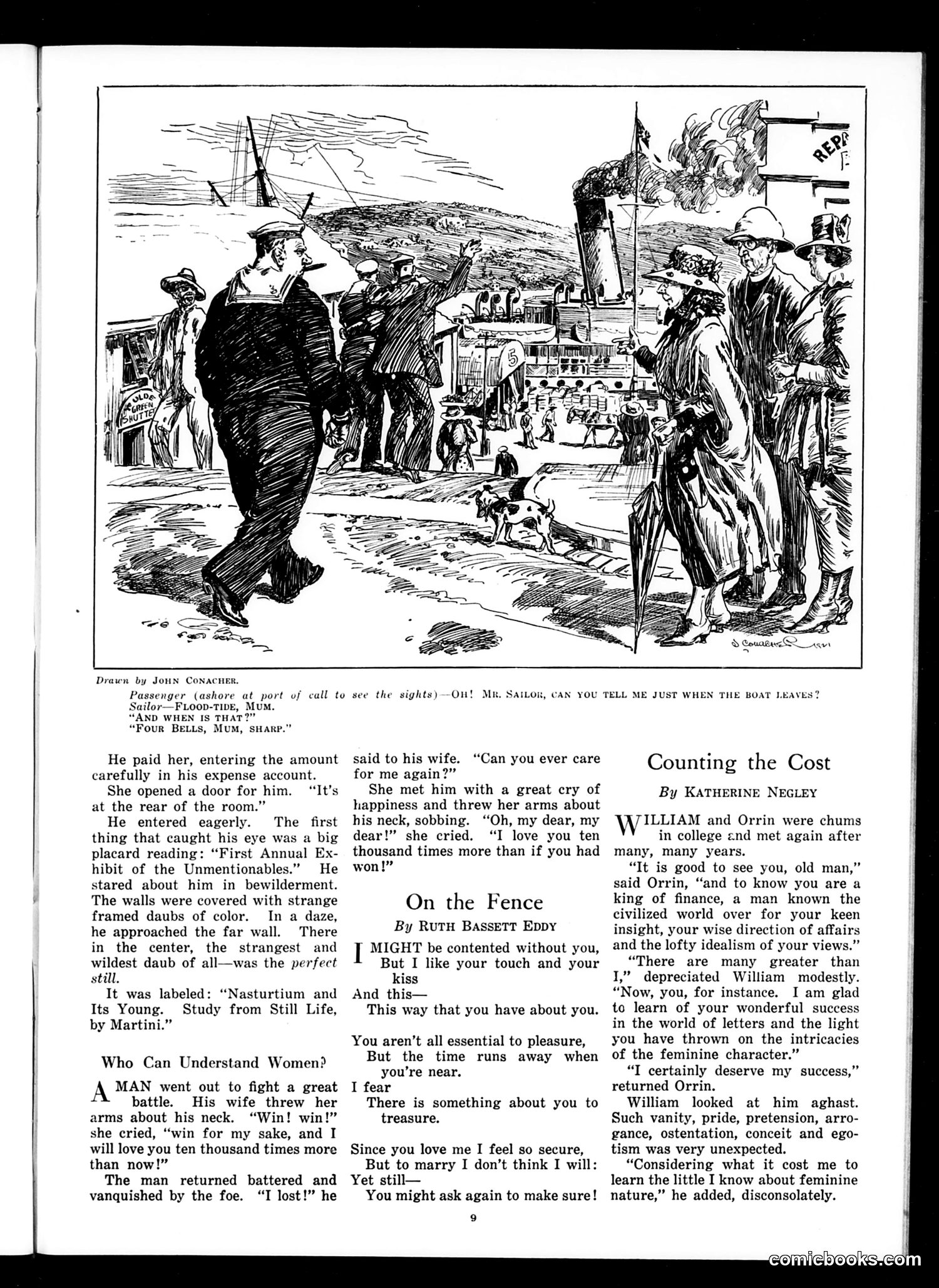
**The Cartoon (by John Connacher):** A sailor ashore seeks entertainment from a woman at port. She directs him to see "the sights" and he discovers an art exhibition of abstract/modernist paintings. The punchline mocks avant-garde art: the "wildest daub of all"—presumably an incomprehensible abstract work—is labeled as a realistic still life of "Nasturtium and Its Young." The satire ridicules both pretentious modern art and those who exhibit it seriously. **The Short Stories** are comedic takes on relationships: "Who Can Understand Women?" presents a wife's paradoxical behavior (loving her husband less for winning, more for losing), and "On the Fence" features a woman stringing along an indecisive suitor. "Counting the Cost" contrasts two old friends—one modestly successful in finance, the other arrogantly successful in letters—satirizing male vanity about achievements. The page reflects early 20th-century American attitudes: skepticism toward modernism, bewilderment about women's irrationality, and gentle mockery of male pretension.
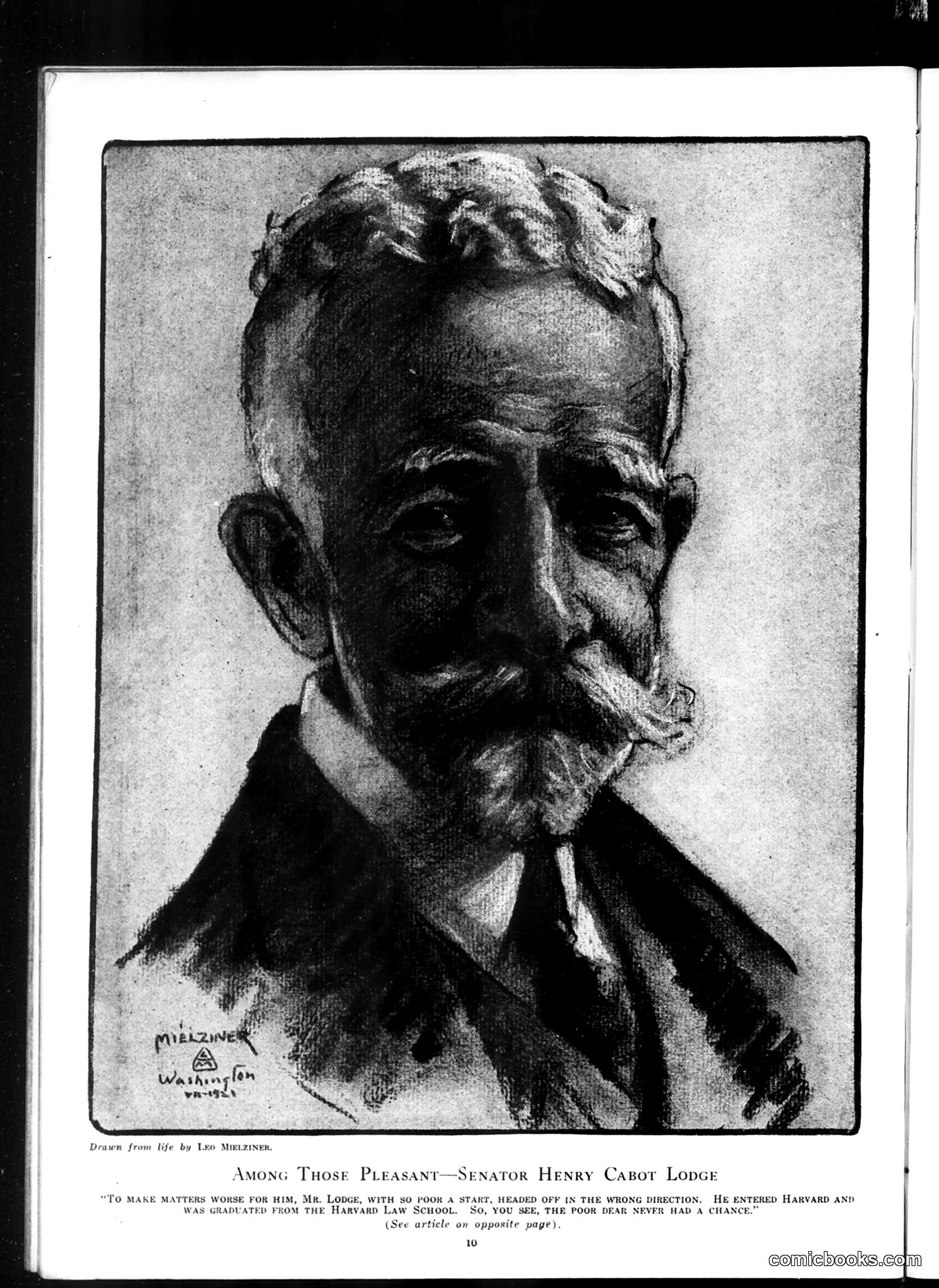
This page features a portrait sketch of **Senator Henry Cabot Lodge**, drawn from life by Leo Mielziner. The accompanying text is satirical commentary on Lodge's privileged background. The satire's point: the quote mocks Lodge's complaint about poverty and disadvantage by listing his actual advantages—attending Harvard University and Harvard Law School. The joke is ironic: Lodge claims hardship, yet he received an elite education that most Americans could never access. The phrase "the poor dear never had a chance" is sarcastic; clearly he *did* have chances that ordinary citizens lacked. This appears to critique either Lodge's claims of self-made success or his sympathy for the poor, implying hypocrisy given his aristocratic education. The article referenced on the opposite page would provide fuller context for the specific political situation being mocked.
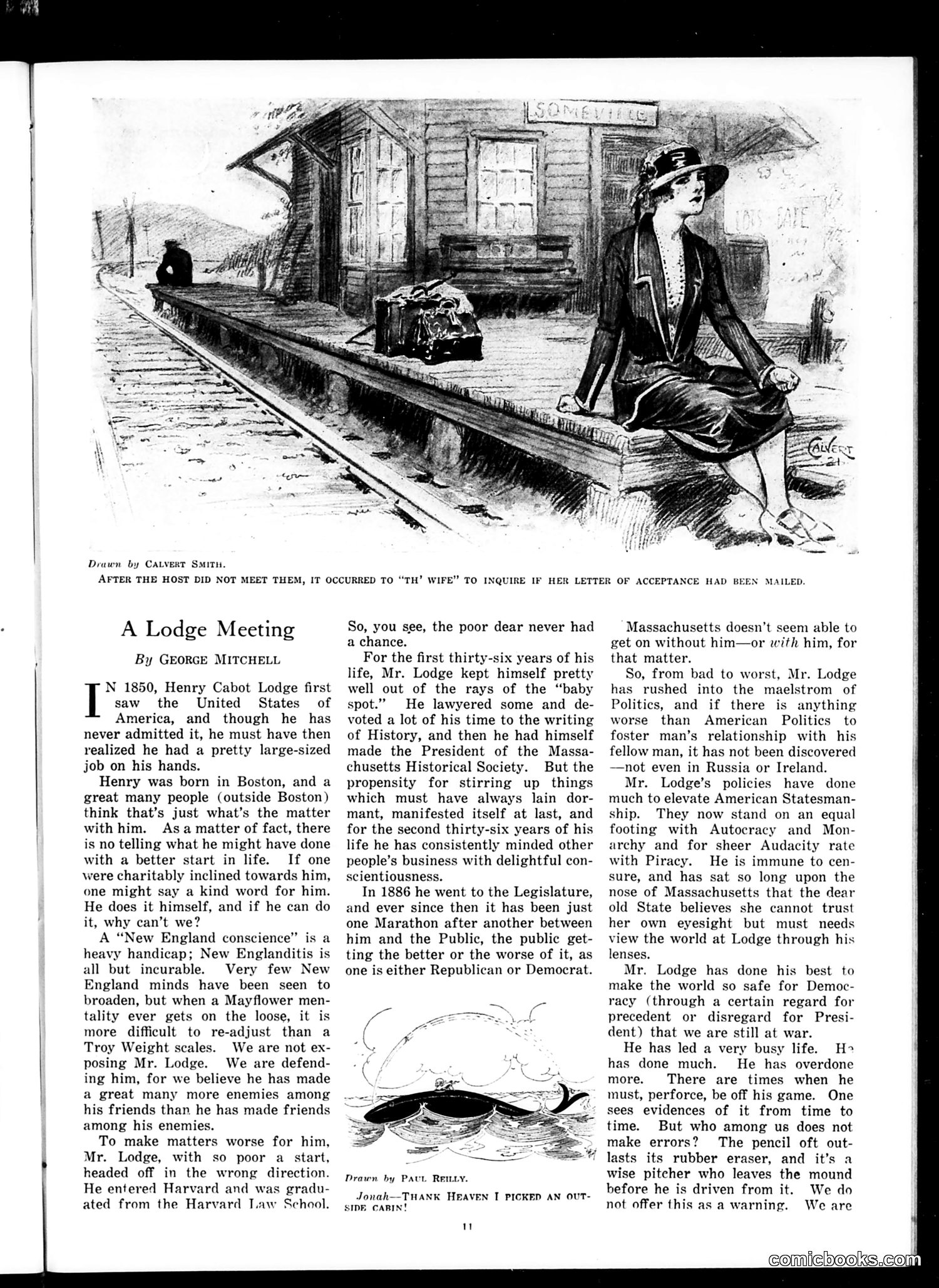
This article satirizes **Henry Cabot Lodge**, the prominent Massachusetts politician and senator. The top cartoon shows a woman waiting at a train station—the joke being she accepted a social invitation from Lodge that was never actually mailed, leaving her stranded. The article mockingly portrays Lodge as an overambitious New Englander with a rigid "conscience" who meddles in others' affairs. It criticizes his Harvard education, his shift from history writing into politics, and especially his political maneuvering since entering the legislature in 1886. The satire's main targets: Lodge's interventionist foreign policies (references to making the world "safe for Democracy" while America remains "at war"), his domineering influence over Massachusetts politics, and his general self-righteousness. The bottom cartoon (by Paul Reilly) appears unrelated—a separate joke about seasickness. The piece uses ironic praise ("We are defending him") to deliver cutting criticism of Lodge's political arrogance and overreach.
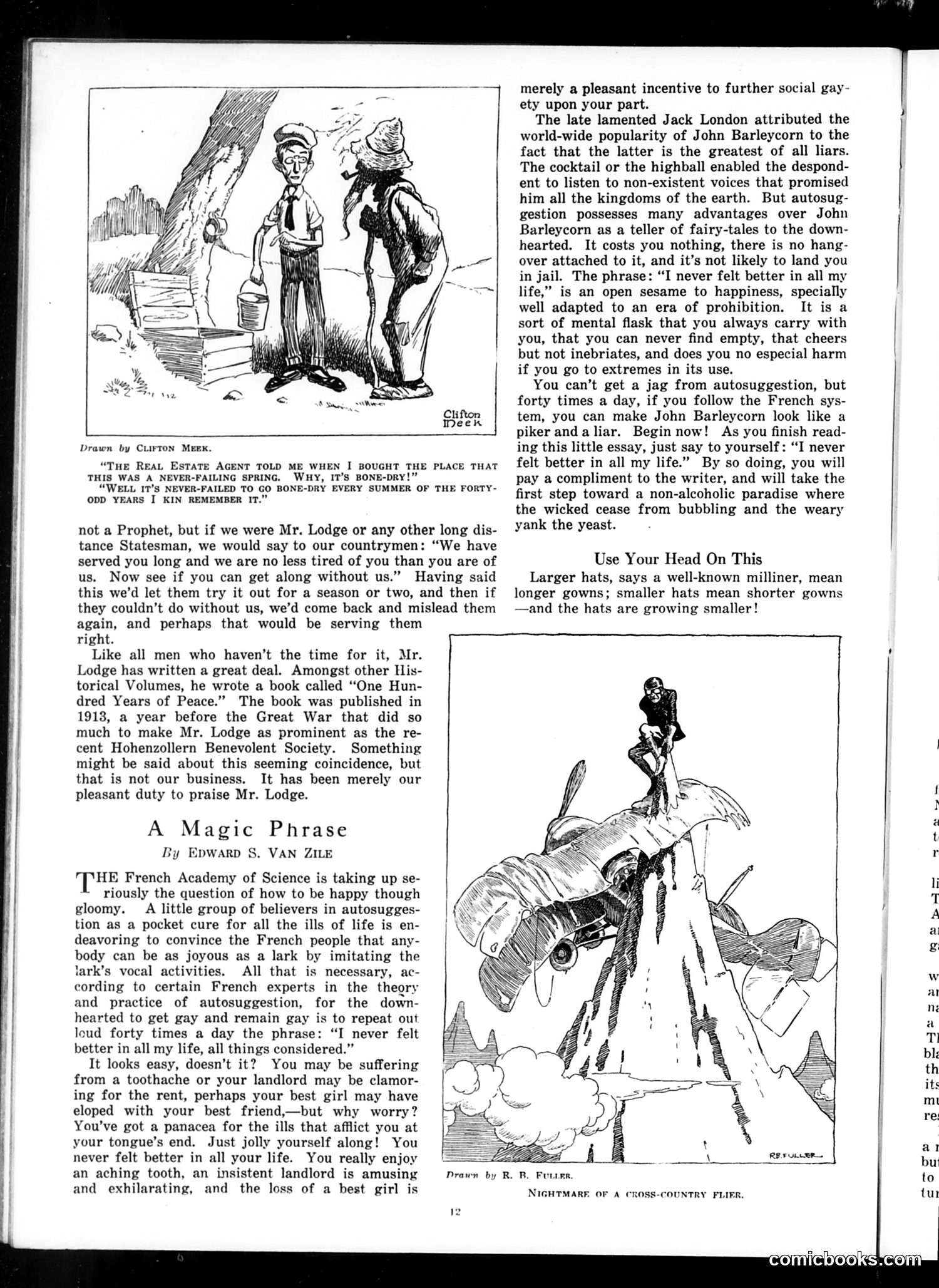
**Top Cartoon (Clifton Meek):** A real estate agent and longtime resident discuss a spring that's gone dry. The joke mocks deceptive real estate marketing—the agent promised a "never-failing spring," but it predictably dries up every summer. The local resident's forty-year experience exposes the agent's false claim. **Main Article ("A Magic Phrase" by Edward S. Van Zile):** This satirizes French autosuggestion theory—the idea that repeating "I never felt better in all my life" forty times daily cures depression and life's problems. Van Zile argues this is merely Prohibition-era substitute for alcohol (referencing Jack London's *John Barleycorn*). The satire suggests self-delusion through positive thinking won't solve real problems like toothaches, eviction, or lost love—it's just mental snake oil replacing literal snake oil. **Context:** Published during Prohibition (1920-1933), the piece mocks both pseudo-scientific psychology and the era's desperation for mood-lifting alternatives to banned alcohol.
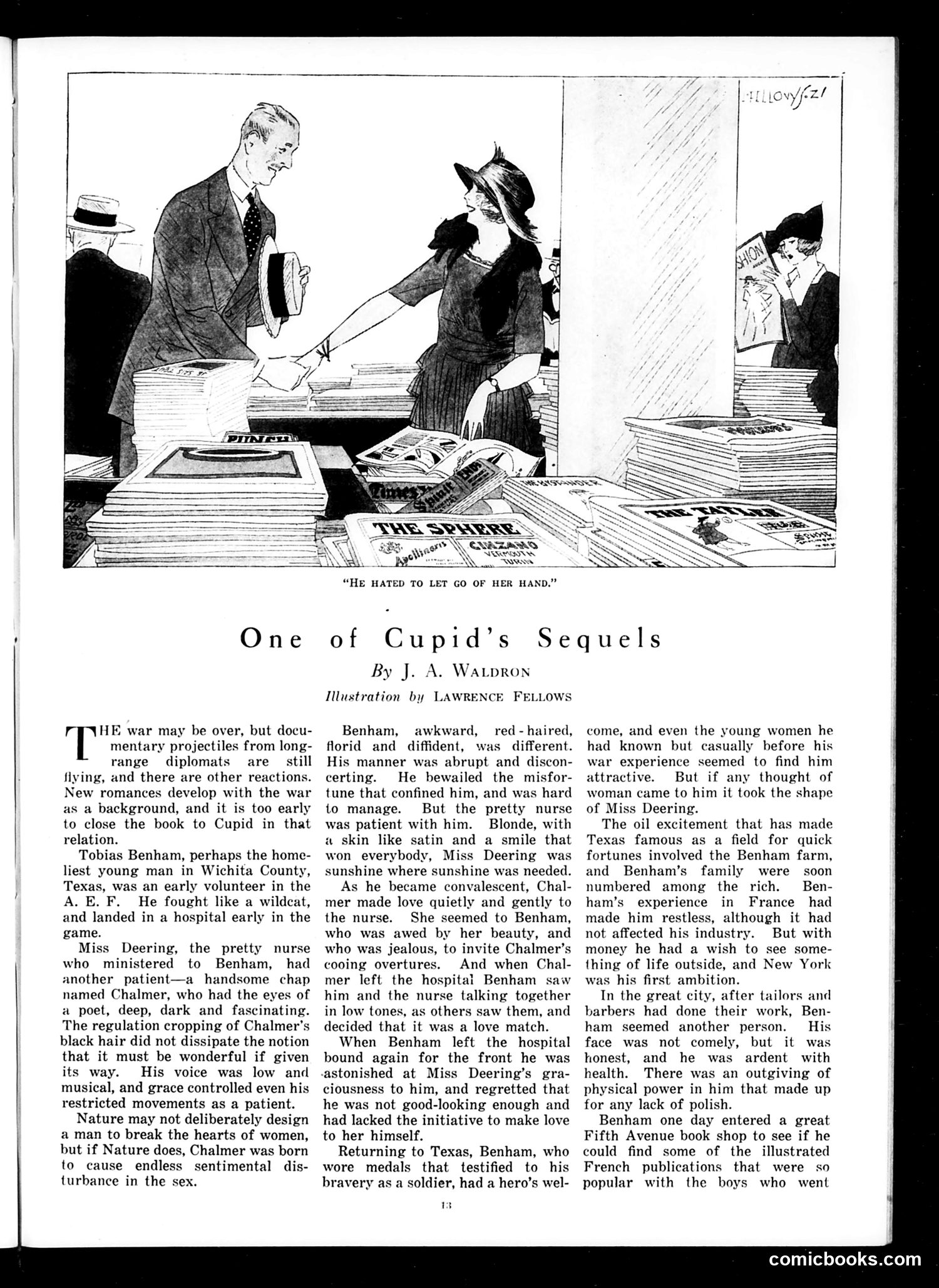
This is a romantic short story illustration, not political satire. The cartoon depicts a scene in what appears to be a bookstore, illustrating J.A. Waldron's narrative about post-WWI romance. The story concerns Tobias Benham, an awkward but brave WWI soldier, who fell for Miss Deering, a nurse, while hospitalized. He believed she preferred the charming patient Chalmer. Years later, after returning home wealthy from an oil discovery and refurbished by city tailors, Benham encounters Miss Deering again in a New York bookshop (the illustrated scene). The cartoon's caption—"He Hated to Let Go of Her Hand"—suggests a romantic reunion. The illustration shows the couple reconnecting among stacks of books, with onlookers observing. This exemplifies the magazine's "Cupid" theme: how wartime separations and circumstances create unexpected second chances at romance among American civilians and returning soldiers.
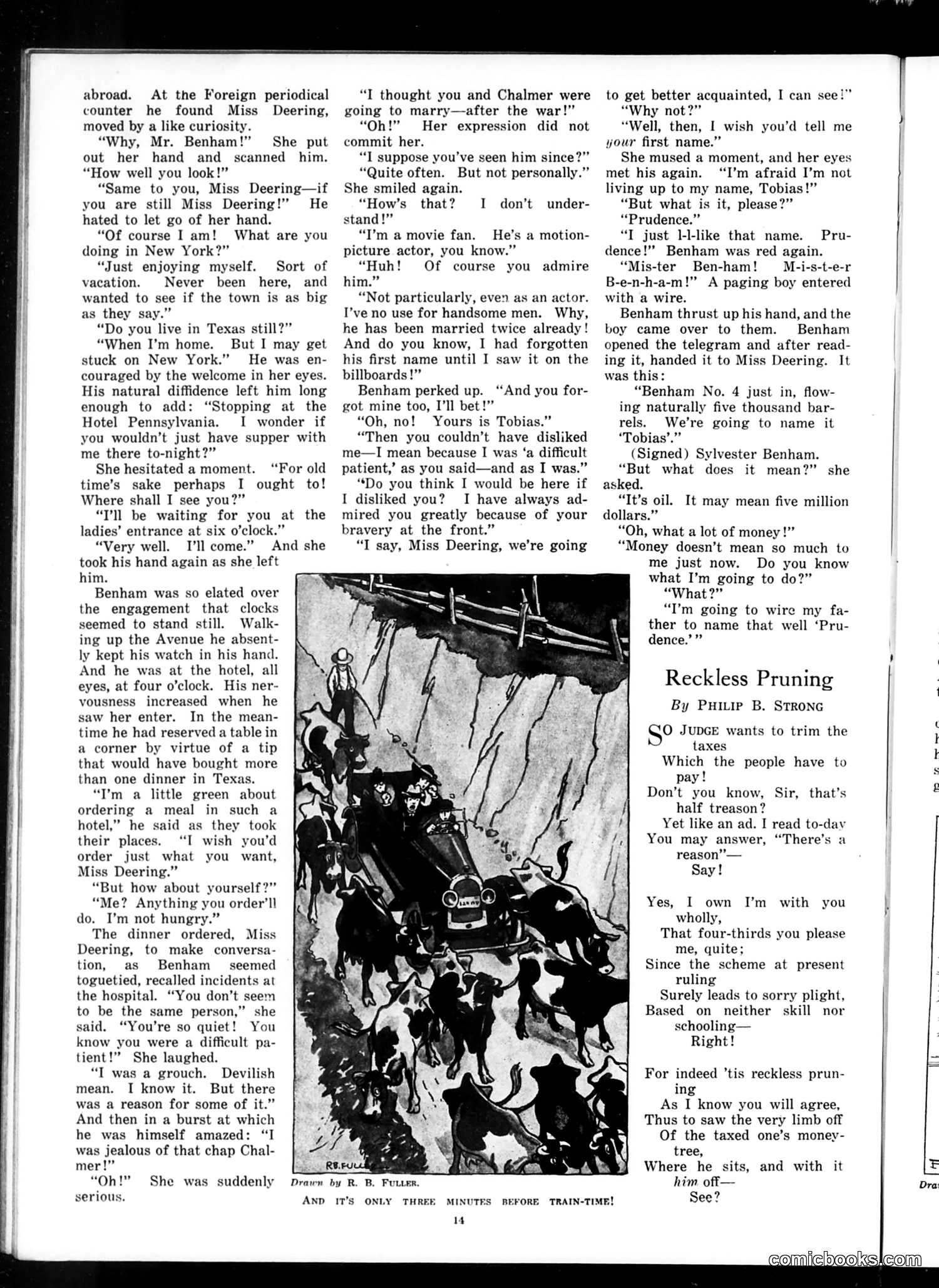
This page contains a romantic narrative (not primarily political satire) about a soldier named Benham reuniting with Miss Prudence Deering in New York. The story involves post-WWI themes: Benham is a war veteran staying at a hotel, reconnecting with a woman he knew from a hospital (likely where he recovered from wounds). The humor lies in mundane romantic awkwardness: Benham's nervousness, his admission of past jealousy over another suitor (Chalmer), and the revelation that Prudence forgot Chalmer's name despite him becoming a movie star—she only remembers him from billboards. The joke satirizes Hollywood's superficiality. The accompanying poem "Reckless Pruning" by Philip B. Strong critiques poorly-conceived tax policy, comparing it to carelessly cutting down a money tree. The dramatic interruption—a telegram arriving just as romance blooms—was a common plot device of the era, likely signaling urgent business news to derail personal plans.
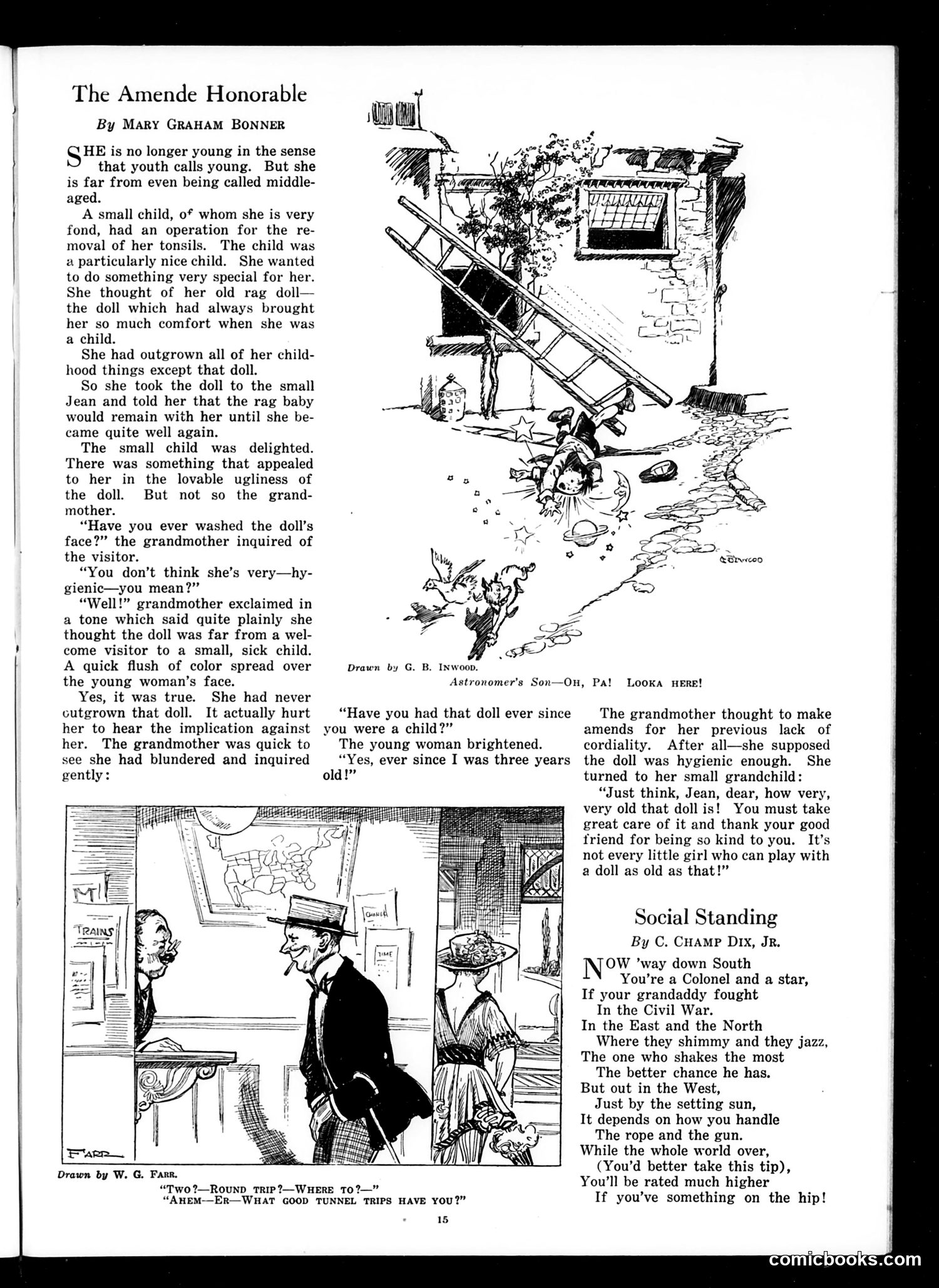
**"The Amende Honorable"** (top): A sentimental story about a woman who gives her childhood rag doll to a sick child. The grandmother initially objects on hygiene grounds, offending the young woman—who admits she's kept the doll since age three. The grandmother apologizes, reframing the doll's age as something precious rather than unsanitary. The joke satirizes how social judgments shift based on framing: the same object is "unhygienic" until repositioned as a cherished heirloom. **"Social Standing"** (bottom): A poem mocking regional status hierarchies in America. In the South, Civil War ancestry grants prestige; in the North/East, dancing ability matters; in the West, gun-handling skills count; and "worldwide," having "something on the hip" (alcohol, during Prohibition) elevates one's standing. The satire targets how arbitrary and geographically inconsistent social respectability is.
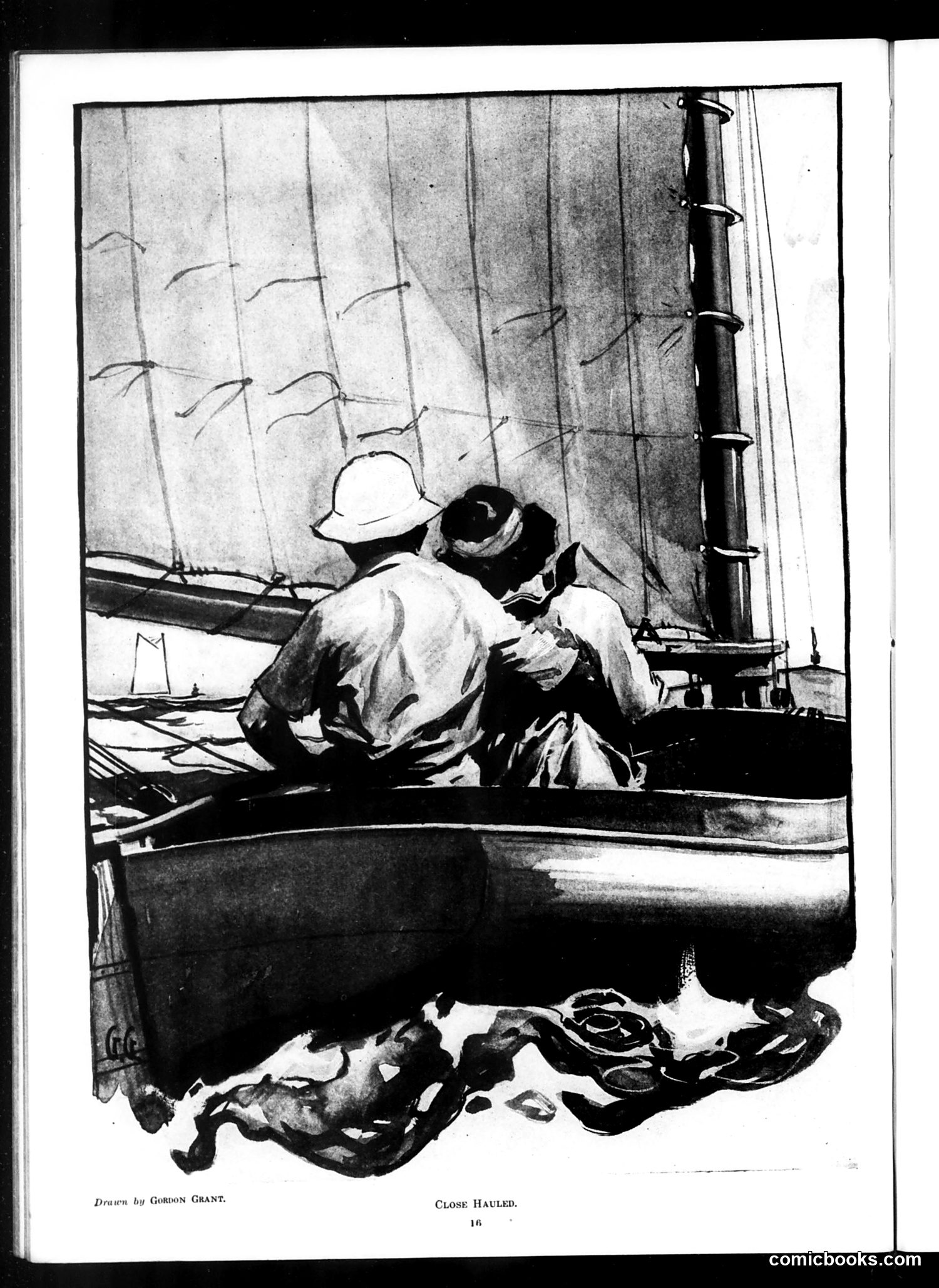
This illustration depicts two sailors working on a sailing vessel, drawn by Gordon Grant (a noted maritime illustrator). The title "Close Hauled" is a nautical term meaning sailing as near to the wind direction as possible. The image shows working sailors performing actual ship labor—hauling ropes and managing sails on what appears to be a tall ship. Given Judge magazine's satirical nature, this likely comments on maritime labor or naval affairs of its era, though without additional context or caption text visible, the specific satirical point remains unclear. The dramatic composition emphasizes the physical demands and skill required of sailors.
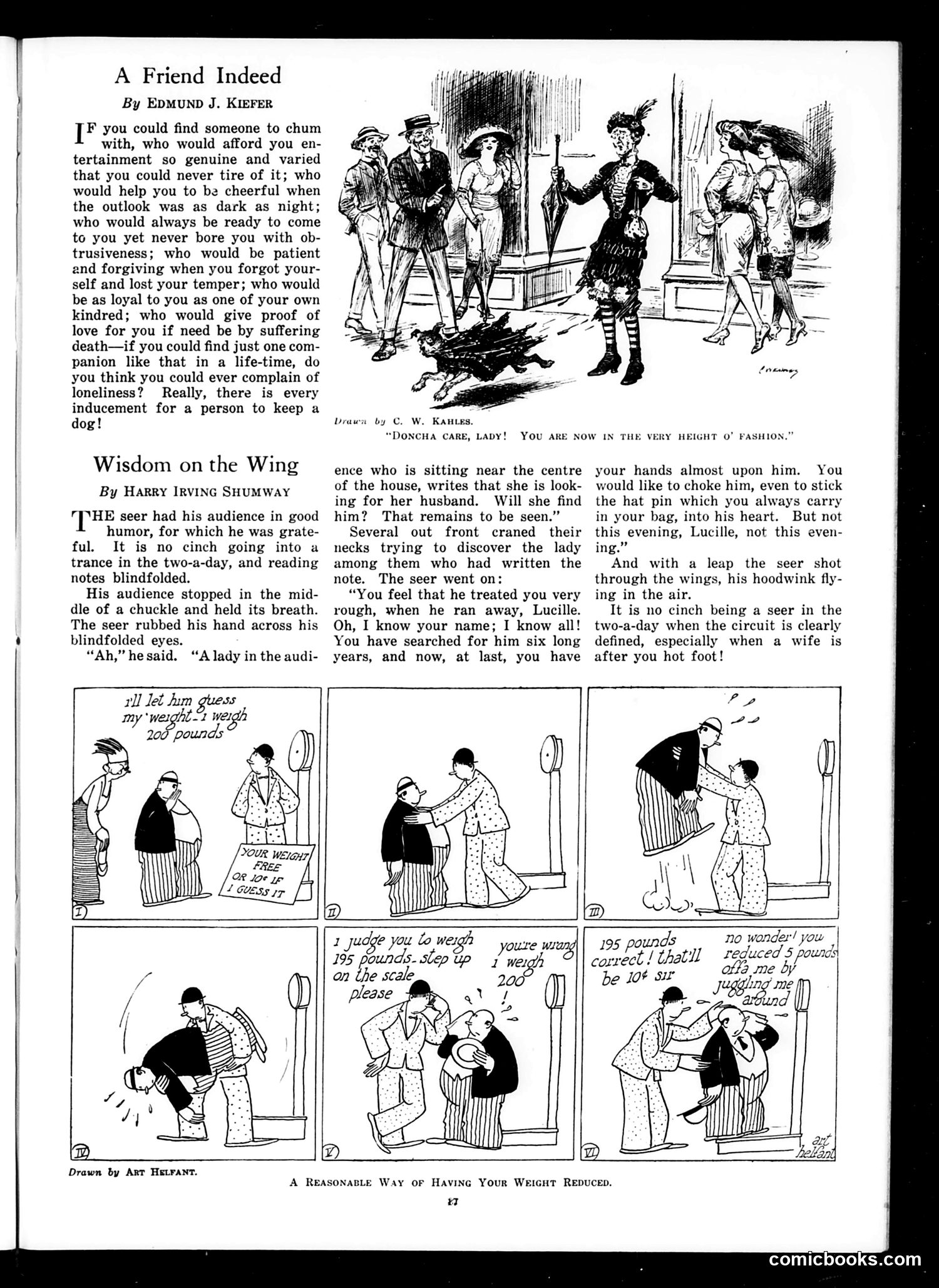
**"A Friend Indeed"** (top): A sentimental essay praising dog ownership, listing virtues like loyalty, entertainment, and unconditional love—positioning dogs as ideal life companions. The accompanying illustration shows a well-dressed group admiring someone's dog. **"Wisdom on the Wing"** (middle): A satirical piece about a stage mind-reader ("seer") performing at a vaudeville theater. The joke: the seer exposes a woman named Lucille searching for her runaway husband of six years, forcing the performer to flee when she realizes she's found him and threatens violence. The satire mocks both fraudulent spiritualist acts and the absurdity of confronting an unfaithful spouse during live performance. **"A Reasonable Way of Having Your Weight Reduced"** (bottom): A six-panel comic strip showing a man attempting to lose weight through increasingly absurd methods—from guessing his weight, to standing on scales, to his wife physically manipulating him—ultimately "reducing" 5 pounds through rough handling. It satirizes fad weight-loss schemes of the era.
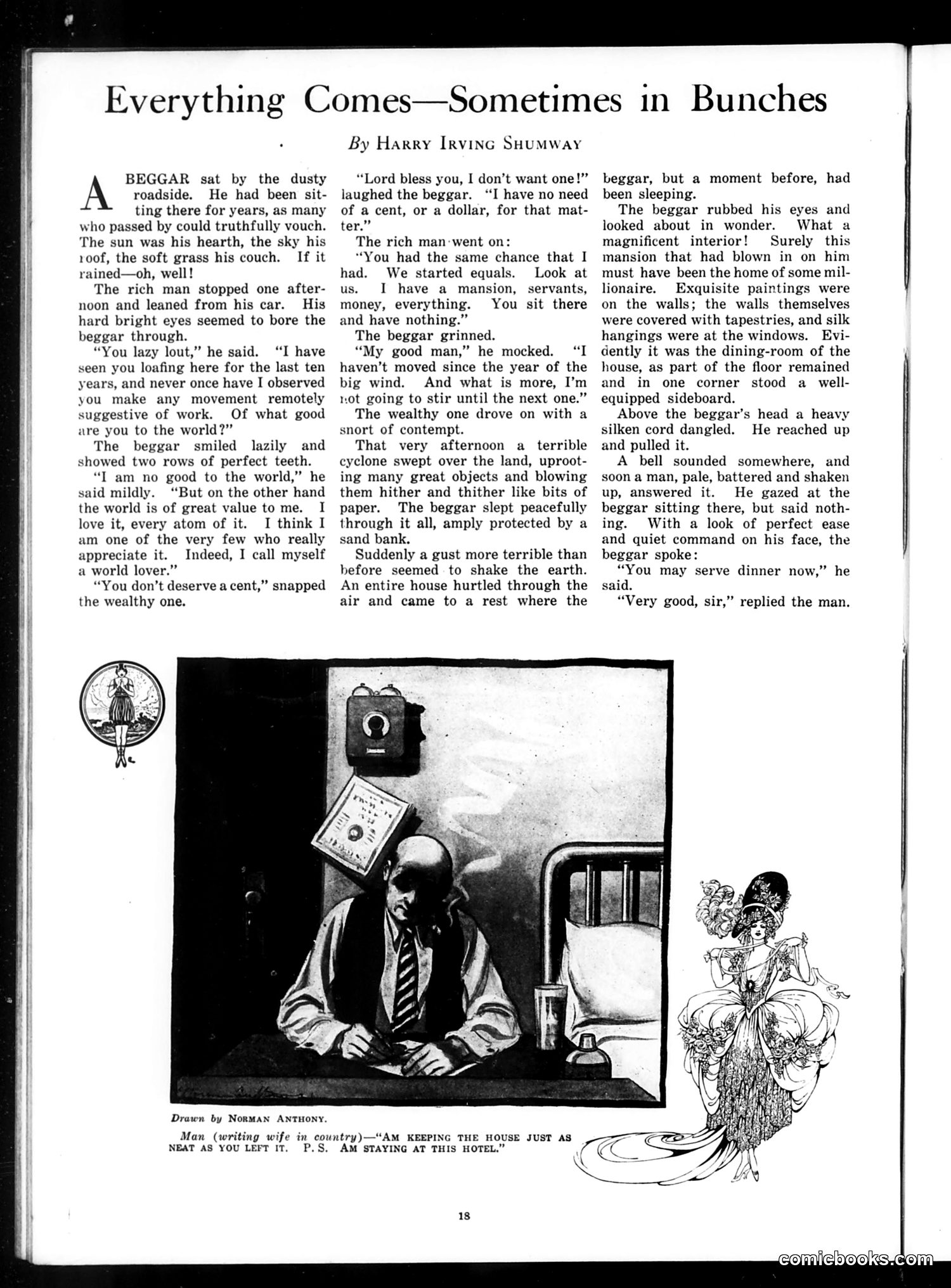
This story satirizes **social mobility and fate** through ironic reversal. A wealthy man confronts a lazy beggar, lecturing him about opportunity and work ethic—the classic "bootstrap" argument. The beggar philosophically accepts his poverty, claiming he loves the world as-is. Then a cyclone delivers poetic justice: it destroys the rich man's mansion but deposits it—intact with servants—directly onto the beggar. The beggar inherits wealth through pure luck, not effort, while the wealthy man loses everything. **The satire's point**: Hard work and moral superiority don't guarantee success; fortune is arbitrary and uncontrollable. The beggar's passivity is vindicated. The story mocks the wealthy man's assumption that poverty reflects laziness or unworthiness, suggesting instead that circumstance—not character—determines fate. It's a Depression-era critique of "self-made" success mythology.
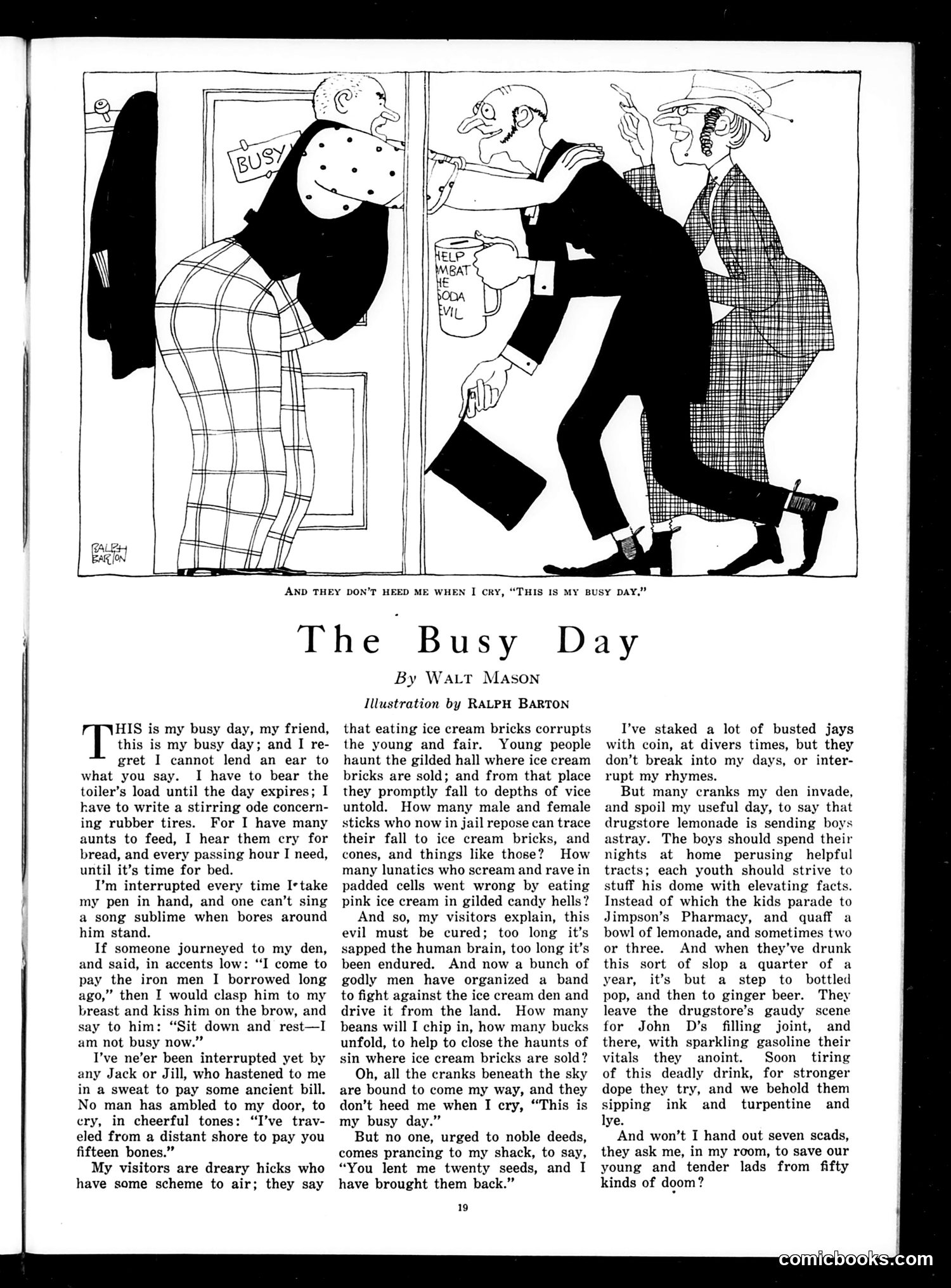
This is a satirical poem with illustration about a common social frustration: being pestered by various people seeking favors or donations when you're trying to work. The cartoon shows the narrator being interrupted by well-meaning visitors who want him to contribute money to reform causes. They obsess over supposed moral dangers—ice cream parlors and drugstore lemonades—claiming these establishments are corrupting youth and leading them to vice, jail, and substance abuse. The satire mocks **moral panic reformers** of the early 20th century who saw danger in seemingly innocuous pleasures. The poet complains that nobody repays borrowed money or shows genuine gratitude, but endless "cranks" arrive demanding donations to crusades against these trivial "evils." The joke: the narrator is busy, but only the virtuous-minded bores interrupt him with righteous causes, while actual obligations go neglected. It's satire on both self-righteous social crusaders and the narrator's inability to say no.
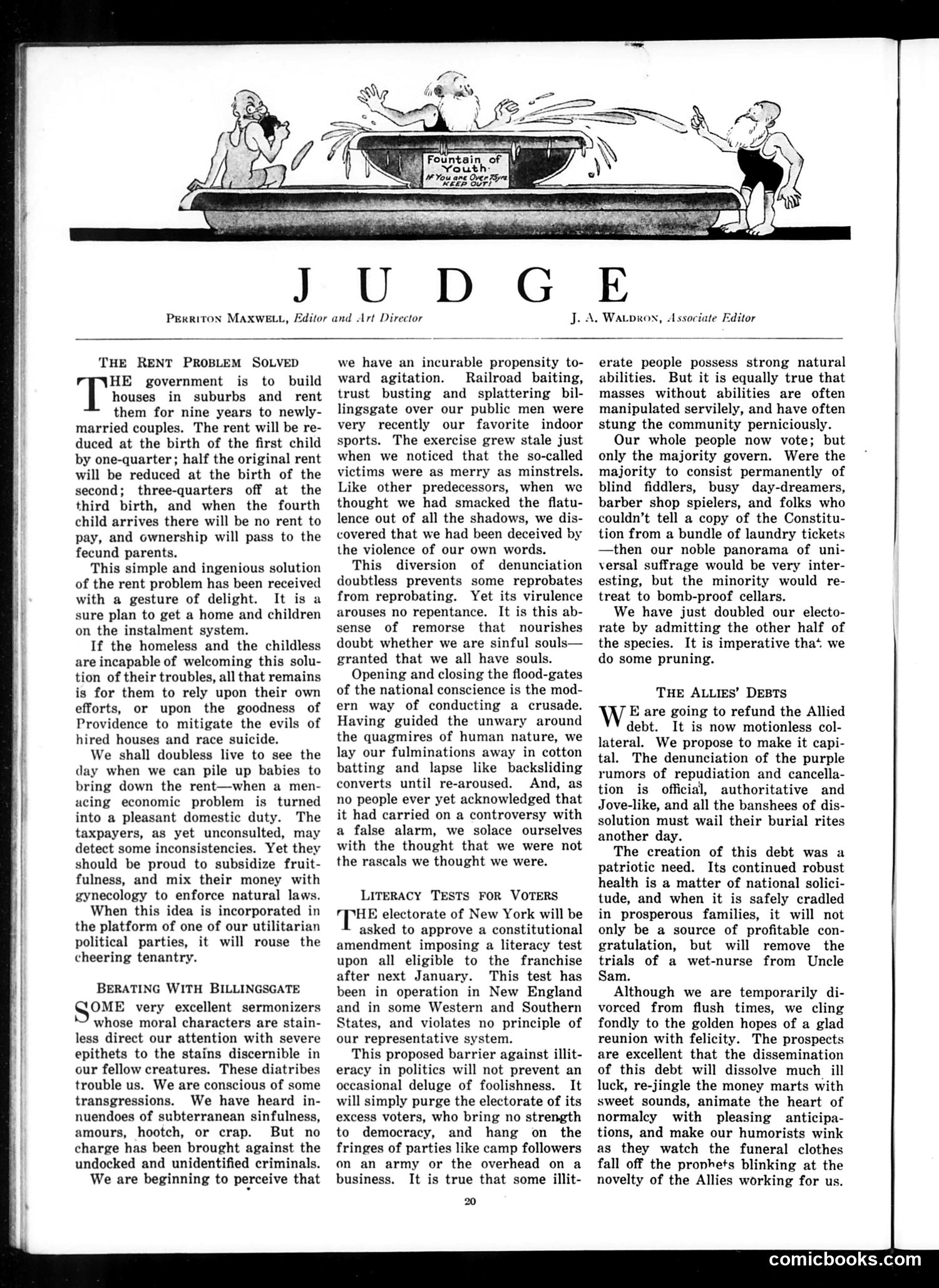
The masthead shows this is from **Judge**, a satirical American magazine edited by Perriton Maxwell. The **"Fountain of Youth"** cartoon at top depicts figures splashing in water labeled with that phrase—likely satirizing promises of rejuvenation or renewal prevalent in the era. The editorial content addresses three contemporary issues: 1. **"The Rent Problem Solved"**: Satirizes a government housing proposal offering reduced rent for newly-married couples with children. Judge mocks this as rewarding reproduction while forcing taxpayers to subsidize "fruitfulness" and "gynecology." The sarcasm suggests skepticism about government incentivizing large families. 2. **"Berating with Billingsgate"**: Criticizes American's tendency toward moral crusading—attacking railroads, trusts, and public figures with harsh rhetoric—while achieving little actual reform. Judge notes these "victims were as merry as minstrels," suggesting the attacks were ineffectual. 3. **"Literacy Tests for Voters"**: Defends imposing literacy requirements for voting eligibility, framing it as removing "excess voters" without merit—reflecting period anxieties about immigration and democratic participation.
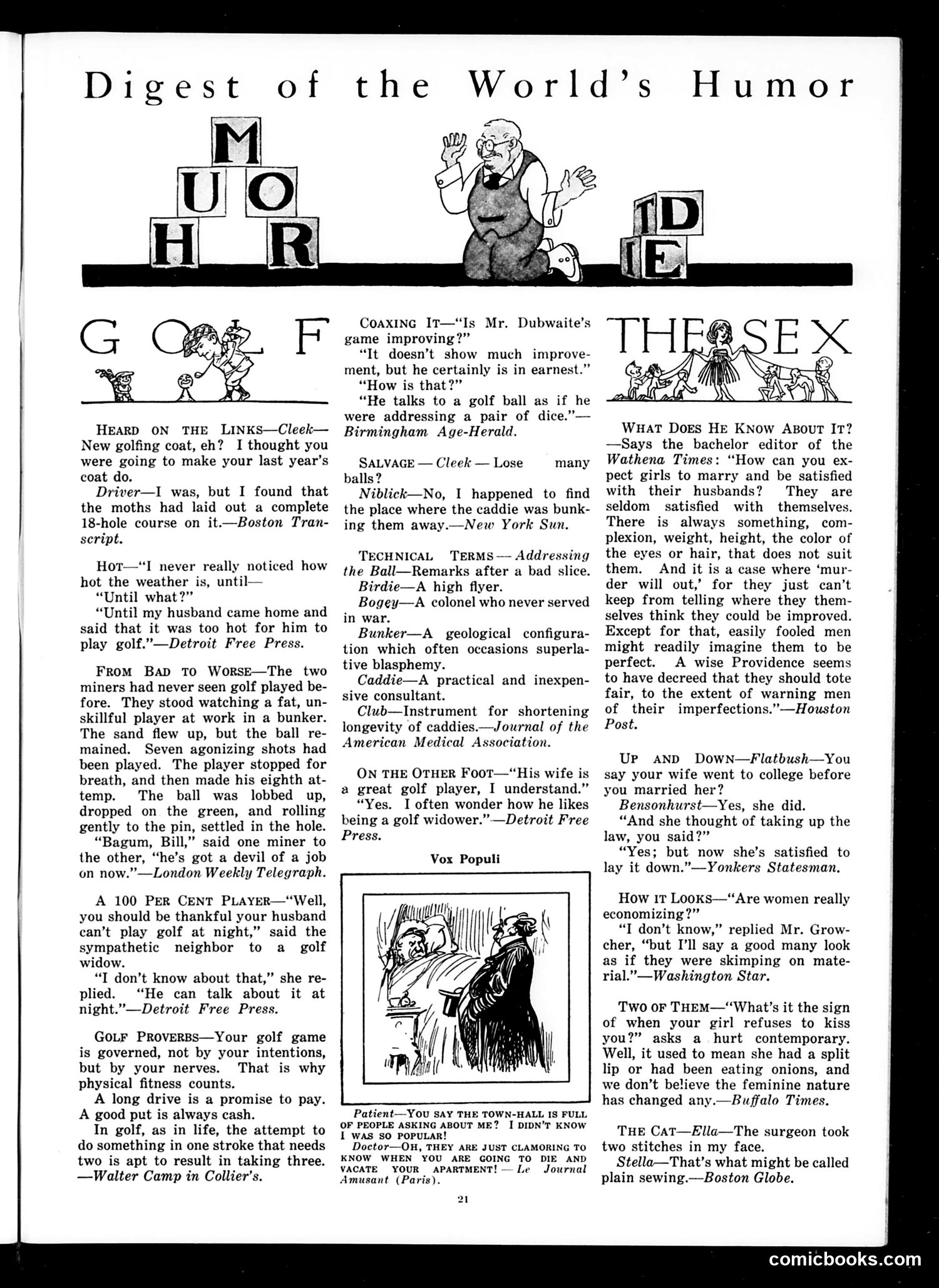
This page from *Judge* magazine presents golf-themed humor from the early 20th century. The jokes satirize several social attitudes: **Golf as male obsession**: Multiple jokes mock husbands prioritizing golf over domestic life—the "golf widow" concept appears twice, with wives frustrated by men's devotion to the sport. **Gender dynamics**: A bachelor editor criticizes women for being perpetually dissatisfied with themselves, arguing they can't keep secrets about their imperfections. This reflects period-typical misogyny packaged as humor. **Class and sport**: Golf references suggest upper-middle-class leisure culture. Technical golf terminology gets mock-definitions (e.g., "Bogey—A colonel who never served in war"), poking fun at the sport's pretension. **The Vox Populi cartoon** shows a doctor telling a sick patient that townspeople are eager to know when he'll die so they can rent his apartment—dark humor about urban competition for housing and indifference. Overall, this digest reflects early-1900s gender relations, class anxieties, and the cultural dominance of golf among the leisured classes that *Judge* served.
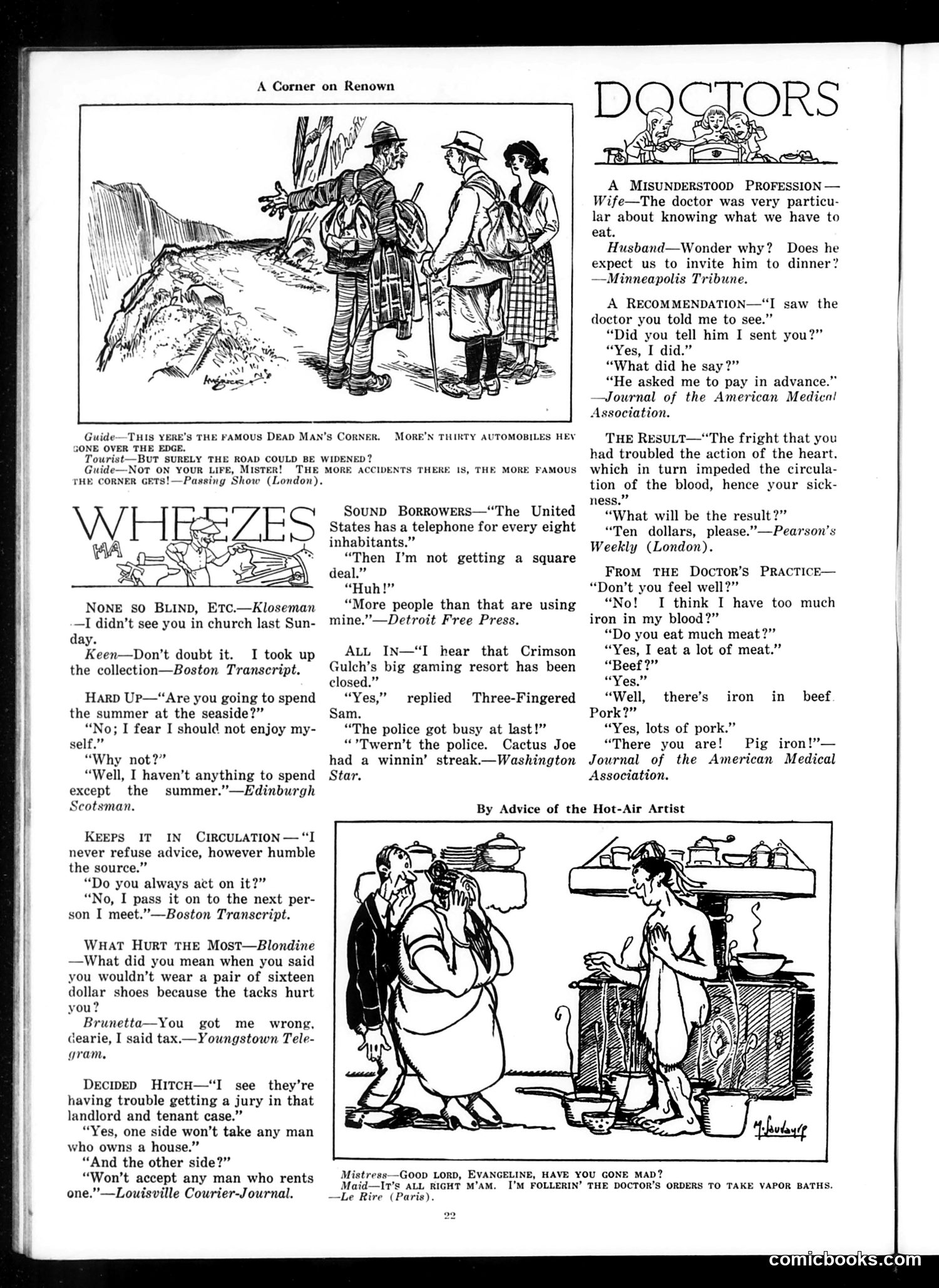
This page from *Judge* magazine collects short humorous anecdotes and jokes satirizing various professions and social situations. The main content focuses on the "Doctors" section, which mocks physicians through several scenarios: **The Doctors Jokes** ridicule physicians for: - Being overly concerned with patients' diets (yet not inviting them to dinner) - Demanding advance payment before treatment - Offering vague diagnoses that blame patients' diets, then charging fees - Making absurd nutritional conclusions (confusing "pig iron" with actual pork consumption) **"Dead Man's Corner"** cartoon depicts tourists at a famous accident location, satirizing how dangerous roads gain notoriety, attracting more accidents—suggesting ironic logic in naming hazardous spots. The other brief jokes mock wealth disparities, advice-passing, tax confusion, and jury selection bias regarding property ownership. The final cartoon shows a maid following a doctor's "vapor bath" orders literally—creating household chaos—a slapstick joke about misinterpreting medical advice. The humor relies on wordplay, logical absurdities, and class observations typical of early 20th-century American satire.
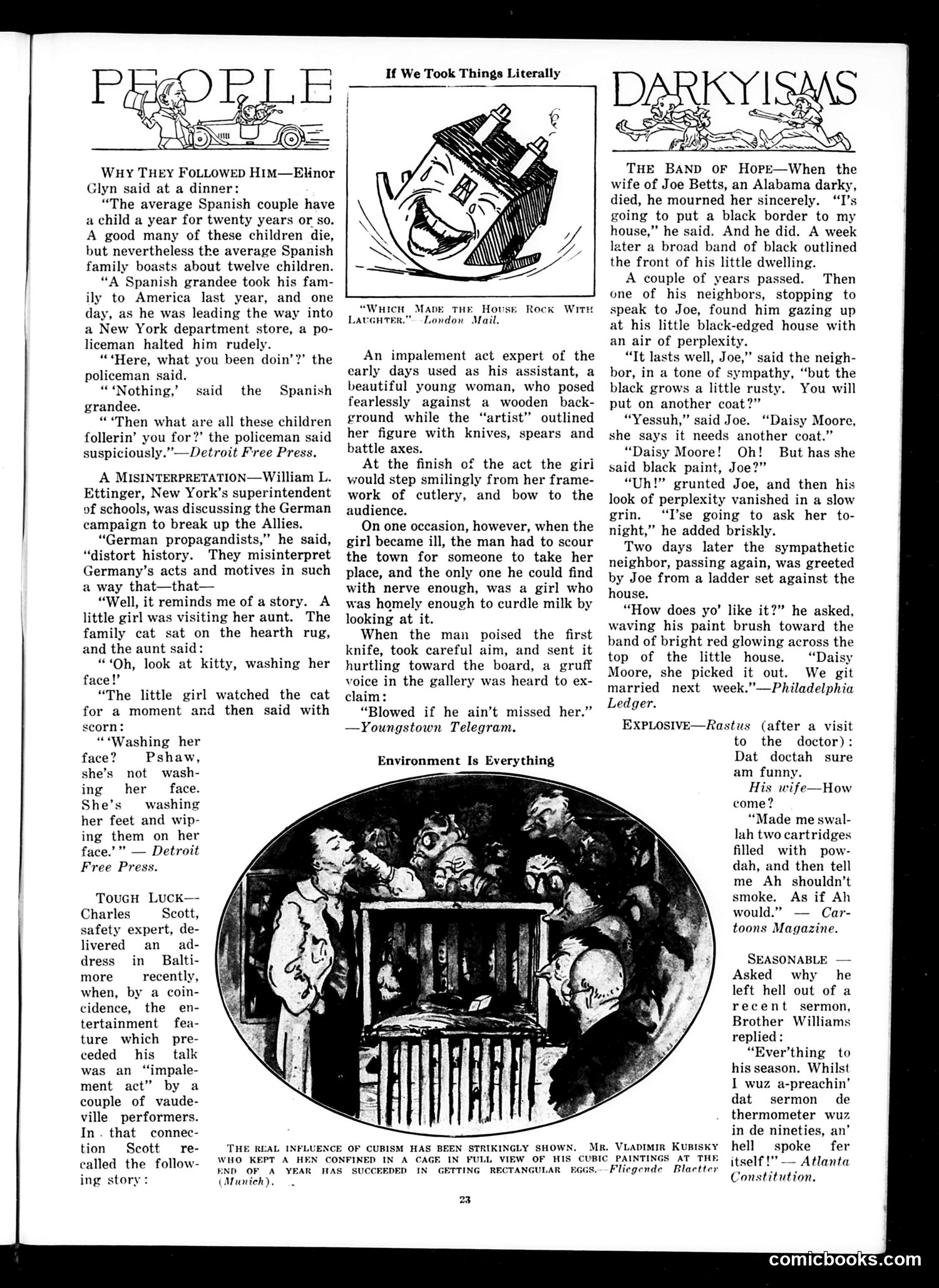
This page contains several humorous anecdotes typical of early 20th-century American satire: **"Why They Followed Him"** mocks Spanish immigrants' large families through a story where a policeman assumes a Spanish man with many children must be committing a crime—a crude ethnic stereotype about reproductive rates. **"A Misinterpretation"** uses a children's story to critique German propaganda during WWI, comparing distortion of facts to a child's illogical reasoning about a cat washing itself. **The central cartoon "Environment Is Everything"** references cubism (the modern art movement) through an artist named Vladimir Kubisky who supposedly influences chickens to lay rectangular eggs—satirizing how environment shapes outcomes, while mocking cubism as absurd. **"The Band of Hope"** is a racist dialect story about an Alabama Black man who paints a mourning border on his house, then jokes about courting a woman named Daisy Moore—trivializing grief while using demeaning stereotypes. The page reflects Judge's typical early-1900s approach: mixing WWI commentary with ethnic and racial mockery considered acceptable humor of that era.
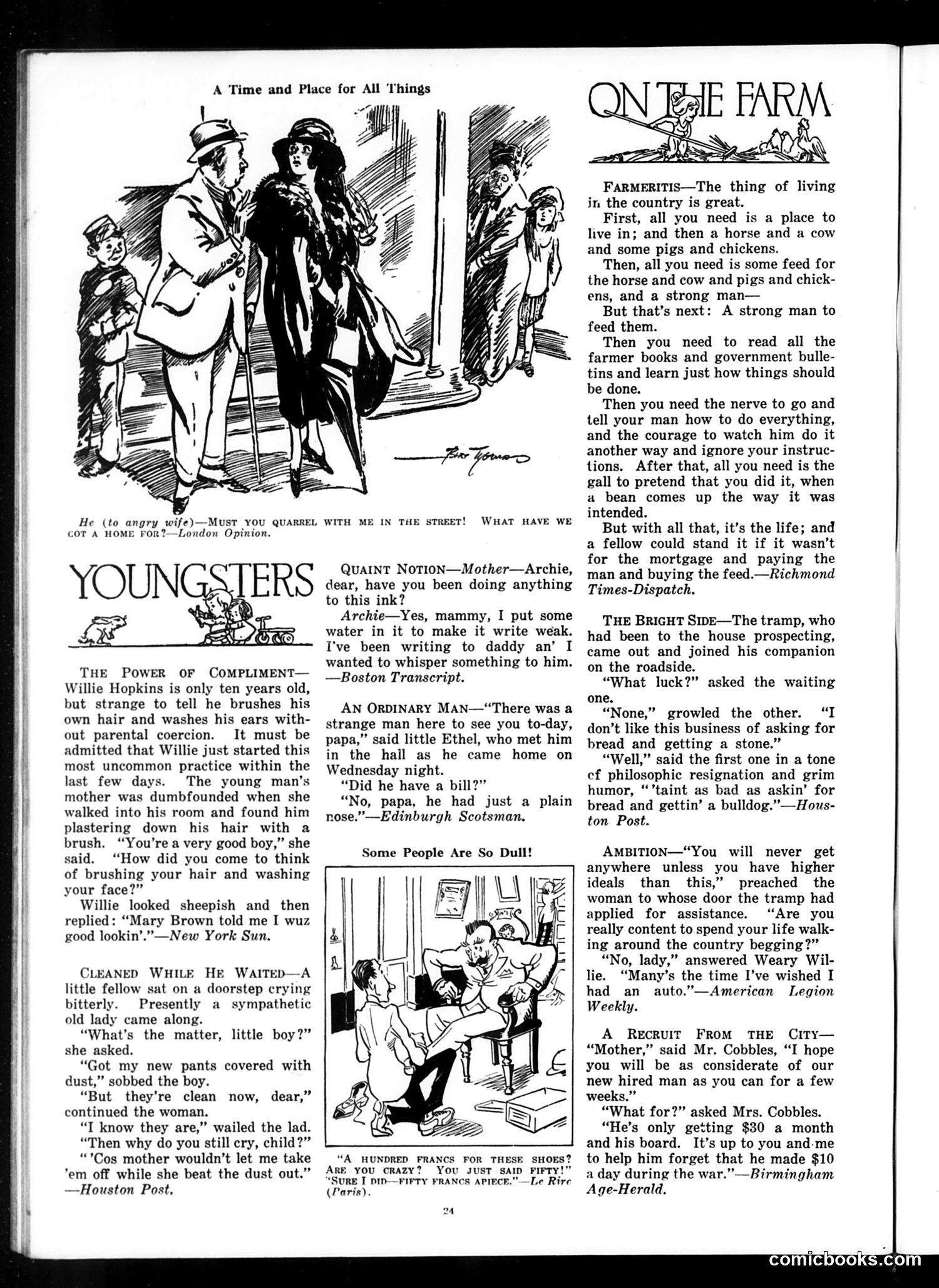
This page from the satirical magazine *Judge* contains multiple humorous anecdotes and cartoons mocking social conventions and human folly. **Main cartoon** (top left): A couple quarreling publicly on the street while onlookers stare. The husband protests their domestic dispute belongs "at home," satirizing Victorian propriety and the gap between public respectability and private behavior. **Anecdotes below** use ironic humor about everyday situations: a boy cleaning his pants while being beaten, a child diluting ink to "whisper" to his father, a girl describing a visitor by his "plain nose" rather than his business. Each joke plays on childlike logic or verbal misunderstandings for comic effect. **"Farmeritis" section**: A satirical piece mocking the romanticized notion of rural life, listing its supposed charms (land, animals, reading farming manuals) before revealing the harsh reality: impossible mortgages and endless labor. **Tramp anecdotes**: Multiple jokes about vagrants, including one where a tramp reveals his "higher ambition" is owning an automobile—satirizing the era's obsession with automobiles and the gap between social classes. The overall tone reflects early 20th-century middle-class anxieties about propriety, labor, and modernity.
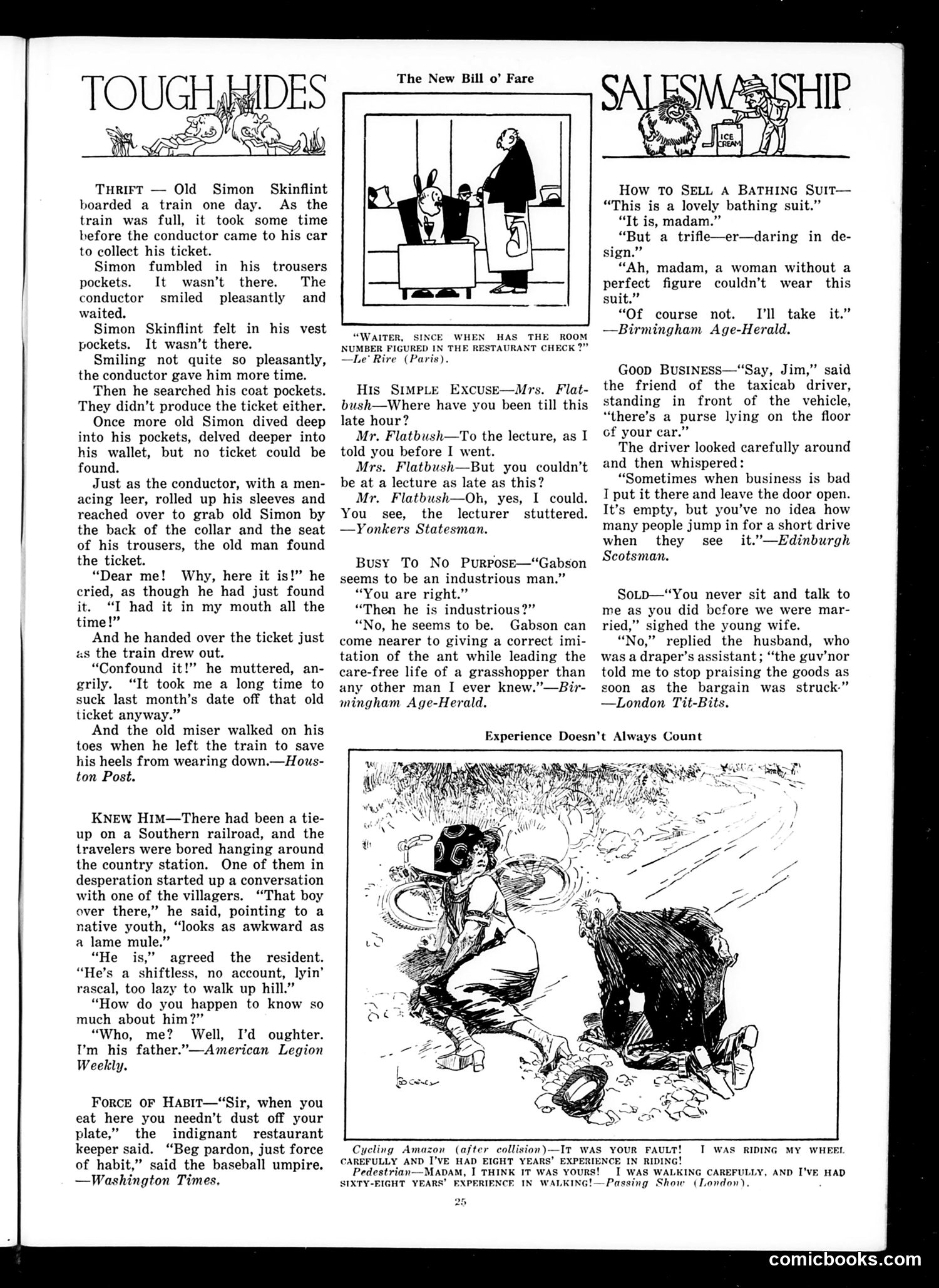
This page contains four short humorous anecdotes satirizing human nature and social types: **"Thrift"** mocks extreme penny-pinching: Old Simon Skinflint reuses a train ticket by sucking off the old date rather than buying a new one—prioritizing a few cents over dignity. **"Knew Him"** uses rural stereotyping for comedy: A traveler insults a local boy as "awkward as a lame mule," only to learn the villager is the boy's father, who confirms he's worthless—playing on rural/rural-dweller caricatures common to the era. **"Force of Habit"** makes a baseball reference: An umpire habitual dust-off gesture at a restaurant parallels his profession's obsessive plate-dusting ritual. **"Bathing Suit" sales pitch** uses flattery as manipulation: A salesman overcomes customer objections by implying only attractive women could wear a revealing suit—satirizing deceptive sales tactics. The bottom cartoon, "Experience Doesn't Always Count," shows a bicycle collision where the experienced rider ironically caused the accident despite six-eight years' experience. These are gentle, observational humor pieces typical of Judge's satirical tone.
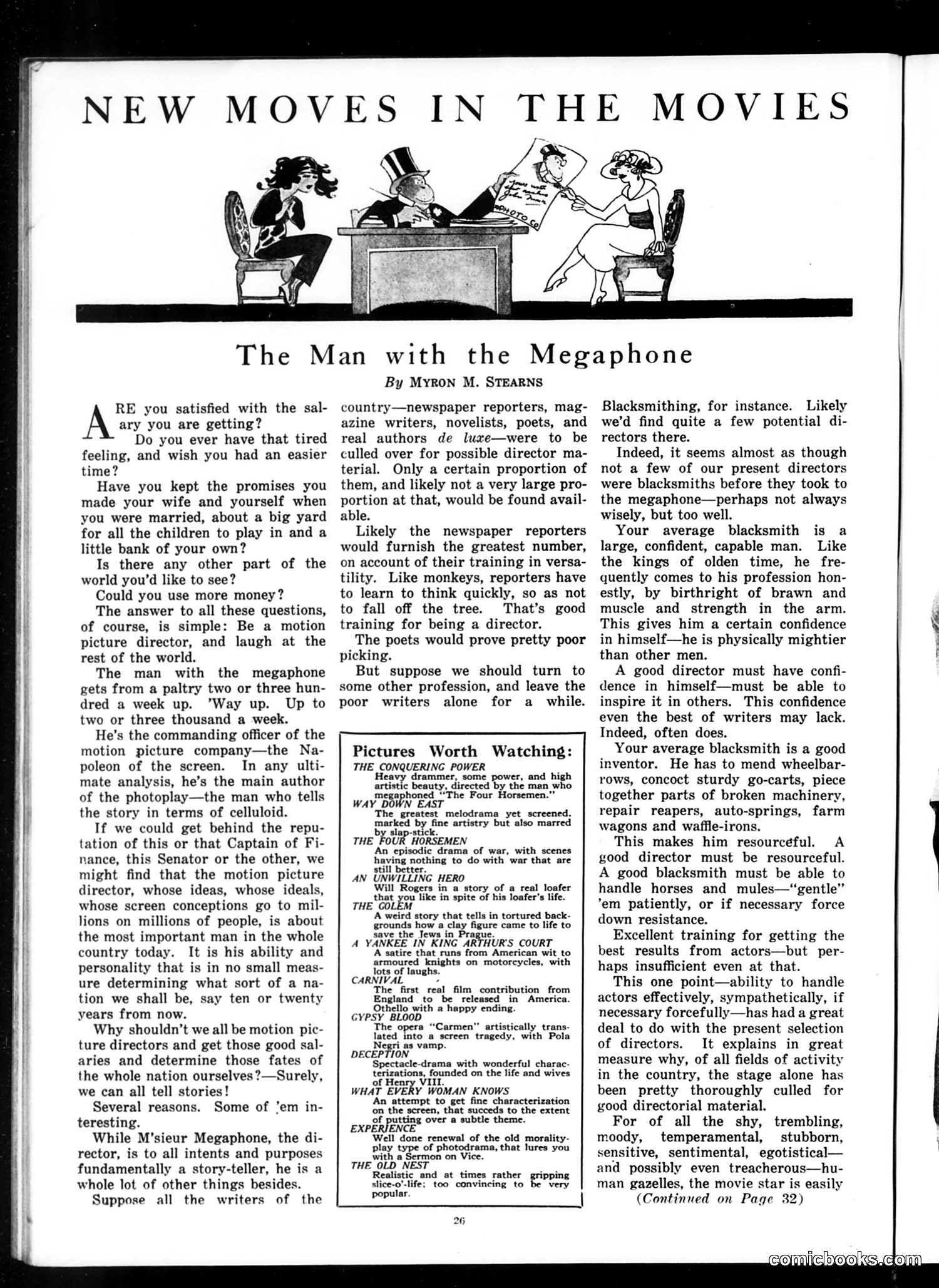
This article satirizes the inflated prestige and salaries of 1920s film directors. The cartoon header depicts a director at a desk, literally commanding attention through a megaphone, positioning him as an authority figure. The piece argues that while film directors wield enormous cultural influence—shaping national character through what millions see—they're fundamentally storytellers. The author notes that most directors come from journalism, where reporters learn quick thinking (comparing them to "monkeys" learning not to fall off trees). Poets, by contrast, would make "pretty poor" directors. The satire's point: yes, directing offers wealth and power, but it requires specific skills beyond mere storytelling ability. The title's megaphone represents not just the director's tool, but his outsized cultural authority in the early cinema era. The article undercuts the romantic notion that anyone can direct by suggesting the profession demands particular personality traits and training—a reality the casual observer misses.
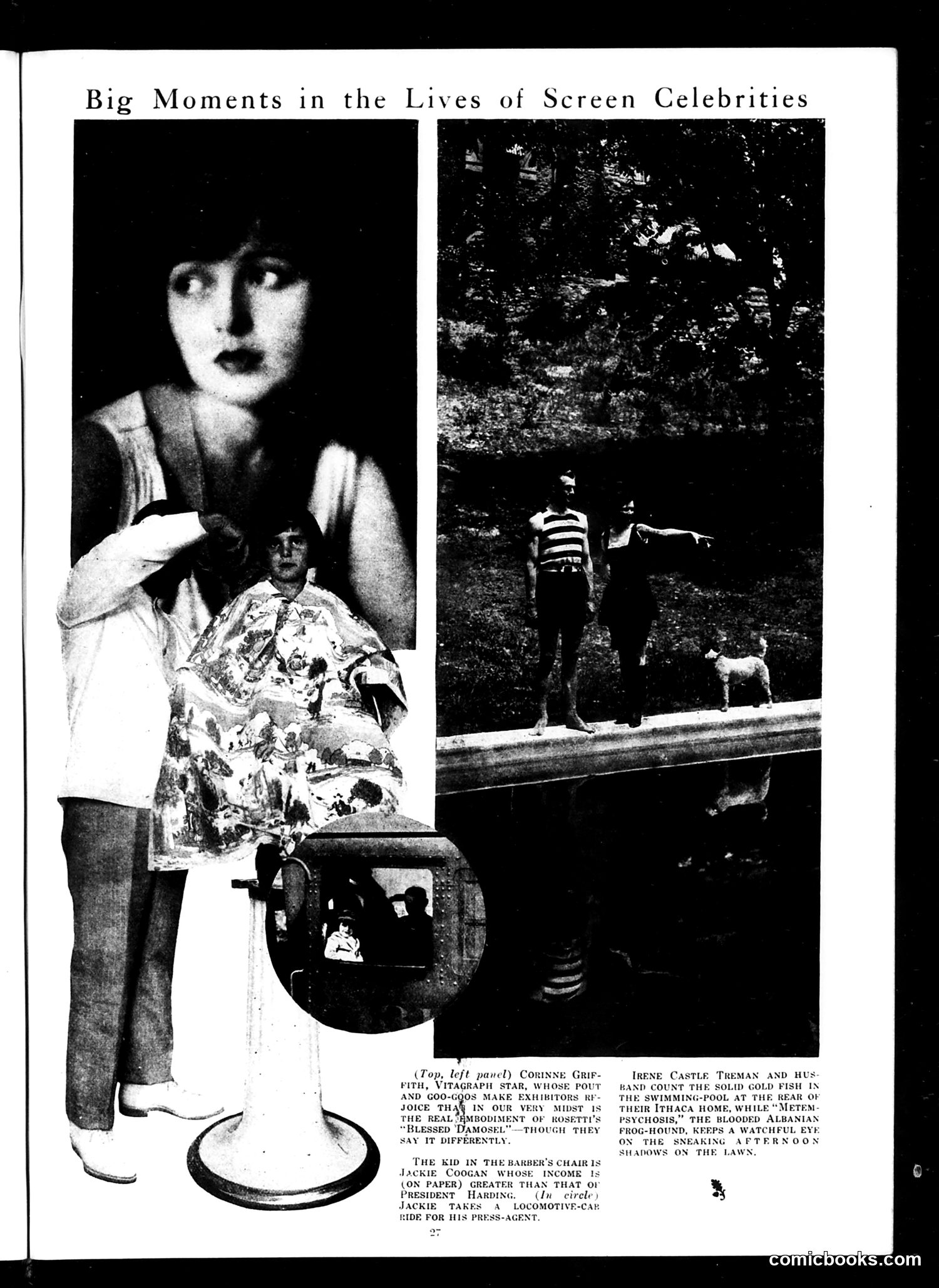
This page from *Judge* magazine features celebrity gossip presented as "Big Moments in the Lives of Screen Celebrities." The left panel shows Corinne Griffith, a Vitagraph film star, with a humorous caption about her perfume and religious devotion. Below that, Jackie Coogan (child actor) is noted as earning more income than President Harding—a satirical jab at the absurdity of celebrity wealth versus political salaries during the early 1920s. The right panel depicts Irene Castle Treman and her husband at their Ithaca home's swimming pool, with their pet dog being watchfully guarded. The satire targets the extravagant lifestyles and pet-keeping obsessions of Hollywood's elite, contrasting their leisured pursuits with ordinary Americans' concerns. The overall tone mocks celebrity culture's superficiality.
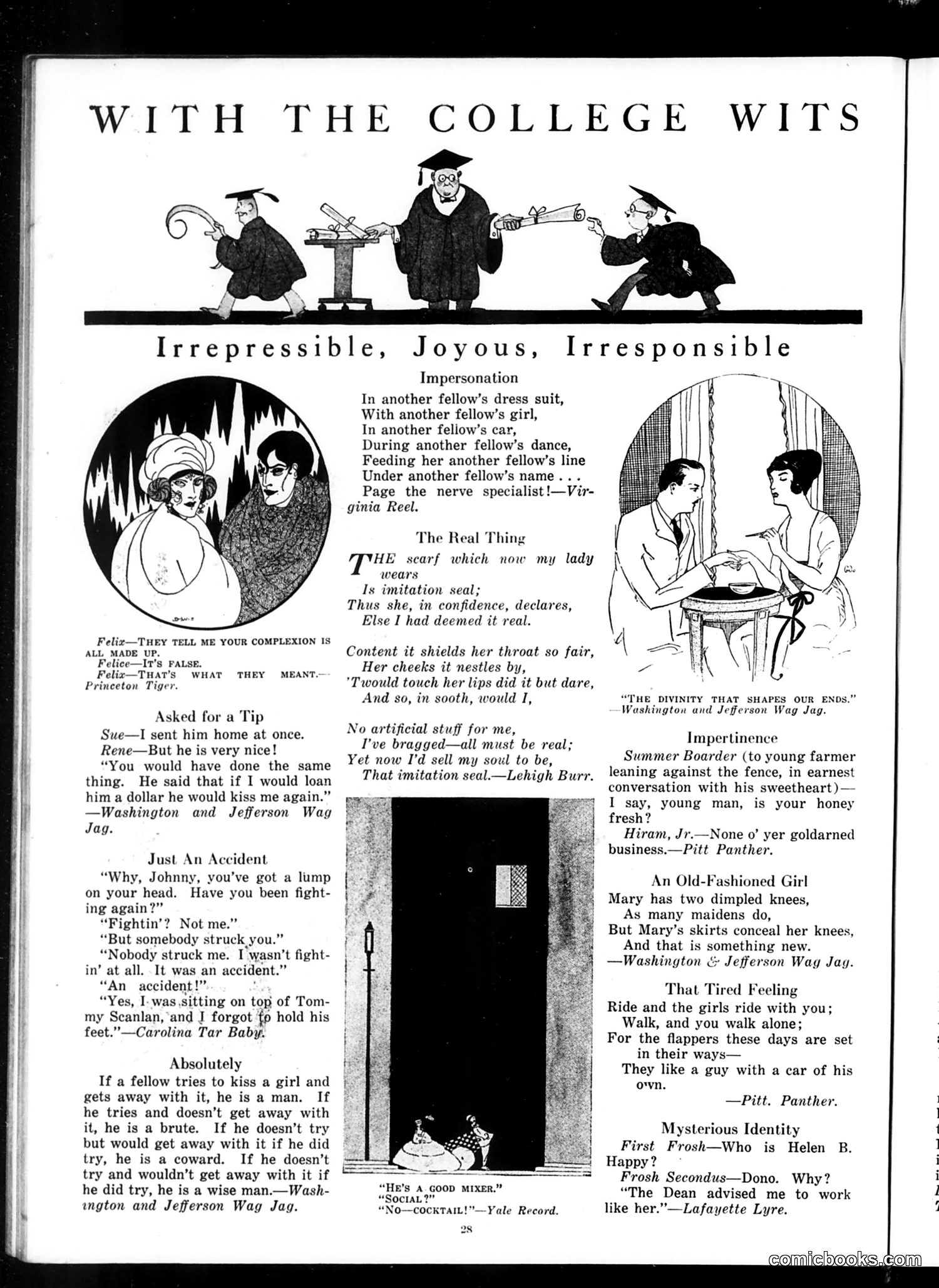
This page collects humorous quips and cartoons satirizing 1920s college and social life. The header cartoon shows three scholars on a seesaw labeled "Irrepressible, Joyous, Irresponsible"—likely mocking the stereotype of frivolous college students. The jokes target young people's behavior: flirtation and kissing etiquette ("Absolutely"), dating deception ("Impersonation"), materialism disguised as romance ("The Real Thing"—a man preferring his girlfriend's fake fur stole to her actual affection), and automobiles as status symbols ("That Tired Feeling"—girls only date boys with cars). Several jokes mock modesty and appearance: the "Old-Fashioned Girl" references changing hemlines; "Feliz/Felice" jokes about makeup as deception. The page represents *Judge* magazine's satirical approach to Jazz Age excess, targeting wealthy college students' superficiality, materialism, and moral flexibility. The cartoons come from various college publications (Yale Record, Pitt Panther, Lafayette Lyre), reflecting widespread campus humor.
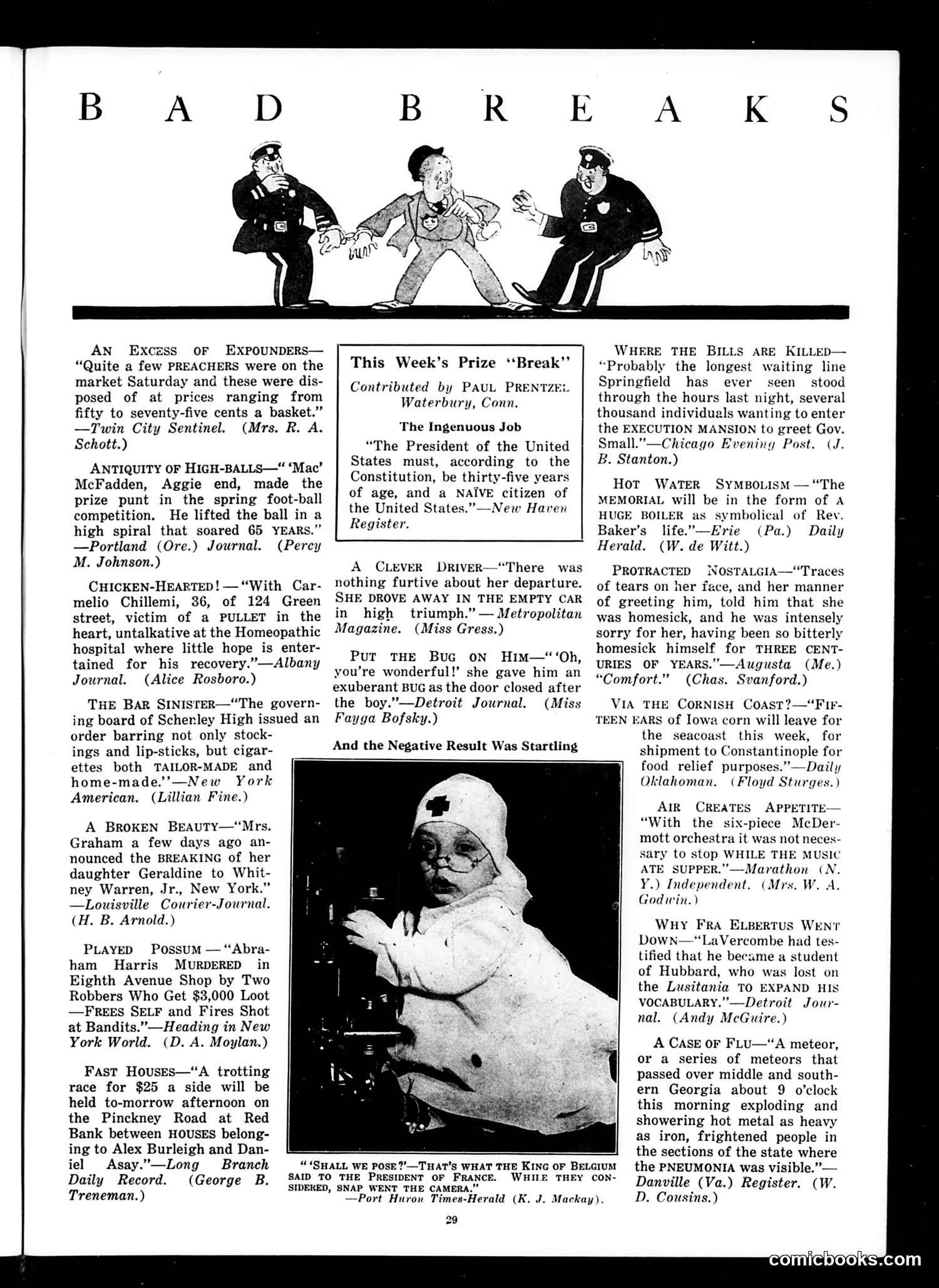
This page from *Judge* magazine collects humorous "breaks"—unintentional comedic errors from newspaper typesetting and reporting. The central cartoon shows three figures (appearing to be authority or press figures) confronting a bandaged, wrapped figure, likely satirizing absurd newspaper content. The "breaks" exploit malapropisms and nonsensical phrasings from actual published articles: - Preachers sold "by the basket" (misplaced modifiers) - A football punt that "soared 65 YEARS" (absurd measurements) - Someone killed by a "PULLET" (chicken, not bullet) - "THREE CENTURIES OF YEARS" homesickness - Orchestra music that "ATE SUPPER" The humor relies on readers recognizing how careless editing produces ridiculous, unintentionally funny newspaper prose. The page mockingly attributes these errors to various newspapers via credited readers, suggesting widespread journalistic sloppiness of the era.
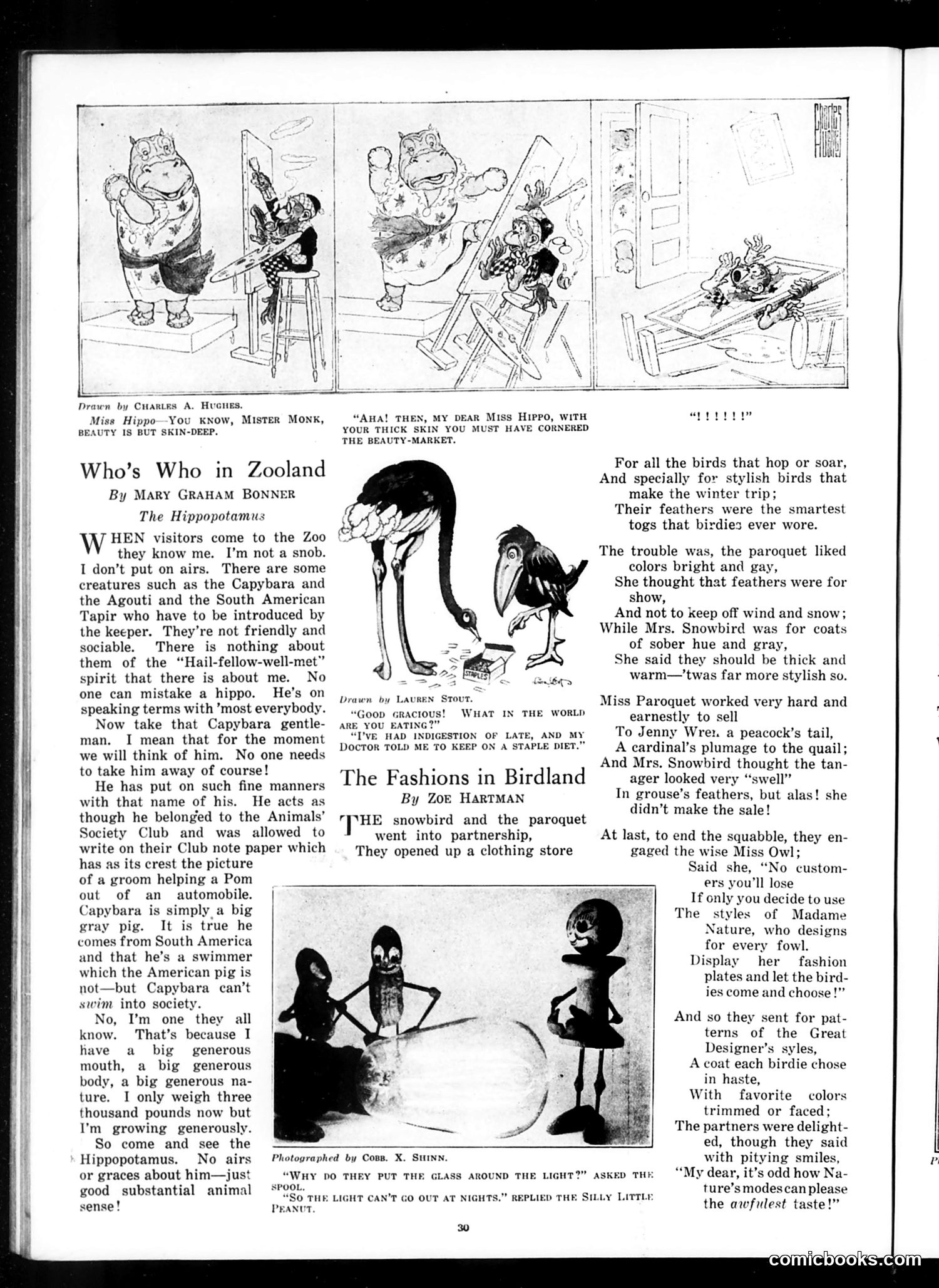
This Judge magazine page contains three satirical pieces: **"Who's Who in Zooland"** features a hippopotamus character praising its own sociability while mocking snobbish zoo animals like the Capybara. The joke plays on class pretensions—the hippo's self-awareness about its "three thousand pounds" and "generous nature" satirizes those who claim friendliness while being obviously self-serving. The title suggests the hippo mistakenly thinks itself important society. **"The Fashions in Birdland"** satirizes female partnership disputes through bird characters. A paroquet (parrot) and snowbird open a clothing store with conflicting aesthetics—one prefers showy colors, the other practical warmth. They consult "Miss Owl" (wisdom) who resolves it by suggesting following nature's designs. This likely mocks women's fashion industry disagreements or debates about women's practical versus decorative clothing choices. **Accompanying humor** includes a child's joke about light bulbs, demonstrating the publication's variety of comedy levels. The tone is lighthearted social commentary on vanity, class, and gender roles through animal personification—typical Judge magazine fare.
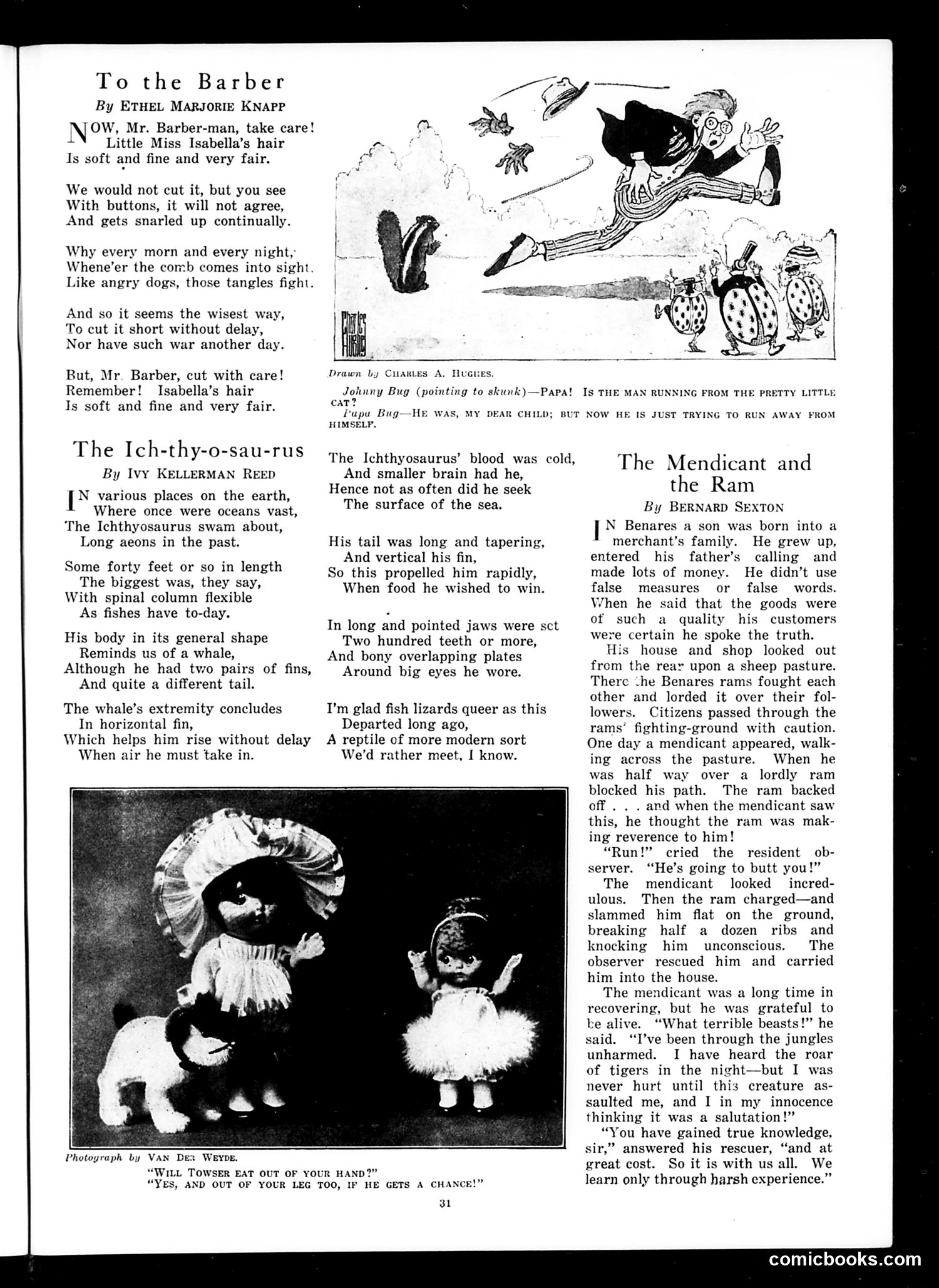
This page contains three distinct pieces of children's literature and humor: **"To the Barber"** is a cautionary poem about a girl's tangled hair. The accompanying cartoon (by Charles A. Hughes) shows a woman chasing a fleeing barber, illustrating the humorous dilemma: the child's hair is beautiful but perpetually snarled, requiring either constant combing battles or a haircut—a common domestic frustration for the era. **"The Ich-thy-o-sau-rus"** is an educational poem about prehistoric marine reptiles, typical of early 20th-century children's magazines mixing instruction with verse. **"The Mendicant and the Ram"** is a moral fable (by Bernard Sexton) about a merchant's son and a beggar in Benares. When a ram charges the mendicant, he initially mistakes the aggressive approach for respectful bowing. After being severely injured, he learns that harsh experience teaches true wisdom—a somewhat dark moral for children's literature. The page also includes humorous photo captions about dogs and bugs, characteristic of Judge's mixed content approach blending satire, instruction, and family humor.
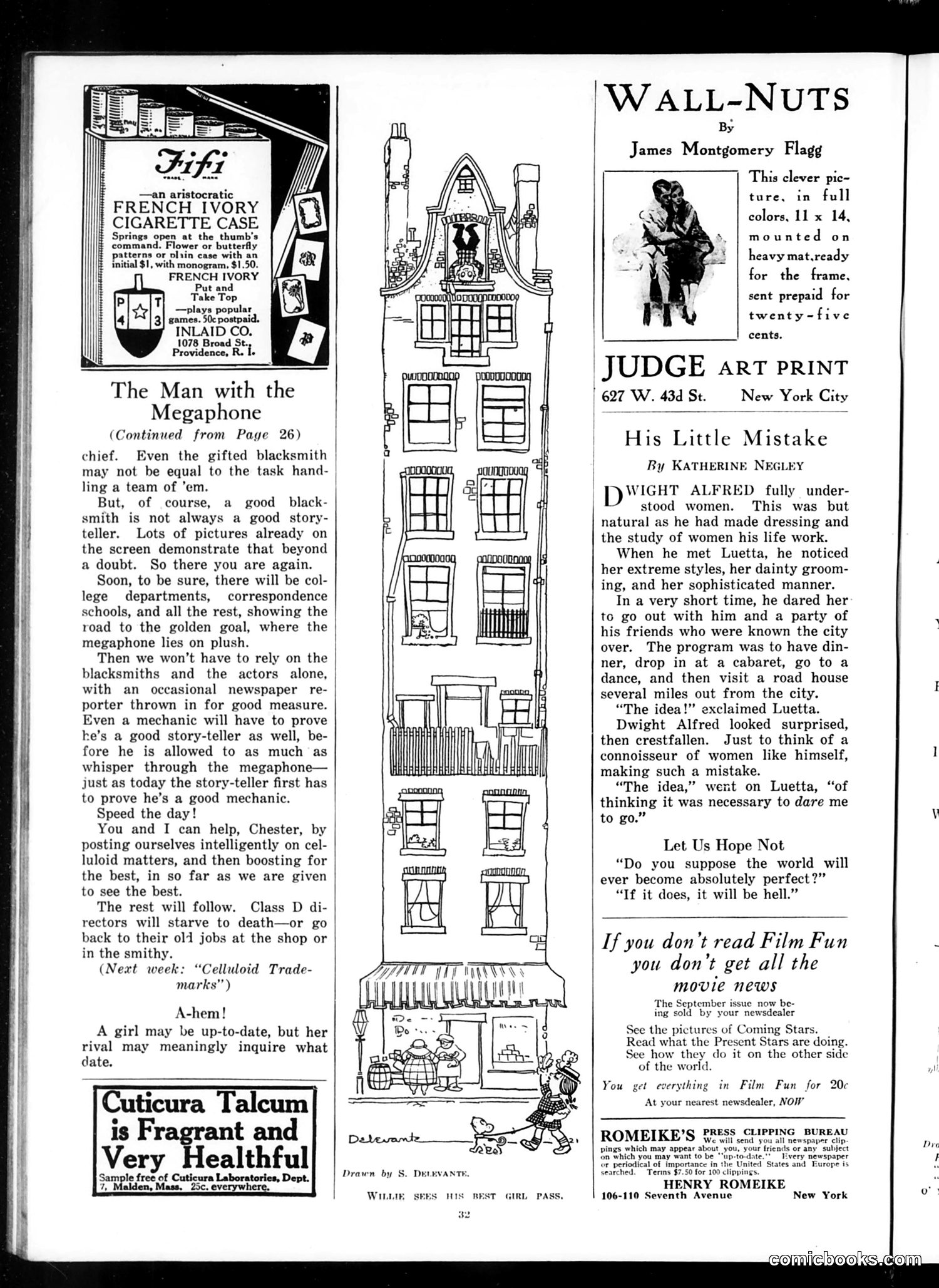
This page is primarily **advertising and serialized fiction**, not political satire. The main content includes: **"The Man with the Megaphone" (continued story):** A discussion about early film directors and screenwriting craft. The piece argues that aspiring film directors need both technical skill and storytelling ability—comparing them to blacksmiths who must also be good storytellers. It's a meta-commentary on the emerging film industry's professionalization. **"His Little Mistake" (short story):** A romantic narrative where a sophisticated man misreads a woman's character, assuming she needs to be "dared" into adventurous behavior when she's already willing. **Supporting content:** A famous James Montgomery Flagg illustration, product advertisements (French Ivory cigarette cases, Cuticura Talcum), and advertisements for Judge's sister publication *Film Fun*. The page reflects 1920s concerns about Hollywood's growing professionalization and contains typical period romance fiction and advertising.
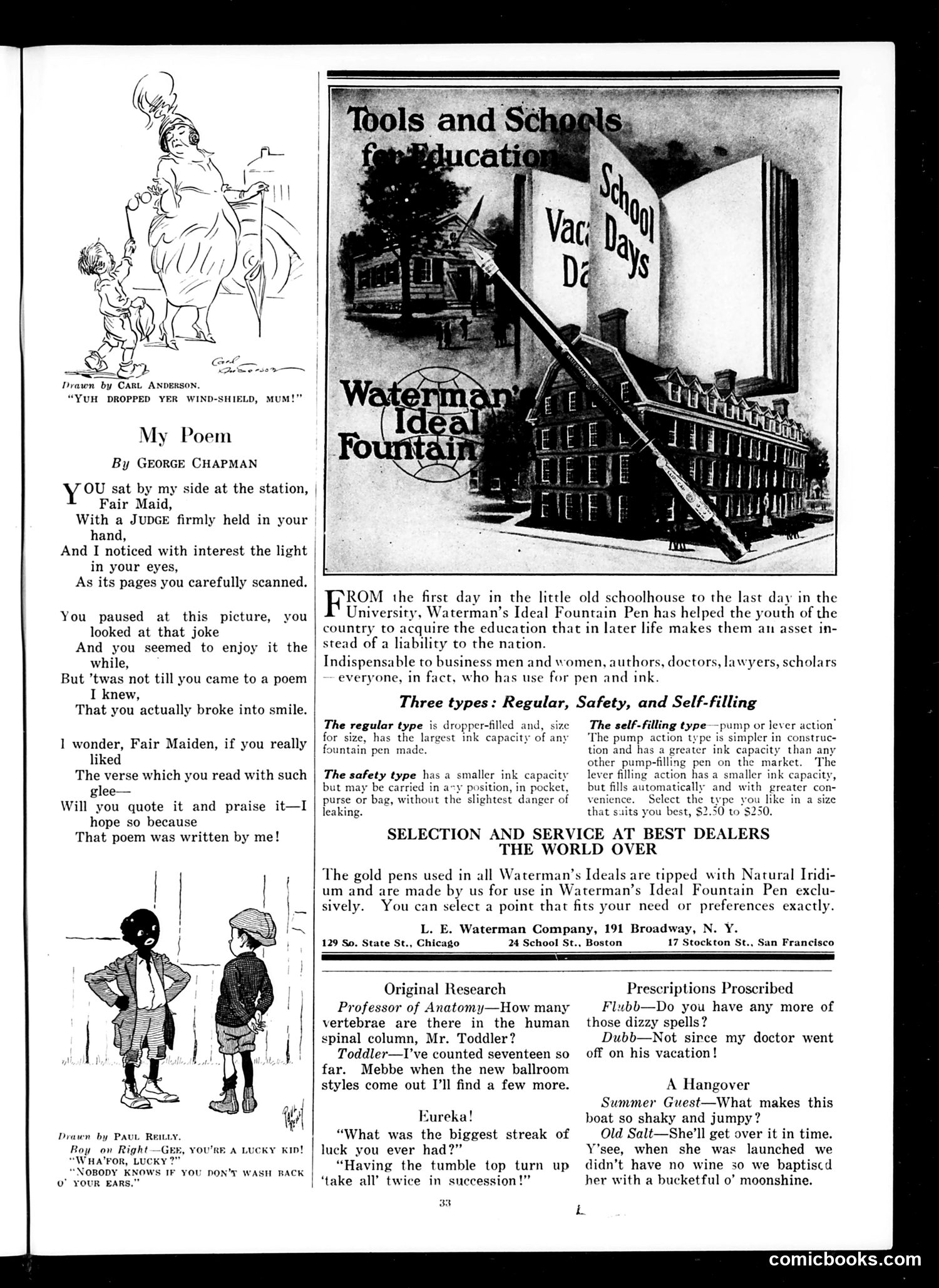
This page contains mostly **advertisements and light humor**, not political satire. The **Waterman's Ideal Fountain Pen ad** dominates the right side, using education as its marketing angle—claiming the pen has aided students "from the first day in the little old schoolhouse to the last day in the University." This reflects early 20th-century consumer advertising that tied products to social values. The **cartoons and jokes** are domestic humor: - Carl Anderson's cartoon shows a woman losing her car's windshield - Paul Reilly's drawing depicts children, with a caption about not washing ears - The "Original Research" and "Prescriptions Proscribed" sections contain gentle wordplay about vertebrae, "ballroom styles" (likely referencing 1920s fashion), and a doctor's vacation **Chapman's poem** is self-promotional verse about impressing a woman reading *Judge* magazine itself—meta-advertising for the publication. The **"Hangover" joke** references Prohibition-era moonshine, a timely reference if this is from the 1920s. Overall: a light-hearted entertainment and advertising page rather than political commentary.
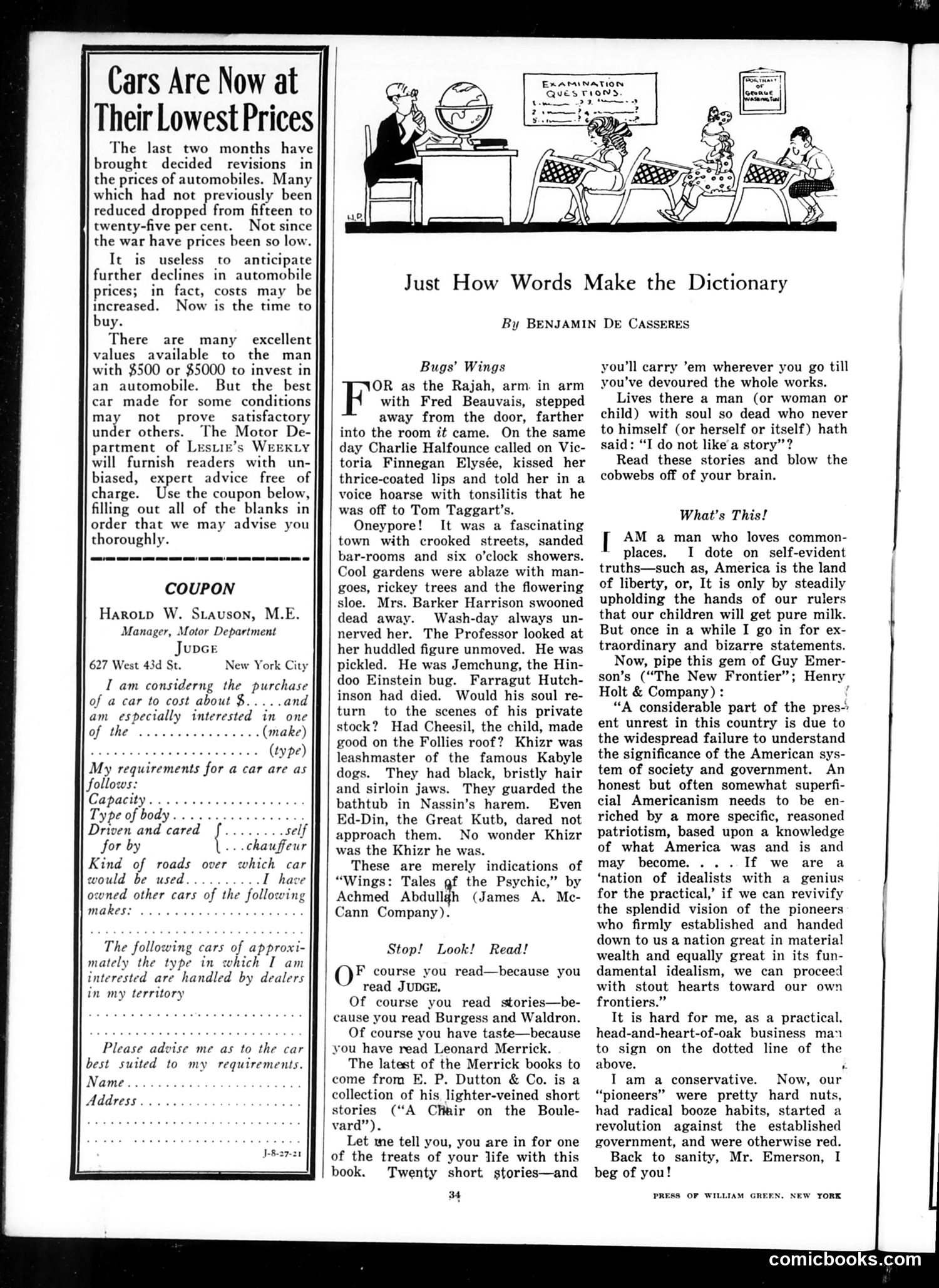
This page mixes automotive advertising with literary content typical of 1920s satirical magazines. **Left side:** A car-buying guide coupon from Leslie's Weekly, capitalizing on post-WWI automobile price drops (15-25% reductions). The Motor Department offers free expert advice to potential buyers with budgets from $500-$5000—substantial sums for the era. **Right side:** The content includes: - A cartoon showing an "Examination Questions" scene with figures taking a test - "Bugs' Wings," a deliberately absurdist short story parody by Benjamin De Casseres—a pseudo-intellectual piece stringing together exotic names (Rajah, Jemchung, Khizr) and nonsensical plot points, likely mocking overwrought literary fiction - Book advertisements praising Judge magazine itself and Leonard Merrick's short stories **The satire:** De Casseres appears to mock pretentious modernist literature and its obfuscating style. The absurdist narrative ridicules readers who chase fashionable but meaningless writing. The page's juxtaposition of practical car-buying advice against absurdist literary parody suggests Judge's self-positioning as common-sense humor against high-minded pretension.
This is not a cartoon but rather an editorial essay—likely an advertiser's statement or house ad. The piece argues that reading advertisements constitutes genuine "economy" alongside saving money. The text makes a pro-advertising pitch: that advertisements identify quality products, prevent unwise purchases, and ultimately save consumers money. It frames ads as "news from the business world, published for your benefit." For modern readers, this represents a strikingly candid advocacy for advertising that would face skepticism today. The argument—that manufacturer reputation guarantees product quality and that ads inherently serve consumer interests—reflects early 20th-century assumptions about brand trust and corporate accountability that have been substantially challenged by consumer protection movements, false advertising cases, and modern marketing critiques. The piece essentially asks readers to trust advertisements as reliable information rather than persuasion, a proposition most contemporary audiences would question.
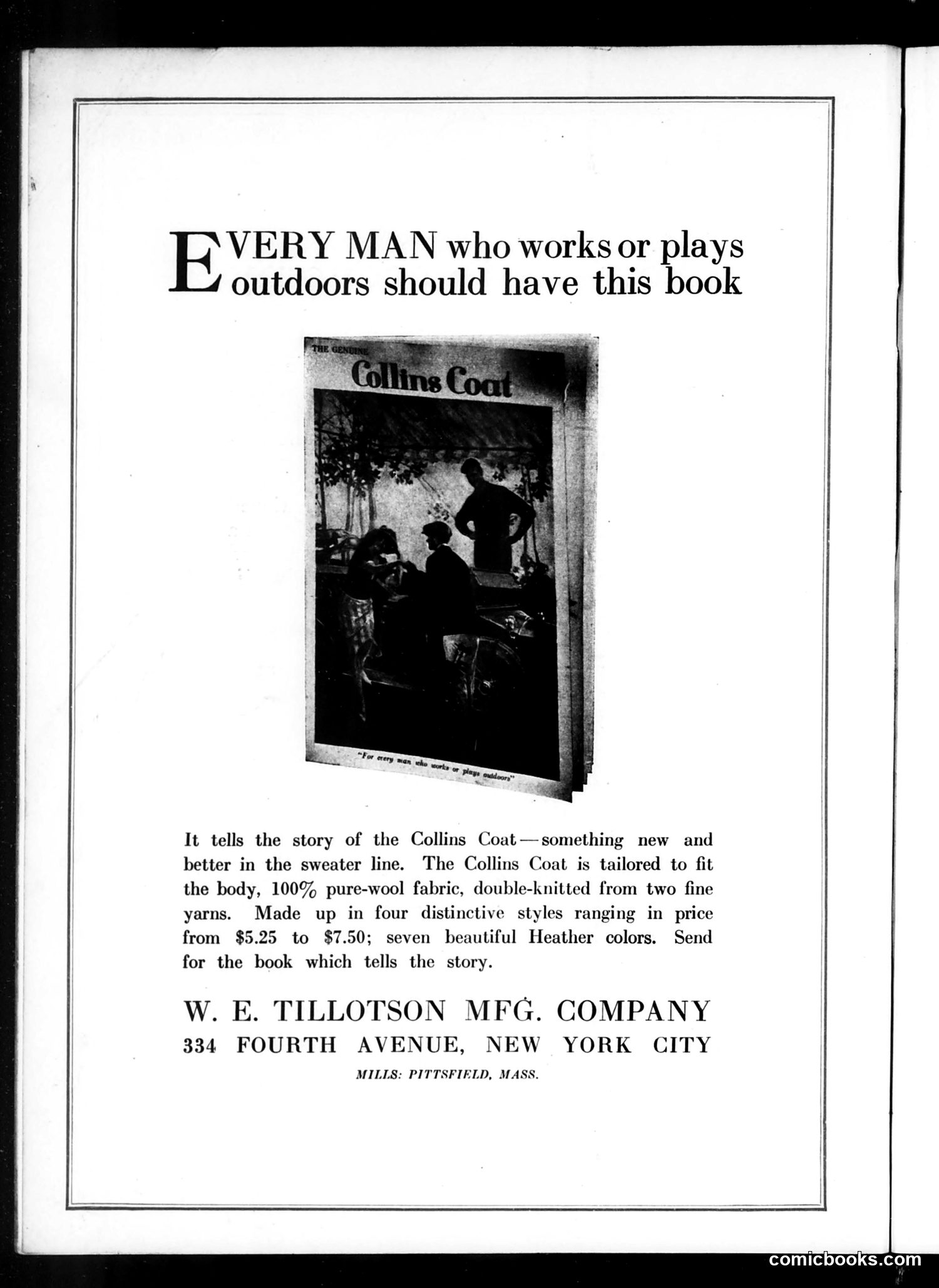
This page is a full-page advertisement, not satirical content. It promotes the "Collins Coat," a wool sweater marketed by W. E. Tillotson Manufacturing Company to outdoor workers and sportsmen. The ad emphasizes the product's quality—100% pure wool, double-knitted construction—and its practical tailoring. Available in four styles priced $5.25-$7.50 in seven colors, it appeals to the target demographic of men doing outdoor labor or recreation. The accompanying photograph shows men in work or recreational contexts. This represents typical Judge magazine advertising rather than political or social satire. The "book" referenced was promotional literature companies sent to potential customers—a common marketing practice of the era.