
Judge, 1921-08-27 · page 26 of 36
Judge — August 27, 1921 — page 26: what you’re looking at
What you’re looking at
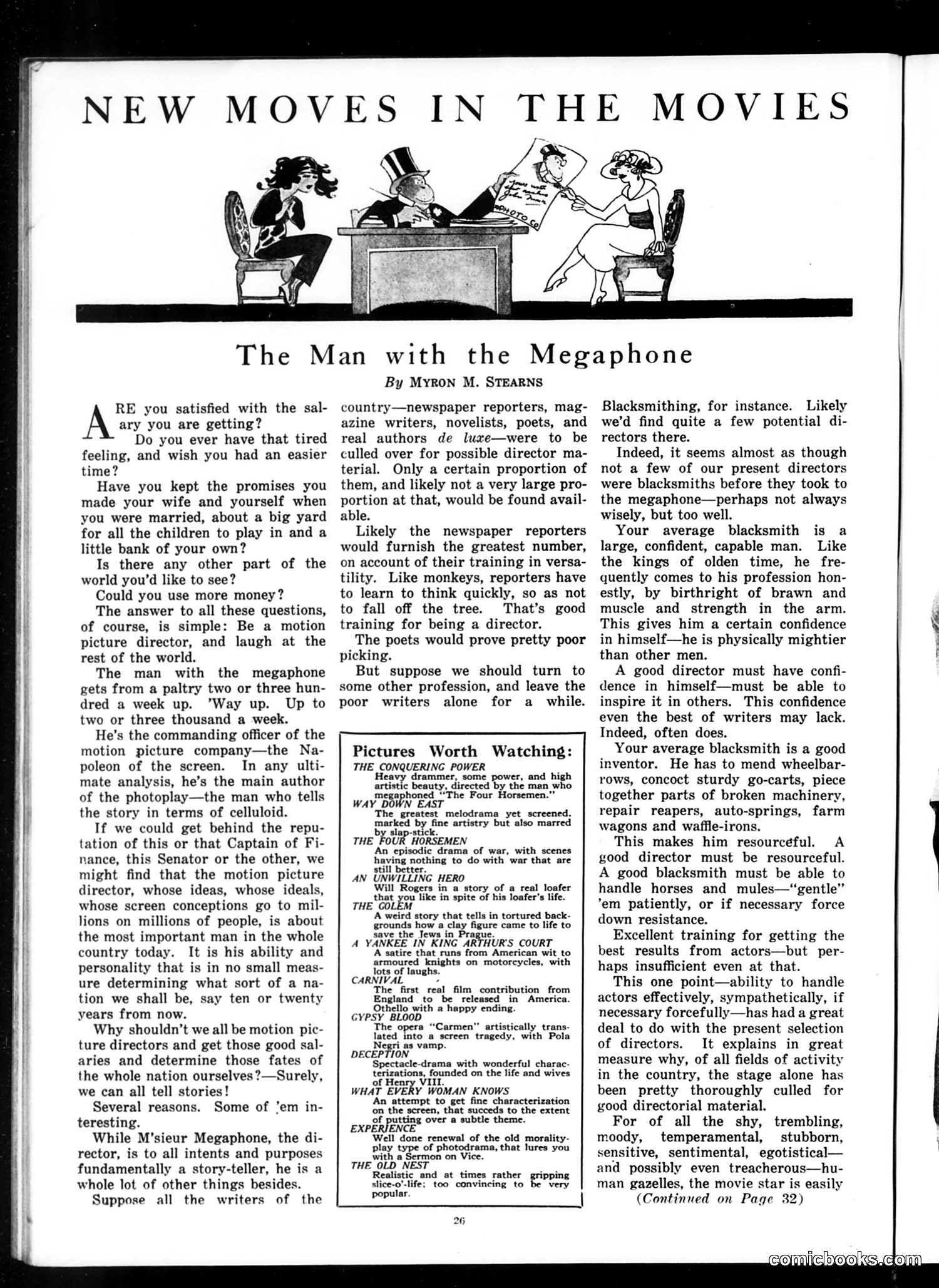
This article satirizes the inflated prestige and salaries of 1920s film directors. The cartoon header depicts a director at a desk, literally commanding attention through a megaphone, positioning him as an authority figure. The piece argues that while film directors wield enormous cultural influence—shaping national character through what millions see—they're fundamentally storytellers. The author notes that most directors come from journalism, where reporters learn quick thinking (comparing them to "monkeys" learning not to fall off trees). Poets, by contrast, would make "pretty poor" directors. The satire's point: yes, directing offers wealth and power, but it requires specific skills beyond mere storytelling ability. The title's megaphone represents not just the director's tool, but his outsized cultural authority in the early cinema era. The article undercuts the romantic notion that anyone can direct by suggesting the profession demands particular personality traits and training—a reality the casual observer misses.
📄 Transcribed text from this page (OCR, searchable)
Machine-transcribed from the original scan — historical spelling and the odd misread are preserved.
The Man with the Megaphone ary you are getting? Do you ever have that tired feeling, and wish you had an easier time? Have you kept the promises you made your wife and yourself when you were married, about a big yard for all the children to play in and a little bank of your own? Is there any other part of the world you'd like to see? Could you use more money? The answer to all these questions, of course, is simple: Be a motion A RE you satisfied with the sal- picture director, and laugh at the rest of the world. The man with the megaphone gets from a paltry two or three hun- dred a week up. ’Way up. Up to two or three thousand a week. He’s the commanding officer of the motion picture company—the Na- poleon of the screen. In any ulti- mate analysis, he’s the main author of the photoplay—the man who tells the story in terms of celluloid. If we could get behind the repu- tation of this or that Captain of Fi- nance, this Senator or the other, we might find that the motion picture director, whose ideas, whose ideals, whose screen conceptions go to mil- lions on millions of people, is about the most important man in the whole country today. It is his ability and personality that is in no small meas- ure determining what sort of a na- tion we shall be, say ten or twenty years from now. Why shouldn’t we all be motion pic- ture directors and get those good sal- aries and determine those fates of the whole nation ourselves ?—Surely, we can all tell stories! Several reasons. Some of ’em in- teresting. While M’sieur Megaphone, the di- rector, is to all intents and purposes fundamentally a story-teller, he is a whole lot of other things besides. Suppose all the writers of the By Myron M. STEARNS country—newspaper reporters, mag- azine writers, novelists, poets, and real authors de luwe—were to be culled over for possible director ma- terial. Only a certain proportion of them, and likely not a very large pro- portion at that, would be found avail- able. Likely the newspaper reporters would furnish the greatest number, on account of their training in versa- tility. Like monkeys, reporters have to learn to think quickly, so as not to fall off the tree. That’s good training for being a director. The poets would prove pretty poor picking. But suppose we should turn to some other profession, and leave the poor writers alone for a while. Pictures Worth Watching: THE CONQUERING POWER Heavy drammer, some power, and high artistic beauty, directed by the man who megaphoned ‘The Four Horsemen.” WAY DOWN EAST The greatest melodrama yet, screened. marked by fine artistry but also marred by slap-stick. THE FOUR HORSEMEN An episodic drama of war, with scenes having nothing to do with war that are still better. AN UNWILLING HERO Will Rogers in a story of a real loafer that you like in spite of his loafer’s life. THE GOLEM A weird story that tells in tortured back- grounds how a clay figure came to life to save the Jews in Prague. 4 YANKEE IN KING ARTHUR'S COURT. A satire that runs from American wit to armoured knights on motorcycles, with lots of laughs. CARNIVAL : The first real film contribution from England to be released in America. Othello with a happy ending. GYPSY BLOOD The opera “Carmen” artistically trans- lated into a screen dy, with Pola Negri as vamp. DECEPTION Spectacle-drama with wonderful charac- terizations, founded on the life and wives of Henry VIII. WHAT EVERY WOMAN KNOWS ‘An attempt to get fine characterization on the screen, that succeds to the extent of putting over a subtle theme. EXPERIENCE Well done renewal of the old morality- play type of photodrama, that lures you with a Sermon on Vice. THE OLD NEST R ‘and at times rather gripping too convincing to be very Blacksmithing, for instance. Likely we'd find quite a few potential di- rectors there. Indeed, it seems almost as though not a few of our present directors were blacksmiths before they took to the megaphone—perhaps not always wisely, but too well. Your average blacksmith is a large, confident, capable man. Like the kings of olden time, he fre- quently comes to his profession hon- estly, by birthright of brawn and muscle and strength in the arm. This gives him a certain confidence in himself—he is physically mightier than other men. A good director must have confi- dence in himself—must be able to inspire it in others. This confidence even the best of writers may lack. Indeed, often does. Your average blacksmith is a good inventor. He has to mend wheelbar- rows, concoct sturdy go-carts, piece together parts of broken machinery, repair reapers, auto-springs, farm wagons and waffle-irons. This makes him resourceful. A good director must be resourceful. A good blacksmith must be able to handle horses and mules—‘“gentle” ‘em patiently, or if necessary force down resistance. Excellent training for getting the best results from actors—but per- haps insufficient even at that. This one point—ability to handle actors effectively, sympathetically, if necessary forcefully—has had a great deal to do with the present selection of directors. It explains in great measure why, of all fields of activity in the country, the stage alone has been pretty thoroughly culled for good directorial material. For of all the shy, trembling, moody, temperamental, stubborn, sensitive, sentimental, egotistical— and possibly even treacherous—hu- man gazelles, the movie star is easily (Continued on Page 32)