
Judge, 1921-08-27 · page 8 of 36
Judge — August 27, 1921 — page 8: what you’re looking at
What you’re looking at
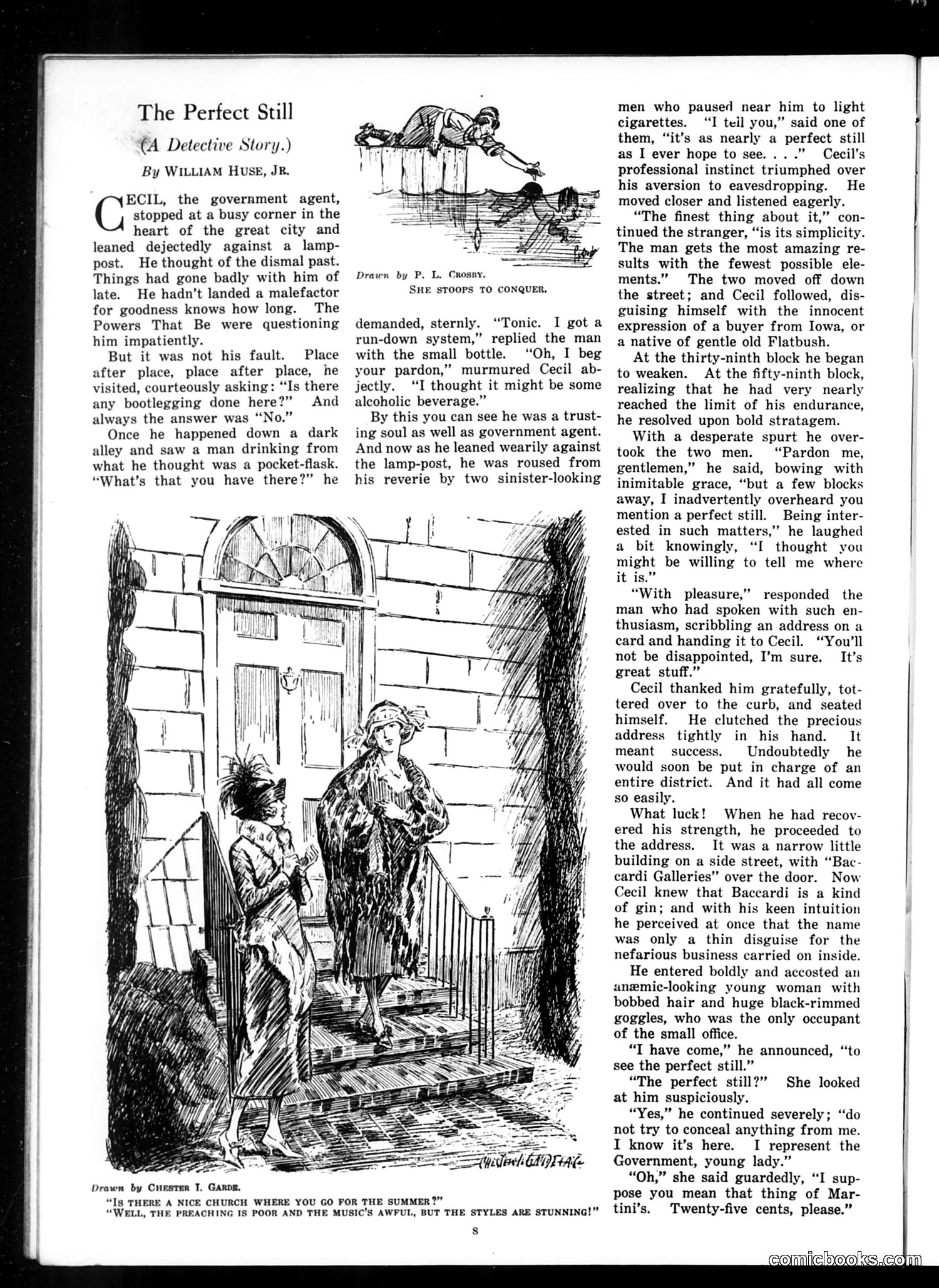
This is a humorous short story satirizing Prohibition enforcement during the 1920s-early 1930s. Cecil is an incompetent government agent tasked with finding illegal stills (apparatus for making bootleg liquor). He's so naive that when he sees a man drinking from a flask, he accepts "tonic for a run-down system" at face value. The joke culminates when Cecil overhears criminals discussing a "perfect still," pursues them obsessively, obtains an address, and discovers it leads to "Baccardi Galleries"—a legitimate liquor store (Bacardi is a known rum brand). The satire mocks both the government's hapless enforcement efforts and Prohibition's absurdity: the agent mistakes a legal business for an illegal operation, suggesting the law itself is confused or unenforceable. The accompanying cartoon about church styles adds lighter social commentary.
📄 Transcribed text from this page (OCR, searchable)
Machine-transcribed from the original scan — historical spelling and the odd misread are preserved.
The Perfect Still (A Detective Story.) By WI..IAM HUsE, JR. stopped at a busy corner in the heart of the great city and leaned dejectedly against a lamp- post. He thought of the dismal past. Things had gone badly with him of late. He hadn’t landed a malefactor for goodness knows how long. The Powers That Be were questioning him impatiently. But it was not his fault. Place after place, place after place, he visited, courteously asking: “Is there any bootlegging done here?” And always the answer was “No.” Once he happened down a dark alley and saw a man drinking from what he thought was a pocket-flask. “What’s that you have there?” he Cis the government agent, Drawn by Cuester T. GARDE. a Drawn by P. L. Crosny. SHE STOOPS TO CONQUER, I got a run-down system,” replied the man demanded, sternly. ‘Tonic. with the small bottle. “Oh, I beg your pardon,” murmured Cecil ab- jectly. “I thought it might be some alcoholic beverage.” By this you can see he was a trust- ing soul as well as government agent. And now as he leaned wearily against the lamp-post, he was roused from his reverie by two sinister-looking “I THERE A NICE CHURCH WHERE YOU GO FOR THE SUMMER?” “WELL, THE PREACHING IS POOR AND THE MUSIC’S AWFUL, BUT THE STYLES ARE STUNNING!” 8 men who paused near him to light cigarettes. ‘I teil you,” said one of them, “it’s as nearly a perfect still as I ever hope to see... .” Cecil’s professional instinct triumphed over his aversion to eavesdropping. He moved closer and listened eagerly. “The finest thing about it,” con- tinued the stranger, “is its simplicity. The man gets the most amazing re- sults with the fewest possible ele- ments.” The two moved off down the street; and Cecil followed, dis- guising himself with the innocent expression of a buyer from Iowa, or a native of gentle old Flatbush. At the thirty-ninth block he began to weaken. At the fifty-ninth block, realizing that he had very nearly reached the limit of his endurance, he resolved upon bold stratagem. With a desperate spurt he over- took the two men. “Pardon me, gentlemen,” he said, bowing with inimitable grace, “but a few blocks away, I inadvertently overheard you mention a perfect still. Being inter- ested in such matters,” he laughed a bit knowingly, “I thought you might be willing to tell me where it is.” “With pleasure,” responded the man who had spoken with such en- thusiasm, scribbling an address on a card and handing it to Cecil. “You'll not be disappointed, I’m sure. It’s great stuff.” Cecil thanked him gratefully, tot- tered over to the curb, and seated himself. He clutched the precious address tightly in his hand. It meant success. Undoubtedly he would soon be put in charge of an entire district. And it had all come so easily. What luck! When he had recov- ered his strength, he proceeded to the address. It was a narrow little building on a side street, with “Bac- cardi Galleries” over the door. Now Cecil knew that Baccardi is a kind of gin; and with his keen intuition he perceived at once that the name was only a thin disguise for the nefarious business carried on inside. He entered boldly and accosted an unemic-looking young woman with bobbed hair and huge black-rimmed goggles, who was the only occupant of the small office. “I have come,” he announced, “to see the perfect still.” “The perfect still?” at him suspiciously. “Yes,” he continued severely; ‘do not try to conceal anything from me. I know it’s here. I represent the Government, young lady.” “Oh,” she said guardedly, “I sup- pose you mean that thing of Mar- tini’s. Twenty-five cents, please.” She looked