
Judge, 1921-08-27 · page 24 of 36
Judge — August 27, 1921 — page 24: what you’re looking at
What you’re looking at
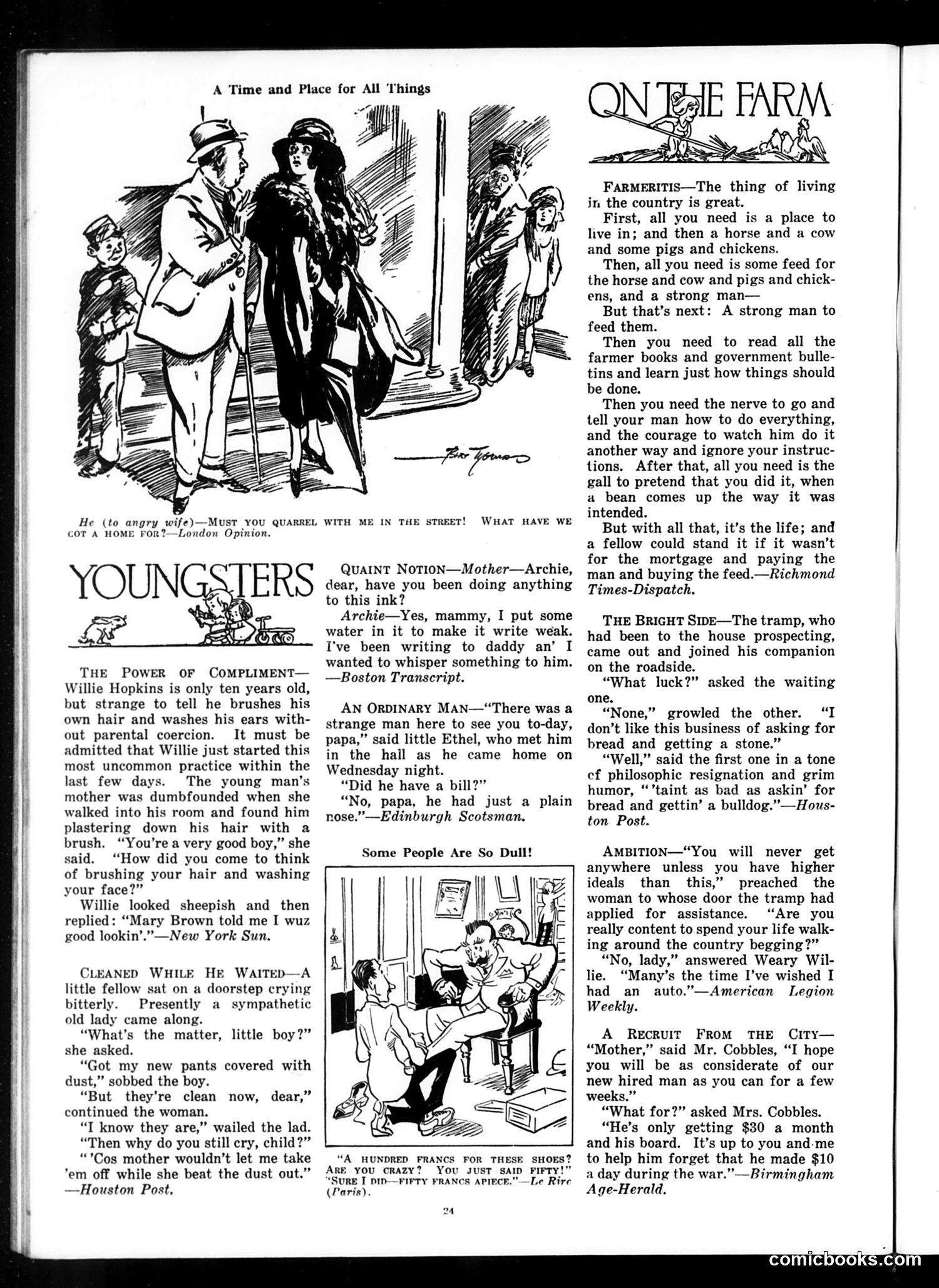
This page from the satirical magazine *Judge* contains multiple humorous anecdotes and cartoons mocking social conventions and human folly. **Main cartoon** (top left): A couple quarreling publicly on the street while onlookers stare. The husband protests their domestic dispute belongs "at home," satirizing Victorian propriety and the gap between public respectability and private behavior. **Anecdotes below** use ironic humor about everyday situations: a boy cleaning his pants while being beaten, a child diluting ink to "whisper" to his father, a girl describing a visitor by his "plain nose" rather than his business. Each joke plays on childlike logic or verbal misunderstandings for comic effect. **"Farmeritis" section**: A satirical piece mocking the romanticized notion of rural life, listing its supposed charms (land, animals, reading farming manuals) before revealing the harsh reality: impossible mortgages and endless labor. **Tramp anecdotes**: Multiple jokes about vagrants, including one where a tramp reveals his "higher ambition" is owning an automobile—satirizing the era's obsession with automobiles and the gap between social classes. The overall tone reflects early 20th-century middle-class anxieties about propriety, labor, and modernity.
📄 Transcribed text from this page (OCR, searchable)
Machine-transcribed from the original scan — historical spelling and the odd misread are preserved.
A Time and Place for All Things He (to angry wife)—MUST YOU QUARREL WITH ME IN THE STREET! WHAT HAVE WE coT A HOME FoR?—London Opinion. THE POWER OF COMPLIMENT— Willie Hopkins is only ten years old, but strange to tell he brushes his own hair and washes his ears with- out parental coercion. It must be admitted that Willie just started this most uncommon practice within the last few days. The young man’s mother was dumbfounded when she walked into his room and found him plastering down his hair with a brush. “You're a very good boy,” she said. “How did you come to think of brushing your hair and washing your face?” Willie looked sheepish and then replied: “Mary Brown told me I wuz good lookin’.”,—New York Sun. CLEANED WHILE HE WAITED—A little fellow sat on a doorstep crying bitterly. Presently a sympathetic old lady came along. “What’s the matter, little boy?” she asked. “Got my new pants covered with dust,” sobbed the boy. “But they’re clean now, continued the woman. “T know they are,” wailed the lad. “Then why do you still cry, child?” “’Cos mother wouldn’t let me take ’em off while she beat the dust out.” —Houston Post, dear,” QuAINT NoTION—Mother—Archie, dear, have you been doing anything to this ink? Archie—Yes, mammy, I put some water in it to make it write weak. I've been writing to daddy an’ I wanted to whisper something to him. —Boston Transcript. AN ORDINARY MAN—“There was a strange man here to see you to-day, papa,” said little Ethel, who met him in the hail as he came home on Wednesday night. “Did he have a bill?” “No, papa, he had just a plain nose.”—Edinburgh Scotsman. Some People Are So Dull! “A HUNDRED FRANCS FOR THESE SHOES? ARE You CRAZY? You JUST SAID FIFTY!” “SURE I DIn—FIFTY FRANCS APIECE.” —Le Rire (Paris). 24 FARMERITIS—The thing of living in the country is great. First, all you need is a place to live in; and then a horse and a cow and some pigs and chickens. Then, all you need is some feed for the horse and cow and pigs and chick- ens, and a strong man— But that’s next: A strong man to feed them. Then you need to read all the farmer books and government bulle- tins and learn just how things should be done. Then you need the nerve to go and tell your man how to do everything, and the courage to watch him do it another way and ignore your instruc- tions. After that, all you need is the gall to pretend that you did it, when a bean comes up the way it was intended. But with all that, it’s the life; and a fellow could stand it if it wasn’t for the mortgage and paying the man and buying the feed.—Richmond Times-Dispatch. THE BRIGHT SIDE—The tramp, who had been to the house prospecting, came out and joined his companion on the roadside. “What luck?” asked the waiting one. “None,” growled the other. “I don’t like this business of asking for bread and getting a stone.” “Well,” said the first one in a tone cf philosophic resignation and grim humor, “’taint as bad as askin’ for bread and gettin’ a bulldog.”—Hous- ton Post. AMBITION—“You will never get anywhere unless you have higher ideals than this,” preached the woman to whose door the tramp had applied for assistance. “Are you really content to spend your life walk- ing around the country begging?” “No, lady,” answered Weary Wil- lie. “Many’s the time I’ve wished I had an auto.”—American Legion Weekly. A RECRUIT FROM THE CiTY— “Mother,” said Mr. Cobbles, “I hope you will be as considerate of our new hired man as you can for a few weeks.” “What for?” asked Mrs. Cobbles. “He’s only getting $30 a month and his board. It’s up to you and-‘me to help him forget that he made $10 a day during the war.”—Birmingham Age-Herald.