
A complete issue · 37 pages · 1921
Judge — June 25, 1921
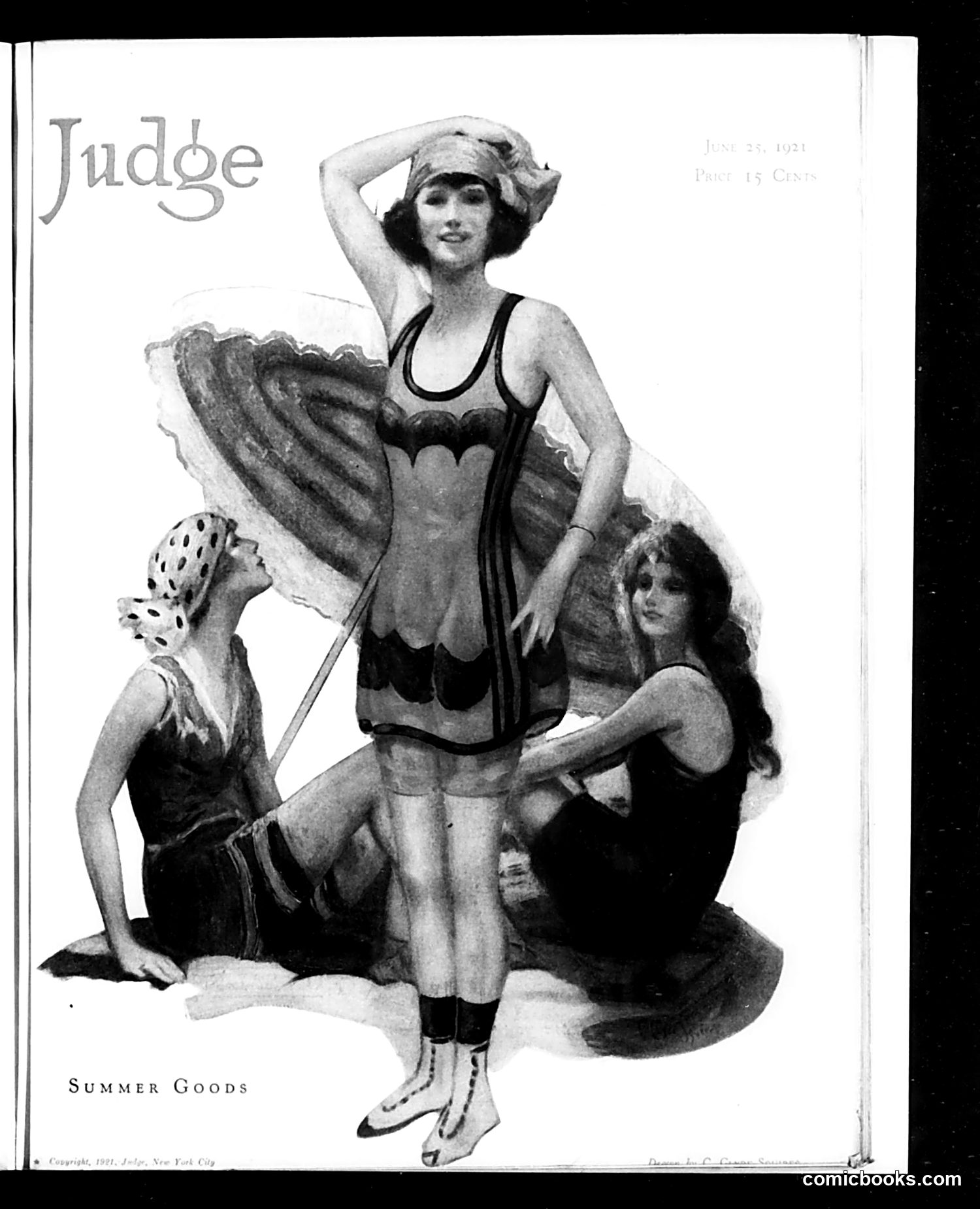
This June 25, 1921 Judge magazine cover is titled "Summer Goods" and depicts three women in fashionable 1920s bathing attire. The central figure strikes a confident pose in a form-fitting swimsuit and cloche hat, while two smaller figures flank her in various summer wear. The satire likely comments on **modern women's fashion and social freedoms** during the Jazz Age. Women's swimwear had become noticeably more revealing and body-conscious compared to Victorian-era designs. The composition—positioning a woman prominently displaying her figure—may satirize contemporary anxieties about changing gender roles, female sexuality, and the "New Woman" of the 1920s who smoked, danced, and dressed more liberally than previous generations. The magazine's title suggests these fashions were commercial "goods" being hawked to consumers.
This page is primarily an **advertisement for Leslie's Weekly magazine** (June 25th issue), not a political cartoon. The ad promotes several feature articles including: - A piece by Heywood Broun on the Dempsey-Carpentier World Championship boxing fight - An article on a Mulford Expedition seeking new medicines in South America - A profile of "Uncle Joe Cannon" (likely the veteran congressman) - An article about Alaska's natural resources - Coverage of intercollegiate athletics at Harvard Stadium The ad uses promotional language ("You Can't Afford to Miss") typical of early 1920s magazine marketing. No satire or political commentary is evident—this is straightforward publishing promotion aimed at contemporary readers interested in sports, exploration, politics, and education.
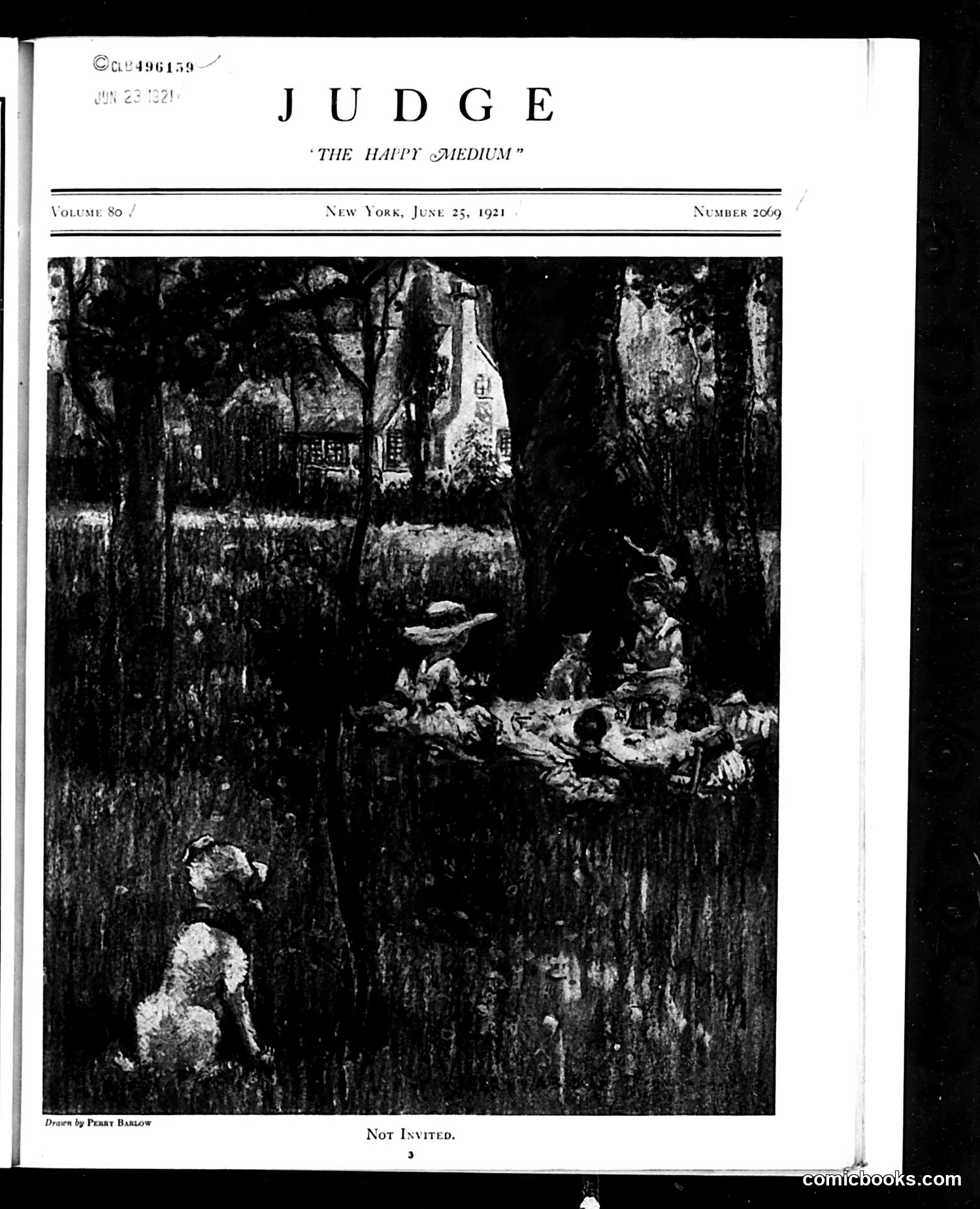
This cartoon by Penny Barlow depicts a picnic scene in a wooded area with a small church visible in the background. Two well-dressed figures enjoy a meal while a dog sits apart in the foreground, excluded from the gathering. The title "Not Invited" suggests social commentary on exclusion. The cartoon likely satirizes social class divisions or exclusionary practices of the era—the dog serving as a metaphor for those deemed unworthy of participation in respectable social gatherings. The contrast between the comfortable picnickers and the isolated dog emphasizes the arbitrary or harsh nature of social ostracism. Without additional context from surrounding articles, the specific target of this satire remains somewhat unclear, though it appears critical of snobbish social practices.
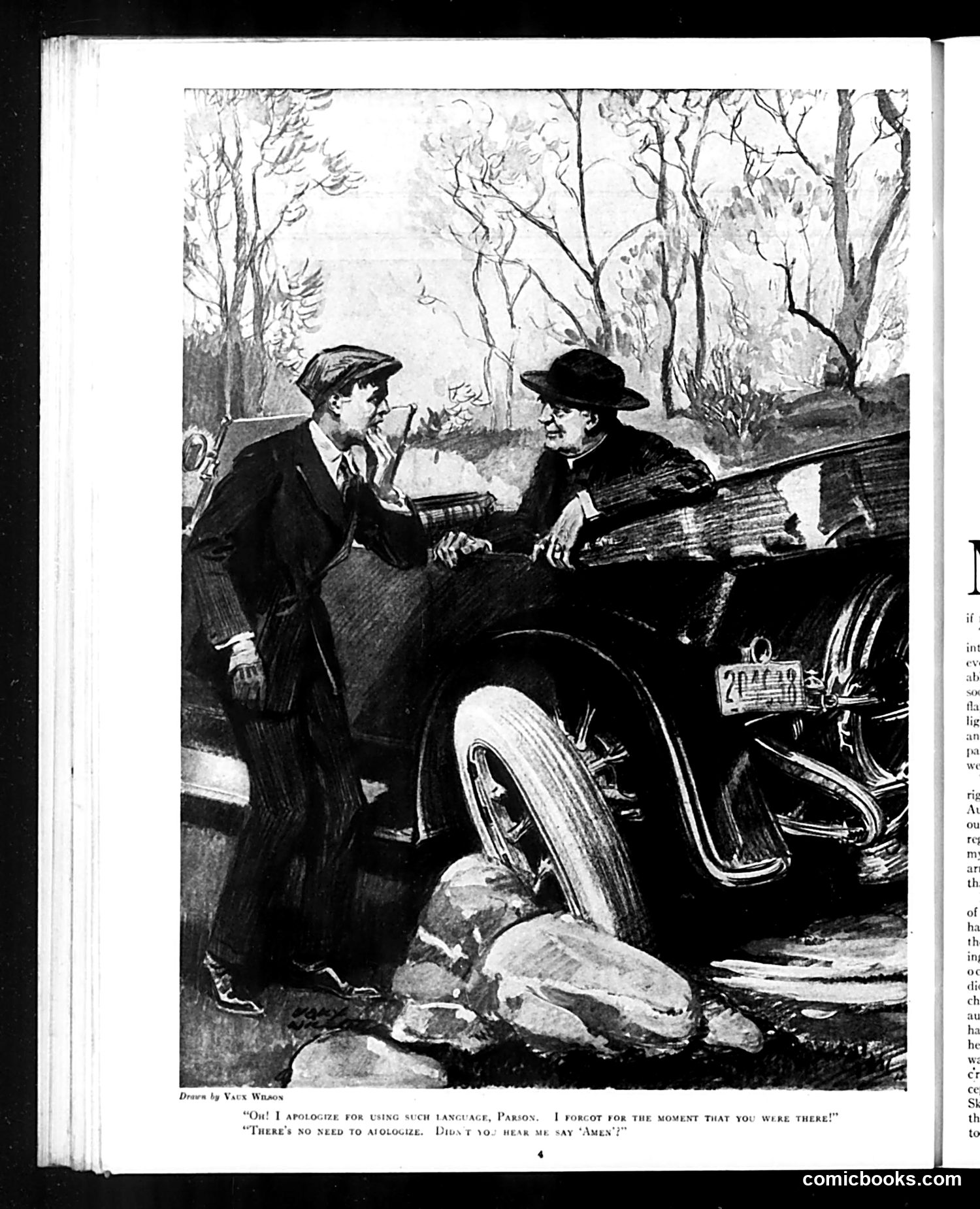
This illustration by Vex Wilson depicts two men beside an automobile in a wooded setting. The caption reads: "Oh! I apologize for using such language, Pardon. I forgot for the moment that you were there!" followed by "There's no need to apologize. Didn't you hear me say 'Amen'?" The satire concerns **automobile culture and masculine behavior**. The joke suggests one man has sworn profusely while driving (a common frustration), then apologizes upon noticing his companion. However, the companion reveals he was cursing along—saying "Amen" to the outbursts rather than objecting. This mocks the then-novel phenomenon of automobiles bringing out crude language in otherwise refined gentlemen, and how social pretense quickly dissolves when men are among themselves. The rural setting emphasizes how cars represented modern intrusions into traditional spaces.
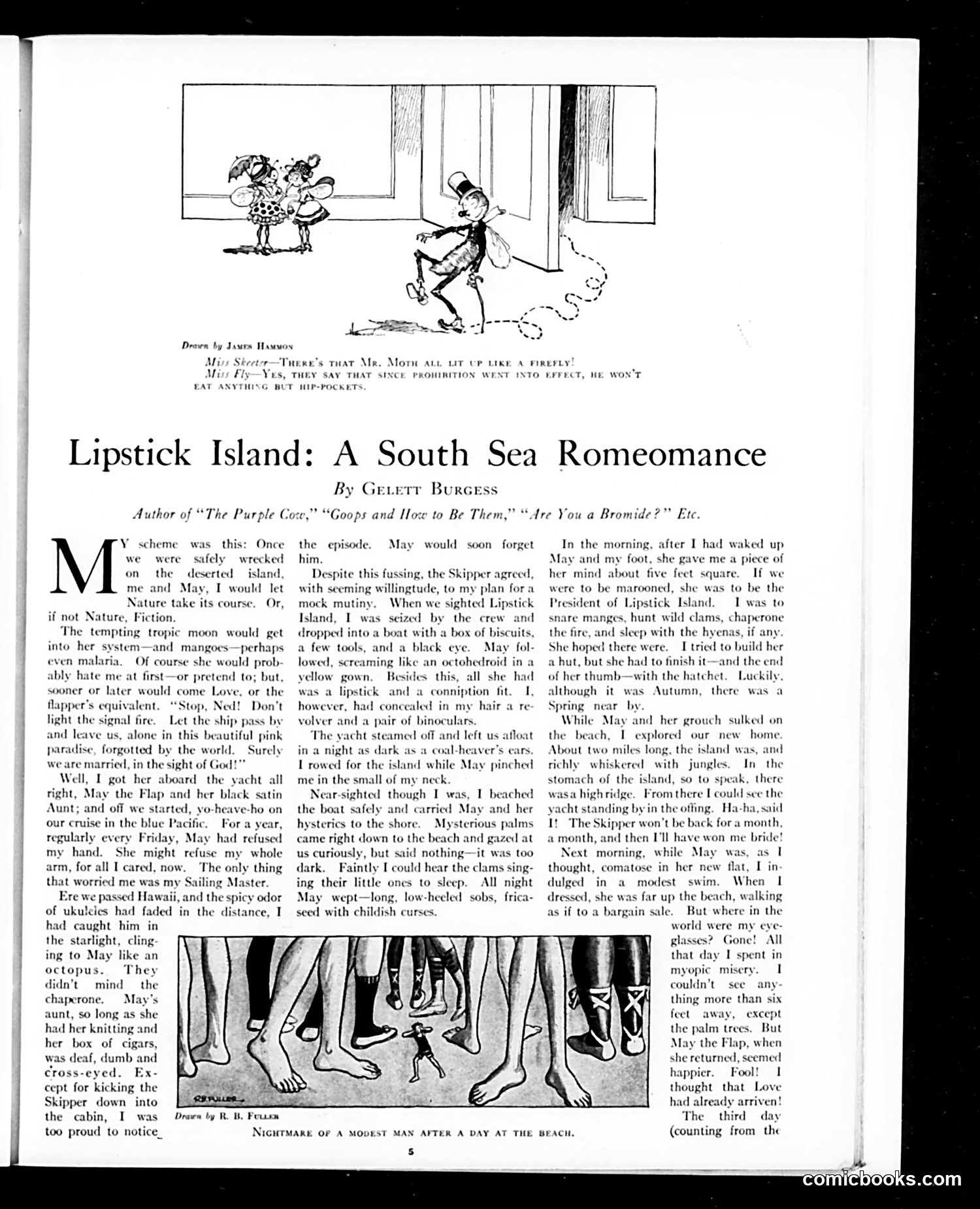
**Top Cartoon:** Drawn by James Harmon, this shows a flapper-era couple. The caption references Prohibition enforcement: a man won't "eat anything" since the law went into effect, suggesting he's consuming only alcohol instead of food—satirizing how Prohibition (1920-1933) perversely encouraged drinking while supposedly protecting public health. **Main Story:** "Lipstick Island: A South Sea Romeomance" by Gelett Burgess is a romantic fiction piece about a shipwrecked couple on an island. It's typical of Judge's entertainment content—light humor rather than political satire. **Bottom Illustration:** Captioned "Nightmare of a Modest Man After a Day at the Beach," this depicts a man surrounded by women's bare feet and legs, satirizing changing social norms as women increasingly exposed their bodies at beaches during the 1920s.
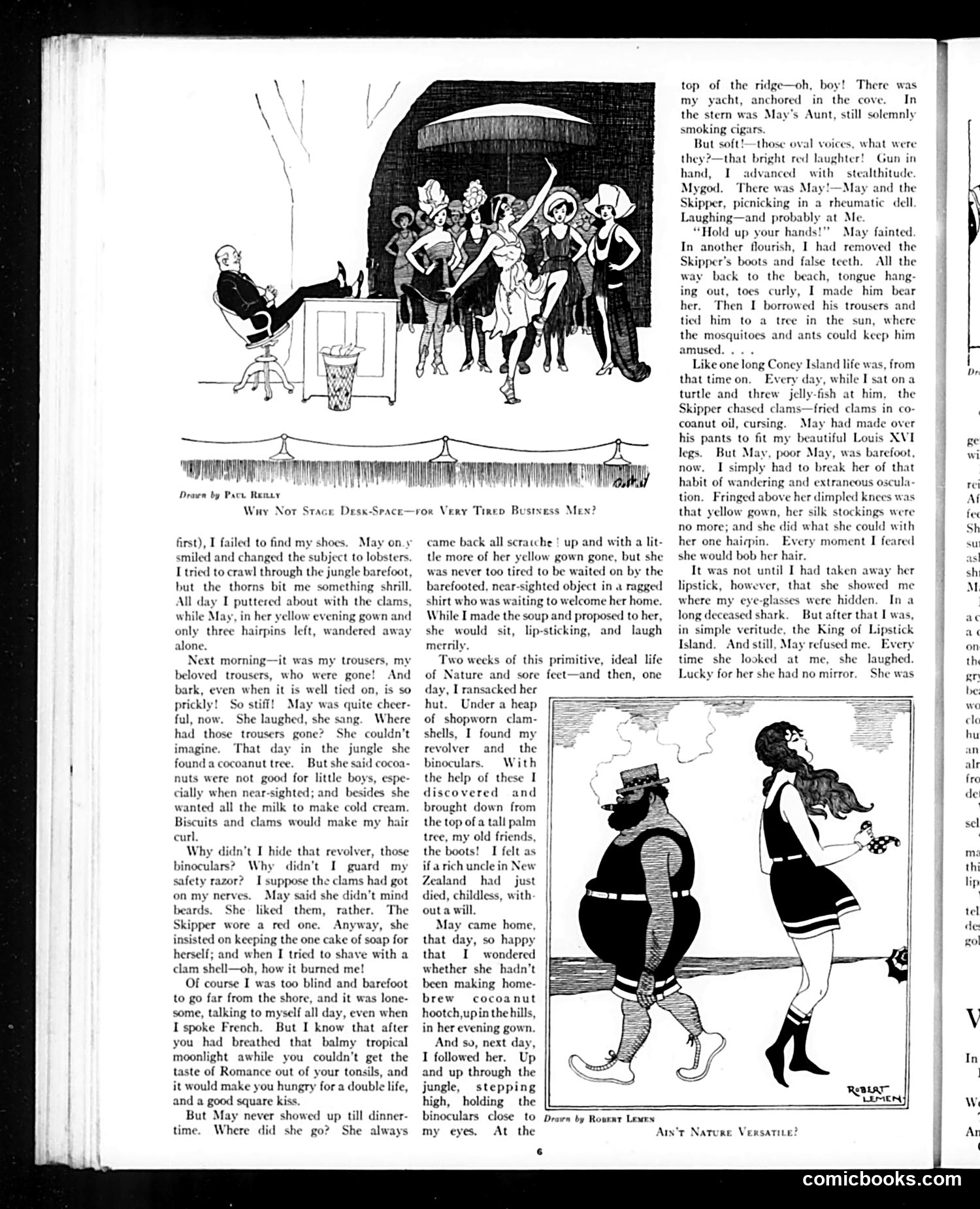
This page contains two unrelated pieces: a humorous short story and two cartoon illustrations. The top cartoon titled "Why Not Stage Dress-Space—for Very Tired Business Men?" depicts exhausted businessmen relaxing in a theatrical setting while performers entertain them on stage. The satire comments on workplace stress and suggests theaters could provide "dress space" (relaxation areas) for overworked men. The bottom cartoon "Ain't Nature Versatile!" by Robert Lemon shows a large figure with binoculars encountering a small woman in a sailor outfit. The joke appears to mock either nature's variety or, more likely, the modern "New Woman"—mocking women's adoption of masculine clothing and activities like using binoculars for observation, which was considered unconventional for women in this era. Both cartoons reflect early 20th-century anxieties about changing gender roles and workplace pressures.
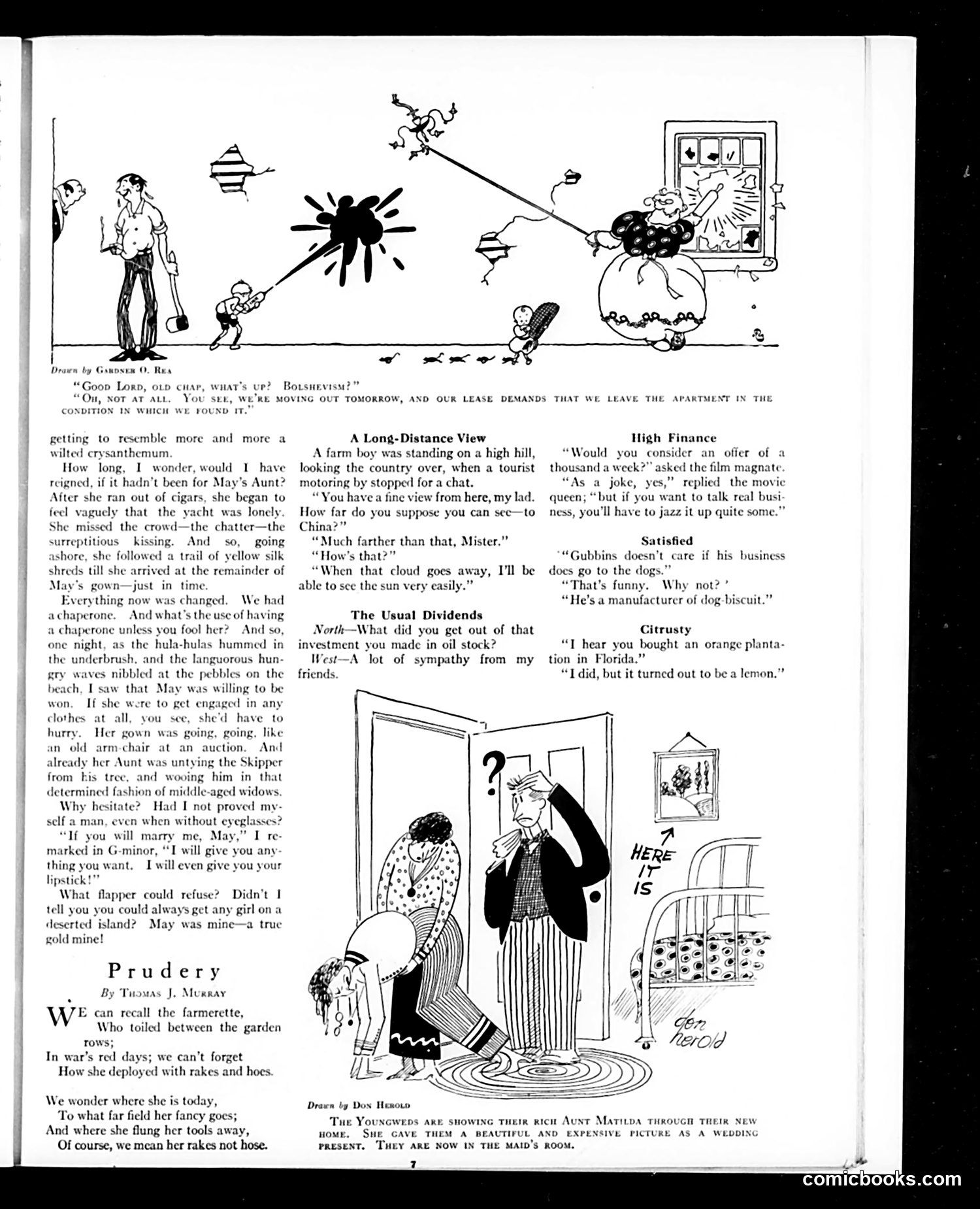
This page contains multiple satirical pieces typical of 1920s American humor: **Top cartoon** (by Gannett Rea): A domestic comedy about a couple on a yacht. The wife's aunt unexpectedly joins them, disrupting a romantic tryst. The narrator boasts of his romantic conquests and proposal on a "deserted island," mocking both flapper-era dating behavior and male boasting about seduction. **"Prudery" poem** (by Thomas J. Murray): A nostalgic commentary on wartime "farmerettes" (women who worked farms during WWI) who've presumably abandoned rural labor for city life. The double entendre in the final lines ("rakes not hose") suggests loose moral behavior. **Small jokes** scattered throughout mock: - Oil stock speculation (post-crash cynicism) - Movie industry wage negotiations - Failed business ventures - Housing displacement ("moving out tomorrow") The overall tone reflects 1920s anxieties about changing social mores, economic volatility, and the "new woman" (flappers and independent working women).
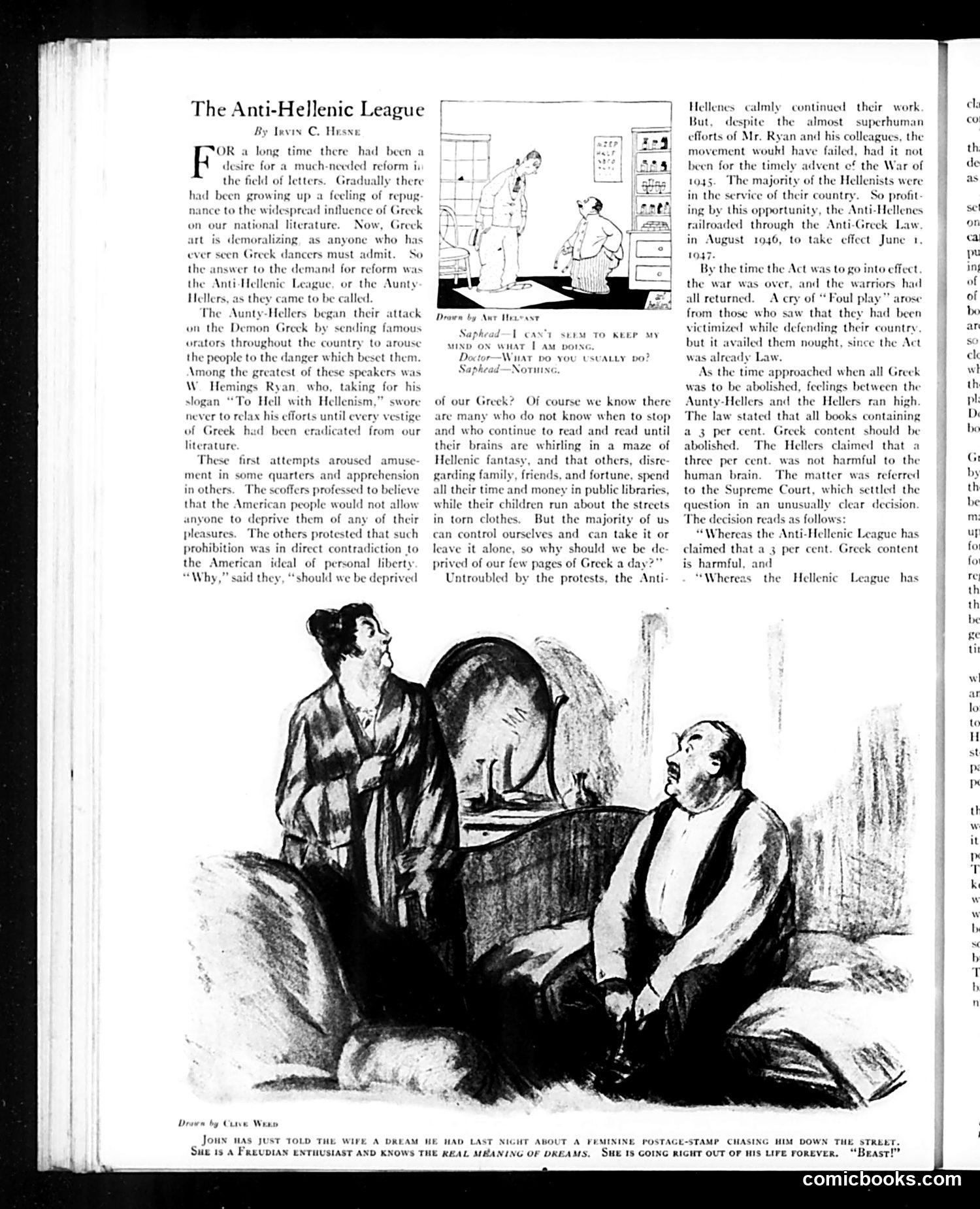
This satirical piece mocks prohibition-era cultural censorship through absurdist humor. The "Anti-Hellenic League" (or "Aunty-Hellers") is a fictional organization demanding Greek literature be banned from America, claiming Greek art is "demoralizing." The main article parodies arguments used by actual Prohibition and censorship advocates: that certain cultural influences corrupt public morality, that citizens can't self-regulate consumption, and that government intervention is justified. It depicts a war-fueled opportunity for the censors to pass the "Anti-Greek Law" in 1946-1047. The bottom cartoon shows a husband telling his wife a dream about a "feminine postage-stamp chasing him down the street"—his Freudian-obsessed wife immediately interprets this as symbolic of feminine pursuit. The caption sardonically notes she "knows the REAL MEANING OF DREAMS" before declaring "Beast!" The joke mocks Freudian psychology's then-fashionable cultural influence, suggesting its interpretive reach is absurd. Together, the page satirizes both censorship impulses and trendy intellectual movements (Freudianism) that Judge's readers viewed skeptically.
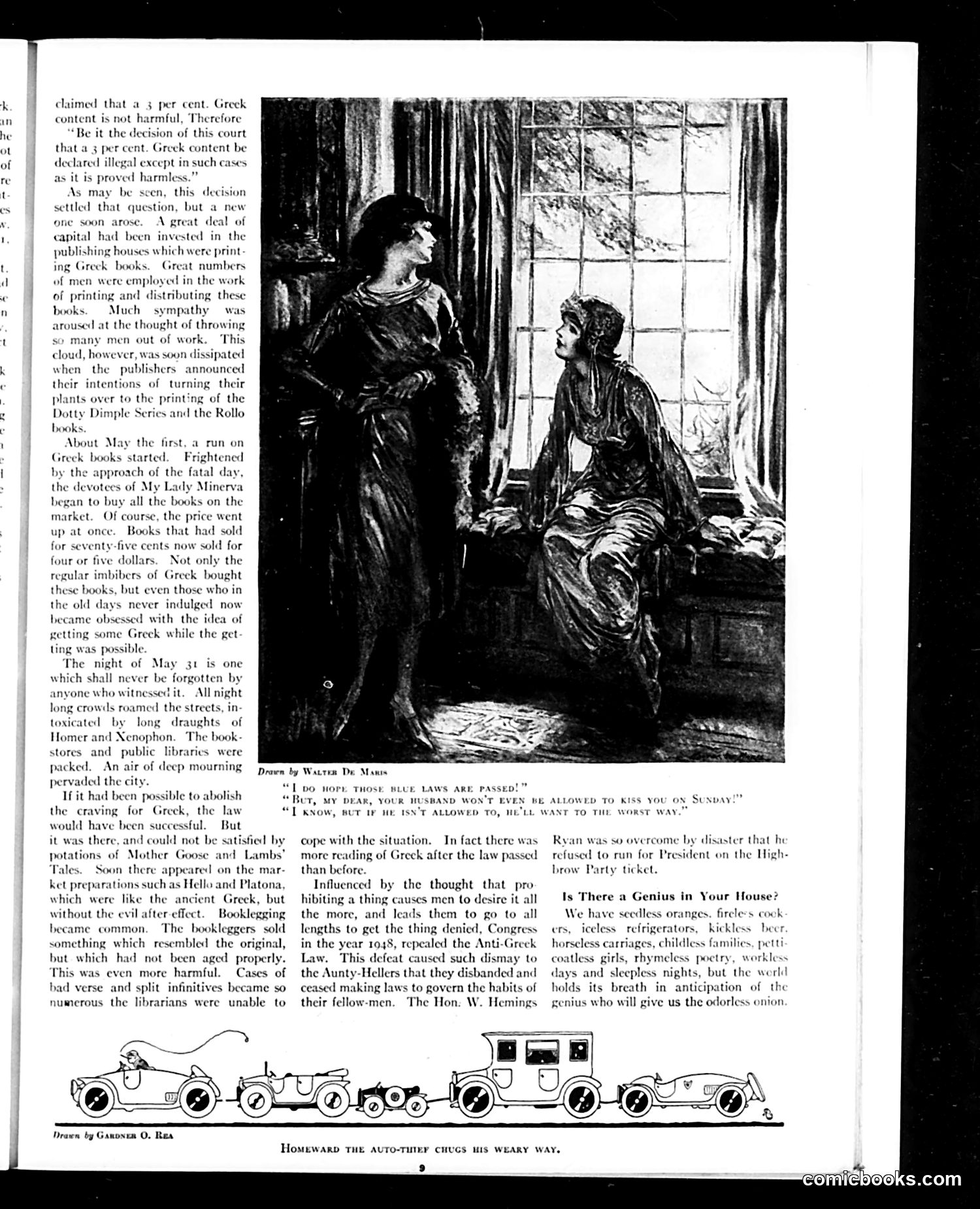
This page satirizes Prohibition-era logic through an absurdist "Anti-Greek Law" parable. The main text mocks how banning something increases desire for it: when Greek literature is prohibited, book prices spike, secret "booklegging" emerges, and reading actually *increases*. Congress eventually repeals the law, recognizing that prohibition backfires. The parallel is transparent: this critiques alcohol Prohibition (referenced as occurring around 1918), arguing that legal bans create black markets and intensify cravings rather than eliminating them. The illustration by Walter de Maris depicts two figures by a window discussing "blue laws" (morality-based legal restrictions), with dialogue about Sunday kissing rules—another jab at Prohibition-era moral legislation. The bottom cartoon about "Homeward the Auto-Thief" appears unrelated advertising material. The final column advertises "odorless onions" as the ultimate consumer innovation—humorous filler typical of Judge's satirical advertising sections.
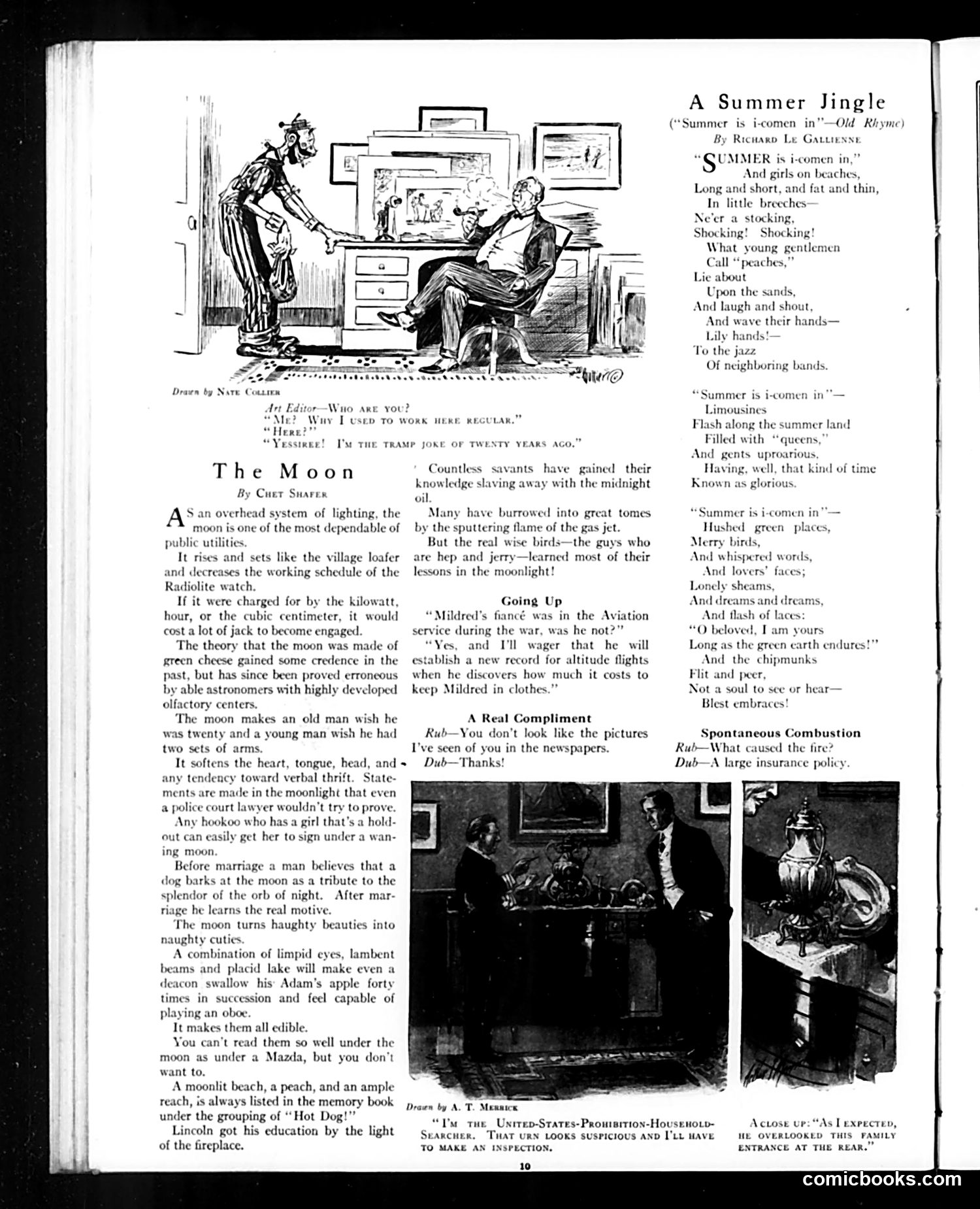
**Top Cartoon:** A tramp encounters a well-dressed man at a desk. The joke plays on class difference—the tramp claims he "used to work here regular," implying either he's delusional or making an absurd claim, while the man dismisses him with "Yessinee! I's the tramp joke of twenty years ago," suggesting this is an outdated joke type. **"The Moon" Essay:** A humorous essay treating the moon as a public utility, comparing it to electric lights and gas. It playfully explores moonlight's romantic effects on courtship and behavior—softening hearts, enabling promises people wouldn't normally make, turning "haughty beauties into naughty cuties." **Bottom Cartoons:** Three brief jokes—one about an aviator boyfriend discovering the cost of keeping his fiancée clothed; one where "Dub" is complimented for not resembling his newspaper photos; one where an insurance inspector suspects arson ("large insurance policy" as motive). The page reflects 1920s humor: romantic nostalgia, class-based comedy, and gentle cynicism about marriage and insurance fraud.
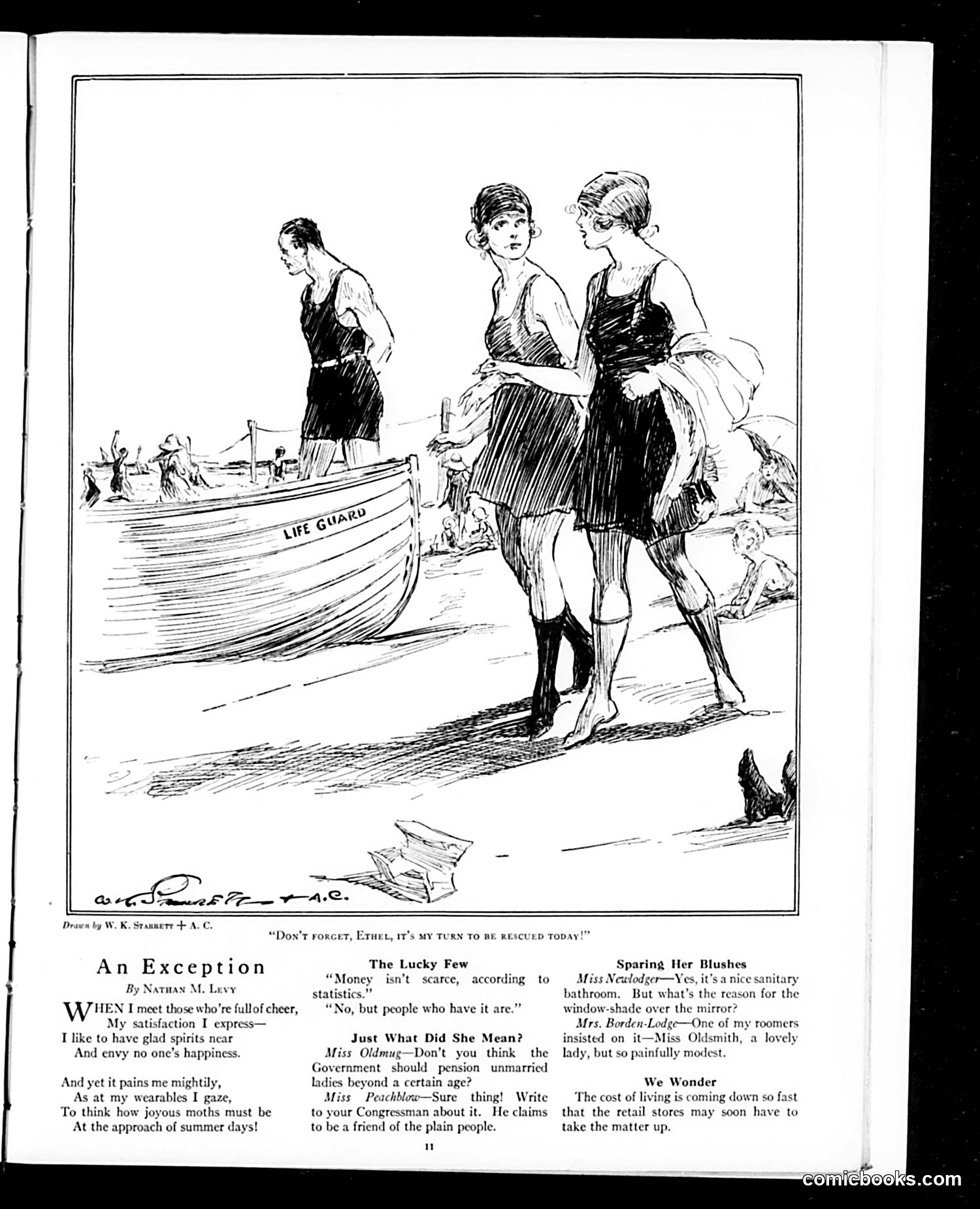
This page contains four separate satirical pieces typical of early 20th-century American humor: **Main Cartoon:** Two women in bathing suits stand on a beach near a lifeguard boat. One says to the other, "Don't forget, Ethel, it's MY turn to be rescued today!" The satire mocks the fashionable practice of women seeking dramatic "rescues" by lifeguards—presenting this as a social game rather than genuine emergency, reflecting period anxieties about female independence and beach culture. **Text Pieces:** The four short humor items skewer various social topics: government pensions for unmarried women, the scarcity of wealthy people despite claims money "isn't scarce," false modesty (a woman so shy she covers her bathroom mirror), and the paradox of falling living costs that retailers won't acknowledge. The overall tone reflects Judge's satirical approach to contemporary social pretension and gender dynamics of the era.
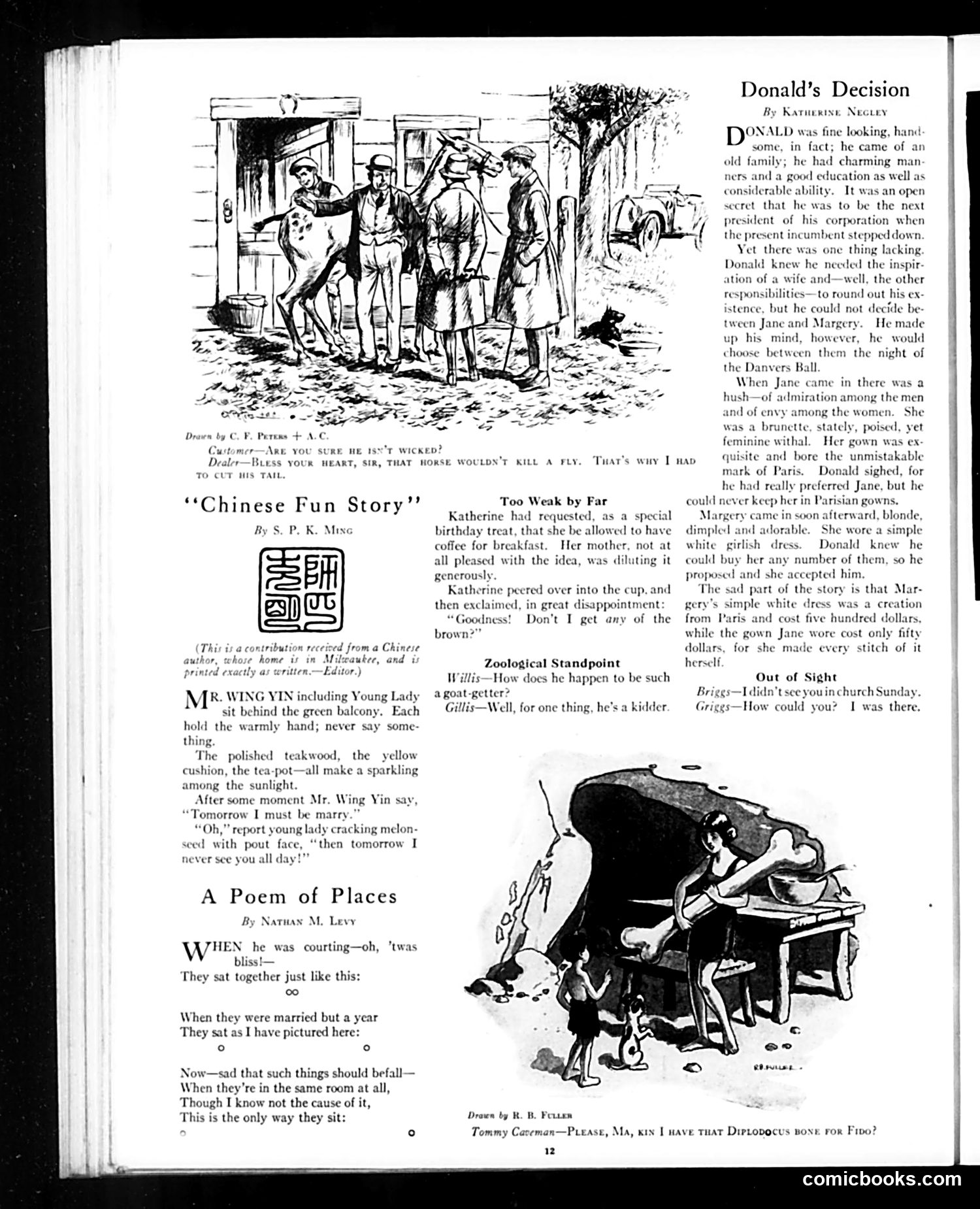
This page contains several satirical pieces typical of early 20th-century humor: **"Donald's Decision"** depicts a wealthy man choosing between two women based on their appearance and apparent cost. The satire targets materialistic values: he prefers Jane but chooses Margery because he can "afford" to keep her in fashionable dresses—only to discover the working-class Jane's dress actually cost more, having been hand-sewn. The joke critiques shallow judgment and the false assumption that expense equals appearance. **"A Poem of Places"** uses visual spacing to satirize marriage: showing couples' distance increasing from courtship to marriage, ending with them sitting apart despite being in the same room. It's social commentary on marital discord. **"Too Weak by Far"** and **"Zoological Standpoint"** are brief domestic and wordplay humor pieces without obvious political content. **"Chinese Fun Story"** appears stereotypical period humor about Chinese courtship customs, reflecting contemporary attitudes toward Asian cultures. The page exemplifies Judge's blend of social satire, domestic humor, and casual ethnic stereotyping typical of its era.
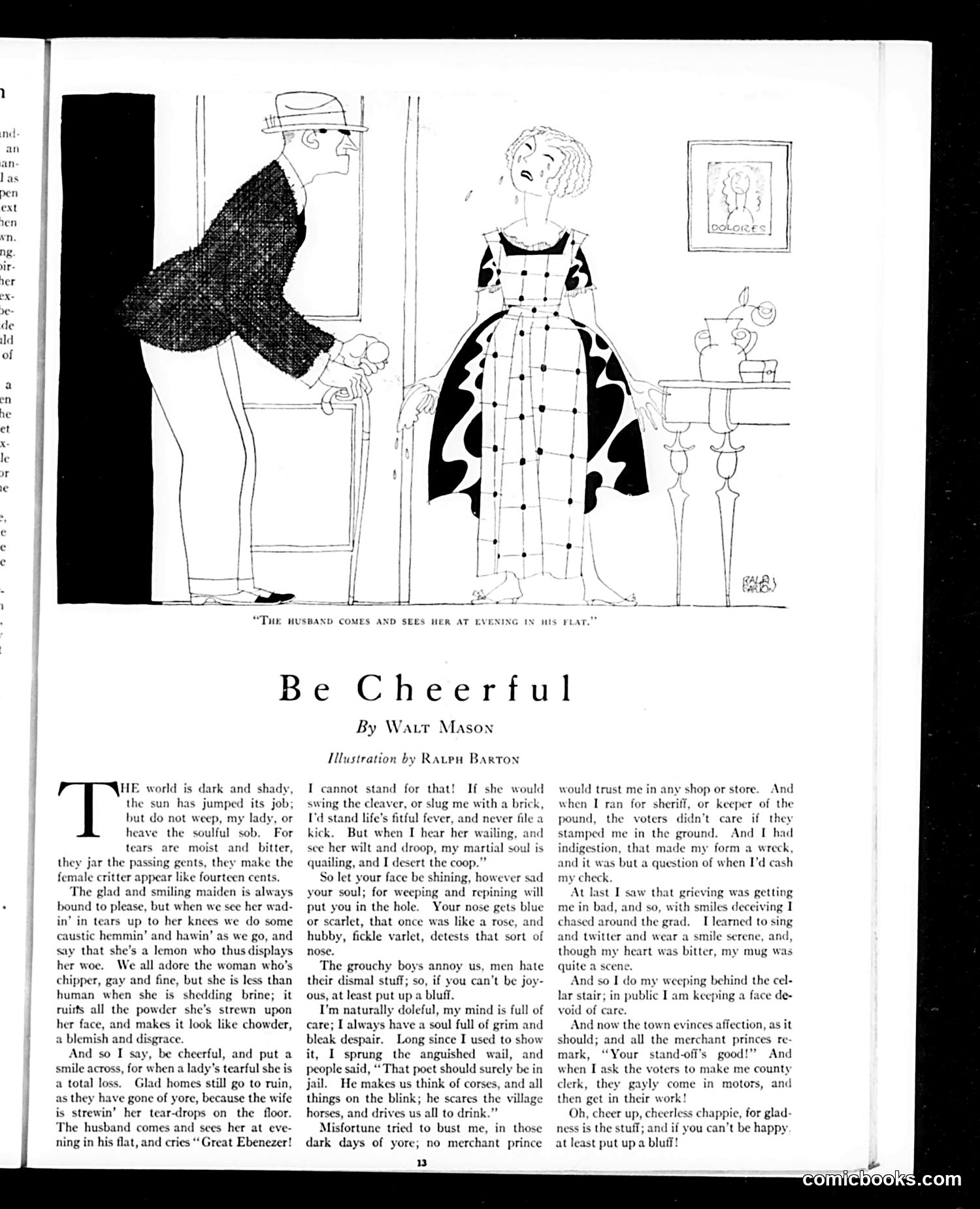
This is an illustrated story-poem by Walt Mason advocating emotional suppression for women and self-deception for social advancement. The cartoon shows a husband arriving home to find his wife crying—his reaction of disgust and abandonment ("I desert the coop") sets up the moral lesson. The poem argues that women's tears repel men, ruin their appearance, and drive husbands away. Mason then pivots to personal testimony: he claims emotional honesty (displaying genuine grief) cost him social standing—voters wouldn't support him, merchants distrusted him. Only after adopting a false cheerful demeanor did he gain respect and political success. The message reflects early-20th-century attitudes: emotional restraint equals virtue; authentic sadness is weakness; women's primary duty is pleasing men; and success comes through performative positivity rather than honest self-expression. It's presented as practical wisdom but embodies significant gender bias and emotional dishonesty.
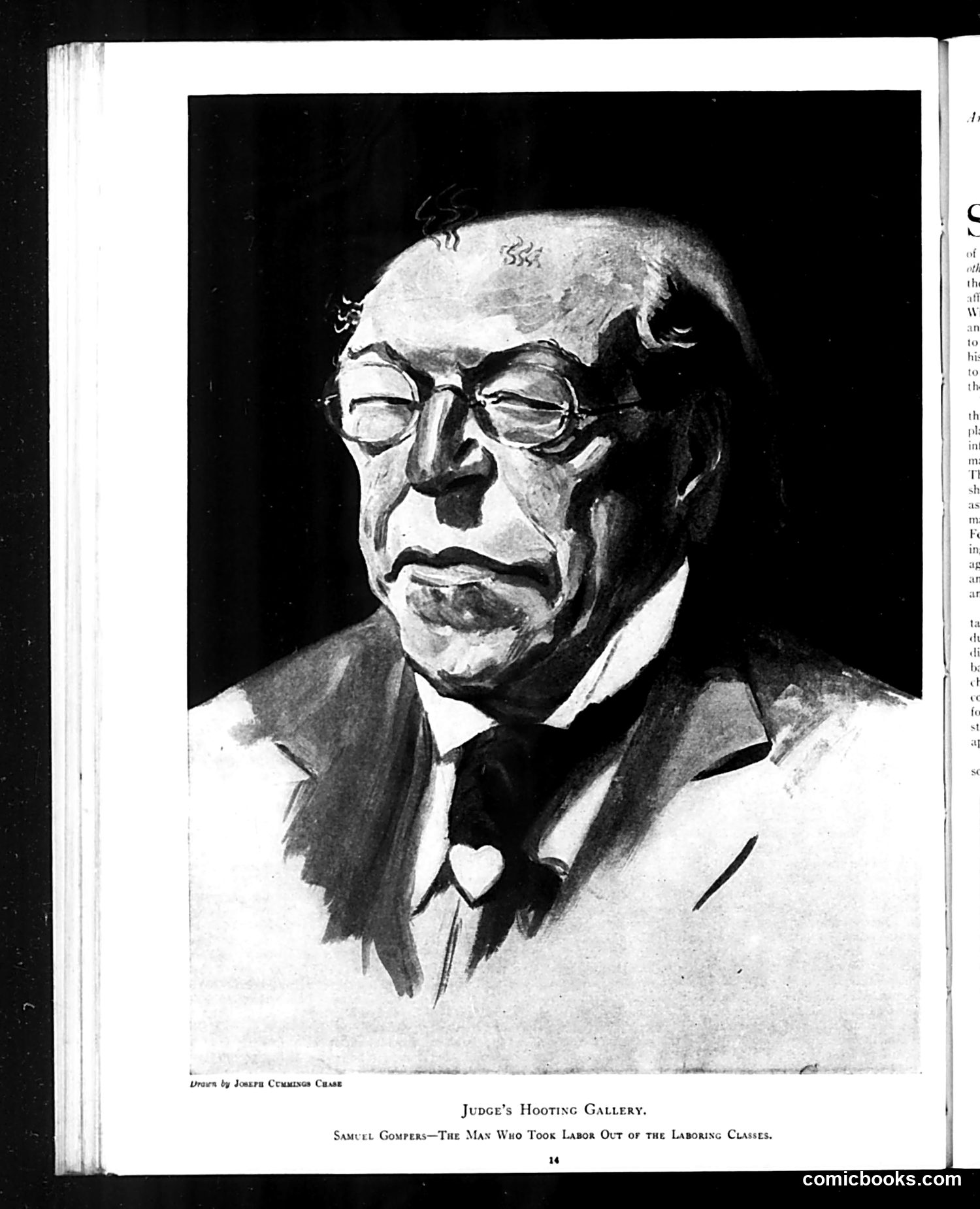
This is a portrait from Judge magazine's "Hooting Gallery"—a satirical feature showcasing caricatures of public figures. The subject is identified as **Samuel Gompers, "The Man Who Took Labor Out of the Laboring Classes."** Gompers was the influential leader of the American Federation of Labor (AFL). The satire's point appears critical: the caption suggests he elevated himself socially or economically through labor leadership, distancing himself from working-class origins. The exaggerated facial features in Joseph Cunard Carse's caricature—particularly the severe expression and prominent features—were typical Judge magazine tactics to mock political/labor figures. The "Hooting Gallery" format invited readers to laugh at these caricatured depictions of prominent people, suggesting Gompers had become disconnected from the workers he represented.
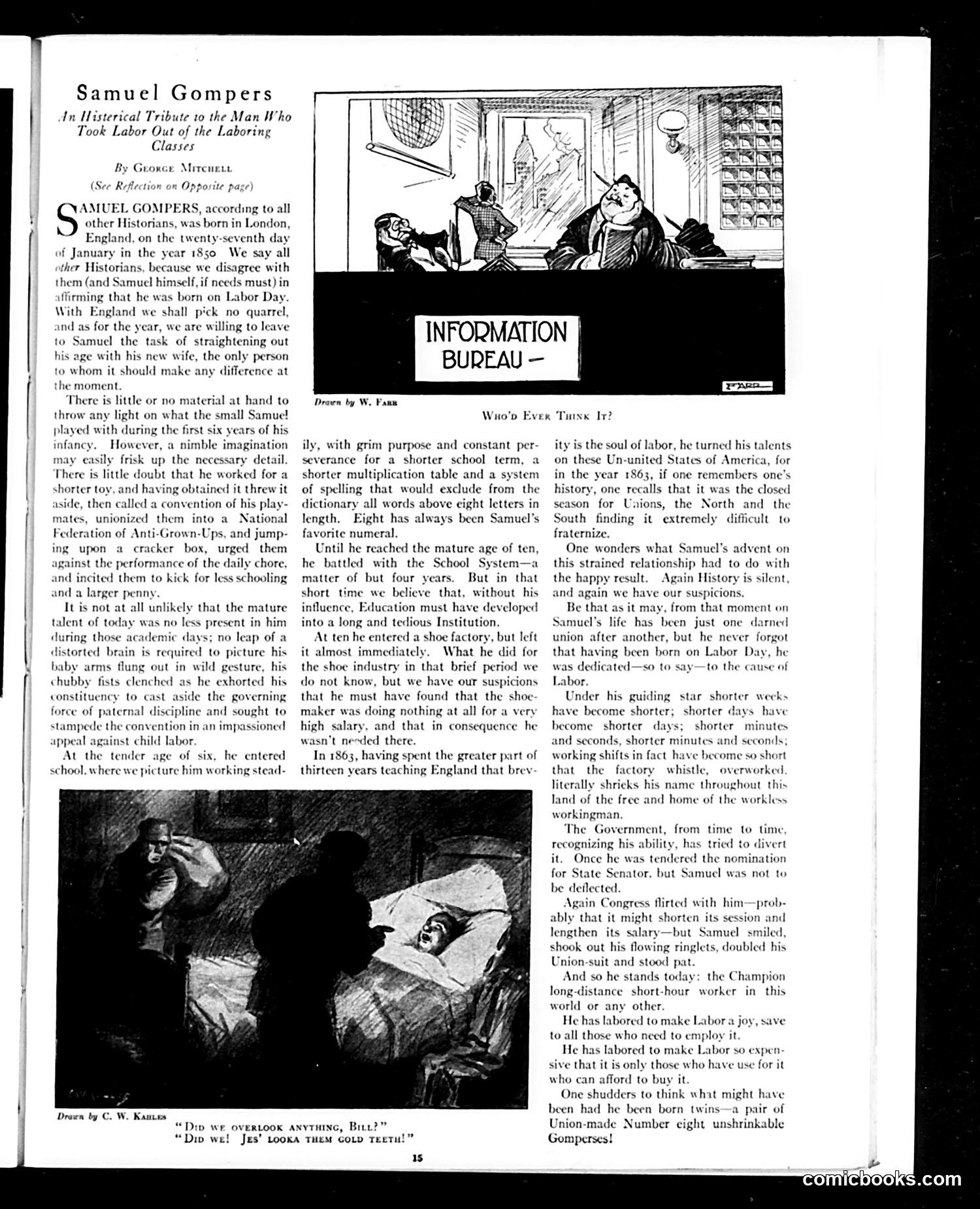
This page attacks Samuel Gompers, the real-world labor leader and founder of the American Federation of Labor, through mock-heroic biography. The satire portrays Gompers as a relentless agitator who, from childhood, systematically reduced everything—school terms, multiplication tables, word lengths, work hours, even minutes and seconds. The cartoon's central joke: Gompers supposedly made labor "so expensive that it is only those who have use for it...can afford to buy it," thereby elevating labor out of the working classes themselves—the opposite of his stated mission. The two small illustrations show Gompers as a scheming organizer. The text is deliberately absurd, crediting him with organizing child labor strikes and union activity during America's Civil War, when unions actually faced suppression. The overall point: Judge's editors viewed Gompers' labor advocacy as economically counterproductive self-sabotage that priced working people out of jobs.
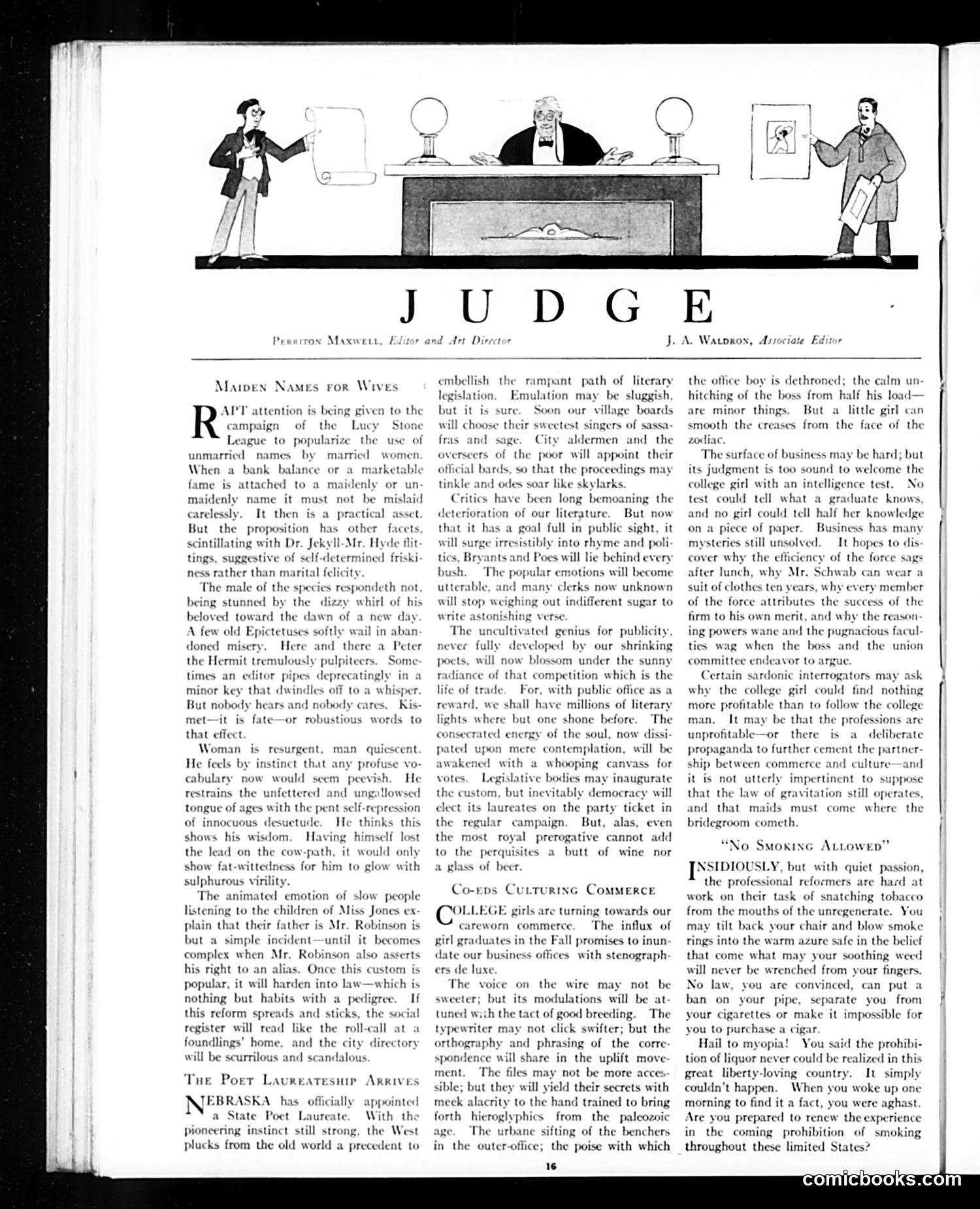
The masthead illustration depicts a courtroom judge presiding at a bench, flanked by two male figures holding documents—a visual representation of judicial authority and legal proceedings. The page contains three satirical articles: 1. **"Maiden Names for Wives"** mocks the Lucy Stone League's campaign allowing married women to retain their maiden names. The satire suggests this creates social chaos: bank records become confused, city directories become unmanageable, and men resent losing patriarchal control over women's identities. The piece ridicules both women's autonomy and men's wounded pride. 2. **"The Poet Laureateship Arrives"** sarcastically celebrates Nebraska appointing a state poet laureate, predicting literary quality will paradoxically *decline* when poetry becomes competitive, political, and tied to public office rather than pure artistic merit. 3. **"Co-eds Culturing Commerce"** briefly notes college women entering business as stenographers, suggesting workplace feminization. All three articles use heavy irony to critique modern social changes—women's liberation, bureaucratic modernization, and commercialism—while revealing conservative anxieties about traditional hierarchies.
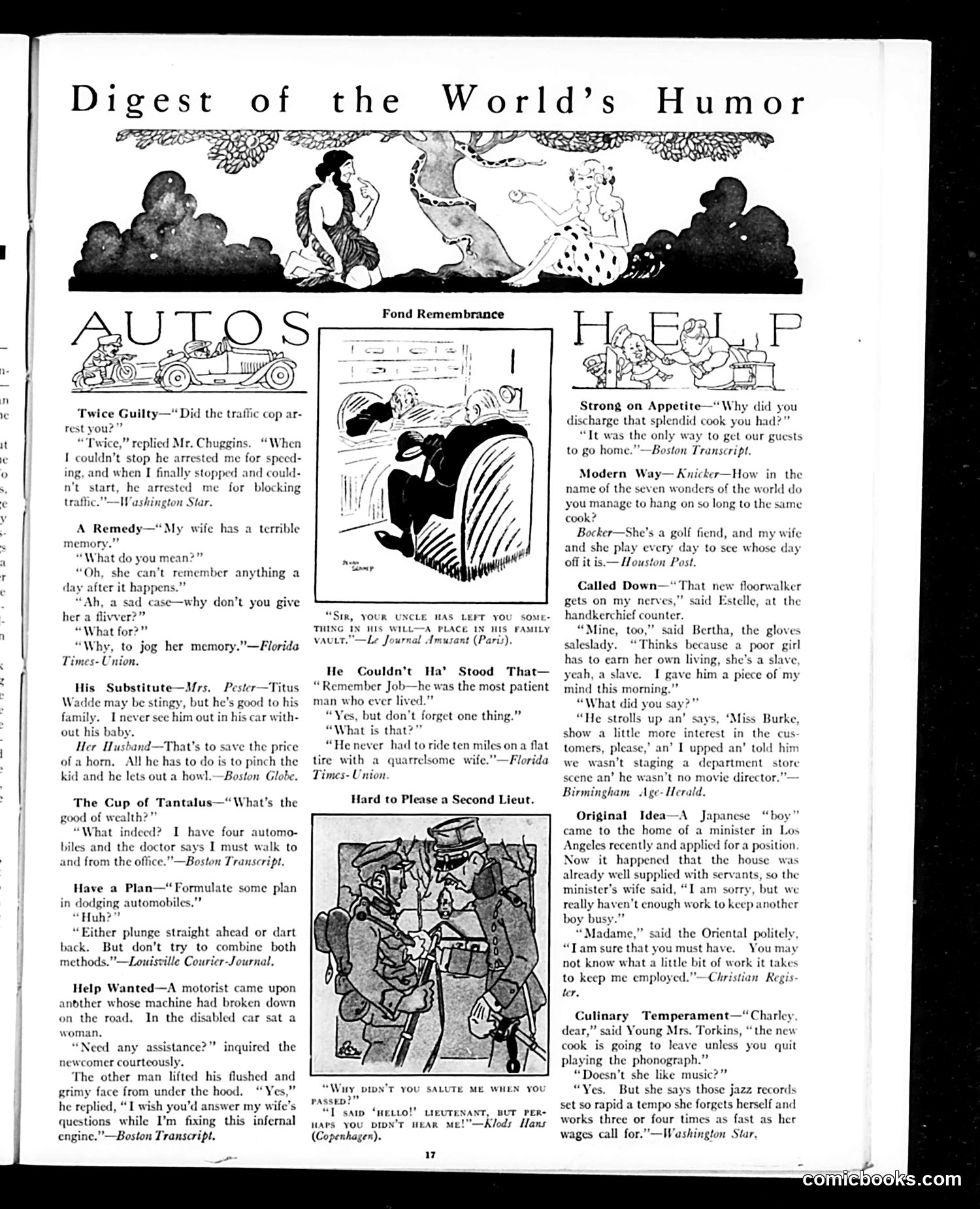
This page is a humor digest collecting jokes about automobiles, marriage, and early 20th-century American life. The cartoons and quips target: **Automobiles**: The central theme. Jokes mock traffic laws ("arrested twice"), car breakdowns, flat tires, and the automobile's disruptive novelty—one quip suggests using a baby's cry as a car horn to save money. **Marriage**: Multiple jokes depict wives as nagging or difficult—particularly in cars (the "quarrelsome wife" on a flat tire is a recurring frustration). **Class and labor**: A Japanese servant applying for work jokes about needing employment despite having little work; salesgirls resent a floor manager's demands they show more "interest." **Social anxieties**: Wealth paradoxes (owning four cars but needing to walk for health), memory loss, and cooks threatening to leave (they're valued but temperamental). The humor reflects early automotive-era anxieties and period attitudes toward gender, class, and immigrant workers. The jokes assume a middle-class readership both fascinated and frustrated by modern machines.
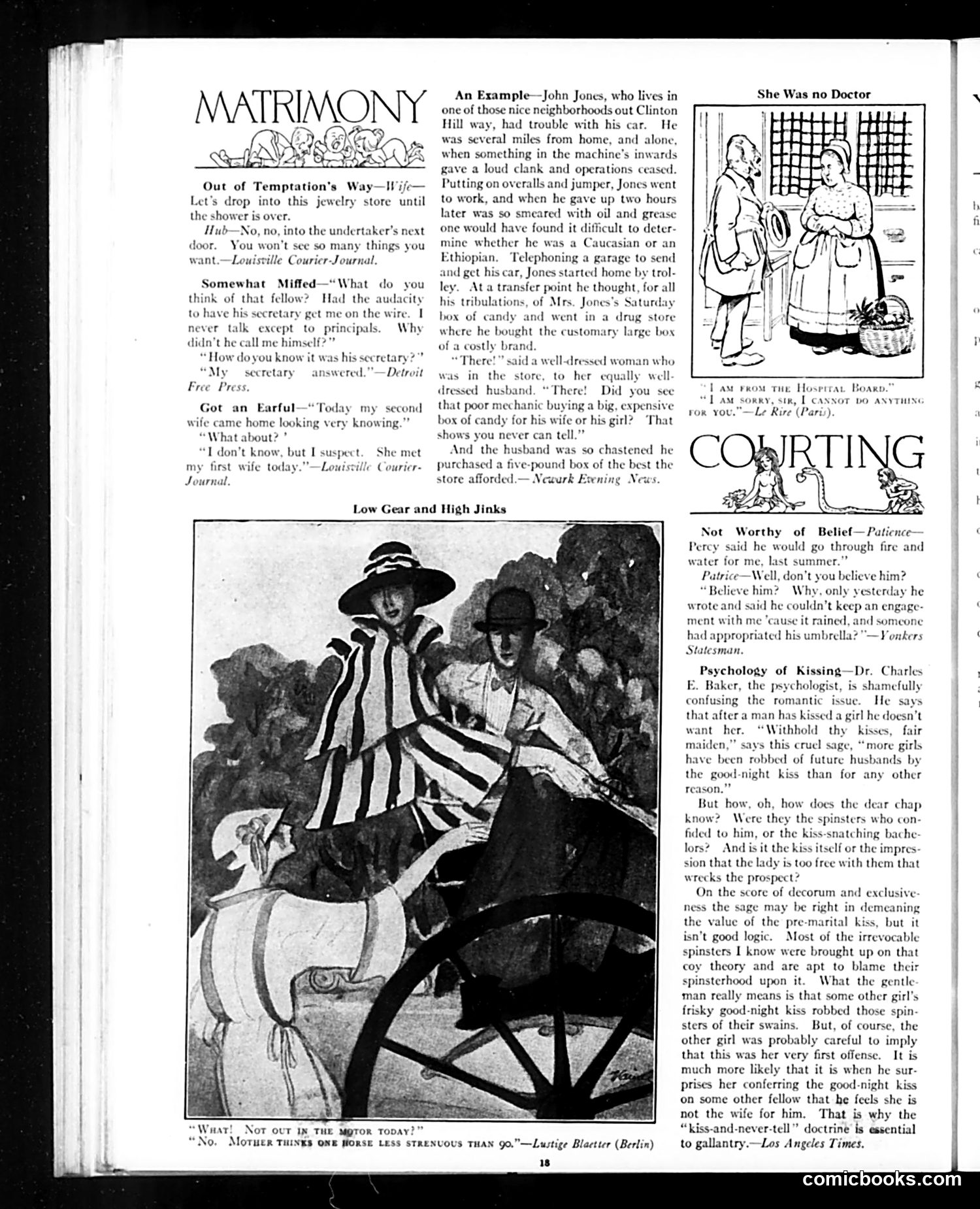
This page contains several short humorous anecdotes typical of early 20th-century Judge magazine, plus one cartoon. **The cartoon "Low Gear and High Jinks"** shows two women in a car, with the caption suggesting one prefers horses to automobiles because a horse is "less strenuous." This jokes about early automobiles' unreliability and the physical demands of operating them—cars frequently broke down and required manual effort to start and control. **The anecdotes mock domestic life:** A husband avoids a jewelry store (where he'd be tempted to buy expensive items) by going to an undertaker instead. A man complains his boss had his secretary call rather than calling himself. A husband meets his first wife (implying infidelity), and his second wife notices. **"An Example"** satirizes class assumptions: A working-class man buys expensive candy while covered in grease, prompting onlookers to assume he's wealthy. His shabby appearance contradicts his purchase, highlighting how people judge by appearances. **The "Courting" section** includes social commentary on courtship customs, particularly regarding the "psychology of kissing"—debating whether pre-marital kisses damage marriage prospects, reflecting period anxieties about changing social morality.
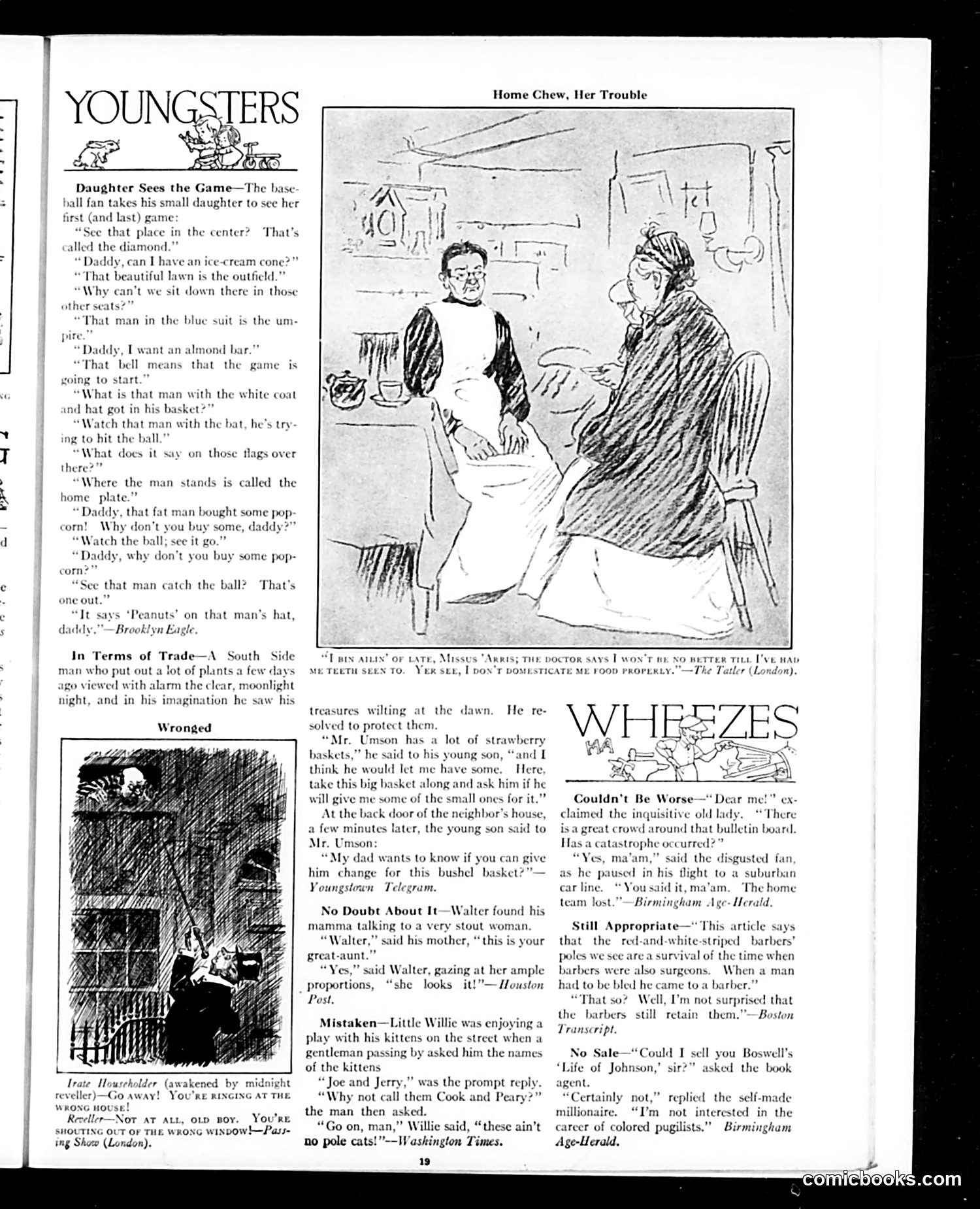
This page contains humorous anecdotes rather than political cartoons. The pieces satirize everyday American life circa early 1900s: **"Daughter Sees the Game"** mocks how children at baseball games ignore explanations of the sport, focusing instead on snacks (ice cream, almond bars, popcorn). The joke is parental frustration—the father's educational efforts are pointless. **"Wronged"** and other brief items use similar domestic humor: a plant owner's nighttime anxiety, a child misunderstanding his father's errand, a boy's confusion about cat names (Cook and Peary—polar explorers, not "pole cats"). **"Home Chew, Her Trouble"** shows a woman with dental problems, with a caption about needing teeth treatment before eating properly. **"Wheezes"** section contains quick jokes: a fan's team loss, a barber's bleeding history, and a self-made millionaire uninterested in biographies. These rely on period-specific references (surgeons as barbers, colored pugilists) that modern readers might not recognize. The humor throughout emphasizes class, consumerism, and the gap between adult intentions and actual behavior.
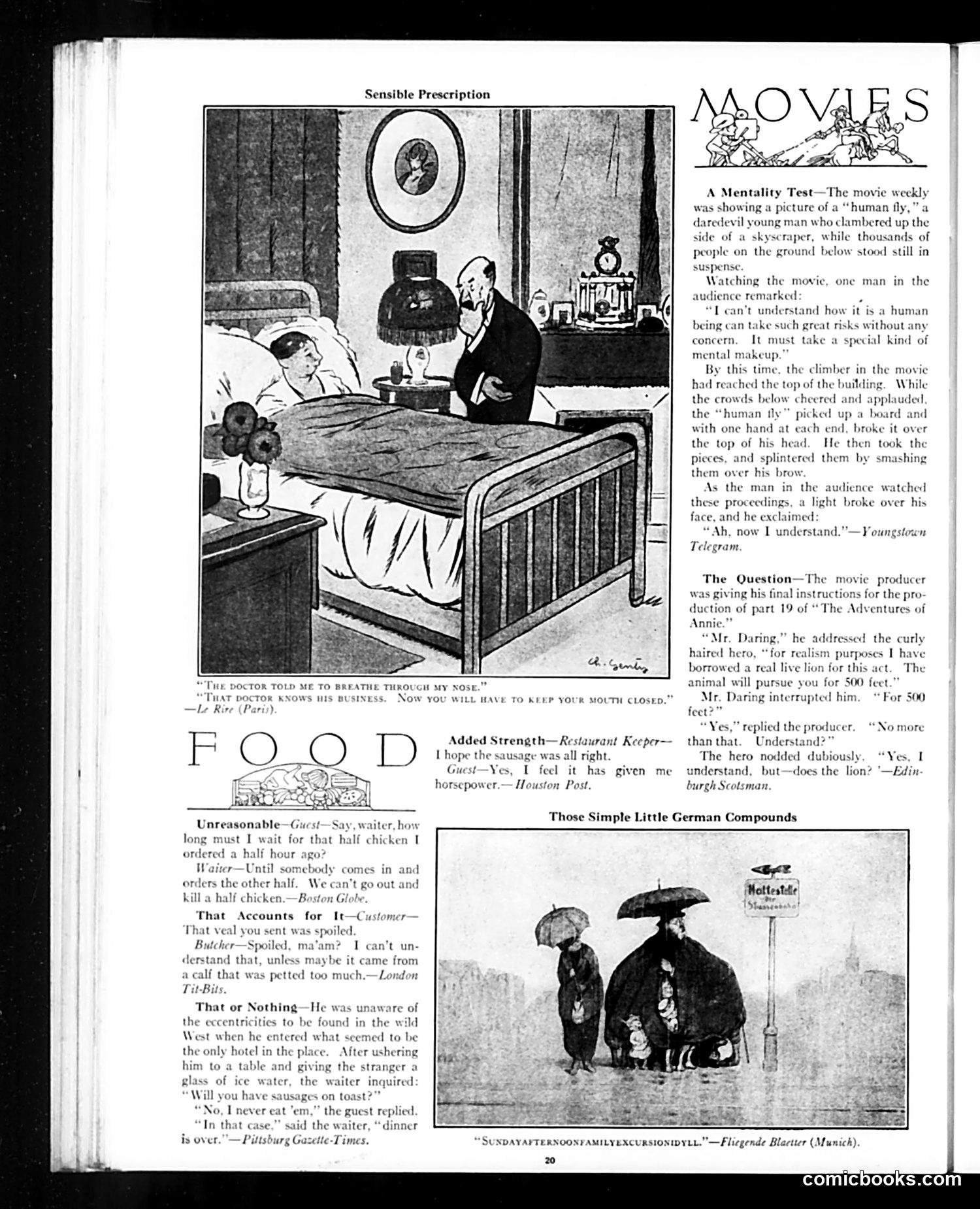
This page contains several short humorous anecdotes satirizing everyday life and emerging entertainment of the early 20th century. **"A Mentality Test"** mocks moviegoers' reactions to "human fly" stunt films (daredevils climbing skyscrapers—a real entertainment phenomenon). The joke: a man questions how anyone could take such risks, then immediately understands upon watching the performer smash a board over his own head, implying the stuntman lacks intelligence. **"The Question"** satirizes silent film production absurdity. A movie producer instructs an actor to be chased by a real lion for 500 feet, then dismisses concerns about the lion's cooperation—poking fun at early cinema's dangerous, improvised methods. The **"Food" section** collects restaurant-related jokes about poor service and spoiled food, reflecting common dining complaints. The page's bottom illustration shows a German family with an umbrella, likely connecting to the section title "Those Simple Little German Compounds," suggesting ethnic humor typical of the era. Overall, the content satirizes early cinema's sensationalism, restaurant culture, and includes period-typical ethnic stereotyping.
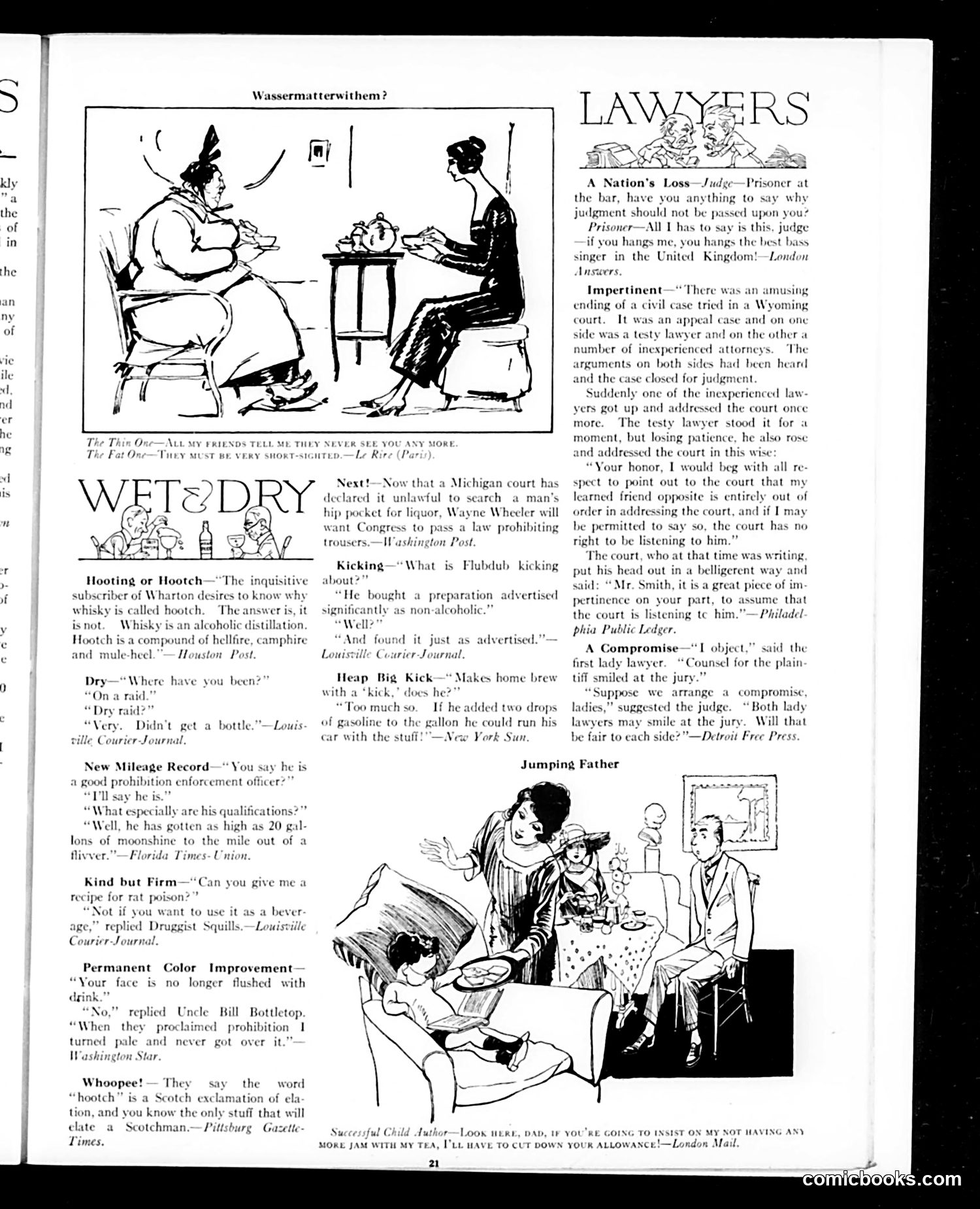
This page satirizes **Prohibition Era America** (likely 1920s), when alcohol sales were banned. The "Wet & Dry" section mocks enforcement efforts and creative workarounds. **Key jokes:** - **"Hooting or Hootch"**: Explains why illegally distilled whisky is called "hootch"—it's a compound of various burning substances, not real alcohol - **"Dry"**: A prohibition officer admits he confiscated no actual liquor on a raid - **"New Mileage Record"**: A satirical claim that an enforcement officer has extracted 20 gallons of homemade moonshine per mile from violators - **"Jumping Father"**: A child threatens to reduce his father's allowance if he won't stop hoarding jam for tea—a gentle joke about rationing or penny-pinching The cartoons mock both **bootleggers' crude methods** and the **futility of Prohibition enforcement**. The left cartoon shows two women discussing absent friends, likely referencing social disruption from alcohol bans. The page reflects widespread public skepticism about Prohibition's effectiveness.
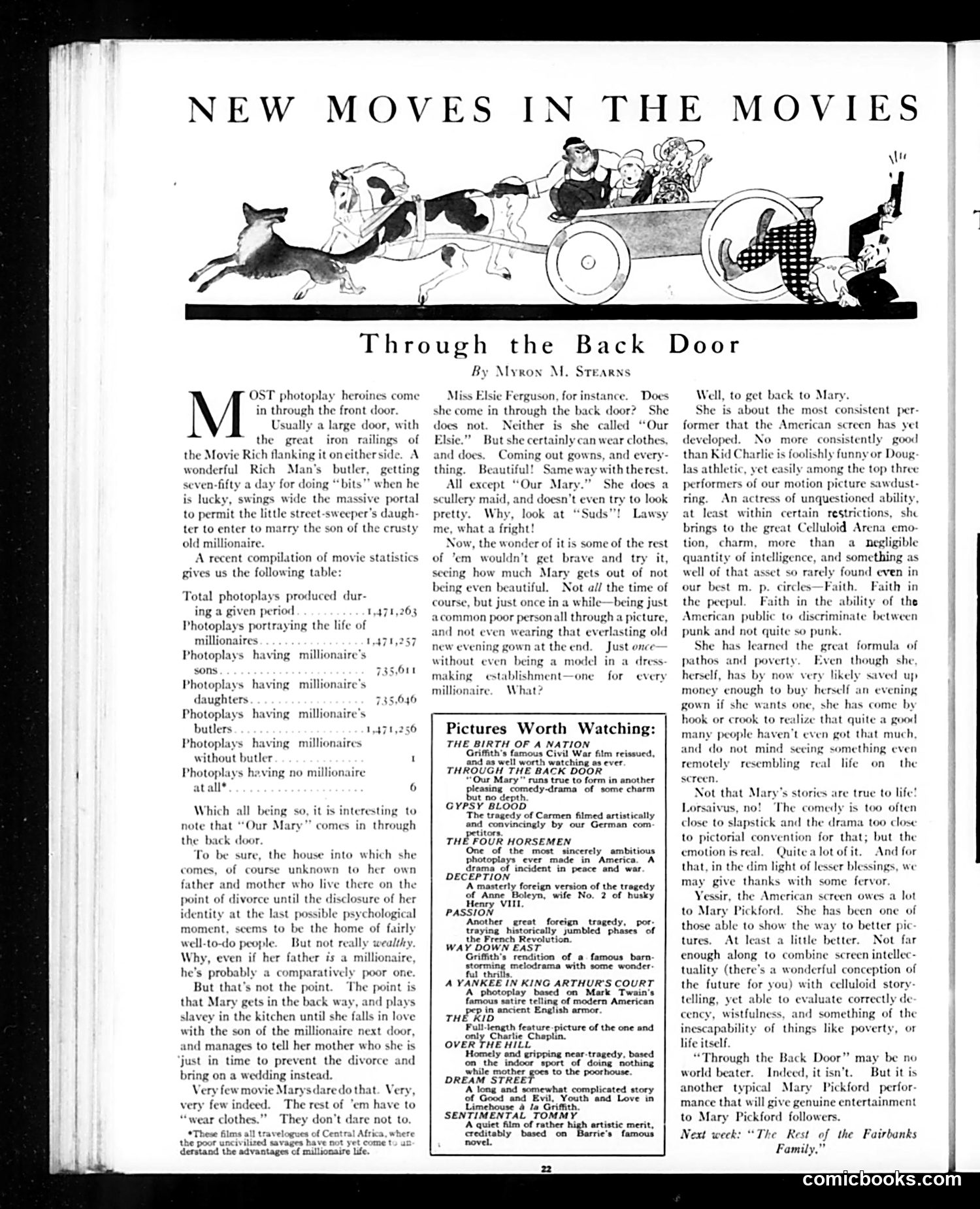
This article by Myron M. Stearns satirizes a clichéd plot device dominating 1920s cinema: the "poor girl enters wealth through the back door" narrative. The accompanying statistics (presented as mock-serious data) mock Hollywood's obsession with millionaires—showing films about millionaires vastly outnumber those without them. The satire targets two contradictions: First, while most movie heroines must *earn* their way (entering as servants, disguised as poor), Mary Pickford's character "Our Mary" does this shamelessly yet succeeds without conventional beauty. Second, the article notes the irony that these films are supposedly aspirational for "uncivilized savages" in Africa who "have not yet understand the advantages of millionaire life"—a patronizing jab at both colonial attitudes and cinema's presumed moral instruction. The piece critiques Hollywood's repetitive class-mobility fantasies while celebrating that at least Pickford's version avoids pretense about its own implausibility.
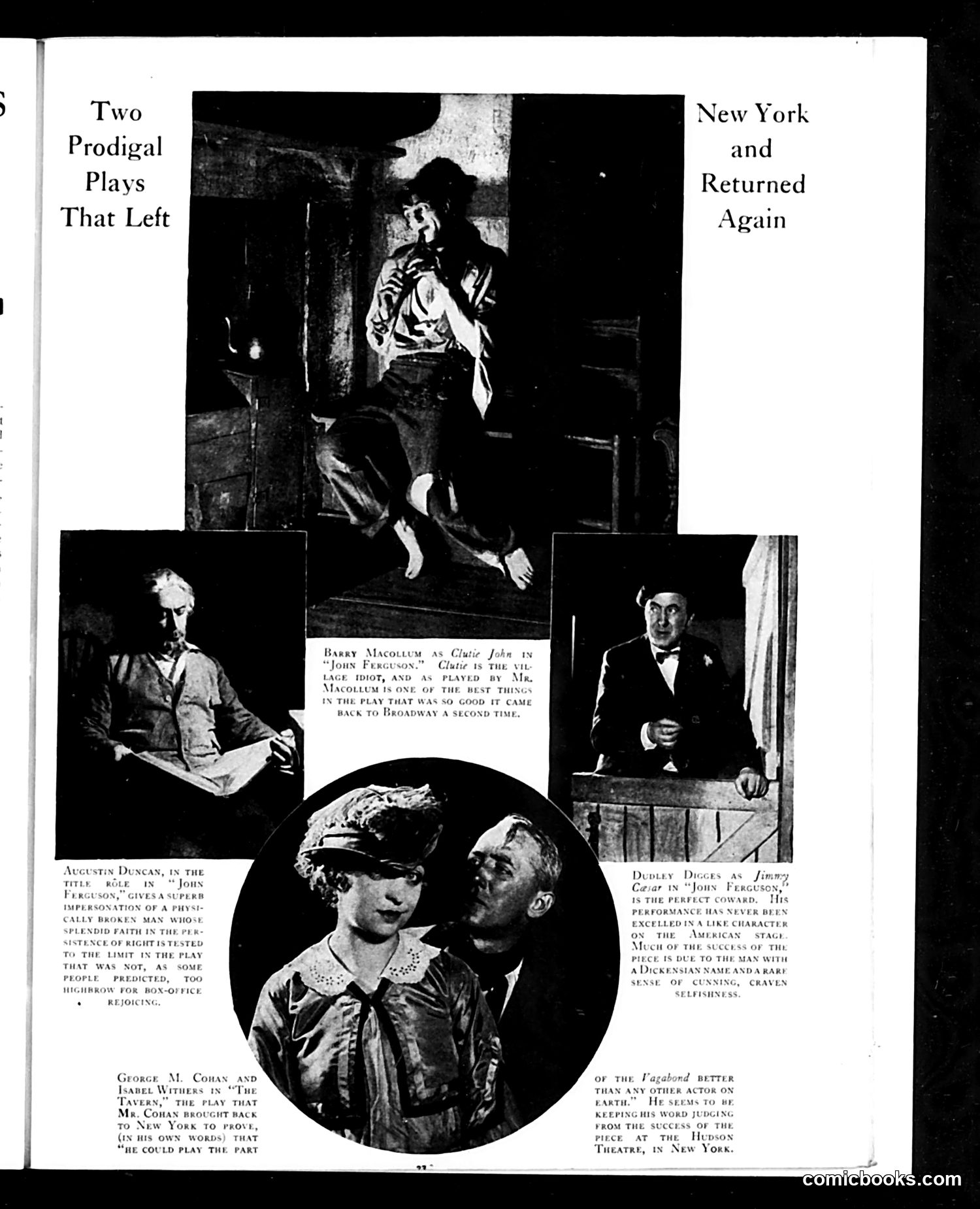
This page celebrates the theatrical success of two plays that initially left Broadway but returned due to popular demand—a notable achievement in early 20th-century theater economics. The featured productions star established actors: **Augustus Duncan** in "John Ferguson," praised for his nuanced performance of a morally conflicted character; **George M. Cohan** in an unnamed play (text unclear), returning to prove he could master serious dramatic roles; **Barry Macollum** as a character named Clark John, delivering acclaimed comic relief; and **Dudley Digges** as a Dickensian-named coward, described as exceptionally cunning and calculating. The satire appears gentle: Judge celebrates these actors' talents and the audience's good taste in supporting returning productions rather than dismissing them as "highbrow" (a contemporary concern about theatrical accessibility). The piece treats theatrical success as evidence of both performer skill and audience sophistication.
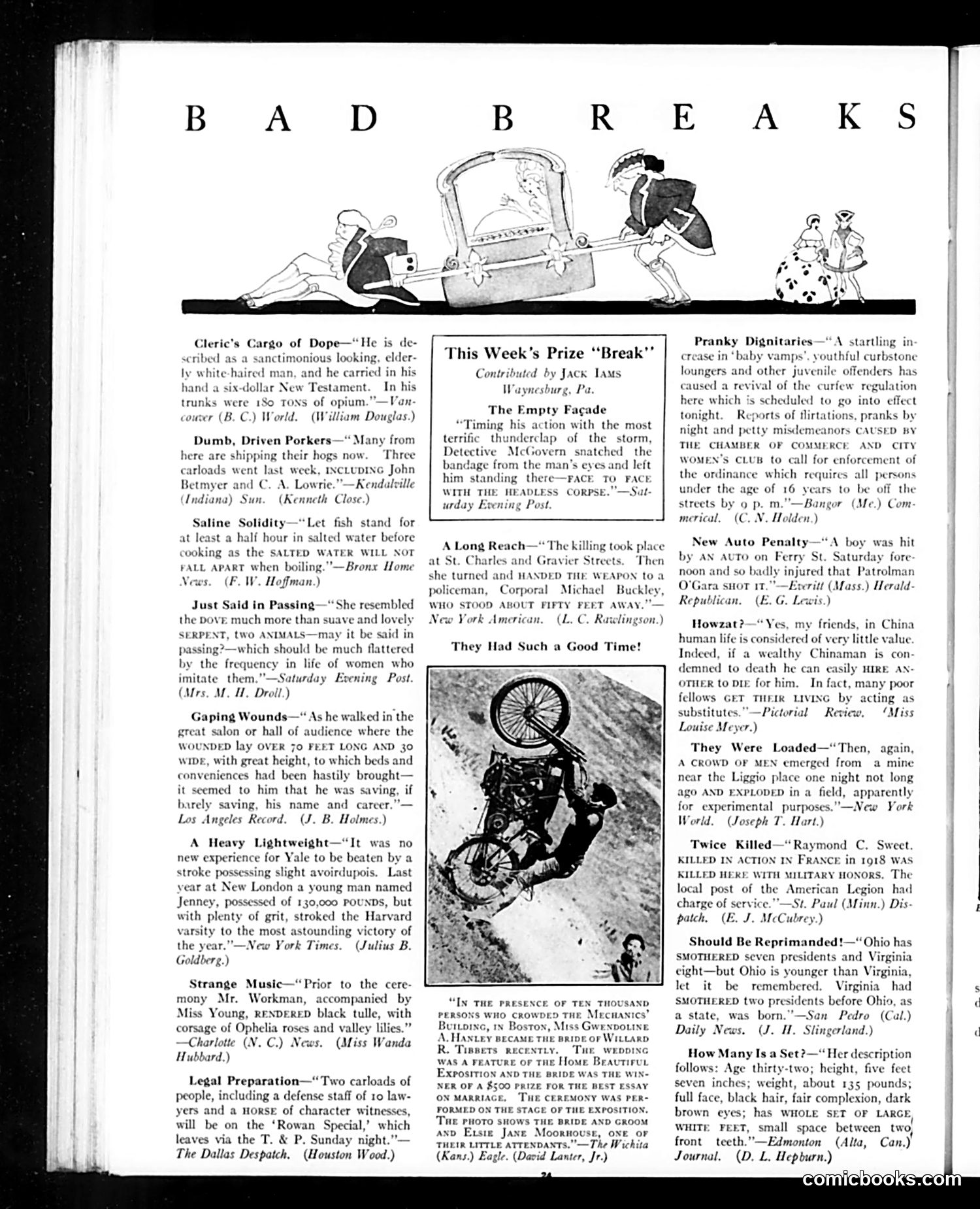
This page from Judge magazine collects humorous newspaper "breaks"—embarrassing typos and editorial errors from real newspapers. The cartoon at top illustrates the concept: figures struggling with an unwieldy printing press or similar machinery, literally embodying journalistic mishaps. The featured examples mock absurd unintended meanings created by poor editing. For instance, a sentence about a detective revealing a corpse becomes darkly comic when it claims the corpse was "standing there." Another reports a bride winning a prize "for the best essay on marriage" during her own wedding ceremony—the editing makes her achievement absurdly coincidental. The humor relies on readers recognizing how careless newspaper production created ridiculous (and sometimes macabre) alternative interpretations. This was satirical commentary on newspaper standards and editorial competence during the early 20th century—mocking the profession's frequent sloppiness before modern fact-checking practices existed.
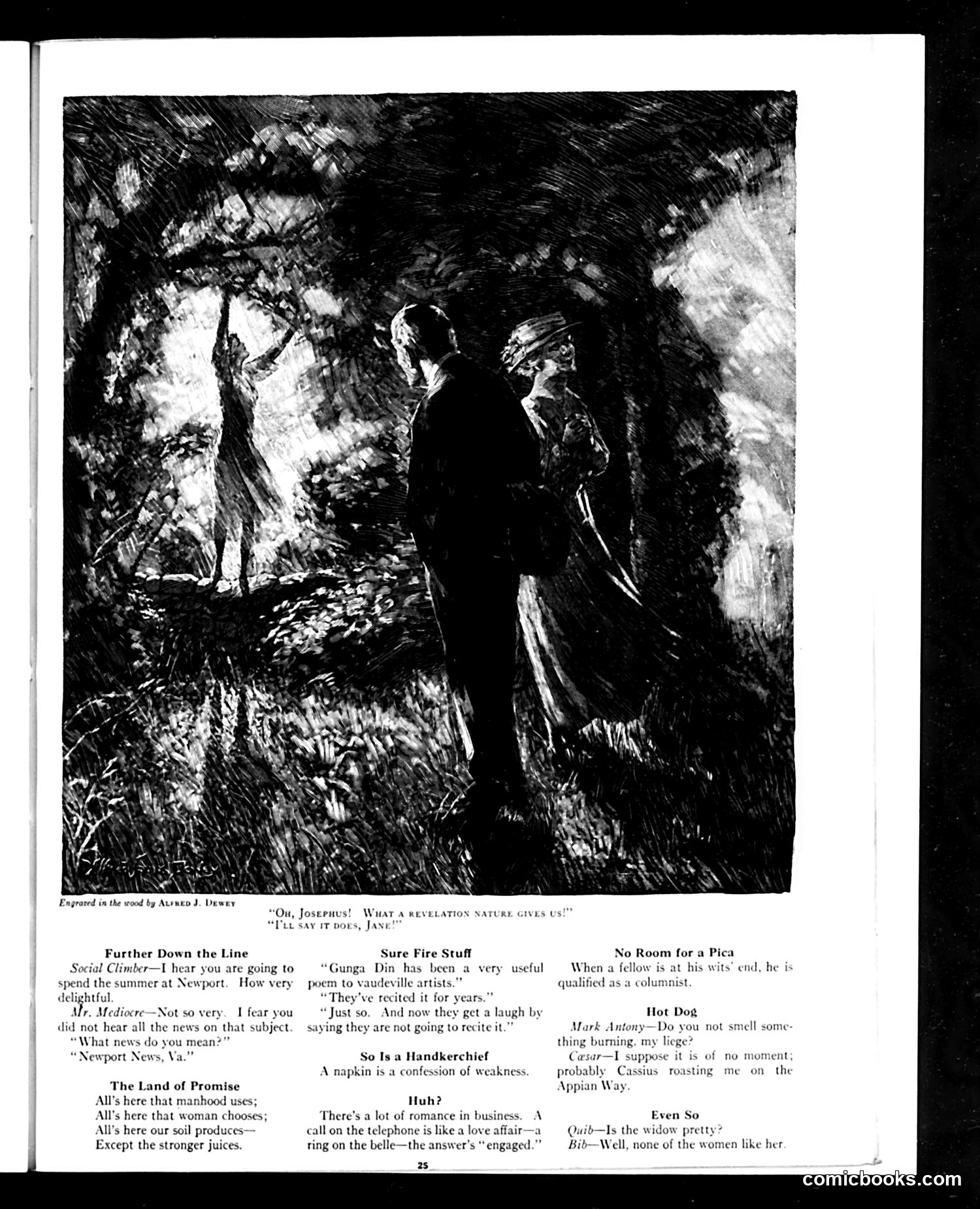
This page from *Judge* contains multiple brief satirical pieces and a wood engraving illustration. The main image shows two silhouetted figures in a dark wood or cave setting, with dialogue attributing a quote to "Josephus" and "Jane"—likely referencing a famous literary or theatrical moment, though the specific source isn't identifiable from this page alone. The text pieces are short, punchy jokes targeting contemporary society: - **"Further Down the Line"** mocks social climbing by contrasting Newport, Rhode Island (a wealthy resort) with Newport News, Virginia (an industrial port city). - **"The Land of Promise"** satirizes American abundance while making a cryptic reference to "stronger juices"—likely alluding to Prohibition-era alcohol restrictions. - **"Sure Fire Stuff"** jokes about vaudeville performers recycling Kipling's "Gunga Din." - Other brief quips play on wordplay and double meanings (handkerchiefs as weakness, telephone calls as romance). The overall tone is light, upper-class oriented humor typical of *Judge*'s satirical approach to American social pretensions and contemporary concerns.
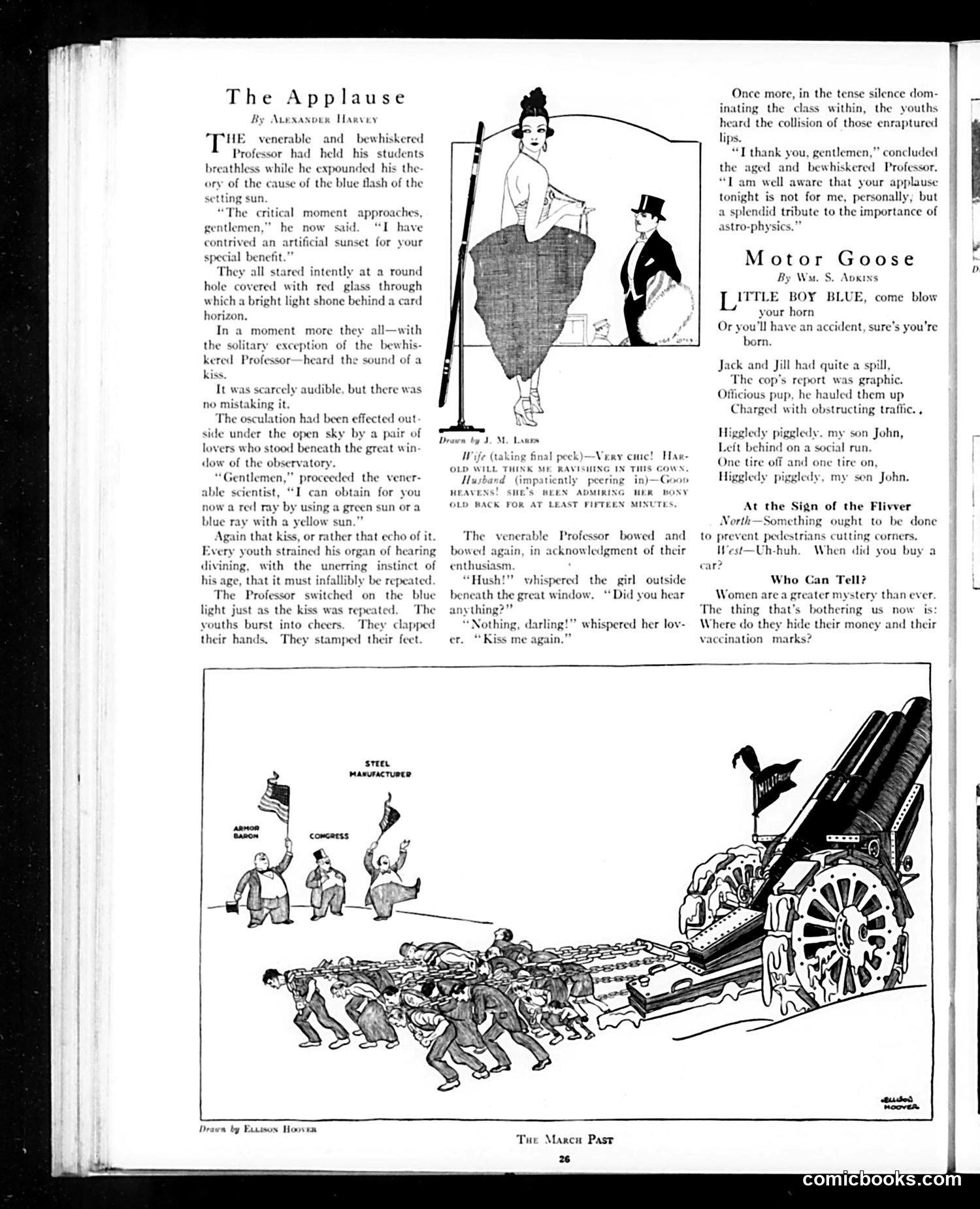
**"The Applause"** satirizes absent-minded professors and youthful distraction. A venerable scientist demonstrates optical principles using an artificial sunset, but repeatedly hears kissing couples outside the observatory window. Students mistakenly applaud the kiss sounds, and the oblivious professor credits their enthusiasm to his astro-physics lecture—a joke about professorial vanity and students' true priorities. **"The March Past"** (bottom cartoon by Ellison Hooven) depicts military/industrial power, showing laborers hauling massive artillery while politicians above celebrate—likely commentary on war profiteering or industrial mobilization, possibly referencing World War I era concerns about steel manufacturers and government contracts. The remaining items are lighter domestic humor and a joke about women's mysterious finances and vaccination marks—typical early-20th-century *Judge* magazine fare mixing intellectual satire with period stereotypes.
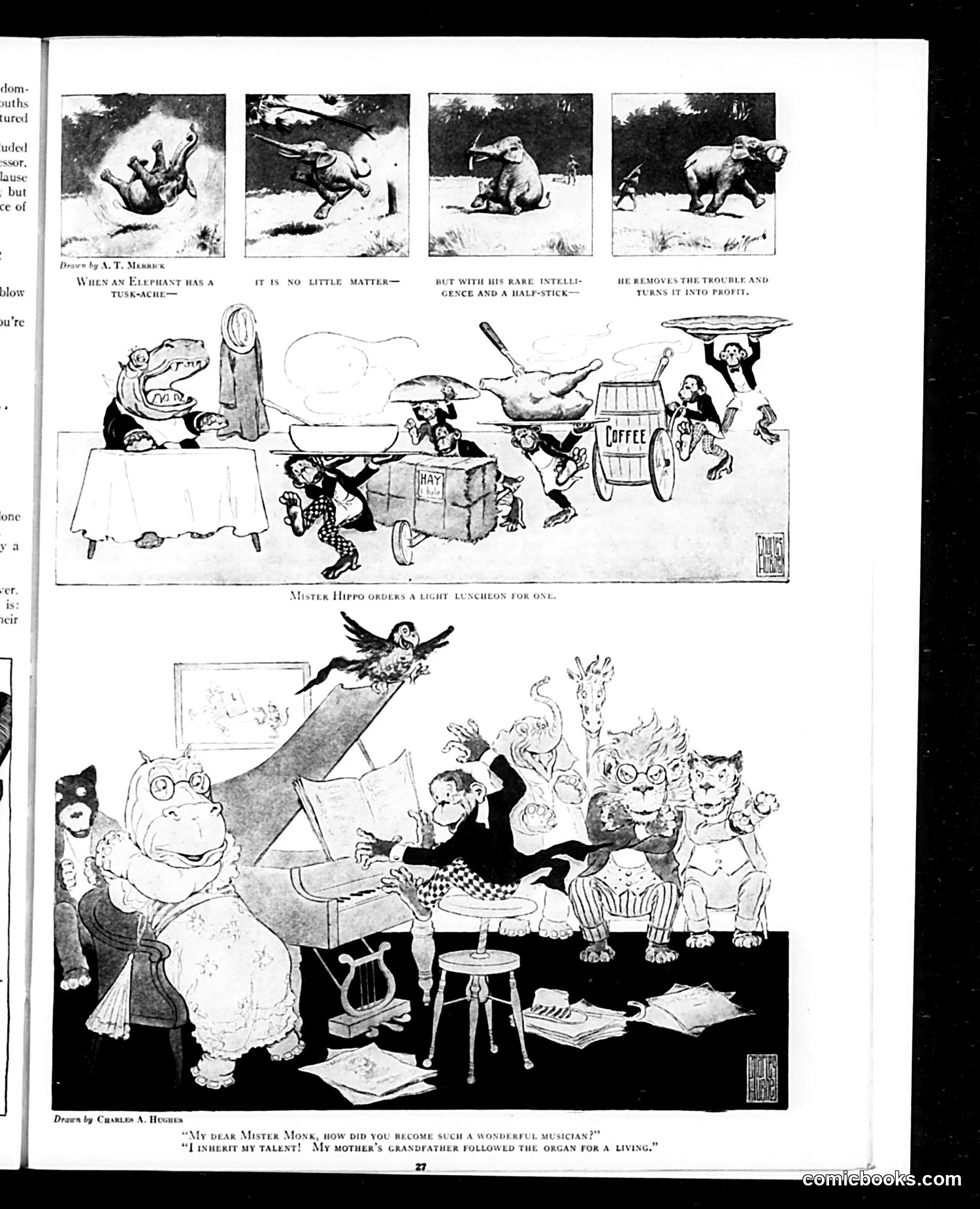
This page contains two separate satirical pieces from *Judge* magazine. **Top section:** Four panels depict an elephant with a toothache, drawn by A.T. Merke. The humor is straightforward slapstick—showing the elephant's distress and a figure using a "half-stick" (club) to extract the tooth, then profiting from the situation. This appears to be pure comedic illustration without political reference. **Bottom section:** Drawn by Charles A. Hoodes, this cartoon mocks pretension and inherited status. "Mister Monk" claims his musicianship derives from inherited talent, but reveals the actual source: his mother's grandfather "followed the organ for a living"—meaning he was a street musician or organ grinder (a low-status occupation). The joke satirizes people who inflate their social credentials by claiming refined ancestry when their relatives actually held humble, working-class jobs. The accompanying musical performance scene emphasizes the absurdity of his pretension.
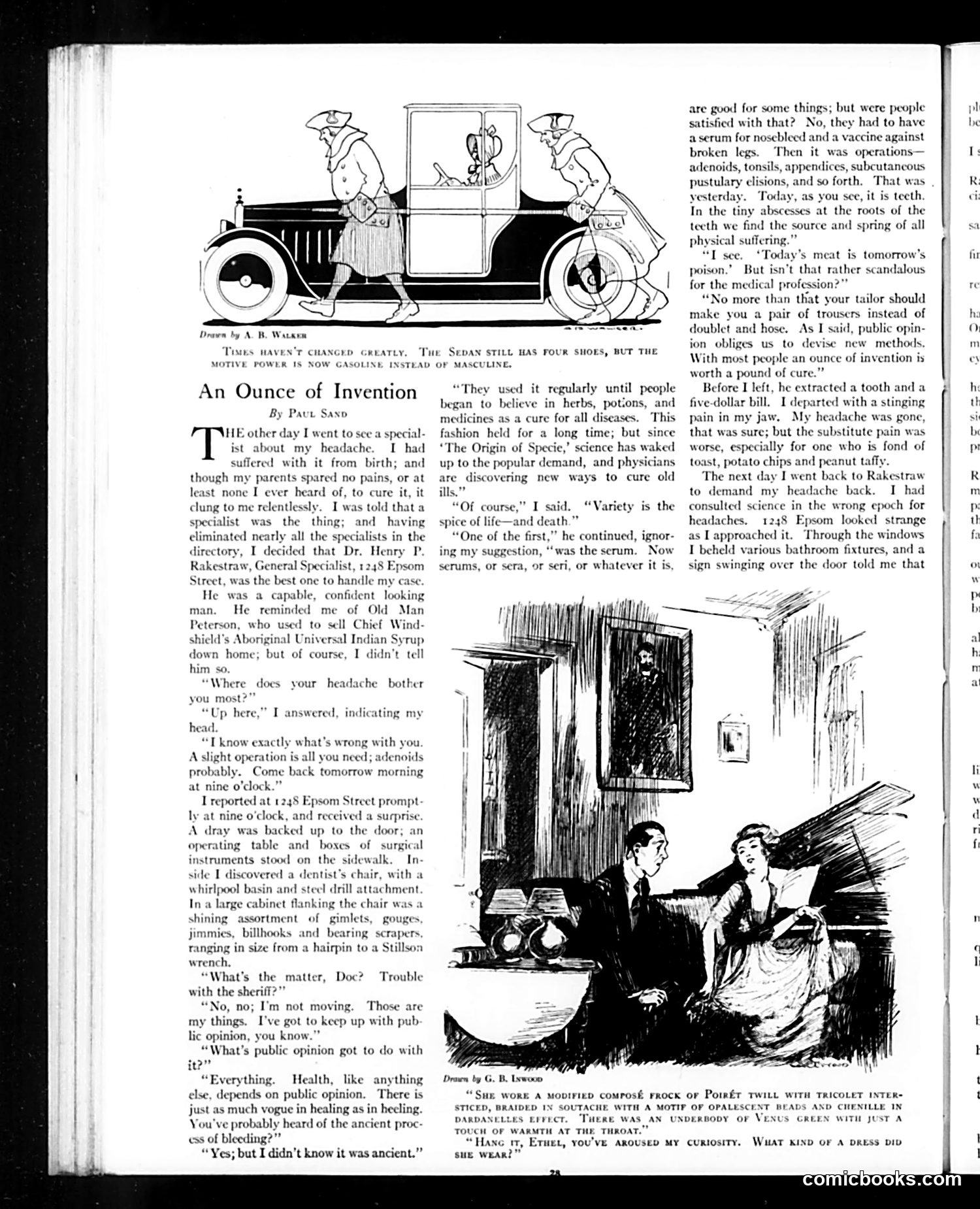
This story-illustration satirizes the medical profession's tendency to chase fashionable trends rather than genuine science. The narrator visits Dr. Rakestraw, a "General Specialist," who operates from a dray wagon filled with bizarre surgical tools (gimlets, billhooks, scrapers). The doctor's absurd logic—that medical treatments follow public opinion like clothing styles, progressing from bloodletting to serums to tooth extraction—mocks physicians who adopt trendy procedures without solid evidence. He extracts the patient's tooth as a cure for headaches, charging five dollars, leaving the patient worse off. The top cartoon shows a sedan automobile where "the motive power is now gasoline instead of masculine"—a gentle jab at how men have been replaced by machines, perhaps referencing women drivers or shifting gender roles during the automobile era. The overall message: both medicine and society chase novelty over substance, and "specialists" exploit public opinion for profit.
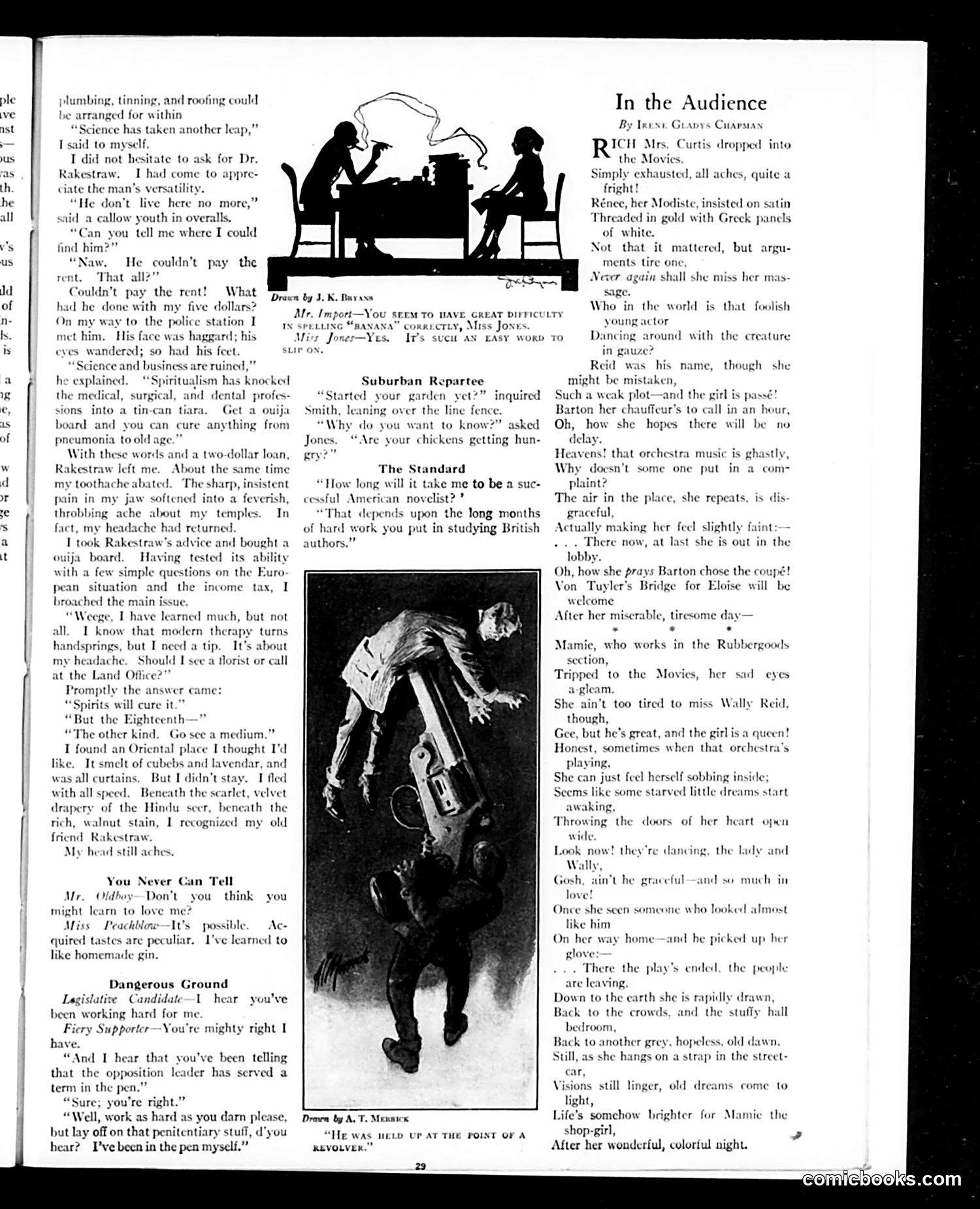
This page contains several short humorous pieces typical of Judge's satirical style: **Main Cartoon (top left):** A silhouetted illustration showing a man consulting with what appears to be a fortune teller or medium, satirizing the period's fascination with spiritualism as an alternative to traditional professional services. **"You Never Can Tell"**: A brief joke about acquired tastes in romance—playing on the idea that love might develop gradually, like learning to enjoy homemade gin (likely cheap or poorly-made liquor). **"Dangerous Ground"**: Political satire about a legislative candidate whose supporter boasts of campaigning for him, but the candidate nervously asks him to stop mentioning the opposition leader's prison record—since the supporter himself has served time. The humor mocks political hypocrisy and selective morality. **"In the Audience"**: A poem about a wealthy woman (Mrs. Curtis) at the movies, complaining about various discomforts while watching an actor named Reid. It satirizes the pretensions and constant dissatisfaction of the wealthy leisure class. The overall theme reflects Jazz Age attitudes toward wealth, spiritualism, and social climbing.
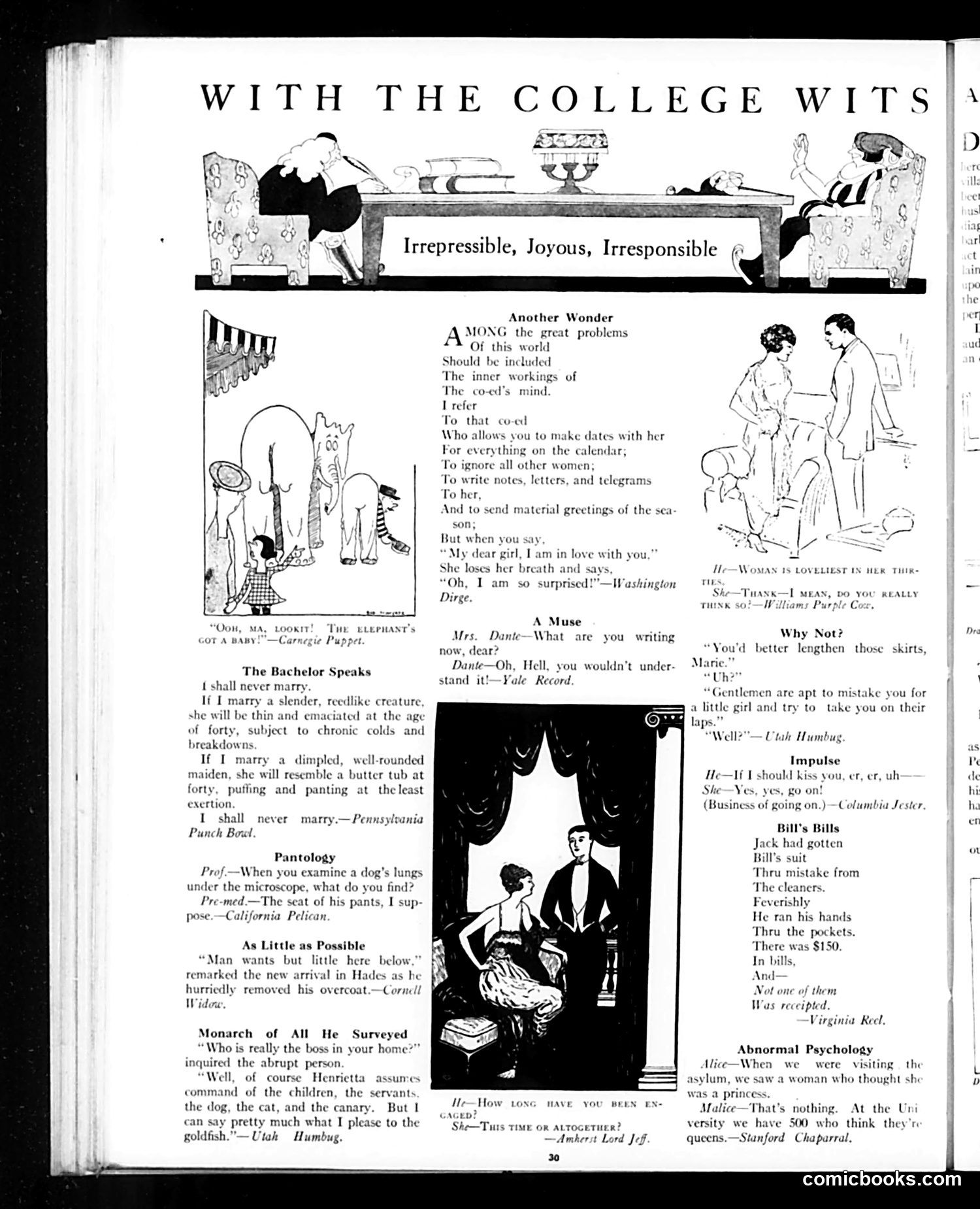
This page compiles short humor pieces satirizing early 20th-century college life and gender relations. Key targets include: **"The Bachelor Speaks"**: Mocks men's impossible standards for wives—slender women become thin and sickly, while plump women become fat and exhausted. The joke critiques male vanity and unrealistic expectations. **"Another Wonder"**: Satirizes the "co-ed" (female college student), a relatively new phenomenon. The piece ridicules women who accept dates and gifts but feign surprise when men express genuine romantic feelings—suggesting women are manipulative or emotionally dishonest. **"Why Not?" and other pieces**: Mock women's fashion (short skirts) and mock asylums/mental institutions through crude "crazy woman" humor. The overall tone reflects period anxieties about changing gender roles, particularly women's increased presence in higher education and relative independence. The humor targets both genders but particularly mocks women as illogical, manipulative, or mentally unstable—reflecting common misogynist stereotypes of the era.
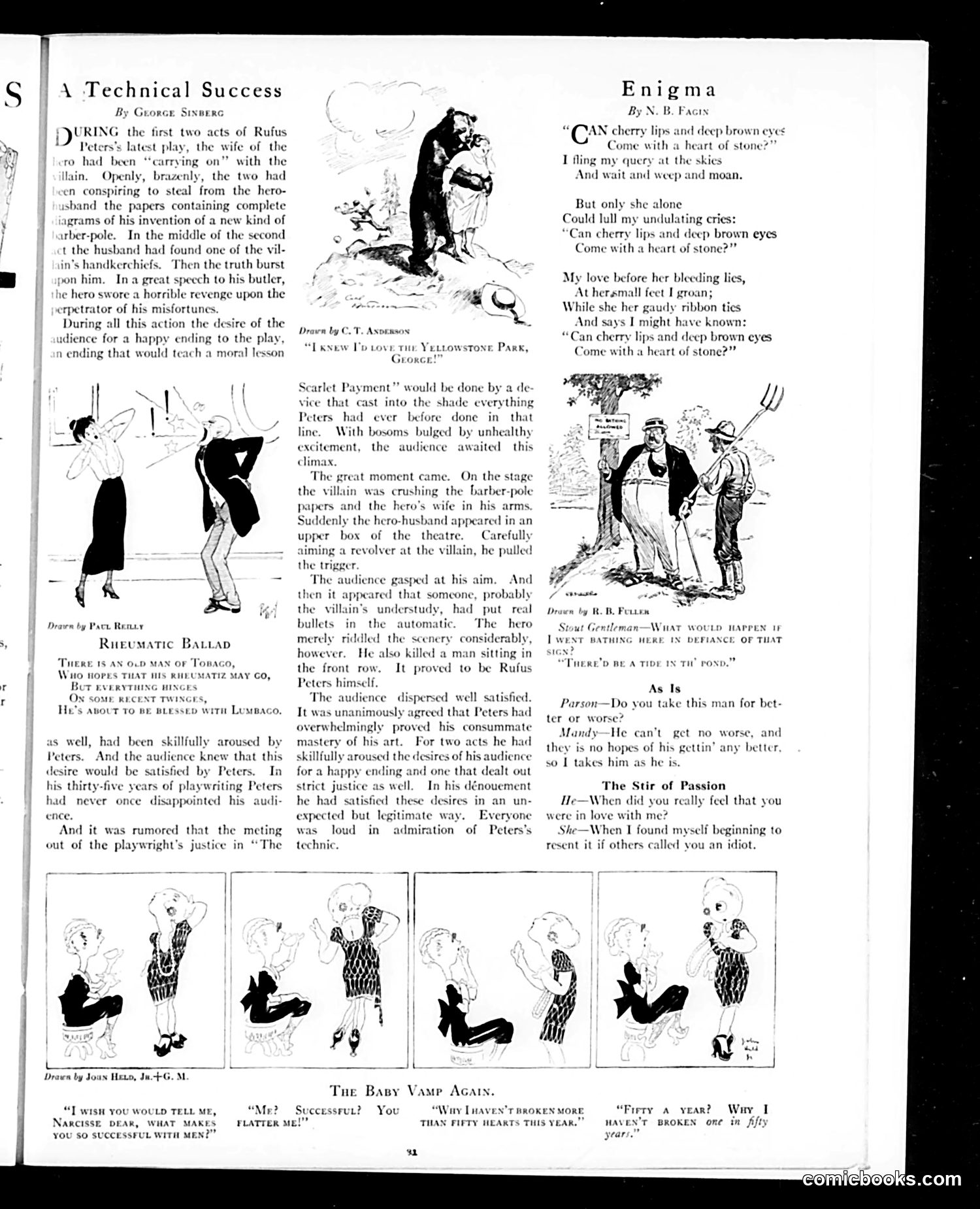
This page from Judge magazine contains several satirical pieces mocking theatrical conventions and romantic folly circa the 1920s. **"A Technical Success"** ridicules playwright Rufus Peters and theater audiences. Peters has written a melodrama where a villain steals secret papers and seduces the hero's wife. The joke: when the hero shoots at the villain during the climax, real bullets have been substituted, killing Peters himself in the audience. The satire suggests that audiences predictably crave "happy endings" and moral instruction, and that Peters cynically manufactures emotional manipulation—only to be literally killed by his own theatrical machinery. **"Enigma"** is a romantic poem about unrequited love, where a woman with "cherry lips" has a heart of stone. **"The Baby Vamp Again"** mocks a young woman bragging she's "broken fifty hearts this year," satirizing 1920s flapper culture and predatory female sexuality. The cartoon illustrations depict these themes visually, emphasizing the absurdity of theatrical convention and romantic performance.
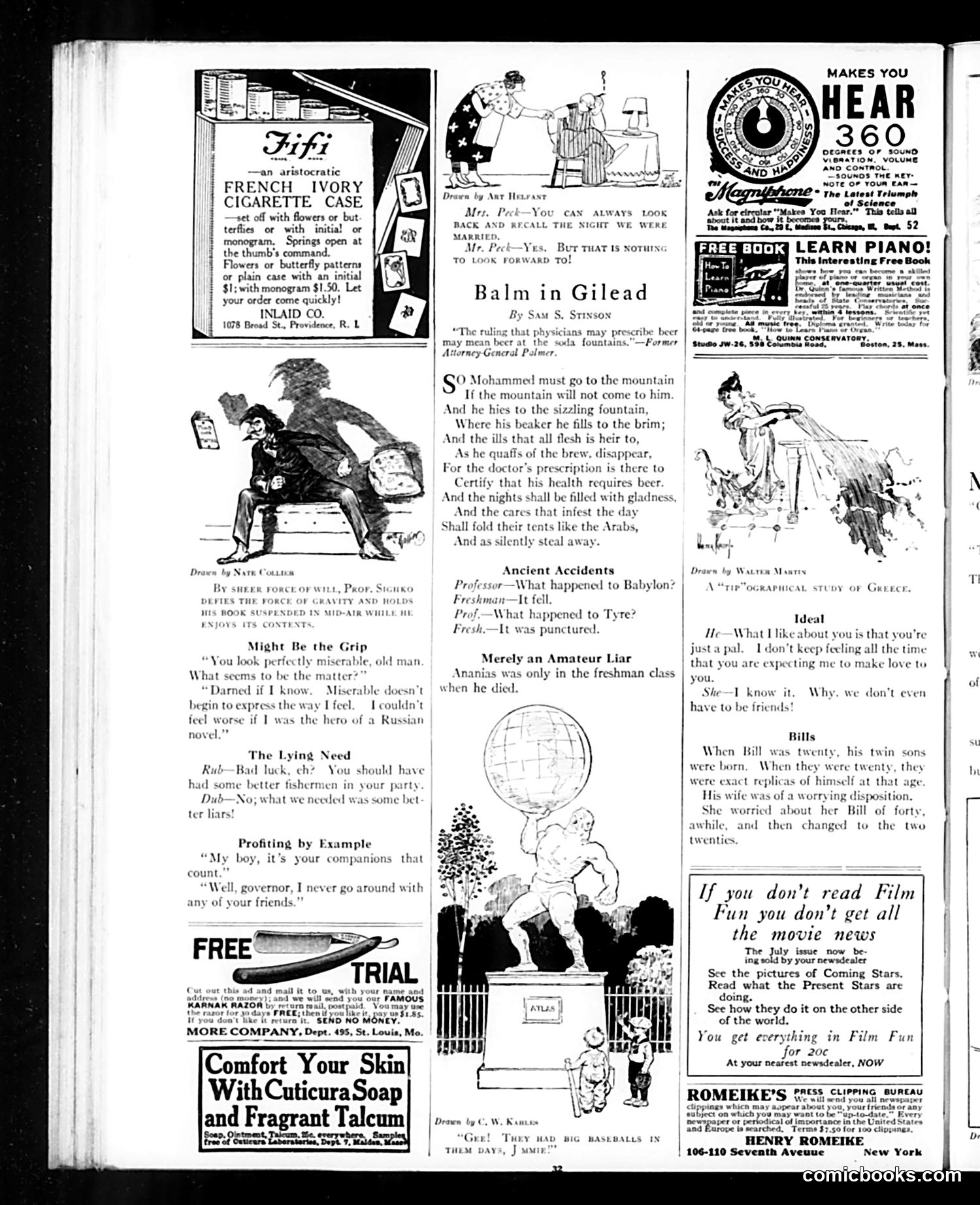
This is a **miscellaneous humor and advertising page** from Judge magazine, featuring several unrelated short jokes and product advertisements. **Key Content:** The jokes satirize familiar human foibles: a man's marital nostalgia ("Might Be the Grip"), the need for better liars over better fishermen, and a son rejecting his father's social circle as bad influence. These require no historical context—they're timeless observations about hypocrisy and social climbing. **Notable reference:** "Balm in Gilead" alludes to Attorney-General Palmer's ruling permitting beer at soda fountains. This reflects **Prohibition-era debates** (likely 1920-1933) when alcohol was banned but loopholes existed. The satirical poem celebrates beer as medicine, mocking the legal fiction that permitted alcohol sales. **The humor** is gentle, domestic, and apolitical—mostly family situations and wordplay ("Tyre was punctured"). The page is **primarily advertising**: cigarette cases, piano lessons, soap, and clipping services dominate the layout. This was standard Judge format.
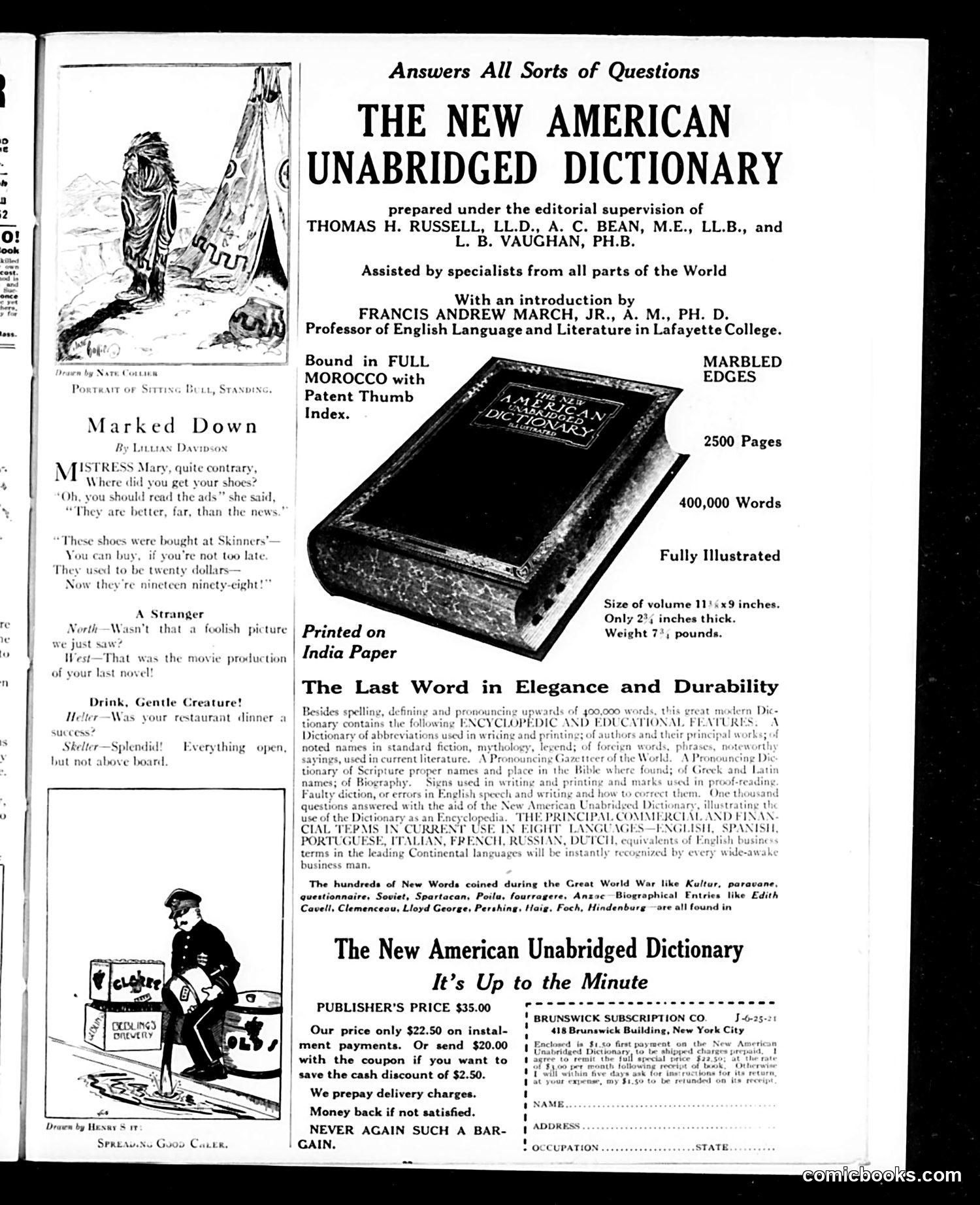
This is primarily a **dictionary advertisement** for *The New American Unabridged Dictionary*, using humor to promote the product. The page includes three small comic sketches: 1. **"Marked Down"** (top left): A dialogue between "Mistress Mary" and a shoe salesman, joking that shoes from "Skinners'" have dropped from $20 to $19.98—a minimal discount presented as remarkable savings. 2. **"A Stranger"** (middle left): A theater conversation where someone praises a foolish movie, only to learn it was adapted from the other person's novel—mocking bad literary adaptations. 3. **"Drink, Gentle Creature!"** (bottom left): A restaurant patron praising excellent food and service, then the proprietor admits "Everything open, but not above board"—suggesting corrupt or illegal business practices (likely Prohibition-era speakeasy humor). These sketches serve as filler entertainment while the advertisement emphasizes the dictionary's comprehensiveness, including new WWI terms and modern content, priced at $22.50 installment payments.
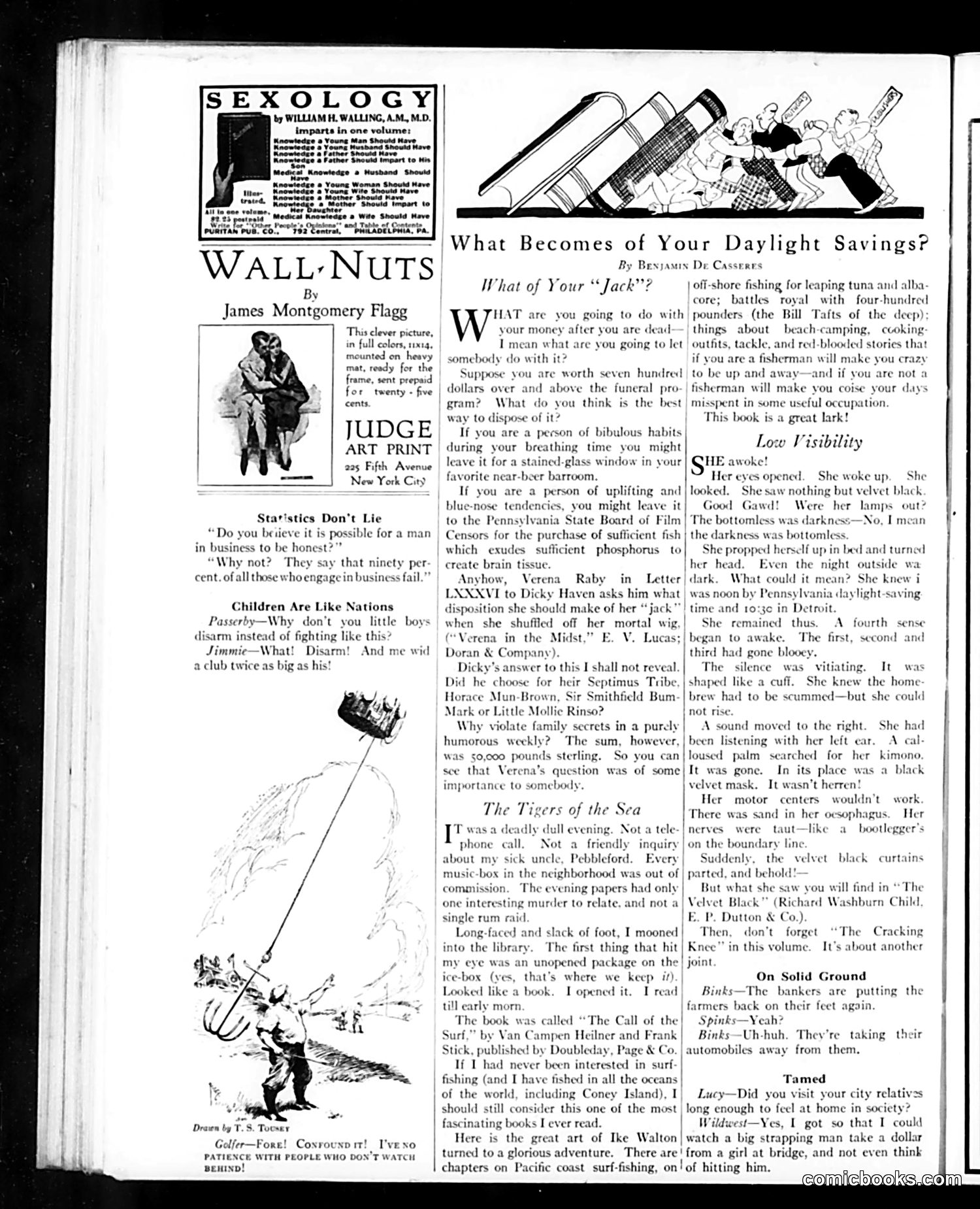
This Judge magazine page contains several satirical pieces typical of early 20th-century American humor: **"Wall Nuts"** by James Montgomery Flagg advertises a "Sexology" medical book—reflecting the era's awkward, clinical approach to discussing sexuality through pseudo-scientific volumes. **"Statistics Don't Lie"** jokes that 90% of businessmen fail, so business dishonesty must be rampant—satirizing American business practices and cynicism about capitalist ethics. **"Children Are Like Nations"** compares child warfare to international disarmament, suggesting nations behave like squabbling children unwilling to give up weapons—Cold War-era satire about arms races. **"What Becomes of Your Daylight Savings?"** humorously questions what people do with money after death, suggesting wasteful or frivolous uses (stained-glass windows in bars, funding film censors). It's social commentary on wealth and priorities. **"The Tigers of the Sea"** reviews a fishing adventure book, praising its exciting tales of ocean sport fishing—pure entertainment content, not satire. The page reflects 1920s-30s concerns: commercialism, business ethics, militarism, and mortality.
This is a full-page advertisement, not a cartoon. It promotes the July issue of *Film Fun*, a humor magazine devoted to screen comedy. The ad claims it contains 67 photographs and drawings of movie stars plus 250 humorous pieces (articles, jokes, sketches). The key selling point mentions the editor "made Judge so successful"—referencing Judge magazine itself, which published this ad. This creates a self-promotional connection: Judge's editor apparently also edited *Film Fun*, lending credibility. For modern readers: this reflects early cinema's massive popularity and the era's enthusiasm for fan magazines. The emphasis on "humor of the screen" suggests slapstick comedy dominated silent film entertainment. The newsstand distribution model and abundant star photography indicate how celebrities were marketed to mass audiences in this period.
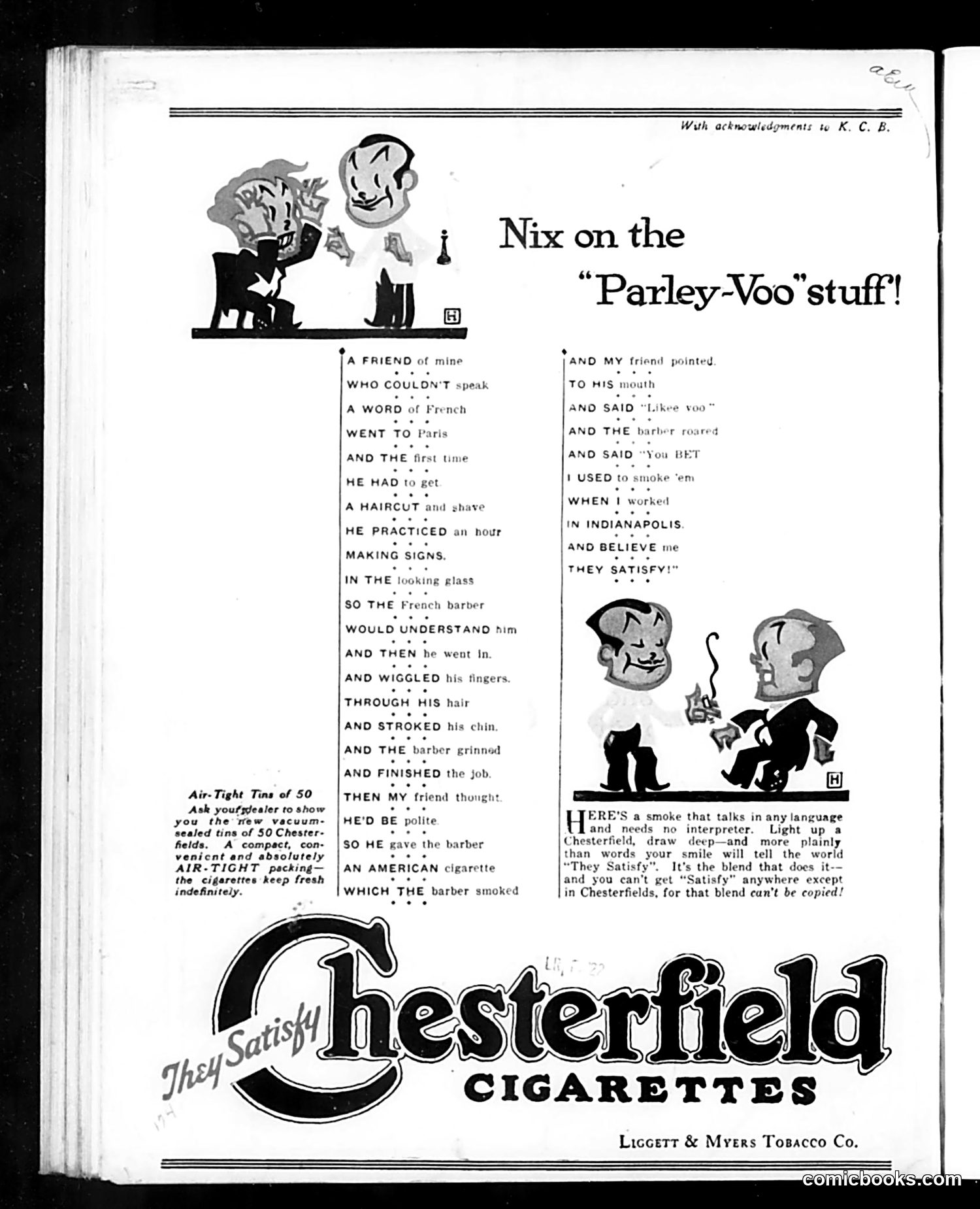
This is a Chesterfield cigarette advertisement disguised as humorous editorial content in *Judge* magazine. The "cartoon" tells a joke about language barriers: an English-speaking man visiting Paris pantomimes to a French barber using exaggerated facial expressions and hand gestures. The barber understands and completes the haircut successfully. The punchline: the man gives the barber an American cigarette as thanks. The barber recognizes it, exclaims he used to smoke them while working in Indianapolis, and declares "They Satisfy!"—the product's slogan. **The satire's point**: The advertisement argues Chesterfields are universally appreciated and need no explanation across cultures—they "talk in any language." It's a clever marketing strategy wrapping product promotion in seemingly editorial humor to make advertising feel like entertainment. The cartoonish caricatures of the Frenchman and American are period-typical visual stereotypes.

I can see this is a page from Judge magazine, but the image appears to be almost entirely blank or white space with only a "comicbooks.com" watermark visible at the bottom right. There is no discernible cartoon, text content, or illustrations that I can analyze to explain political or social satire to a modern reader. It's possible this is a blank page from the magazine, a scanning error, or the content failed to render properly. Without visible cartoon panels, caricatures, or OCR'd text beyond the watermark, I cannot identify figures, historical references, or satirical intent as requested.