
A complete issue · 36 pages · 1921
Judge — June 18, 1921
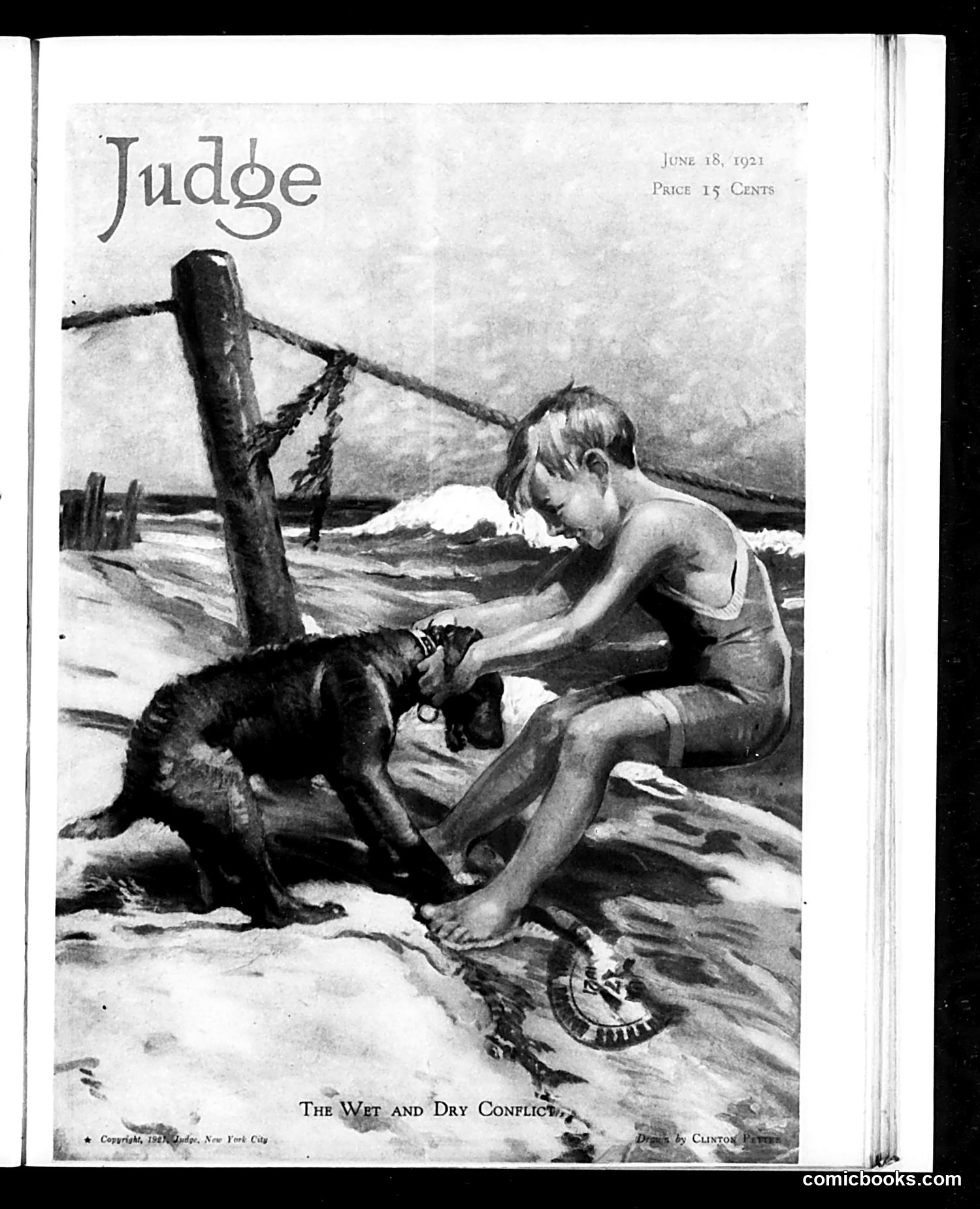
This June 1921 Judge cartoon satirizes the **Prohibition debate** during early Enforcement of the 18th Amendment (ratified 1919). The image shows a young boy on a beach with a small dog, apparently engaged in a playful tug-of-war over what appears to be a fish or wet object. The title "The Wet and Dry Conflict" is a pun: **"Wets"** were those opposing Prohibition, while **"Drys"** supported it. By depicting this as a childish, pointless struggle between a boy and dog, the cartoonist mocks both sides of the Prohibition battle as equally foolish and undignified. The cartoon suggests the conflict was petty and ridiculous rather than substantive political debate.
This appears to be **advertising copy rather than satirical content**. The page promotes Leslie's, described as a "new" illustrated weekly newspaper, by drawing parallels to successful entertainments. The text references **Frank Bacon's play "Lightnin'"** and **Sinclair Lewis's novel "Main Street"** as examples of popular works that succeeded by satisfying public taste. The advertisement argues Leslie's similarly appeals to mass audiences through "good drawings, interesting pictures, articles that are worth reading and remembering." There is **no cartoon visible** on this page—it's pure promotional text using contemporary cultural touchstones (circa 1920s, based on the references) to market the publication. The "satire" inherent in Judge magazine doesn't apply here; this is straightforward commercial messaging.
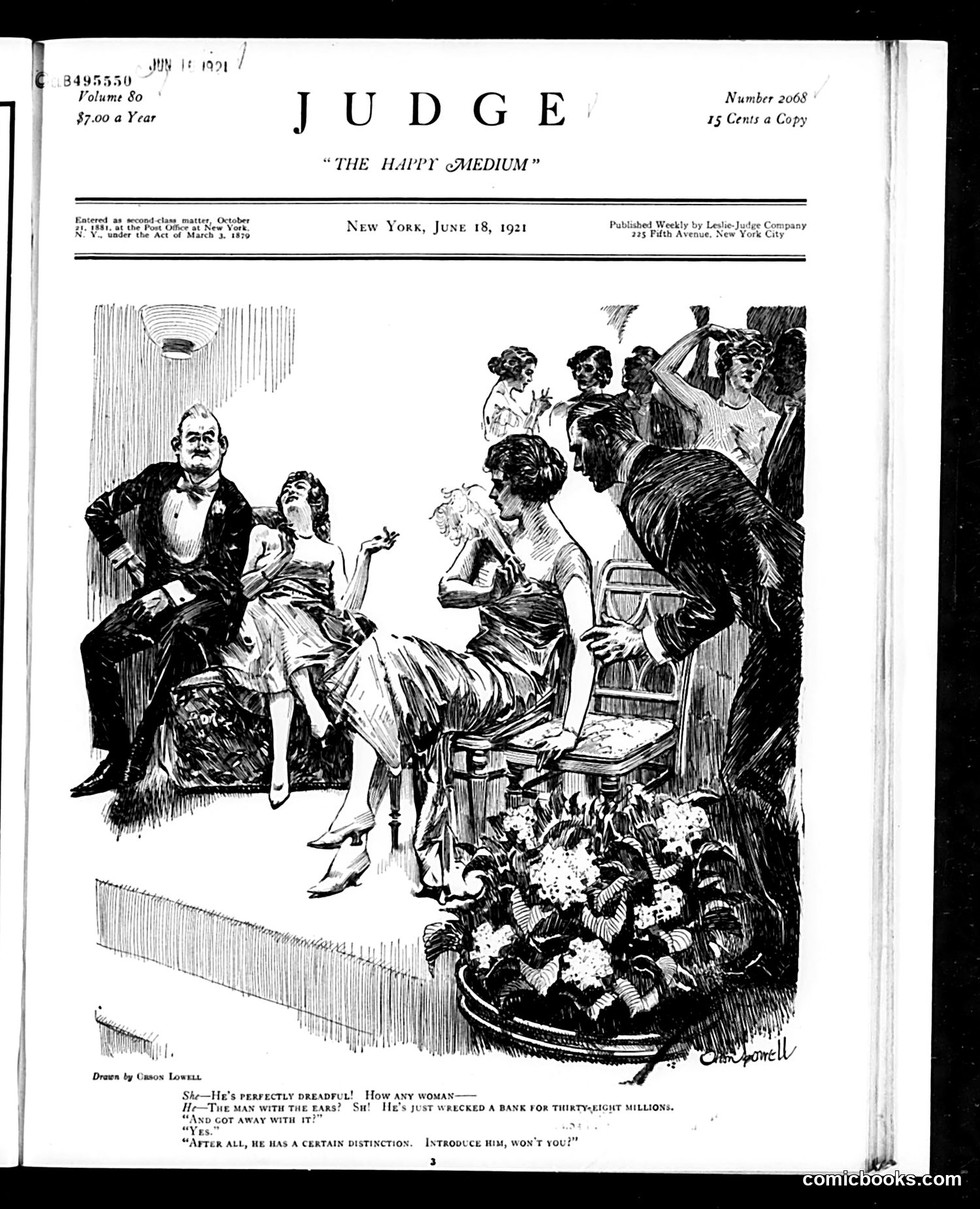
This cartoon satirizes wealthy society's casual attitude toward financial crime. The scene depicts a fashionable drawing room where a distinguished older man and an elegantly dressed woman entertain guests. The caption references a man who "wrecked a bank for thirty-eight millions" yet remains socially acceptable—he's introduced with the phrase "After all, he has a certain distinction!" The satire targets 1920s high society's hypocrisy: massive financial fraud apparently warrants only mild social disapproval among the wealthy elite. The cartoon mocks how fortune and social standing allow wrongdoers to maintain respectability despite devastating economic crimes that harmed ordinary people. It reflects post-WWI public cynicism about unequal justice and privileged immunity.
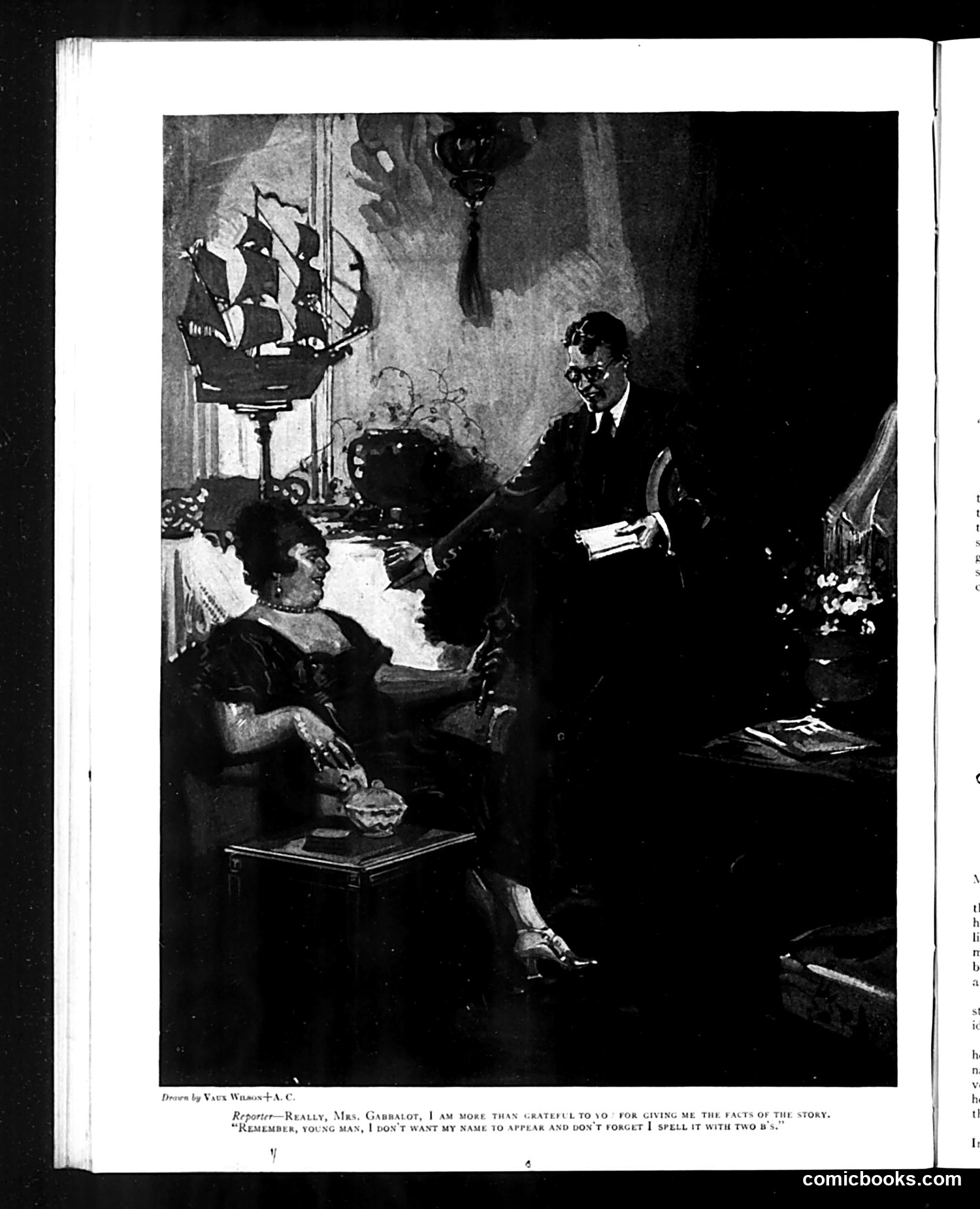
This appears to be a satirical illustration from *Judge* magazine depicting an interview scene. The caption identifies the seated figure as "Mrs. Gabalot" and includes a quote about spelling a name with "two R's." The cartoon satirizes a common social dynamic: a reporter (standing, holding papers) interviews a woman of apparent wealth or social prominence. The humor likely stems from Mrs. Gabalot's concern about name-spelling—a vanity concern typical of the newly wealthy or socially ambitious figures *Judge* frequently mocked. The ornate interior with decorative ship model and elegant furnishings emphasizes her pretensions. The satire targets either pretentious society figures or the superficiality of popular journalism, which the magazine regularly criticized. The artist is credited as Vaux Wilson, F.A.C.
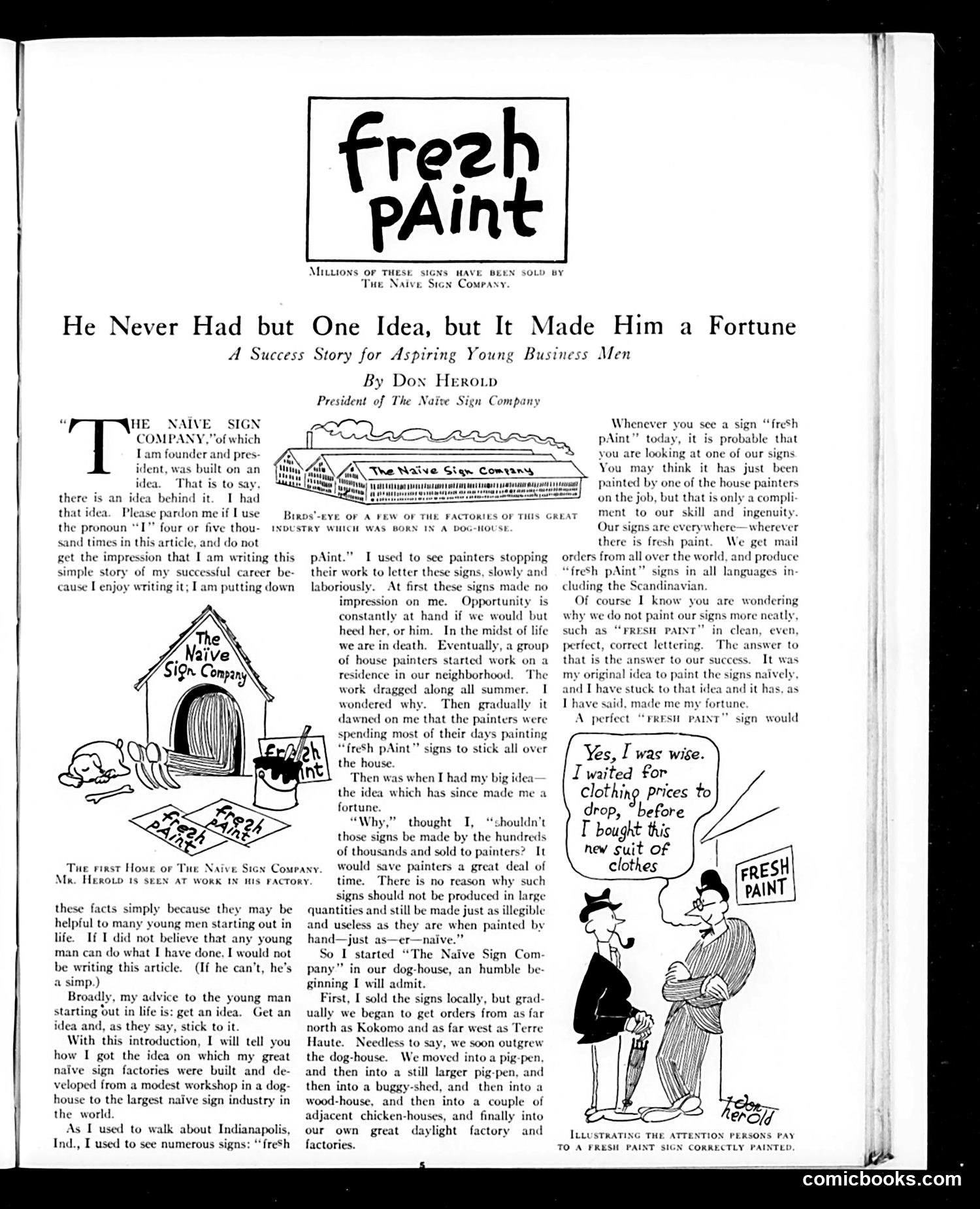
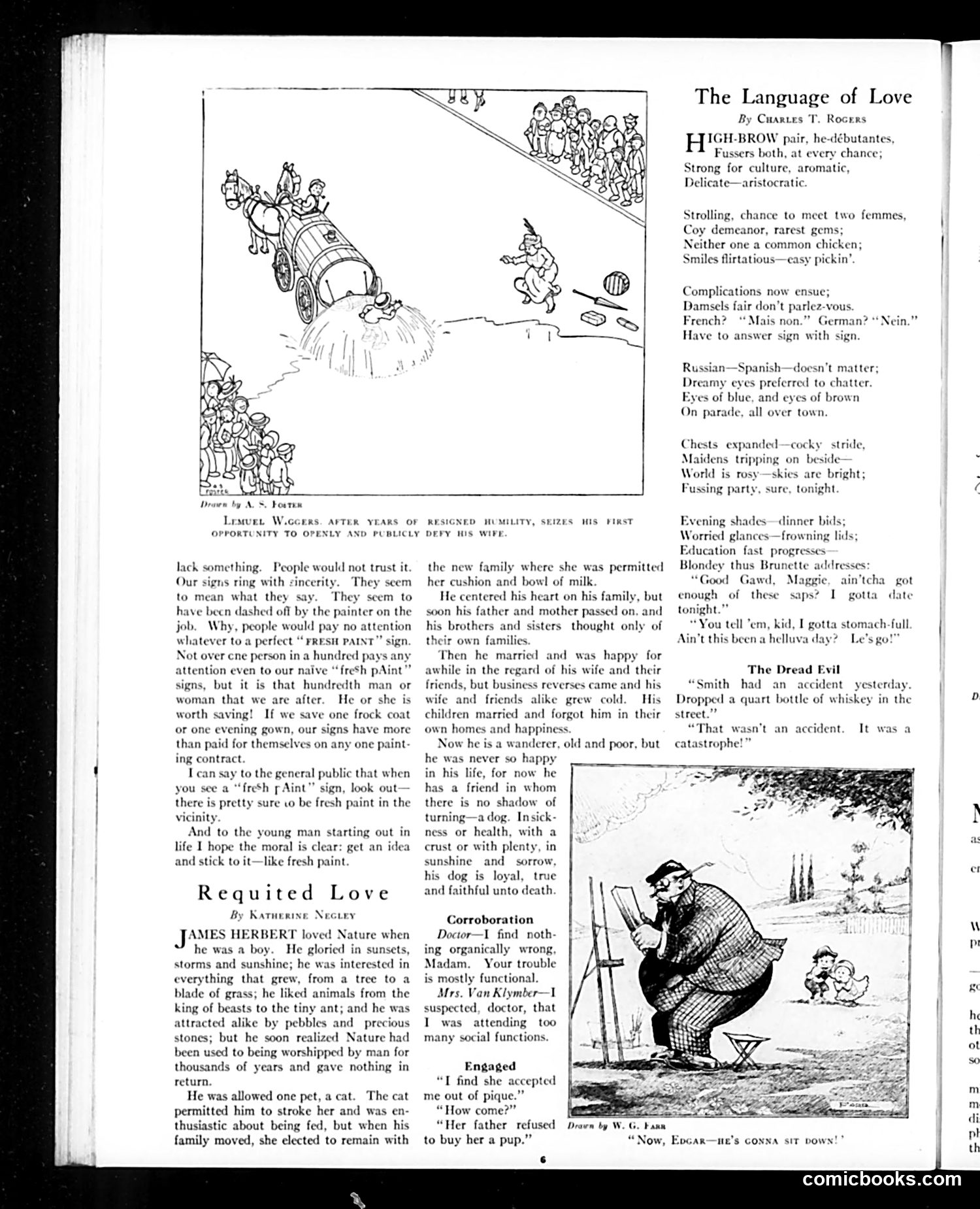
This page contains three short stories/satirical pieces rather than political cartoons: 1. **"The Language of Love"** by Charles T. Rogers satirizes courtship among the wealthy elite—mocking their pretensions about culture, their flirtatiousness, and their obsession with status markers (high-brow tastes, aristocratic preferences). The humor targets shallow upper-class romance. 2. **"Requited Love"** by Katherine Newlin presents a character named James Herbert who loves nature but is corrupted by human society and materialism, losing his authentic connection to the natural world. 3. **"The Dread Evil"** and other brief vignettes appear to be social commentary on contemporary issues, though specific references are unclear without additional context. The overall tone satirizes American social pretensions and moral contradictions of the era.
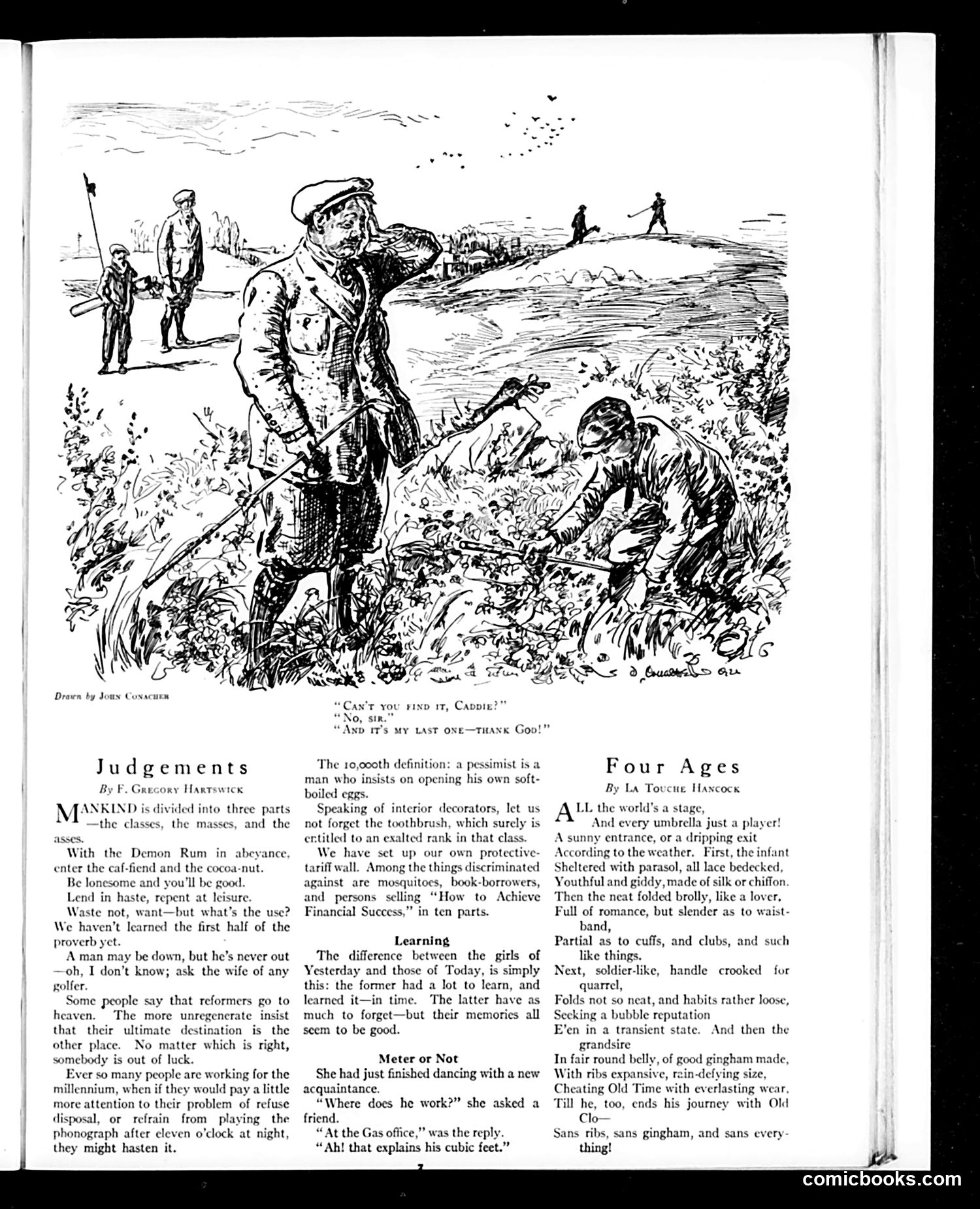
This page from *Judge* magazine contains two separate pieces of satirical humor typical of early 20th-century American wit. **The Cartoon** depicts a military officer and soldier searching a field, with the caption "'Can't you find it, Caddie?' 'No, sir.' 'And it's my last one—thank God!'" The joke appears to reference lost golf balls during wartime—likely WWI, when the contrast between soldiers' actual combat and officers' recreational concerns would seem absurd and darkly comic. **"Judgements"** is a column of brief satirical observations mocking various social types: reformers, pessimists, interior decorators, and loan-givers. The humor relies on wordplay and cynical social commentary. **"Four Ages"** is a poetic parody comparing umbrellas' lifecycles to human aging stages—from delicate infancy through romantic youth, practical middle age, to worn-out old age. It's whimsical literary satire rather than political commentary. The page reflects *Judge*'s typical blend of political observation, social satire, and light verse aimed at educated readers.
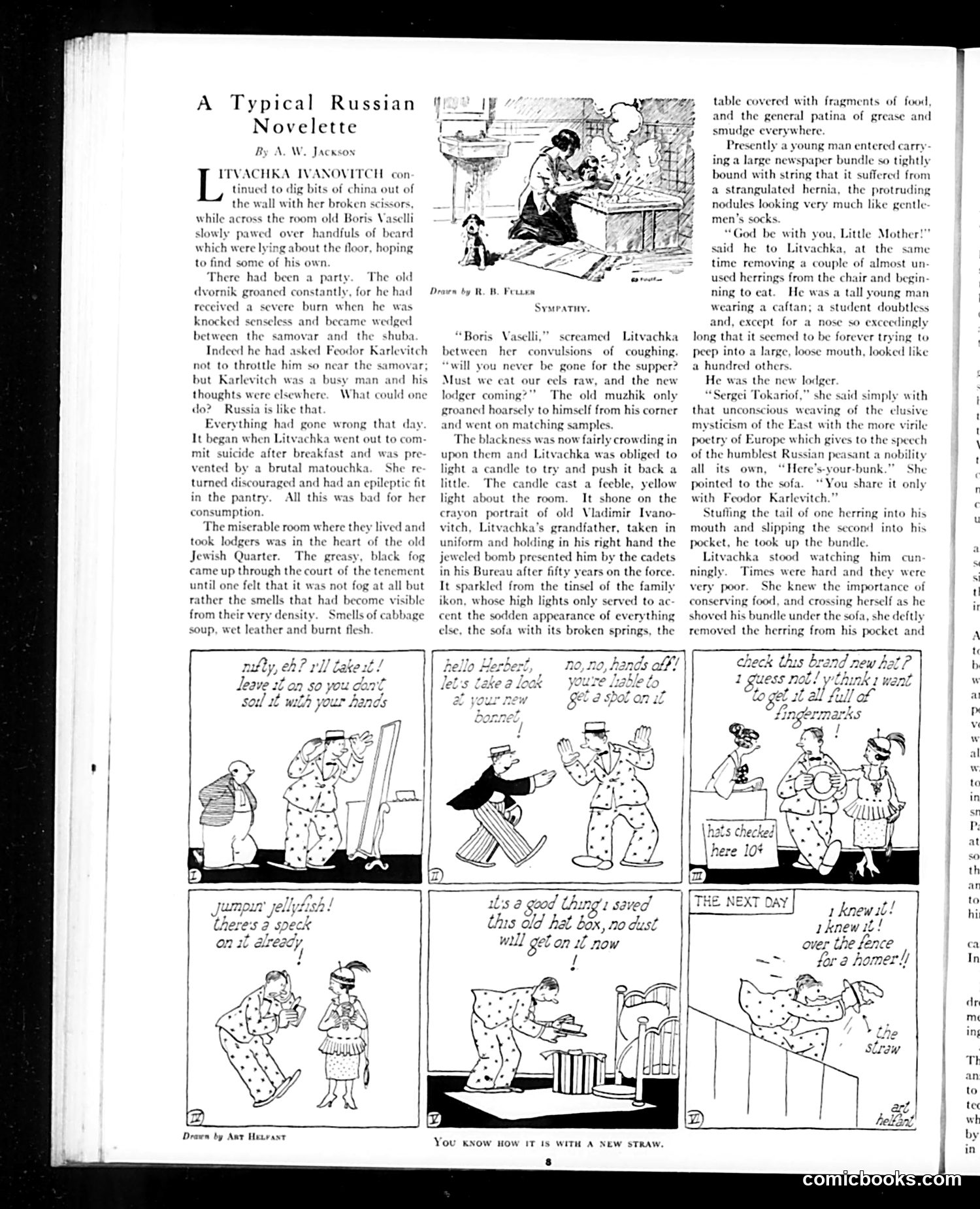
This is a satirical parody of Russian literature—specifically the melodramatic, poverty-stricken naturalism popularized by authors like Dostoevsky and Gorky. The text mockingly exaggerates typical themes: suicide attempts, disease (consumption), domestic violence, squalid tenement living, and existential despair. The accompanying comic strip continues the joke, showing a new lodger arriving with a newspaper-wrapped bundle. The humor culminates when the poor, desperate Litvachka steals back a herring she offered him—the punchline being her resourcefulness in poverty mirrors the grim, morally-compromised characters of Russian novels. The satire targets both Russian literature's relentless bleakness and American readers' fascination with it. By making the melodrama absurdly literal (candle pushing back darkness, a bundle's protrusions resembling "gentlemen's socks"), Judge ridicules the genre's overwrought style while acknowledging Russian literature's genuine cultural prestige.
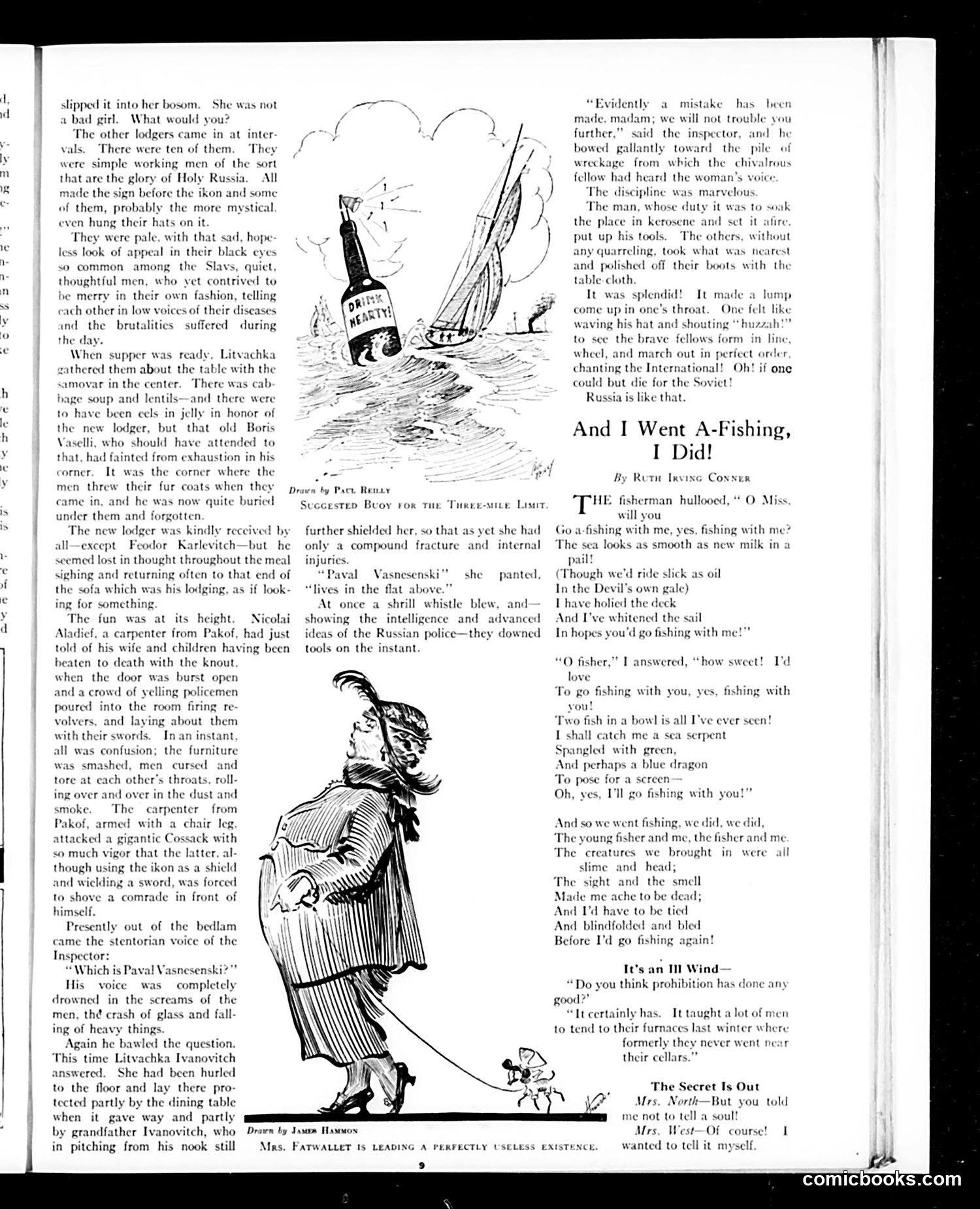
This page contains two distinct pieces satirizing Russian politics and society. **The upper section** depicts a police raid on a working-class Russian lodging house. The satire mocks both Russian autocracy and revolutionary sympathies: police violently ransack the apartment searching for a suspect, destroying furniture and beating residents. However, the "intelligent" Russian police immediately stop their rampage when informed they've targeted the wrong flat—demonstrating absurd bureaucratic obedience over justice. The text notes residents singing "the International" (the socialist anthem), suggesting the lodging housed politically radical workers. The satire appears to mock both the brutality of Russian police-state tactics and the romantic idealism of revolutionary fervor. **The lower section**, "And I Went A-Fishing, I Did!" by Ruth Irving Conner, is a lighthearted poem about a fishing outing, unrelated to the political content above. The overall page reflects early 20th-century American satirical commentary on Russian repression and social unrest during the pre-revolutionary period.
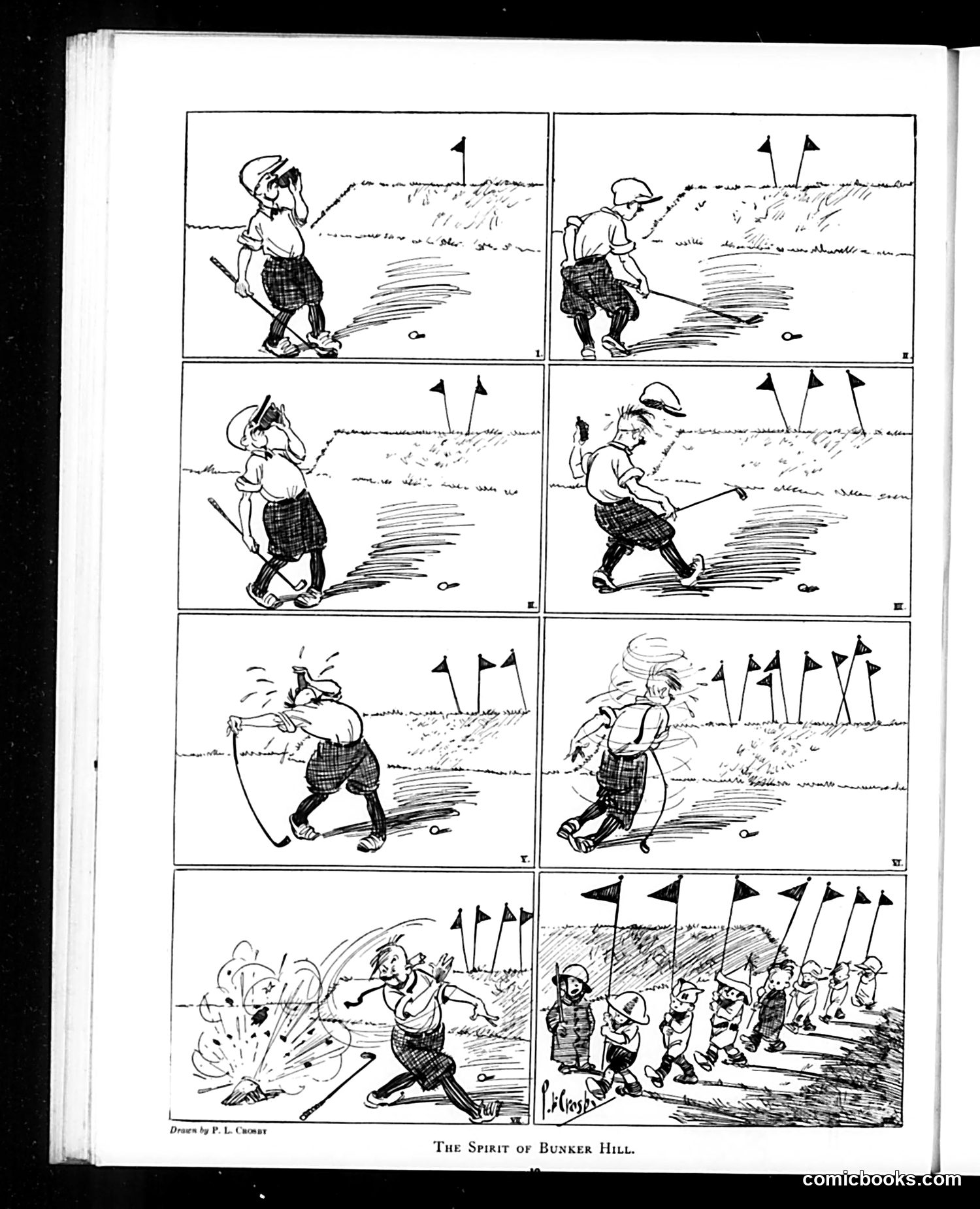
This comic strip depicts a golfer attempting to play on what appears to be Bunker Hill, the Revolutionary War battlefield. The eight-panel sequence shows the golfer's progressive frustration with sand bunkers (obstacles in golf), which grow increasingly elaborate and problematic—from simple sand traps to explosive conditions to what appears to be military fortifications in the final panel. The satire plays on the double meaning of "bunker": both golf hazards and military trenches/fortifications. By setting the golfing mishaps at Bunker Hill, the cartoonist jokes about how golf's challenges echo actual warfare. The punchline emerges in the final panel, where the golfer's struggles have somehow conjured actual soldiers with flags, humorously suggesting his golf game has become as chaotic as actual battle.
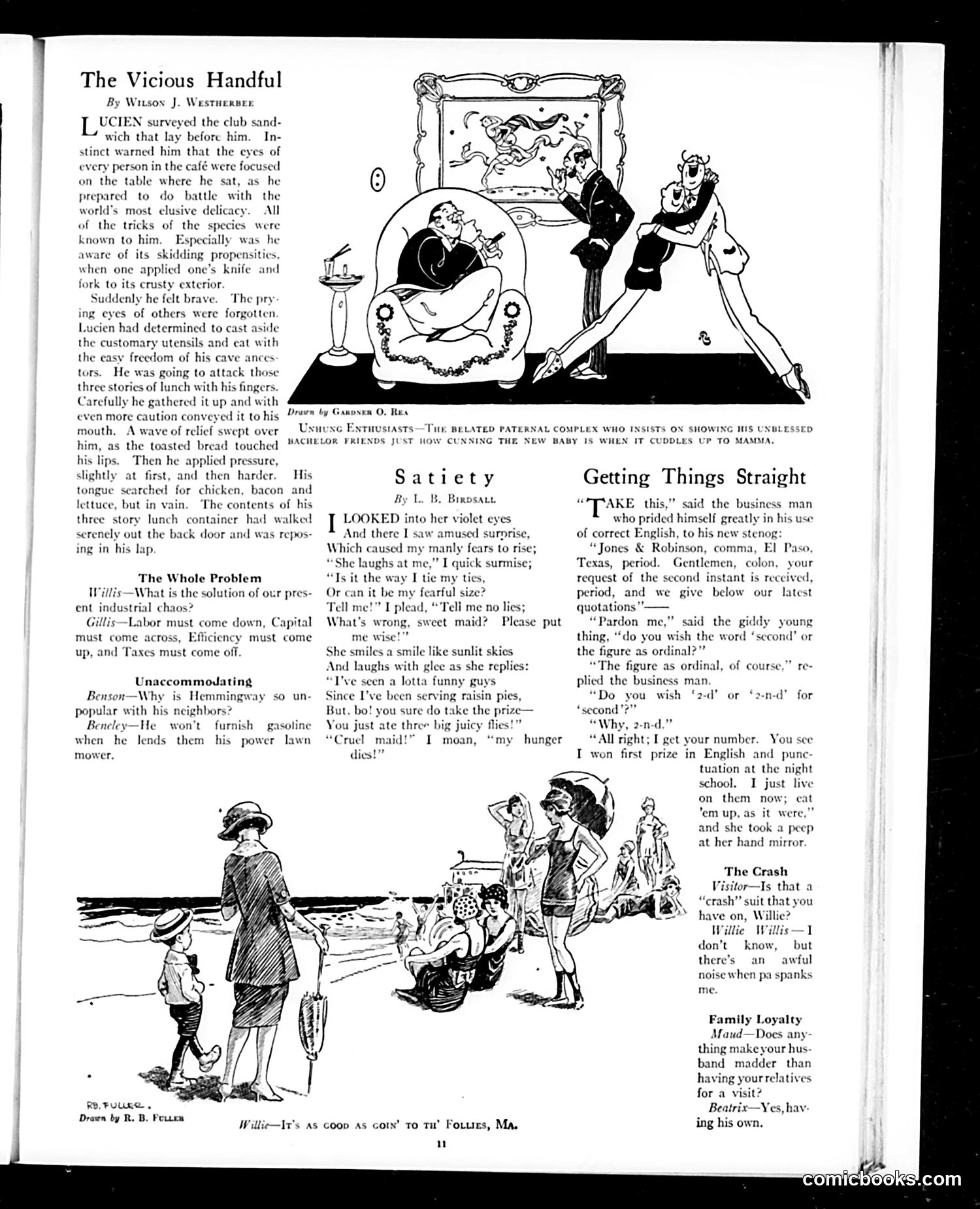
This page from *Judge* magazine contains several satirical short pieces and cartoons mocking everyday social situations: **"The Vicious Handful"** ridicules the difficulty of eating a club sandwich in public without making a mess—a slapstick scenario where the protagonist's contents spill into his lap despite his careful approach. **The brief joke exchanges** target pretentious behavior: an industrial-era debate about economic solutions ("Labor must come down, Capital must come across"), a neighbor unwilling to lend his lawn mower, and a stenographer who pedantically corrects business correspondence while admiring her hand mirror. **"The Crash"** plays on "crash suit" (likely a fashionable but flimsy garment), where a boy claims the suit makes noise—actually his father spanking him. The humor relies on social embarrassment, class consciousness, and gender stereotypes typical of early 20th-century satire. The cartoons illustrate awkward moments: a man struggling with messy food, a woman at the beach, and an overeager new father showing off his baby to bachelor friends.
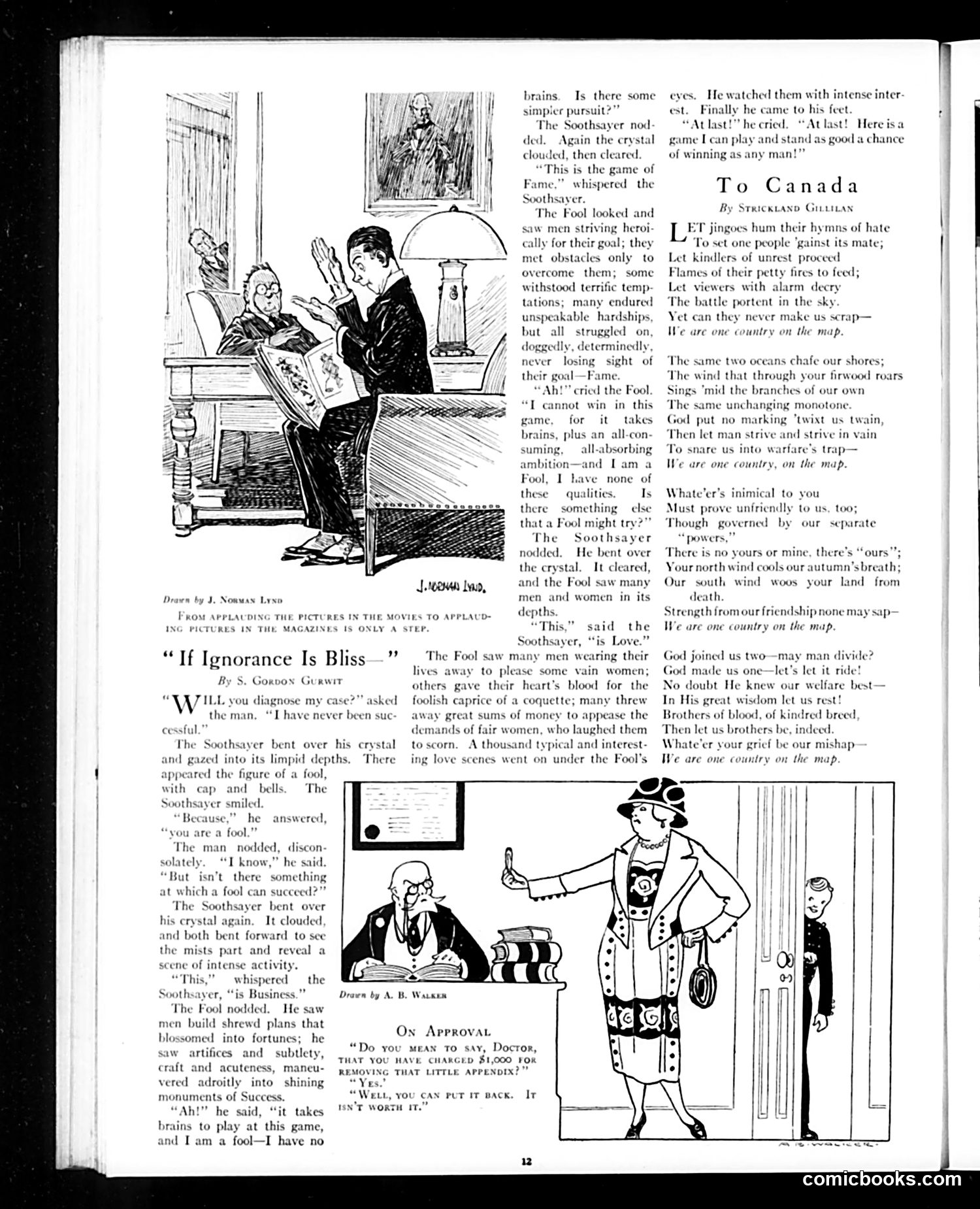
This Judge magazine page contains satirical commentary on two topics: **"If Ignorance Is Bliss"** (left): A fortune-teller tells a self-described fool that success requires either brains (for Fame) or love—qualities the fool lacks. The joke satirizes people who lack ambition or intelligence, suggesting they're doomed to failure in competitive pursuits. **"To Canada"** (center/right): A patriotic poem arguing that Canada and another nation (likely the U.S.) share common geography and heritage, so they shouldn't fight. This appears to address pre-WWI anxieties about North American conflict. **"On Approval"** (bottom right): A doctor charges $1,000 to remove an appendix, but the patient requests it back if "it's not worth it"—mocking both inflated medical costs and consumer culture's "try before you buy" mentality. The drawings support each narrative. The overall page reflects early 20th-century concerns: individual merit, international relations, and healthcare commercialization.
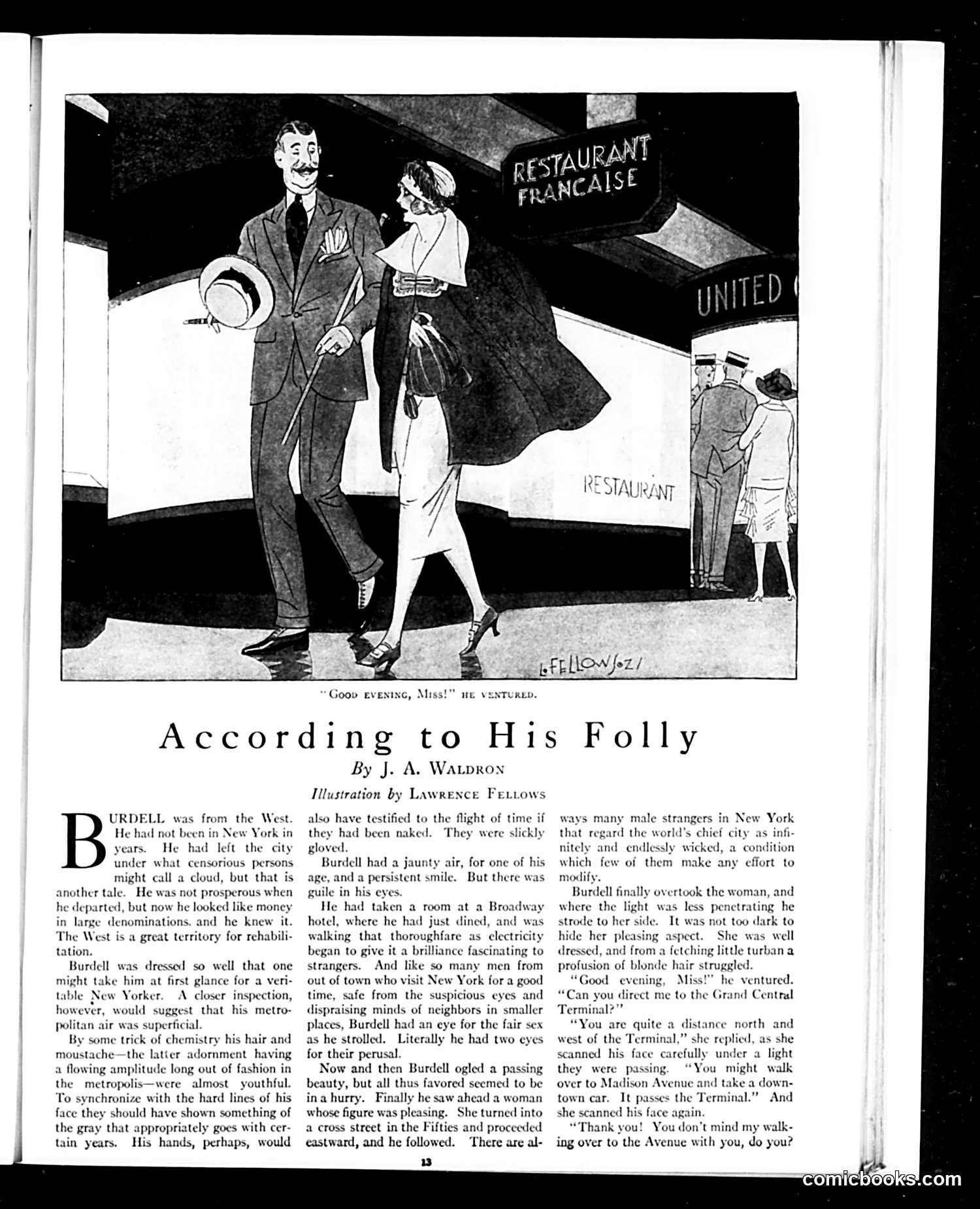
This is a short story illustration titled "According to His Folly" by J.A. Waldron, with artwork by Lawrence Fellowes. It depicts a plot setup common to early 20th-century fiction and humor magazines. **The Scene:** Burdell, a formerly unsuccessful man from the West who has returned to New York newly wealthy, is walking a Broadway street. He begins following an attractive blonde woman, ostensibly to ask directions to Grand Central Terminal—a transparent pretext. **The Satire:** The joke targets masculine behavior and hypocrisy. The story emphasizes Burdell's efforts to appear respectable (well-dressed, fashionable) while his actual behavior—following and accosting a stranger woman—reveals his true character. The "folly" is his belief that money and appearance make such conduct acceptable. **Social Context:** The piece mocks men who visit cities seeking moral "wickedness" away from hometown scrutiny, presenting Burdell as precisely this type: prosperous but essentially disreputable, attempting sophistication while engaging in crude pursuit.
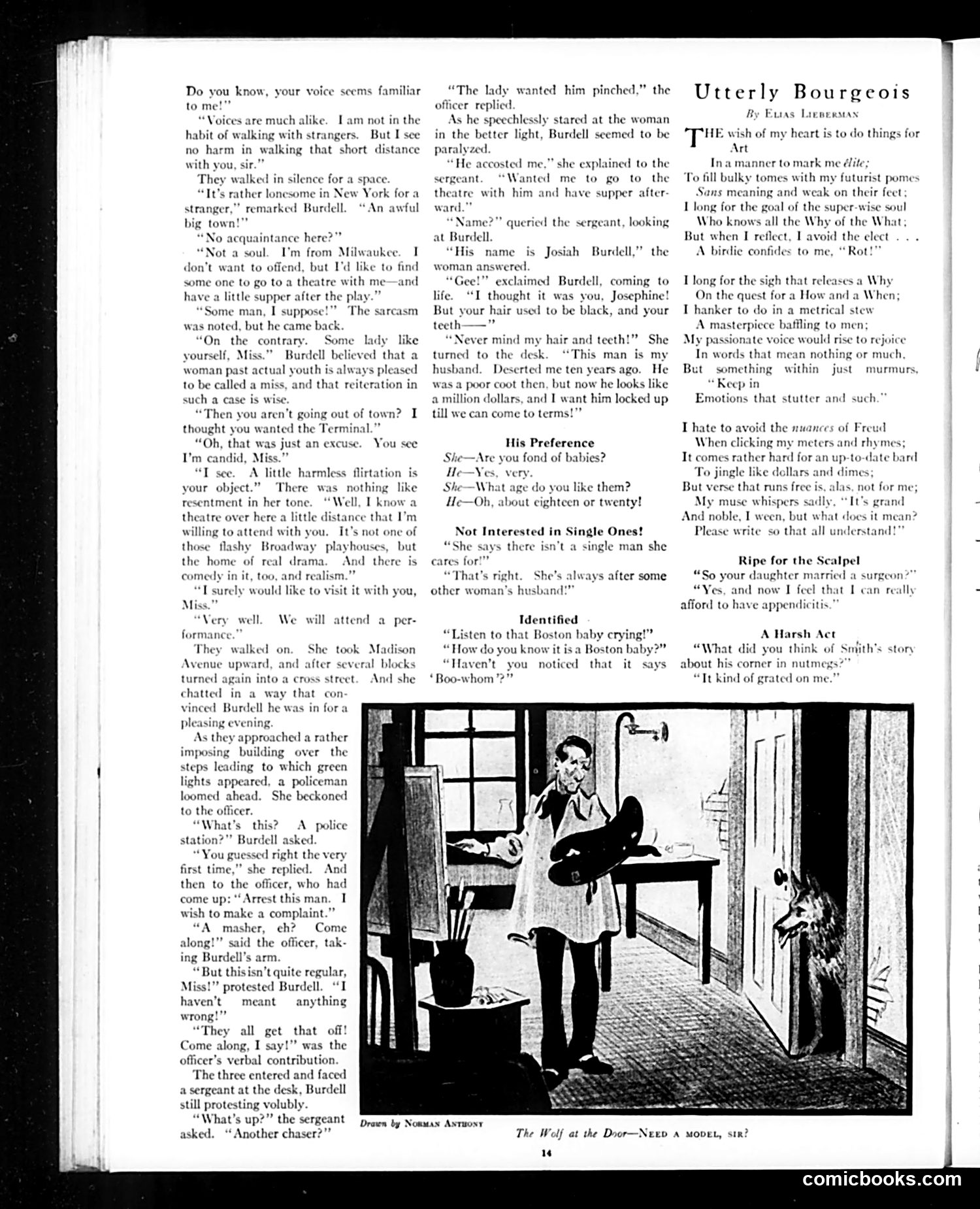
This illustration depicts a classic confidence-man scenario with a moral twist. A well-dressed man ("Burdell") attempts to pick up a woman on the street, offering theater tickets and supper—a recognized "masher" tactic of the era (unwanted sexual advances). The woman cleverly leads him to a police station under the pretense of going to a theater. The punchline: when confronted by lamplight, Burdell recognizes his estranged wife of ten years. She reveals she's had him arrested not for harassment, but because he's now wealthy and she wants him "locked up till we can come to terms"—demanding financial settlement for his abandonment. The satire targets marital opportunism and infidelity: Burdell's attempt at seduction backfires into extortion by his own wife. The "wolf at the door" reference suggests poverty has made him desperate enough to chase women; wealth has merely made him a target for his abandoned spouse's revenge.
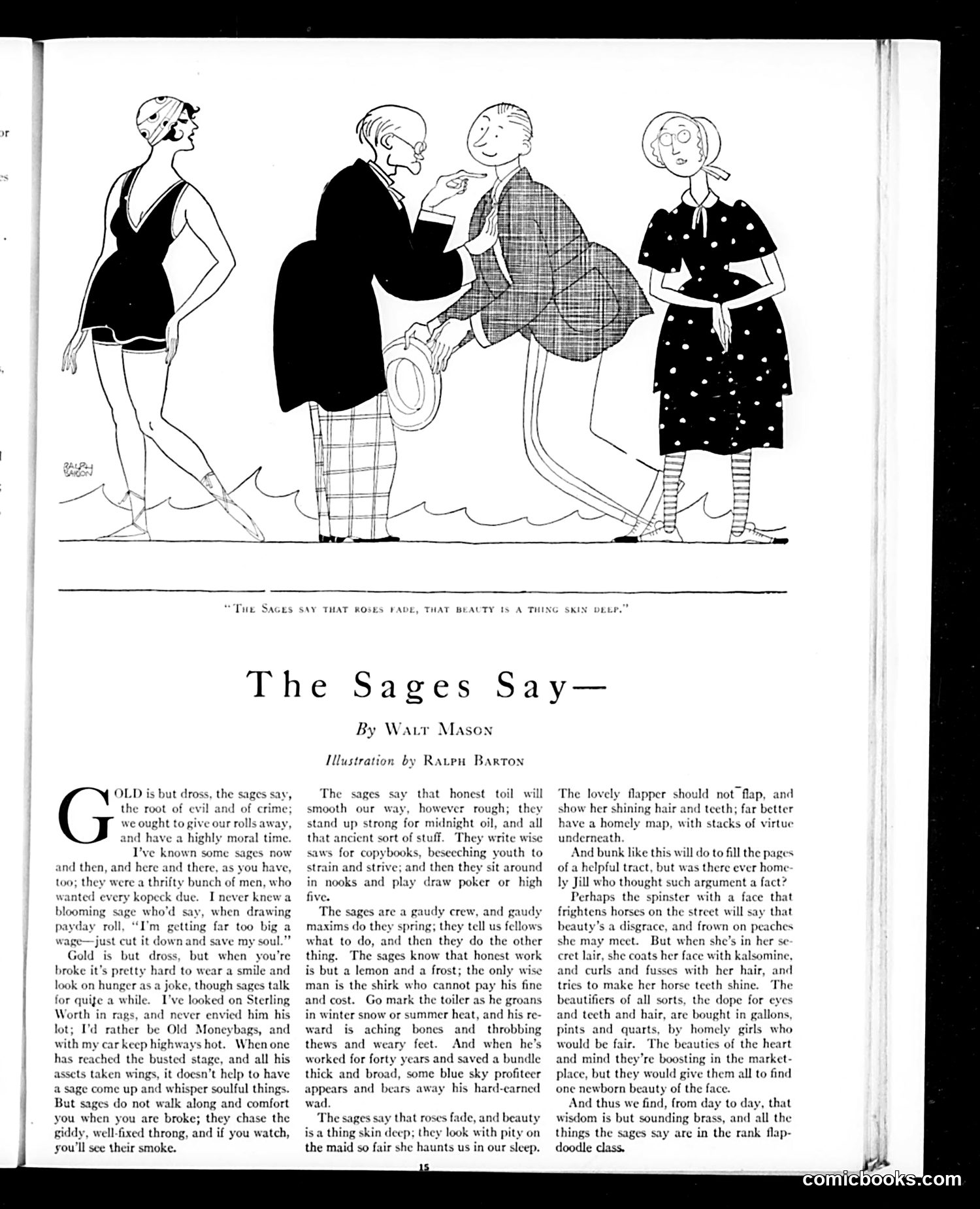
This is a satirical essay-poem by Walt Mason, illustrated by Ralph Barton, mocking the hypocrisy of moral philosophers and self-proclaimed "sages." The cartoon depicts four women of different body types and styles, illustrating the essay's central irony: **sages preach that beauty is superficial and that virtue matters more than appearance, yet they themselves pursue wealth, comfort, and physical attractiveness.** Mason's specific targets include: - **Hypocritical moralists** who counsel poverty and hard work while avoiding both - **Fake philosophers** who write inspirational maxims for copybooks but play poker privately - **Female vanity debates**: The essay notes that women claiming to despise beauty secretly spend fortunes on cosmetics, hair treatments, and skincare—undermining their own preaching about inner virtue The satire's point: people universally contradict their stated principles. Sages who say "gold is dross" pursue it relentlessly; women who claim beauty is "skin deep" buy beautifiers "in gallons." Therefore wisdom itself is "sounding brass"—mere noise without substance.
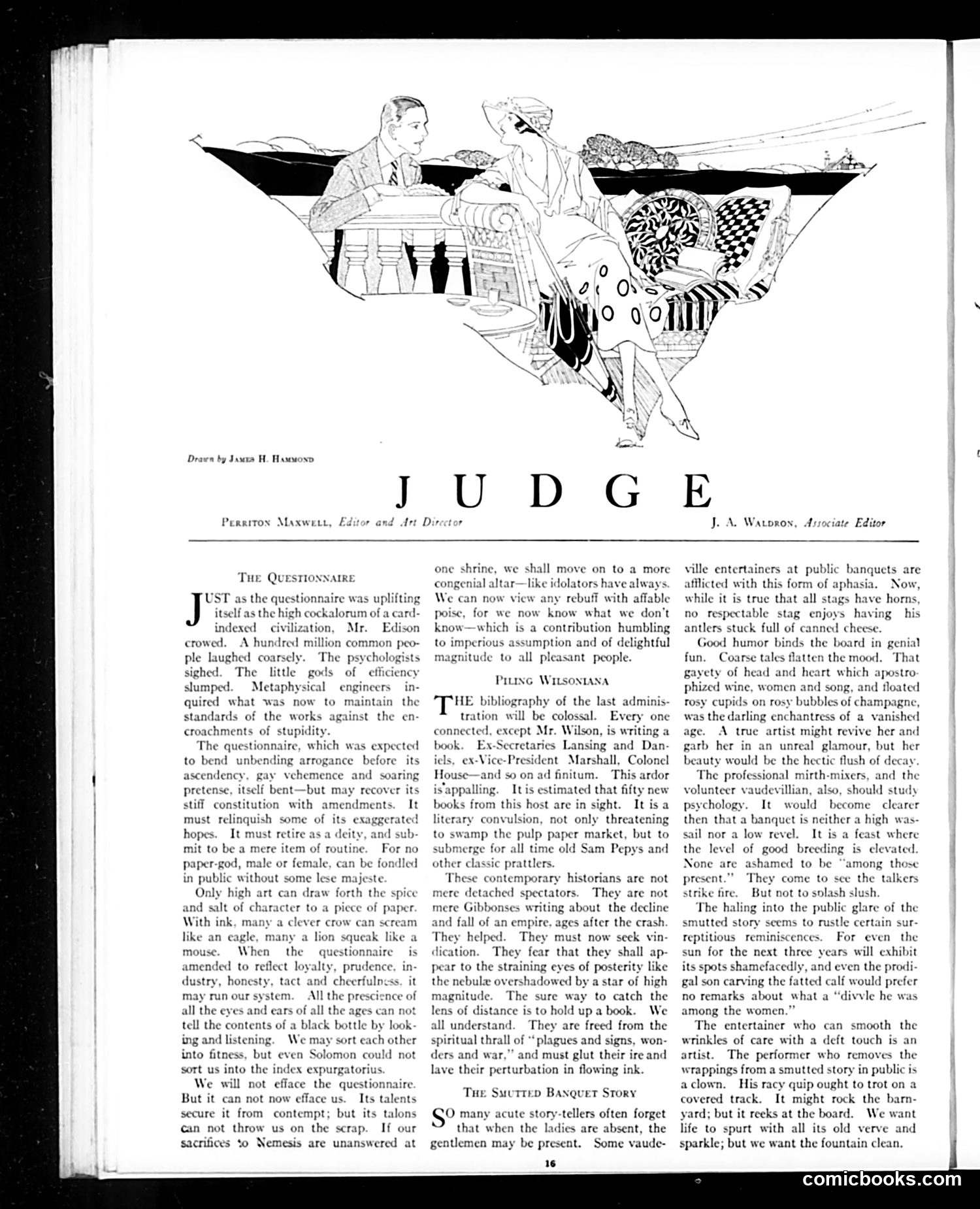
This page from *Judge* contains three separate satirical pieces: **"The Questionnaire"** mocks the early 20th-century obsession with questionnaires and efficiency metrics as tools for understanding human nature. The satire argues that reducing complex human character to questionnaire answers is futile—"all the eyes and ears of all the ages can not tell the contents of a black bottle by looking." **"Piling Wilsoniana"** satirizes former Wilson administration officials rushing to publish memoirs after leaving office (likely post-1921). The piece ridicules their self-justifying accounts and competitive memoir-writing as an "ardor" threatening to overwhelm literary markets while burying classics like Pepys. **"The Shutted Banquet Story"** criticizes vaudeville performers at formal banquets who tell off-color jokes when women are absent, then allegedly sanitize their acts when ladies return—hypocritical and crude behavior that ruins refined dinner atmosphere. The illustration shows passengers on a ship, likely accompanying one of these pieces, though the specific connection isn't entirely clear from the visible text.
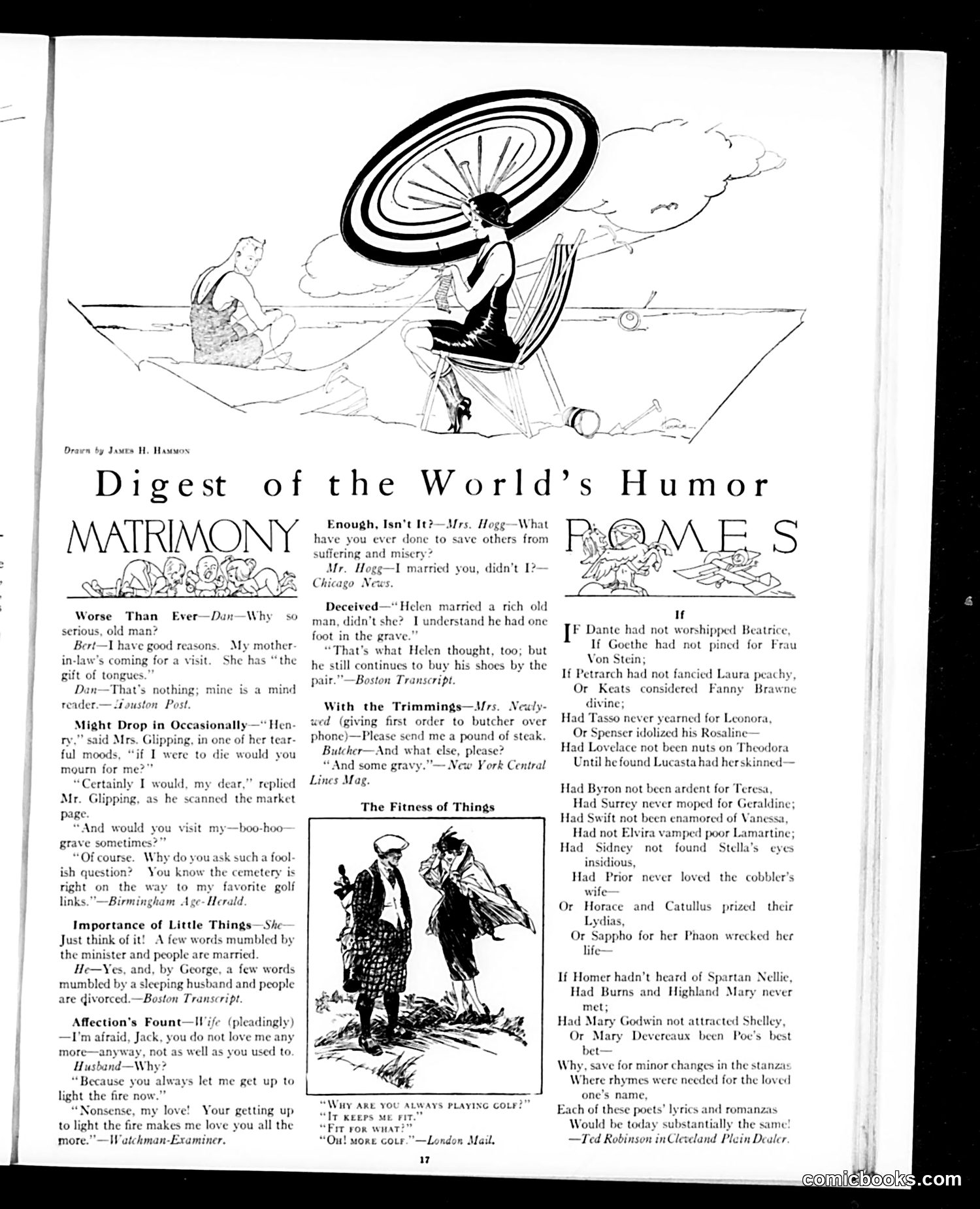
This is a humor collection page from *Judge* magazine featuring various marriage and relationship jokes, plus a literary poem. **The Cartoons:** The top illustration (drawn by James H. Hannon) shows a woman at the beach with an oversized hat being blown by wind—a visual gag about fashionable but impractical headwear. The middle cartoon depicts two men golfing, illustrating the joke about golf keeping one "fit for" avoiding domestic duties. **The Jokes:** The "Matrimony" section contains period-typical husband-wife witticisms: mothers-in-law complaints, cemetery visits, divorce threats over marital indifference, and a cruel jab where Mr. Hogg claims marrying the unpleasant Mrs. Hogg was his charitable act. **The Poem:** "If" parodies famous poets' romantic inspirations, suggesting that without specific muses (Dante's Beatrice, Byron's Teresa, etc.), their greatest works would be virtually identical—a satirical comment on Romantic poetry's reliance on idealized love subjects. **Overall Tone:** Early 20th-century domestic satire mocking marriage tedium, masculine indifference, and literary pretension.
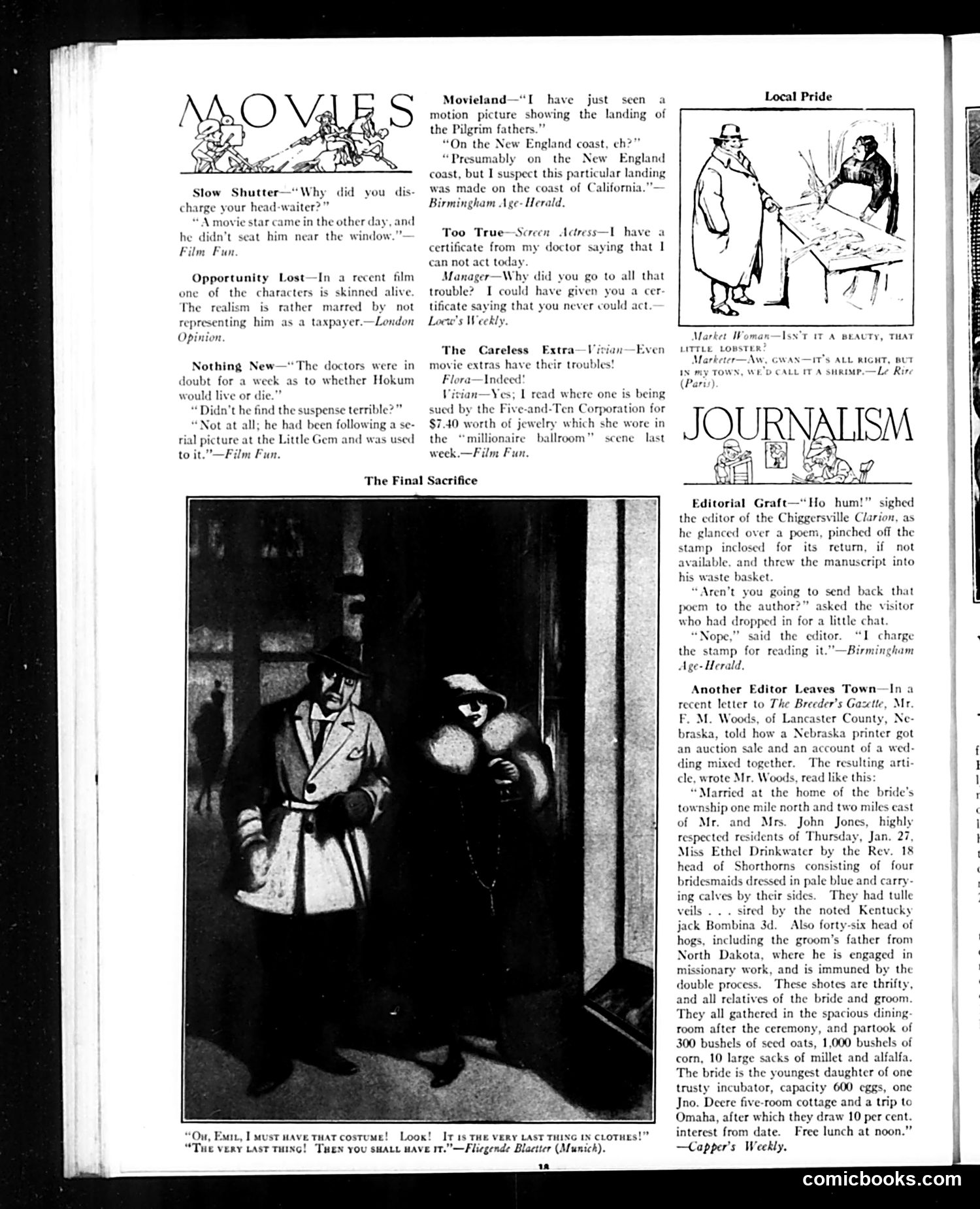
This page from Judge satirizes early film industry absurdities and newspaper editorial mishaps. **"The Final Sacrifice"** cartoon depicts a period drama scene where an actor demands his costume back, saying "the very last thing in clothes"—mocking both theatrical melodrama and the film industry's obsession with authenticity in costume design. **Film industry jokes** ridicule Hollywood's fakery: movies claiming to show the Pilgrims landing on the New England coast were actually filmed in California; a studio sued an extra for "stealing" $7.40 in prop jewelry; and doctors' certificates excusing actresses from acting are treated as absurd. **The "Another Editor Leaves Town" piece** is the page's centerpiece: it mocks small-town newspaper incompetence through a hilariously garbled wedding announcement where livestock sale descriptions accidentally mixed with marriage details—bridesmaids described alongside cattle, the groom's father listed among hog inventory. This satirizes rural journalism's carelessness and the chaos of paste-up journalism. The humor targets both Hollywood's pretense and provincial American journalism's incompetence.
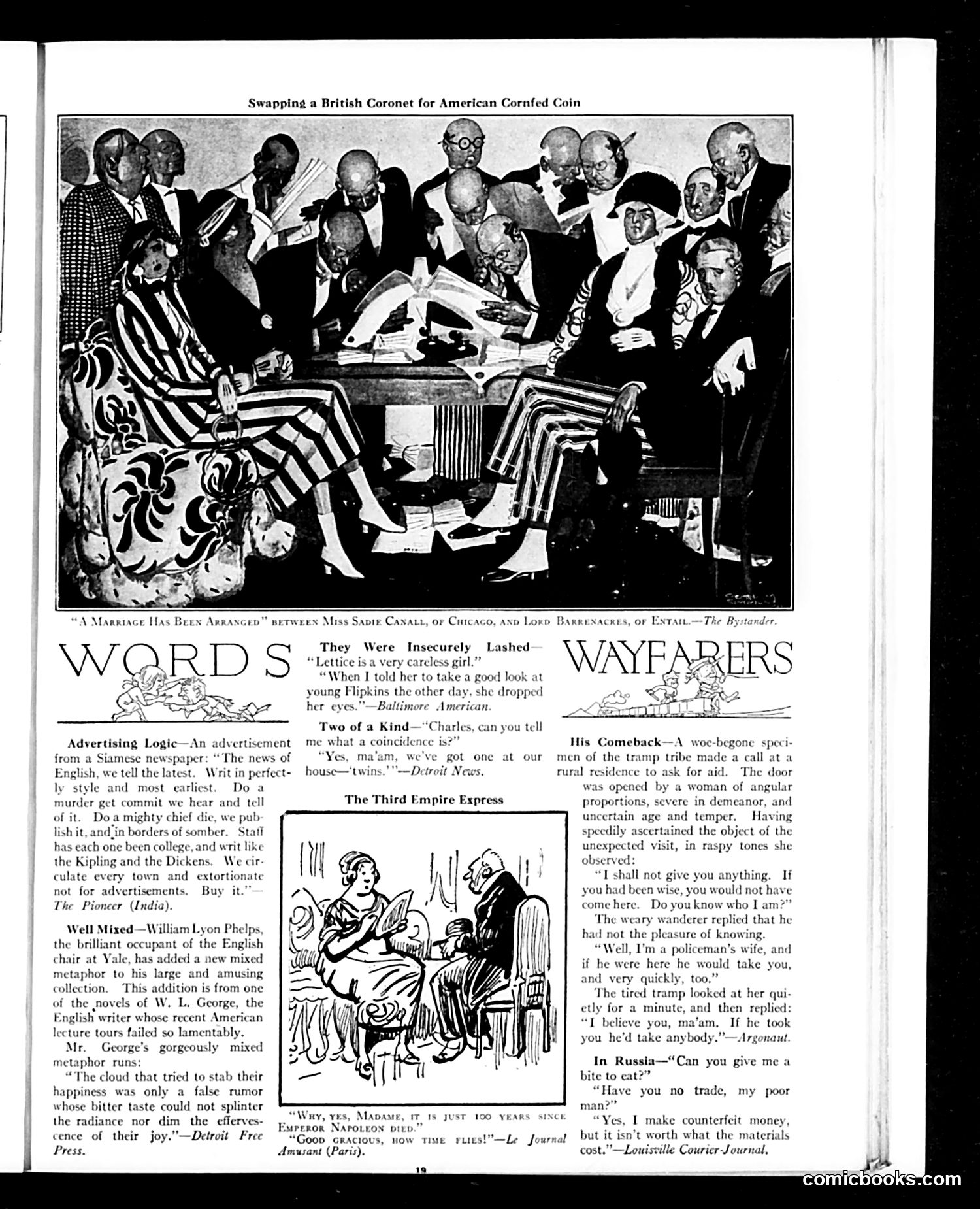
The page's main cartoon depicts an international marriage arrangement between Miss Sadie Cavall of Chicago and Lord Barrenacres of England—satirizing the Gilded Age practice of wealthy American heiresses marrying impoverished British nobility in exchange for titles. The title "Swapping a British Coronet for American Cornfed Coin" makes the transaction explicit: the American brings money ("cornfed" suggesting agricultural wealth), the British aristocrat brings a coronet (crown/title). The surrounding text offers brief satirical anecdotes mocking linguistic incompetence, mixed metaphors, and social pretension. These reinforce the page's theme: the absurdity of different cultures attempting transactions based on superficial values rather than genuine merit. The cartoon's crowded scene of onlookers suggests this was a notable social spectacle—Judge treating such transatlantic marriages as objects of ridicule rather than romance.
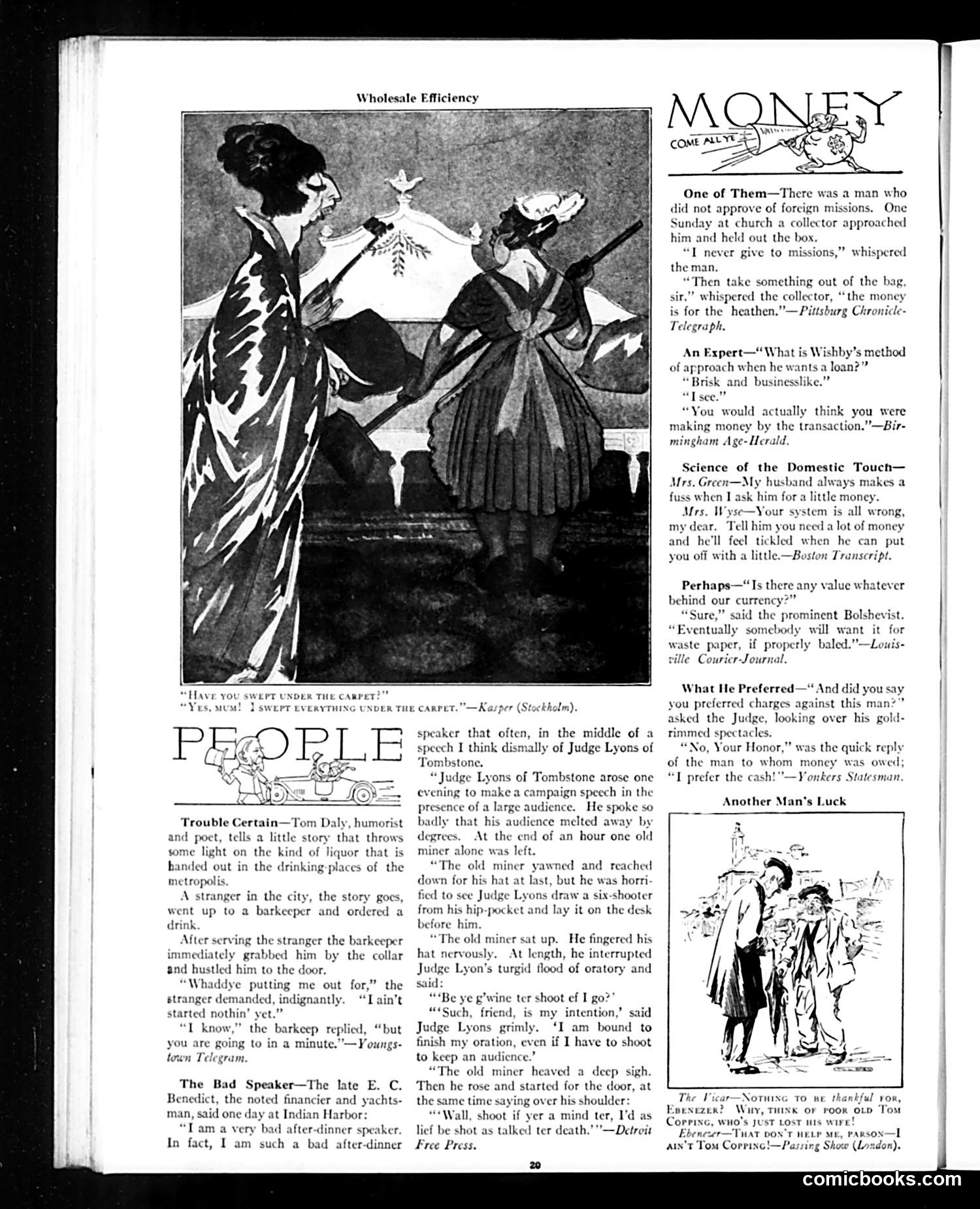
This page from *Judge* magazine contains several short humorous anecdotes and jokes satirizing American social and economic life, likely from the early 20th century. The main cartoon depicts a woman sweeping money under a carpet while a man watches—illustrating the title "Wholesale Efficiency" by showing how corruption or financial mismanagement conceals problems rather than solving them. The text sections mock various targets: a bad public speaker (Judge Lyons), class hypocrisy regarding charitable giving to missions, ineffective loan-seeking approaches, marital money dynamics, and currency value (notably referencing a "prominent Bolshevik," suggesting Cold War-era anxieties about communism). A final cartoon shows a widow being confused with another man named Corping, satirizing either coincidence or social indifference to personal tragedy. The overall theme criticizes inefficiency, dishonesty, and social pretense in American institutions and relationships.
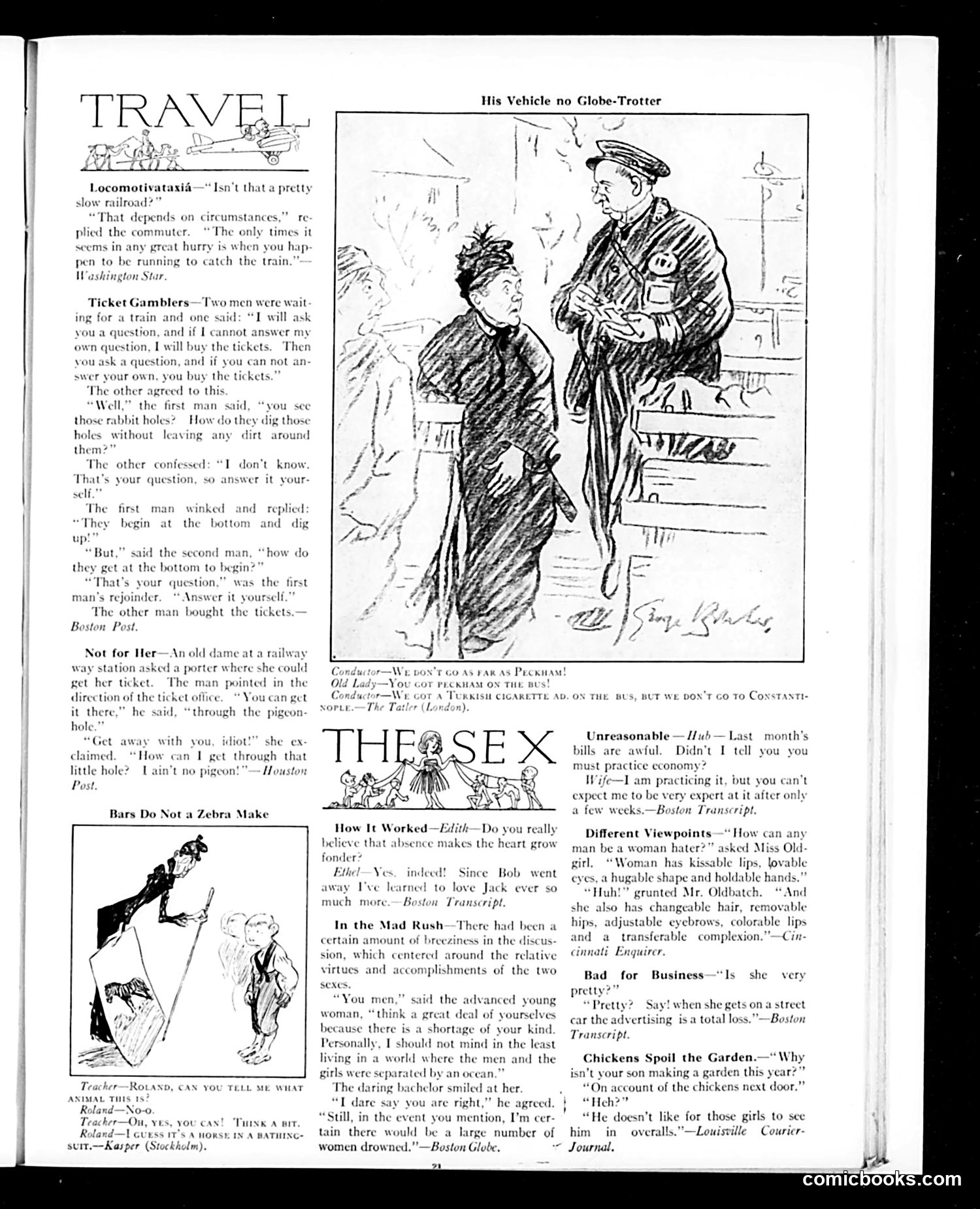
The main cartoon depicts a woman and a porter at a train station. The caption references "Peckham on the bus" and a Turkish cigarette advertisement, suggesting the woman is refusing to travel by bus—implying she considers bus travel beneath her social station, preferring trains instead. The satire mocks pretentious attitudes about transportation class distinctions. The page contains several short humor pieces typical of early 20th-century American magazines: jokes about slow railroads, ticket-office confusion, and absurd logic puzzles. Other items satirize gender relations ("The Other Sex" section) with jokes about romantic absence, women's changeable nature, and courtship rituals. The humor reflects period anxieties about modernization, gender roles, and social propriety—all presented as lighthearted domestic comedy for Judge's middle-class readership.
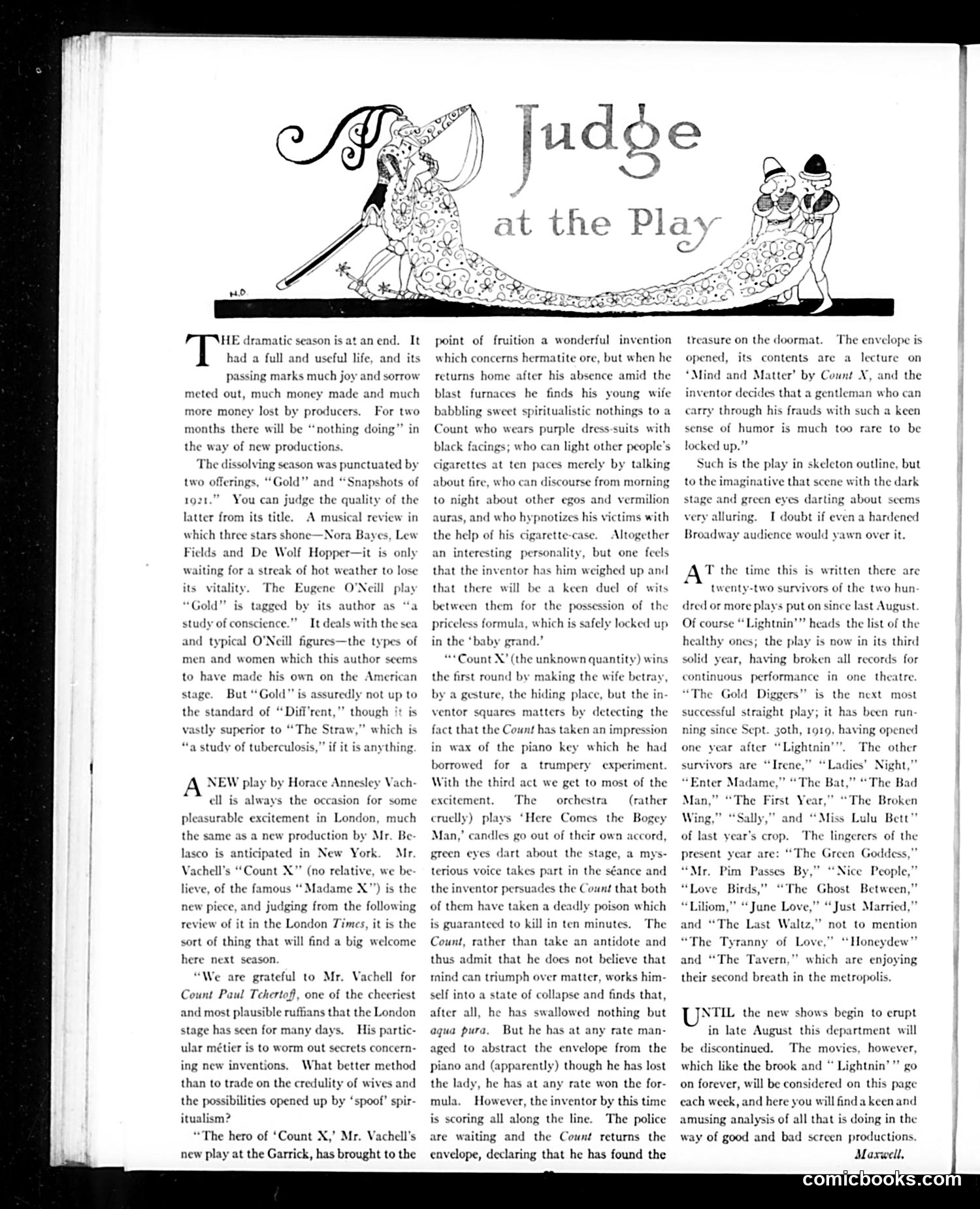
This page reviews the 1920-21 theatrical season. The decorative header depicts a theatrical judge figure evaluating plays. **Key references:** - **Eugene O'Neill plays** ("Gold," "Diff'rent," "The Straw"): The critic praises O'Neill's darker works but finds "Gold" (about a sea captain and conscience) inferior, though superior to his tuberculosis-focused "The Straw." - **"Count X" by Horace Annesley Vachell**: A London play about Count Paul Tchertsof, a charming con-artist who exploits women's credulity through fake spiritualism and séances. The plot involves competing over a formula locked in a piano, with the Count manipulating the inventor's wife through spiritual fakery (purple suits, hypnosis via cigarette cases, phantom green eyes). **The satire:** Judge mocks spiritualism as transparent fraud—the "mysterious voice" and supernatural effects are theatrical tricks. The inventor ultimately defeats the Count through rational deception rather than belief. **For modern readers:** This reflects 1920s skepticism toward spiritualist movements popular in that era.
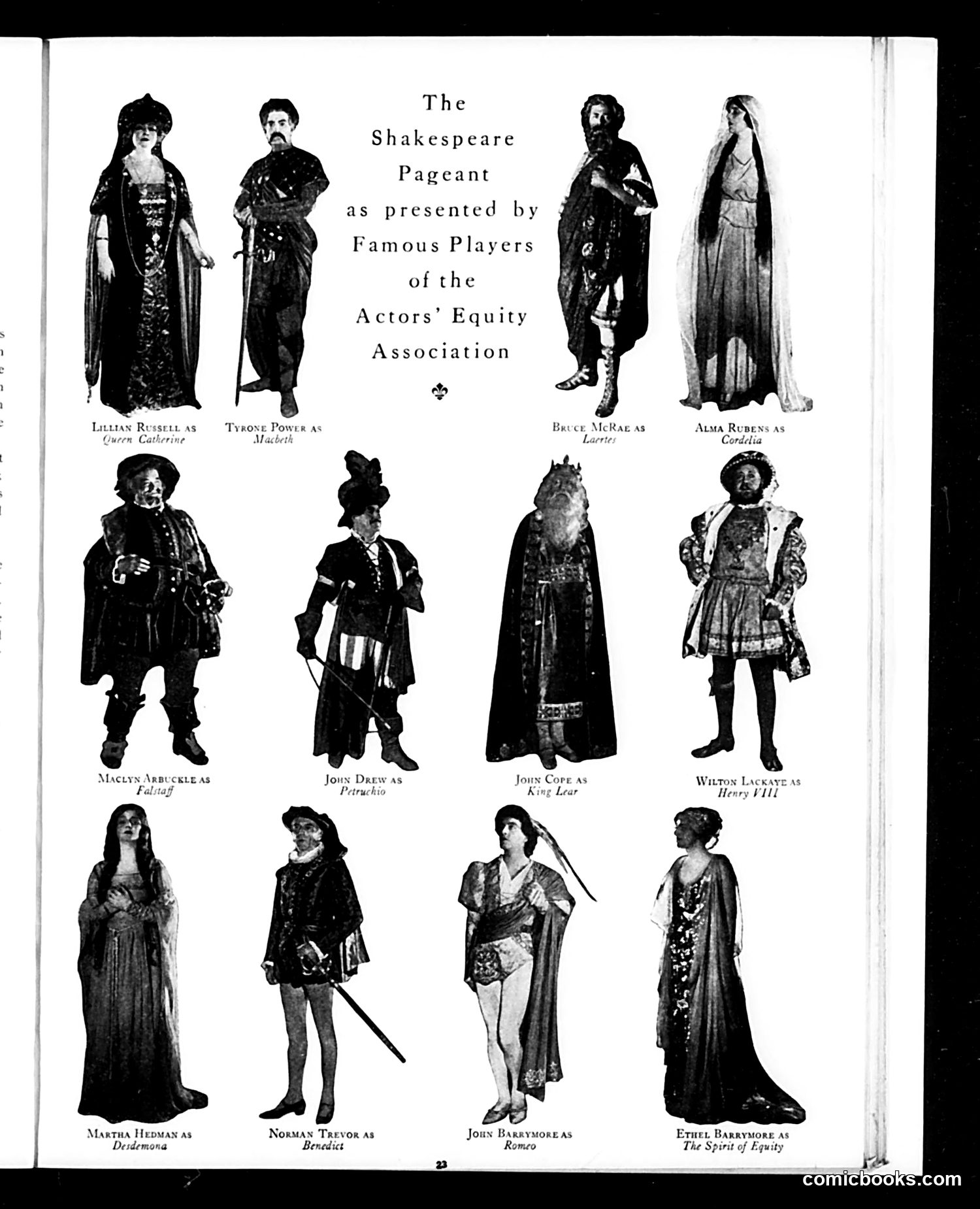
This is a title page for a theatrical production rather than a political cartoon. It presents "The Shakespeare Pageant," a benefit performance by the Actors' Equity Association featuring prominent early 20th-century actors in Shakespearean roles. The page displays twelve actors in costume portraying famous Shakespeare characters: Queen Catherine, Macbeth, Laertes, Cordelia, Falstaff, Petruchio, King Lear, Henry VIII, Desdemona, Benedick, Romeo, and "The Spirit of Equity." The inclusion of "The Spirit of Equity" as a final character suggests this pageant was a fundraiser for the Actors' Equity Association, the actors' labor union. This likely reflects theatrical labor issues of the era, with the pageant serving both entertainment and union advocacy purposes. The elaborate costumes and prestigious casting demonstrate the event's significance to the theatrical community.
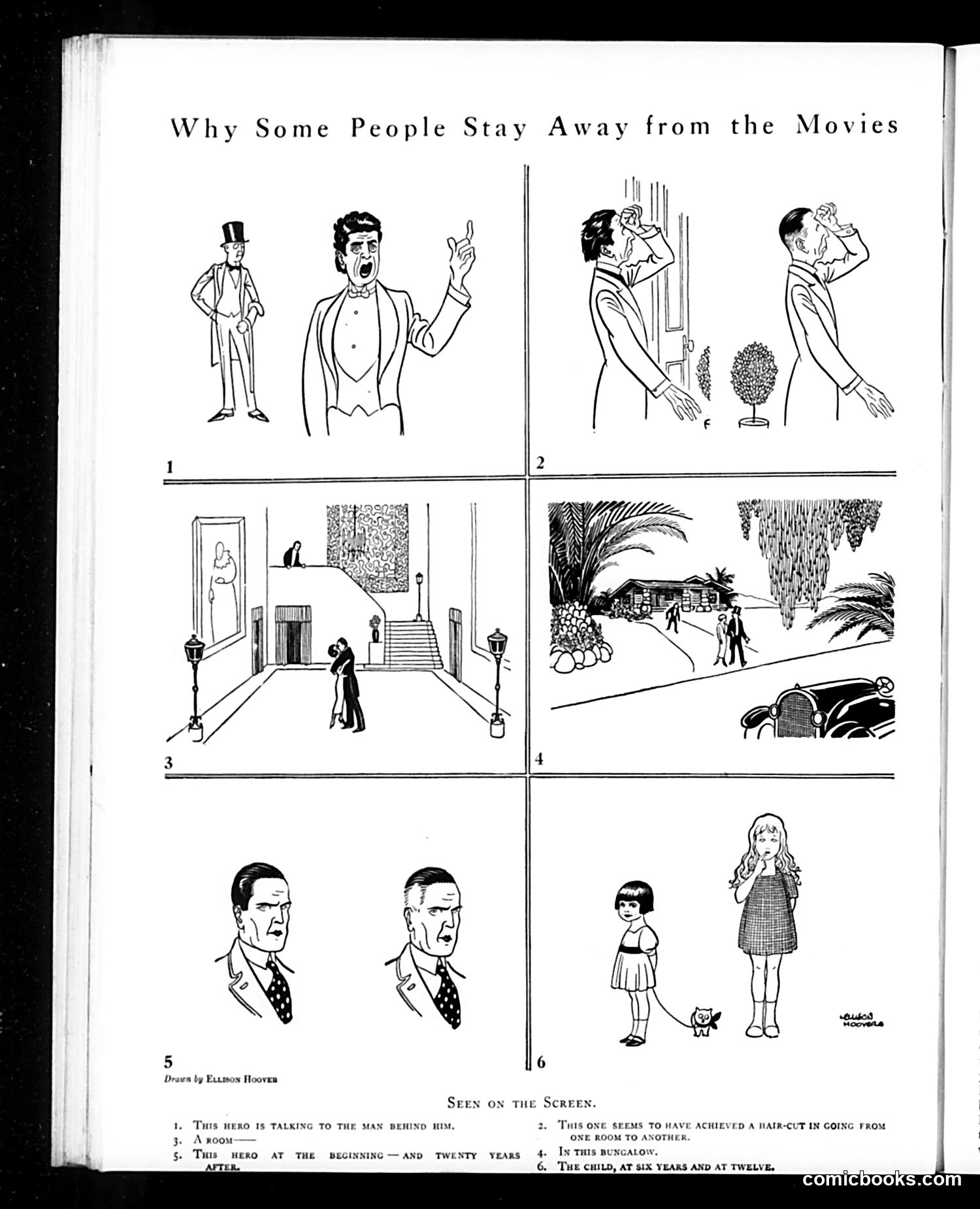
This satirical cartoon by Elinor Hoover mocks common complaints about early film continuity and production quality. Each panel illustrates a different moviegoing pet peeve: 1. **Talking to invisible people** — a character addresses someone off-screen or absent 2. **Continuity errors** — a character's hairstyle changes between scenes 3. **Unclear spatial logic** — confusing room layouts or transitions 4. **Implausible settings** — a bungalow appears inconsistent or poorly designed 5. **Aging inconsistencies** — a hero looks different at the film's beginning and twenty years later 6. **Child aging problems** — a child appears dramatically aged (six to twelve) between scenes The humor targets the technical and narrative sloppiness of early cinema—likely 1920s films—where low budgets, rushed production, and primitive filmmaking techniques created jarring discontinuities. The satire suggests these flaws were common enough that audiences actively avoided movies because of them.
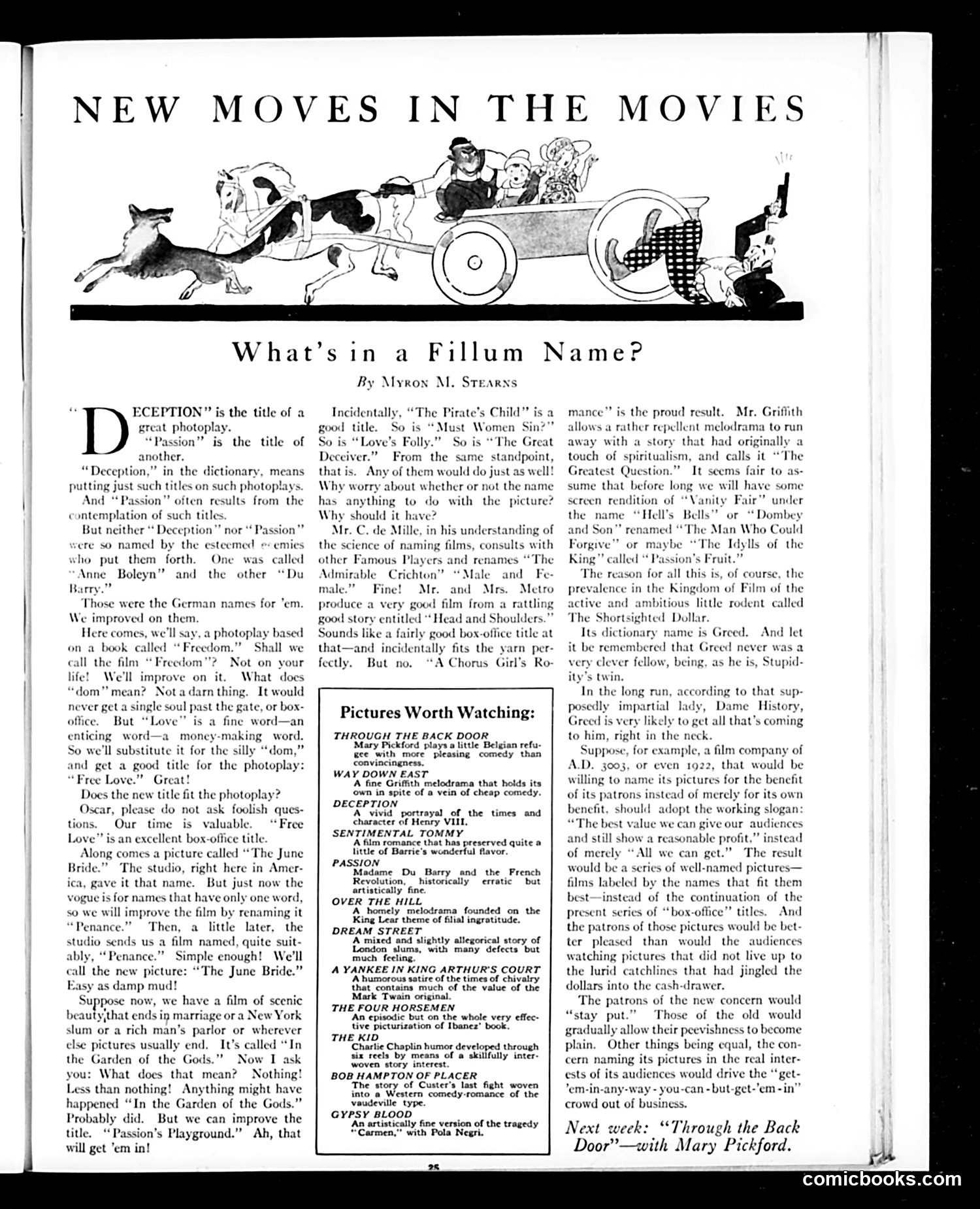
This article by Myron M. Stearns satirizes Hollywood's practice of renaming films to maximize box-office appeal, regardless of accuracy. The author mocks studios for replacing meaningful titles with sensational ones—"Freedom" becomes "Free Love," "The June Bride" is renamed "Penance," and "In the Garden of the Gods" becomes "Passion's Playground"—purely for commercial profit. He ridicules the logic: why should a title actually *fit* the film's content? The piece names real producers like Cecil B. DeMille and Metro Pictures, citing their renaming of "The Admirable Crichton" to "Male and Female." The satire targets how studios treat titles as marketing gimmicks rather than honest descriptions, prioritizing words with proven box-office draw ("Love," "Passion") over accuracy. The accompanying "Pictures Worth Watching" box reviews contemporary films, providing context for 1921 cinema standards.
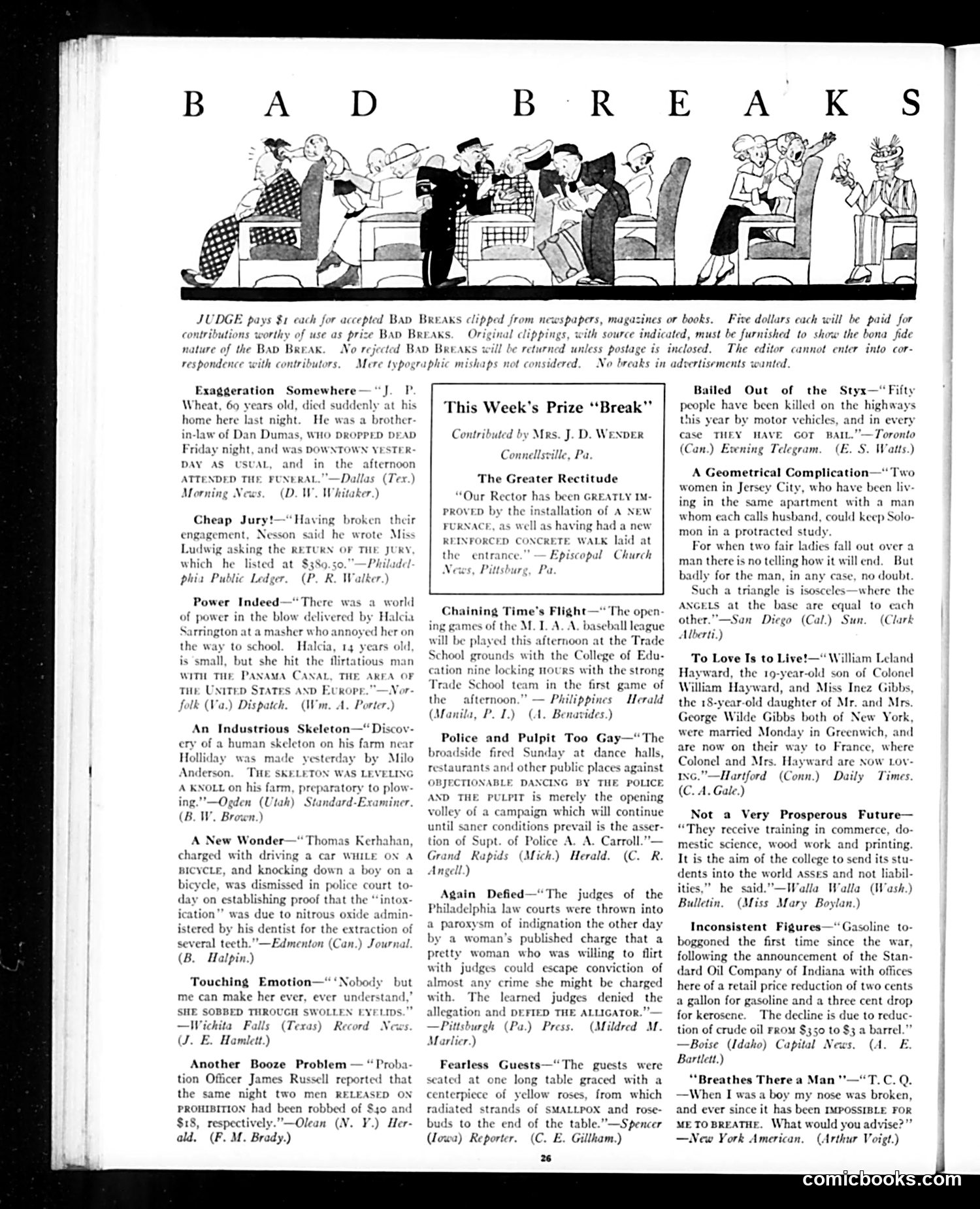
This page features *Judge* magazine's weekly humor column showcasing funny newspaper typos and misstatements—"bad breaks"—submitted by readers. The cartoon header shows people reading newspapers, establishing the source of these errors. The column collects absurd sentences from real newspapers where careless wording created unintended meanings. Examples include: a man described as "leveling a knoll" while being a skeleton; judges who "defied the alligator" (likely meant "alleged"); and a church centerpiece decorated with "smallpox and rosebuds" (probably "smilax," a flowering plant). The humor relies on readers recognizing the original intent versus the ridiculous literal reading. This was popular early-20th-century entertainment—mocking newspaper quality and enjoying the wordplay. The magazine paid prize money for best submissions, encouraging reader participation in identifying these journalistic gaffes.
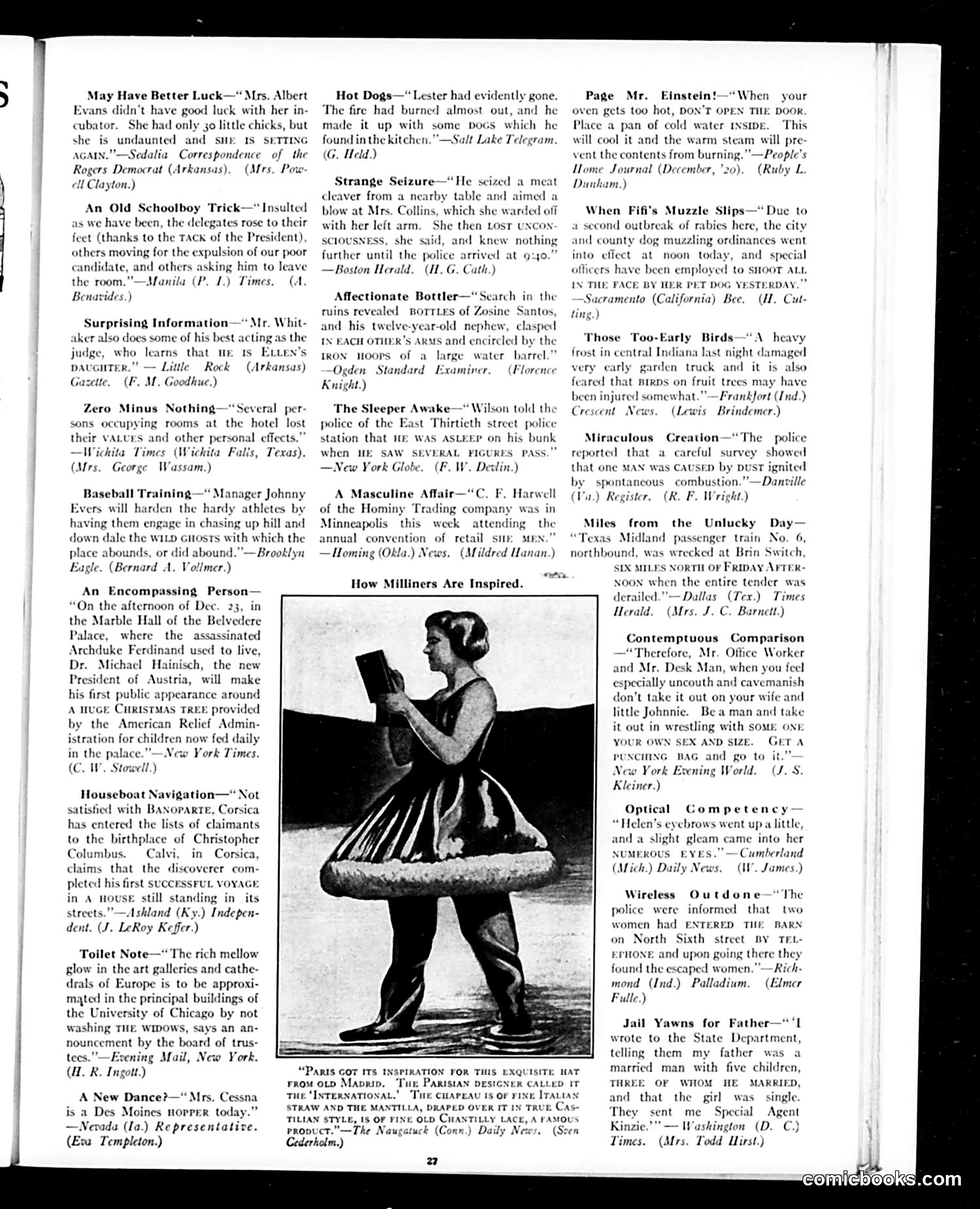
This page from **Judge** magazine is a humor section featuring brief anecdotes and visual gags. The cartoon shows a fashionable woman in an elegant dress examining a large hat—illustrating the accompanying caption about Parisian hat designers. The text snippets are satirical "funny newspaper excerpts" where editors highlighted unintentionally absurd or poorly-worded passages from actual papers. Examples include: - A woman setting an incubator again after poor results ("May Have Better Luck") - A journalist noting a delegate was pricked with a tack during a commotion ("Old Schoolboy Trick") - A report of theft that says valuables were "lost" without explanation ("Zero Minus Nothing") The humor derives from these genuine newspaper quotes' awkward phrasing or illogical statements. The sources are credited to newspapers and individuals, suggesting Judge's editors collected these from real publications to mock journalistic carelessness or absurdity—a form of media criticism through comedy.
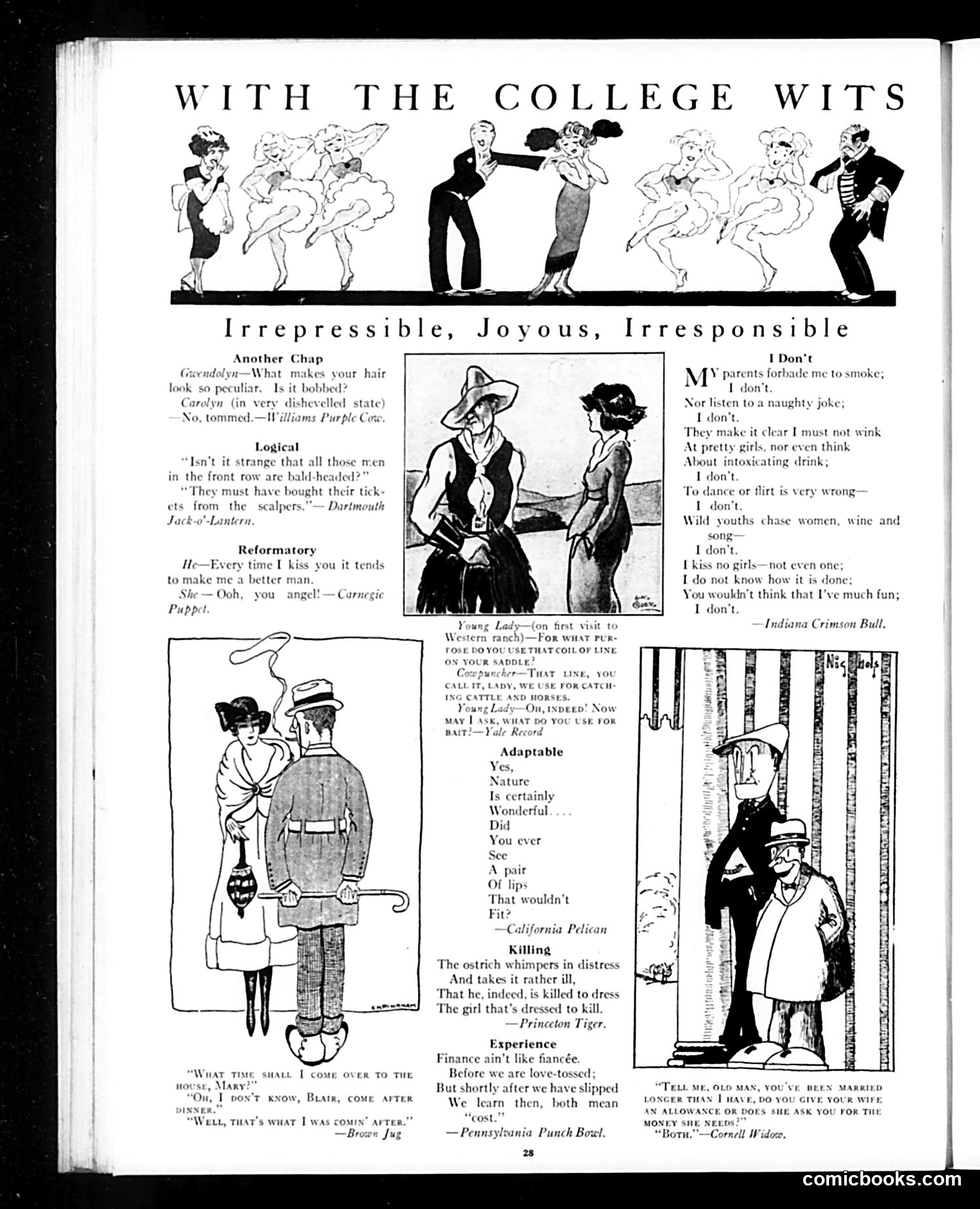
This page collects humorous quips from college humor magazines, satirizing young people—particularly college students and "flappers" of the Jazz Age era. The central theme mocks the tension between parental restrictions and youth rebellion. The "I Don't" poem parodies a rebellious young man claiming absolute restraint (no smoking, drinking, flirting, dancing) while ironically suggesting he secretly wants to do all these things. Other jokes mock courtship conventions: a cowpuncher's literal misunderstanding of "coil of line," an ostrich's death for women's fashion, and a couple's financial conflicts post-marriage. The cartoon vignettes depict typical college scenarios—flirtation, confusion about adult behavior, and generational clashes. The satire targets both youth excess and parental hypocrisy, common Judge themes during the 1920s social upheaval when traditional values were visibly eroding.
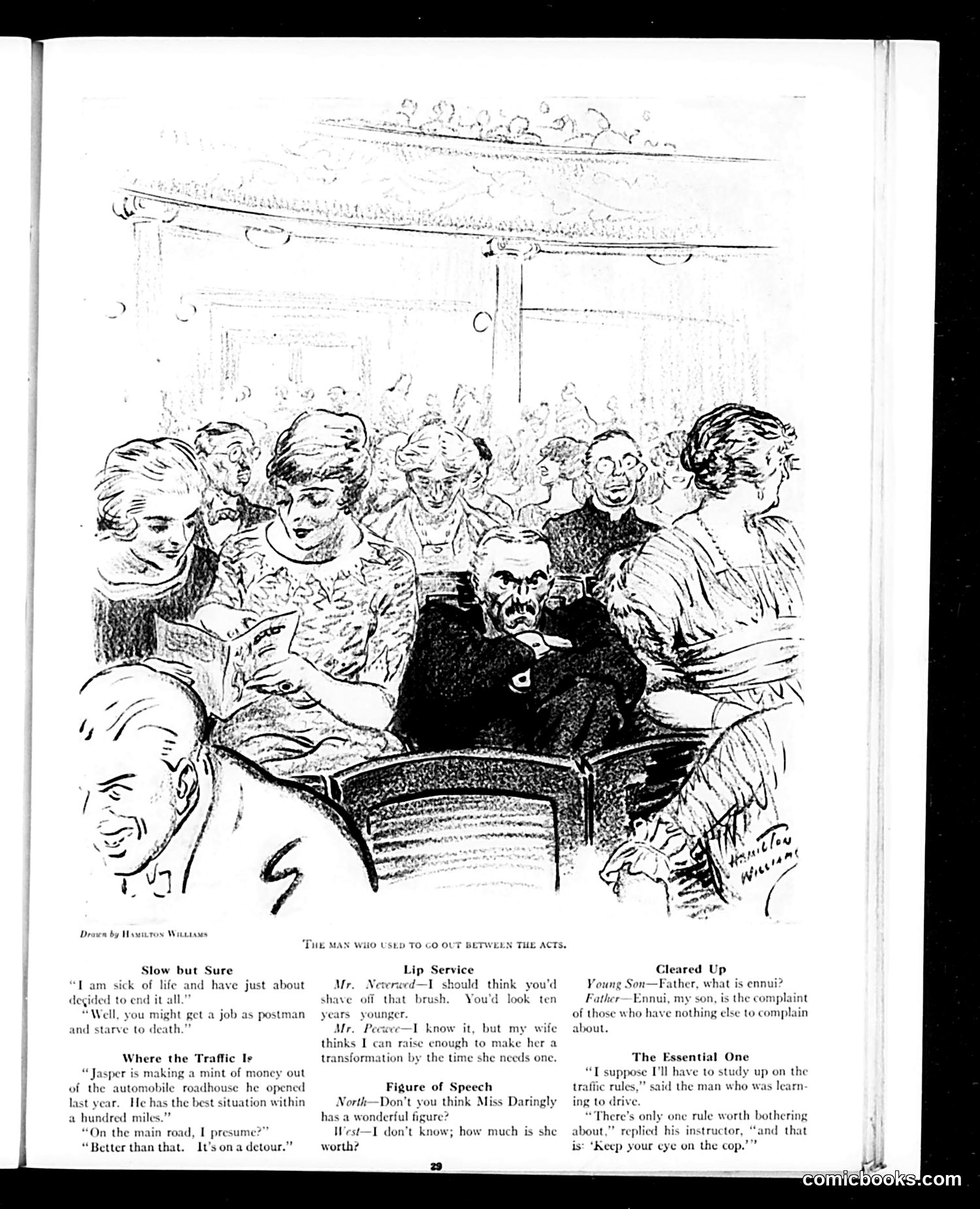
This page features multiple satirical comic strips and jokes typical of early 20th-century American humor. The main illustration depicts "the man who used to go out between the acts"—a theater patron who would leave during intermissions, likely to visit a bar or conduct business, a social custom now largely obsolete. The accompanying jokes mock various contemporary concerns: postmen's low wages, automobile culture and roadside establishments (emerging businesses), men's grooming choices, women's materialism, and traffic enforcement. "The Essential One" joke satirizes drivers' real priorities—avoiding police tickets rather than actual road safety—reflecting early automobile anxieties and tensions between new traffic laws and driver behavior. The humor assumes reader familiarity with these social practices and frustrations. The overall tone is cynical about modern life, commerce, and human nature—typical of Judge's satirical stance toward American society.
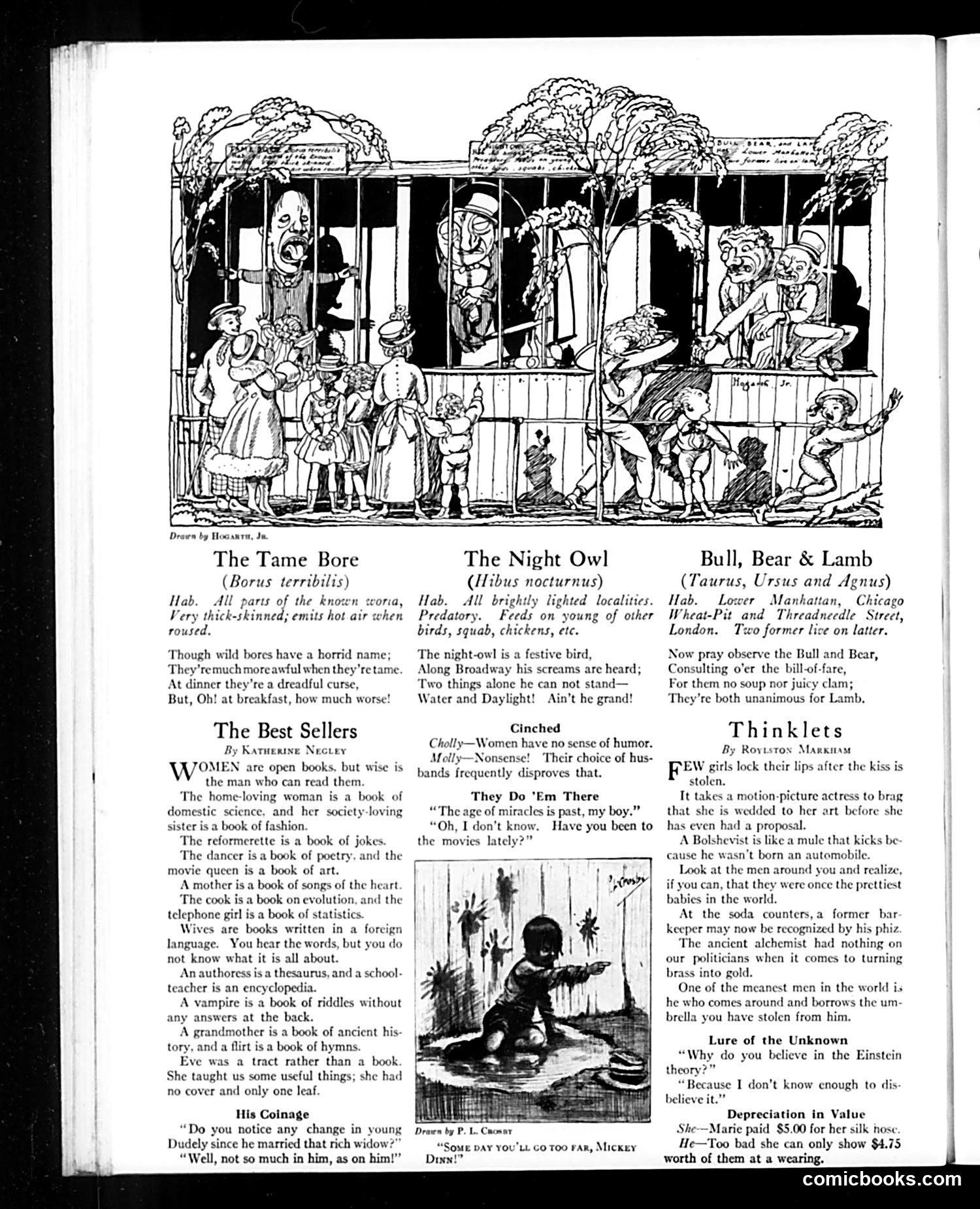
This page from the satirical magazine *Judge* contains multiple humorous pieces targeting early 20th-century social types and behaviors. **Top cartoon** ("The Tame Bore," "The Night Owl," "Bull, Bear & Lamb"): Naturalistic parodies of human types as animal species. The "Tame Bore" mocks tedious dinner guests; the "Night Owl" ridicules Broadway socialites who avoid daylight; the "Bull, Bear & Lamb" uses financial metaphors—bulls and bears are stock market speculators who prey on innocent "lambs" (ordinary investors), visualized as threatening lambs on Lower Manhattan's streets. **"The Best Sellers"**: A clever play on women as "books"—witty social commentary equating female archetypes (homemakers, reformers, dancers, mothers) to different literary genres, culminating in the dig that wives are incomprehensible "foreign language" books. **Other pieces** mock modern foibles: movies as miraculous entertainment, Bolshevism, motion-picture actresses' vanity, and women's diminishing value after wearing silk stockings. The humor targets contemporary anxieties about changing gender roles, commercialism, and modernity.
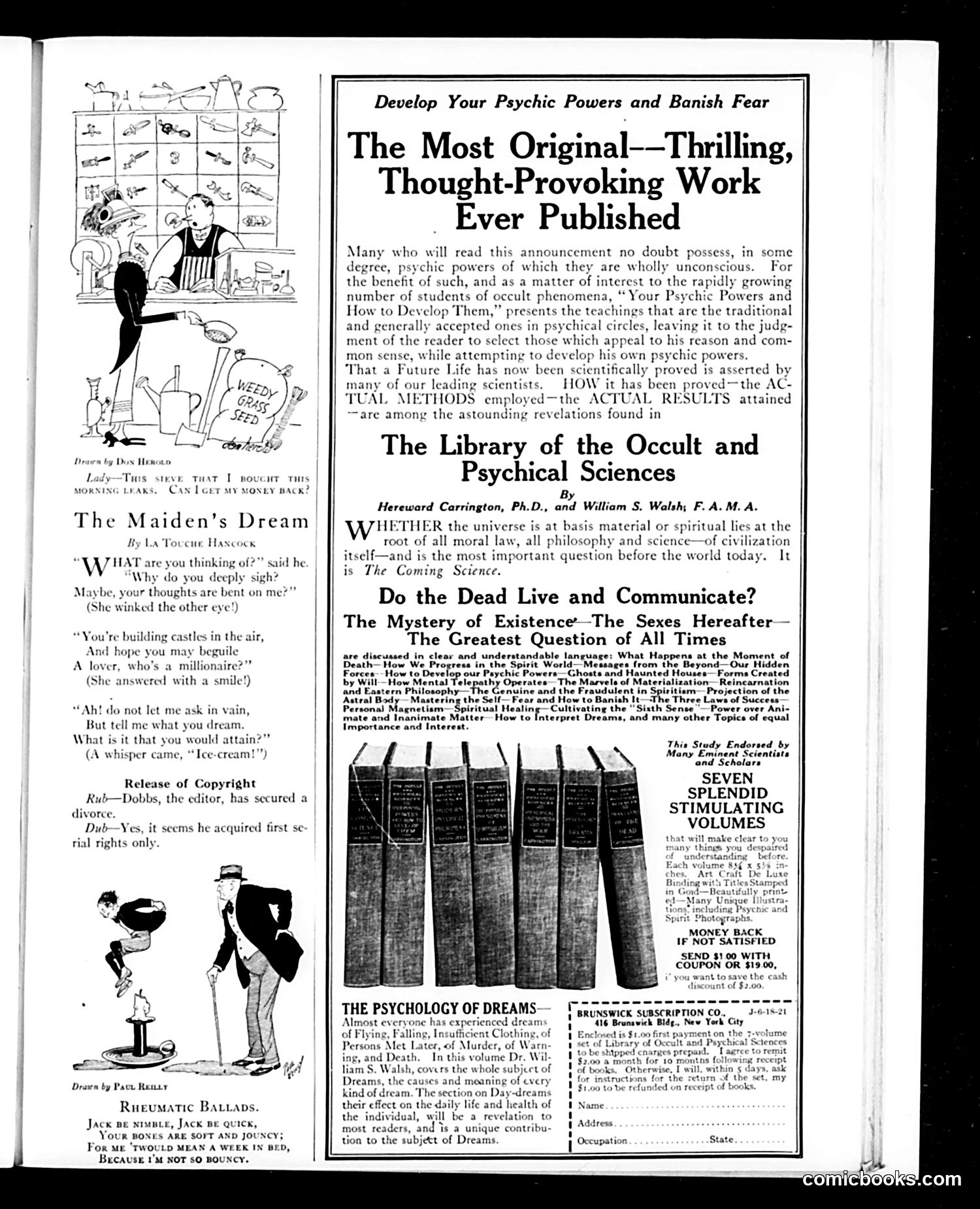
This Judge magazine page contains three satirical cartoons and an occult book advertisement. **"The Maiden's Dream"** depicts a flirtation where a man asks what a young woman dreams of. She coyly hints at romantic fantasies (a millionaire lover), but the punchline reveals her actual desire: ice cream. The satire mocks sentimental romantic idealization—the gap between what women are *expected* to want versus their actual, mundane preferences. **"Release of Copyright"** jokes about an editor's divorce, with the pun that he only obtained "serial rights" to his wife—implying he didn't secure permanent ownership. It satirizes both marital instability and publishing jargon. **"Rheumatic Ballads"** presents a nursery-rhyme style joke about physical resilience, contrasting "Jack" (presumably young and bouncy) with someone older whose bones are stiff. The bulk of the page is **paid advertising** for occult instruction books promising psychic powers and communication with the dead—typical of early 20th-century spiritualism fads that Judge's sophisticated audience would have found laughably credulous.
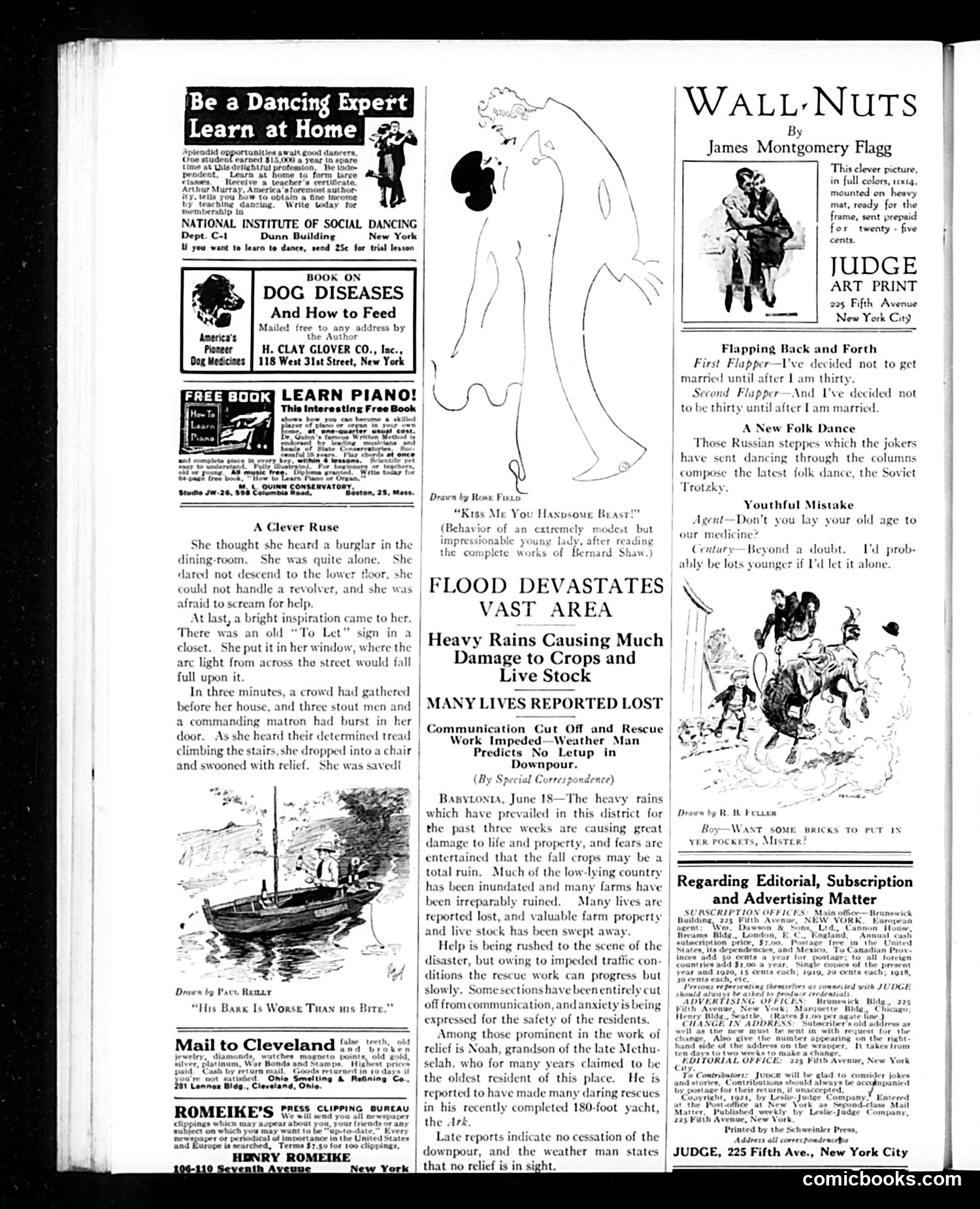
This page from Judge magazine contains mostly **advertisements and filler content** rather than sustained political satire. The key elements: **"A Clever Ruse"** — A brief humorous story about a woman who avoids a feared burglar by placing a "To Let" sign in her window, attracting a crowd and rescue efforts. It's mild domestic humor, not political commentary. **"Flood Devastates Vast Area"** — A news parody that appears to satirize disaster reporting. The joke involves **Noah** (the Biblical figure) being described as "grandson of the late Methuselah" conducting modern rescue operations in a yacht called "the Ark." This is absurdist humor playing on the Noah's Ark flood narrative—contemporary disaster news reimagined with Biblical characters treated as current residents. The remaining content consists of **advertisements** for dancing lessons, dog-care books, piano instruction, and Romeike's press-clipping bureau. The humor is lighthearted and domestic rather than sharp political satire. Judge here functions partly as a general-interest magazine mixing ads, jokes, and mild news parody.
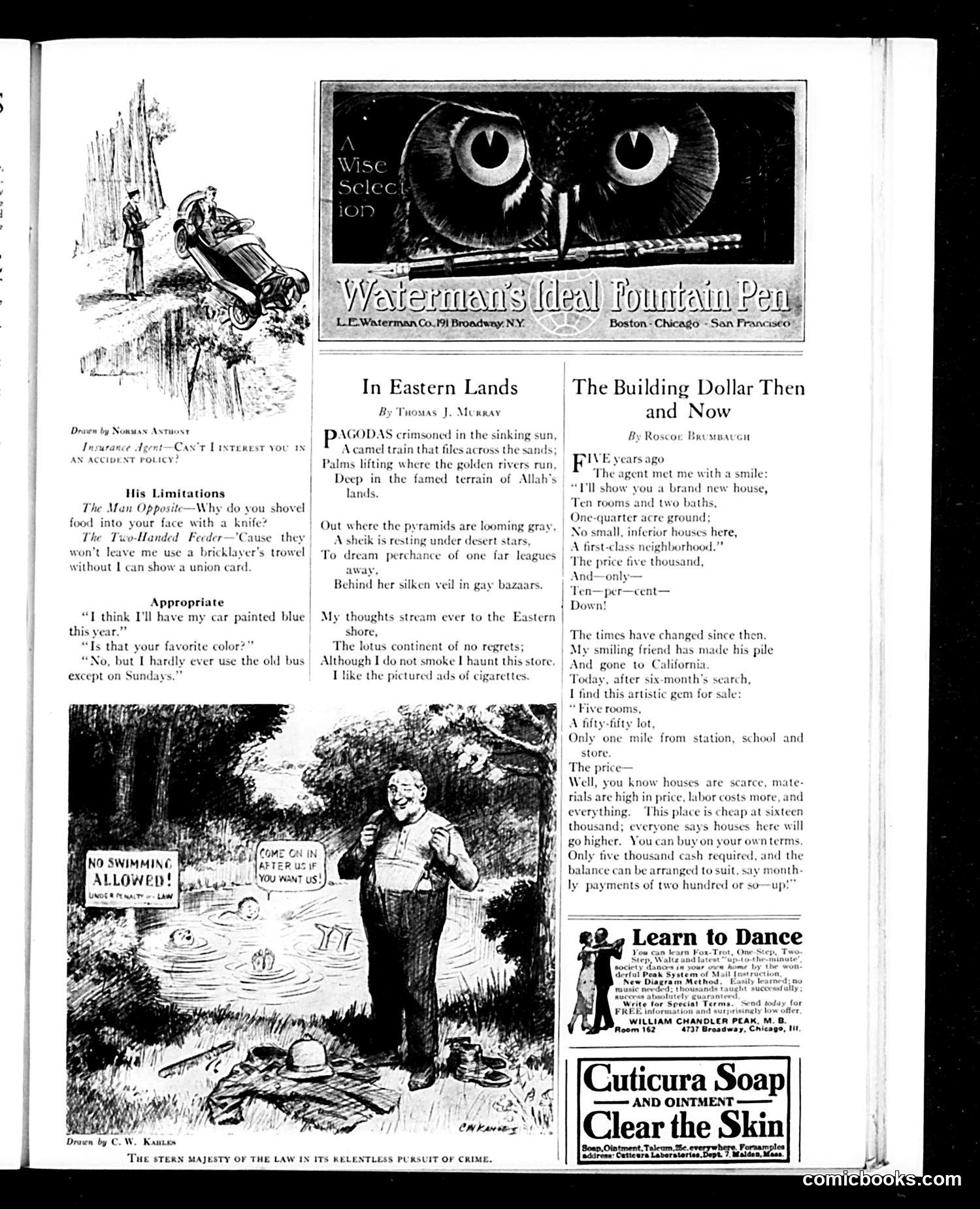
This page contains two distinct cartoons plus advertisements. **"His Limitations"** (top left): A satirical joke about labor unions. A man feeding another uses a shovel instead of appropriate utensils because union rules require a bricklayer's trowel—he can't use simpler tools without union authorization. The satire targets rigid union regulations as absurdly inefficient and comical. **"The Stern Majesty of the Law"** (bottom): A man stands by a swimming hole marked "No Swimming Allowed." The caption suggests this depicts law enforcement pursuing criminals with excessive zeal. The cartoon likely mocks overzealous policing or enforcement of minor infractions. The page also includes poetry ("In Eastern Lands" and "The Building Dollar Then and Now"), period advertisements (Waterman pens, dance lessons, Cuticura Soap), and a joke about painting a car blue for Sundays only. These reflect early 20th-century American consumer culture and middle-class concerns about property values and labor relations.
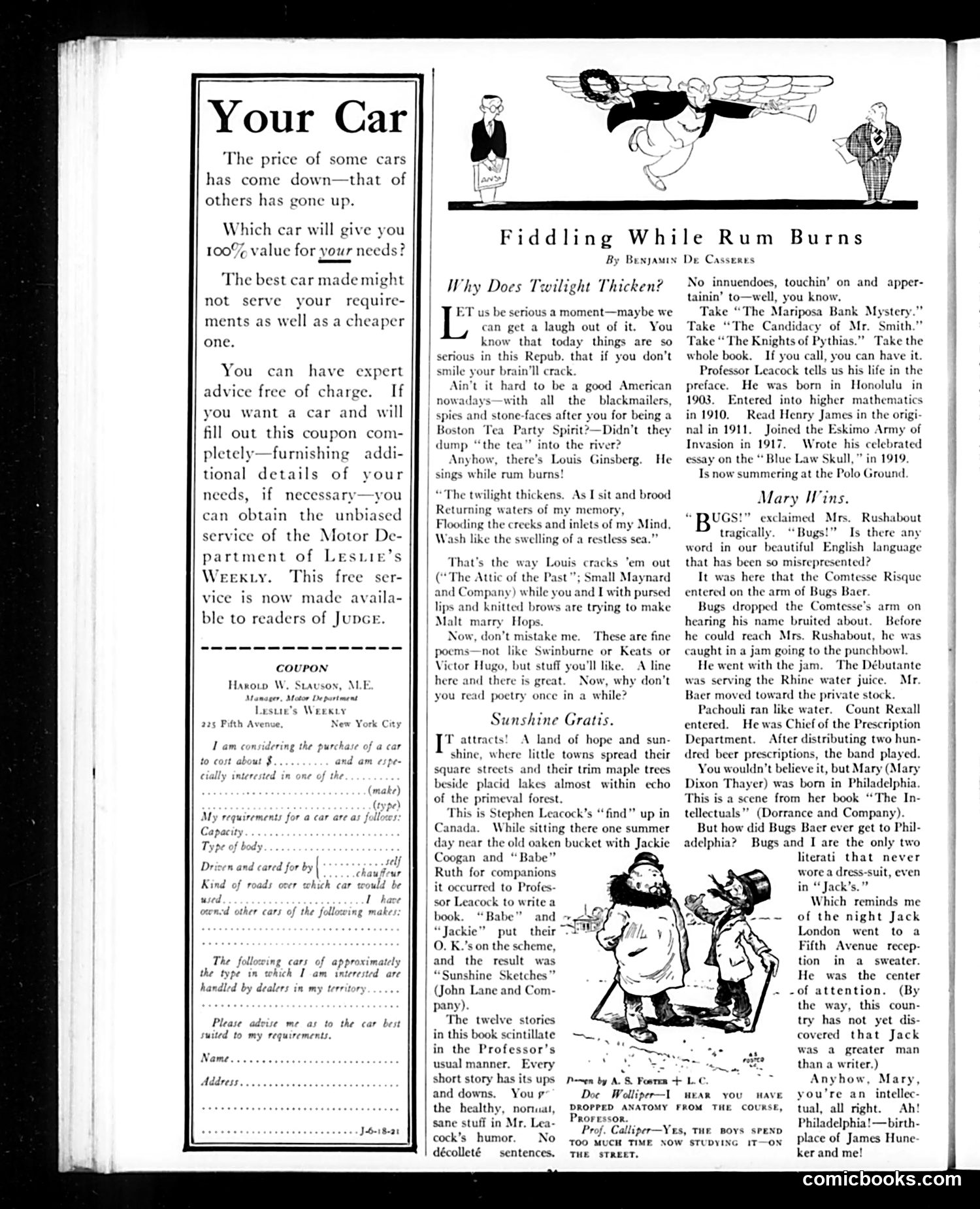
This page contains **advertising and literary content** rather than political satire. The left column features a **car-buying advice coupon** from Leslie's Weekly's Motor Department, offering free expert consultation to readers—a straightforward service advertisement. The right side includes three short pieces: a humorous essay by Benjamin De Casseres mocking American anxiety during unspecified turbulent times (referencing "blackmailers" and "spies"), a book review of Stephen Leacock's *Sunshine Sketches* praising its gentle humor, and the beginning of a satirical society story called "Mary Wins" involving characters like "Bugs Baer" at a high-society event. The cartoons at the top—showing an angel with a trumpet and well-dressed figures—appear decorative rather than pointedly satirical. Overall, this is a **mixed-content page** blending consumer service, book reviews, and light social satire typical of Judge's lighter material.
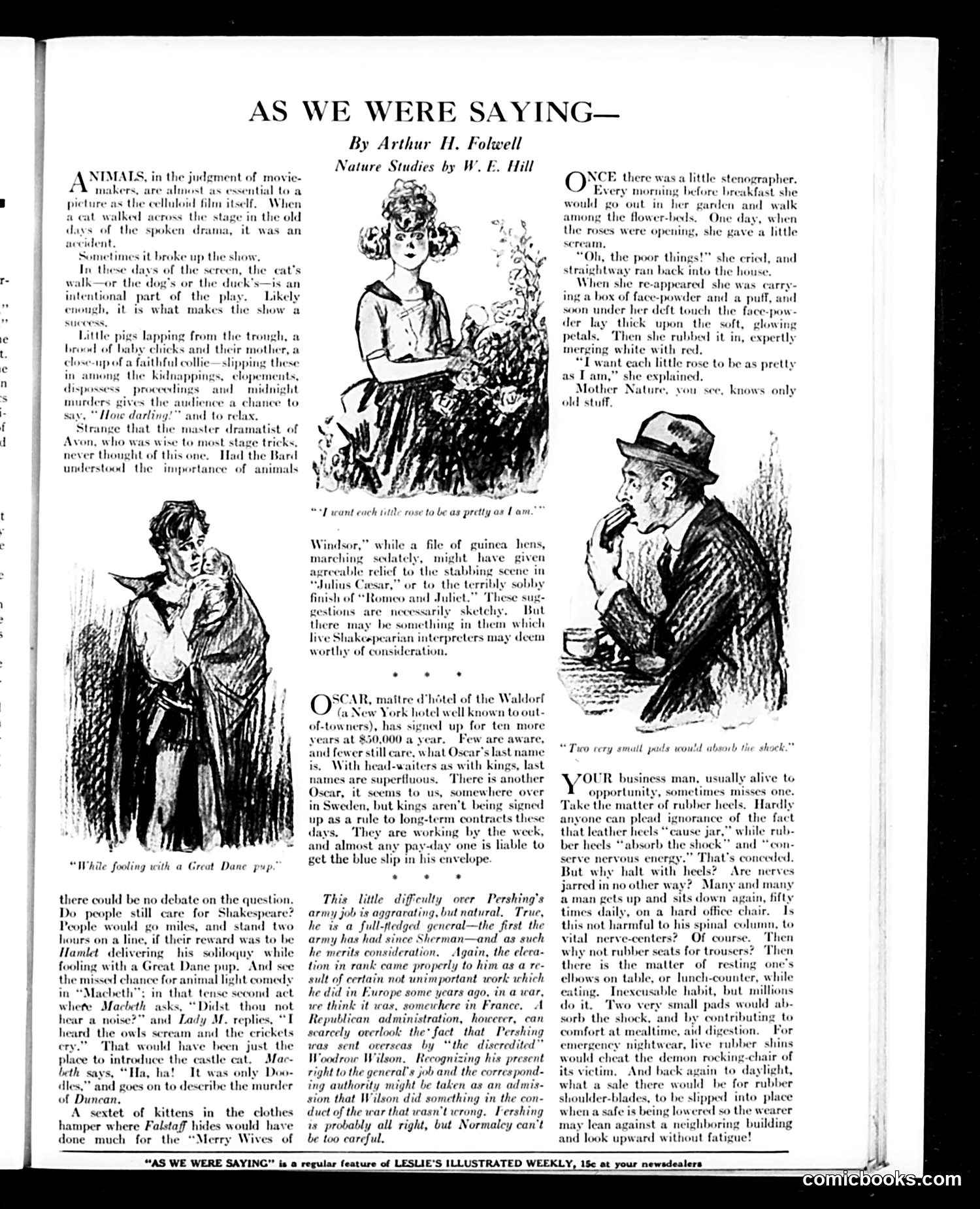
This page contains three disconnected satirical pieces by Arthur H. Folwell with illustrations by W.E. Hill: **1. Animals in Drama:** Folwell argues that Shakespeare missed opportunities for comic relief by not including animals in his plays. He suggests scenarios like Hamlet with a Great Dane or kittens hiding during *Macbeth*—apparently lampooning theatrical pretension by noting that modern cinema succeeds partly through animal antics. **2. Oscar the Maître d'Hôtel:** A brief note about a well-known hotel headwaiter who signed a ten-year contract for $50,000/year. The satire seems to mock either celebrity wages or the absurdity of long-term employment contracts in an era of job instability. **3. Pershing's Army Job & "Normalcy":** The most political piece critiques Republican reluctance to promote General John J. Pershing (who served under Democrat Woodrow Wilson in WWI) because doing so would acknowledge Wilson's competence—a dig at post-war partisan politics and the Republican "Return to Normalcy" under Harding. The page also includes two humorous illustrations and what appears to be an unrelated anecdote about a woman powdering rose petals.
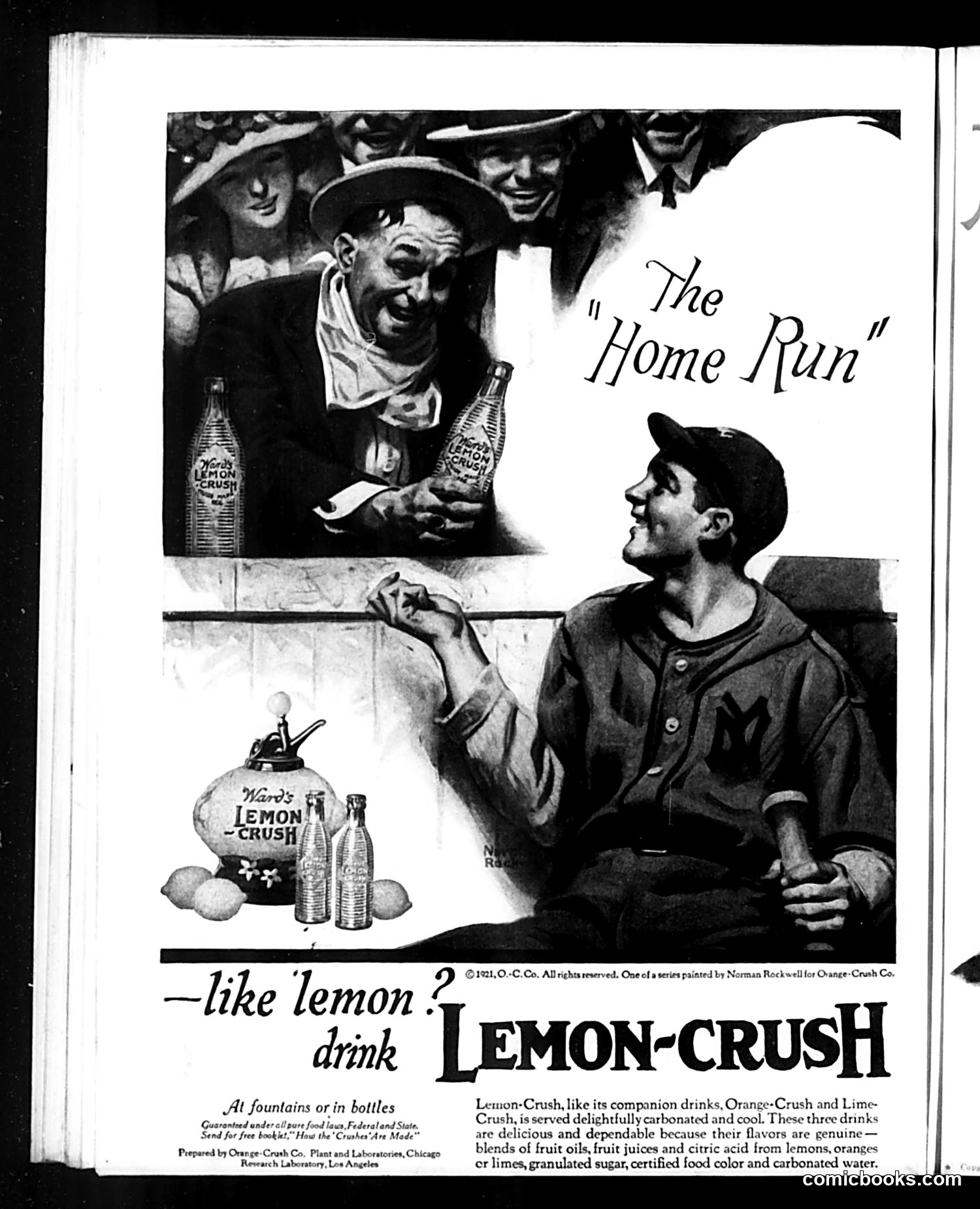
This is primarily a **commercial advertisement**, not political satire. It's a 1921 Lemon-Crush beverage ad illustrated by Norman Rockwell. The image depicts an idealized "Home Run" scenario: a young baseball player in uniform gazes upward while an older man (possibly a vendor or authority figure) holds bottles above, surrounded by admirers. The visual metaphor conflates hitting a home run with enjoying a refreshing drink. The text emphasizes that Lemon-Crush is "served delightfully carbonated and cool" at fountains or in bottles, made from "genuine" fruit ingredients. The copyright credit to Rockwell and Orange-Crush Co. establishes this as branded content. For modern readers: this represents early 20th-century advertising's strategy of associating consumer products with wholesome American activities (baseball) and aspirational lifestyles. It's not satirical—it's straightforward product promotion dressed in nostalgic Americana imagery.