
Judge, 1921-06-18 · page 22 of 36
Judge — June 18, 1921 — page 22: what you’re looking at
What you’re looking at
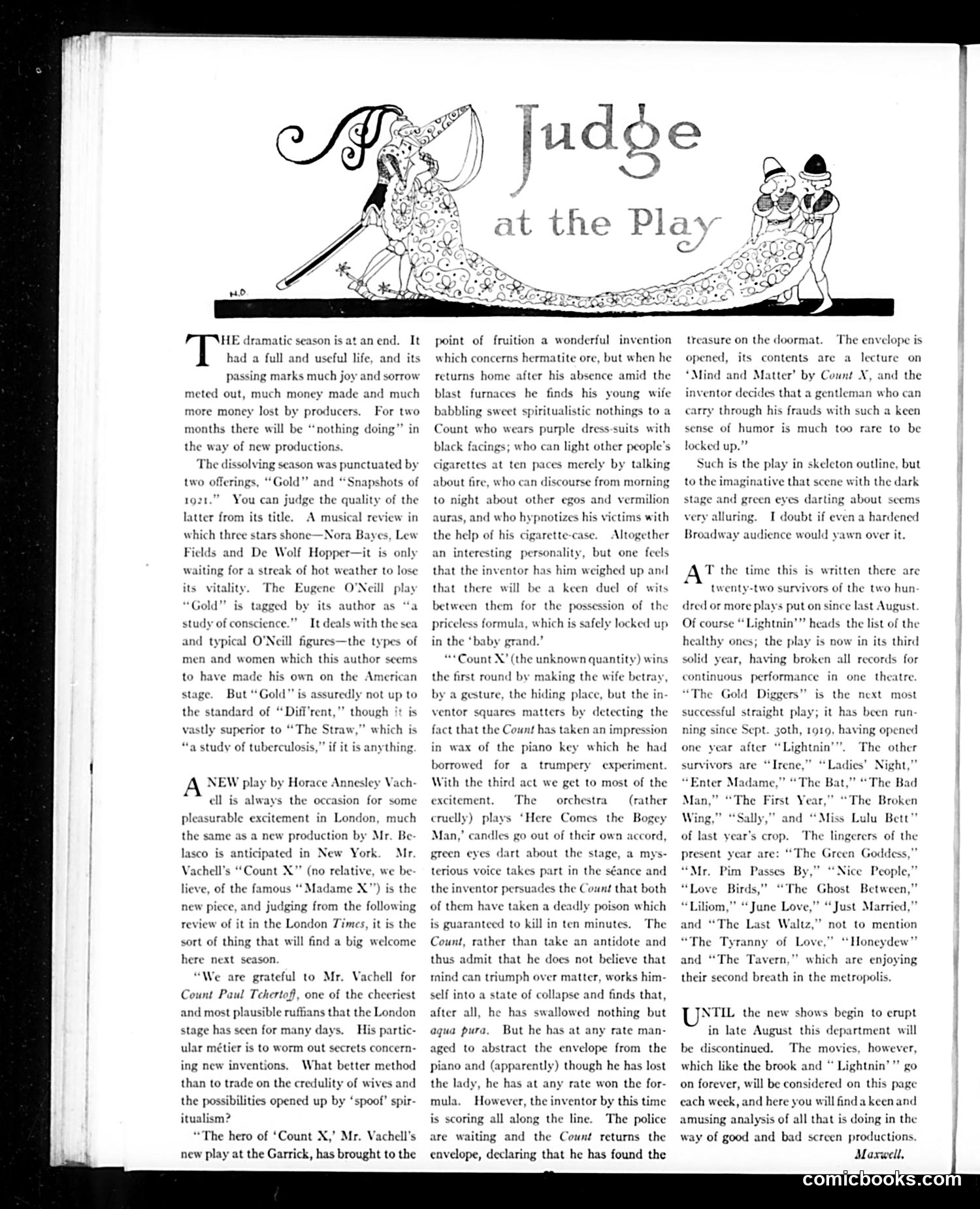
This page reviews the 1920-21 theatrical season. The decorative header depicts a theatrical judge figure evaluating plays. **Key references:** - **Eugene O'Neill plays** ("Gold," "Diff'rent," "The Straw"): The critic praises O'Neill's darker works but finds "Gold" (about a sea captain and conscience) inferior, though superior to his tuberculosis-focused "The Straw." - **"Count X" by Horace Annesley Vachell**: A London play about Count Paul Tchertsof, a charming con-artist who exploits women's credulity through fake spiritualism and séances. The plot involves competing over a formula locked in a piano, with the Count manipulating the inventor's wife through spiritual fakery (purple suits, hypnosis via cigarette cases, phantom green eyes). **The satire:** Judge mocks spiritualism as transparent fraud—the "mysterious voice" and supernatural effects are theatrical tricks. The inventor ultimately defeats the Count through rational deception rather than belief. **For modern readers:** This reflects 1920s skepticism toward spiritualist movements popular in that era.
📄 Transcribed text from this page (OCR, searchable)
Machine-transcribed from the original scan — historical spelling and the odd misread are preserved.
dramatic season is at anend. It HE had passing marks much joy and sorrow a full and useful life, and its meted out, much money made and much more money lost by producers. For two months there will be “nothing doing” in the way of new productions. The dissolving season was punctuated by “Gold” and “ You can judge the quality of the ings, apshots of latter from its title. A musical review in which three stars shone—Nora Bayes, Lew Fields and De Wolf Hopper—it is only waiting for a streak of hot weather to lose O'Neill play is tagged by its author as “a It deals with the sea its vitality. The Eugene “Gold study of conscience.” and typical O'Neill figures—the types of men and women which this author seems to have made his own on the American But “Gold” is assuredly not up to the standard of “Diff’rent,”’ though it is vastly superior to “The Straw,” which is “a study of tuberculosis,” if it is anything A NEW play by Horace Annesley Vach- ell is always the occasion for some pleasurable excitement in London, much the same as a new production by Mr. Be lasco is anticipated in New York. Mr. Vachell’s “Count X” (no relative, we be lieve, of the famous “ Madame X”) is the new piece, and judging from the following review of it in the London Times, it is the sort of thing that will find a big welcome here next season. “We are grateful to Mr. Vachell for Count Paul Tchertof{, one of the cheeriest and most plausible ruffians that the London stage has scen for many days. His partic- ular métier is to worm out secrets concern- What better method than to trade on the credulity of wives and the possibilities opened up by ‘spoof’ spir- itualism? “The hero of ‘Count X,’ Mr. Vachell’s new play at the Garrick, has brought to the ing new inventions. point of fruition a wonderful invention which concerns hermatite ore, but when he returns home after his absence amid the blast babbling sweet spiritualistic nothings to a furnaces he finds his young wife Count who wears purple dress-suits with black facings; who can light other people’s cigarettes at ten paces merely by talking about fire, who can discourse from morning to night about other egos and vermilion auras, and who hypnotizes his victims with the help of his cigarette-case. Altogether an interesting personality, but one feels that the inventor has him weighed up and that there will be a keen duel of wits between them for the possession of the priceless formula, which is safely locked up in the ‘baby grand.’ “*Count X’ (the unknown quantity) wins the first round by making the wife betray, by a gesture, the hiding place, but the in ventor squares matters by detecting the fact that the Count has taken an impression in wax of the piano key which he had borrowed for a trumpery experiment. With the third act we get to most of the excitement. The orchestra (rather cruelly) plays ‘Here Comes the Bogey Man,’ candles go out of their own accord, green eyes dart about the stag a mys- terious voice takes part in the séance and the inventor persuades the Count that both of them have taken a deadly poison which The Count, rather than take an antidote and is guaranteed to kill in ten minutes. thus admit that he does not believe that mind an triumph over matter, works him- self into a state of collapse and finds that, after all, aqua pura. aged to abstract the envelope from the he has swallowed nothing but But he has at any rate man- piano and (apparently) though he has lost the lady, he has at any rate won the for- ntor by this time is scoring all along the line. The police are waiting and the Count returns the envelope, declaring that he has found the However, the inv mula. treasure on the doormat. The envelope is opened, its contents are a lecture on ‘Mind and Matter’ by Count X. inventor decides that a gentleman who can and the Js with such a keen carry through his fr: sense of humor is much too rare to be locked up.” Such is the play in skeleton outline, but to the imaginative that scene with the dark stage and green eyes darting about seems very alluring. I doubt if even a hardened Broadway audience would yawn over it. T the time this is written there are twenty-two survivors of the two hun dred or more plays put on since last August Of course “Lightnin’” heads the list of the healthy ones; the play is now in its third 1 year, having broken all records for continuous performance in one thea “The old successful straight play; it has been run Diggers” is the next st ning since Sept. 3oth, 1919, having opened one year after “Lightnin The other Tren survivors are “* “Ladies’ “Enter Madame,” “The Ba Man,” “The First Year,” “The Broken Wing,” “Sally “Miss Lulu Bett” of last year’s crop. The lingerers of the * and The Green Goddess,” present year ar “Mr. Pim Passes By,” “Love Birds,” “The “Liliom,” “June Love, and “The Last Waltz,” “Nice People Ghost Between,” “Just Married,” not to mention “The Tyranny of Love,” “Honeydew” “The Tavern,” their second breath in the metropol: and which are enjoying IL the new shows begin to erupt in late August this department will be discontinued. The movies, however, which like the brook and “ Lightnin’”’ on forever, will be considered on this page go each week, and here you will finda keen and amusing analysis of all that is doing in the way of good and bad scrcen productions. Maxwell.