
Judge, 1921-06-18 · page 19 of 36
Judge — June 18, 1921 — page 19: what you’re looking at
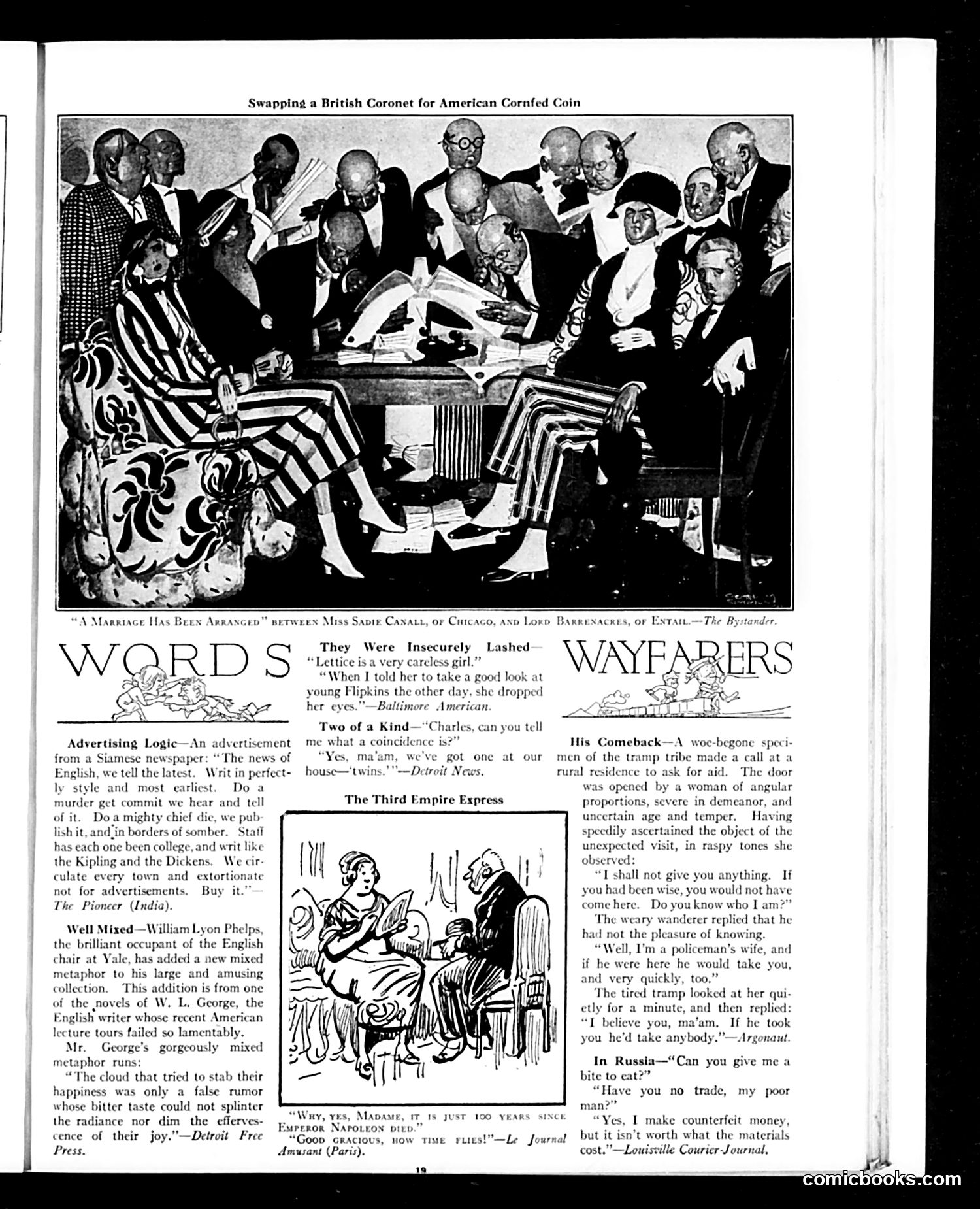
What you’re looking at
The page's main cartoon depicts an international marriage arrangement between Miss Sadie Cavall of Chicago and Lord Barrenacres of England—satirizing the Gilded Age practice of wealthy American heiresses marrying impoverished British nobility in exchange for titles. The title "Swapping a British Coronet for American Cornfed Coin" makes the transaction explicit: the American brings money ("cornfed" suggesting agricultural wealth), the British aristocrat brings a coronet (crown/title). The surrounding text offers brief satirical anecdotes mocking linguistic incompetence, mixed metaphors, and social pretension. These reinforce the page's theme: the absurdity of different cultures attempting transactions based on superficial values rather than genuine merit. The cartoon's crowded scene of onlookers suggests this was a notable social spectacle—Judge treating such transatlantic marriages as objects of ridicule rather than romance.
📄 Transcribed text from this page (OCR, searchable)
Machine-transcribed from the original scan — historical spelling and the odd misread are preserved.
Swapping a British Coronet for American Cornfed Coin Advertising Logic—An advertisement from a Siamese newspaper: “The news of English, we tell the latest. Writ in perfect- ly style and most earliest. Do a murder get commit we hear and tell of it. Doa mighty chief die, we pub lish it, and“in borders of somber. Statf has each one been college, and writ like the Kipling and the Dickens. We cir culate every town and extortionate not for advertisements. Buy it.” The P ‘er (India), Well Mixed —William Lyon Phelps, the brilliant occupant of the English chair at Yale, has added a new mixed metaphor to his large and amusing collection. This addition is from one of the novels of W. L. George, the English writer whose recent American lecture tours failed so lamentably. Mr. George’s gorgeously mixed aphor runs: “The cloud that tried to stab their happiness was only a false rumor whose bitter taste could not splinter the radiance nor dim the efferves- cence of their joy.”—Detroit Free Press. me “A Marntace Has Been Arrancen” petwees Miss Sapte Canatt, or Ciicaco, ano Lorp Barrenacres, or Extat.—The By \WAYEAR They Were Insecurely Lashed tice is a very careless gir “When I told her to tak od look at young Flipkins the other day, she dropped Baltimore American her eyes.” Two of a Kind—"Charles, can you tell me what a coincidence is?” “Yes, ma'am, we've got one house—‘twins.’""-—Detroit News. at our The Third Empire Express “Way, ves, Mapame, rr ts just Esreror Naro.eon pirp.” “Goon Gracious, How Tine Amusant (Paris). ER J His Comeback—A_ woe-begon men of the tr rural residence to ask for aid. 100 YEARS SIN! viues!"—Le Journal speci- » tribe made a call at a The door was opened by a woman of angular proportions, severe in demeanor, and uncertain age and temper. Having speedily ascertained the object of the unexpected visit, in raspy tones she observed: “T shall not give you anything. If you had been wise, you would not have come here. Do you know who I am?” ‘The weary wanderer replied that he had not the pleasure of knowing. “Well, I'm a policeman’s wife, and if he were here he would take you, and very quickly, too.” The tired tramp looked at her qui- etly for a minute, and then replied: “I believe you, ma’am. If he took you he'd take anybody.”—A In Russia—“Can you give me a bite to cat?” “Have you no trade, my poor cs, I make counterfeit money, but it isn’t worth what the materials cost.” —Louisville Courier-Journal,