
Judge, 1921-06-18 · page 7 of 36
Judge — June 18, 1921 — page 7: what you’re looking at
What you’re looking at
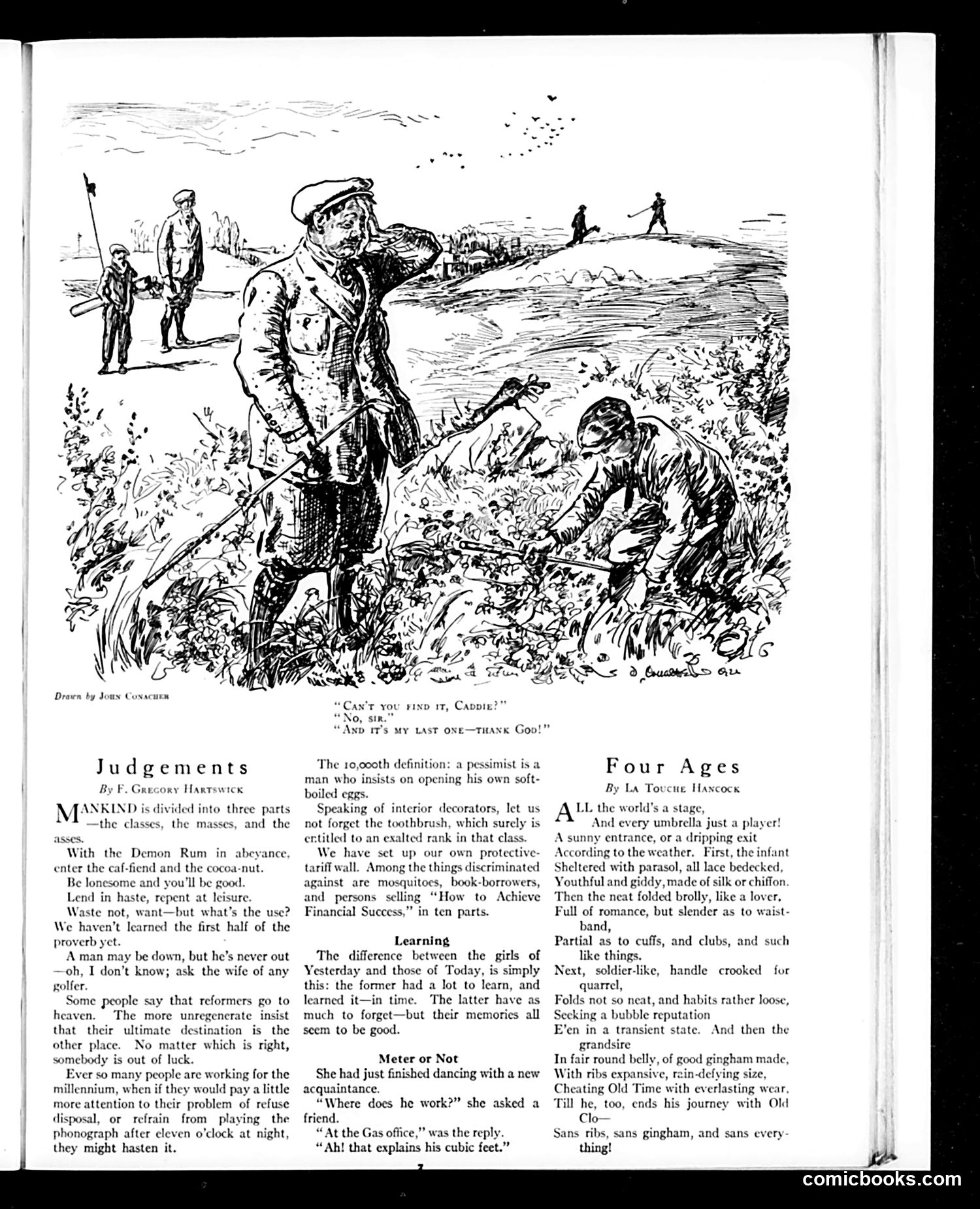
This page from *Judge* magazine contains two separate pieces of satirical humor typical of early 20th-century American wit. **The Cartoon** depicts a military officer and soldier searching a field, with the caption "'Can't you find it, Caddie?' 'No, sir.' 'And it's my last one—thank God!'" The joke appears to reference lost golf balls during wartime—likely WWI, when the contrast between soldiers' actual combat and officers' recreational concerns would seem absurd and darkly comic. **"Judgements"** is a column of brief satirical observations mocking various social types: reformers, pessimists, interior decorators, and loan-givers. The humor relies on wordplay and cynical social commentary. **"Four Ages"** is a poetic parody comparing umbrellas' lifecycles to human aging stages—from delicate infancy through romantic youth, practical middle age, to worn-out old age. It's whimsical literary satire rather than political commentary. The page reflects *Judge*'s typical blend of political observation, social satire, and light verse aimed at educated readers.
📄 Transcribed text from this page (OCR, searchable)
Machine-transcribed from the original scan — historical spelling and the odd misread are preserved.
Drawn by Jous Coxscuen Judgements By t MOSER D isi I —the classes, the masses, Grecory Hartswick Jinto three parts and the asses. With the Demon Rum in abeyance, enter the caf-fiend and the cocoa-nut. Be lonesome and you'll be good. Lend in haste, repent at leisure. Waste not, want—but what's the use? We haven't Icarned the first half of the proverb yet. A man may be down, but he’s never out —oh, I don’t know; ask the wife of any golfer. Some people say that reformers go to The more unregenerate insist that their ultimate destination is the other place. No matter which is right, somebody is out of luck. Ever so many people are working for the millennium, when if they would pay a little more attention to their problem of refuse disposal, or refrain from playing the phonograph after eleven o'clock at night, they might hasten heaven. SIR. it’s MY LAsT ONE—THANK Goo! The 10,000th definition: a pessimist is a man who insists on opening his own soft- boiled eggs. Speaking of interior decorators, let us not forget the toothbrush, which surely is entitled to an exalted rank in that class. We have set up our own protective- tariff wall. Among the things discriminated against are mosquitoes, book-borrowers, and persons selling “How to Achieve Financial Success,” in ten parts. Learning The difference between the girls of Yesterday and those of Today, is simply this: the former had a lot to learn, and learned it—in time. The latter have as much to forget—but their memories all seem to be good. Meter or Not She had just finished dancing with a new acquaintance. “Where does he work?” she asked a friend. “At the Gas office,” was the reply. “Ah! that explains his cubic feet.” Four Ages By La Tovcue Hancock LL the world’s a stage, And every umbrella just a player! A sunny entrance, or a dripping exit According to the weather. First, the infant Sheltered with parasol, all lace bedecked, Youthful and giddy, made of silk or chiffon Then the neat folded brolly, like a lover, Full of romance, but slender as to waist- band, Partial as to cuffs, and clubs, and such like things. Next, soldier-like, handle quarrel, Folds not so neat, and habits rather loose, ing a bubble reputation E’en in a transient state. grandsire In fair round belly, of good gingham made, With ribs expansive, rzin-defying size, Cheating Old Time with everlasting wear, Till he, too, ends his journey with Old Clo— Sans ribs, sans gingham, and sans every crooked for And then the comicbooks.com