A complete issue · 32 pages · 1921
Judge — March 12, 1921
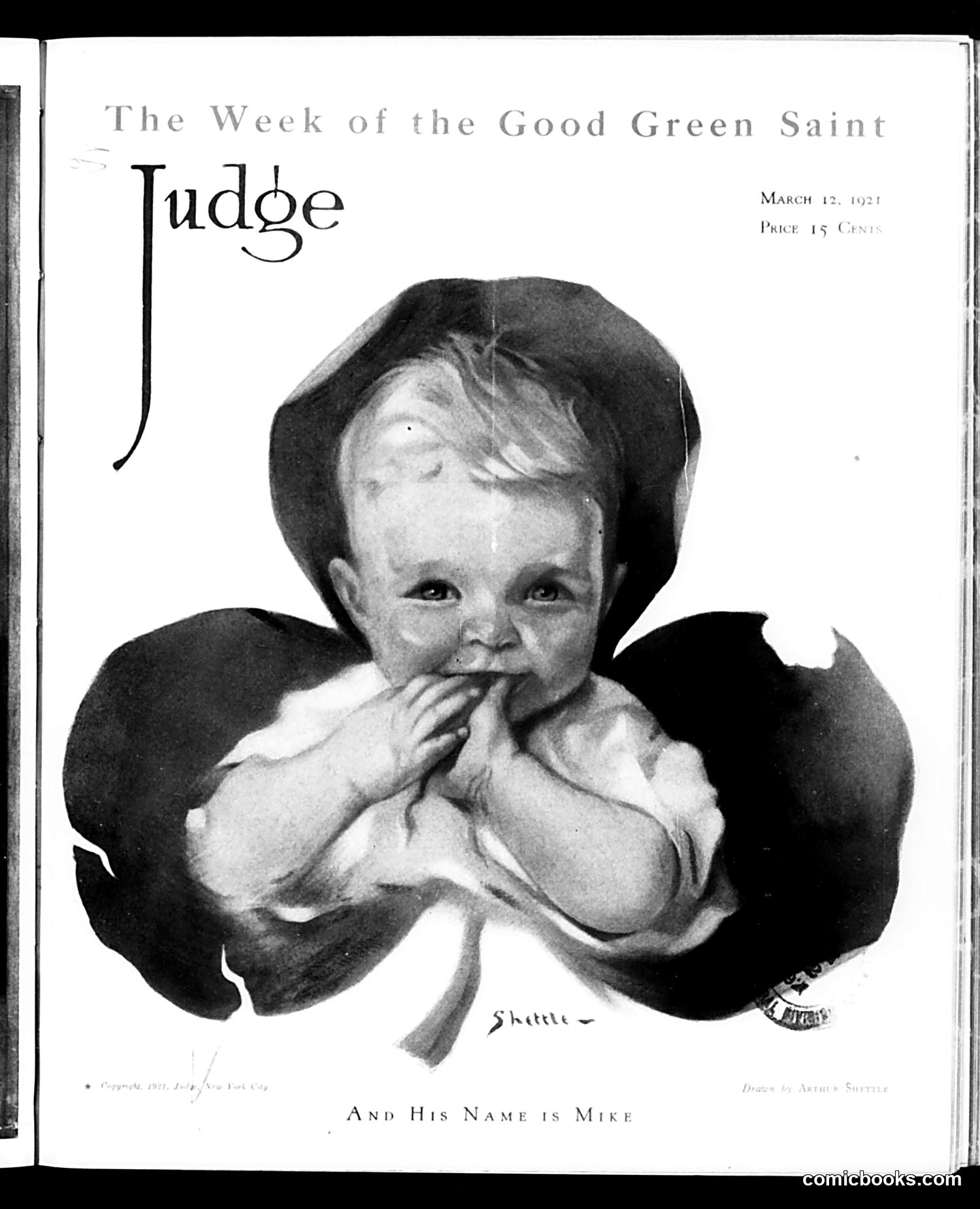
This is the cover of *Judge* magazine from March 12, 1927. The illustration shows a cherubic infant with a bonnet, hand to mouth in a contemplative pose. The title reads "And His Name is Mike," referencing the caption "The Week of the Good Green Saint" at the top. This appears to be St. Patrick's Day–themed content (March 12 precedes March 17). "Mike" is a stereotypical Irish name, and the "Good Green Saint" alludes to St. Patrick. The infantilized depiction likely satirizes Irish-American culture or contemporary Irish immigration issues. The drawing is credited to artist Arthur Shultze. The magazine cost 15 cents. Without additional context articles, the specific satirical target remains somewhat unclear, though the ethnic caricature is evident.
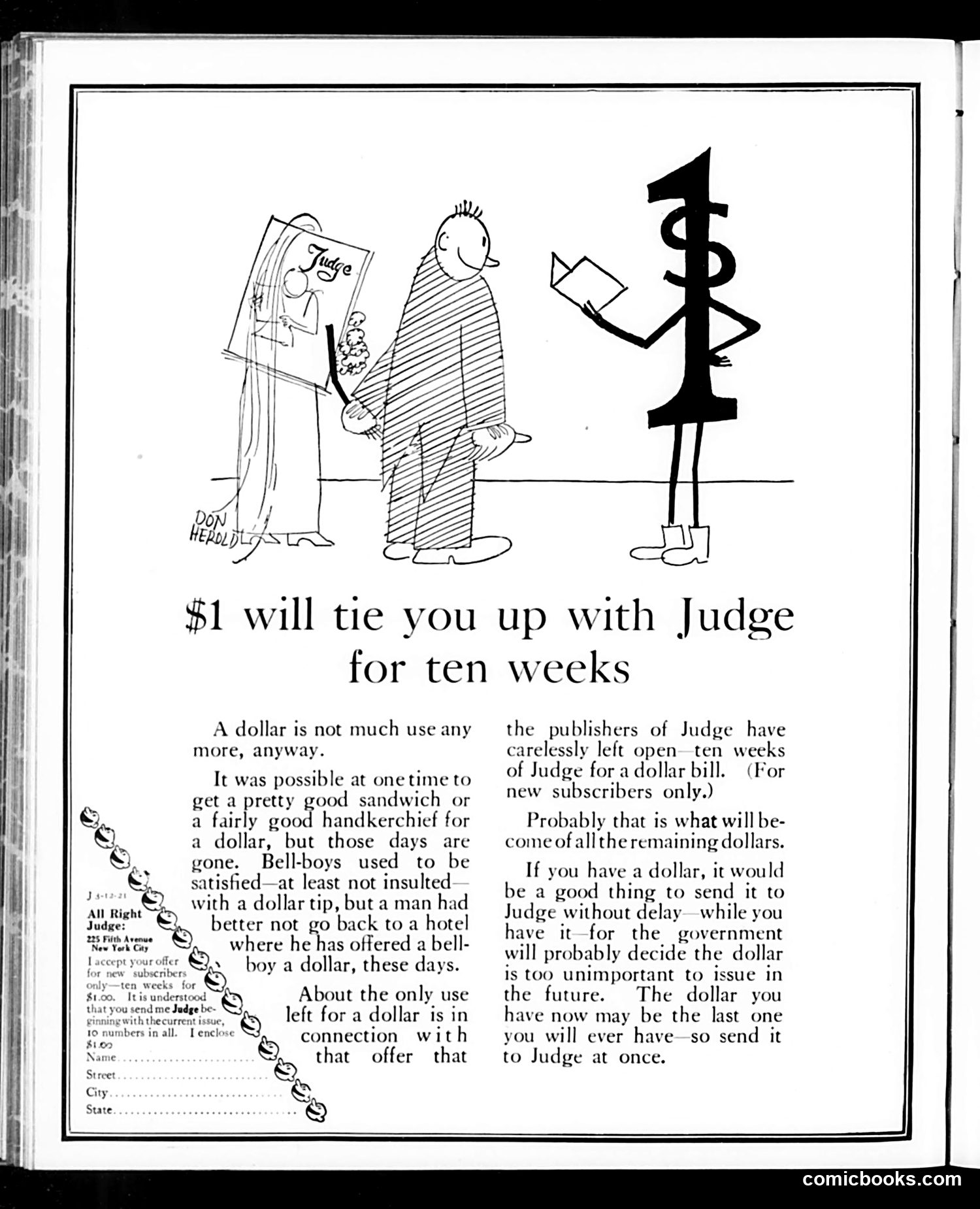
This page satirizes the declining value of the dollar during a period of inflation (likely post-WWI era, based on the style). The cartoon depicts three figures: a judge in robes, a mummy-like wrapped figure, and a personified dollar sign character holding a document. The central joke: "A dollar is not much use any more, anyway." The text laments that dollars once bought tangible goods (sandwiches, handkerchiefs) but now purchase almost nothing. The satirical proposal suggests sending your last dollar to Judge magazine as a subscription—implying even that investment is futile given currency worthlessness. The "mummy" figure likely represents the dying American dollar. The advertisement simultaneously mocks economic conditions while capitalizing on readers' despair through a humorous magazine offer.
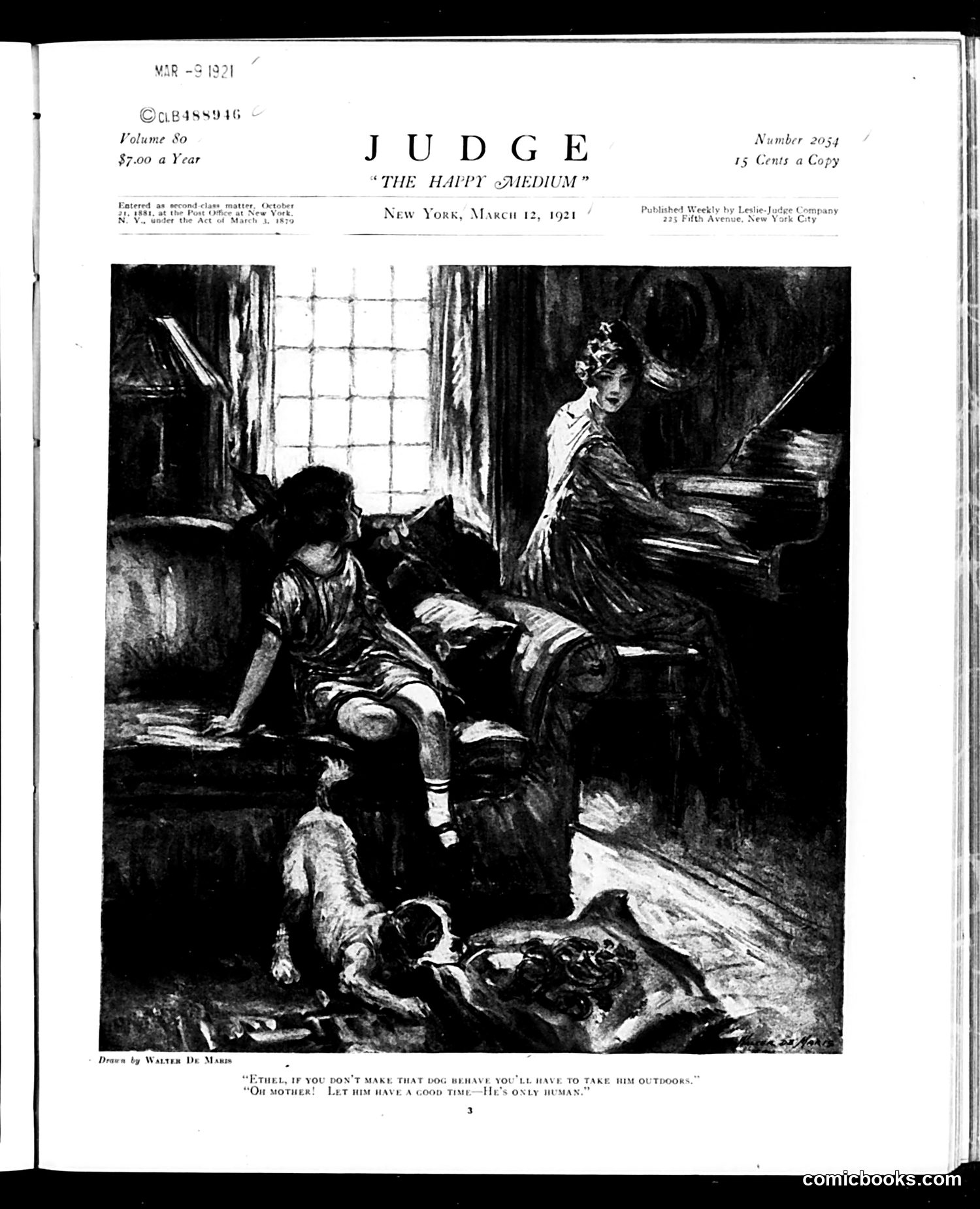
This illustration by Warwick De Marne depicts a domestic scene satirizing parenting attitudes toward pets. The caption reads: "Ethel, if you don't make that dog behave, you'll have to take him outdoors." The mother responds: "Oh mother! Let him have a good time—He's only human." The satire critiques excessive parental indulgence—specifically, the humor lies in treating a misbehaving dog as though it deserves the same freedoms and leniency as a child. The grandmother's demand for discipline contrasts with the mother's permissive, modern approach. This likely reflects broader 1920s social anxieties about changing parenting styles and generational conflicts over whether children (and pets) were being spoiled by new, more relaxed child-rearing philosophies.
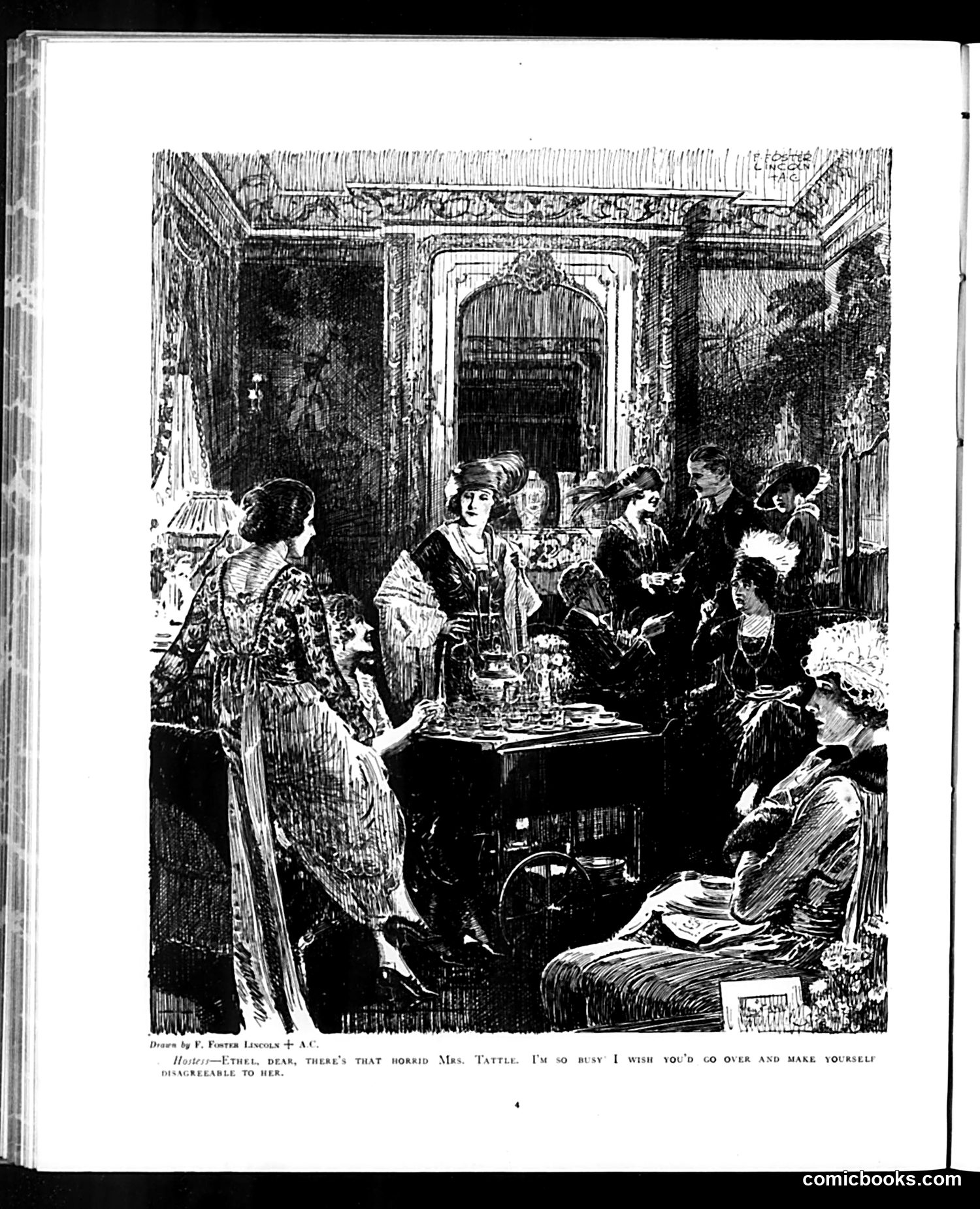
This is a satirical illustration by F. Forrest Lincoln depicting an upper-class social gathering. The caption reads: "Host—Ethel, dear, there's that horrid Mrs. Tattletale. I'm so busy I wish you'd go over and make yourself disagreeable to her." The satire mocks elite social hypocrisy and etiquette. Rather than warmly greeting an unwanted guest, the host asks his wife to deliberately discourage her presence by being rude—thus avoiding the obligation to entertain her while maintaining plausible deniability. The joke targets the artificiality of high society: beneath refined appearances and social conventions lie petty schemes and calculated rudeness. The elaborate interior setting and fashionable dress emphasize the gap between these characters' pretensions and their actual behavior.
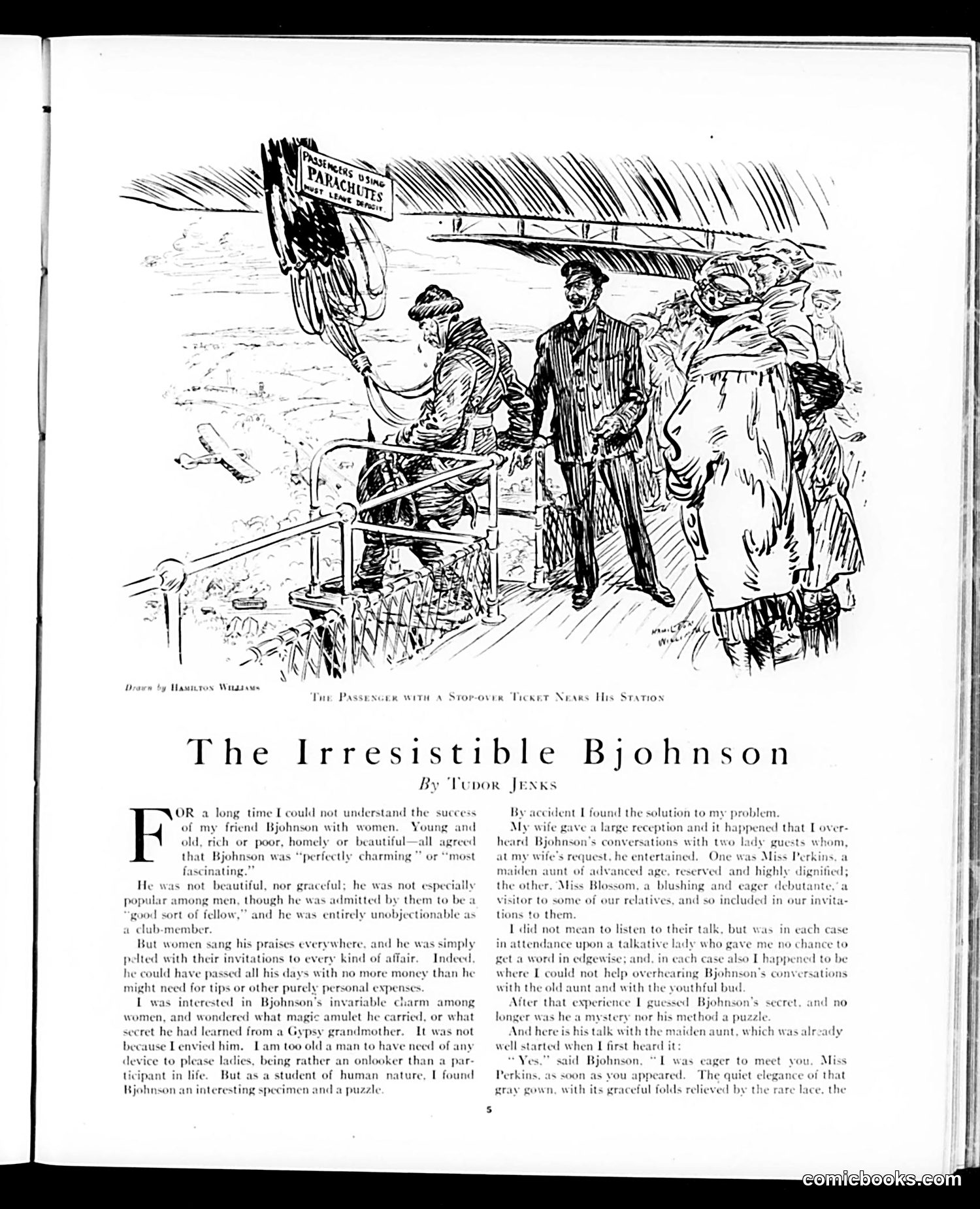
The illustration shows a man in formal attire (center) at what appears to be a railway platform, surrounded by admiring women and onlookers. The caption references "The Passenger with a Stop-over Ticket Nears His Station." The accompanying short story by Tudor Jenks describes a mysterious man named Bjohnson whose charm makes him irresistible to women. The narrator is puzzled by Bjohnson's appeal—he's neither exceptionally handsome nor wealthy, yet women consistently flock to him and seek his company. The satire appears to mock the inexplicable nature of masculine charm and social magnetism among the wealthy or well-connected, suggesting that some men possess an indefinable quality that transcends conventional attractiveness. The railway setting implies Bjohnson is a traveling gentleman whose charisma follows him everywhere.
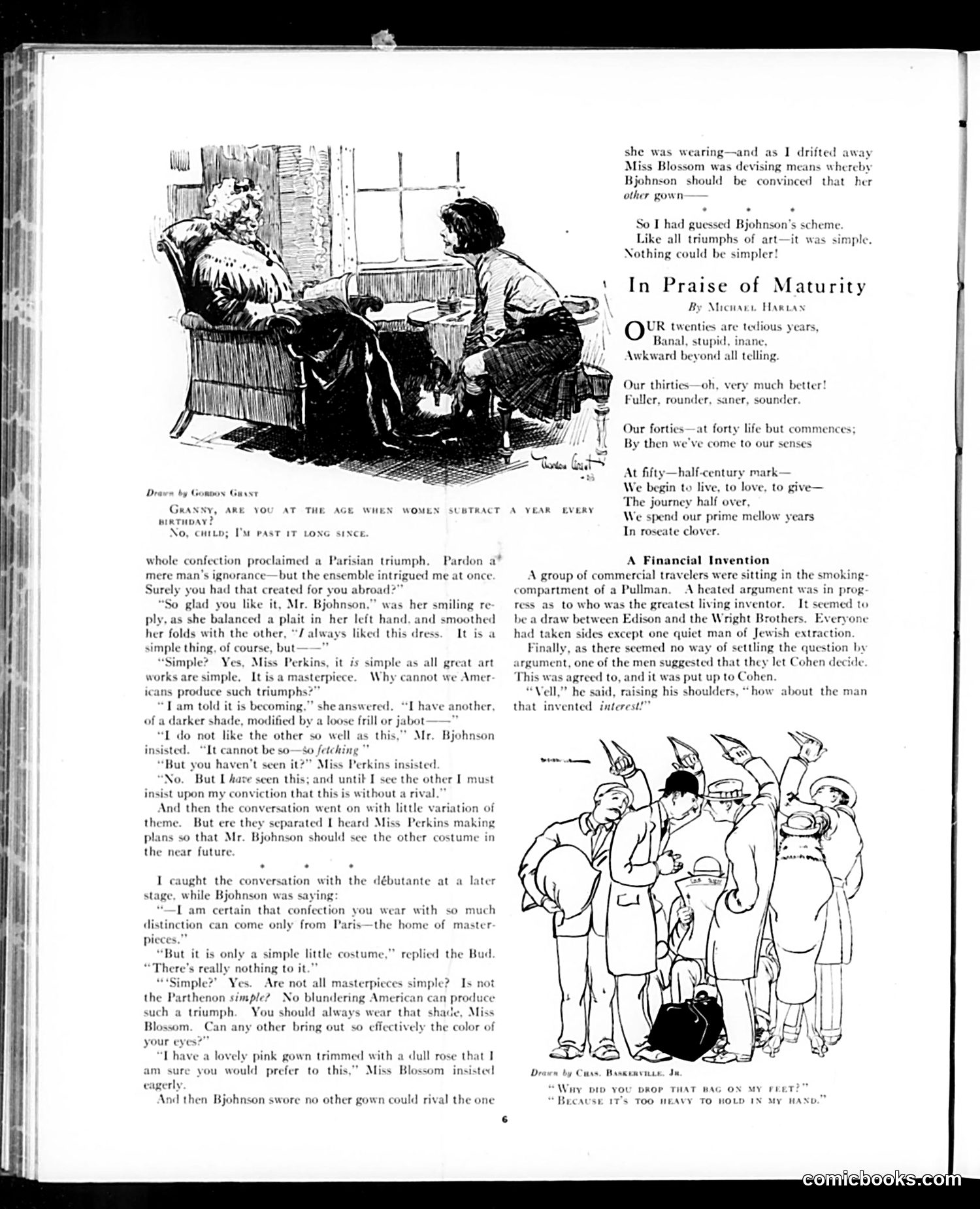
The page contains two distinct elements: **Left side:** A narrative story about costume design featuring characters named Miss Blossom, Mr. Bjohnson, and Miss Perkins debating women's fashion. The story satirizes artistic pretension—Miss Perkins insists a simple gown is a "masterpiece," while others dispute whether it rivals Paris fashions. The humor targets both fashion snobbery and artistic gatekeeping. **Right side:** A poem titled "In Praise of Maturity" by Michael Harlan celebrates aging over youth, suggesting one's thirties, forties, and fifties are superior to one's twenties. Below is "A Financial Invention"—a brief anecdote about commercial travelers debating Edison versus the Wright Brothers' inventions, with a humorous punchline about "interest." The bottom cartoon (by Chas. Bartholomew Jr.) shows soldiers discussing a heavy artillery shell, with the caption about it being "too heavy to hold in my hand."
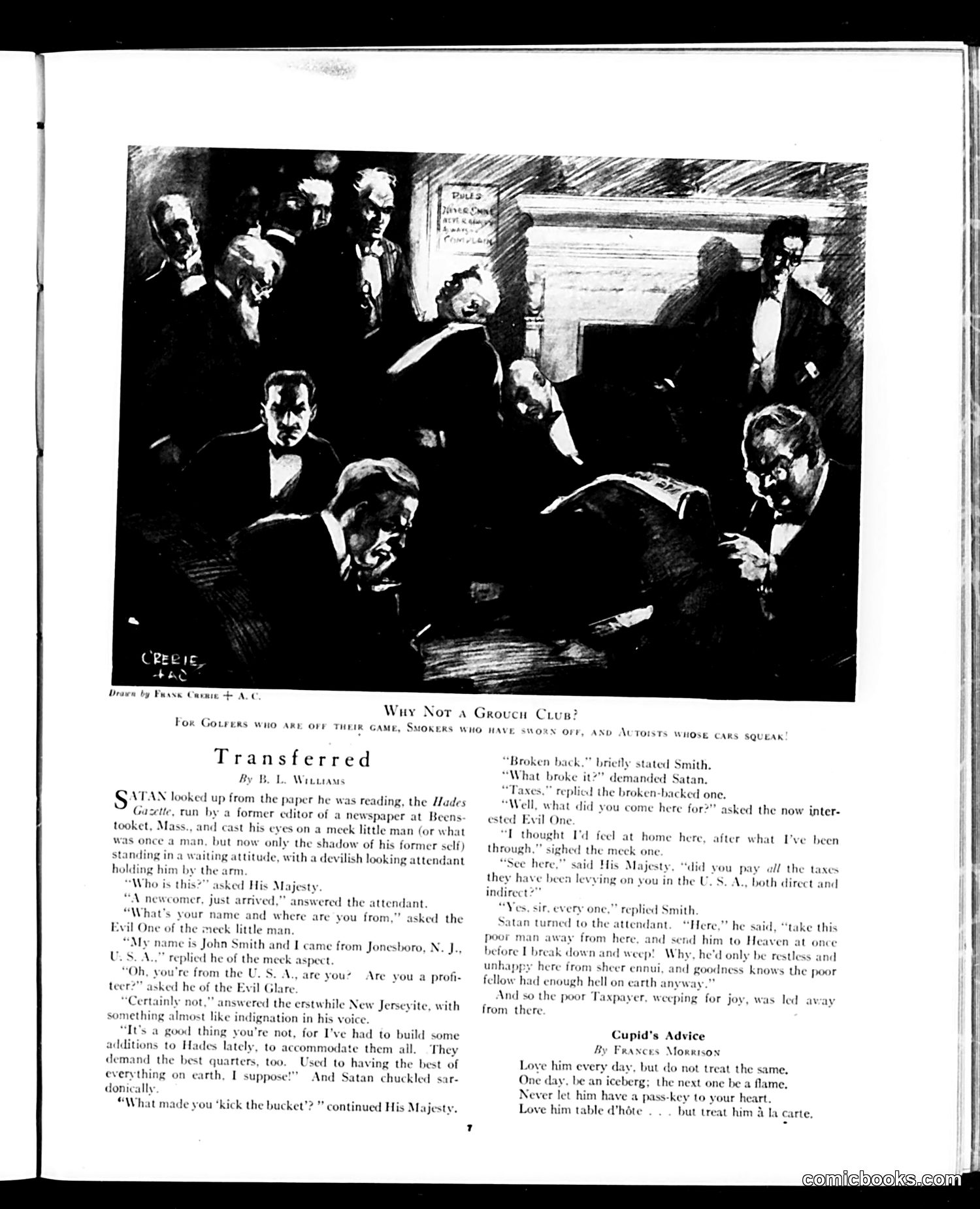
This 1920s satirical cartoon critiques American taxation and bureaucratic burden through a Hell-based allegory. The main cartoon depicts Satan rejecting a newly arrived taxpayer (John Smith from New Jersey) because the man has already suffered so much from U.S. taxes—both direct and indirect—that Hell would be redundant punishment. The joke: taxation is presented as worse than damnation itself. Satan argues the taxpayer deserves Heaven as relief, not further torment. This reflects post-WWI American frustration with rising income taxes and expanding government revenue collection. The framing headline ("Why Not a Grouch Club?") suggests forming clubs for those ruined by taxes, lost sports games, and broken cars—everyday American grievances. The accompanying "Cupid's Advice" column is unrelated relationship humor filler.
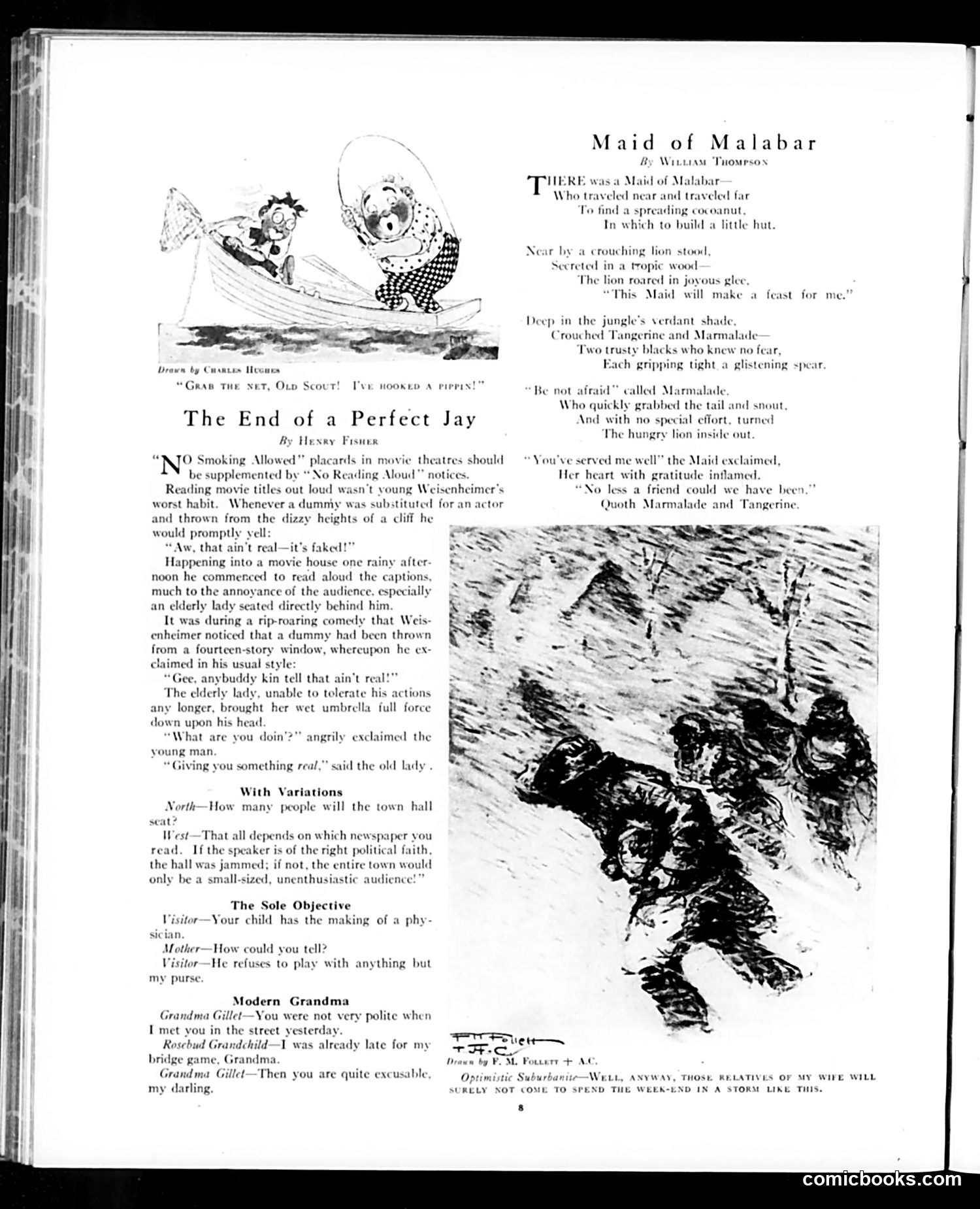
This page contains several short humor pieces typical of Judge magazine's satirical style: **"The End of a Perfect Jay"** mocks movie theater etiquette—specifically an annoying patron who reads captions aloud during films. The joke culminates when an elderly woman hits him with her umbrella, giving him something "real" after he repeatedly calls staged stunts "fake." **"Maid of Malabar"** is an illustrated poem about colonial-era adventure, featuring two Black servants named Tangerine and Marmalade who help a maid escape a lion. The racial characterization and naming reflect period attitudes typical of early 20th-century American humor magazines. **Other brief items** mock modern social behavior: a politician's claim about crowd size depending on newspaper bias, a child interested only in stealing visitors' purses, and a grandmother accepting rudeness if excused by bridge game attendance. These pieces satirize contemporary middle-class anxieties, changing social manners, and generational conflicts—standard Judge fare targeting readers' recognition of relatable social situations.
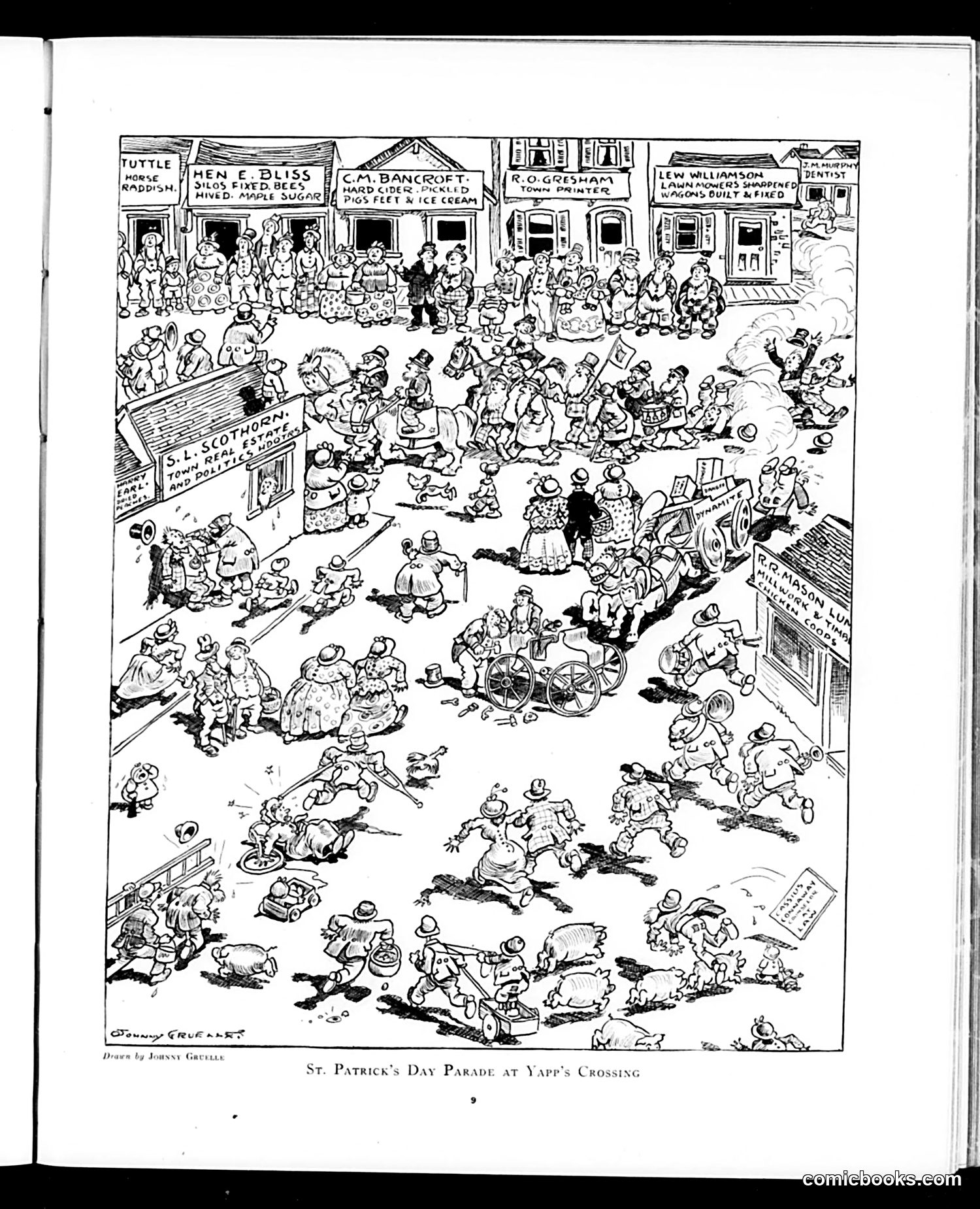
This is a crowded street scene depicting a St. Patrick's Day parade in what appears to be a small town or village. The cartoon shows numerous figures—many wearing hats—engaged in chaotic celebration. Along the storefronts visible at top are various business signs including a dentist, town printer, lawn mower shop, and food vendors (maple sugar, ice cream). The satire likely mocks Irish-American parade celebrations of the era, depicting them as rowdy, disorganized affairs. The numerous falling figures, people tumbling about, and general pandemonium suggest drunken revelry. This reflects period stereotypes about Irish immigrants and St. Patrick's Day festivities in America. The illustration is credited to Knosty Grisette and appears in *Judge*, a satirical magazine known for ethnic and cultural humor targeting various immigrant groups.
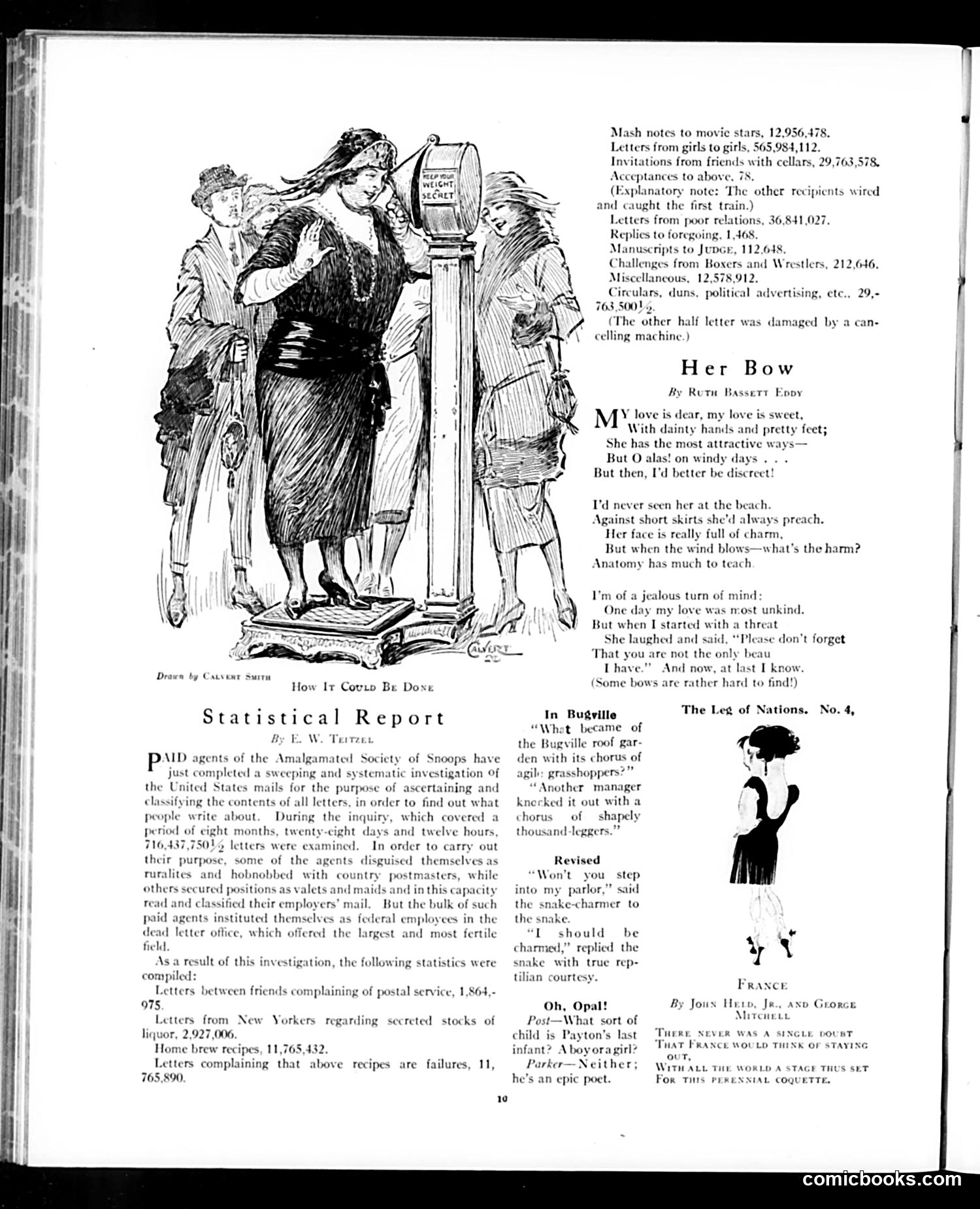
This cartoon mocks the idea of government surveillance of private mail. The illustration shows a woman on a scale being weighed by officials—a visual metaphor for invasive inspection. The accompanying "Statistical Report" parodies bureaucratic language to satirize mail-opening. It fictionalizes an "Amalgamated Society of Snoops" investigating over 716 million letters to classify citizens' private correspondence. The absurd statistics reveal what Americans actually write about: complaints about postal service, Prohibition-era liquor hiding, home brew recipes, and "mash notes" (love letters). The satire targets several concerns: government overreach, Prohibition enforcement (New Yorkers discussing "secreted stocks"), and the violation of privacy. By presenting this in dry statistical language, Judge magazine highlights how ridiculous and intrusive such systematic mail surveillance would be—likely reflecting contemporary anxieties about government power during the Prohibition era.
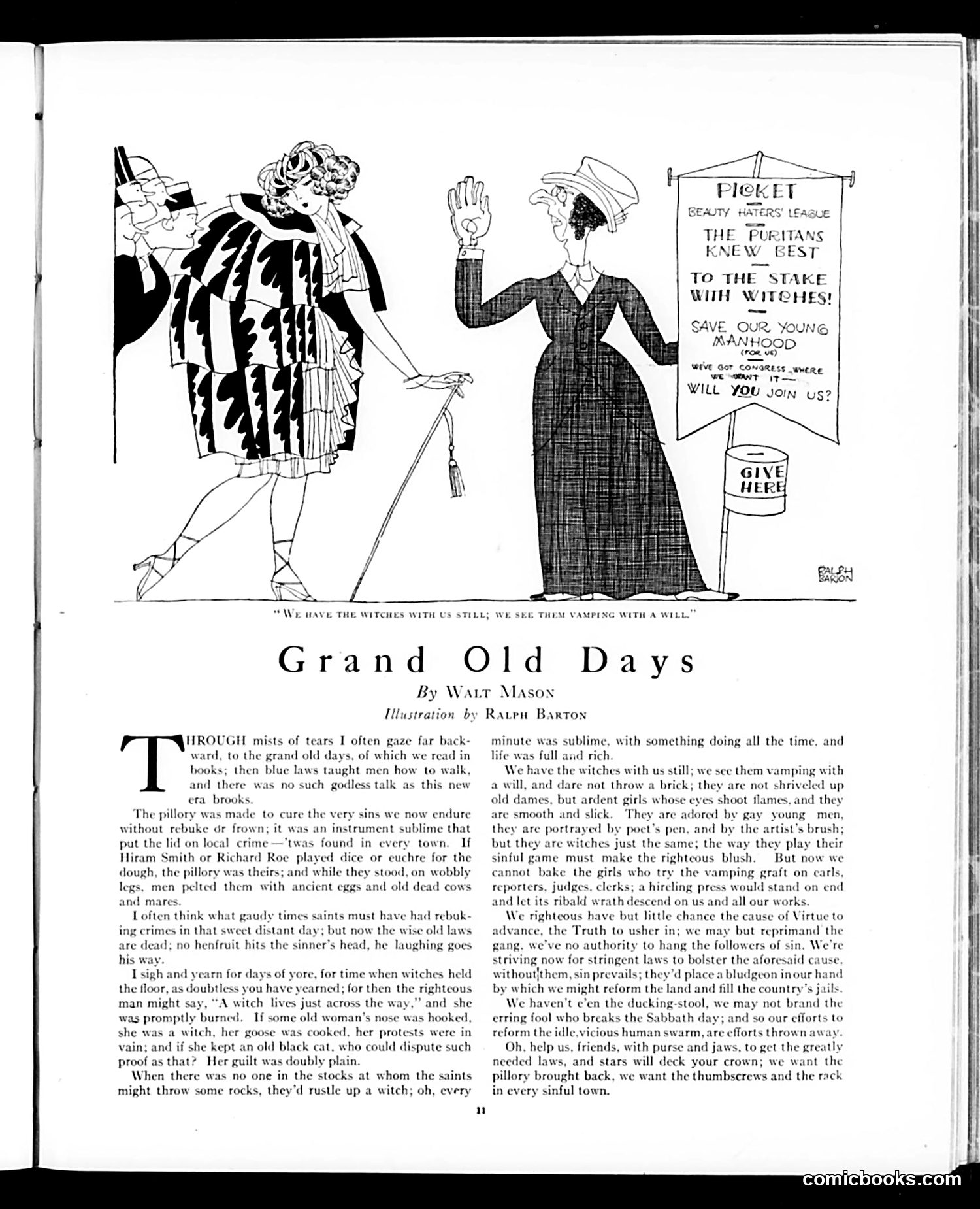
This is satirical commentary on conservative efforts to regulate young women's behavior and sexuality, likely from the 1920s Jazz Age era. The illustration shows "witches" (modern young women) being called before a "Beauty Haters League" tribunal that invokes Puritan imagery—referencing Salem witch trials and colonial-era moral enforcement. The propaganda poster demands "SAVE OUR YOUNG MANHOOD" from these supposed threats. Walt Mason's accompanying text mocks nostalgic conservatives who romanticize harsh historical punishments (pillories, witch-burnings, ducking stools) as solutions to contemporary "sin." The satire is that these reformers now target "vamping" young women with bobbed hair and makeup instead of actual witches—yet lack legal power to enforce their moral codes. The joke: fundamentalist crusaders mourned lost tools of social control while modern women evaded traditional restrictions. Mason presents their frustration as absurd and outdated, defending women's freedom against authoritarian moralism.
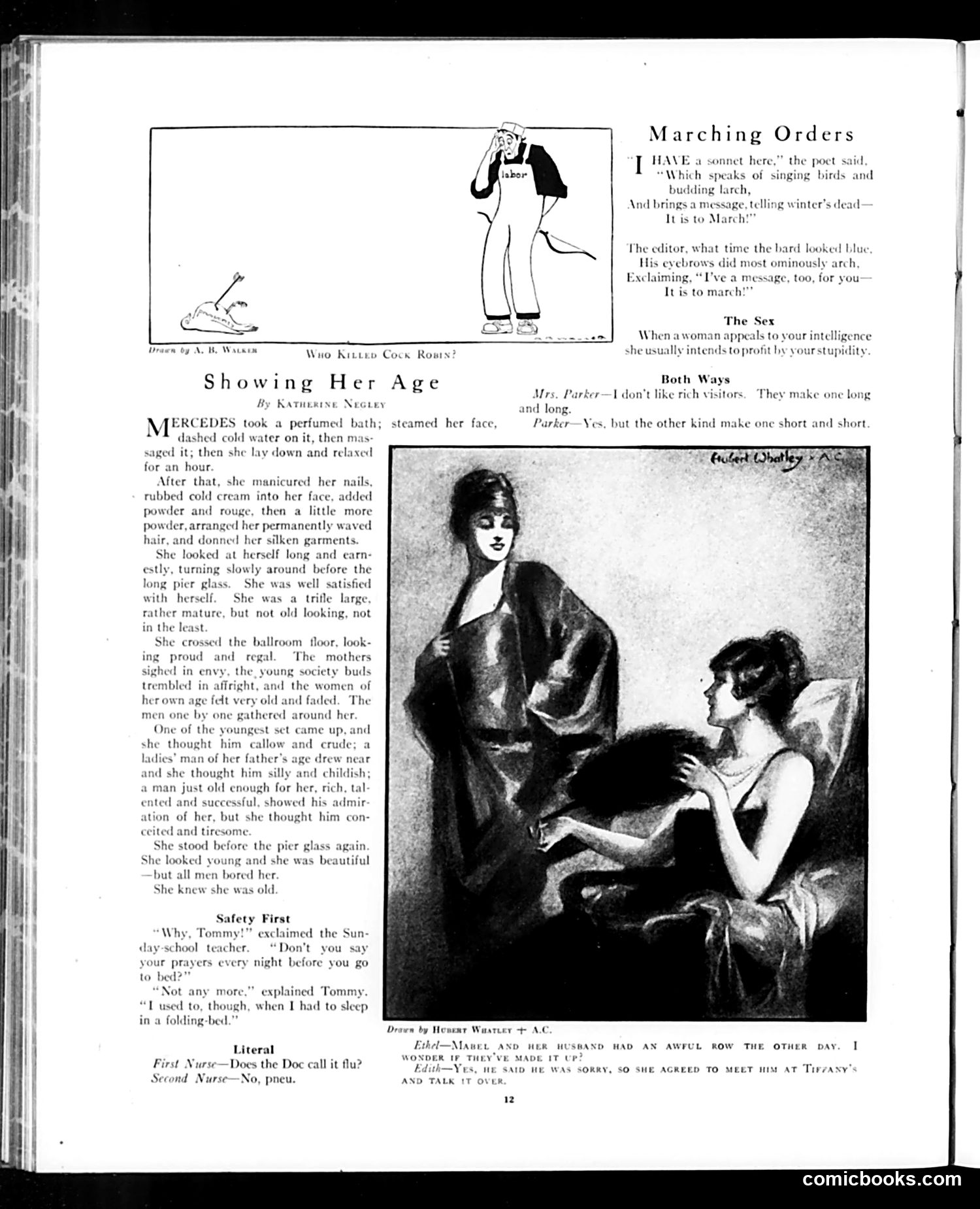
This page contains several short satirical pieces typical of Judge magazine's humor: **"Marching Orders"** is a joke about a poet pitching spring verses to an editor, who dismisses him by saying his own "message" is "to march"—likely a WWI reference urging military enlistment rather than artistic pursuits. **"Showing Her Age"** satirizes a middle-aged woman (Mercedes) who spends hours beautifying herself, then stands before a mirror convinced she looks young and beautiful—despite actually being old. The irony is that she deceives herself while men her age actually gather around her, yet she judges them harshly. It's commentary on vanity and self-delusion. The smaller jokes mock predictable social behaviors: women's appeals to intelligence, contrasting effects of wealthy versus poor visitors, a child avoiding prayers by sleeping in a folding bed, and a couple reconciling their marital "row" at Tiffany's. The illustration shows an elegantly dressed woman in period attire—likely from the 1920s based on style.
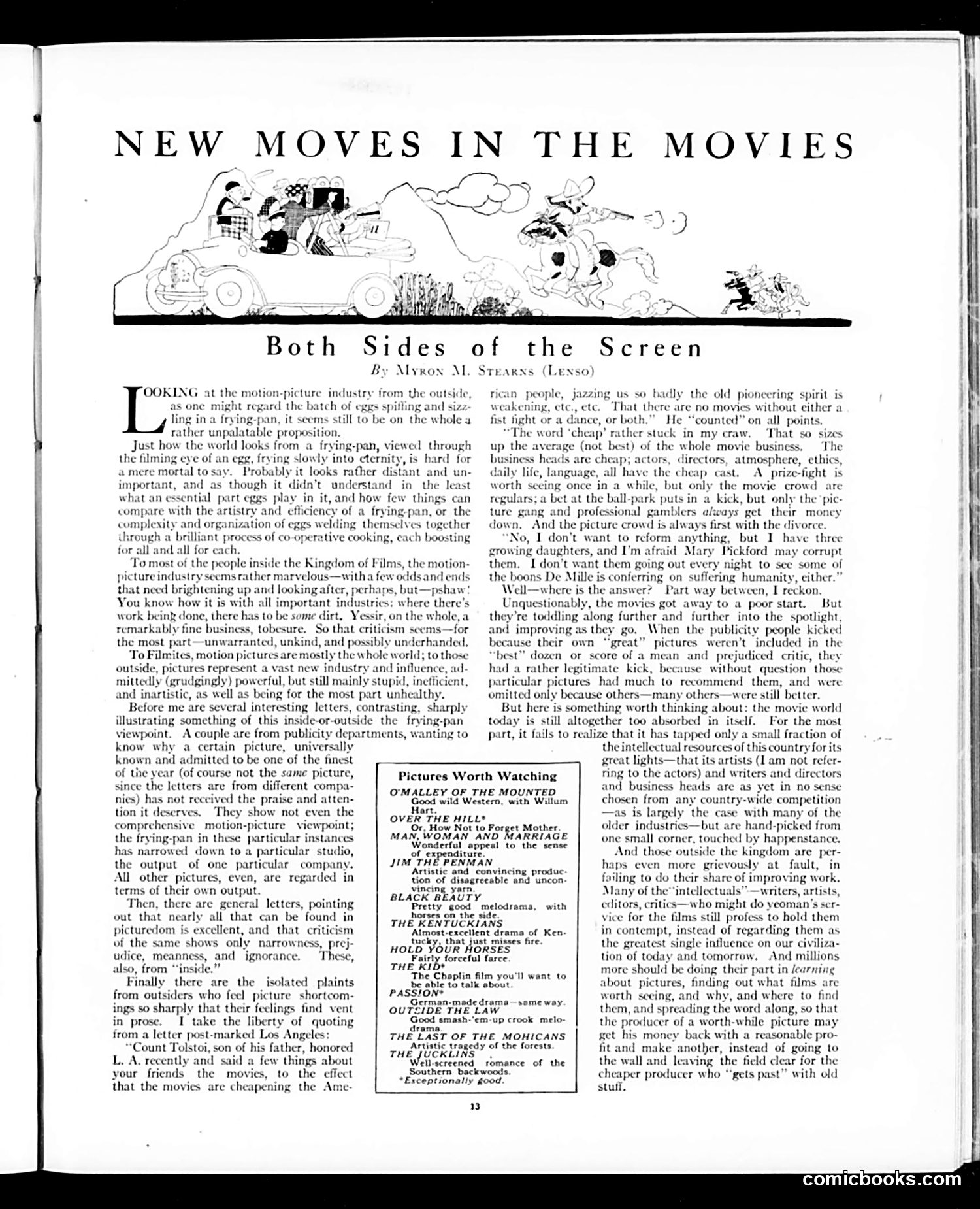
This article discusses the film industry's self-perception versus public criticism circa the 1920s. The author uses a frying-pan metaphor to contrast "insiders" (filmmakers who see movies as essential art) with "outsiders" (the public who view them as largely stupid and morally questionable). The piece addresses letters from film publicity departments defending movies against critics, versus complaints from concerned citizens. One letter-writer worried about movies' influence on his daughters, citing their focus on "fist fights or dances" and their association with divorce culture and gambling. The author argues both sides have merit: films started poorly but are improving, yet the industry remains self-absorbed and fails to recognize its potential cultural responsibility. The sidebar lists "Pictures Worth Watching"—films the author deems artistically worthy—suggesting quality cinema exists but remains rare. This reflects 1920s concerns about cinema's moral influence on youth and society.
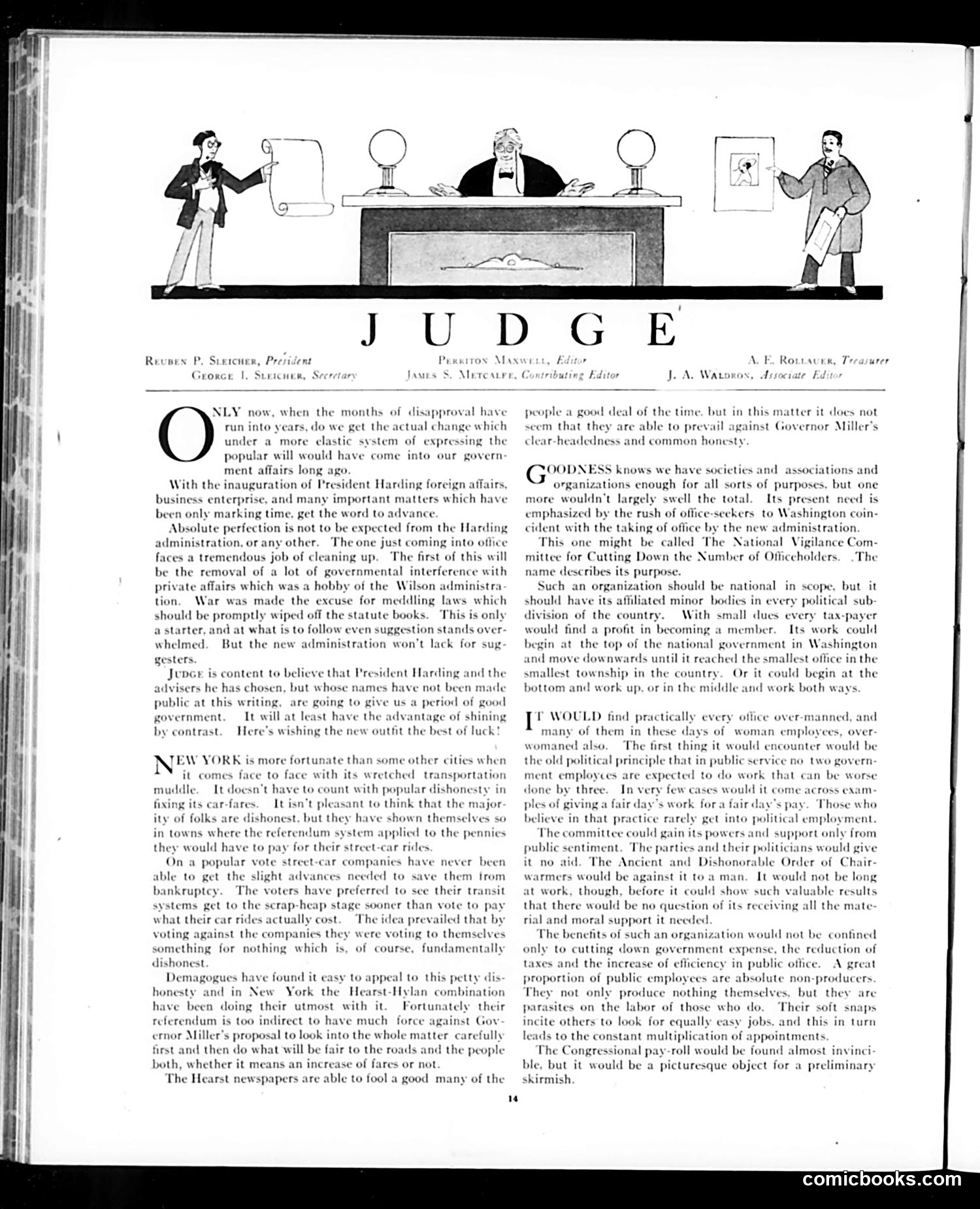
This page features editorial commentary celebrating President Harding's recent inauguration (1921), contrasting his administration favorably with Wilson's. The cartoon header shows a judge presiding over proceedings—a visual pun on the magazine's name. The text criticizes the Wilson administration's wartime government interference in private affairs, suggesting Harding will restore business freedom. It defends Governor Miller's transit proposal against attacks by the Hearst-Hylan newspaper combination, praising Miller's "clear-headedness and common honesty" against what Judge views as populist demagoguery appealing to voters' "petty dishonesty." The editorial proposes creating a "National Vigilance Committee for Cutting Down the Number of Officeholders"—satirizing the flood of office-seekers descending on Washington with the new administration, while advocating for government downsizing. The piece reflects early 1920s conservative, pro-business sentiment skeptical of both Wilson-era progressivism and urban political machines.
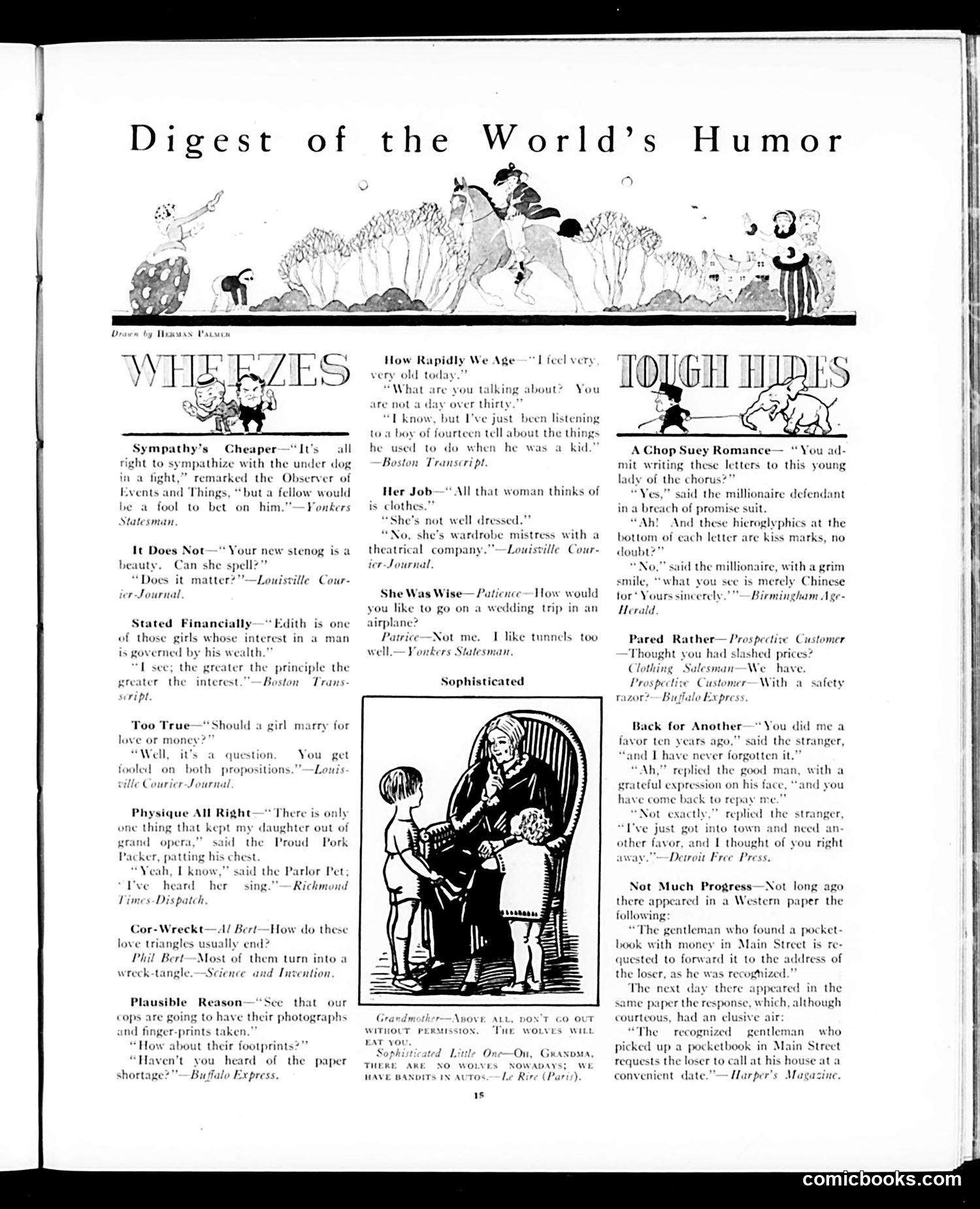
This page from *Judge* magazine collects brief humorous anecdotes and jokes organized around social observations. Key content includes: **The central cartoon** depicts a grandmother warning her granddaughter about "wolves" (a period term for predatory men), while the girl replies that modern dangers are "bandits in autos"—a topical reference to automobile-related crime and social change of the era. **The jokes satirize**: - Gender and economics (women's financial motivations in relationships) - Workplace dynamics (stenographers, wardrobe mistresses) - Generational differences (youth seeming prematurely aged by modern life) - Urban crime (the pocketbook exchange jokes reflect anxiety about theft and dishonesty) - Aviation as a new technology (airplane wedding trips) The humor relies on wordplay, reversals of expectations, and observations about contemporary anxieties—automobiles, changing social mores, and criminal activity—rather than political satire. It's fundamentally middle-class social commentary dressed as light entertainment.
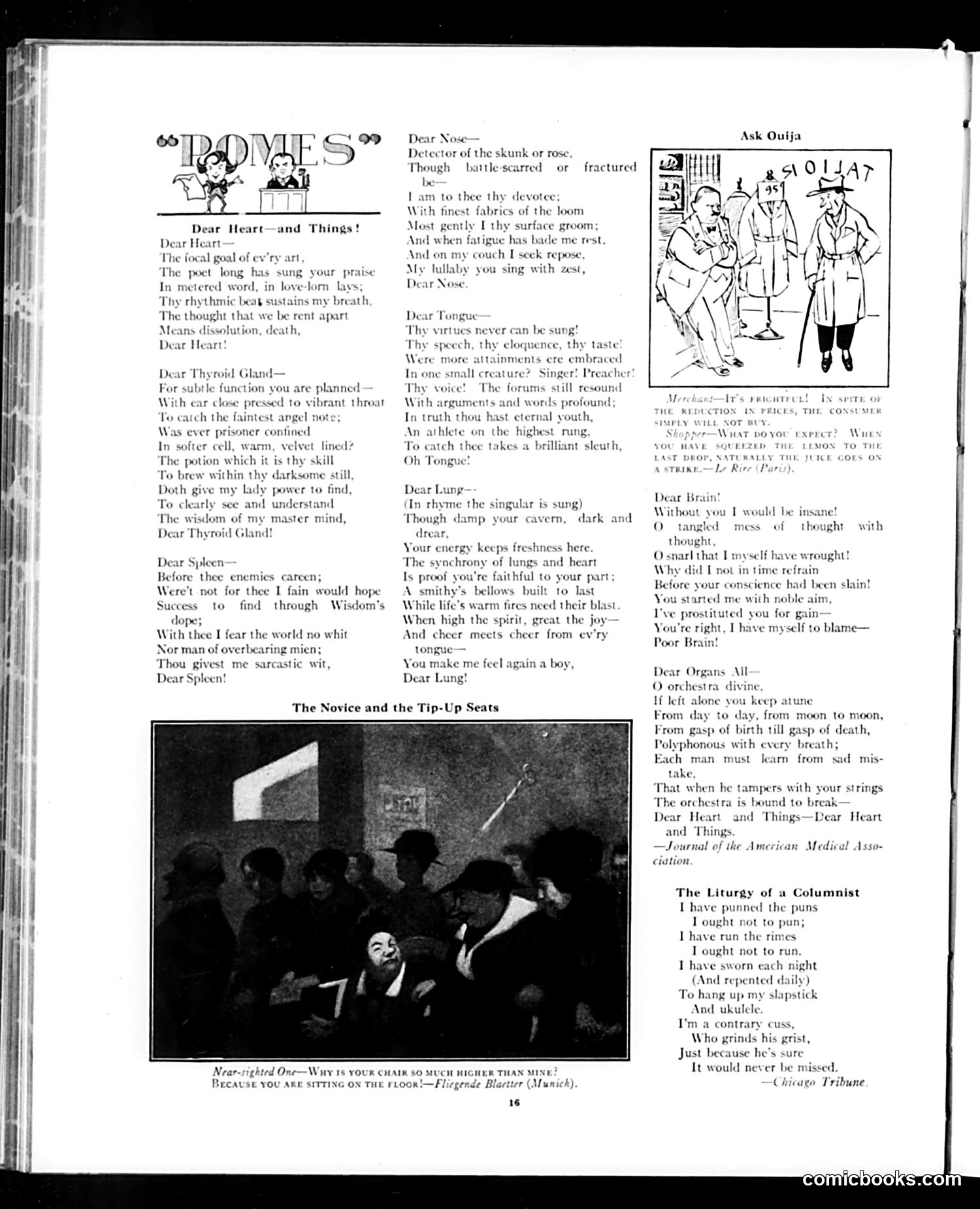
This Judge magazine page combines whimsical poetry with social satire. The left side features "Dear Heart—and Things," a humorous poem addressing bodily organs (heart, thyroid gland, spleen, nose, tongue, lung, brain) as if writing fan letters. It's lighthearted medical anthropomorphization popular in early 20th-century humor. The cartoon "The Novice and the Tip-Up Seats" (bottom) shows a practical joke: a nearsighted person sits on the floor unaware, while others occupy elevated seats. The humor relies on physical comedy and the victim's obliviousness. "Ask Ouija" (right) satirizes Depression-era consumer behavior: when prices drop, shoppers still won't buy, suggesting economic pessimism overshadows bargains. The final piece mocks columnist clichés—puns, forced rhymes, slapstick humor—admitting these tired devices persist because their predictability ensures continued use. The overall tone reflects 1920s-30s mass-market humor: gentle, domestic, and self-aware about its own formulaic nature.
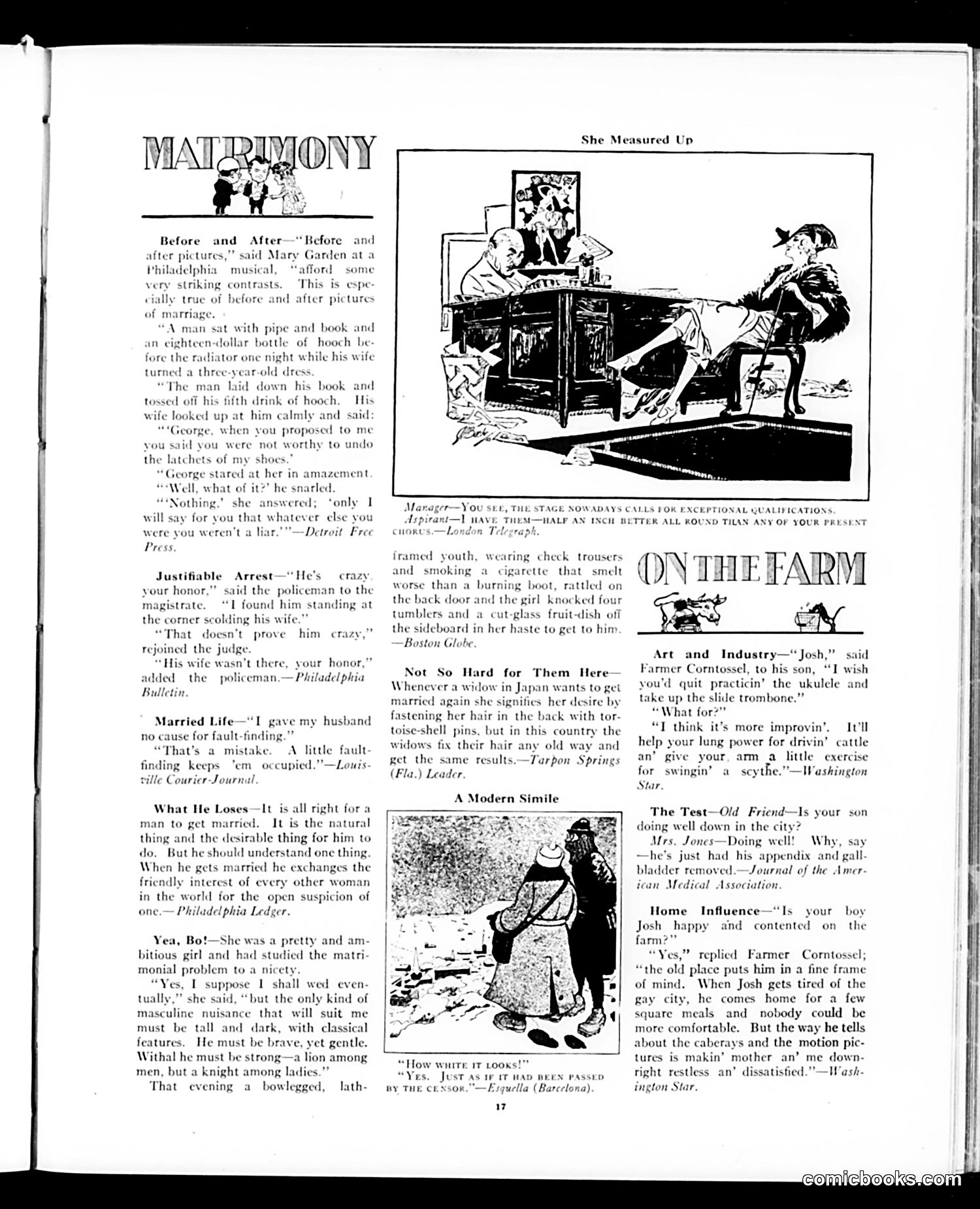
This page from *Judge* contains multiple short humorous anecdotes satirizing early 20th-century American marriage and rural life. The "Before and After" section mocks how marriage transforms couples—a husband initially romantic becomes slovenly and disrespectful. The "Justifiable Arrest" joke relies on the period's assumption that wives nagging husbands was so universal that a man scolding *his* wife unprompted must be insane. "What He Loses" cynically suggests marriage exchanges women's friendly attention for suspicion and jealousy. The "On the Farm" section presents rural wisdom through character "Farmer Corntossel," portraying farm life as simpler but vulnerable to urban influence. One joke plays on Japanese widow remarriage customs versus American informality. Throughout, the satire targets: marital discord, the loss of independence in marriage, tension between rural and urban values, and assumptions about gender roles. The humor assumes readers recognize these social anxieties as universal and comedic rather than serious critiques.
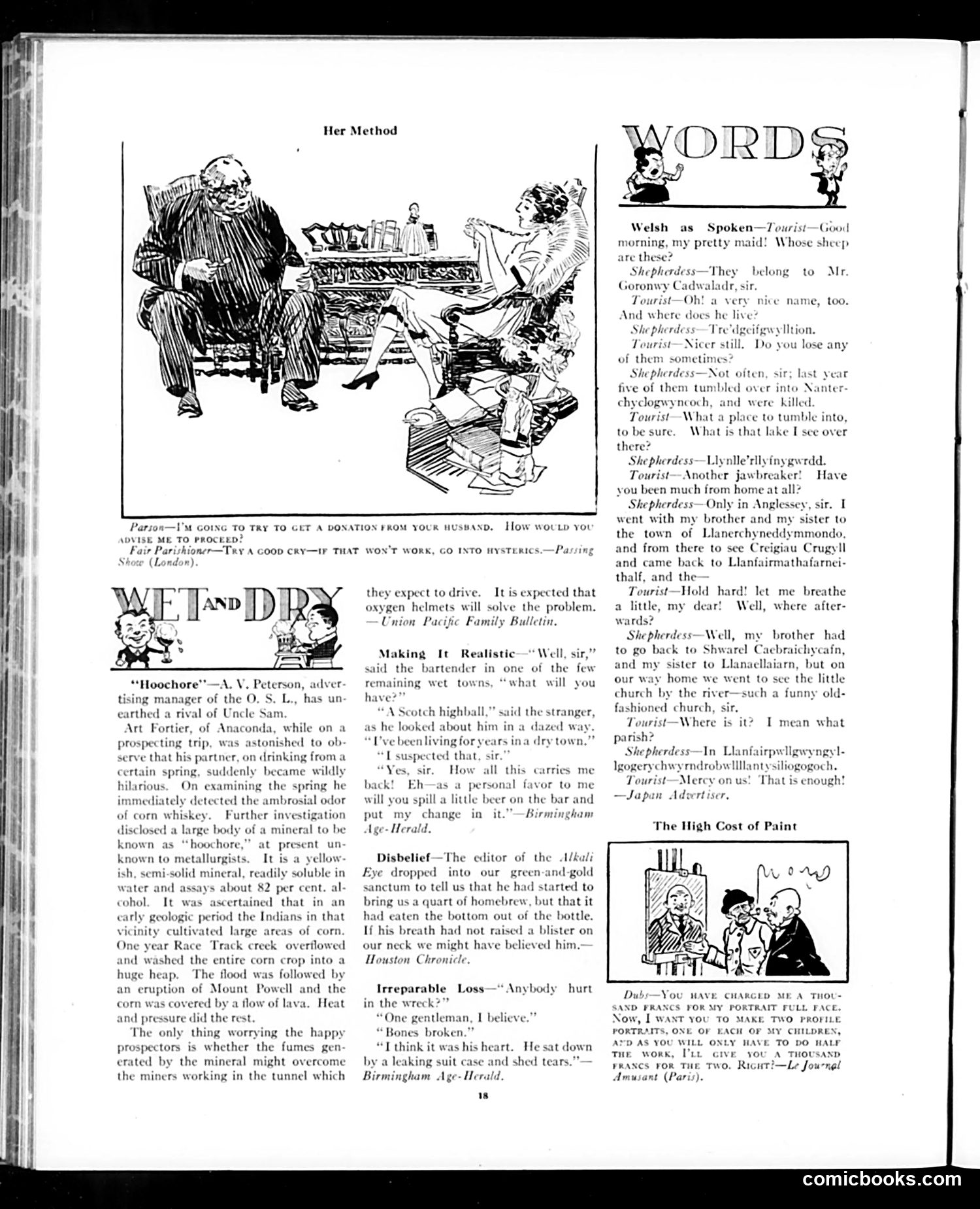
The main cartoon shows a church representative (identified by text as "Parton") approaching a wealthy woman for a donation. The joke relies on crude gender stereotyping: when asked how to solicit money from the woman's husband, she advises using "a good cry—if that won't work, go into hysterics." This satirizes both women as emotionally manipulative and the era's assumption that wealthy men would capitulate to female emotional displays. The surrounding "Wet and Dry" section includes period humor about Prohibition's effects—jokes about illicit whiskey ("hoochore"), a man desperate for beer in a "dry town," and homebrew so potent it corrodes containers. The Welsh dialogue satirizes the difficulty English speakers face with Welsh place names and language, presenting them as absurdly unpronounceable. These pieces reflect early 20th-century American attitudes: condescension toward women, Prohibition-era anxieties, and ethnic/regional mockery presented as lighthearted entertainment.
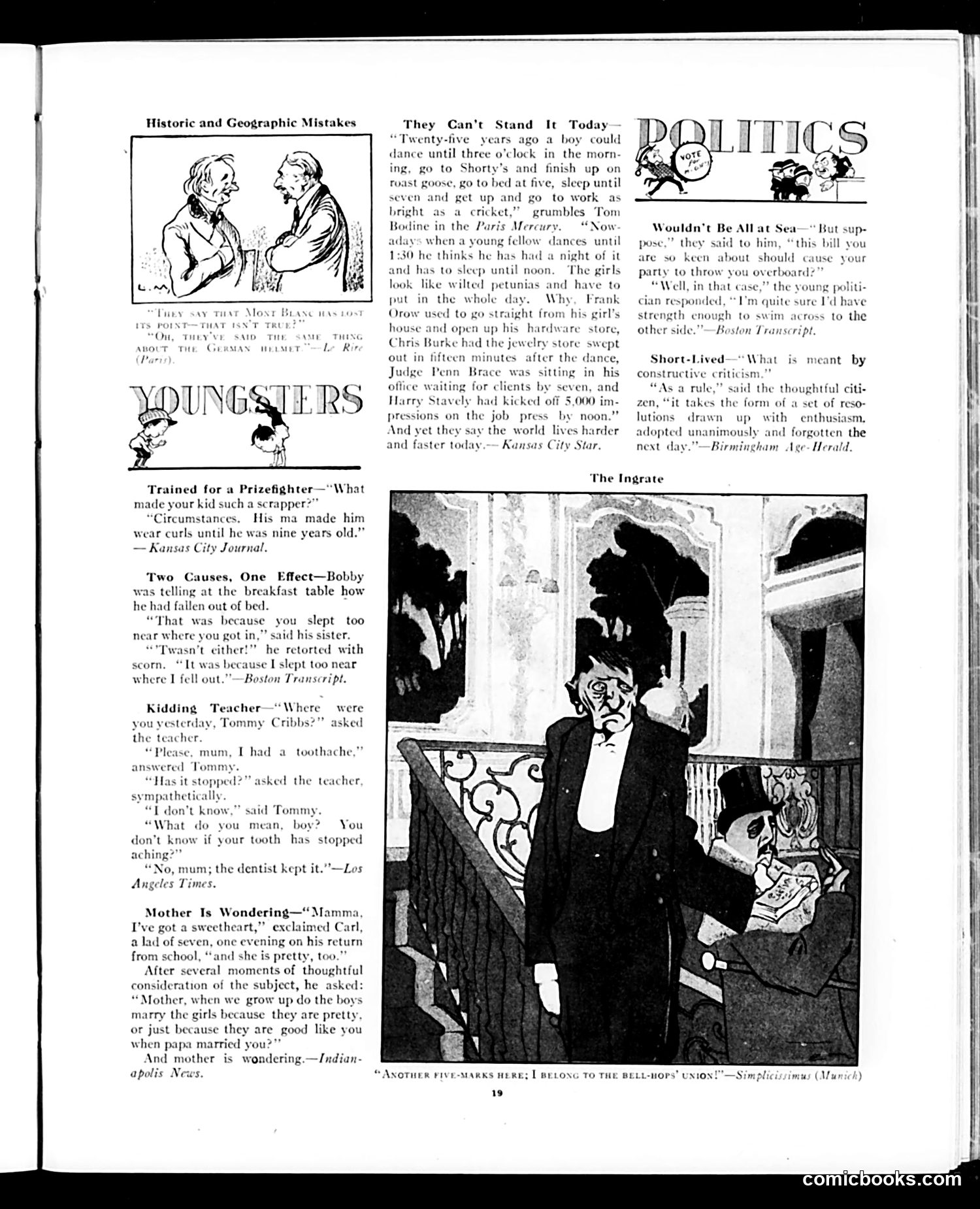
This page collects brief humorous anecdotes and a cartoon satirizing early 20th-century American and European life. **The anecdotes** mock generational decline and modern inconvenience: nostalgic complaints that young people today can't endure what their elders could (dancing all night, then working), with girls looking like "wilted petunias" from exhaustion. There's gentle humor about children's logic (a boy's reasoning about why fathers marry mothers) and teachers (a child's innocent confusion about whether his toothache "stopped"). **"The Ingrate" cartoon** (captioned from Munich) depicts a well-dressed older man appearing frustrated or indignant. The caption indicates he's complaining about a bell-hop demanding payment while claiming union membership—satirizing the emerging labor movement and service workers' newfound assertiveness about wages and unionization. The "ingrate" likely refers to the bell-hop's apparent ingratitude despite receiving payment. The page reflects anxieties about modernity: weakening youth, changing social hierarchies, and labor organizing challenging traditional employer-employee relationships.
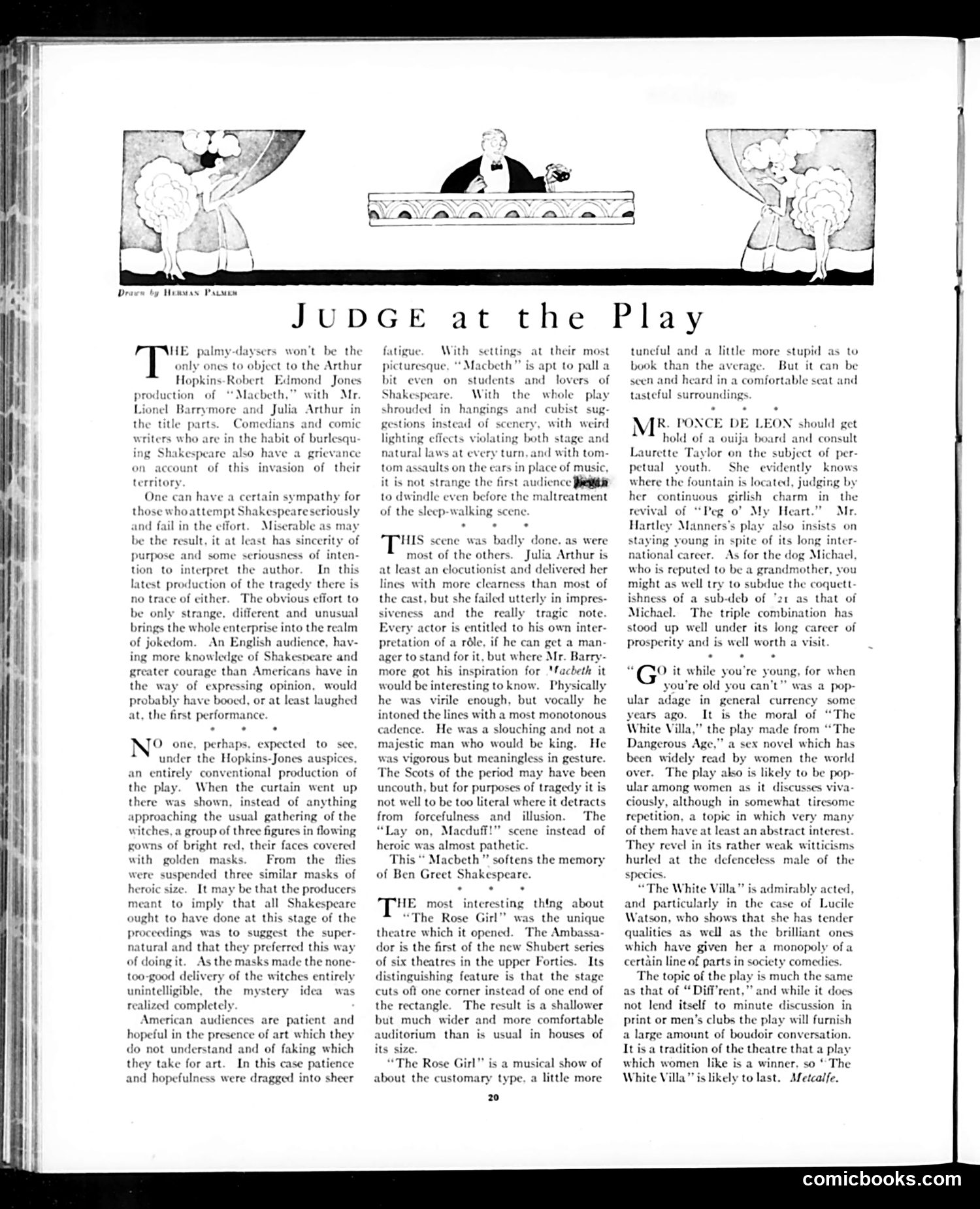
This page contains a theater review criticizing an Arthur Hopkins production of *Macbeth* starring Lionel Barrymore and Julia Arthur. The cartoon header depicts a judge presiding over the theatrical performance. The critic savagely attacks the production's modernist staging choices—particularly the three red-gowned witches with golden masks and suspended heroic-sized masks, which the reviewer finds pretentious and incomprehensible rather than atmospheric. The critic complains that avant-garde design choices (cubist suggestions, weird lighting, tom-tom sound effects) undermine Shakespeare rather than enhance it. The review is especially harsh on Barrymore's performance, calling his delivery monotonous and his physicality slouching and unmajestic for a king. Julia Arthur fares slightly better for clear elocution but lacks tragic impressiveness. The satire targets what the critic sees as fashionable pretension in "serious" theater—experimental staging masquerading as art that American audiences politely endure. The piece implies Hopkins-Jones deliberately chose bizarre unconventionality over conventional interpretation.
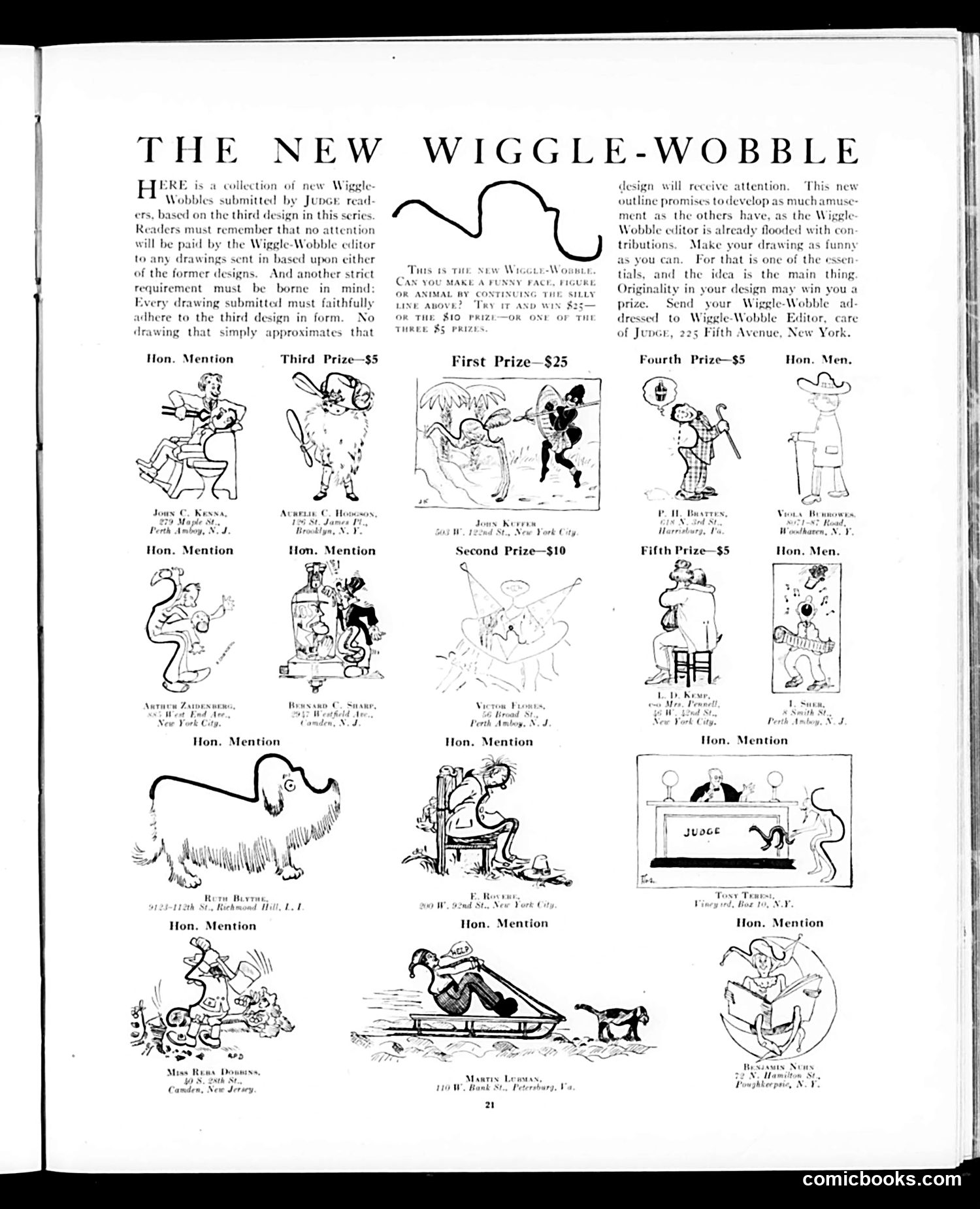
This page announces a drawing contest in *Judge* magazine for readers to submit humorous cartoon designs based on an established template—"the third design in this series." The contest offers cash prizes ($25 for first place, down to $5 for fourth) plus honorable mentions. The key constraint is strict adherence to a specific outline form; judges will ignore submissions that merely approximate rather than faithfully follow the template. The page displays winning and honorable-mention entries—simple line drawings of people, animals, and situations rendered in exaggerated, comic styles typical of early 20th-century humor magazines. The editorial note emphasizes that originality and humor within the rigid format are valued most. Readers are encouraged to submit their own "Wiggle-Wobbles" to the Judge offices in New York, suggesting this was a popular, ongoing reader-participation feature that generated considerable submissions.
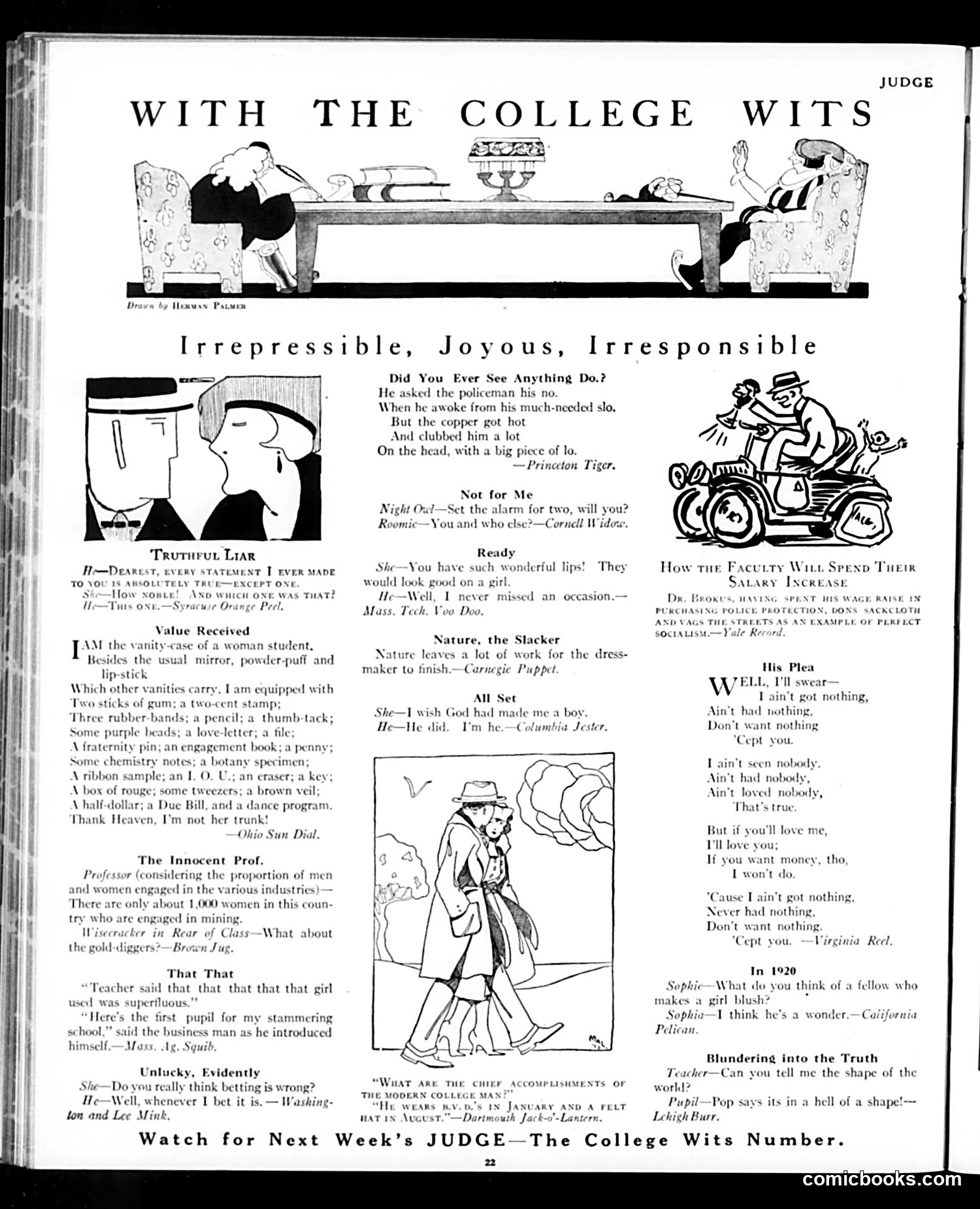
This page from Judge satirizes college life and student behavior through short humor pieces and cartoons. The content targets common college stereotypes: **Main Themes:** - **Student dishonesty** ("Truthful Liar"—a student claims every statement is true except one, creating logical paradox) - **Women students' vanity** ("Value Received"—mocking the excessive items a woman carries in her vanity case) - **Professorial naïveté** ("The Innocent Prof."—a professor discussing mining statistics while students make crude "gold-digger" jokes about women) - **Linguistic confusion** ("That That"—jokes about grammar and stammering) - **Dating behavior** ("Ready," "All Set"—flirtation and romantic pursuit) - **Faculty salary complaints** (implied criticism of professors) The cartoons include illustrations of students in cars and a figure in period clothing. The overall tone is lighthearted mockery of college culture, particularly student pretension, romantic entanglements, and academic absurdity. This appears designed as entertainment for readers familiar with college life.
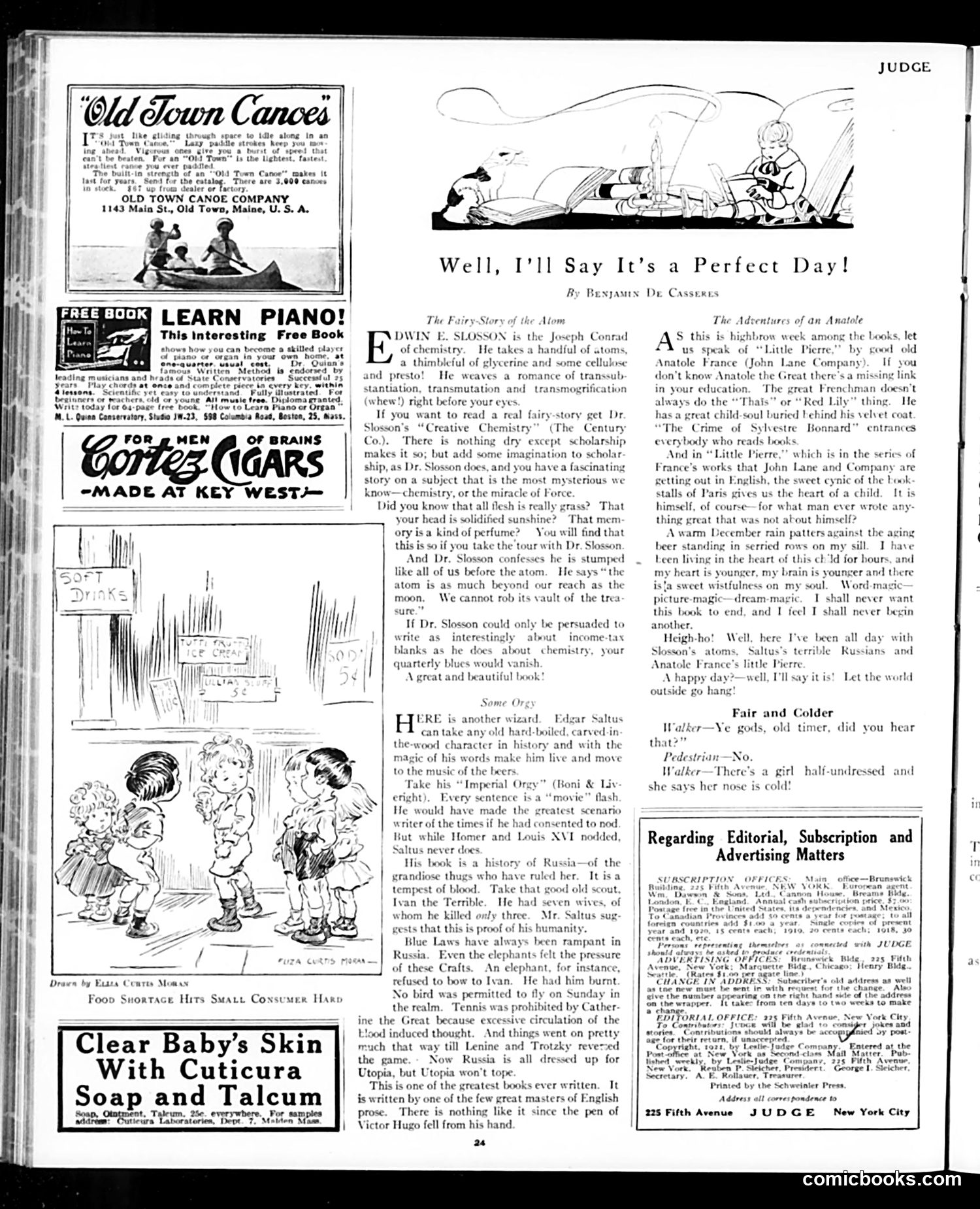
This page contains primarily **literary criticism and book reviews** rather than political cartoons. The main content is Benjamin De Casseres reviewing three books: 1. **Dr. Edwin E. Slosson's "Creative Chemistry"** — presented as making chemistry romantic and accessible through imaginative storytelling about atoms and molecular transformation. 2. **Edgar Saltus's "Imperial Orgy"** — a history of Russia's rulers described as prose artistry comparable to Victor Hugo, depicting autocratic excess and the Crafts (appearing to reference pre-revolutionary Russian brutality). 3. **Anatole France's "Little Pierre"** — praised as capturing childhood's innocent perspective through the lens of a "great Frenchman." The **cartoons are minor**: a small illustration about food shortages affecting consumers, and sketches promoting consumer products (pianos, cigars, baby soap). The page's **satire is gentle** — celebrating intellectual and literary merit for educated readers rather than attacking political figures or movements. This reflects *Judge* magazine's focus on sophisticated, urbane humor for middle-class audiences during the 1910s-1920s.
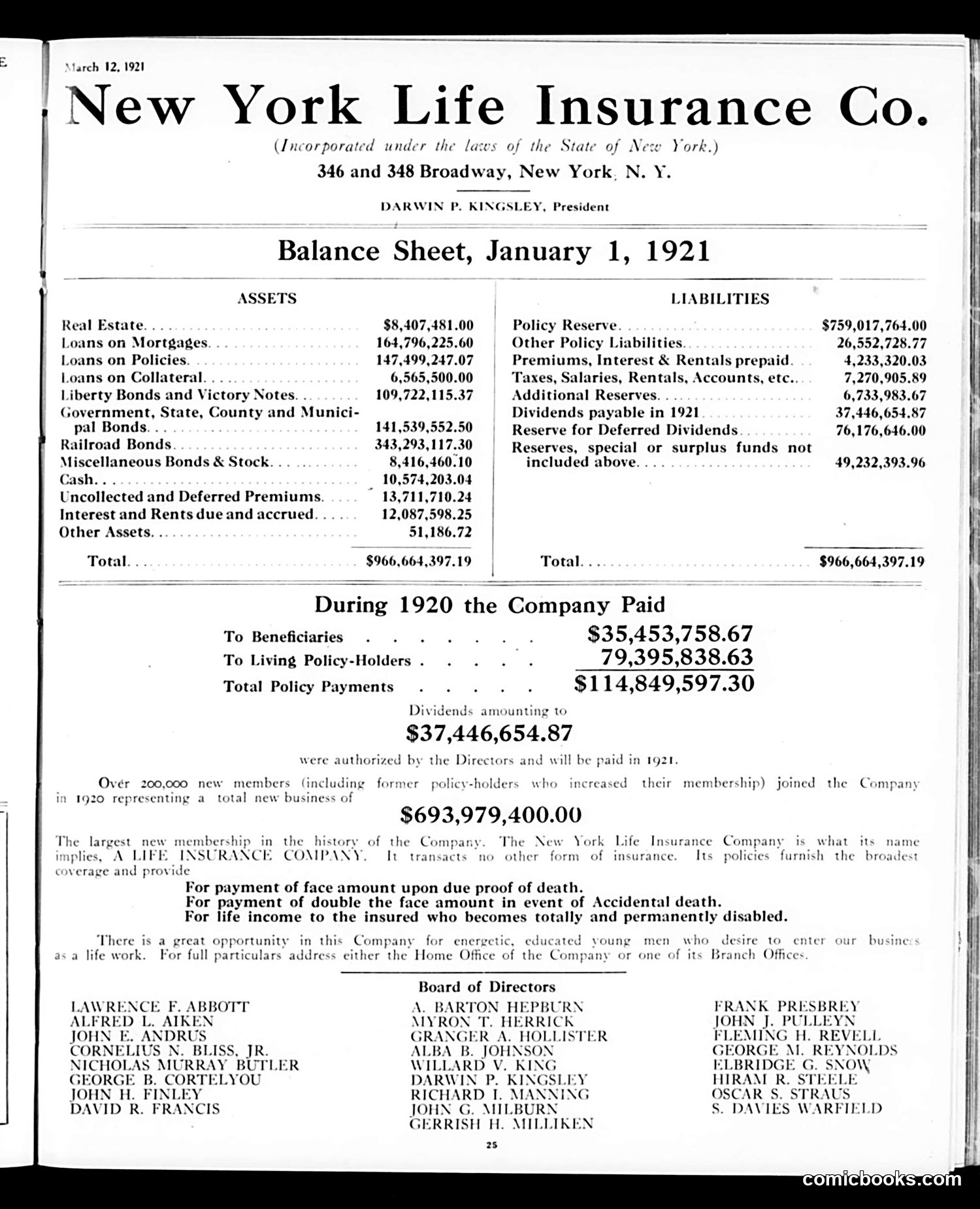
This page is **not a cartoon or satirical content** — it's a full-page advertisement/financial statement for New York Life Insurance Company, dated March 12, 1921. The document presents the company's balance sheet as of January 1, 1921, showing nearly $967 million in assets and liabilities. It highlights that during 1920 the company paid over $114 million in benefits and authorized $37 million in dividends. A key selling point is that over 200,000 new members joined in 1920, representing $694 million in new business — described as "the largest new membership in the history of the Company." The page concludes with a recruiting pitch for "energetic, educated young men" interested in insurance sales as a career, and lists the company's board of directors (prominent New York businessmen). As a Judge magazine advertisement, this represents corporate promotion rather than satire — common in early 20th-century magazines that supplemented editorial content with paid advertising.
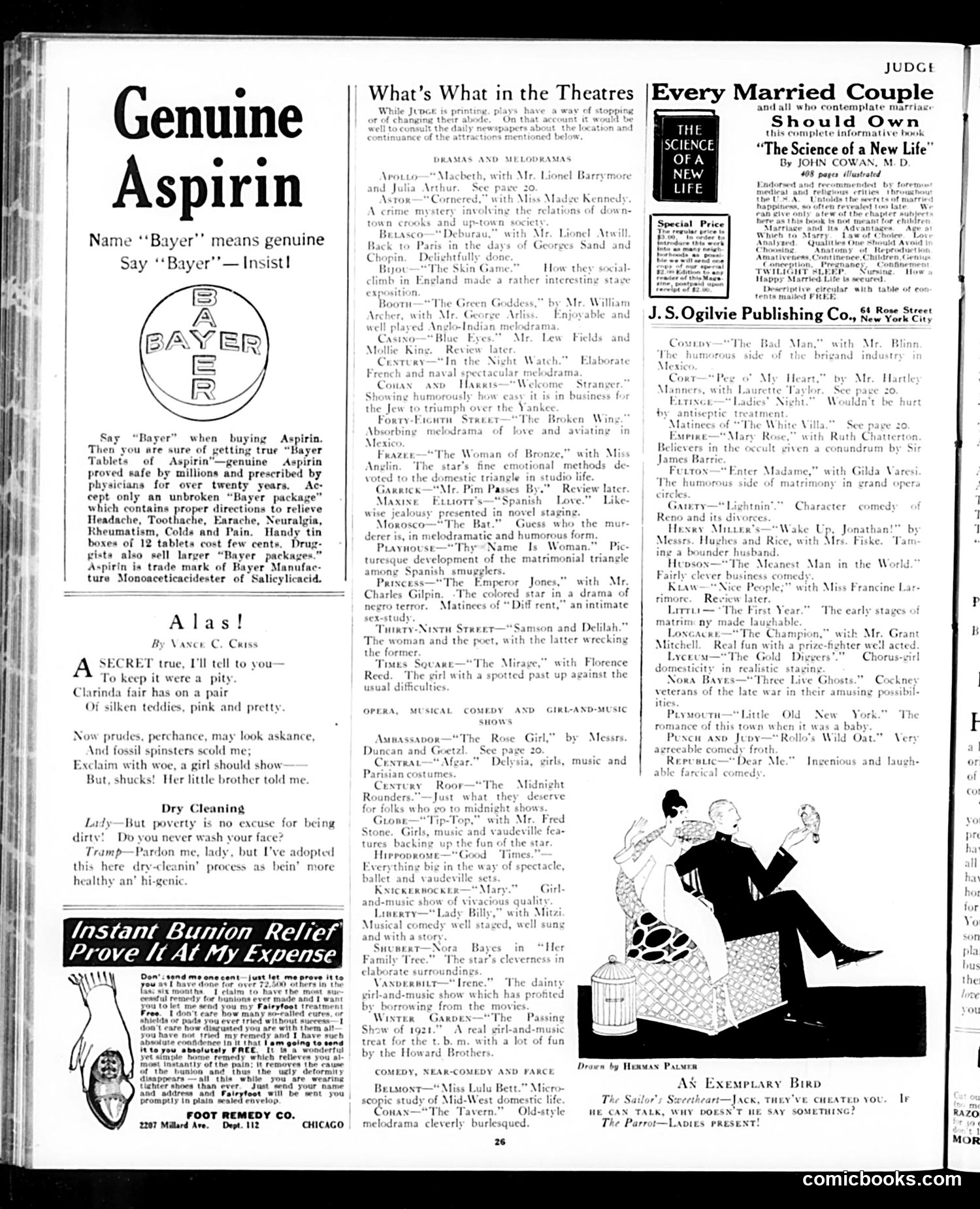
This page is primarily **advertising and theater listings**, not political satire. The main content includes: **Advertisements:** - Bayer Aspirin emphasizes the importance of the "Bayer" brand name, reflecting early 20th-century concerns about pharmaceutical authenticity and counterfeit medicines - A bunion relief product and other patent medicines typical of the era **Theater Reviews:** Extensive listings of Broadway productions with brief critiques of various shows, melodramas, and comedies. **Two Minor Comic Items:** 1. **"Alas!"** - A poem about a woman's undergarments (silk teddies), mocking prudish attitudes while treating the subject as lighthearted gossip 2. **"An Exemplary Bird"** - A cartoon about a parrot that won't talk, captioned with the joke that a silent parrot proves ladies should "say something" (likely poking fun at women's chattiness) These are gentle social humor rather than pointed political satire. The page reflects Judge's typical mix of advertising revenue, entertainment coverage, and mild domestic comedy from the early 1920s.
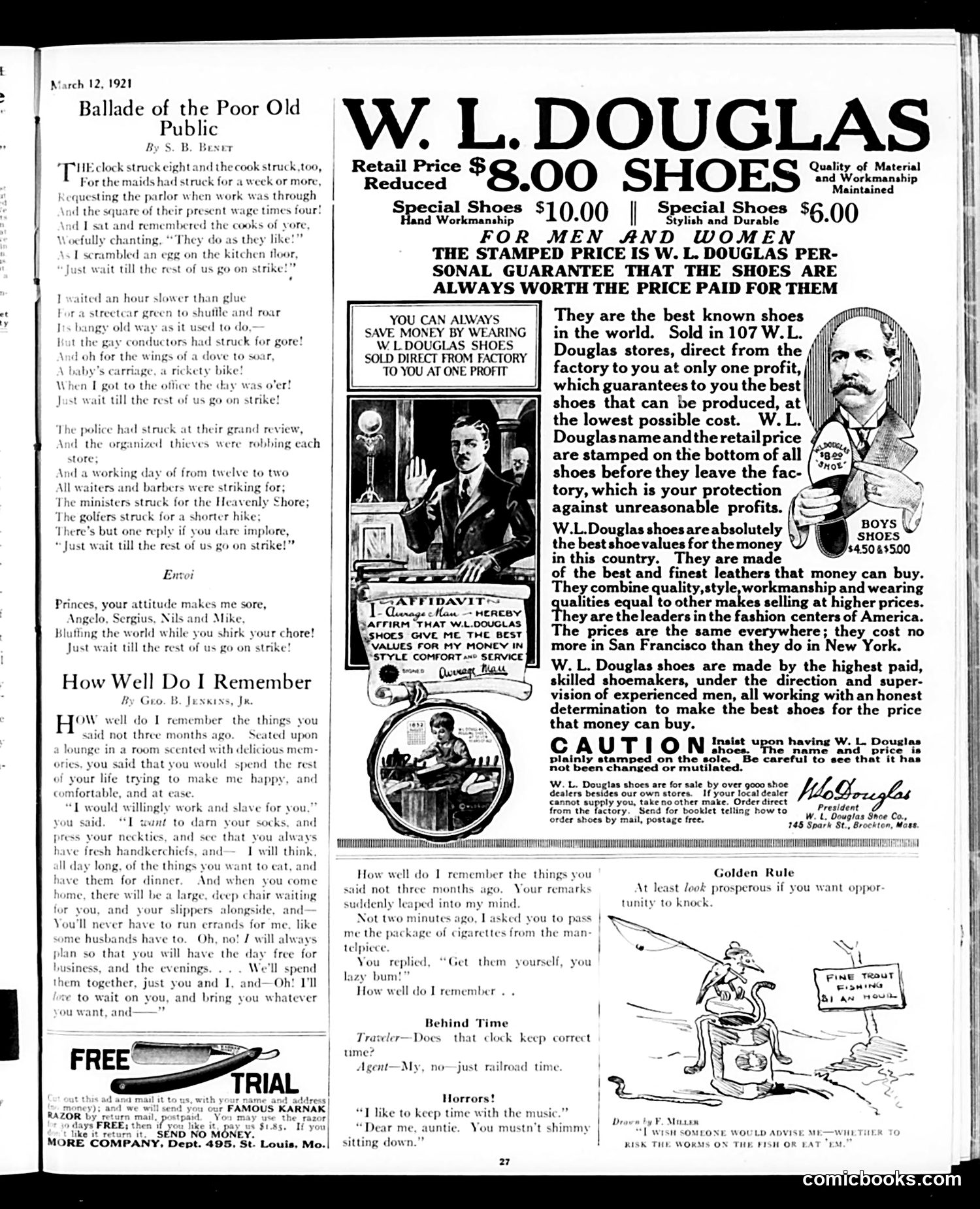
This page combines satirical poetry with advertising. The main content is "Ballade of the Poor Old Public" by S.B. Benet, a sharp critique of the strike wave sweeping America in 1921. The poem sardonically catalogs strikes across professions—cooks, streetcar conductors, police, thieves, barbers, ministers—showing how labor unrest has paralyzed daily life. The repeated refrain "Just wait till the rest of us go on strike!" mocks the working public's helplessness while everyone else demands better wages and conditions. The satire targets organized labor's growing power and the public's frustration with constant disruptions. It's also paired with companion poem "How Well Do I Remember," depicting a husband's broken romantic promises—a domestic parallel to labor's failed commitments. The W.L. Douglas shoe advertisement fills the right side, featuring the company founder's portrait and emphasizing direct factory sales, undercutting competitor profits—itself an ironic commentary on fair labor practices amid the era's labor turbulence.
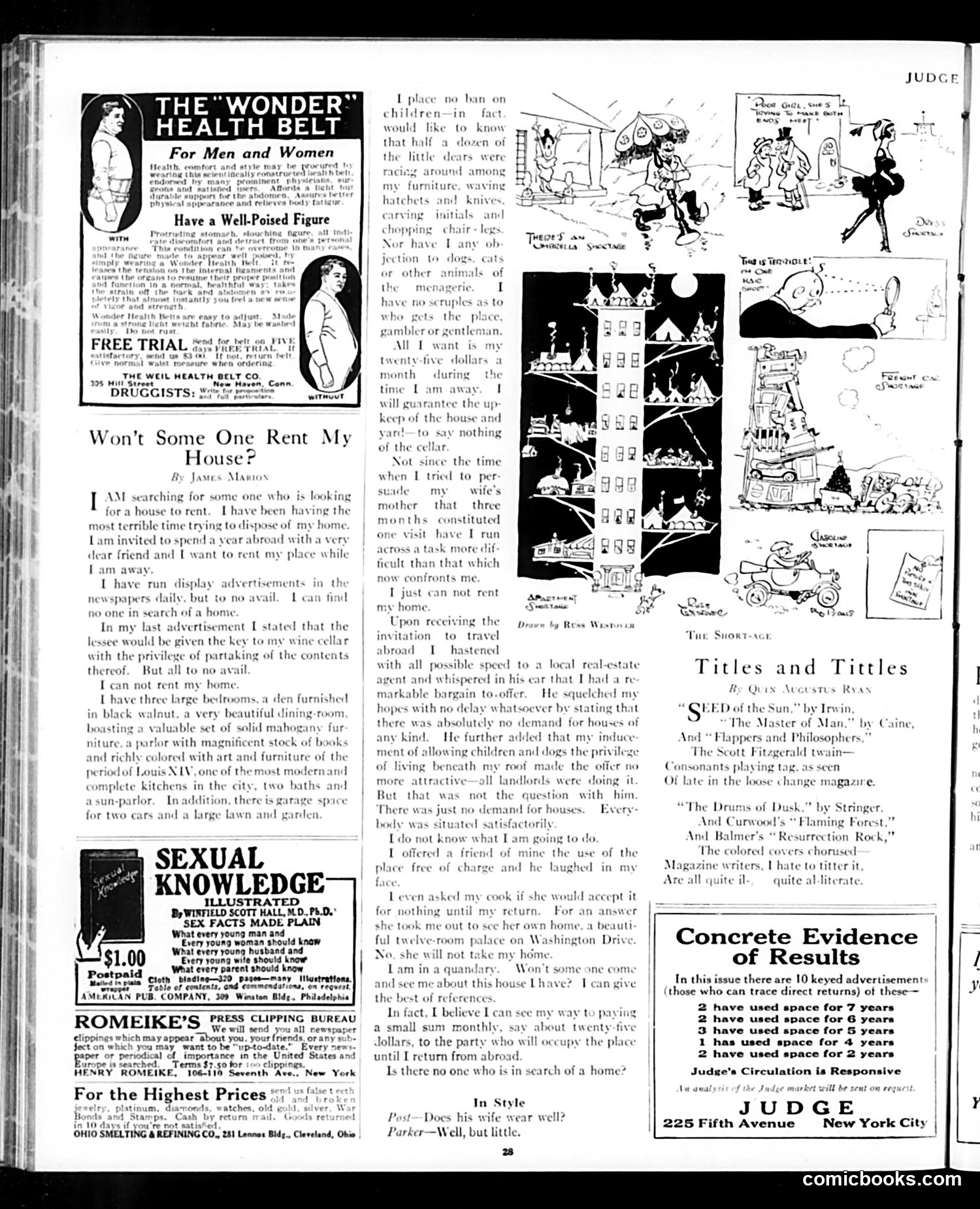
This page contains mostly **advertisements and unrelated content** rather than a unified political cartoon. The main article, "Won't Some One Rent My House?" by James Marius, is a **humorous complaint piece** about the author's inability to find a tenant. The satire targets the post-WWI housing shortage and tenant behavior: the author lists his house's luxurious features (mahogany furniture, wine cellar, modern kitchens) yet cannot rent it. His frustration escalates absurdly—he even offers it free to a friend, who laughs at him. The joke satirizes how desirable housing remains unavailable despite owners' desperate efforts and generous offers, reflecting genuine economic frustration of the era. The right side contains **unrelated comics** about children's mischief and book reviews. The page is primarily filled with **period advertisements**: a "Wonder Health Belt" (medical device), sexual education books, and a press clipping service—typical Judge magazine content mixing satire with commercial pitches. No specific political figures or events are referenced.
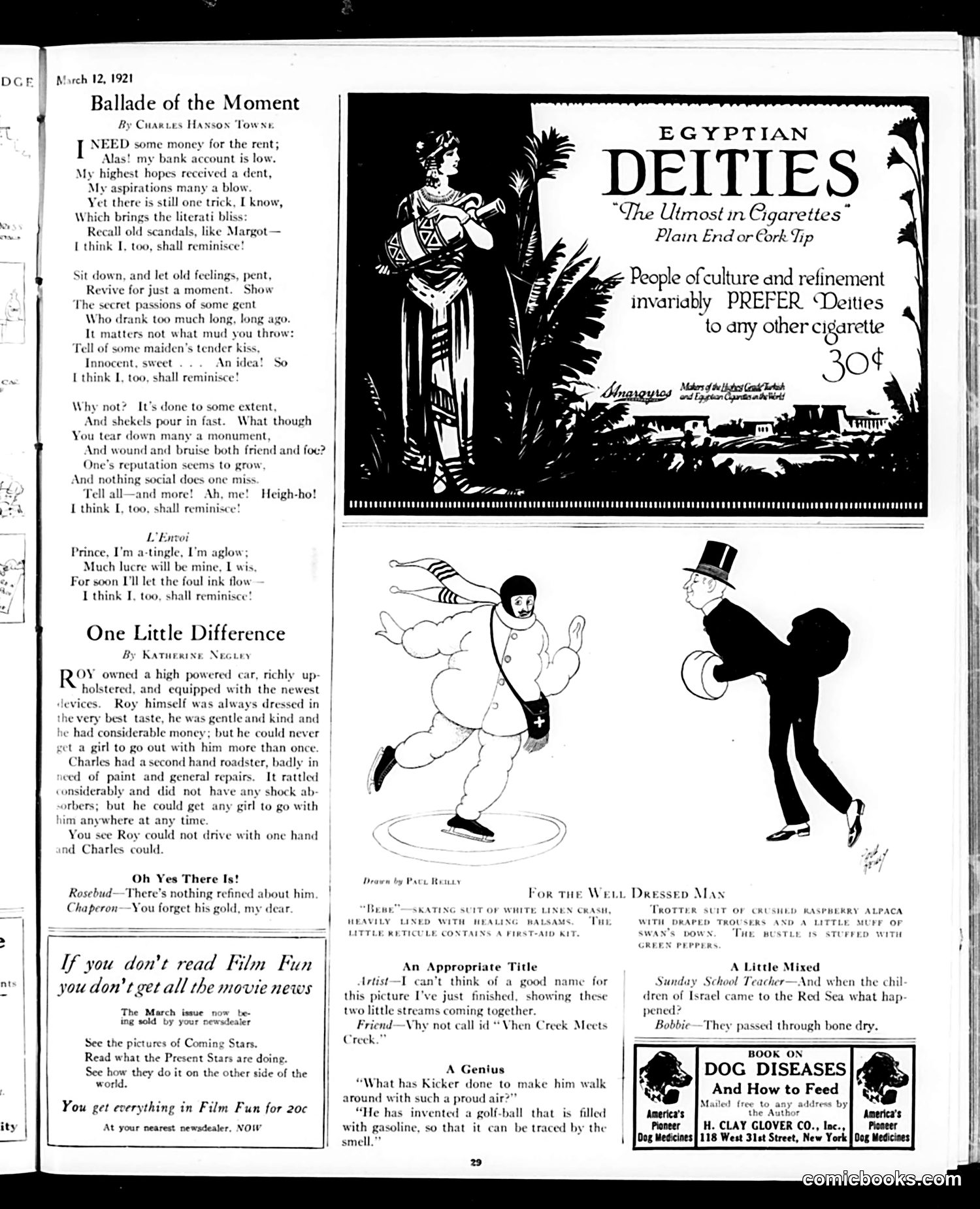
This March 1921 Judge page contains satirical commentary on several topics: **"Ballade of the Moment"** by Charles Hanson Towne critiques the era's gossip culture and sensationalism. The poem mocks writers who profit by excavating old scandals (referencing "Margot," likely a socialite), rehashing affairs and indiscretions. The joke is that truth matters less than financial gain—"shekels pour in fast" regardless of reputational damage inflicted. **"One Little Difference"** contrasts two men seeking dates. Roy owns an expensive car and behaves properly but strikes out; Charles drives a battered jalopy but succeeds. The punchline reveals the difference: Charles drives one-handed, implying seduction through casual confidence or physical contact—suggesting that apparent sophistication matters less than attitude. The page is otherwise advertisements (Egyptian Deities cigarettes) and minor humor bits. The overall tone reflects 1920s social anxieties about wealth, morality, and changing courtship customs during the Jazz Age.
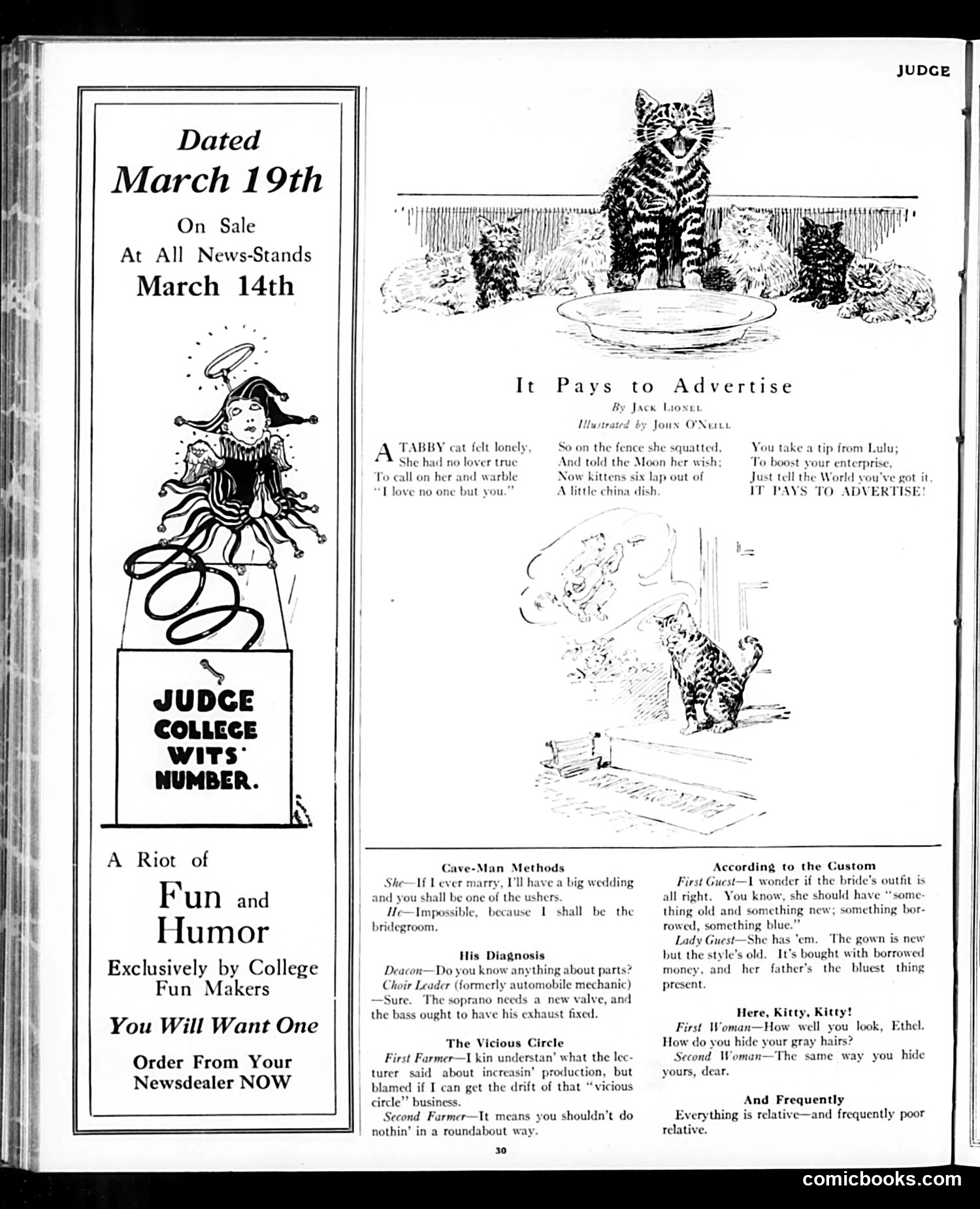
This page features a humorous illustrated story about a lonely tabby cat that wishes upon the moon for a lover. The cat's wish manifests literally: she acquires six kittens lapping from a china dish. The joke's title, "It Pays to Advertise," is a pun—the cat "advertised" her desire and received results. The page also includes several short joke sections ("Cave-Man Methods," "His Diagnosis," "The Vicious Circle," "Here, Kitty, Kitty!" and "And Frequently") that offer quick satirical observations on marriage customs, church choir dynamics, agricultural confusion, aging women's vanity, and economic inequality. The left side advertises Judge's "College Wits' Number," promoting humorous content as entertainment. The cartoons target everyday social situations and human foibles rather than specific political figures or events.
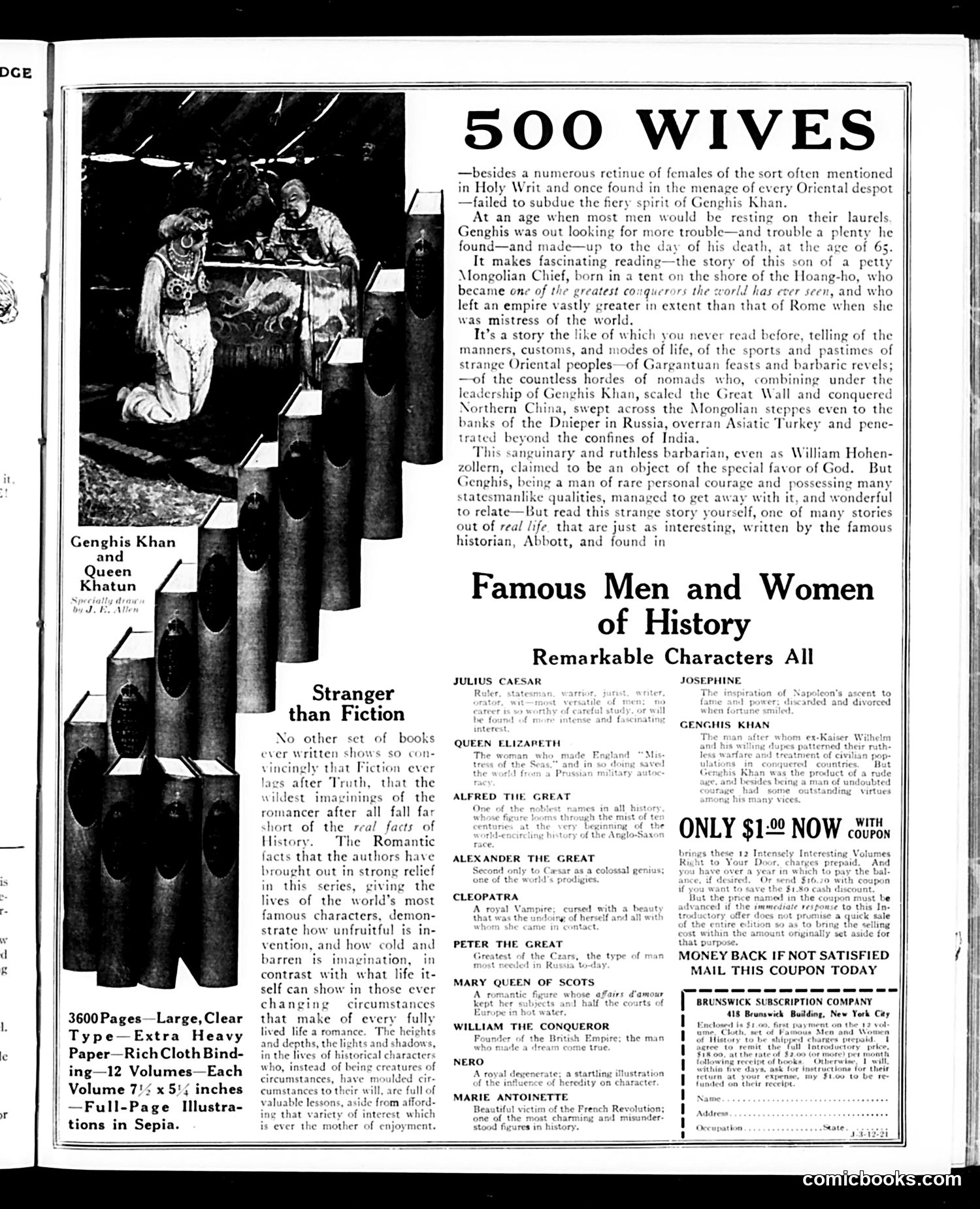
This page is primarily **advertising**, not satire. It promotes a 12-volume book series titled "Famous Men and Women of History" published by Brunswick Subscription Company. The advertisement uses Genghis Khan and Queen Khatun as its main appeal, featuring an illustration of the Khan in ornate dress. The text emphasizes the exotic appeal of his life story—his conquests, his 500 wives, and his ruthlessness—positioning history as "stranger than fiction." The marketing strategy targets middle-class readers seeking educational, romantic narratives. References to William Hohenzollern (the German Kaiser, relevant during WWI era) suggest the book's contemporary relevance. The advertiser claims the volumes, written by historian Abbott, offer fascinating accounts of real historical figures that rival any novel. This is essentially a mail-order book advertisement, not political commentary. The "satire" element, if present, is subtle—possibly mocking the sensationalism with which publishers marketed historical biography to mass audiences.