
Judge, 1921-03-12 · page 20 of 32
Judge — March 12, 1921 — page 20: what you’re looking at
What you’re looking at
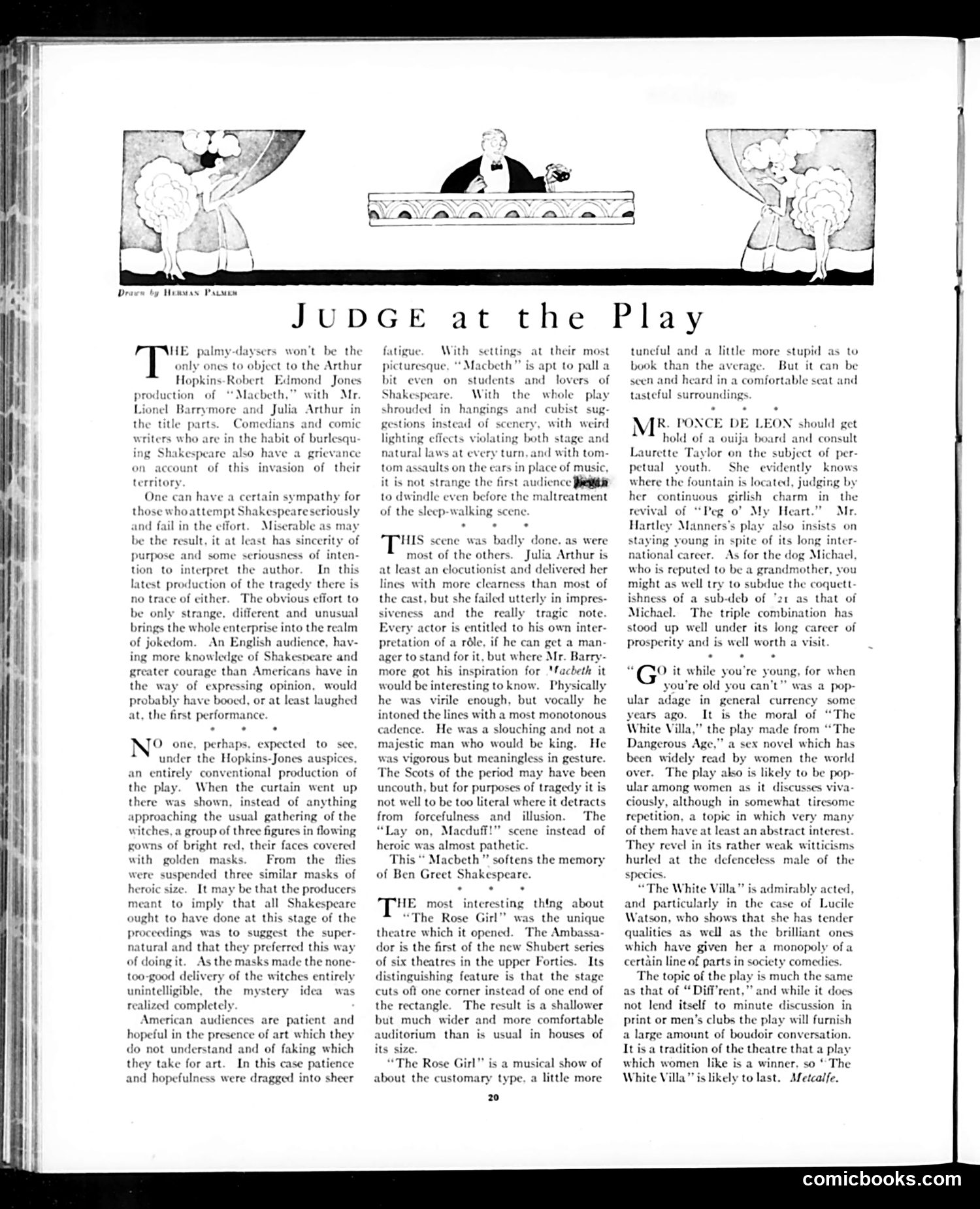
This page contains a theater review criticizing an Arthur Hopkins production of *Macbeth* starring Lionel Barrymore and Julia Arthur. The cartoon header depicts a judge presiding over the theatrical performance. The critic savagely attacks the production's modernist staging choices—particularly the three red-gowned witches with golden masks and suspended heroic-sized masks, which the reviewer finds pretentious and incomprehensible rather than atmospheric. The critic complains that avant-garde design choices (cubist suggestions, weird lighting, tom-tom sound effects) undermine Shakespeare rather than enhance it. The review is especially harsh on Barrymore's performance, calling his delivery monotonous and his physicality slouching and unmajestic for a king. Julia Arthur fares slightly better for clear elocution but lacks tragic impressiveness. The satire targets what the critic sees as fashionable pretension in "serious" theater—experimental staging masquerading as art that American audiences politely endure. The piece implies Hopkins-Jones deliberately chose bizarre unconventionality over conventional interpretation.
📄 Transcribed text from this page (OCR, searchable)
Machine-transcribed from the original scan — historical spelling and the odd misread are preserved.
Dro by Hewes Poewe JUDGE at the Play Ts palmy-daysers won't be the only ones to object to the Arthur Hopkins-Robert. Edmond Jones production of “Macbeth,” with) Mr. Lionel Barrymore and Julia Arthur in the title parts. Comedians and comic writers who are in the habit of burlesqu ing Shakespeare also have a grievance on account of this invasion of their territory One can have a certain sympathy for those whoattempt Shakespeare seriously and fail in the effort. Miserable as may be the result, it at least has sincerity of purpose and some seriousness of inten- tion to interpret the author. In this latest production of the tragedy there is no trace of either. The obvious effort to be only strange, different and unusual brings the whole enterprise into the realm of jokedom. An English audience, hav- ing more knowledge of Shakespeare and greater courage than Americans have in the way of expressing opinion, would probably have booed, or at least laughed at, the first performance. N2 one, perhaps, expected to see, AN “under the Hopkins-Jones auspices, an entirely conventional production of the play. When the curtain went up there was shown, instead of anything approaching the usual gathering of the witches, a group of three figures in flowing gowns of bright red, their faces covered with golden masks. From the flies were suspended three similar masks of heroic size. It may be that the producers meant to imply that all Shakespeare ught to have done at this stage of the proceedings was to suggest the super- natural and that they preferred this way of doing it. As the masks made the none- too-good delivery of the witches entirely unintelligible, the mystery idea was realized completely American audiences are patient and hopeful in the presence of art which they do not understand and of faking which they take for art. In this case patience and hopefulness were dragged into sheer fatigue. With settings at their most picturesque. ‘* Macbeth” is apt to pall a bit even on students and lovers of Shakespeare. With the whole play shrouded in hangings and cubist sug- gestions instead of scenery, with weird lighting effects violating both stage and natural laws at every turn, and with tom- tom assaults on the ears in place of music it is not strange the first audience Piepiea to dwindle even before the maltreatment of the sleep-walking scene. HIS scene was badly done. as were most of the others. Julia Arthur is at least an elocutionist and delivered her lines with more clearness than most of the cast, but she failed utterly in impres- siveness and the really tragic note. Every actor is entitled to his own inter- pretation of a réle, if he can get a man- ager to stand for it, but where Mr. Barry- more got his inspiration for Macbeth it would be interesting to know. Physically he was virile enough, but vocally he intoned the lines with a most monotonous cadence. He was a slouching and not a majestic man who would be king. He was vigorous but meaningless in gesture. The Scots of the period may have been uncouth, but for purposes of tragedy it is not well to be too literal where it detracts from forcefulness and illusion. The “Lay on, Macdufi scene instead of heroic was almost pathetic. This * Macbeth” softens the memory of Ben Greet Shakespeare. THe most interesting thing about “The Rose 1’ was the unique theatre which it opened. The Ambassa- dor is the first of the new Shubert series of six theatres in the upper Forties. Its distinguishing feature is that the stage cuts off one corner instead of one end of the rectangle. The result is a shallower but much wider and more comfortable auditorium than is usual in houses of its size. “The Rose Girl” is a musical show of about the customary type. a little more 20 tuncful and a little more stupid as t book than the average. But it can be seen and heard in a comfortable seat and tasteful surroundings. M& PONCE DE LEON should get AV1 hold of a oujja board and consult ne a ouija board an nsu Laurette Taylor on the subject of per- petual youth. She evidently knows where the fountain is located, judgi her continuous girlish charm in the revival of “Peg o’ My Heart.” Mr. Hartley Manners’s play’ also insists on staying young in spite of its long inter national career. As for the dog Michacl, who is reputed to be a grandmother, you might as well try to subdue the coquett- ishness of a sub-deb of as that of Michacl. The triple combination has stood up well under its long career of prosperity and is well worth a visit. O it while you're young, for when you're old you can’t” was a pop- ular adage in general currency some years ago. It is the moral of “The White Villa,” the play made from “The Dangerous Age,” a sex novel which has been widely read by women the world over. The play ako is likely to be pop- ular among women as it discusses viva- ciously, although in somewhat tiresome repetition, a topic in which very many of them have at least an abstract interest. They revel in its rather weak witticisms hurled at the defenceless male of the species. The White Villa” is admirably acted, and particularly in the case of Lucile Watson, who shows that she has tender qualities as well as the brilliant ones which have given her a monopoly of a certain line of parts in society comedies. he topic of the play is much the same as that of “Diff’rent,” and while it does not lend itself to minute discussion in print or men’s clubs the play will furnish a large amount of boudoir conversation. It is a tradition of the theatre that a play which women like is a winner, so ‘ The White Villa” is likely to last. Metcalfe. comicbooks.com