
Judge, 1921-03-12 · page 14 of 32
Judge — March 12, 1921 — page 14: what you’re looking at
What you’re looking at
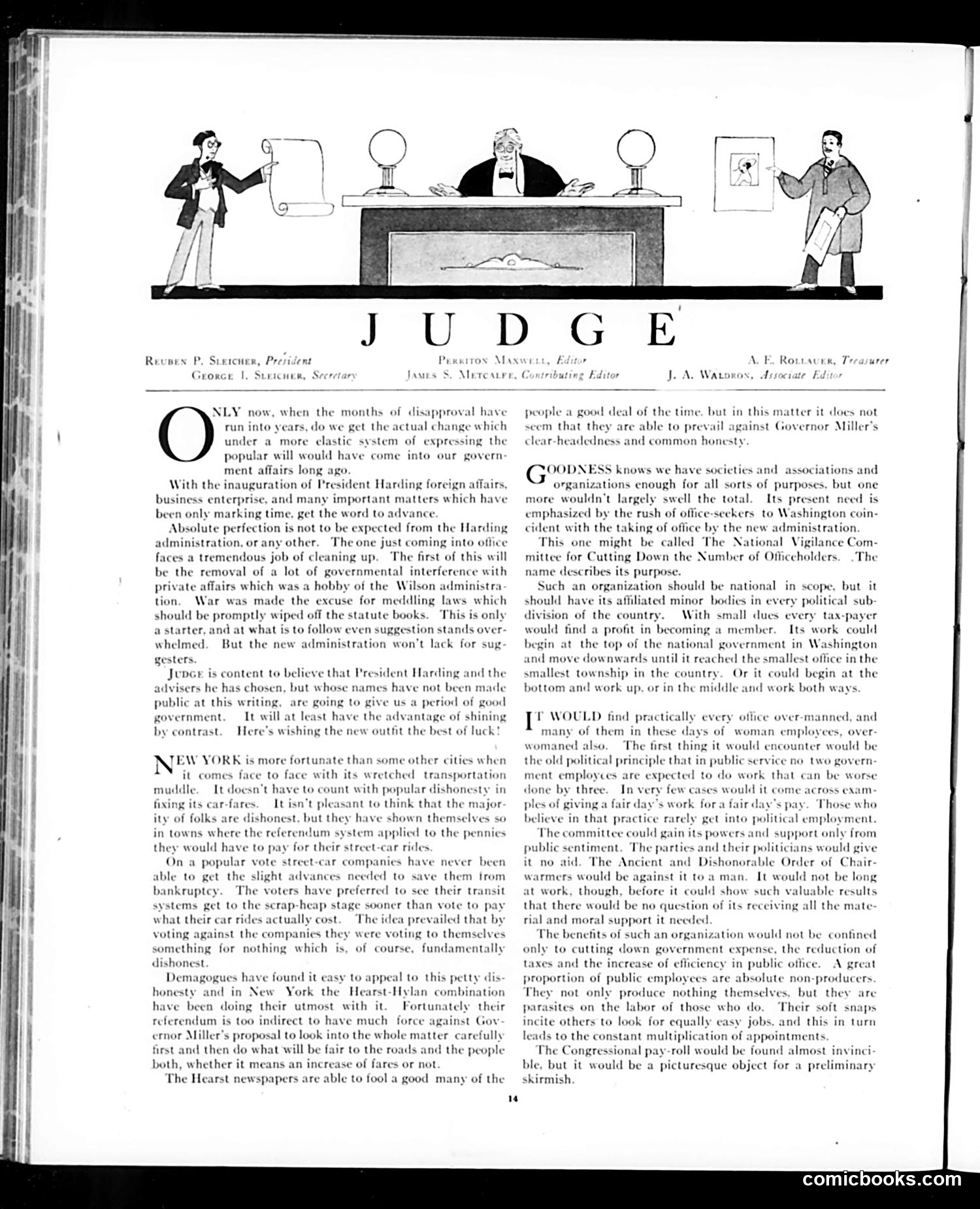
This page features editorial commentary celebrating President Harding's recent inauguration (1921), contrasting his administration favorably with Wilson's. The cartoon header shows a judge presiding over proceedings—a visual pun on the magazine's name. The text criticizes the Wilson administration's wartime government interference in private affairs, suggesting Harding will restore business freedom. It defends Governor Miller's transit proposal against attacks by the Hearst-Hylan newspaper combination, praising Miller's "clear-headedness and common honesty" against what Judge views as populist demagoguery appealing to voters' "petty dishonesty." The editorial proposes creating a "National Vigilance Committee for Cutting Down the Number of Officeholders"—satirizing the flood of office-seekers descending on Washington with the new administration, while advocating for government downsizing. The piece reflects early 1920s conservative, pro-business sentiment skeptical of both Wilson-era progressivism and urban political machines.
📄 Transcribed text from this page (OCR, searchable)
Machine-transcribed from the original scan — historical spelling and the odd misread are preserved.
Reupes P. Suercner, President Steiner, Seerctar S. Merearrs Grorce | Max A. F. Rotraver, Tr ate Editor J. A. Warore NLY now, when the months of disapproval have run into years, do we get the actual change which under a more clastic system of expressing the popular will would have come into our govern ment affairs long ago. With the inauguration of President Harding foreign affairs, business enterprise, and many important matters which have been only marking time, get the word to advance. Absolute perfection is not to be expected from the Harding administration, or any other. The one just coming into office faces a tremendous job of cleaning up. The first of this will be the removal of a lot of governmental interference with private affairs which was a hobby of the Wilson administ War was made the excuse for meddling laws which »ks. This is only tion should be promptly wiped off the statute be a starter, and at what is to follow even suggestion stands over- whelmed. But the new administration won't lack for sug gesters. JunGe is content to believe that President Harding and the advisers he has chosen, but whose names have not been made public at this writing, are going to give us a period of good It will at least have the advantage of shining government Here's wishing the new outfit the best of luck! by contrast NEW IN it muddle. It« fixing its car-fares ity of folks are dishonest in towns where the referendum system applied to the pennies they would have to pay for their street-car rides. On a popular vote street-car companies have never been able to get the slight advance bankruptey. The voters have preferred to sce their transit systems get to the scrap-heap stage sooner than vote to pay what their car rides actually cost. The idea prevailed that by voting against the companies they were voting to themselves course, fundamentally YORK is more fortunate than some other cities when comes face to face with its wretched transporta yesn't have to count with popular dishonesty in It isn’t pleasant to think that the major but they have shown themselves so ion needed to save them trom something for nothing which is, of dishonest Demagogues have found it easy to appeal to this petty dis honesty and in New York the Hearst-Hylan combination have been doing their utmost with it. Fortunately their referendum is too indirect to have much force against Gov crnor Miller's proposal to look into the whole matter carefully first and then do what will be fair to the roads and the people both, whether it means an increase of fares or not The Hearst newspapers are able to fool a good many of the but in this matter it does not people a good deal of the time seem that they are able to prevail against Governor Miller's clear-headedness and common honesty OODNESS knows we have societies and associations and organizations enough for all sorts of purposes. but one more wouldn't largely swell the total. [ts present need is emphasized by the rush of office-seekers. to Washington coin- cident with the taking of office by the new administration. This one might be called The National Vigilance Com- mittee for Cutting Down the Number of Officeholders. The name describes its purpose. Such an organization should be national in scope, but it should have its affiliated minor bodies in every political sub- With small dues every tax-payer Its work could division of the country. would find a profit in becoming a member begin at the top of the national government in Washington and move downwards until it reached the smallest office in the Or it could begin at the ork both ways. smallest township in the country bottom and work up. or in the middle and I PF WOULD find practically every office over-manned, and many of them in these days of woman employees, over womaned also. The first thing it would encounter would be the old political principle that in public service no two govern ment employces are expected to do work that can be worse done by three. In very few ples of giving a fair day’s work fora fair day's pay believe in that practice rarely get into political employment. The committee could gain its powers and support only from public sentiment. The parties and their politicians would give it no aid. The Ancient and Dishonorable Order of Chair- warmers would be against it toa man. It would not be long at work, though, before it could show such valuable results that there would be no question of its receiving all the mate: ne across exam Those who es would it ¢ rial and moral support it nee The benefits of such an organization would not be confined to cutting down government expense, the reduction of taxes and the increase of efficiency in public office. A great proportion of public employees are absolute non-producers They not only produce nothing themselves, but they are Their soft and this in turn pintments. only parasites on the labor of those who do. incite others to look for equally easy job: leads to the constant multiplication of apf The Congressional pay-roll would be found almost invinei ble, but it would be a picturesque object for a preliminary skirmish snaps comicbooks.com asurer