
A complete issue · 32 pages · 1921
Judge — January 1, 1921
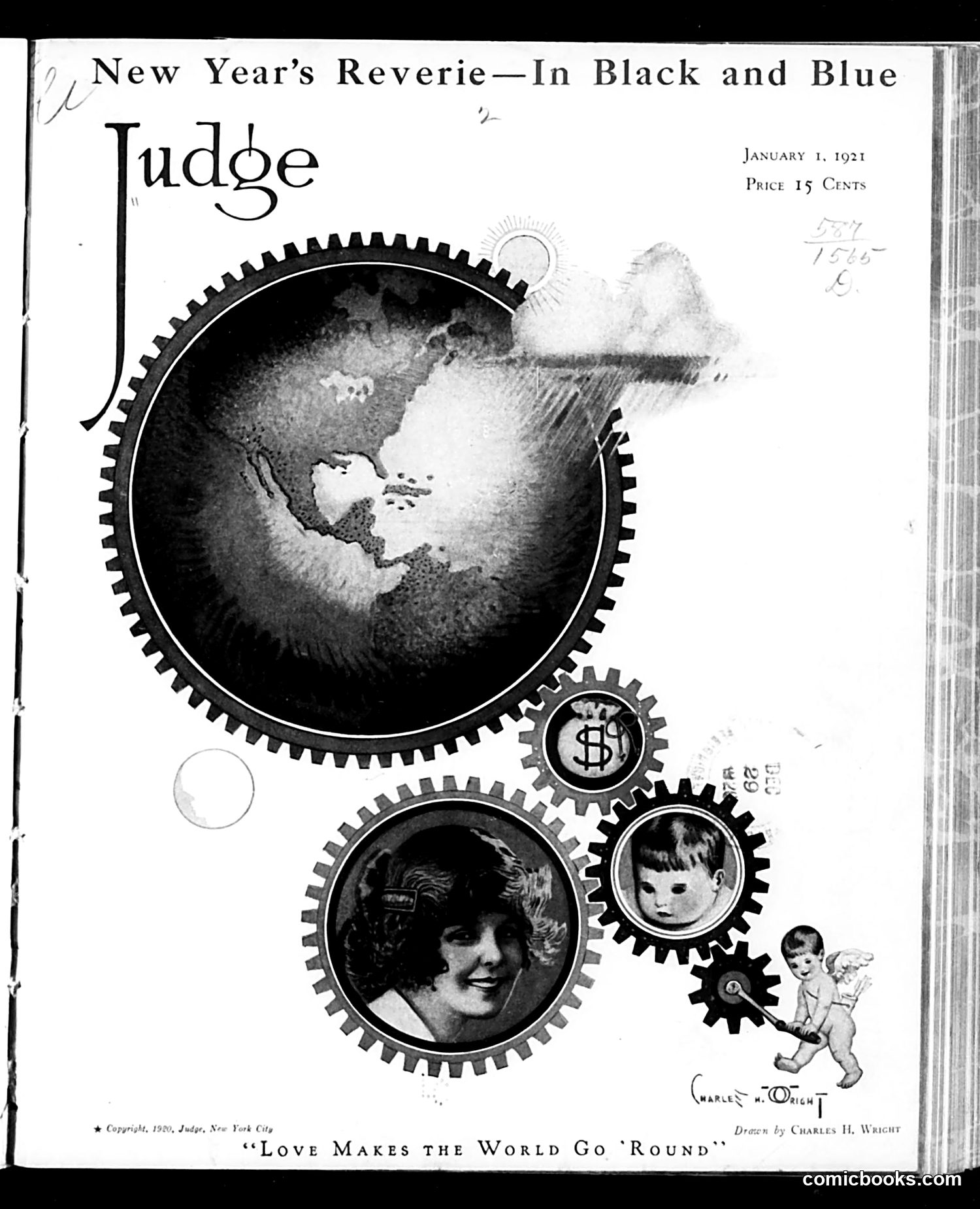
This New Year's cover satirizes global interconnectedness through mechanical imagery. The large gear contains a world map, suggesting the world operates as machinery. Below are three smaller gears: one depicting a woman's face (likely representing a movie star or public figure of the era), one showing a cherub or cupid symbol with a dollar sign, and another with a child's face. The caption "Love Makes the World Go Round" sarcastically comments on 1920s consumer culture and entertainment industry influence. The gears suggest these forces—celebrity, commerce, and sentimentality—mechanically drive society rather than genuine human connection. The cherub-and-dollar-sign gear particularly mocks commercialized romance and commodified emotion in post-WWI American culture.
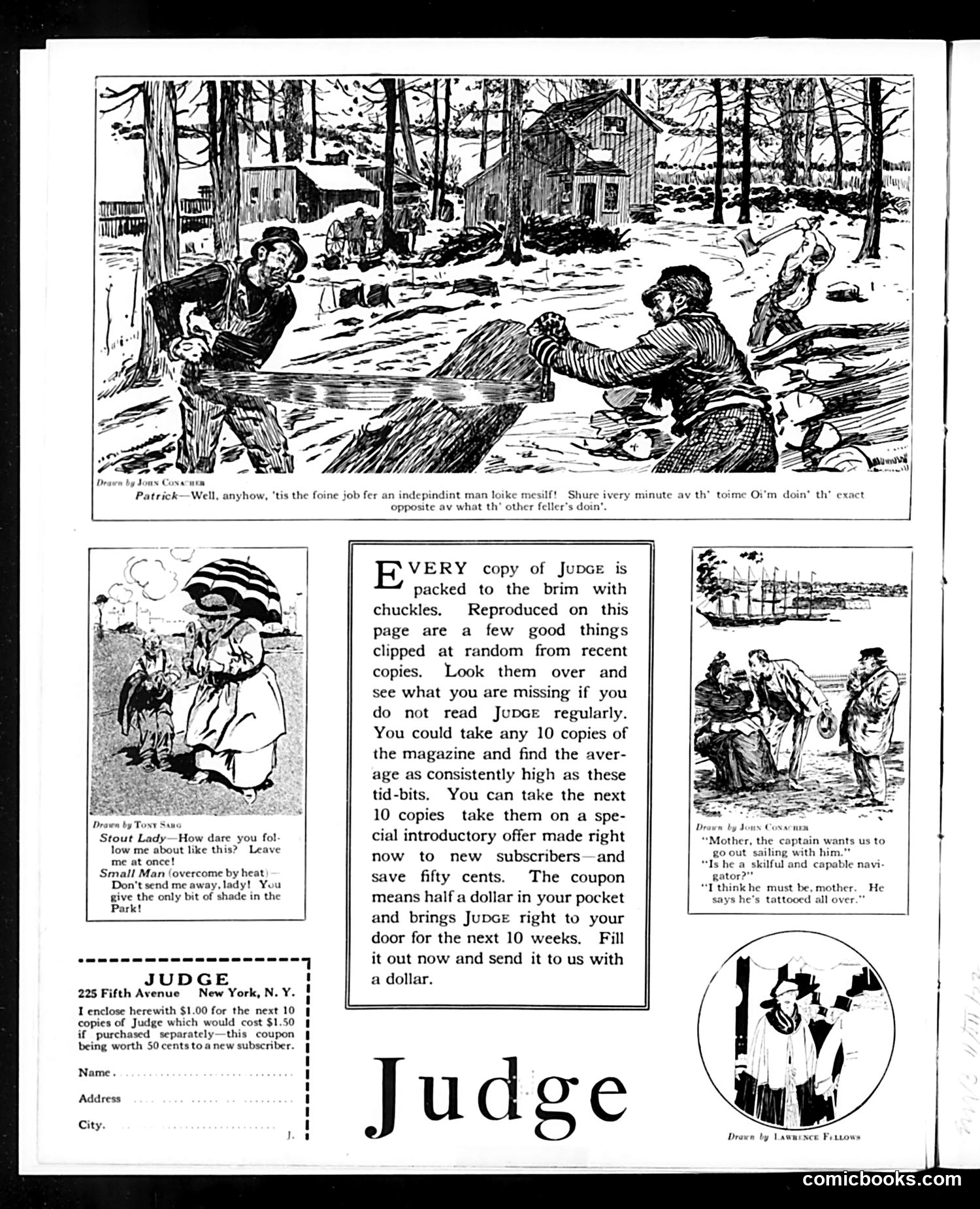
This page is primarily **advertising and promotional material** for *Judge* magazine itself, rather than political satire. The top cartoon by John Coxcomb depicts two men sawing a log, with Patrick (one figure) explaining the concept of independence—each man working at his own pace rather than coordinating. This appears to be a **humorous commentary on American individualism** and the difficulty of coordinating work when everyone operates independently. The remaining content is a **subscription promotion**, emphasizing that *Judge* contains quality humor and illustrations worth reading regularly. The coupon offers 10 copies for $1 (50 cents savings), targeting new subscribers. The scattered illustrations showcase typical magazine content—domestic humor, nautical scenes, and social situations. This is essentially **marketing material** dressed up with sample cartoons.
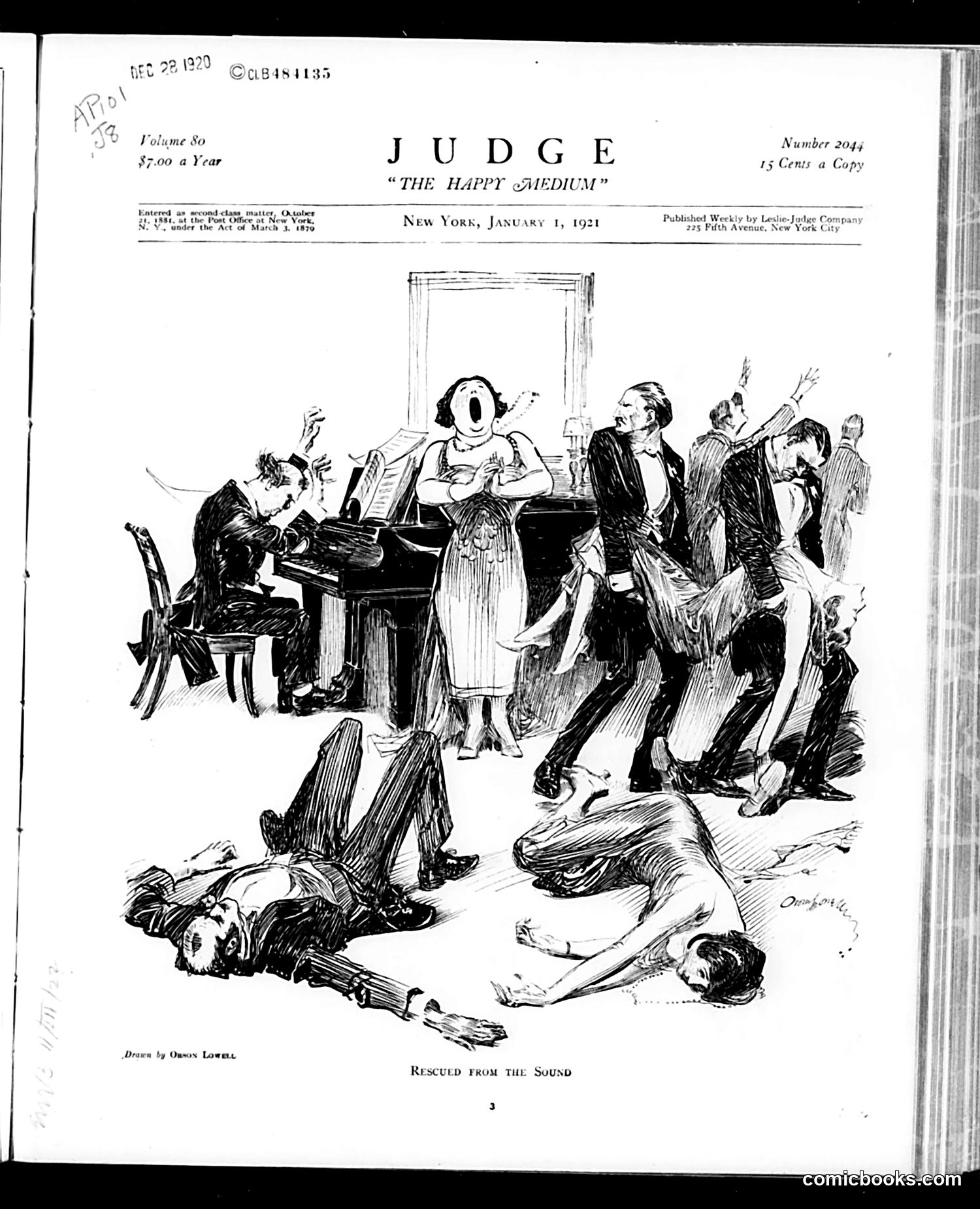
This 1921 Judge magazine cartoon, drawn by Cesare Lowell, depicts a musical performance gone awry. The title "Rescued from the Sound" is a pun: performers have literally been rescued from making terrible "sound" (music). The scene shows musicians and singers collapsed or exhausted on the floor while an audience and pianist remain standing. The exaggerated poses suggest the performers have been overwhelmed or defeated by their own performance—likely depicting a catastrophically bad concert or opera. The satire targets amateur or incompetent musicians who subject audiences to painful entertainment. The "rescue" is ironic: the audience has been saved from enduring more bad music, while the performers' dignity lies defeated on stage.
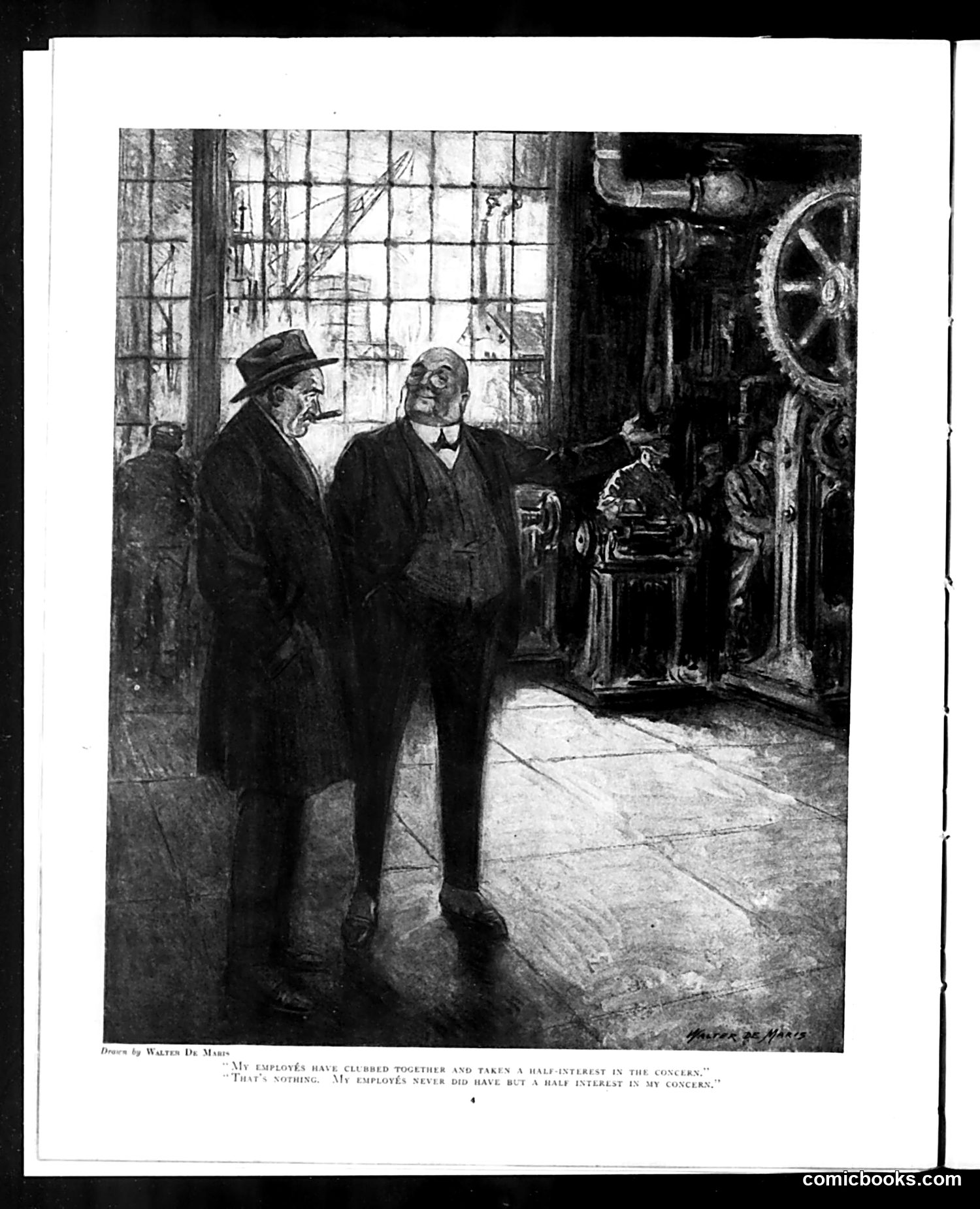
This cartoon by **Walter De Maris** depicts an industrial factory scene with two well-dressed men—apparently an employer and worker or labor representative—having a heated exchange. The caption reads: *"My employees have clubbed together and taken a half-interest in the concern. That's nothing. My employees never did have but a half-interest in my concern."* The satire targets **labor-management relations**, likely from the early 20th century. The joke criticizes employers who claim workers lack genuine investment or commitment to their jobs. The irony is that even when workers literally purchase ownership stakes in their company, the employer dismisses their involvement—suggesting workers were never truly motivated anyway. This reflects contemporary debates about **worker profit-sharing schemes** and labor's struggle for recognition and fair treatment.
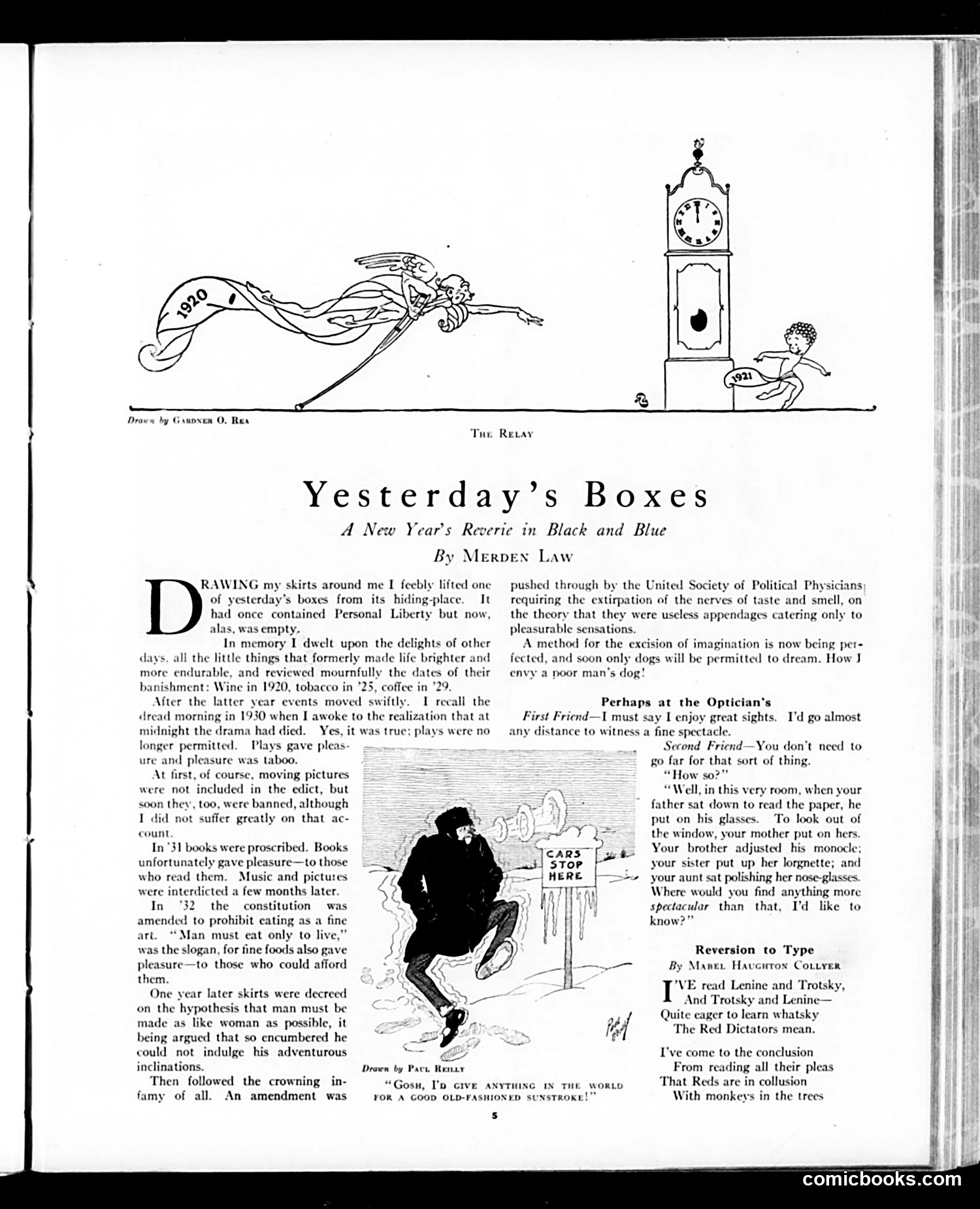
**The Top Cartoon ("The Relay"):** This appears to be a New Year's allegory showing 1920 passing a baton to 1921. The figure labeled 1920 flies away while 1921 (a cherub) waits to receive it—a common visual metaphor for the transition between years. **The Main Article:** Merden Law's essay reflects on freedoms lost during the 1920s. He references prohibition's elimination of alcohol and theater censorship that banned stage plays. The text nostalgically mentions books being proscribed in 1931 and a 1932 constitutional amendment restricting art, with the slogan "Man must eat to live" being used to justify limiting pleasures. **The Cartoon Below:** Shows a man at what appears to be a shop window with a "Cards Stop Here" sign, illustrating restrictions on commerce or leisure activities—likely relating to prohibition enforcement or censorship.
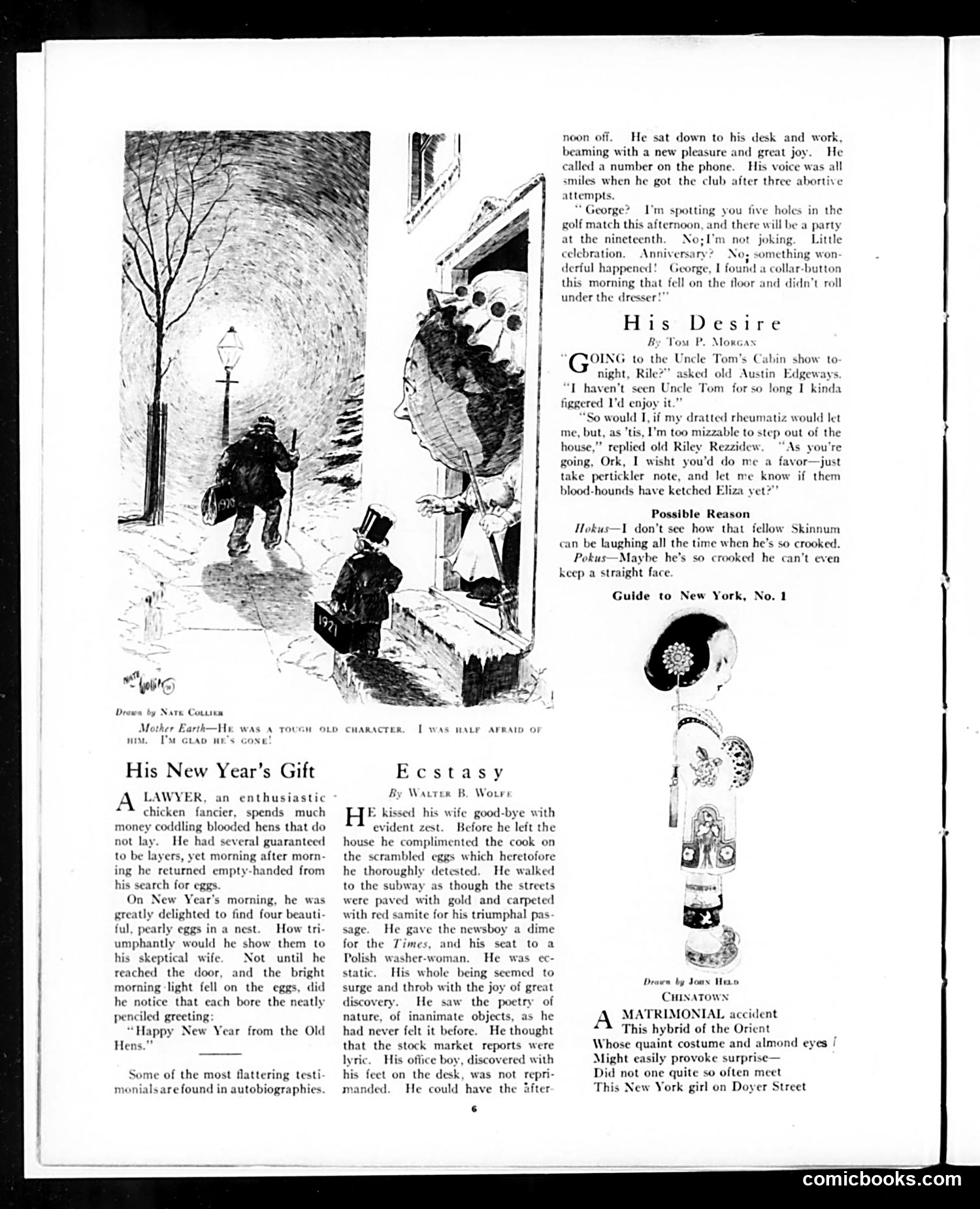
This page contains three separate fiction pieces rather than political cartoons. "His New Year's Gift" by an unnamed author depicts a lawyer who obsessively searches for chicken eggs as a New Year's present, only to discover his wife has laid them herself—a domestic humor story. "Ecstasy" by Walter B. Wolfe humorously describes a man's euphoric morning commute after complimenting his cook. "His Desire" features dialogue about attending a golf match and finding a lost collar button. The small illustrations and "Guide to New York, No. 1" appear to be magazine features rather than satire. There is no clear political content on this page—it focuses on everyday domestic and social humor typical of early 20th-century light fiction magazines.
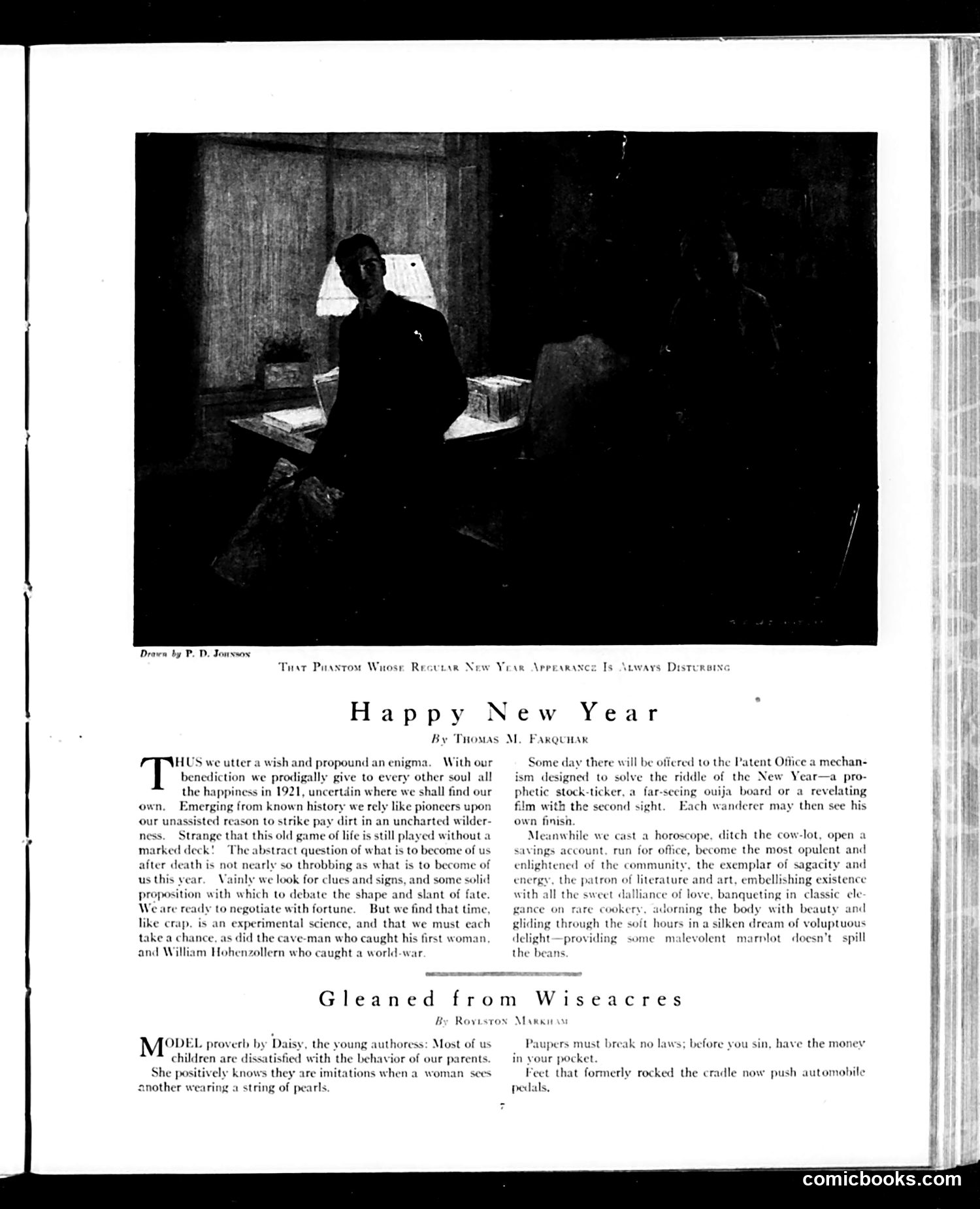
This appears to be a New Year's editorial page from Judge magazine (likely early 1921, given the "Happy New Year" framing and reference to 1921). **Main Content:** The illustrated cartoon at top shows a séance or fortune-telling scene—a darkened room with figures consulting what appears to be a medium about the future. The caption references "That Phantom Whose Regular New Year Appearance Is Always Disturbing," likely satirizing the common practice of people seeking predictions about the coming year through spiritualism, which was popular in the 1920s. **Text Features:** Two pieces follow: Thomas M. Farquhar's "Happy New Year" essay uses cynical humor about humanity's helplessness regarding fate, comparing life to gambling. The shorter "Gleaned from Wiseacres" section offers sardonic observations—including commentary on women's fashion (pearls), automobiles replacing traditional cradles, and class commentary ("paupers must break no laws...have the money in your pocket"). **The Satire:** The overall tone mocks New Year's optimism, uncertainty about the future, and social pretensions—suggesting readers' desperate attempts to predict or control their destinies through superstition, while acknowledging life's randomness.
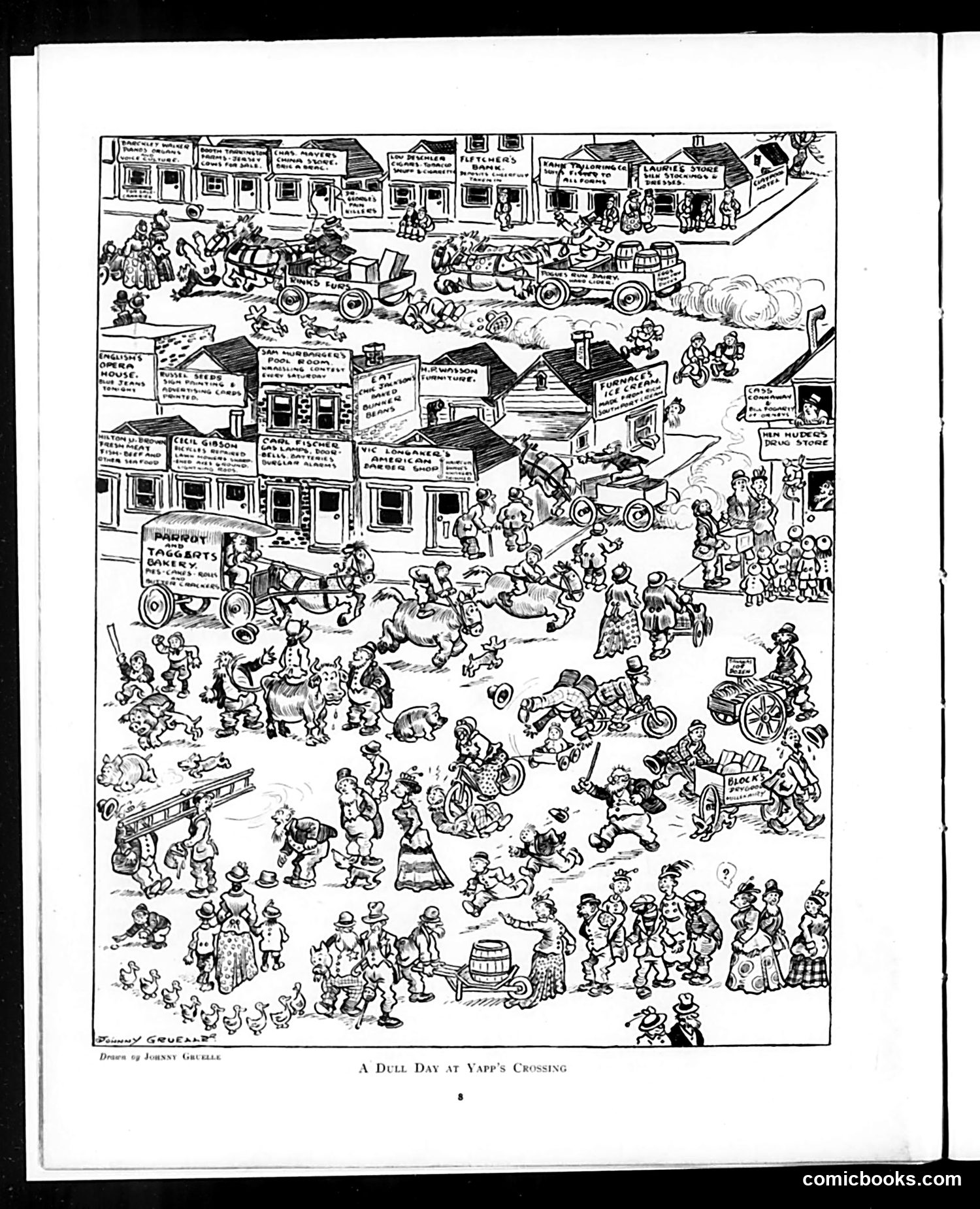
This is a densely-packed satirical illustration by Johnny Gruelle depicting a chaotic country crossroads community. The scene shows numerous figures engaged in various activities—children playing, adults socializing, vendors operating carts and stands, and various animals. Multiple shop signs and building labels are visible throughout. The satire appears to target rural American life and small-town commerce, with exaggerated characters and absurd activities creating comedic contrast. Without clearer legibility of the individual signs and labels, the specific satirical targets remain unclear, though the overall joke seems to be depicting the supposed "dullness" of country life—ironically shown as frenetic and disorganized chaos. The illustration showcases Judge magazine's style of crowded, detailed social commentary typical of early-to-mid 20th century American satire.
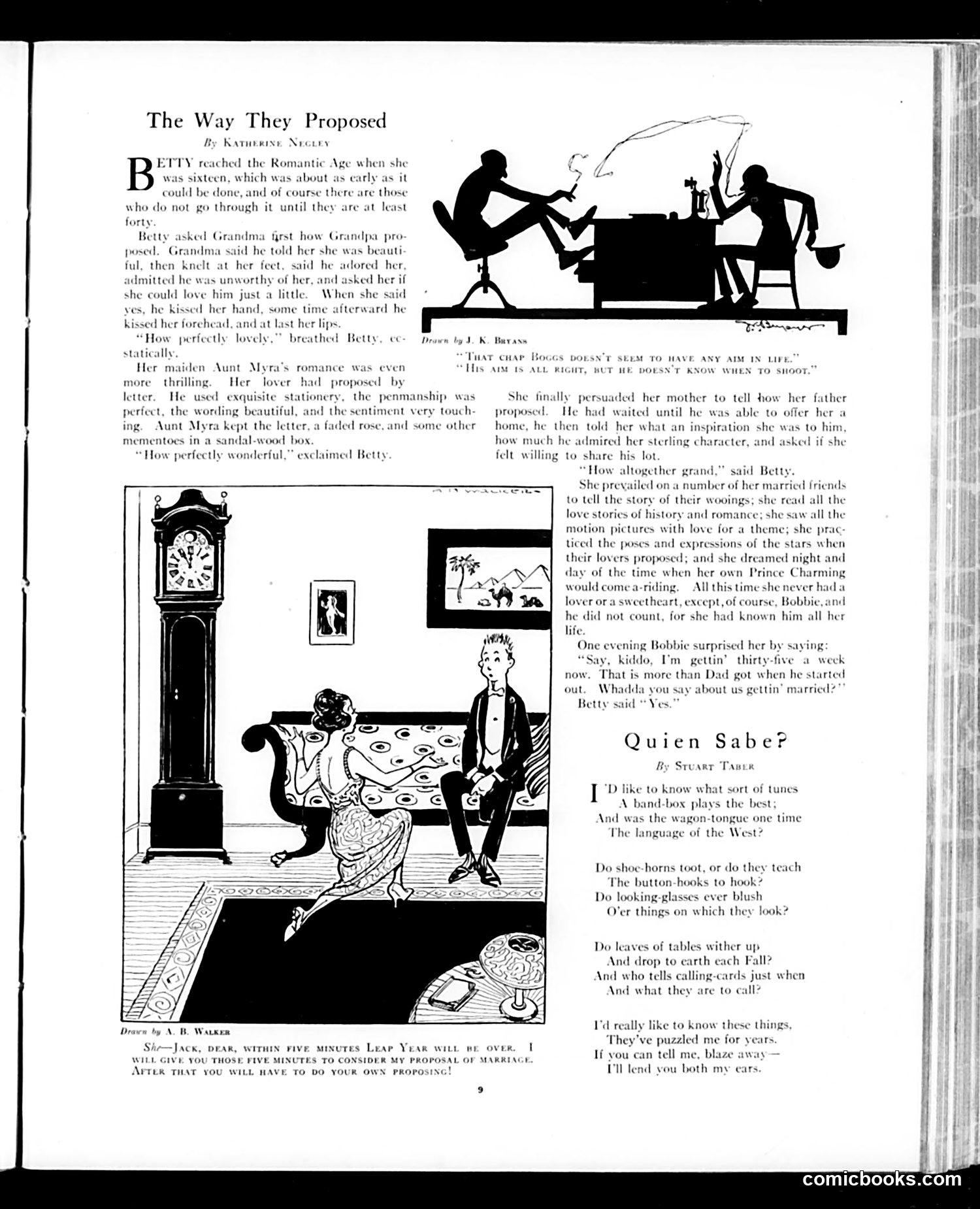
This two-part piece satirizes the gap between young women's romantic fantasies and mundane reality. **"The Way They Proposed"** (by Katherine Neculy): Betty becomes obsessed with elaborate, poetic marriage proposals after hearing romanticized versions from relatives—her grandmother's chivalrous courtship, her aunt's letter with exquisite stationery and rose. She studies movie proposals, practices poses, and dreams of "Prince Charming." When actual marriage comes, it's brutally anticlimactic: her childhood friend Bobbie simply mentions earning thirty-five dollars weekly and asks, "Whadda y'say about us gettin' married?" She accepts immediately. The satire targets how popular culture (films, literature, motion pictures) inflates young women's expectations with impossible romance, while real life offers pragmatic, unglamorous proposals based on financial stability rather than passion. The accompanying cartoon (by Warren) reinforces this: a man says he'll give his girlfriend "five minutes" to decide his proposal, or "you will have to do your own proposing"—mocking both male ultimatums and shifting gender dynamics.
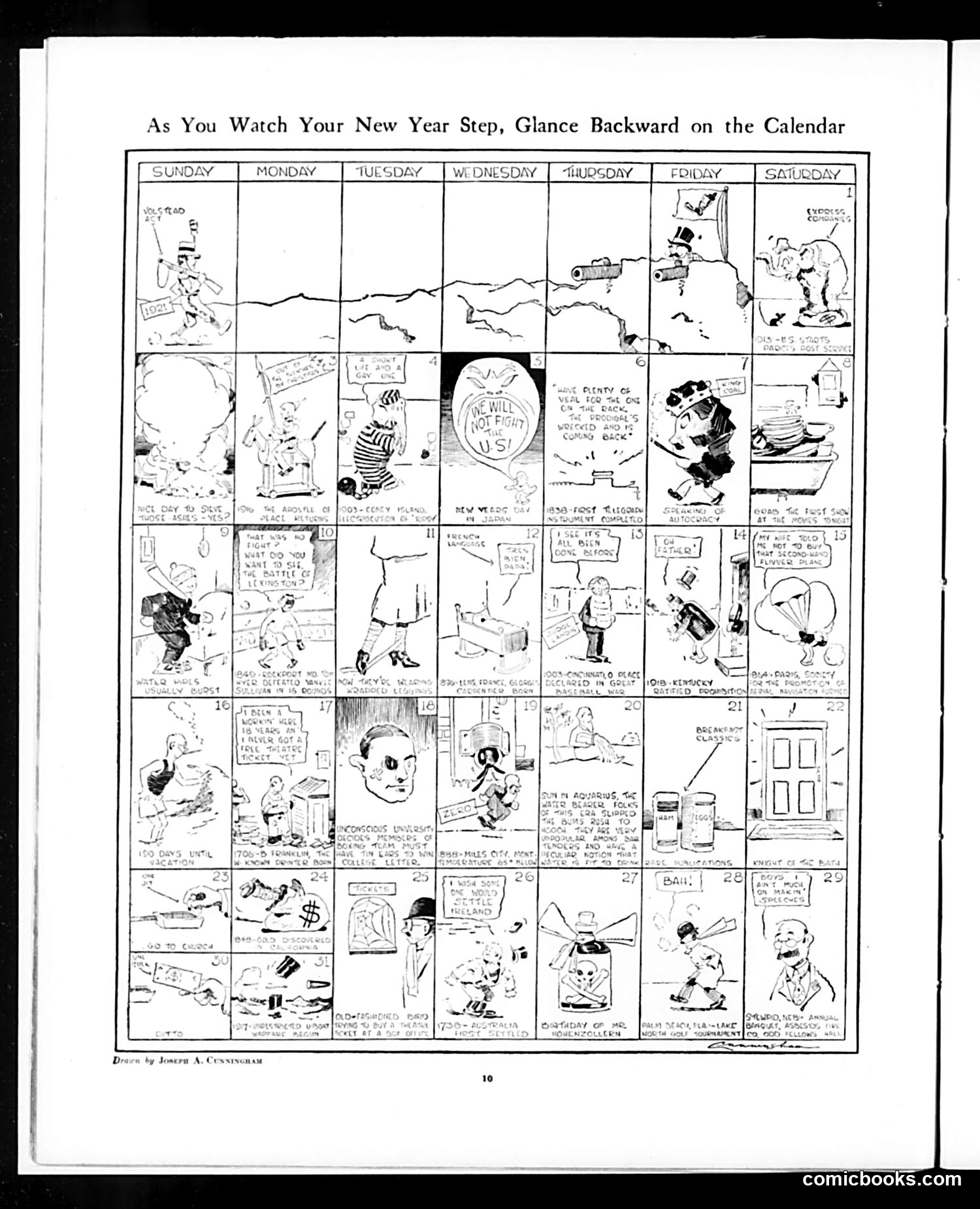
This is a **daily comic strip calendar** by James A. Cunningham depicting humorous New Year's reflections. The strip shows a character reviewing the past year day-by-day, with each panel containing comedic situations and observations. The satire appears to target **everyday American life and personal failings**—including financial struggles (visible money/debt imagery), romantic misadventures, domestic mishaps, and social embarrassments. The character repeatedly finds himself in undignified or problematic situations, suggesting commentary on the challenges of ordinary people navigating modern society. The "glance backward" framing invites readers to recognize themselves in these relatable failures and comedic misfortunes, making gentle fun of universal human weakness and the hope that the new year might bring improvement—a common Judge magazine theme combining humor with social observation.
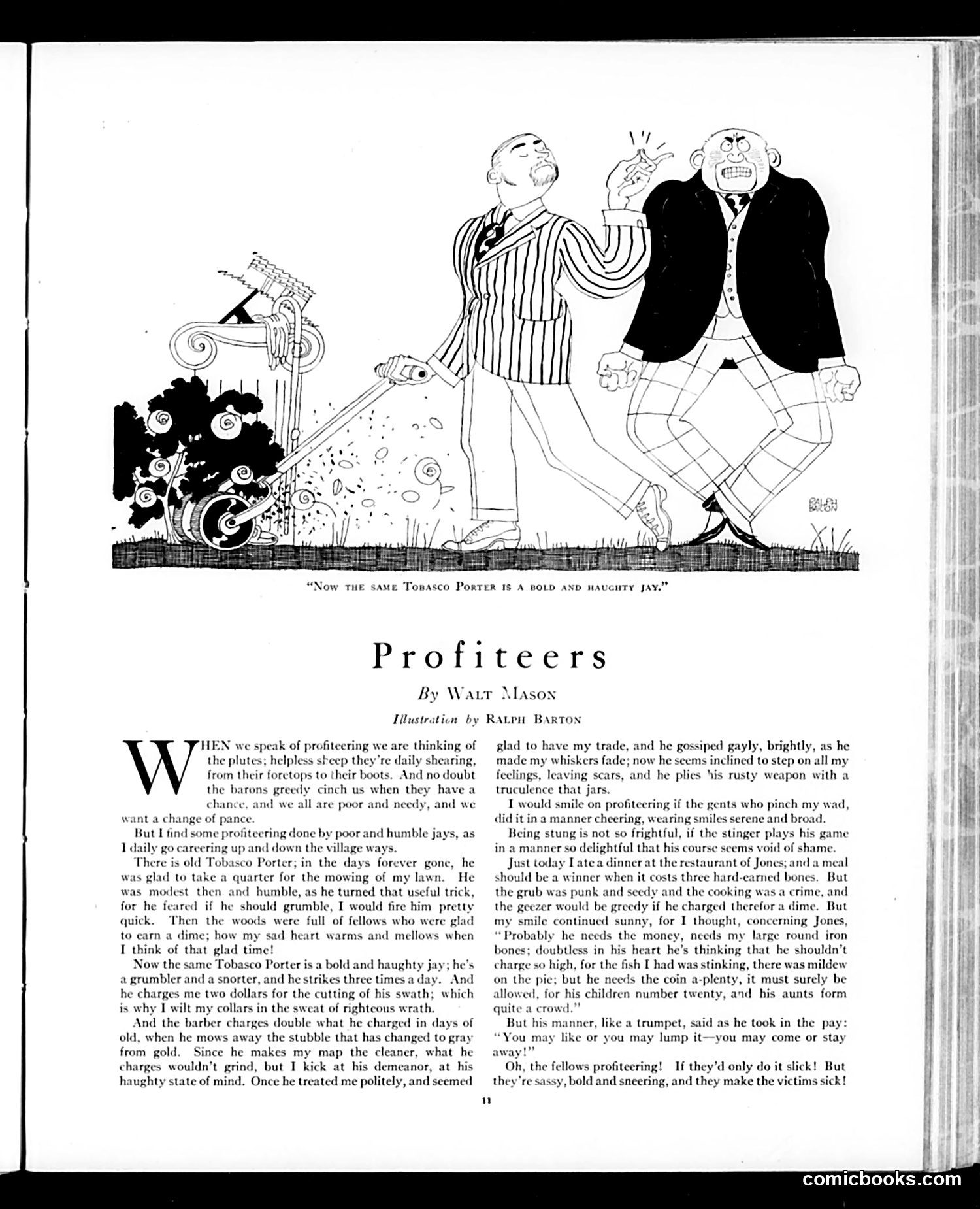
This is a satirical poem with illustration about **wartime or post-war profiteering**—when ordinary working-class people exploit customers through price-gouging and poor service. The cartoon depicts two grotesque figures: a barber and Tobasco Porter (a lawn-mower), now acting as arrogant "profiteers." The text contrasts their former humble, polite service with their current greed and rudeness. The narrator, despite being cheated—overcharged for bad food, poor haircuts, lawn-mowing—tries to rationalize their behavior as financial desperation ("he needs the money," "his children number twenty"). The satire's point: **small-time working-class profiteers are worse than wealthy ones because they add insult to injury**—they're rude and contemptuous while gouging. The narrator can forgive greed if done "cheerily," but resents the arrogance. The final couplet condemns profiteers for being "sassy, bold and sneering"—their attitude makes victims "sick." The illustration's exaggerated facial expressions emphasize their contemptible, predatory nature.
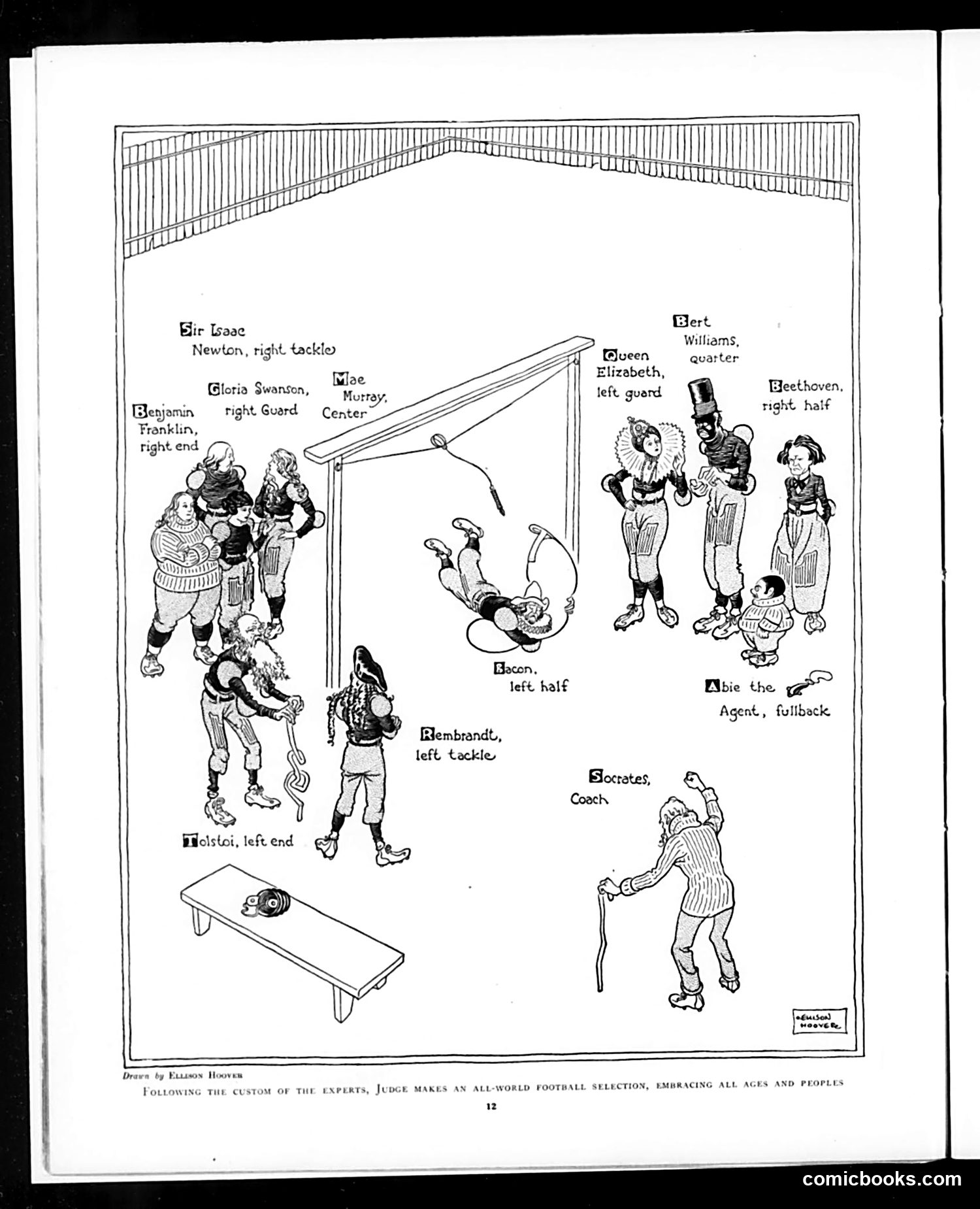
This is a humorous cartoon depicting an absurdist "all-world football team" composed of famous historical and contemporary figures rather than actual athletes. The satire mocks the era's tendency for experts to make grandiose "all-time" selections by taking the concept to an ridiculous extreme. The roster includes: - **Historical figures**: Isaac Newton, Benjamin Franklin, Rembrandt, Bacon, Socrates (as coach) - **Classical/artistic figures**: Beethoven - **Contemporary celebrities**: Gloria Swanson (silent film star), appearing to be other entertainers Each is assigned a football position as if their names or achievements somehow qualify them for the sport. The joke appears to target the pretentiousness of sports experts and the arbitrary nature of "all-world" selections—the absurdity of naming philosophers and artists as football players exposes how such expert pronouncements often lack real basis. This reflects early 20th-century American skepticism toward expert authority and cultural pomposity.
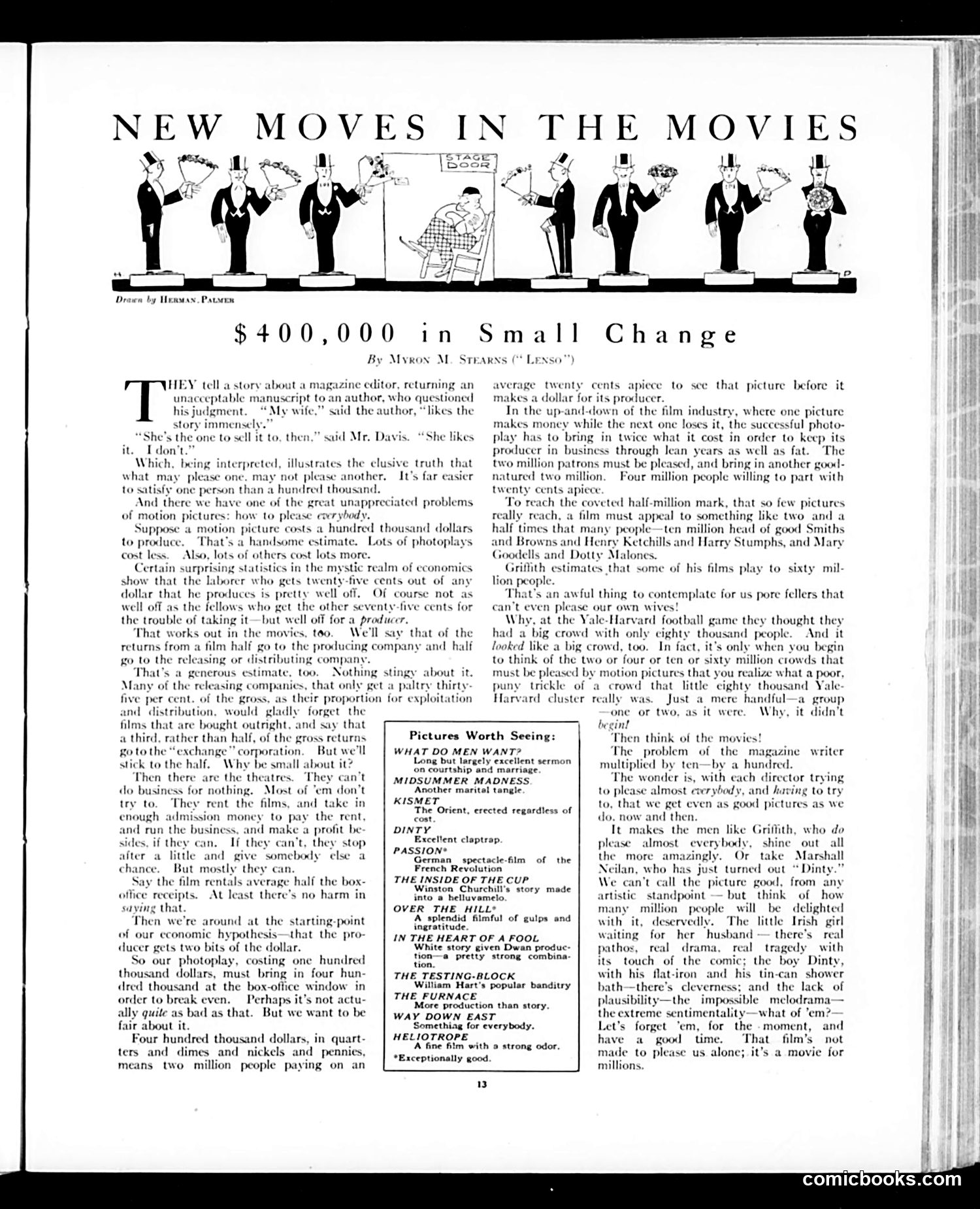
This satirical article by Myron M. Stearns analyzes the economics of film production, using humor to expose an industry paradox: movies must please millions to recoup costs, yet pleasing everyone is nearly impossible. The cartoon header (drawn by Herman Palmer) depicts men in top hats representing different stakeholders—producers, distributors, theater owners—each taking their cut while a figure labeled "STAGE" sits passively. **The satire's point:** A $100,000 film must gross $400,000 at the box office (two million paying customers) just to break even, after accounting for exhibitor cuts, distributor shares, and theater rentals. The author uses ironic economic analysis to argue that producers face impossible odds: they need mass appeal but can't satisfy everyone. This absurdity explains why films often fail financially despite quality work—the system's math is stacked against success. The accompanying film reviews mock contemporary movies' varying quality, reinforcing that profit ≠ artistic merit.
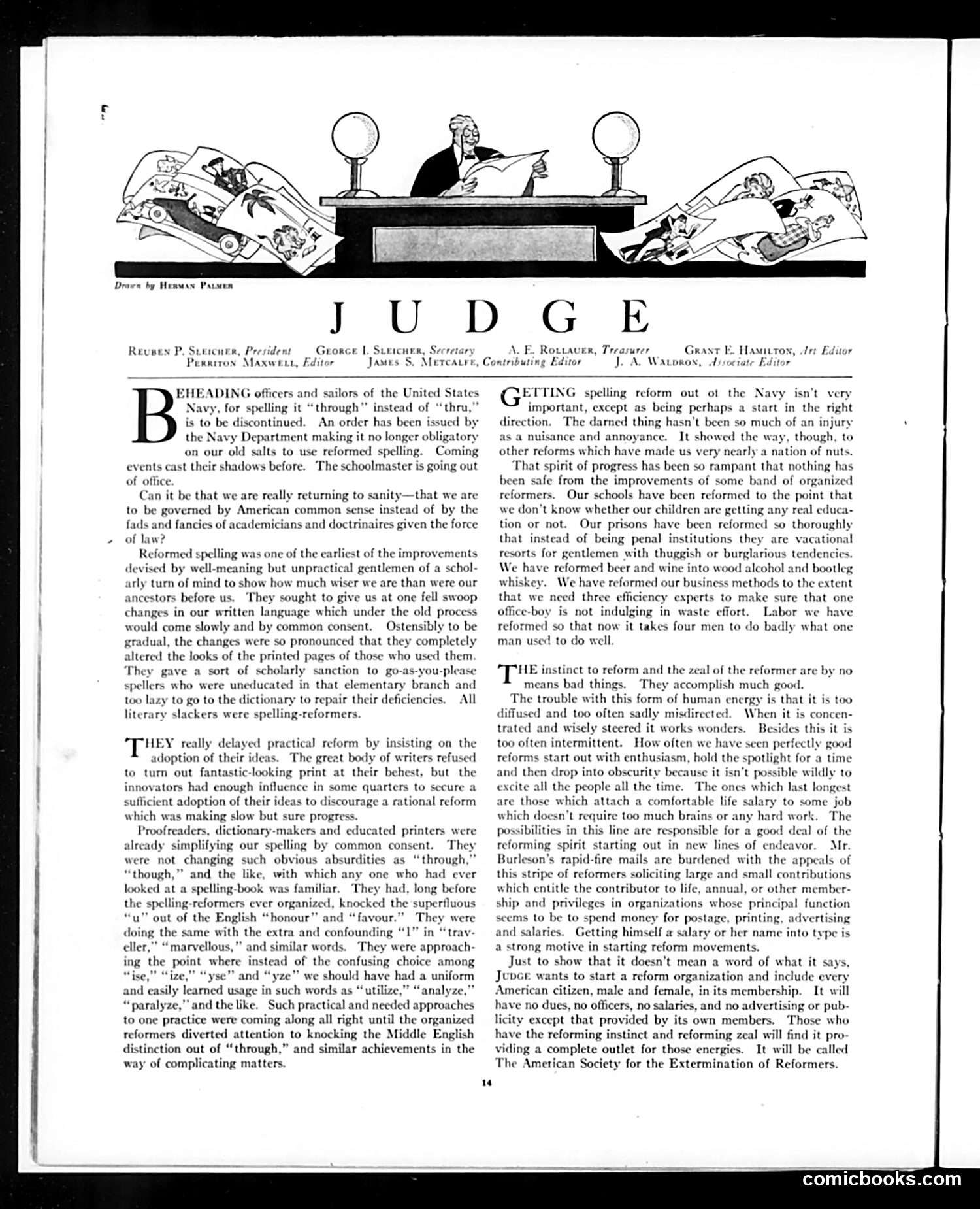
This editorial page attacks the progressive "spelling reform" movement of the early 20th century—efforts to modernize English spelling (e.g., "thru" for "through," removing the "u" from "honour"). The occasion is the Navy Department abandoning mandatory reformed spelling. The author argues reformers were well-intentioned but impractical academics who *delayed* natural spelling evolution. Proofreaders and printers were already gradually simplifying spelling through common consent—the proper way. Organized reformers' insistence on dramatic, artificial changes disrupted this organic process and gave "scholarly sanction to go-as-you-please spellers." The piece sarcastically warns that the spelling-reform spirit exemplifies a broader problem: "organized reformers" imposing changes on schools, prisons, and other institutions, creating "a nation of nuts." The cartoon's judge figure, presumably Herman Palmer's editorial visual commentary, reinforces this skepticism toward expert-driven social "improvement."
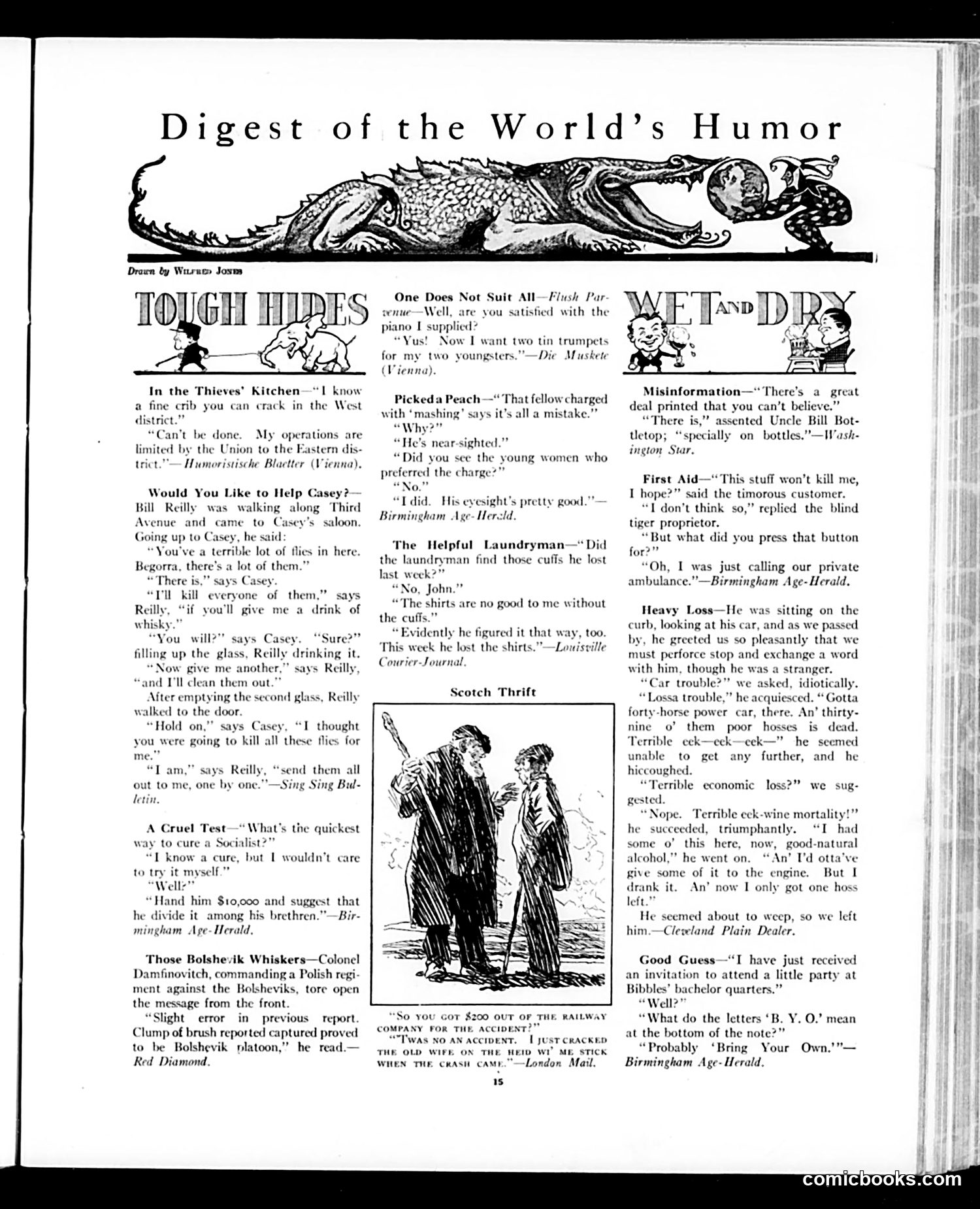
This page from *Judge* collects brief satirical jokes and cartoons typical of early 20th-century American humor magazines. Key content includes: **The cartoons/jokes address:** 1. **Labor unions** ("In the Thieves' Kitchen"): Mocks union work restrictions limiting criminals to specific districts—satire on perceived union inflexibility. 2. **Bolshevism/Red Scare** ("Those Bolshevik Whiskers"): References post-WWI anti-communist sentiment; a Polish colonel mistakes a brush clump for Bolsheviks, mocking both communist threat fears and military incompetence. 3. **Prohibition-era bootlegging** ("First Aid"): References illegal alcohol sales and the blind tiger (speakeasy) proprietor's expectation that his product might poison customers. 4. **Class/wealth satire** ("A Cruel Test"): Jokes that socialists wouldn't truly share wealth—common anti-socialist mockery of the era. The humor reflects 1920s American anxieties: labor militancy, communist fears, Prohibition enforcement, and socialist ideology.
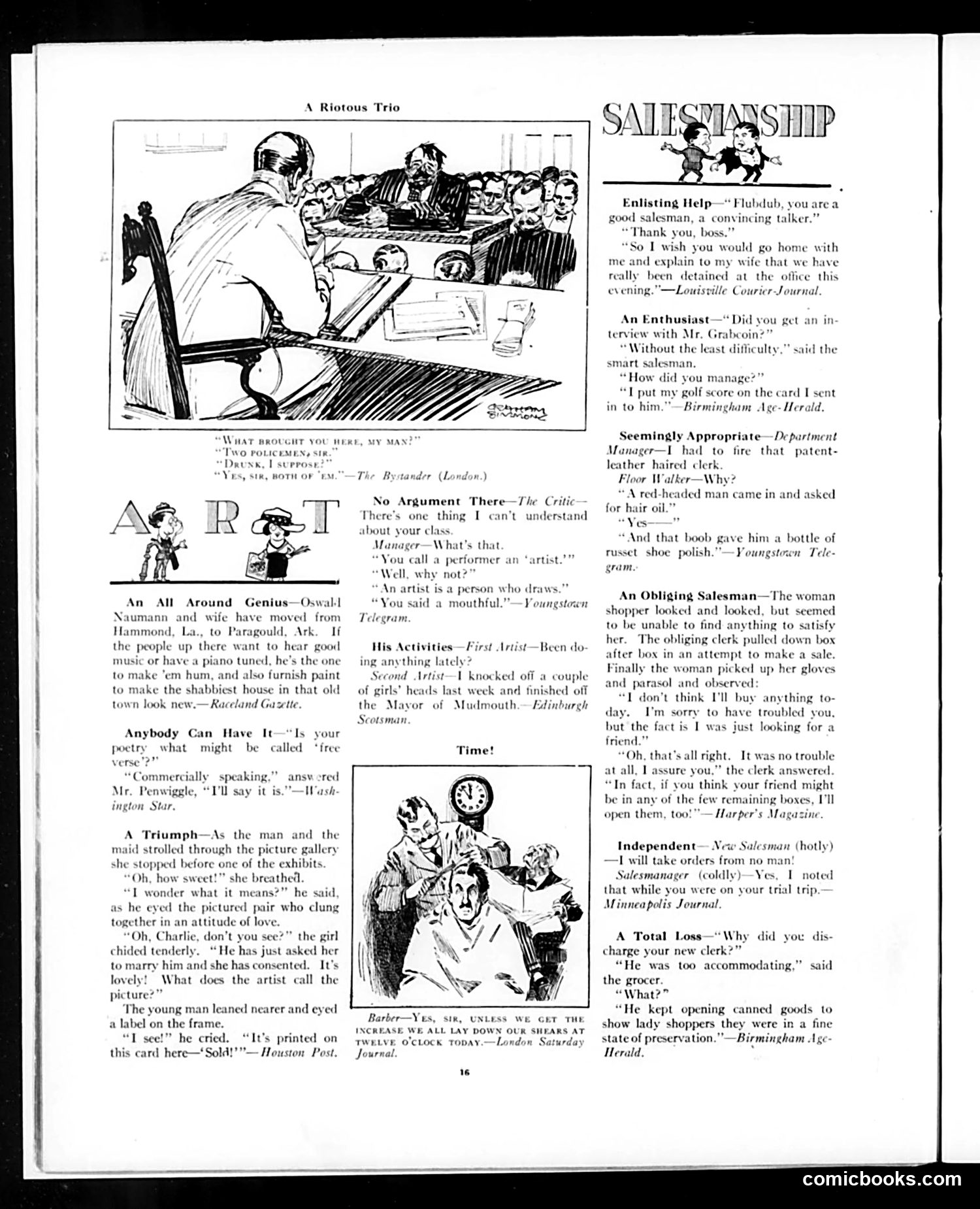
This page from *Judge* contains multiple short humorous anecdotes and cartoons satirizing early 20th-century American business and social life. **Main cartoon ("A Riotous Trio"):** A man confronts two drunk policemen, asking what brought them there. The joke satirizes police corruption or incompetence—both officers are intoxicated while on duty. **Other sections mock workplace absurdities:** - A manager misunderstands "free verse" poetry - An art critic doesn't grasp that "artist" means someone who draws - A barber threatens a strike at noon unless granted a wage increase - A salesman exploits a golf anecdote to secure an interview - A clerk comically gives shoe polish instead of hair oil to a red-headed customer - An overly accommodating grocer opens canned goods for browsing customers, defeating preservation The satire targets incompetent professionals, workplace power dynamics, and the sometimes-absurd customer service expectations of the era. The humor relies on literal misunderstandings and professional failures.
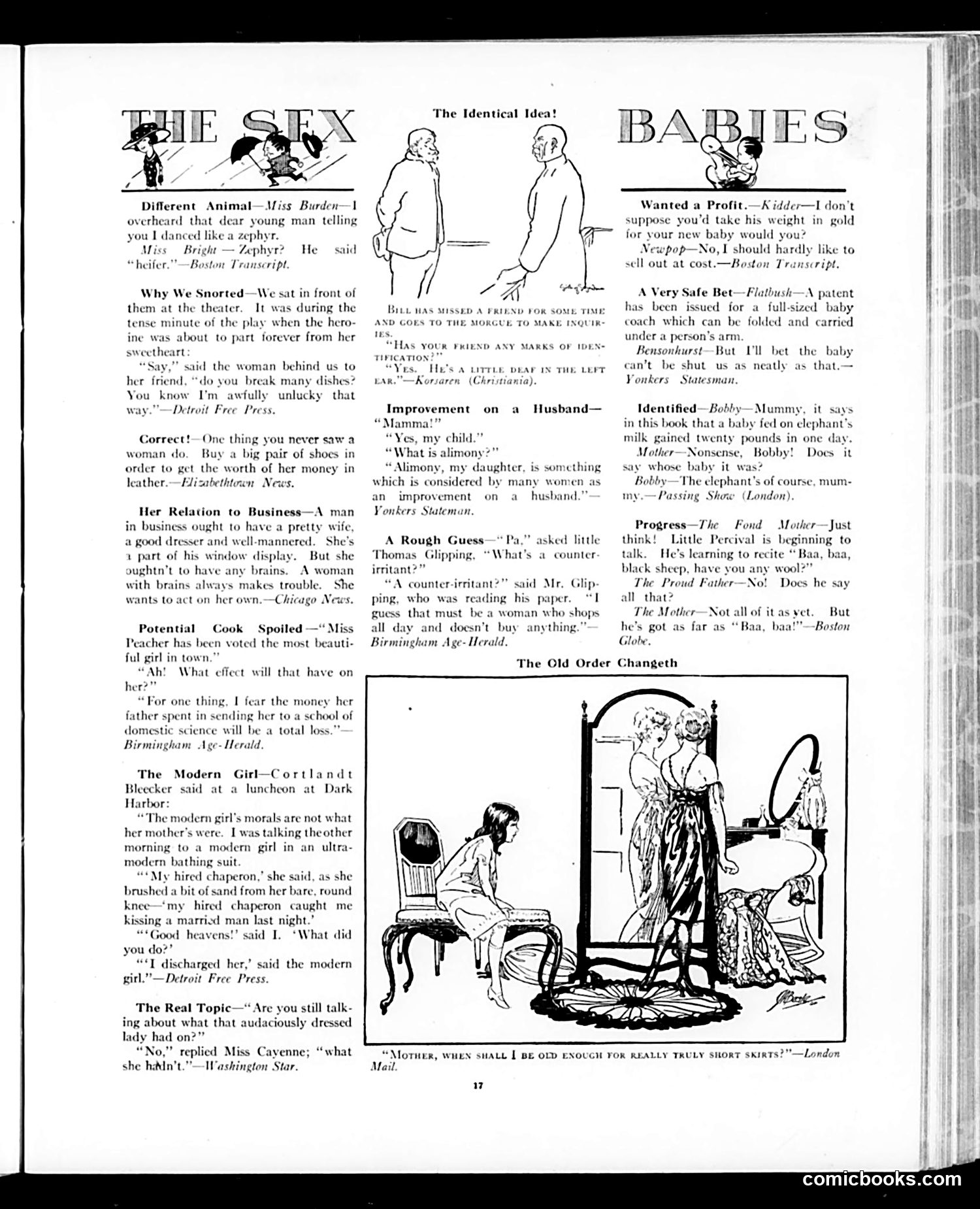
This page from *Judge* (circa early 1900s) contains humorous short anecdotes satirizing contemporary American social attitudes, particularly regarding gender roles and modern life. **Key satirical themes:** - **Women's intellect as liability**: Multiple jokes mock educated or business-minded women, suggesting brains make wives "troublesome" and spoil their value as decorative "window displays." - **Modern morality**: "The Modern Girl" piece satirizes young women's loosening social constraints—a woman dismisses her chaperone after being caught kissing a married man, treating the transgression as the chaperone's failure rather than her own. - **Marriage critique**: The "Improvement on a Husband" joke equates alimony with marital improvement, implying wives view separation as beneficial. - **Fashion/Youth**: The bottom cartoon shows a girl asking when she's old enough for shorter skirts, mocking both fashion trends and generational impatience. The humor targets both women (for ambition, modern behavior) and men (for foolishness), but predominantly reflects anxieties about women's changing social roles in the early 20th century. The tone is condescending toward female independence.
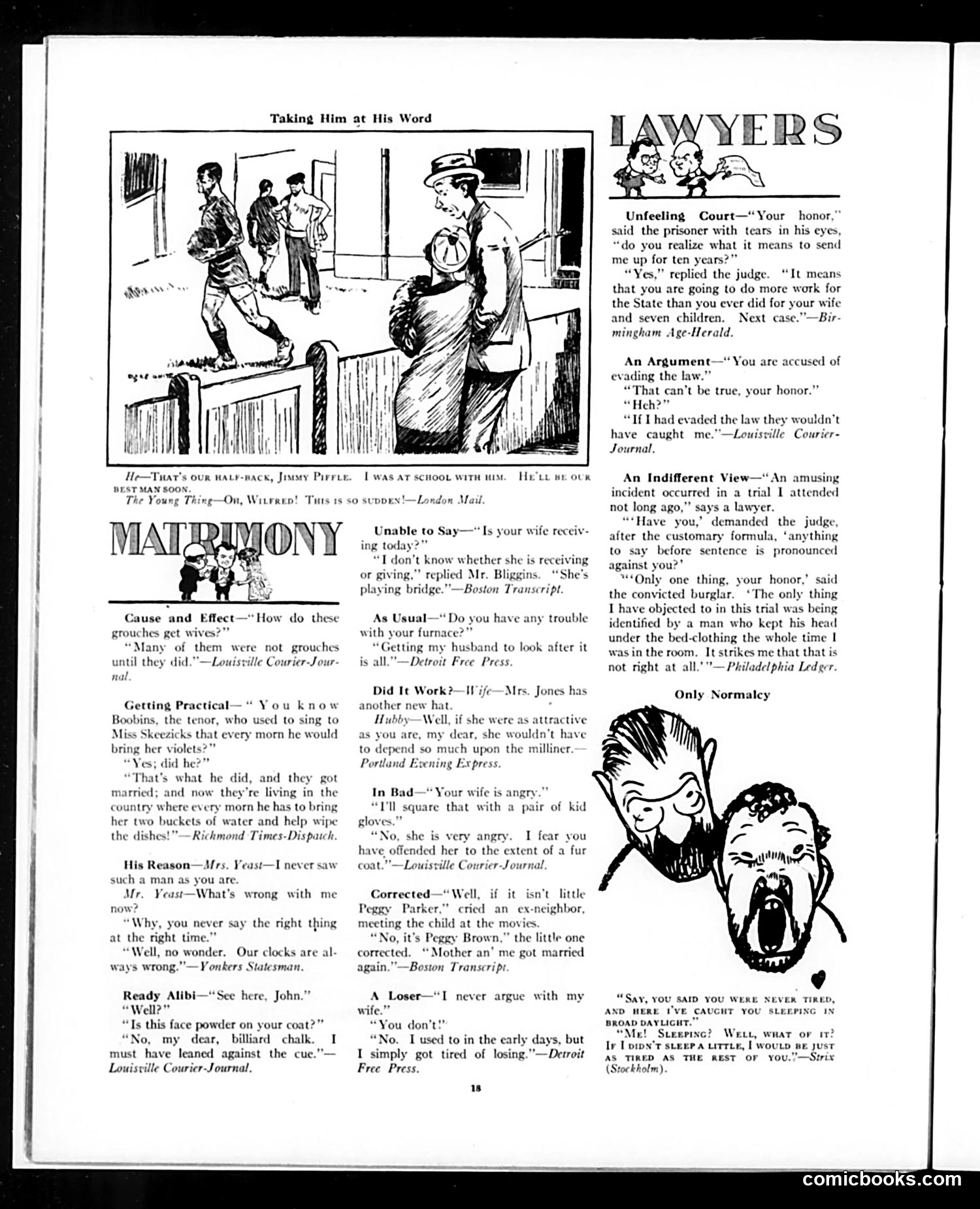
This page collects short humorous anecdotes and jokes typical of early 20th-century American magazines. The content satirizes domestic life and courtroom proceedings. **Key themes:** The main cartoon shows a courtroom scene where a judge sentences a prisoner to ten years, then callously adds he'll do "more work for the State than you ever did for your wife and seven children"—mocking judicial indifference to human suffering. Other jokes target marriage dynamics: wives becoming shrewish after marriage ("grouches get wives"), husbands failing household duties, wives spending on hats and fur coats to appease anger. One anecdote features a burglar objecting that his accuser kept his head under bedclothes—absurdist humor about criminal justice. **The satire:** These pieces mock both domestic disappointment and the legal system's cold efficiency. Marriages devolve from romance (singing suitors) to drudgery (hauling water buckets). Courts show no mercy or understanding. The humor reflects anxieties about matrimony and authority structures common to the era.
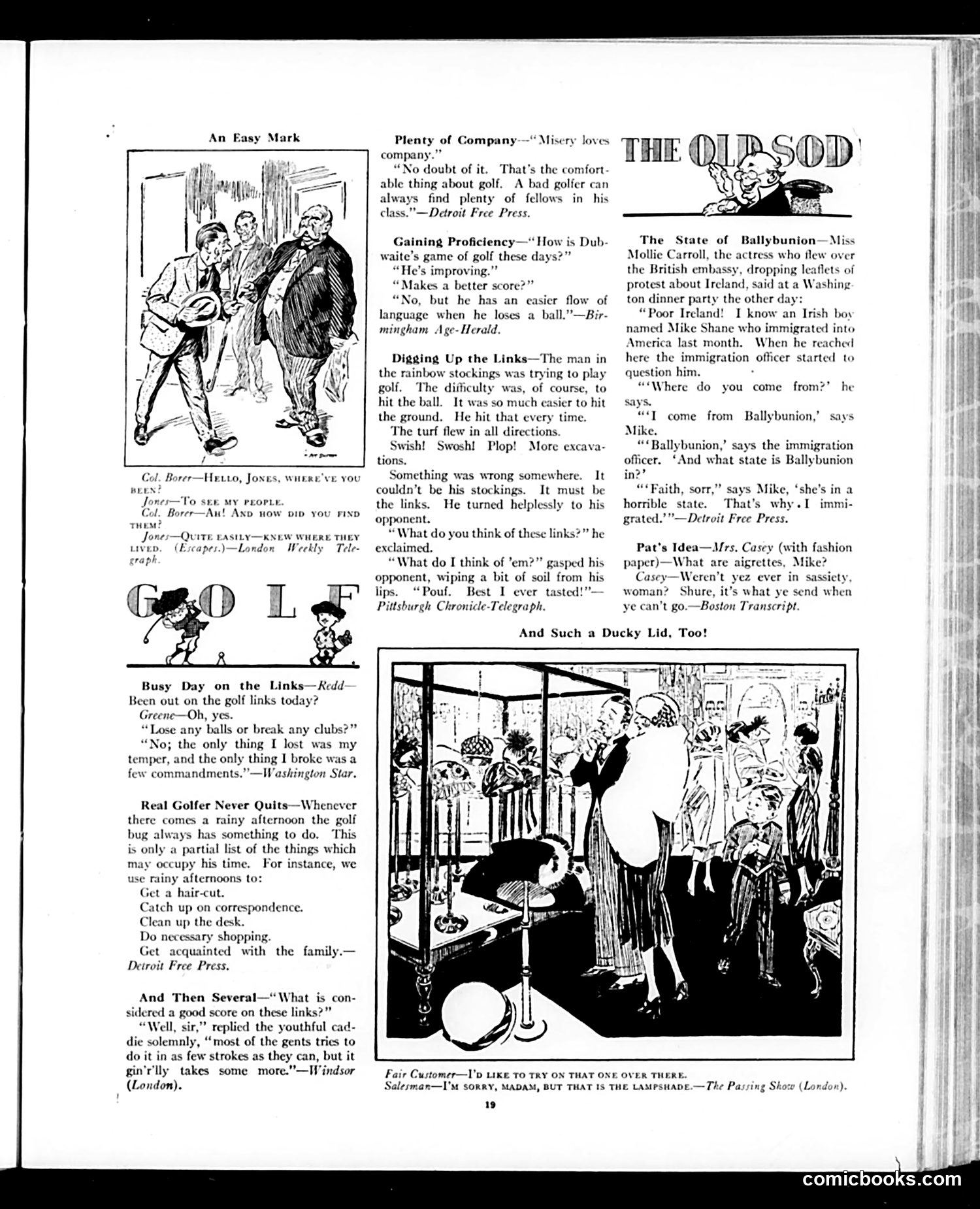
This page from *Judge* contains multiple short humor pieces and cartoons about golf and Irish immigration, typical of early 20th-century American satire. **Golf humor dominates**: Several jokes mock golfers' poor performance, lost temper, and tendency to dig up turf while swinging. One cartoon shows a frustrated golfer destroying the course. The satire targets golf's popularity among the leisure class while poking fun at their actual incompetence. **Irish immigrant joke**: A piece about actress Mollie Carroll references an Irish boy named Mike Shane. When questioned by immigration officials about his origin in "Ballybunion," he responds it's in "a horrible state"—the joke plays on both the actual impoverished condition of Ireland and the wordplay of "state" (geographical location vs. condition). **Class humor**: "Pat's Idea" mocks working-class Irish characters discussing fashion terms they don't understand, reinforcing period stereotypes. The overall tone reflects contemporary attitudes toward immigrants and the leisure activities of the wealthy classes.
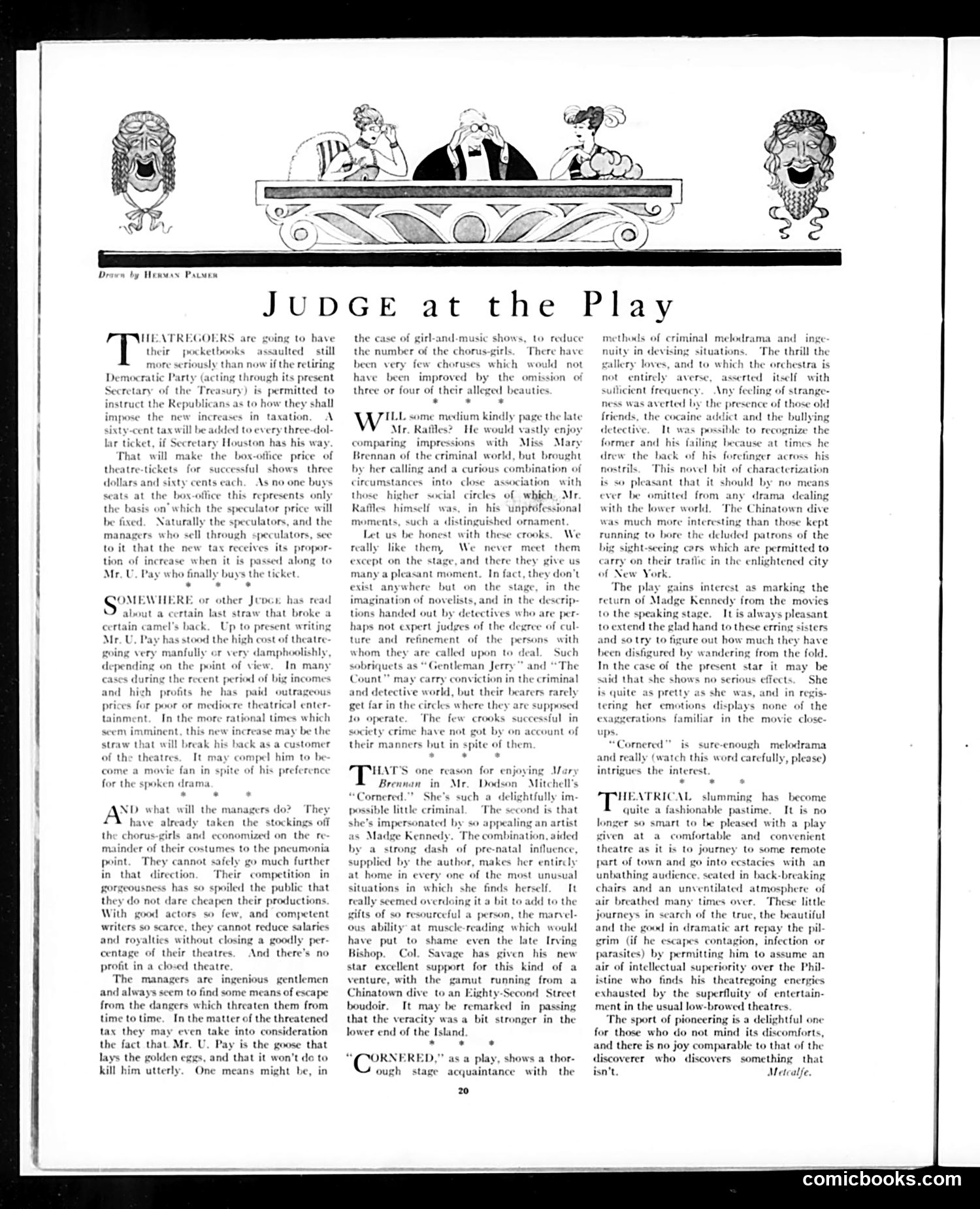
This article satirizes a proposed entertainment tax by Secretary of the Treasury William Houston, aimed at theatregoers during the Democratic administration. The piece argues the tax will devastate theater owners and actors while punishing the regular theatergoer ("Mr. U. Pay"—a pun on "you pay"). The satire's target: speculators and theater managers who will absorb the new cost into ticket prices, making live theater unaffordable and potentially driving audiences to cheaper movies instead. The author mocks managers' attempts to economize by cutting chorus girls and production values—arguing they've already stripped costs to the bone. A secondary commentary discusses stage portrayals of criminals (referencing "Raffles" and "Gentleman Jerry" archetypes), suggesting theatrical depictions bear little resemblance to actual criminals or their social circumstances—a jab at melodramatic crime entertainment of the era. The cartoon's decorative header shows classical theatrical masks and judges, reinforcing the "judgment" theme of theater criticism.
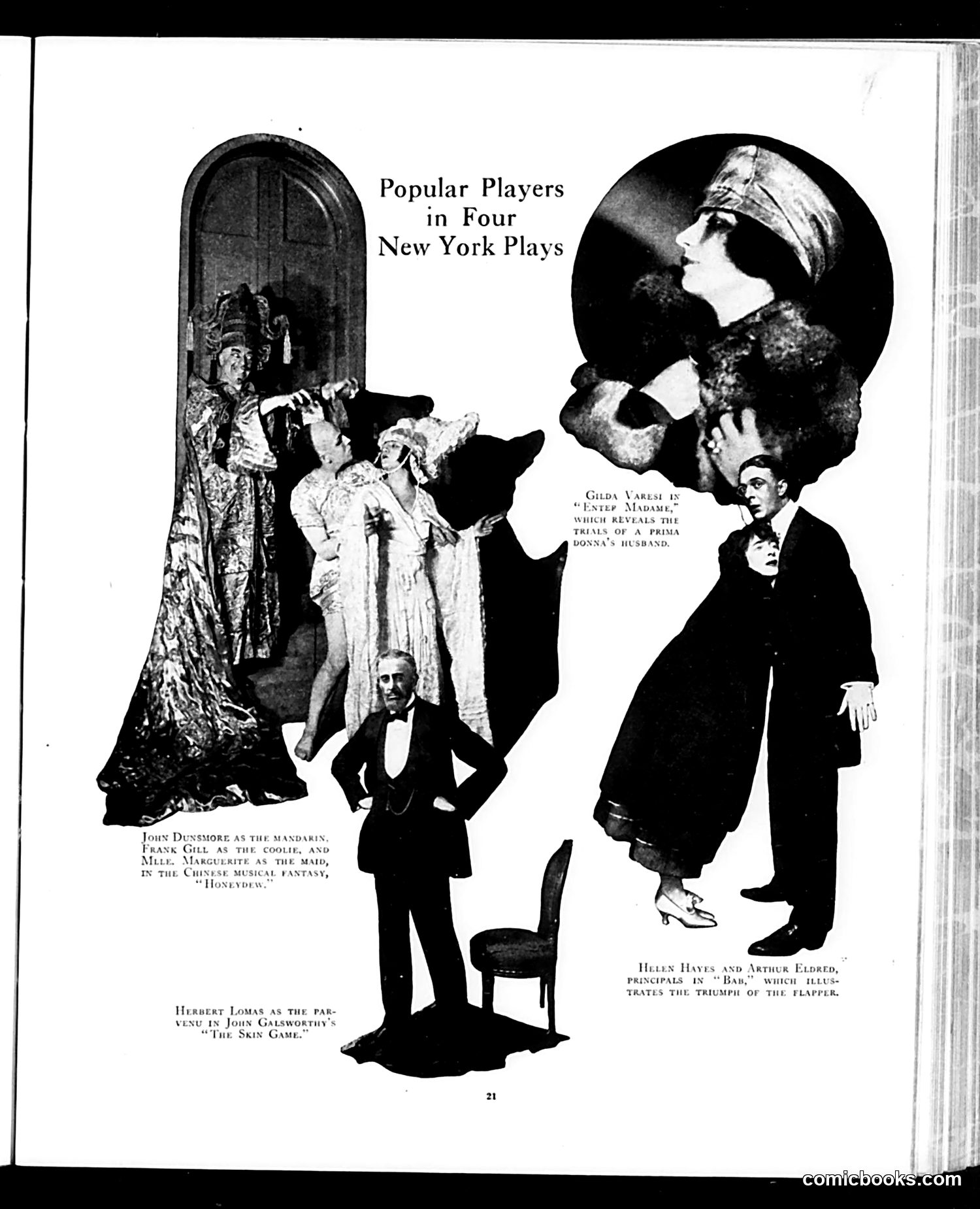
This page showcases four popular Broadway productions circa the 1920s. It features photographs of actors in their theatrical roles: 1. **"Enter Madame"** stars Gilda Varesi in a play about a prima donna's husband—a domestic comedy about opera world tensions. 2. **"Honeydew,"** a Chinese musical fantasy, features John Dunsmore as a mandarin, with supporting roles by Frank Gill and Mlle. Marguerite. 3. **"Bar"** stars Helen Hayes and Arthur Eldred, described as illustrating "the triumph of the flapper"—a reference to the 1920s young woman archetype known for defying Victorian conventions through dancing, smoking, and liberated behavior. 4. **"The Skin Game"** by John Galsworthy features Herbert Lomas as a "parvenu" (newly rich person)—likely satirizing social climbing and class tensions. This is essentially theatrical promotion content rather than satirical commentary.
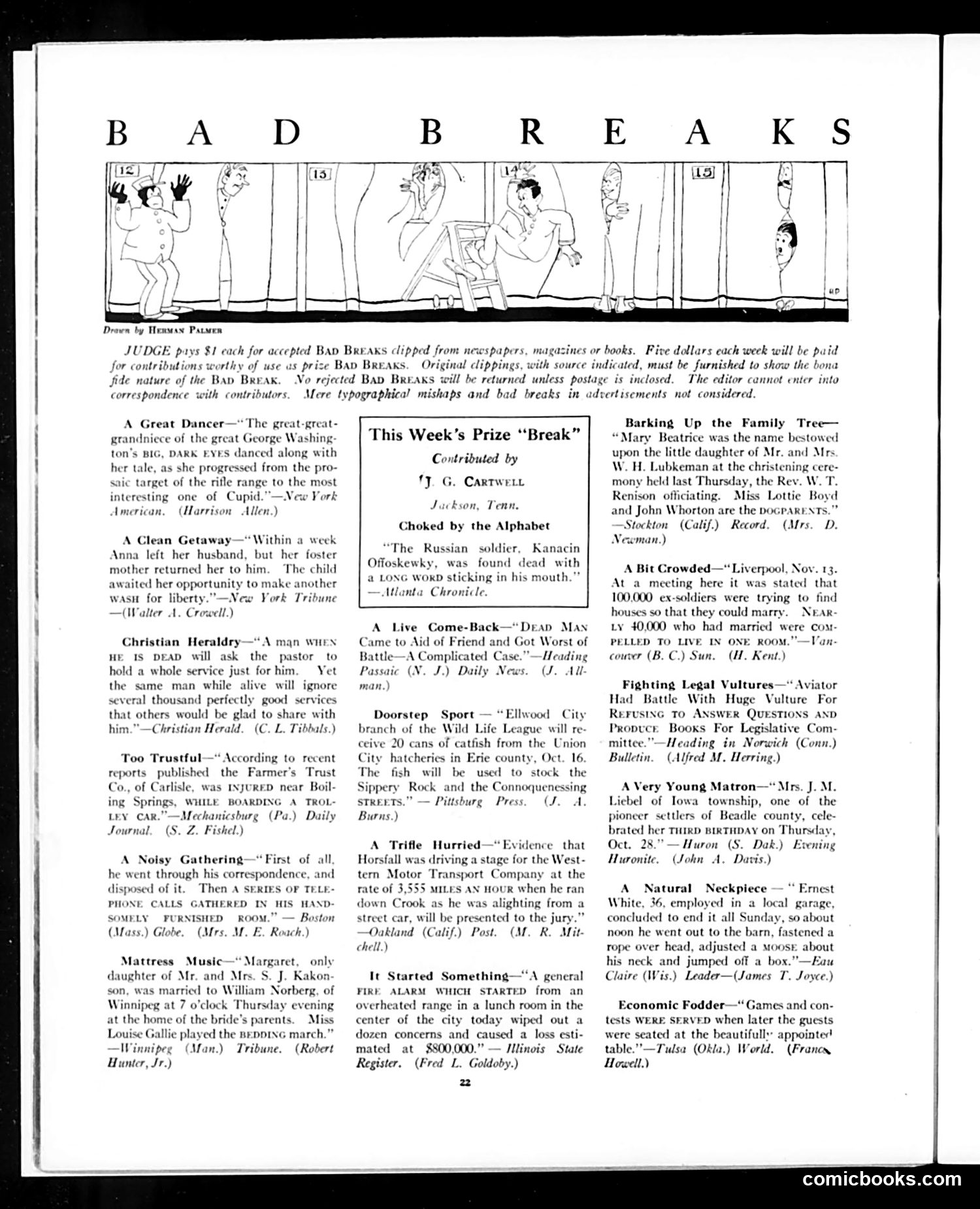
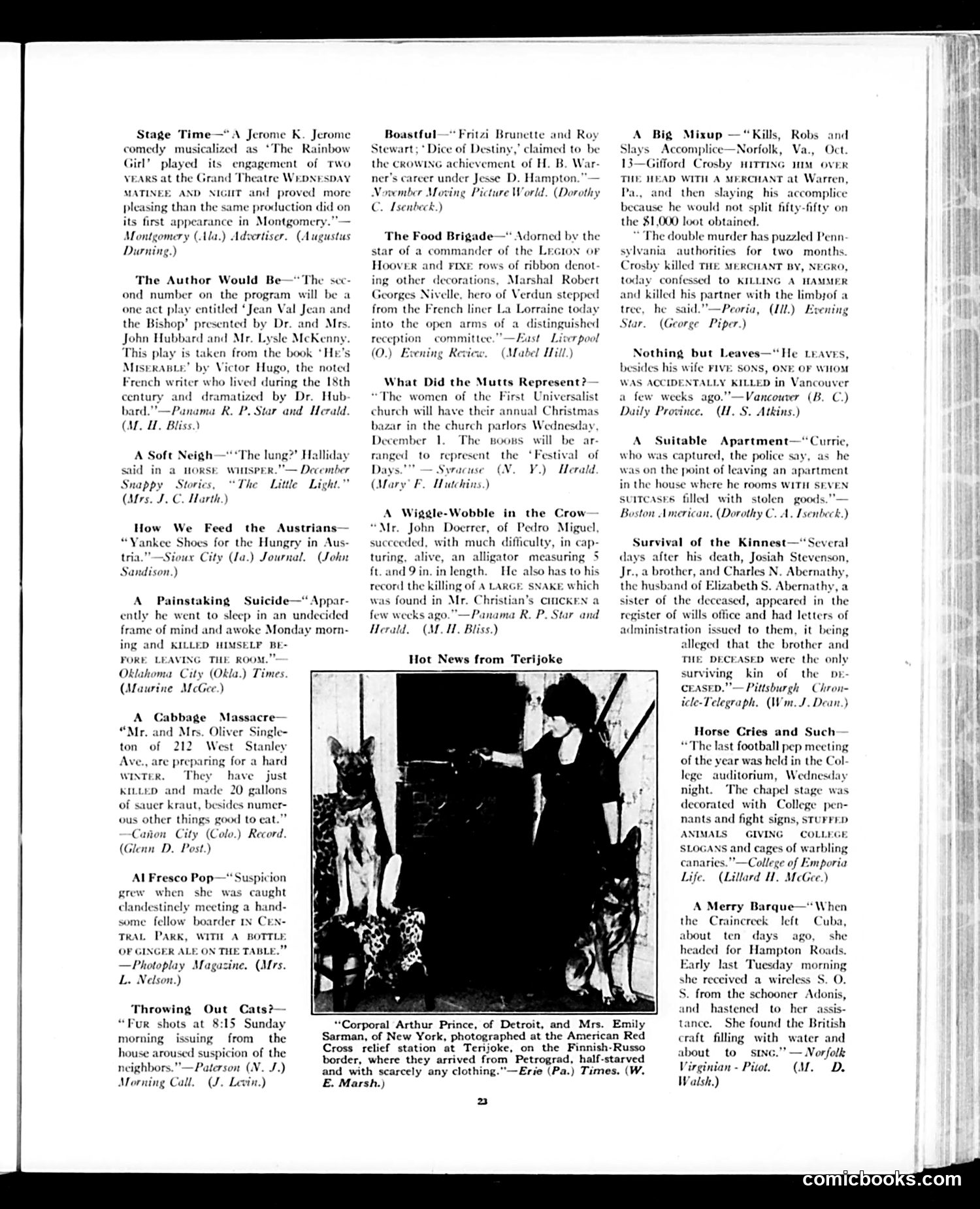
This page from *Judge* magazine showcases a humor feature called "Bad Breaks"—funny, unintentional errors from newspapers, magazines, and books. Readers submitted clipped examples of typographical mishaps, malapropisms, and accidental double-entendres that created unintended comedy. The examples ridicule newspapers' carelessness. Notable ones include: a soldier allegedly "choked by the alphabet" (a long word stuck in his mouth); someone driving a stage at "3,555 miles an hour"; and a fire that "wiped out a dozen concerns" from an overheated kitchen range—the absurd casualty figures exposing sloppy editing. The top cartoon by Herman Palmer illustrates the feature's concept through physical comedy. The feature essentially crowdsourced humor by publicly embarrassing careless publications, while rewarding readers one dollar per accepted submission—a form of early reader engagement and gentle press criticism wrapped in satire.
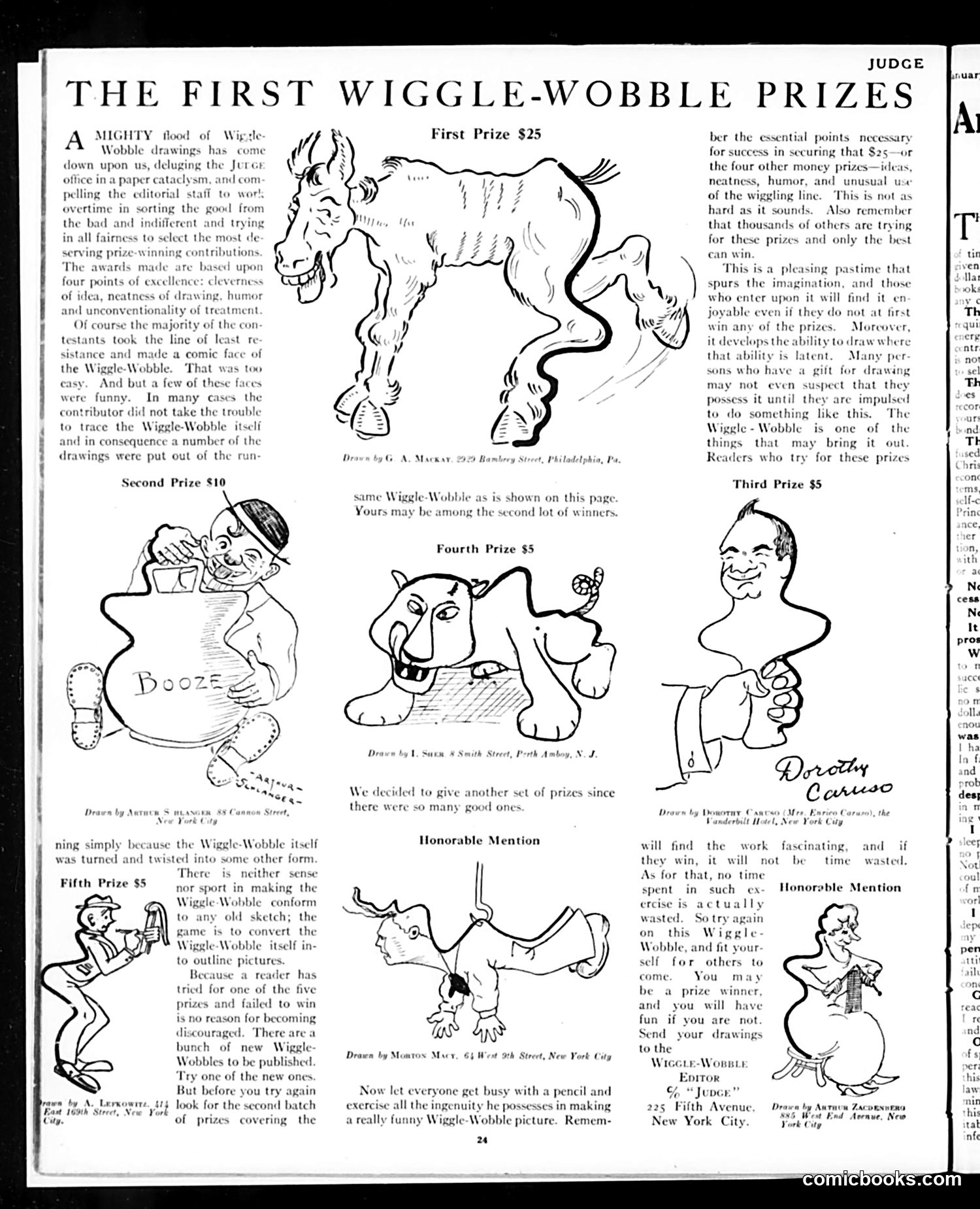
This page announces *Judge* magazine's drawing competition for readers. The "Wiggle-Wobble" is a continuous, undulating line that contestants must transform into recognizable cartoon figures—animals, people, or objects—while keeping the original squiggly form intact. The page displays prize-winning entries ($25 first prize down to $5 fifth prize, plus honorable mentions) that show varied interpretations: a cow, a drunk man with "booze," a dog, a smiling man, and a dancing figure. The editorial text emphasizes that success requires humor, neatness, and creativity in converting the line itself into pictures—not simply redrawing it as something else entirely. Judges rejected many entries for lazily tracing the Wiggle-Wobble without genuine artistic transformation. This was a popular participatory feature encouraging amateur artistic talent, likely designed to boost magazine sales and reader engagement during the early 20th century.
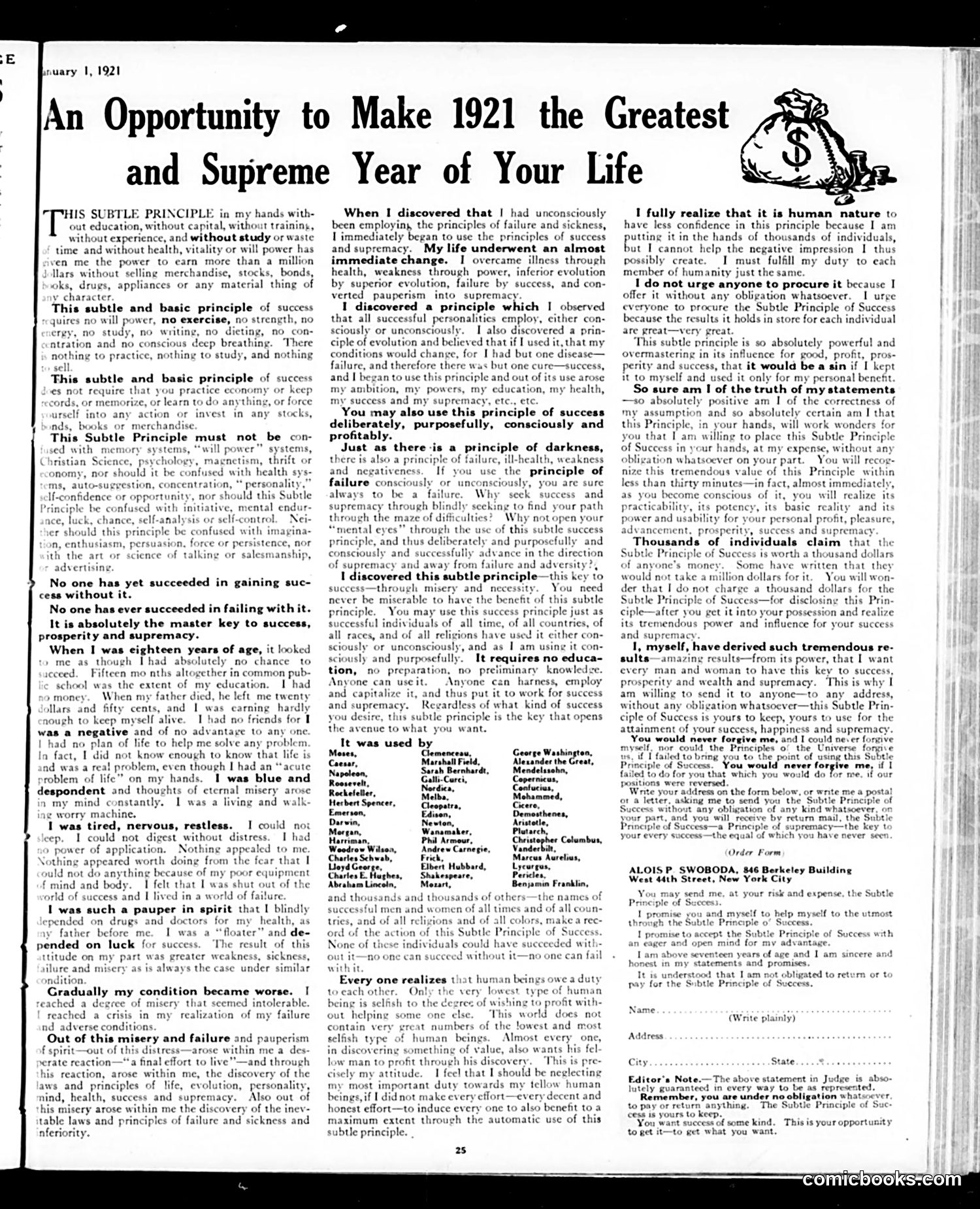
This page is **not a political cartoon** but rather a full-page advertisement disguised as editorial content—a common practice in early 20th-century magazines. The ad promotes the "Subtle Principle of Success," a self-help scheme by Alois P. Swoboda (advertised at bottom). Swoboda claims his principle requires no education, capital, effort, or work—just belief in his system—to earn "more than a million dollars." The text is a classic **get-rich-quick pitch**, using a rags-to-riches narrative (Swoboda's personal story of overcoming poverty) to sell his correspondence course. The repeated insistence that success requires "no will power," "no study," and "no action" is intentionally paradoxical—designed to appeal to desperate readers seeking effortless wealth. This reflects early 1920s **commercial exploitation** of working-class anxieties about prosperity. The ad's prominence in *Judge* (a satirical magazine) is itself somewhat ironic, though such ads subsidized publications.
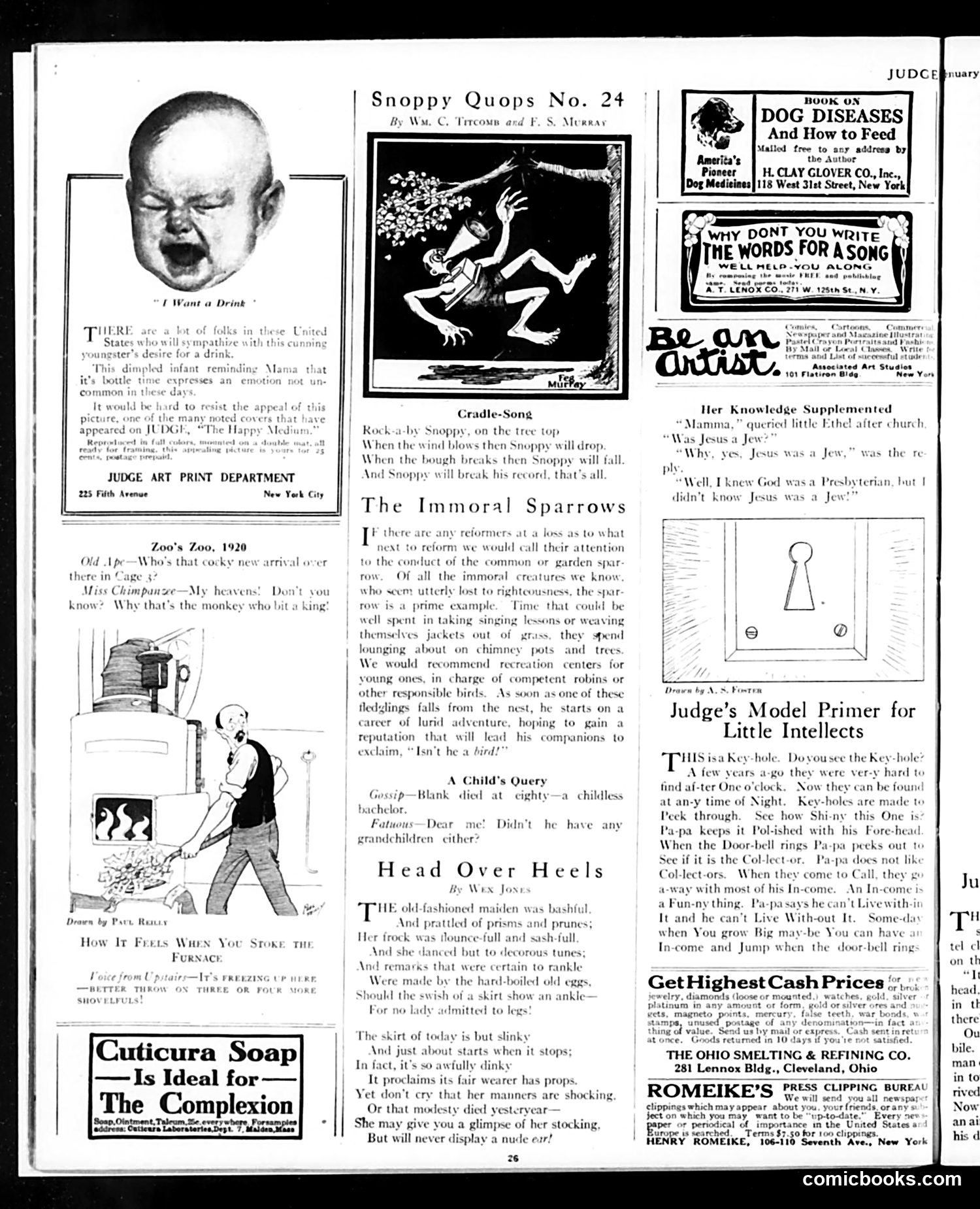
This page from Judge magazine (appears to be from 1920, based on "Zoo's Zoo, 1920" reference) contains several satirical pieces typical of the era: **"Sloppy Quops"** is a comic strip about a character who falls from trees, illustrated with simple humor. **"The Immoral Sparrows"** satirizes moral reformers by suggesting they should establish "recreation centers" for sparrows—mocking the Progressive Era's enthusiasm for social reform by applying it absurdly to birds' behavior. **"Head Over Heels"** contrasts old-fashioned modest women (who hide ankles) with modern "flappers" who wear short skirts but still won't expose their ears—satirizing changing female fashion and morality in the 1920s. The page also includes lighter fare: a child's innocent religious confusion (not knowing Jesus was Jewish), a "Model Primer" teaching children about keyholes and bill collectors, and advertisements for dog medicine and soap. Overall, the page reflects post-WWI American concerns about modernization, changing social values, and moral standards—presented through humor and satire.
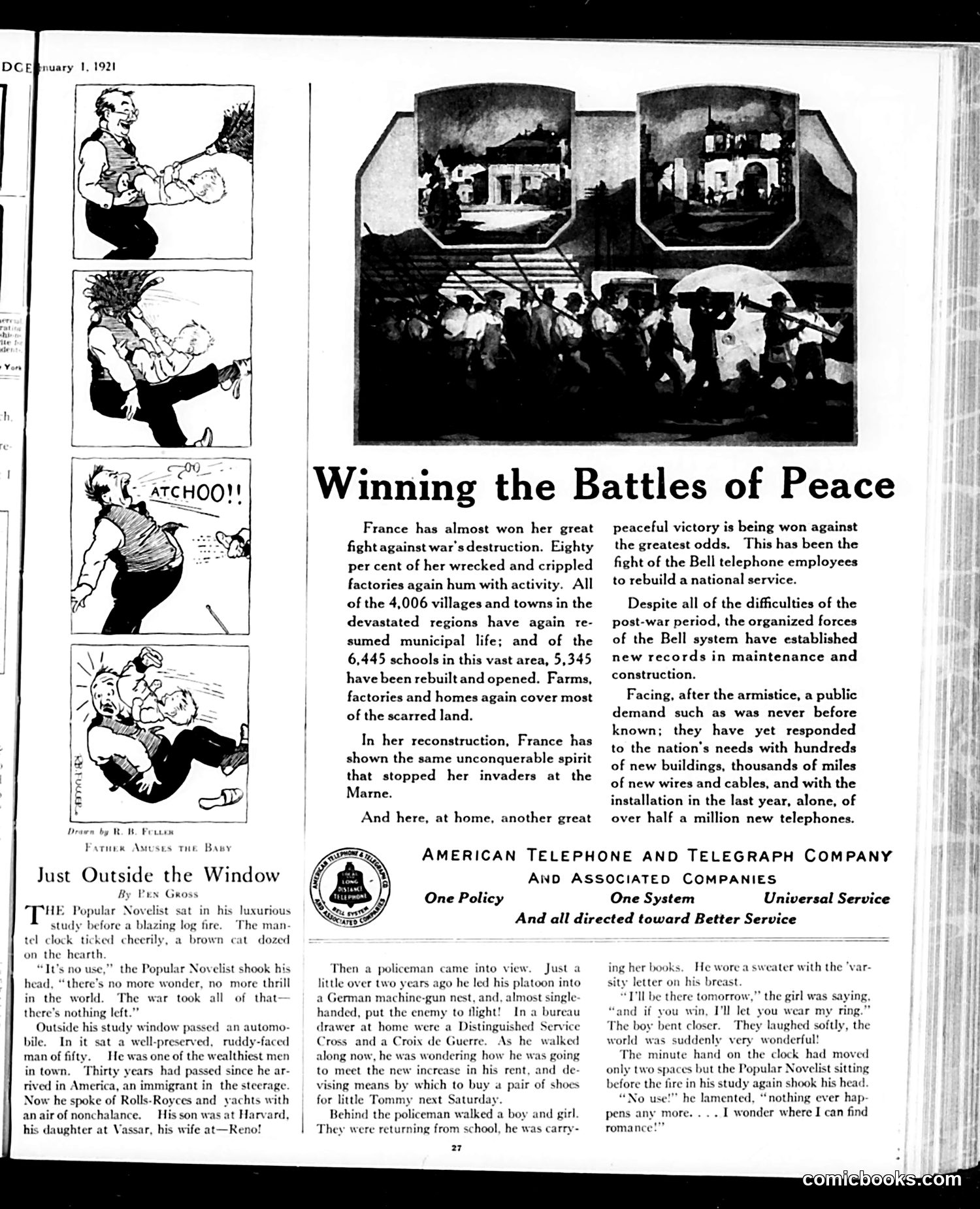
This satirical story contrasts the Popular Novelist's jaded post-WWI despair with the vibrant human drama unfolding outside his window. The novelist, unable to find "wonder" after the war, considers life exhausted of meaning—yet the page presents four compelling figures he overlooks: 1. **The wealthy immigrant** (Rolls-Royce owner)—success achieved, but his wife is divorcing him ("at—Reno!") 2. **The decorated policeman**—a war hero now struggling financially, worried about rent and buying shoes for his son 3. **Two young lovers**—finding joy and romance despite modest circumstances The satire targets literary pessimism: a writer complaining life lacks drama while genuine human struggles and triumphs literally pass by. The page also includes a Bell Telephone advertisement about America's post-war reconstruction efforts, suggesting national resilience contrasts sharply with the novelist's cynicism. The joke is that reality—messy, complex, human—offers far more compelling stories than the novelist recognizes.
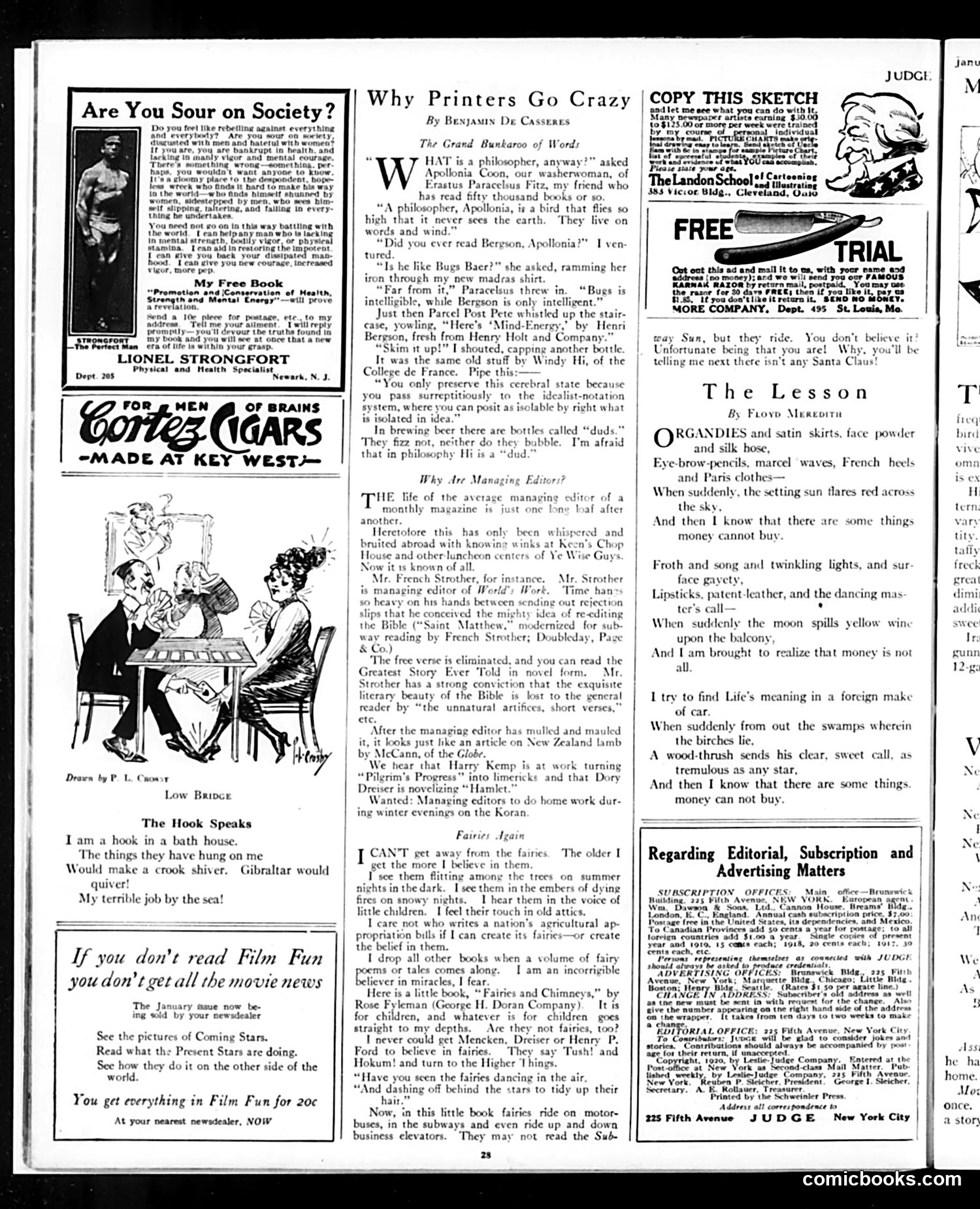
This page from *Judge* satirizes literary and editorial pretension through three main pieces: **"Why Printers Go Crazy"** mocks philosophical obscurantism. The character Paracelsus reads Bergson—a contemporary French philosopher known for dense, abstract writing—aloud while working-class Apollonia irons shirts. The joke: Bergson's incomprehensible jargon about "idealist-notation systems" is compared to defective beer bottles ("duds") that don't fizz. It's satire of both impenetrable academic philosophy and the absurdity of quoting it in everyday settings. **"Why Are Managing Editors?"** ridicules magazine editors who "improve" classic literature. Editor Strother supposedly rewrites the Bible's Matthew as a novel, while editor Harry Kemp converts *Pilgrim's Progress* into limericks and Dreiser novelizes *Hamlet*. The satire: editors busily mangle masterworks under the guise of making them accessible—destroying their beauty through misguided "modernization." The page's advertisements and other content are peripheral to these two satirical pieces attacking pretentiousness in literature, philosophy, and editorial judgment.
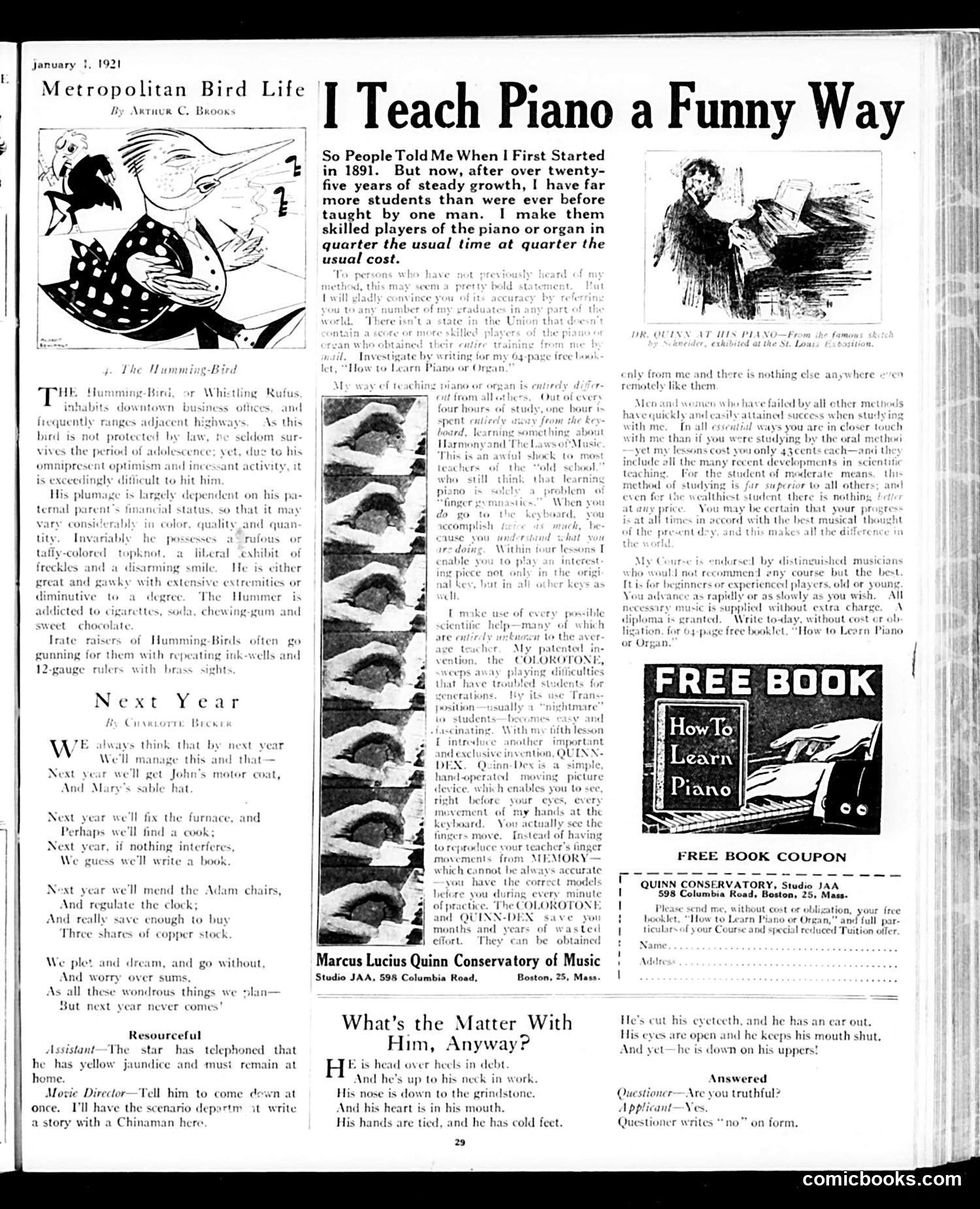
This page mixes editorial cartoons with advertising and humor. **"Metropolitan Bird Life"** presents a naturalist's description of the "Humming-Bird" (a human type)—a young man dependent on parents, addicted to cigarettes and chocolate, difficult to "hit" (catch/marry), sporting yellow jaundice. The piece satirizes idle youth of the era. **"Next Year"** is a humorous poem about perpetual procrastination—people constantly deferring life improvements (fixing the furnace, hiring a cook, writing a book) until "next year," which "never comes." This reflects post-WWI anxieties and unfulfilled promises. **"What's the Matter With Him, Anyway?"** depicts a man simultaneously burdened by debt, overwork, and desperation—head "over heels in debt," "up to his neck in work," "down to the grindstone," with "cold feet." It's likely commentary on post-war economic hardship. The page also contains substantial advertising for piano lessons and a free instructional booklet.
This is primarily a **promotional and entertainment listing page** from Judge magazine (December 1920). The left side advertises the upcoming January 1st issue, which will feature business forecasts from financial leaders—marketed as providing valuable professional insights at minimal cost. The bulk of the page lists **current Broadway theatrical productions** with brief reviews. These include musicals, comedies, and dramas—titles like "Irene," "The Bad Man," and "The Passing Show of 1920." The right side contains **two advertisements**: one for a hair-dressing product and another for a stammer-cure treatment. There is also an announcement about **Judge's College Wits contest**, an annual competition where college students submit poems, essays, and drawings, with prizes including silver cups. **No political satire or caricature appears on this page.** It functions as a typical entertainment and advertising section of a weekly magazine aimed at middle-to-upper-class readers interested in theater and consumer products.
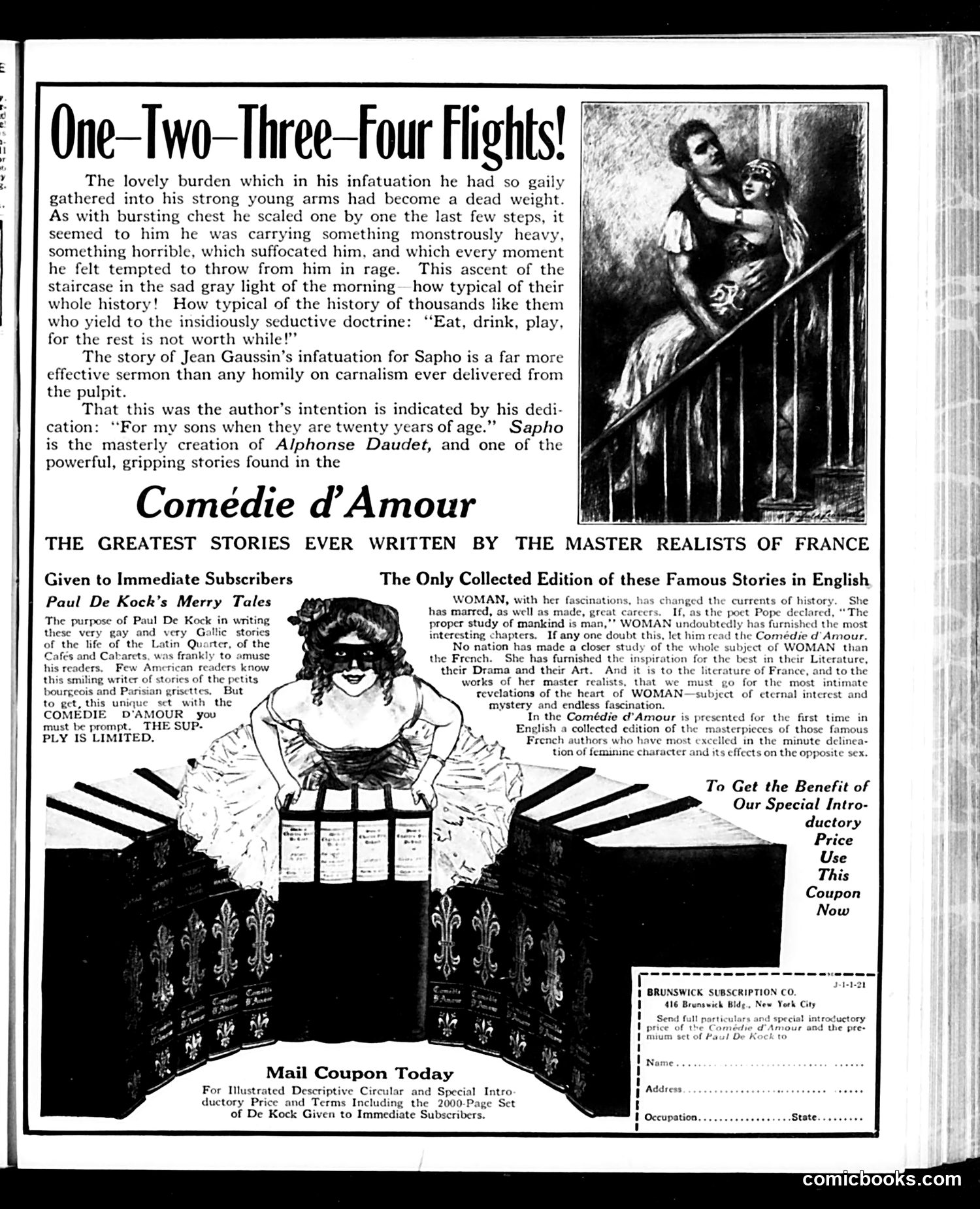
This page is primarily a **book subscription advertisement** for "Comédie d'Amour," a collected edition of French literature. The top illustrates a story by Alphonse Daudet about a young man climbing stairs while carrying a woman—depicting how romantic infatuation becomes burdensome over time. The narrative frames this as moral instruction against hedonism. The bulk of the page advertises a subscription set combining works by Paul de Kock (lighthearted Latin Quarter tales) and other French "master realists." The marketing emphasizes that **women** have been history's greatest subject, positioning these French stories as intimate psychological studies of feminine character and its effects on men. The coupon at bottom invites readers to mail for details and special introductory pricing. This represents early 20th-century American publishing's strategy of marketing European literature as sophisticated, morally instructive entertainment to middle-class subscribers.
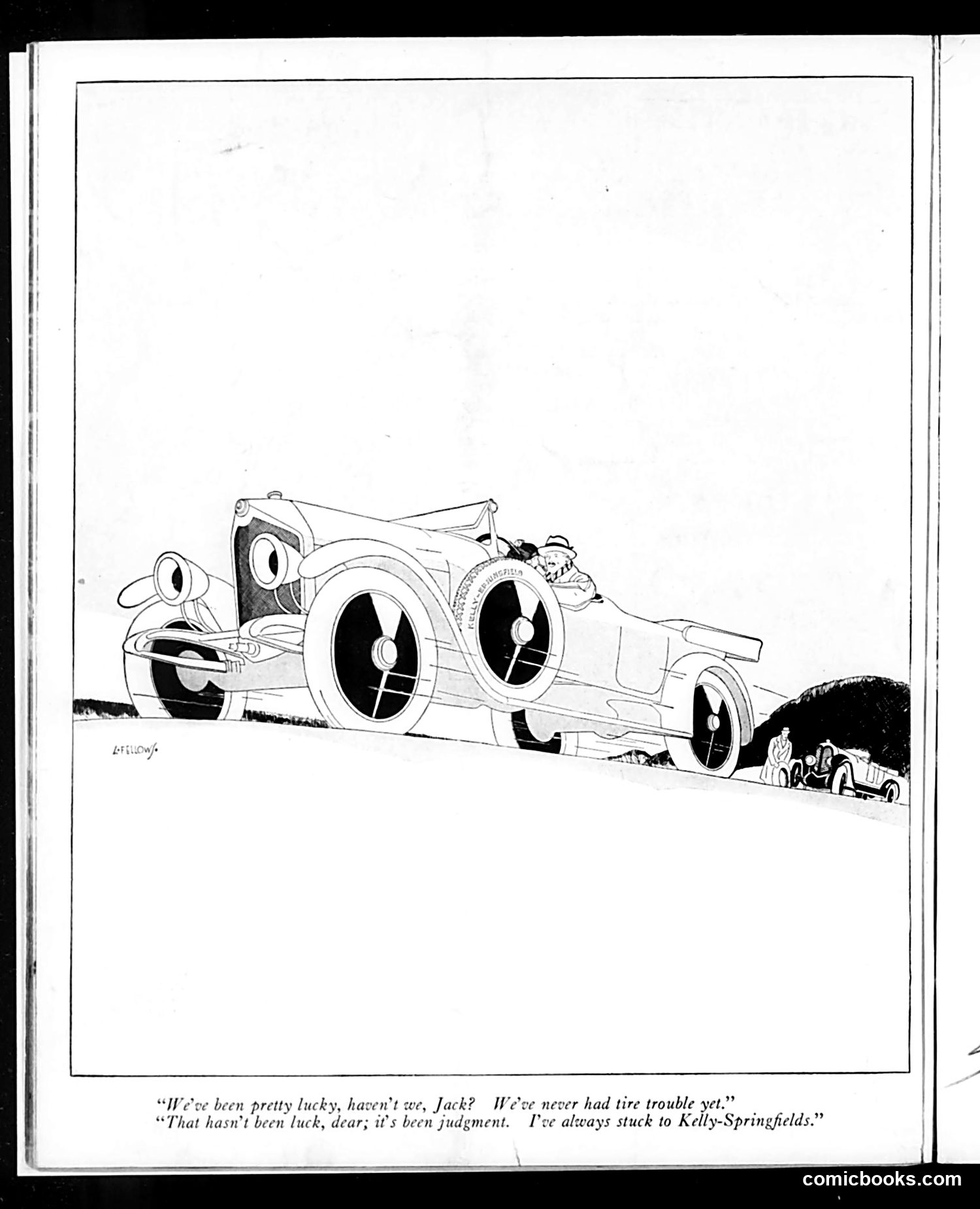
This is a satirical advertisement disguised as a comic panel, typical of Judge magazine's style. The cartoon depicts an exaggerated automobile with anthropomorphic features (large eyes, expressive face) driven by a couple. The husband boasts about never experiencing tire trouble, attributing it to his loyalty to Kelly-Springfield brand tires—a deliberate product endorsement. The satire mocks both automobile culture and advertising claims of the era. The absurdly stylized car design emphasizes the humor, while the dialogue presents an obviously self-interested testimonial as wisdom. The cartoon ridicules how manufacturers used lifestyle narratives and brand loyalty to market products, presenting commercial choice as prudent judgment rather than advertising manipulation.