
Judge, 1921-01-01 · page 5 of 32
Judge — January 1, 1921 — page 5: what you’re looking at
What you’re looking at
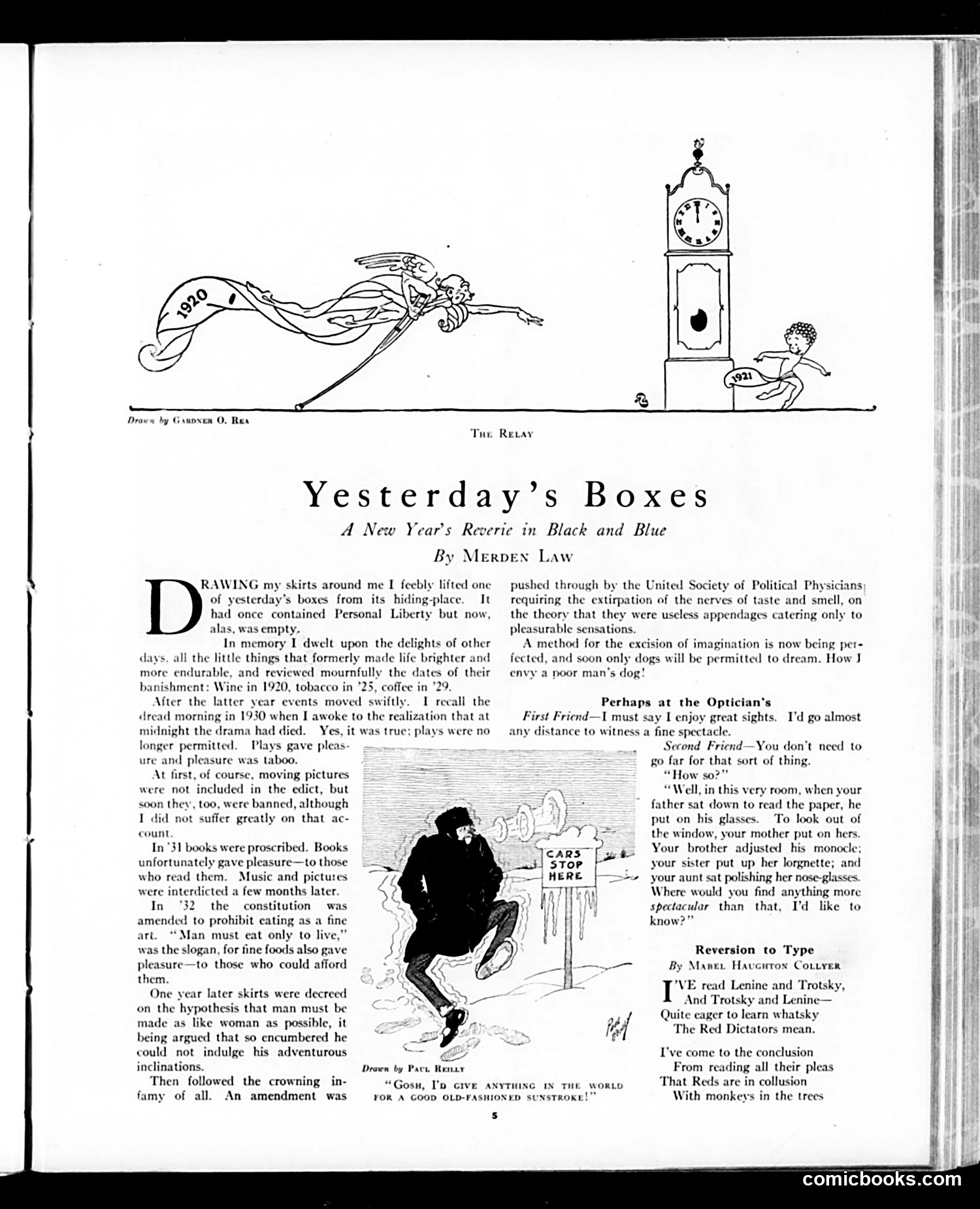
**The Top Cartoon ("The Relay"):** This appears to be a New Year's allegory showing 1920 passing a baton to 1921. The figure labeled 1920 flies away while 1921 (a cherub) waits to receive it—a common visual metaphor for the transition between years. **The Main Article:** Merden Law's essay reflects on freedoms lost during the 1920s. He references prohibition's elimination of alcohol and theater censorship that banned stage plays. The text nostalgically mentions books being proscribed in 1931 and a 1932 constitutional amendment restricting art, with the slogan "Man must eat to live" being used to justify limiting pleasures. **The Cartoon Below:** Shows a man at what appears to be a shop window with a "Cards Stop Here" sign, illustrating restrictions on commerce or leisure activities—likely relating to prohibition enforcement or censorship.
📄 Transcribed text from this page (OCR, searchable)
Machine-transcribed from the original scan — historical spelling and the odd misread are preserved.
a Draws by Gaunsen O, Res Tue Retay ’ Yesterday’s Boxes A New Year's Reverie in Black and Blue By Merven Law RAWING my skirts around me I feebly lifted one of yesterday’s boxes from its hiding-place. It had once contained Personal Liberty but now, alas, was empty. In memory I dwelt upon the delights of other days. all the little things that formerly made life brighter and more endurable, and reviewed mournfully the dates of their banishment: Wine in 1920, tobacco in '25, coffee in ‘29. Miter the latter year events moved swiftly. I recall the dread morning in 1930 when I awoke to the realization that at midnight the drama had died. Yes, it was true: plays were no longer permitted. Plays gave pleas- ure and pleasure was taboo. At first, of course, moving pictures were not included in the edict, but soon they, too, were banned, although I did not suffer greatly on that ac- count In “31 books were proscribed. Books unfortunately gave pleasure—to those who read them. Music and pictures were interdicted a few months later. In "32. the constitution was amended to prohibit eating as a fine art. ‘Man must eat only to live,” was the slogan, for fine foods also to those who could afford ar later skirts were decreed on the hypothesis that man must be made as like woman as possible, it being argued that so encumbered he could not indulge his adventurous inclinations. Then followed the crowning in- famy of all. An amendment was Drown by Pace H “Gosu, I'p cr E ANYTHING IN THE WORLD FOR A GOOD OLD-FASHIONED SUNSTROKE!” pushed through by the United Society of Political Physicians requiring the extirpation of the nerves of taste and smell, on the theory that they were useless appendages catering only to pleasurable sensations A method for the excision of imagination is now being per- fected, and soon only dogs will be permitted to dream. How J envy a poor man’s dog! Perhaps at the Optician’s First Friend—I must say I enjoy great sights. I'd go almost any distance to witness a fine spectacle. Second Friend—You don't need to go far for that sort of thing. “How so?” “Well, in this very room, when your father sat down to read the paper, he put on his glasses. To look out of the window, your mother put on hers. Your brother adjusted his monocle; your sister put up her lorgnette; and your aunt sat polishing her nose-glasses Where would you find anything more spectacular than that, I'd like to know?” Reversion to Type By Manet Havcwrox Cortyer ad Lenine and Trotsky And Trotsky and Lenine— Quite eager to learn whatsky The Red Dictators mean. I've come to the conclusion From reading all their pleas That Reds are in collusion With monkeys in the trees comicbooks.com