
Judge, 1921-01-01 · page 13 of 32
Judge — January 1, 1921 — page 13: what you’re looking at
What you’re looking at
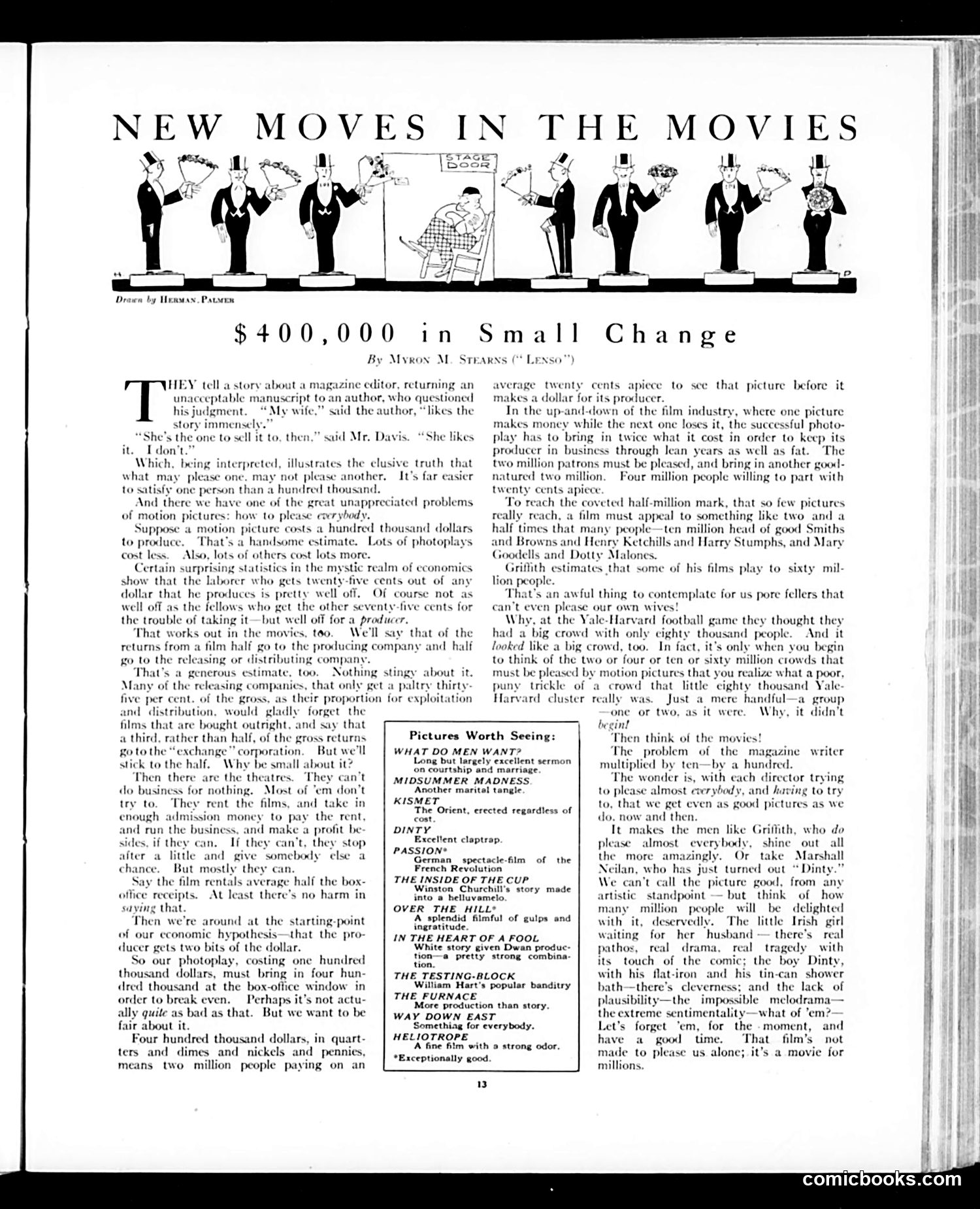
This satirical article by Myron M. Stearns analyzes the economics of film production, using humor to expose an industry paradox: movies must please millions to recoup costs, yet pleasing everyone is nearly impossible. The cartoon header (drawn by Herman Palmer) depicts men in top hats representing different stakeholders—producers, distributors, theater owners—each taking their cut while a figure labeled "STAGE" sits passively. **The satire's point:** A $100,000 film must gross $400,000 at the box office (two million paying customers) just to break even, after accounting for exhibitor cuts, distributor shares, and theater rentals. The author uses ironic economic analysis to argue that producers face impossible odds: they need mass appeal but can't satisfy everyone. This absurdity explains why films often fail financially despite quality work—the system's math is stacked against success. The accompanying film reviews mock contemporary movies' varying quality, reinforcing that profit ≠ artistic merit.
📄 Transcribed text from this page (OCR, searchable)
Machine-transcribed from the original scan — historical spelling and the odd misread are preserved.
NEW BAKO MAGES I N THE MOVIES Drown by Urns. Pacscon $400,000 in By Myron M. Stearns ( HEY tell a story about a magazine editor, returning an unacceptable manuscript to an author, who questioned his judgment.“ My wife,” said the author, “likes the story immensely.” “She's the one to sell it to, then,” it. Tdon't.” Which, being interpreted, illustrates the clusive truth that what may please one. may not please another. It’s far easier to satisfy one person than a hundred thousand. And there we have one of the great unappreciated problems of motion pictures: how to please everybody. Suppose a motion picture costs a hundred thousand dollars to produce. That's a handsome estimate. Lots of photoplays cost less. Also, lots of others cost lots more. Certain surprising statistics in the mystic realm of economics show that the laborer who gets twenty-five cents out of any dollar that he produces is pretty well off, Of course not as well off as the fellows who get the other seventy-five cents for the trouble of taking it—but well off for a producer. That works out in the movies, too. We'll say that of the returns from a film half go to the producing company and half go to the releasing or distributing company. That's a generous estimate, too. Nothing stingy about it. Many of the releasing companies, that only get a paltry thirty five per cent. of the gross, as their proportion for exploitation and distribution, would gladly forget. the films that are bought outright, and say that a third, rather than half, of the gross returns suid Mr. Davis. “She likes goto the “exchange” corporation. But we'll stick to the half. Why be small about it? Long but largely exceltent sermon Then there are the theatres. They can't’ | mz0SUMMER MADNES do business for nothing. Most of °em don’t They rent the films, and take in KISMET ie The Orient, enough admission money to pay the rent, Cas and run the business, and make a profit be DINTY sides. if they can. If they can’t, they stop after a little and give somebody else a chance. But mostly they can. Say the film rentals average half the box- fice receipts. At least there’s no harm in saying that. Then we're around at the starting-point of our economic hypothesis—that the pro- ducer gets two bits of the dollar. So our photoplay, costing one hundred thousand dollars, must bring in four hun- dred thousand at the box-office window in order to break even, Perhaps it’s not actu- ally quite as bad as that. But we want to be fair about it. Four hundred thousand dollars, in quart- ters and dimes and nickels and pennies, means two million people paying on an PASSION* ingratitude. tion. HELIOTROPE Pictures Worth Seeing: WHAT DO MEN WANT? The Another maritel tangle. erected regardless of Exceltent claptrap German spectacle-flm of the French Revolution THE INSIDE OF THE CUP ‘Winston Churchill’s story made into a helluvamelo. OVER THE HILL* A splendid Bimful of gulps end with it, deservedly. The little Irish girl IN THE HEART OF A FOOL White story given Dwan produc: tion—a pretty strong combina- THE TESTING-BLOCK William Hart's popular banditry THE FURNACE More production than story. WAY DOWN EAST ¢ a ‘Somethiag for everybody. Let’s forget ‘em, for the moment, and ‘A fine film with a strong odor, -xceptionally good, Small * Lexso”™) Change average twenty cents apiece to sce that picture before it makes a dollar for its producer. In the up-and-down of the film industry, where one picture makes money while the next one loses it, the successful photo- play has to bring in twice what it cost in order to keep its producer in business through lean years as well as fat. The two million patrons must be pleased, and bring in another good- natured two million. Four million people willing to part with twenty cents apiece To reach the coveted half-million mark, that so few pictures really reach, a film must appeal to something like two and a half times that many people—ten million head of good Smiths and Browns and Henry Ketchills and Harry Stumphs, and Mary Goodells and Dotty Malones. Griflith estimates that some of his films play to sixty mil- lion people. That's an awful thing to contemplate for us pore fellers that can’t even ple ur own Wives! Why, at the Yale-Harvard football game they thought they had a big crowd with only cighty thousand people. And it looked like a big crowd, too. In fact, it’s only when you begin to think of the two or four or ten or sixty million crowds that must be pleased by motion pictures that you realize what a poor, puny trickle of a crowd that little cighty thousand Yale: Harvard cluster really was. Just a mere handful—a group one or two, as it were. Why, it didn’t begint Then think of the movies! problem of the magazine writer multiplied by ten—by a hundred. The wonder is, with each director trying to please almost everybody, and having to try to, that we get even as good pictures as we do, now and then. It makes the men like Griffith, who do please almost everybody, shine out all the more amazingly. Or take Marshall Neilan, who has just turned out “Dinty.” We can’t call the picture good, from any artistic standpoint — but think of how many million people will be delighted waiting for her husband — there's real pathos, real drama, real tragedy with its touch of the comic; the boy Dinty, with his flat-iron and his tin-can shower bath—there’s cleverness; and the lack of plausibility—the impossible melodrama— the extreme sentimentality—what of "em? have a good time. That film’ not made to please us alone; it’s a movie for millions. comicbooks.com