
Judge, 1921-01-01 · page 7 of 32
Judge — January 1, 1921 — page 7: what you’re looking at
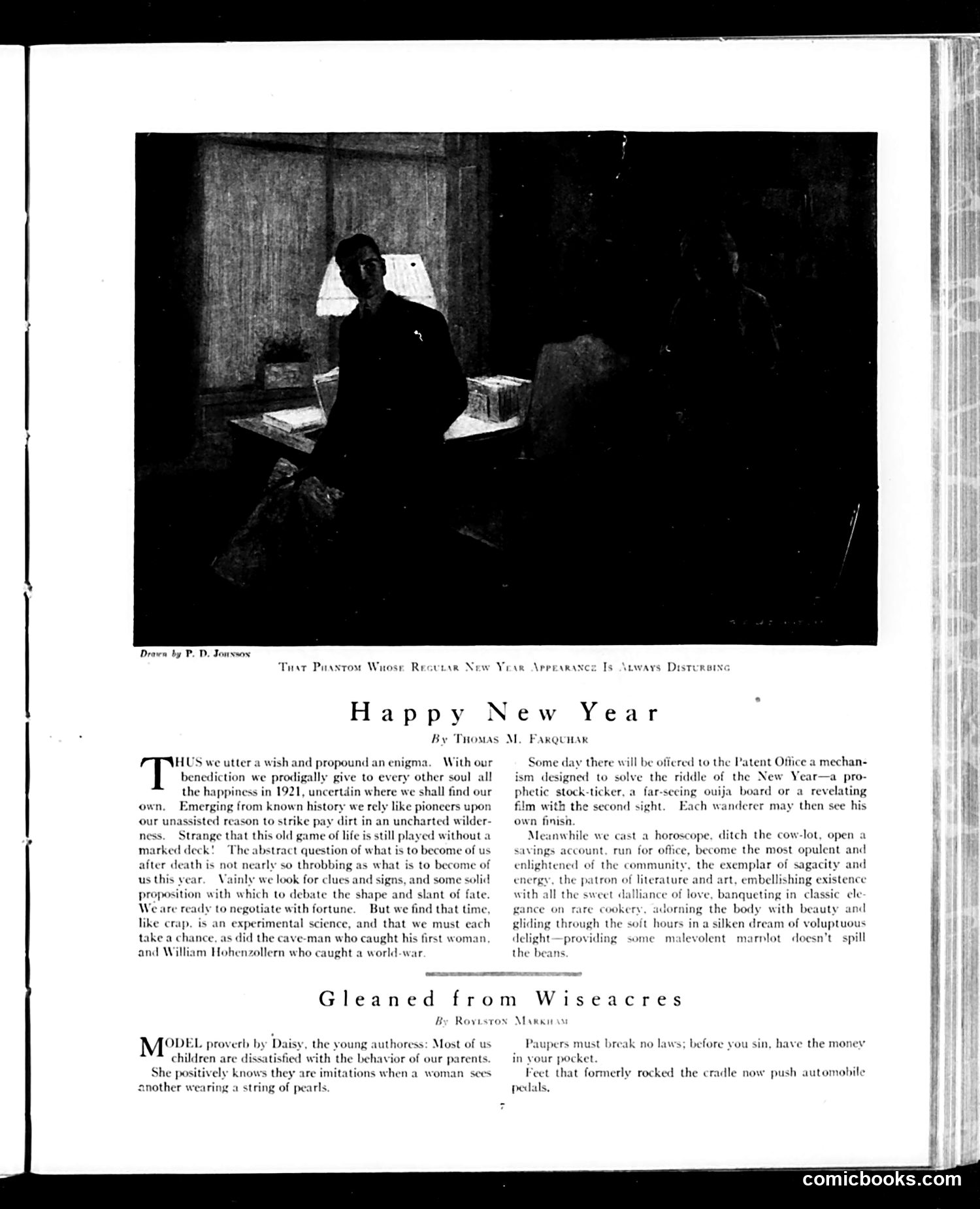
What you’re looking at
This appears to be a New Year's editorial page from Judge magazine (likely early 1921, given the "Happy New Year" framing and reference to 1921). **Main Content:** The illustrated cartoon at top shows a séance or fortune-telling scene—a darkened room with figures consulting what appears to be a medium about the future. The caption references "That Phantom Whose Regular New Year Appearance Is Always Disturbing," likely satirizing the common practice of people seeking predictions about the coming year through spiritualism, which was popular in the 1920s. **Text Features:** Two pieces follow: Thomas M. Farquhar's "Happy New Year" essay uses cynical humor about humanity's helplessness regarding fate, comparing life to gambling. The shorter "Gleaned from Wiseacres" section offers sardonic observations—including commentary on women's fashion (pearls), automobiles replacing traditional cradles, and class commentary ("paupers must break no laws...have the money in your pocket"). **The Satire:** The overall tone mocks New Year's optimism, uncertainty about the future, and social pretensions—suggesting readers' desperate attempts to predict or control their destinies through superstition, while acknowledging life's randomness.
📄 Transcribed text from this page (OCR, searchable)
Machine-transcribed from the original scan — historical spelling and the odd misread are preserved.
a 6 wen by B.D. Je Tuat Puasros Wuose Recunar Year Appearance Is Mt ways Dis URBIN Happy New Year By Tuomas M. FarQuuan HUS we utter a wish and propound an enigma. With our benediction we prodigally give to every other soul all the happiness in 1921, uncertdin where we shall find our own, Emerging from known history we rely like pioneers upon our unassisted reason to strike pay dirt in an uncharted wilder- ness. Strange that this old game of life is still played without a marked deck! The abstract question of what is to become of us after death is not nearly so throbbing as what is to become of ar. Vainly we look for clues and signs, and some solid on with which to debate the shape and slant of fate. We are ready to negotiate with fortune. But we find that time. like crap, is an experimental science, and that we must each take a chance, as did the cave-man who caught his first woman and William Hohenzollern who caught a world-war. us this v Gleaned from Wiseacres By Royistos Moret proverb by Daisy, the young authoress: Most of us children are dissatisfied with the behavior of our parents. She positively knows they are imitations when a woman sces. another wearing a string of pearls. Some day there will be offered to the Patent Office a mechan- ew Year—a pro- ism designed to solve the riddle of the > phetic stock-ticker, a far-secing ouija board or a revelating film with the second sight. Each wanderer may then see his. | own finish. Meanwhile we cast a horoscope. ditch the cc savings account. run for office, become the most opulent and Jot, open a enlightened of the community, the exemplar of sagacity and energy, the patron of literature and art, embellishing existence cet dalliance of love, banqueting in classic ck i orning the body with beauty and i silken dream of voluptuous ¢ malevolent’ marnlot doesn’t spill with all the gance on rare cookery gliding t soit hours ina delight—providing the beans hrough th Margit Paupers must break no laws; before you sin, have the money | in your pocket. Feet that formerly rocked the cradle now push automobile pedals, il comicbooks.com