
Judge, 1921-01-01 · page 14 of 32
Judge — January 1, 1921 — page 14: what you’re looking at
What you’re looking at
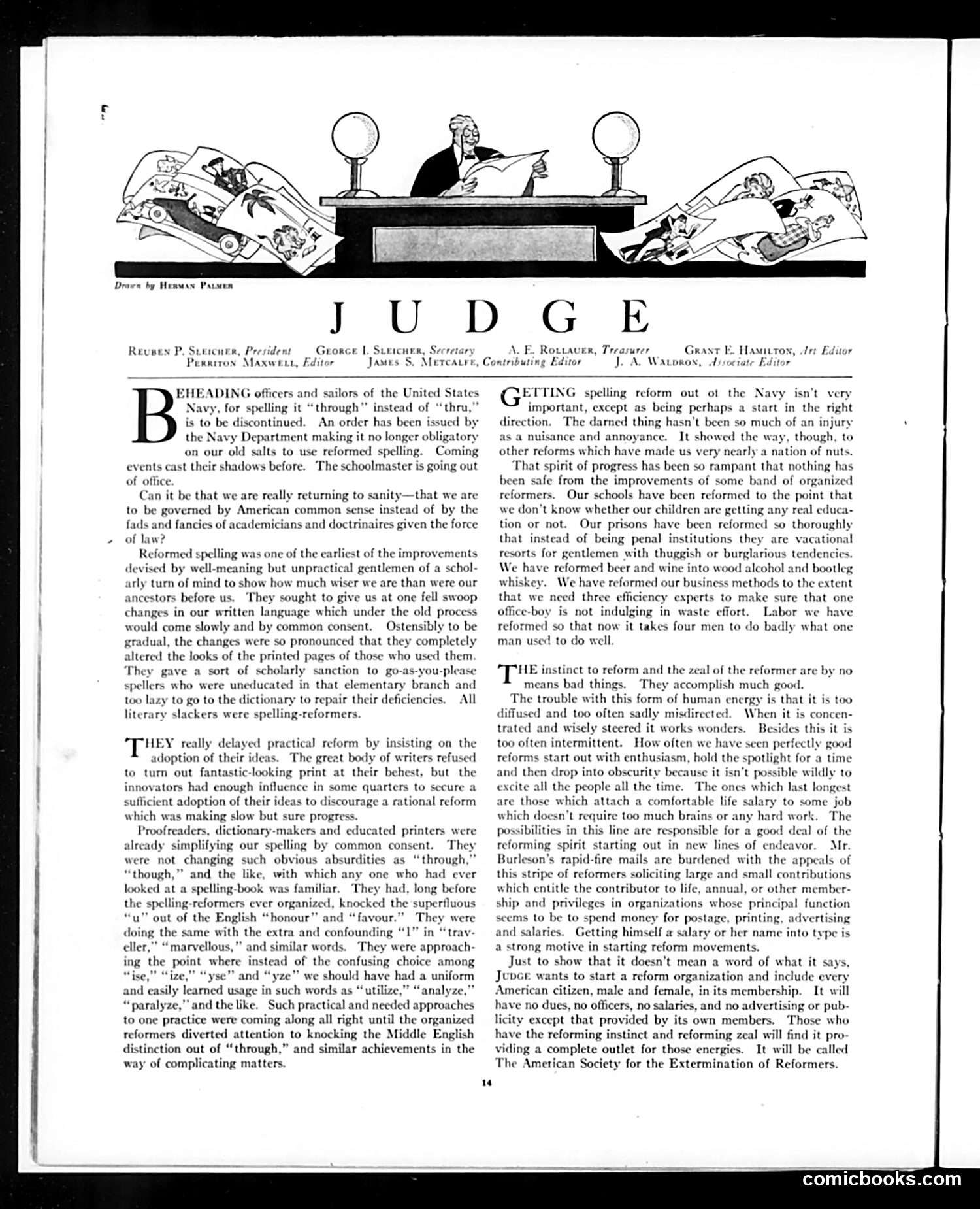
This editorial page attacks the progressive "spelling reform" movement of the early 20th century—efforts to modernize English spelling (e.g., "thru" for "through," removing the "u" from "honour"). The occasion is the Navy Department abandoning mandatory reformed spelling. The author argues reformers were well-intentioned but impractical academics who *delayed* natural spelling evolution. Proofreaders and printers were already gradually simplifying spelling through common consent—the proper way. Organized reformers' insistence on dramatic, artificial changes disrupted this organic process and gave "scholarly sanction to go-as-you-please spellers." The piece sarcastically warns that the spelling-reform spirit exemplifies a broader problem: "organized reformers" imposing changes on schools, prisons, and other institutions, creating "a nation of nuts." The cartoon's judge figure, presumably Herman Palmer's editorial visual commentary, reinforces this skepticism toward expert-driven social "improvement."
📄 Transcribed text from this page (OCR, searchable)
Machine-transcribed from the original scan — historical spelling and the odd misread are preserved.
Drown by Hemwas Pararen Grorce I. Steicner, Secretary Revuses P. Srercner, President Edie James S. Metcacre, Perriron Maxwewt, Co Ham Int Ed ociate ALE buting Editor Routaver, Treasurer Grast E J. A. Watpeos, TON, EHEADING officers and sailors of the United States avy, for spelling it “through” instead of “thru,” is to be discontinued. An order has been issued by the Navy Department making it no longer obligatory on our old salts to use reformed spelling. Coming events cast their shadows before. The schoolmaster is going out of office. Can it be that we are really returning to sanity—that we are » be governed by American common sense instead of by the dis and fancies of academicians and doctrinaires given the force of law? Reformed spelling was one of the earliest of the improvements devised by well-meaning but unpractical gentlemen of a schol- arly turn of mind to show how much wiser we are than were our ancestors before us. They sought to give us at one fell swoop changes in our written language which under the old process would come slowly and by common consent. Ostensibly to be gradual, the changes were so pronounced that they completely altered the looks of the printed pages of those who used them They gave a sort of scholarly sanction to go-as-you-please spellers who were uneducated in that elementary branch and too lazy to go to the dictionary to repair their deficiencies. All literary slackers were spelling-reformers. HEY really delayed practical reform by insisting on the adoption of their ideas. The great body of writers refused to turn out fantastic-looking print at their behest, but the innovators had enough influence in some quarters to secure a sufficient adoption of their ideas to discourage a rational reform which was making slow but sure progress. Proofreaders, dictionary-makers and educated printers were already: simplifying our spelling by common consent. The were not changing such obvious absurdities as “through, “though,” and the like, with which any one who had ever looked at a spelling-book was familiar. They had, long before the spelling-reformers ever organized, knocked the superfluous “u" out of the English “honour” and “favour.” They were doing the same with the extra and confounding “1” in “trav- eller,” “marvellous,” and similar words. They were approach- ing the point where instead of the confusing choice among *ise,”” “iz we should have had a uniform and easily learned usage in such words as “utilize,” “analy “paralyze,” and the like. Such practical and needed approaches to one practice were coming along all right until the organized reformers diverted attention to knocking the Middle English distinction out of “through,” and similar achievements in the way of complicating matters. ETTING spelling reform out ot the Navy isn’t very important, except as being perhaps a start in the right direction. The darned thing hasn't been so much of an injury as a nuisance and annoyance. It showed the way, though, other reforms which have made us very nearly a nation of nuts. That spirit of progress has been so rampant that nothing has been safe from the improvements of some band of organized reformers. Our schools have been reformed to the point that we don’t know whether our children are getting any real educa tion or not. Our prisons have been reformed so thoroughly that instead of being penal institutions they are vacational resorts for gentlemen with thuggish or burglarious tendencies. We have reformed beer and wine into wood alcohol and bootleg whiskey. We have reformed our business methods to the extent that we need three efficiency experts to make sure that one office-boy is not indulging in waste effort. Labor we have reformed so that now it takes four men to do badly what one man used to do well THE instinct to reform and the zeal of the reformer are by no means bad things. They accomplish much good. The trouble with this form of human energy is that it is too diffused and too often sadly misdirected. When it is concen- trated and wisely steered it works wonders. Besides this it is too often intermittent. How often we have seen perfectly good reforms start out with enthusiasm, hold the spotlight for a time and then drop into obscurity because it isn’t possible wildly to excite all the people all the time. The ones which last longest are those which attach a comfortable life salary to some job which doesn’t require too much brains or any hard work. The possibilities in this line are responsible for a good deal of the reforming spirit starting out in new lines of endeavor. Mr. Burleson’s rapid-fire mails are burdened with the appeals of this stripe of reformers soliciting large and small contributions which entitle the contributor to life, annual, or other member- ship and privileges in organizations whose principal function seems to be to spend money for postage, printing, advertising and salaries. Getting himself x salary or her name into type is a strong motive in starting reform movements. Just to show that it doesn’t mean a word of what it says, Jvvcr wants to start a reform organization and include every American citizen, male and female, in its membership. It will have no dues, no officers, no salaries, and no advertising or pub- licity except that provided by its own members. Those who have the reforming instinct and reforming zeal will find it pro- viding a complete outlet for those energies. It will be called The American Society for the Extermination of Reformers. to comicbooks.com