
A complete issue · 36 pages · 1920
Judge — March 20, 1920
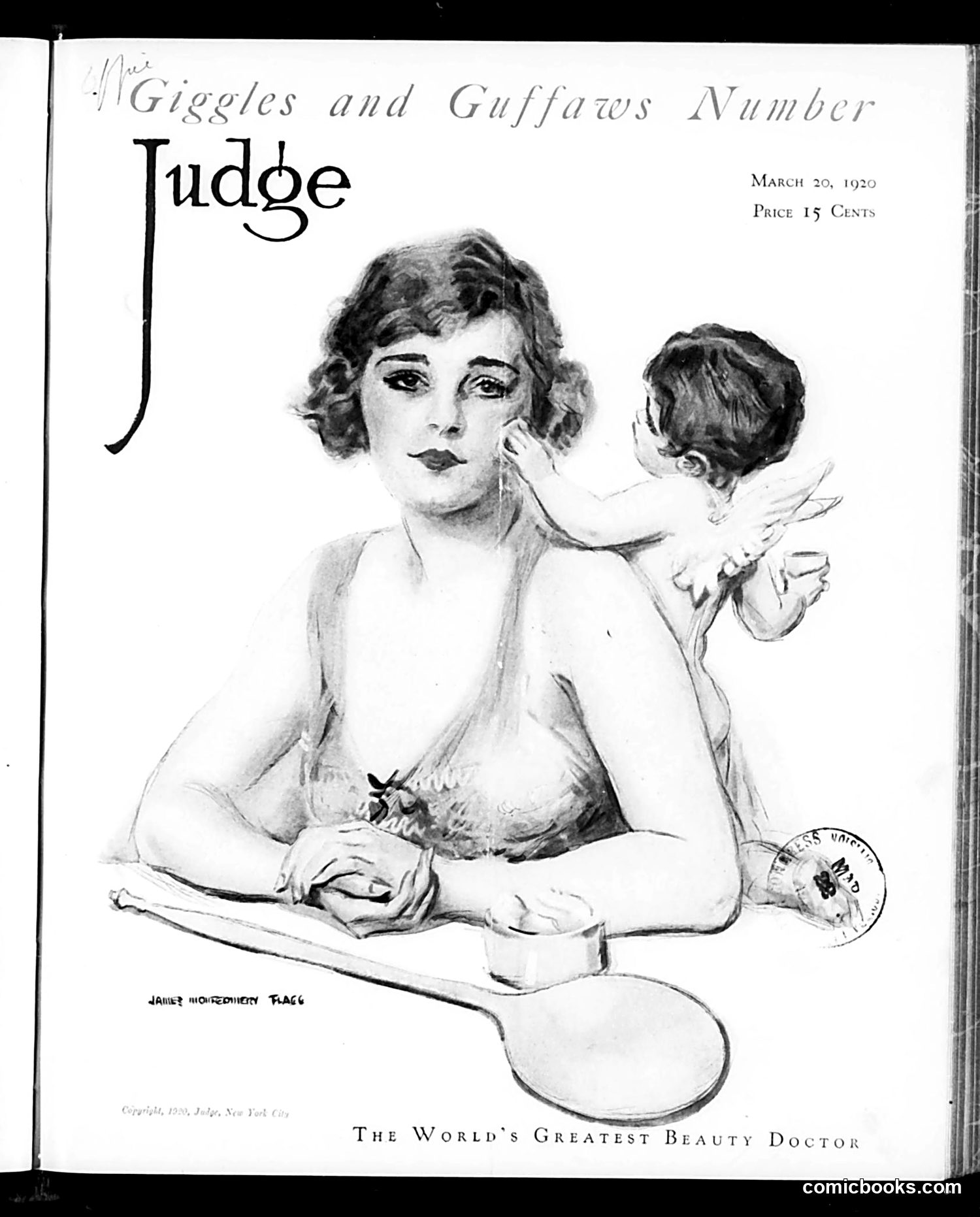
This cover satirizes the "beauty doctor" industry of the 1920s. The illustration shows a woman holding a child while displaying a large mirror—visual elements suggesting vanity and cosmetic procedures. The caption "The World's Greatest Beauty Doctor" is ironic; the satirical point likely mocks the dubious claims and practices of cosmetic physicians who promised miraculous beauty treatments during this era. The satire targets both the vanity of women pursuing cosmetic enhancement and the quackery of practitioners making exaggerated medical claims. This reflects Jazz Age anxieties about commercialized beauty culture and modern medicine's boundaries. The magazine's subtitle "Giggles and Guffaws Number" confirms this is humorous social commentary rather than serious criticism.
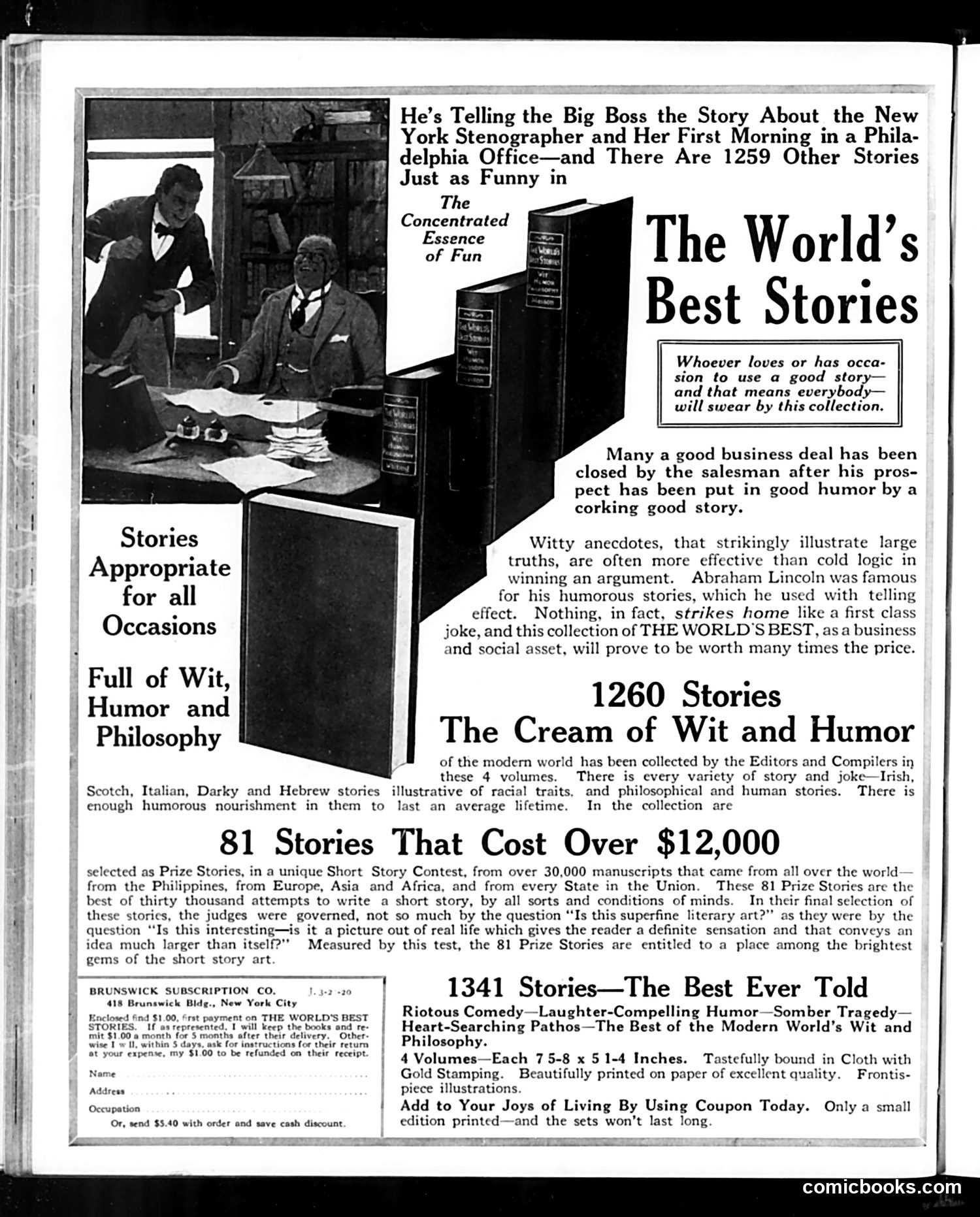
This is primarily a **book advertisement** rather than satirical content. It promotes "The World's Best Stories," a 1,341-story collection in four volumes published by Brunswick Subscription Co. The photograph shows two men in an office setting—likely depicting a boss and salesman—illustrating the advertisement's opening claim about a New York stenographer's first morning in Philadelphia. This is a narrative hook to demonstrate the book's appeal: humorous anecdotes useful for business and social situations. The ad emphasizes that witty stories—like those Abraham Lincoln famously used—can close business deals and serve as social assets. The collection includes 81 "Prize Stories" selected from 30,000 manuscript submissions worldwide, organized by theme (comedy, tragedy, philosophy, etc.). The books are cloth-bound with gold stamping, positioned as an aspirational purchase for middle-class readers seeking conversational material and self-improvement.
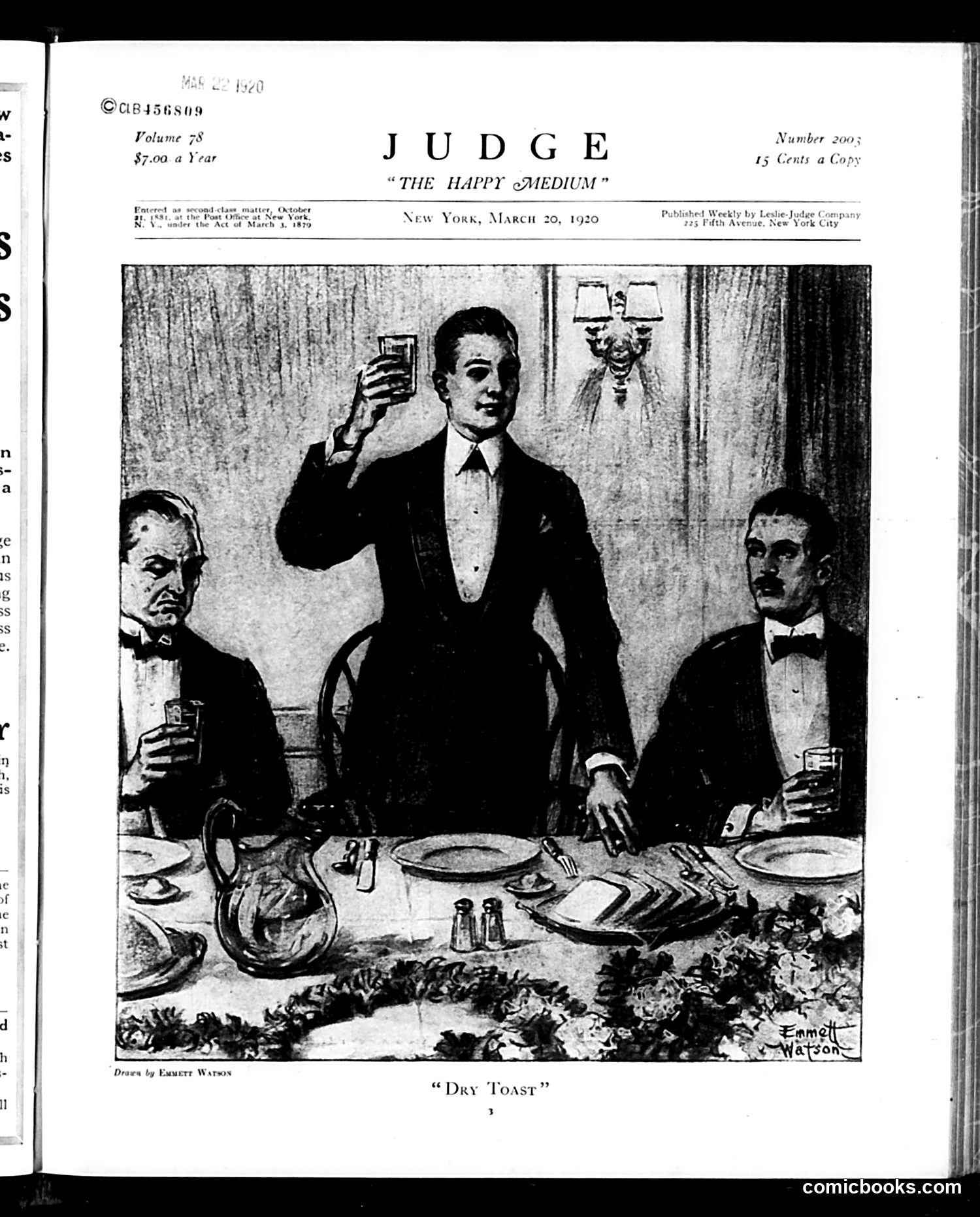
This cartoon satirizes **Prohibition**, which had just begun (the 18th Amendment took effect January 1920). The title "Dry Toast" is a pun: the men are attempting to make a celebratory toast, but with water or other non-alcoholic drinks instead of alcohol. Three formally-dressed men sit at a dining table, raising glasses that appear empty or contain only water. Their expressions look disappointed or forced—the humor lies in the contrast between the formal dinner setting (suggesting refined celebration) and the grim reality of Prohibition's enforcement. The cartoon mocks how Prohibition eliminated alcohol from social gatherings, making traditional toasts awkward and joyless. It's political commentary on the unpopular new law that most Americans opposed.
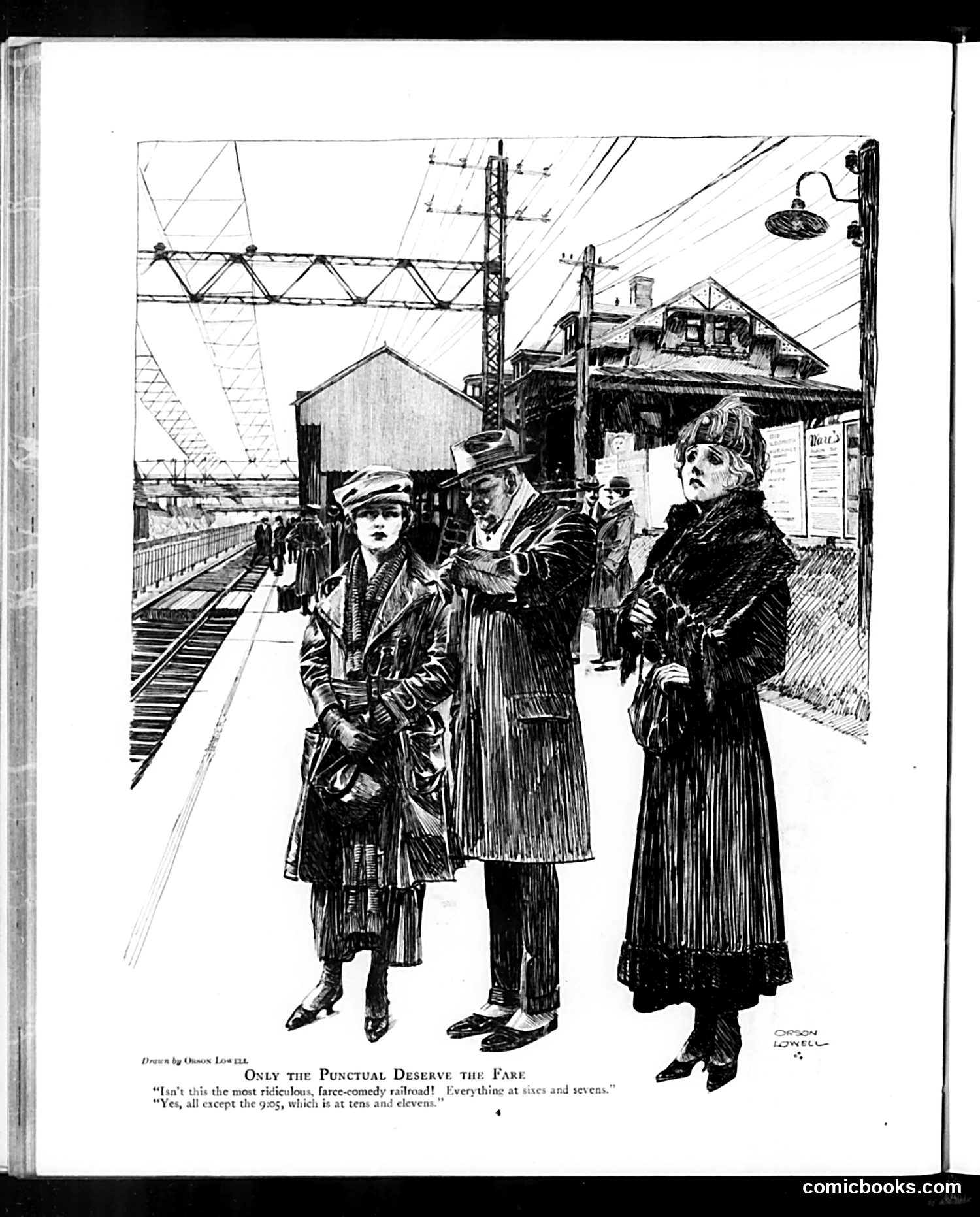
This satirical cartoon criticizes railroad fare practices through a scene at a train station. Three well-dressed passengers stand on the platform, with the caption quoting: "that's the most ridiculous, farce-comedy railroad! Everything at sixes and sevens. Yes, all except the 9:05, which is at tens and elevens." The joke plays on the phrase "sixes and sevens" (meaning chaotic/disorganized) and "tens and elevens" (the price markup). The satire mocks railroad companies for their unreliable schedules and inconsistent service—everything runs late except when fares mysteriously increase. The title suggests that only punctual travelers deserve fair pricing, implying railroads penalize irregular customers while exploiting those dependent on their service.
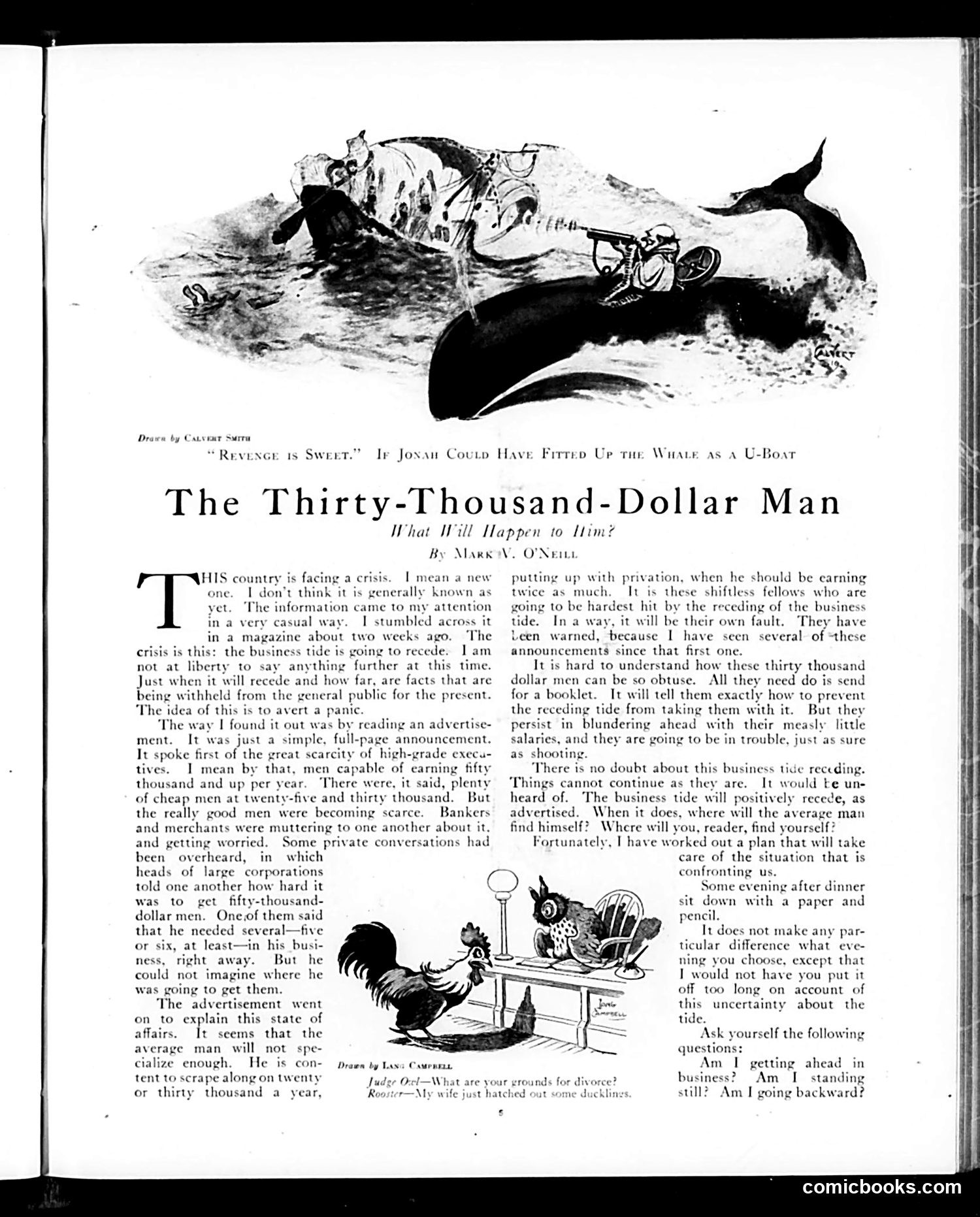
This article by Mark W. O'Neill addresses an economic crisis—likely the early 1900s recession. O'Neill argues that average businessmen earning $30,000 annually are unprepared for the coming downturn. He criticizes their lack of financial planning and suggests they've become complacent during prosperous times. The top cartoon, drawn by Cesare Stetro, depicts a whale as a U-boat (German submarine warfare reference), titled "Revenge is Sweet"—likely satirizing business competition as warfare. The bottom cartoon by Laz Campbell shows a rooster and judge, with dialogue about "grounds for divorce" and "ducklings," apparently making a crude agricultural/sexual joke. The overall page warns middle-class professionals that economic security requires preparedness, not entitlement.
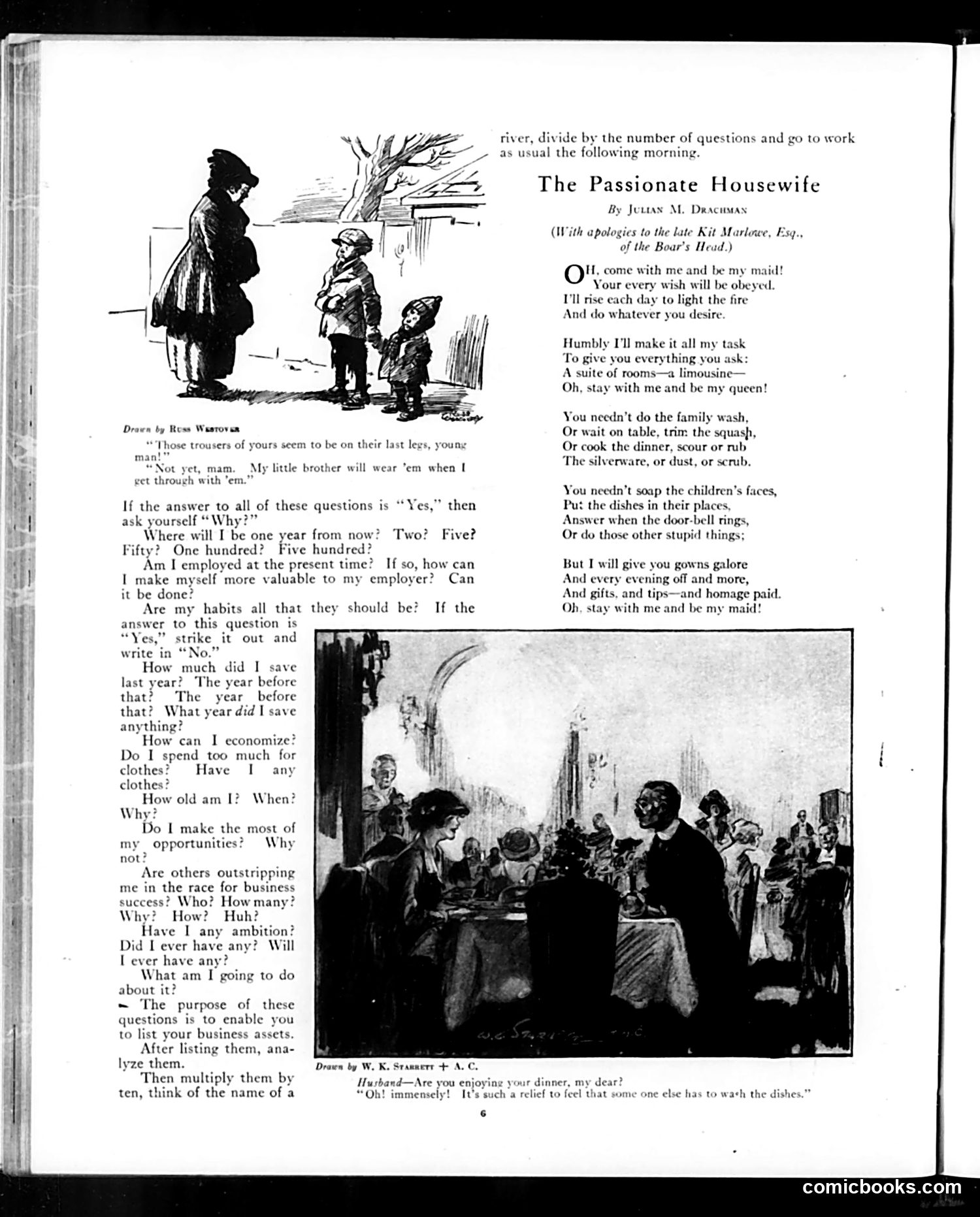
This satirical poem by Julian M. Drachman mocks the romantic fantasy of domestic service. The text presents an exaggerated suitor's promise of luxurious living ("a suite of rooms—a limousine") if a woman becomes his maid. The satire works by inverting the servant-employer relationship: the "maid" is promised everything *except* actual domestic work (no dishwashing, child-care, or cooking). This absurdity exposes the exploitation inherent in domestic labor—the poem suggests that employers dangle material rewards while demanding exhausting, unglamorous work. The accompanying illustrations show working-class domesticity: a stern employer figure with children, and a domestic dinner scene. Together, text and image critique the gap between romantic promises and the grim reality of housework, particularly for working-class women.
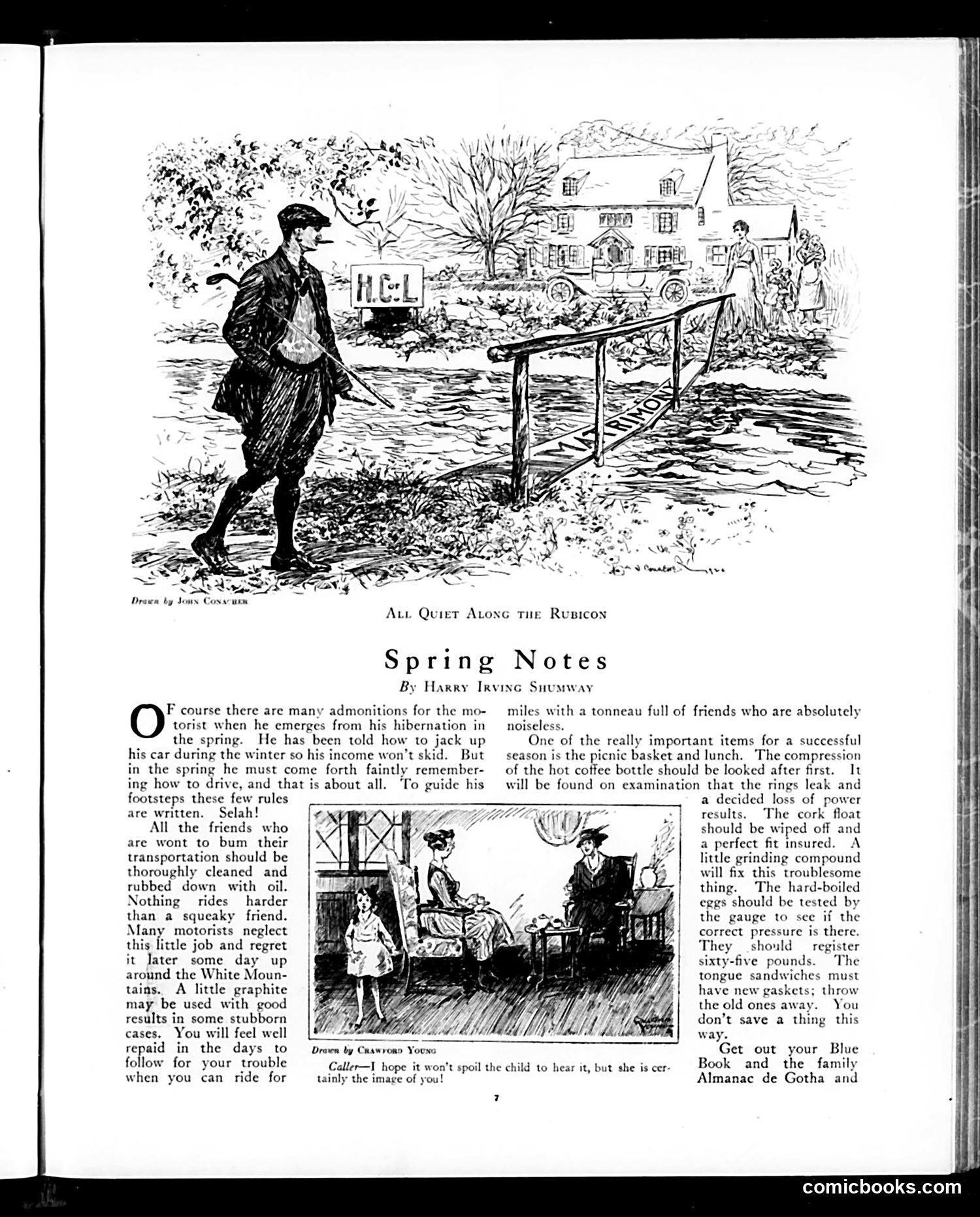
This page from *Judge* magazine contains automotive humor targeting early 1900s motorists. The main article, "Spring Notes" by Harry Irving Shumway, offers tongue-in-cheek advice for spring driving season, playfully treating car maintenance using automotive terminology applied to social situations. The satire works by extending mechanical jargon to human "friends who are wont to bum their transportation"—freeloaders seeking rides. Shumway humorously suggests these companions need "cleaning and rubbing down with oil" like vehicles, and warns against "squeaky friends." The picnic basket instructions deliberately confuse car parts (cork floats, pressure gauges, gaskets) with food items (eggs, sandwiches), creating absurdist comedy about motorists' spring excursions. This reflects the era when automobiles were still novel luxuries, and elaborate preparations—plus uninvited passengers—were common frustrations for early car owners.
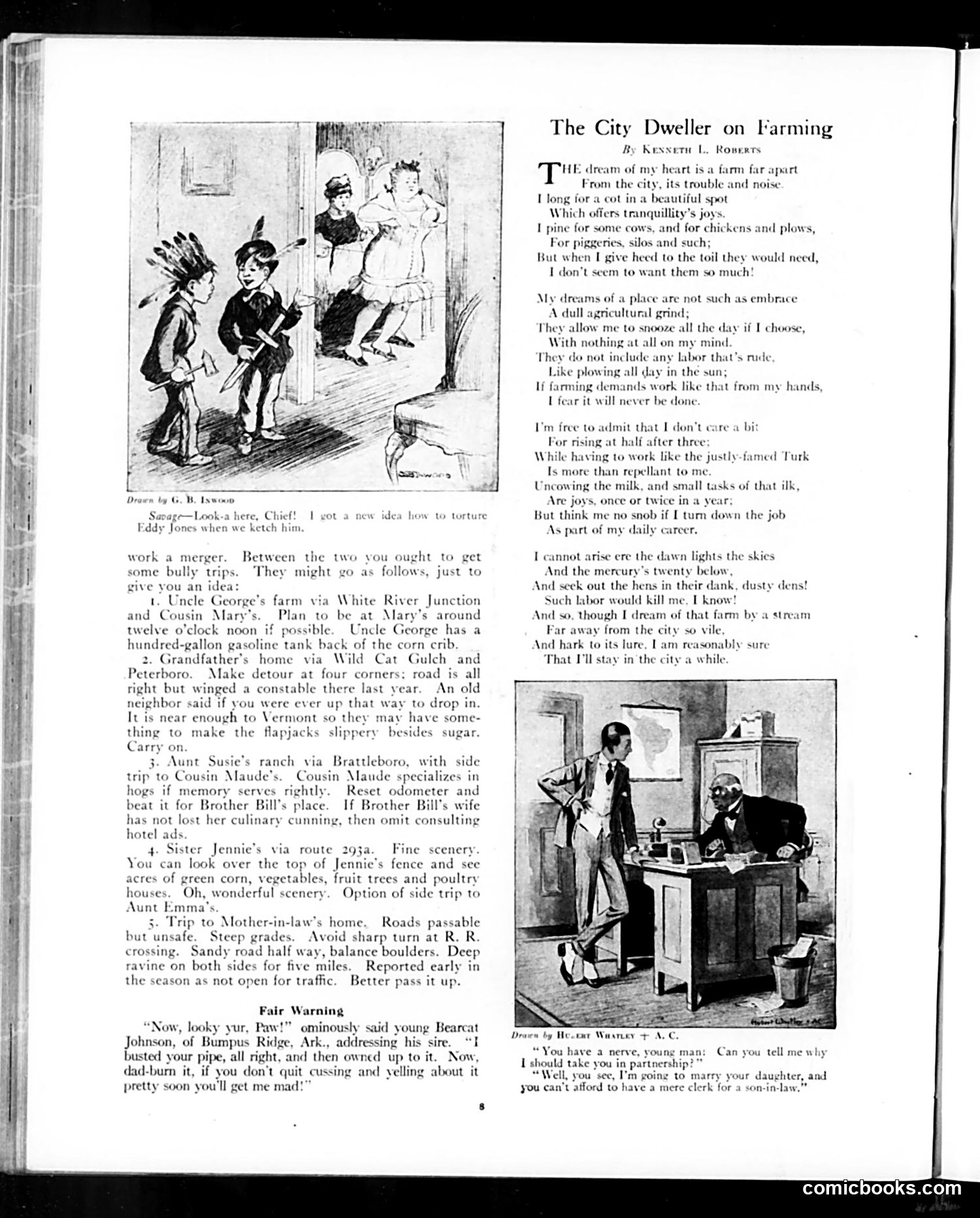
This page contains satirical content mocking urban aspirations versus rural reality. **"The City Dweller on Farming"** (poem by Kenneth L. Roberts) ridicules city people romanticizing farm life while unwilling to endure its actual hardships. The speaker dreams of pastoral peace—cows, chickens, fields—but admits he won't wake before dawn, won't perform manual labor, fears cold weather, and ultimately prefers city comfort. The satire targets middle-class nostalgia for agrarian simplicity untempered by willingness to experience genuine farmwork. **The travel guide section** sarcastically lists "bully trips" visiting relatives' farms, with jokes about dangerous roads, peculiar neighbors ("something to make the flapjacks slippery besides sugar"), and a darkly funny suggestion to avoid the mother-in-law's house entirely due to treacherous conditions and ravines. **"Fair Warning"** depicts a backwoods youth (Bearcat Johnson) confessing he broke his father's pipe. The humor derives from his father's excessive reaction to minor property damage—a criticism of harsh parenting. The cartoons satirize both urban sentimentality about farm life and rural family dynamics of the period.
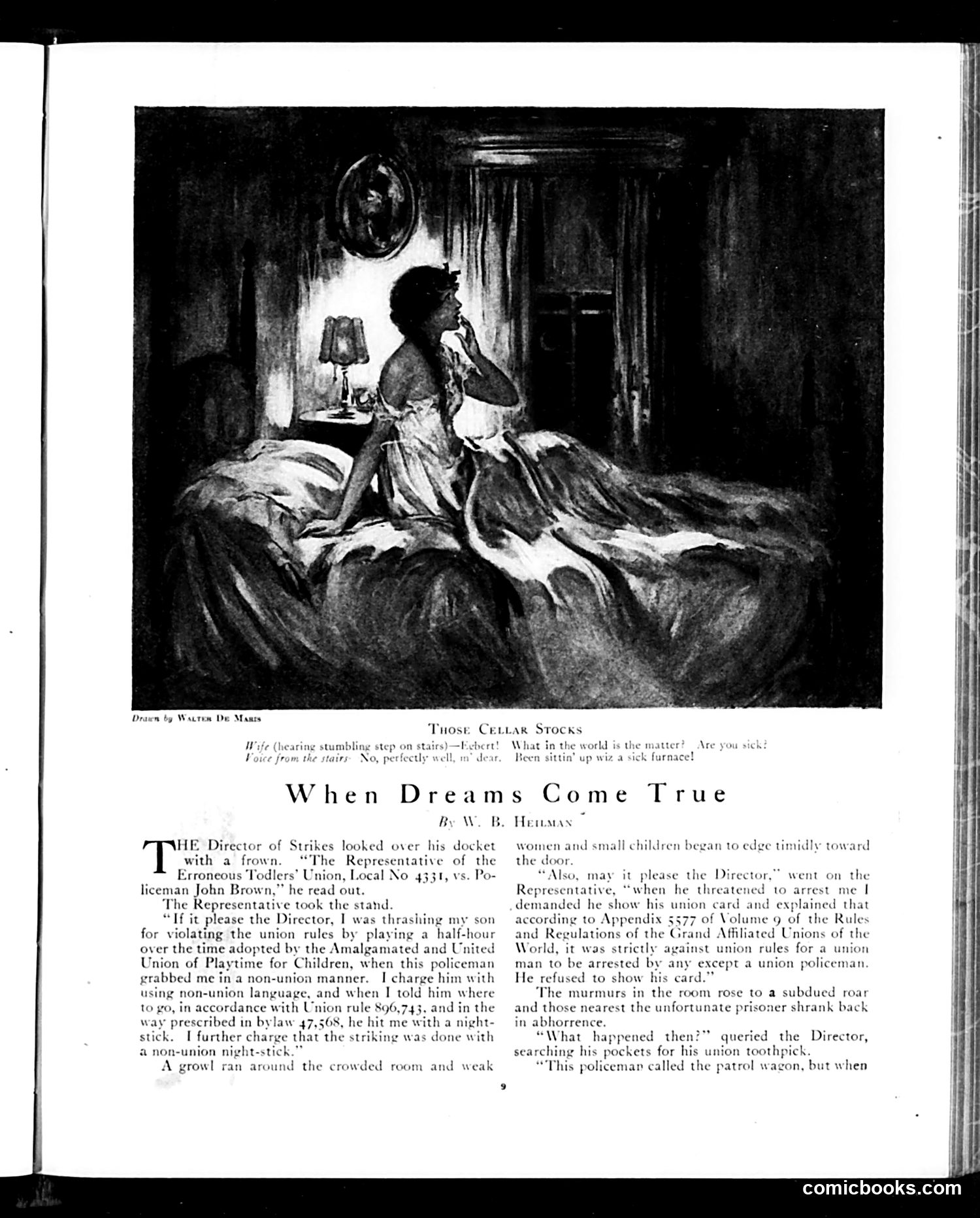
This 1920s Judge cartoon mocks the absurd expansion of labor union power and regulation. The story depicts a "Director of Strikes" presiding over a surreal court case: a father is charged by the "Erroneous Toddlers' Union" for disciplining his son—allegedly violating union "playtime" rules by striking him with a non-union nightstick. The satire targets how unions, portrayed as increasingly bureaucratic and overreaching, have created elaborate rule books (with comically precise citations like "Appendix 5577, Volume 9") governing even domestic life. A policeman arrested without showing his "union card" becomes another absurdity showing unions claiming authority over law enforcement itself. The joke: unions have grown so powerful and regulation-obsessed that they now regulate everything—including how parents discipline children and which nightsticks are "union-approved." The drawing's grim bedroom scene contrasts with the farcical text, emphasizing how ridiculous these claims of authority have become.
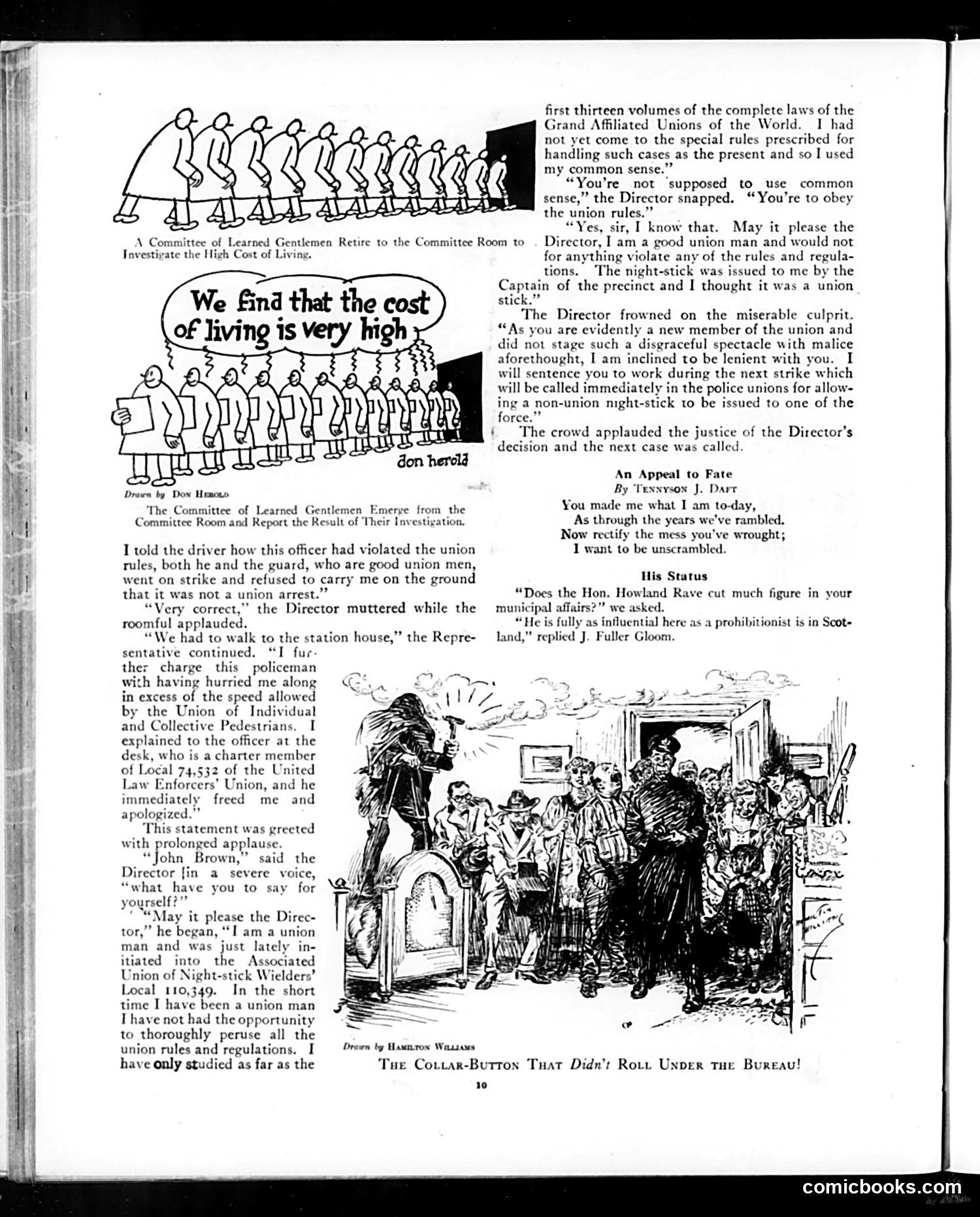
This page satirizes **union bureaucracy and rigid rule-following** replacing practical judgment. The top cartoon shows a "Committee of Learned Gentlemen" investigating the cost of living—mocking how organizations create committees that accomplish nothing but generate reports. The main narrative ridicules **union inflexibility**: a police officer is punished not for misconduct, but for using "common sense" instead of following union regulations. The Director sentences him to work during the next strike as punishment. The satire's point: unions have become so obsessed with rules and procedures that they've lost sight of actual justice or practical governance. The lower illustration, "The Collar-Button That Didn't Roll Under the Bureau," suggests union bureaucracy is so overwhelming it loses track of minor details—the collar-button representing things that slip through excessive regulation. The text passages about "Hon. Howland Rave" and other figures appear to be separate commentary pieces. This appears to be **anti-union satire from the early-to-mid 20th century**, when organized labor faced criticism for institutional rigidity.
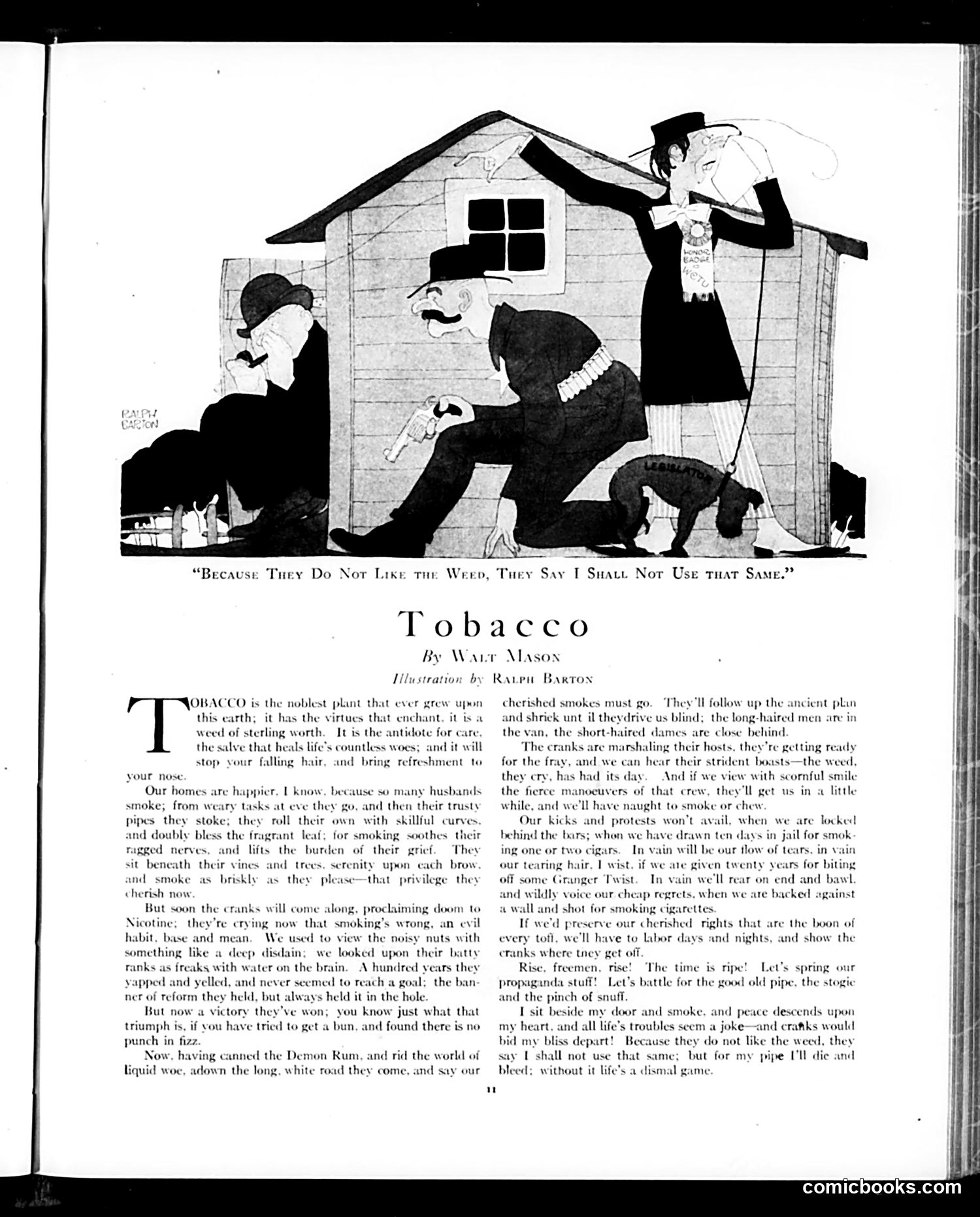
This 1920s piece defends tobacco against Prohibition-era reform movements. The cartoon shows well-dressed smokers in a shed, apparently defiant or conspiratorial about their habit. Mason's essay sarcastically attacks anti-smoking "cranks" (reformers), comparing them to Prohibition advocates who successfully banned alcohol. He claims smokers face persecution—jail time, execution—for their vice. The tone is tongue-in-cheek but earnest: smokers are portrayed as defending personal liberty against puritanical government overreach. The phrase "Because They Do Not Like the Weed, They Say I Shall Not Use That Same" captures the satirical argument: reformers' personal dislike shouldn't dictate others' behavior. This reflects early 20th-century debate over government regulation of personal habits, with Mason positioning tobacco rights alongside broader individual freedoms against what he views as authoritarian reform movements.
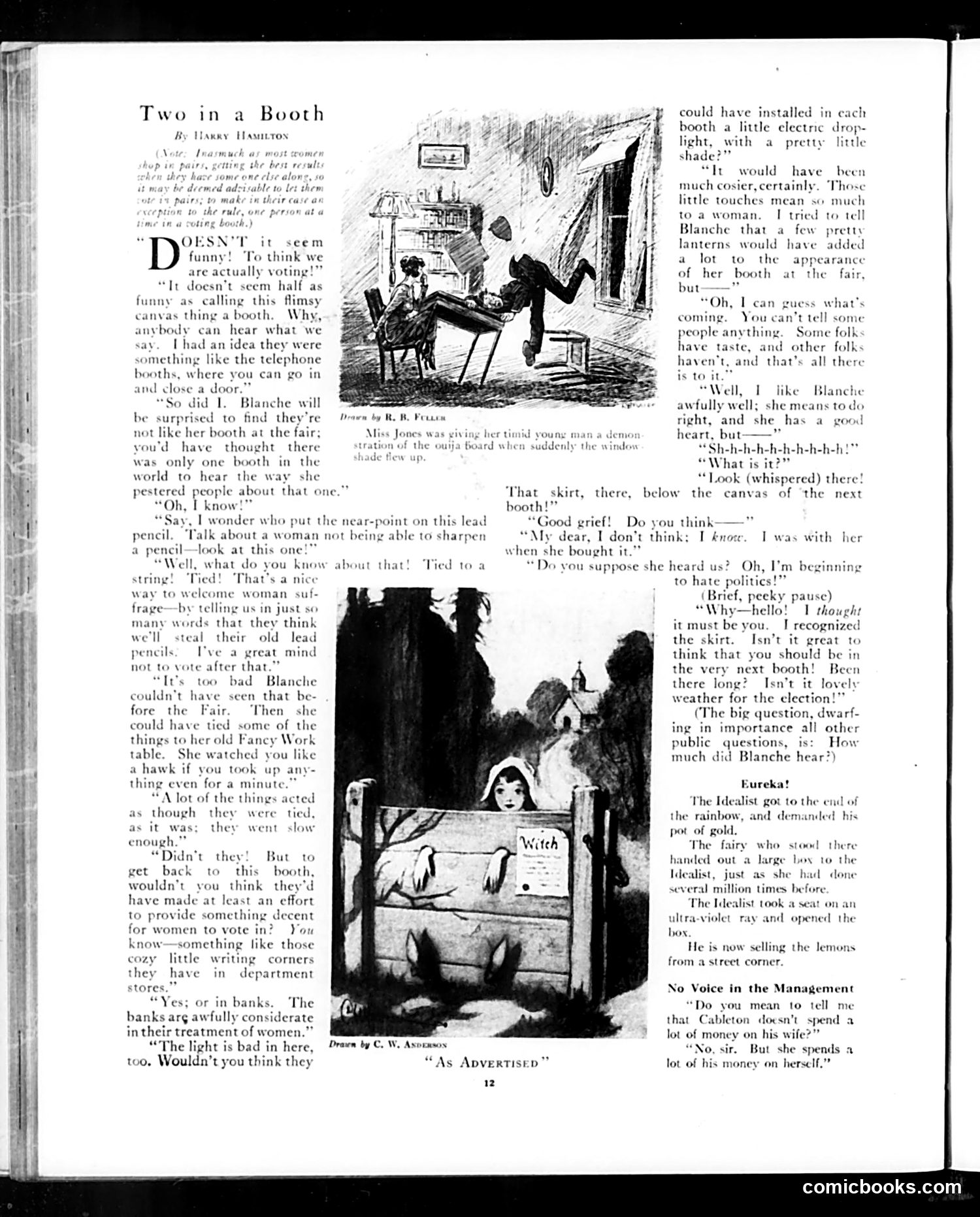
This page satirizes early women's suffrage and the poor conditions provided for female voters. Two women discuss voting in a makeshift polling booth—essentially a flimsy canvas enclosure offering no privacy (anyone can hear them) and no amenities (bad lighting, no writing surface, a pencil tied to prevent theft). The satire cuts multiple ways: it mocks election officials for treating women voters as untrustworthy (the tied pencil suggests women will steal), while also gently ribbing the women for their concern with comfort and aesthetics. One woman complains they're being welcomed to voting with condescension and distrust. The cartoon reflects the tension around women's suffrage (likely early 1900s, pre-1920), showing how women experienced voting as second-class citizens. The additional short stories below ("Eureka!" and "No Voice in the Management") continue gender-based humor about women's economic dependence on men.
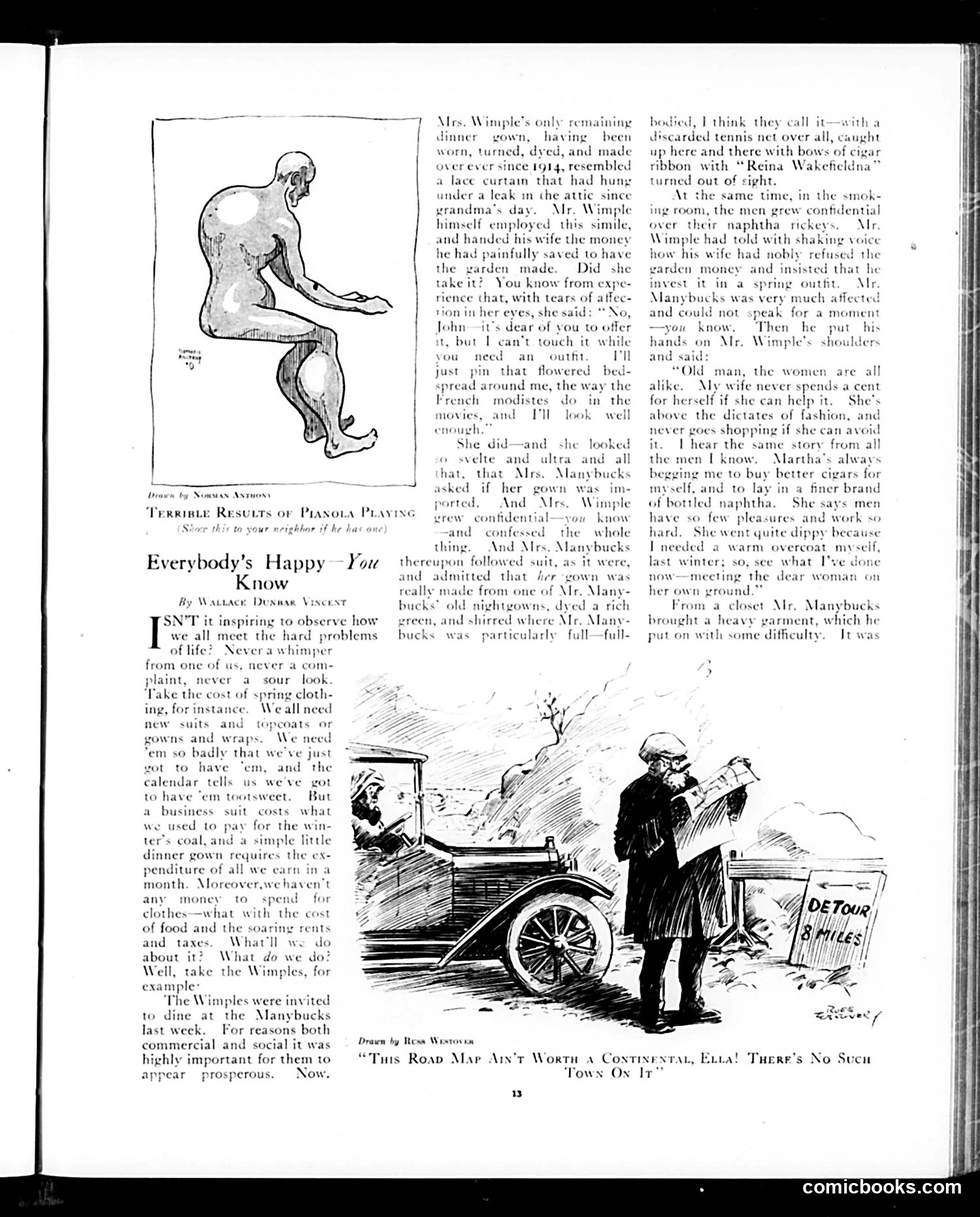
This page contains two satirical pieces about economic hardship during what appears to be the early 1920s. **"Terrible Results of Pianola Playing"** (top illustration): A crude drawing depicting the physical consequences of mechanical piano use—a woman grotesquely contorted, suggesting that automated music-playing devices are physically damaging or morally corrupting. **"Everybody's Happy—You Know"** (main story): A social satire about middle-class couples pretending prosperity while secretly struggling financially. The Wimples attend a dinner party where Mrs. Wimple wears a gown made from a repurposed bedsheet, which Mrs. Manybucks admires. Rather than reveal the truth, both couples confess their financial deceptions to each other in separate rooms, discovering they share identical economic anxieties—high clothing costs, soaring rents and taxes, insufficient income. The satire's point: Americans maintain cheerful facades about financial hardship while secretly making do with makeshift solutions. The "happy" title is ironic; everyone suffers silently, assuming others are prosperous. **"This Road Map Ain't Worth a Continental, Ella!"** (bottom): A couple lost on a rural detour, suggesting travel frustrations.
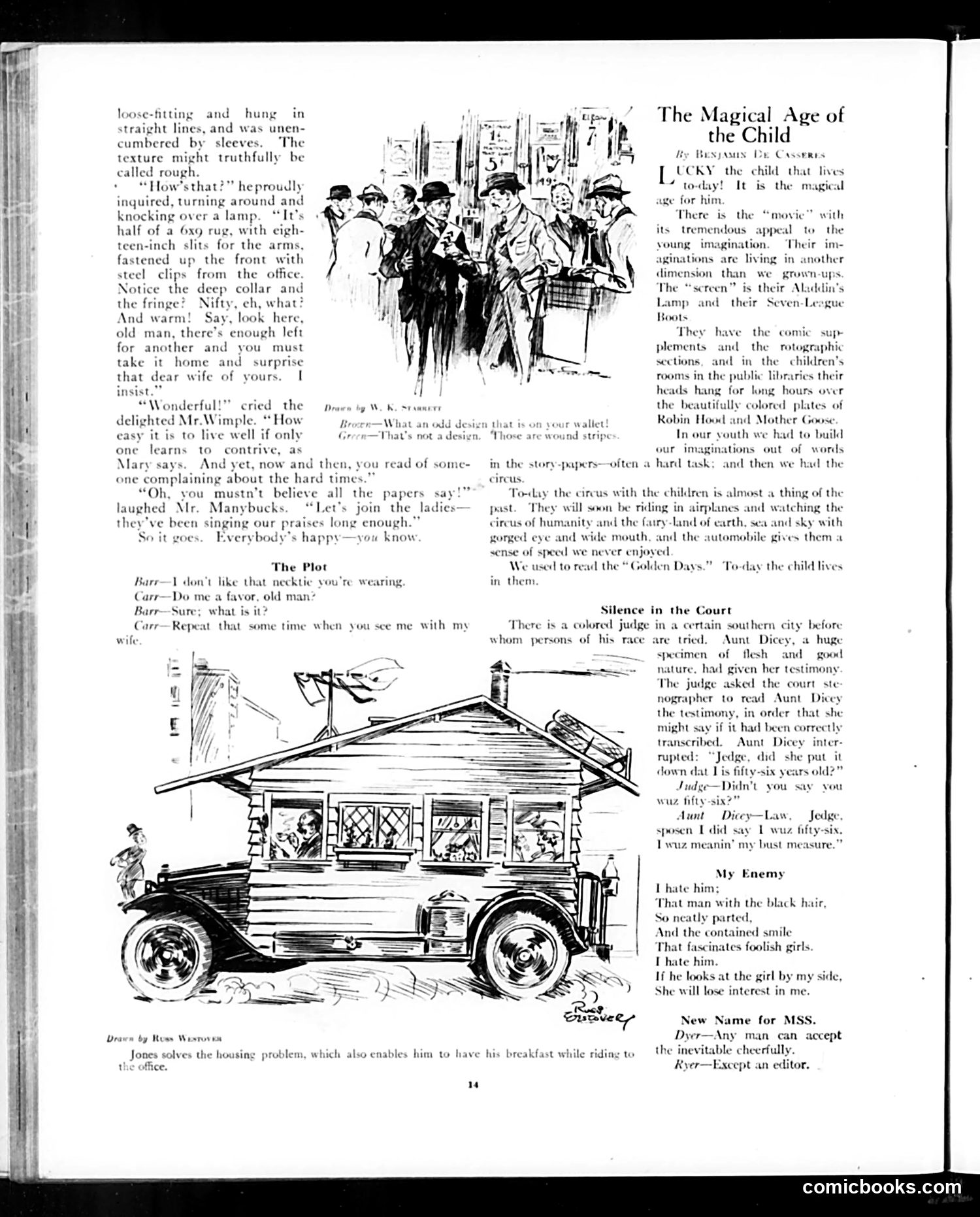
This Judge magazine page contains three distinct pieces of satire: **"The Magical Age of the Child"** (main article): An essay contrasting children's modern entertainment (movies, comic strips, automobiles) with previous generations' simpler imaginative play. The author argues today's children live in a more magical world through mechanical marvels. **"The Plot"** (dialogue): A brief sketch where Mr. Barr complains about Mr. Carr's necktie, then Carr asks him to repeat the complaint in front of Carr's wife—implying he wants his wife to hear criticism of his taste. It's a mild joke about marital dynamics. **"Silence in the Court"** (anecdote): A humorous story about Aunt Dicey, a Black woman testifying before a Black judge in the South. When asked if her testimony was accurate, she corrects the stenographer: she said her "bust measure" was fifty-six, not her age. The humor relies on the dialect and the assumption of confusion, reflecting period attitudes. **"My Enemy"** and **"New Name for MSS."** are brief comic poems about jealousy and editorial stubbornness.
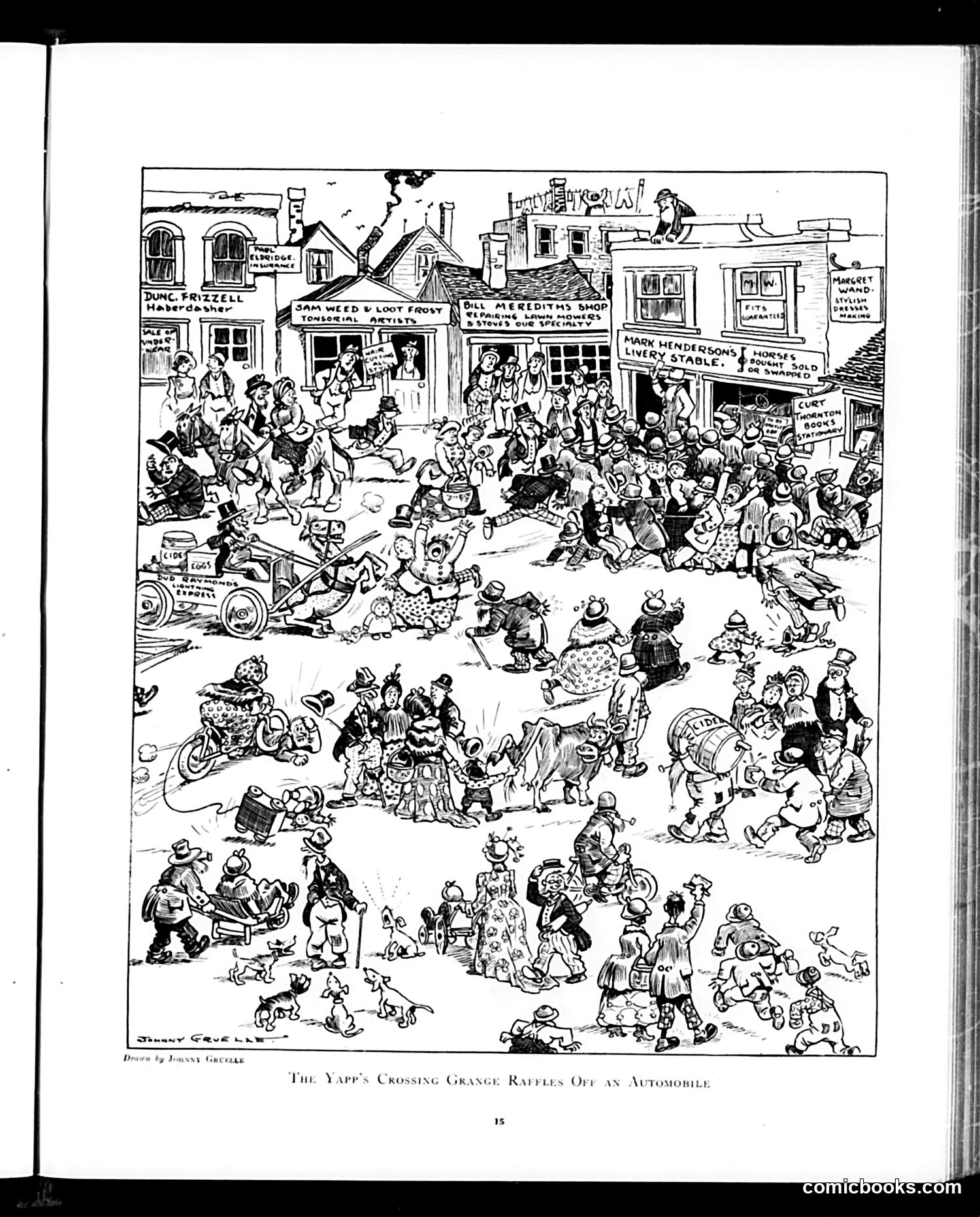
This is a humorous scene depicting a rural community gathering where a grange (a farmers' organization) is raffling an automobile—a luxury item that would have seemed exotic and exciting to rural Americans in the early 20th century. The cartoon satirizes the contrast between traditional rural life and modern technology. The crowded street is filled with farmers, townspeople, and children in old-fashioned dress, alongside the newfangled automobile. Various local businesses are labeled (a hairdresser, livery stable, etc.), establishing a small-town setting. The joke appears to be about rural enthusiasm for modern automobiles and the spectacle such an event would generate in a small community, where owning or even seeing a motorcar was unusual. The artist captures the excitement and chaos of the occasion through the densely-packed, animated crowd.
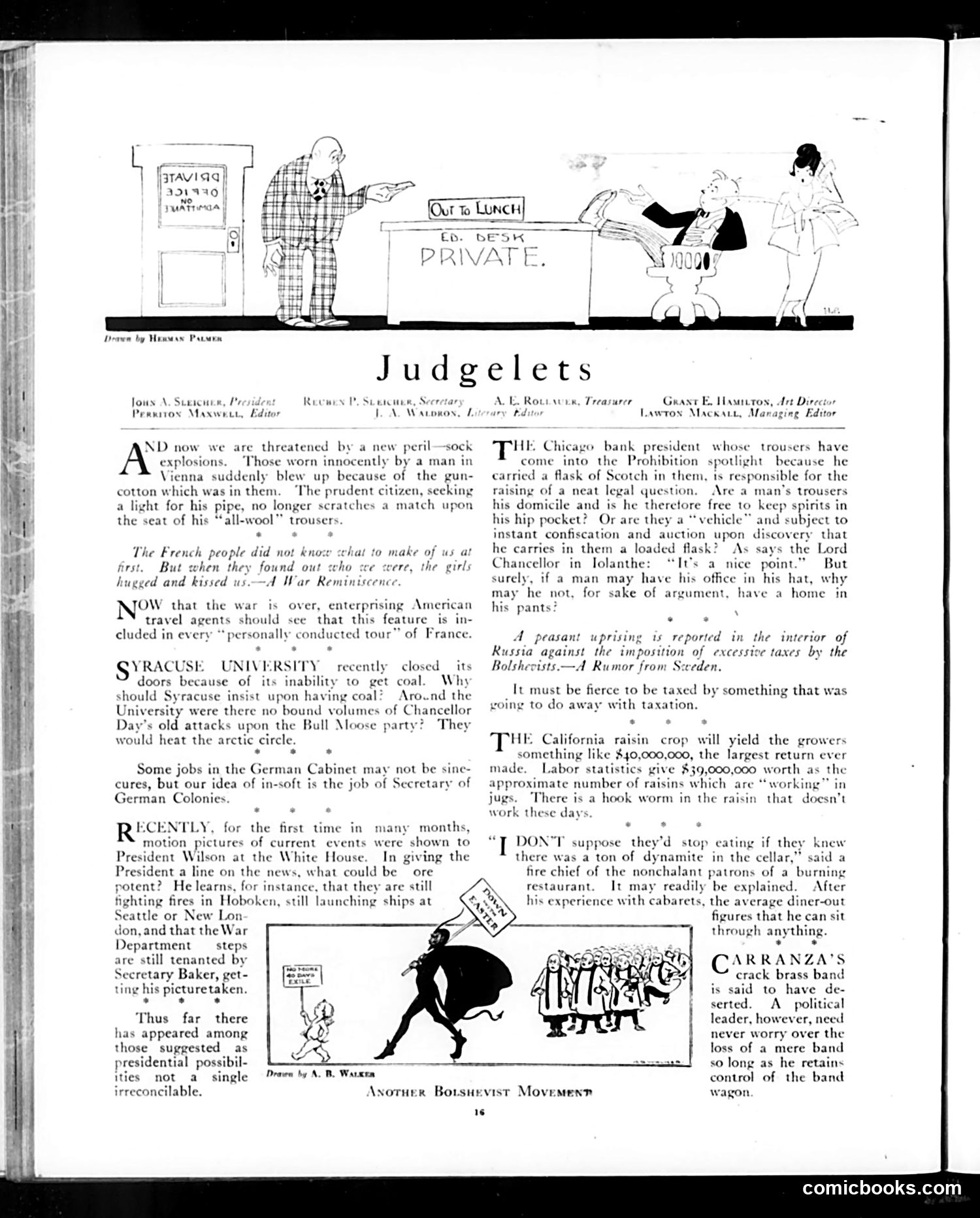
This page collects brief satirical commentary on current events, likely from the early 1920s (post-WWI). **Top Cartoon**: A man at work receives notice he's "Out to Lunch" while his desk reads "Private"—satirizing workplace privacy violations or intrusive management. **Main Articles Mock**: - **Sock explosions in Vienna**: Gun-cotton hidden in socks as weapons; French civilians initially confused, then celebrated the discovery. - **Prohibition-era flask scandal**: A Chicago banker carrying Scotch in his trouser flask raises absurd legal questions about whether clothing constitutes a "domicile" protected from search. - **Syracuse University coal shortage**: Jokes the university should burn Chancellor Day's old "Bull Moose" political pamphlets for heat (referencing TR's 1912 Progressive Party). - **Russian peasant taxation**: The irony that Bolsheviks promised to eliminate taxes, now imposing them. - **Carranza's band desertion**: A Mexican political leader loses his military band but retains power—suggesting appearance matters less than actual control. The humor relies on contemporary political knowledge now obscure to modern readers.
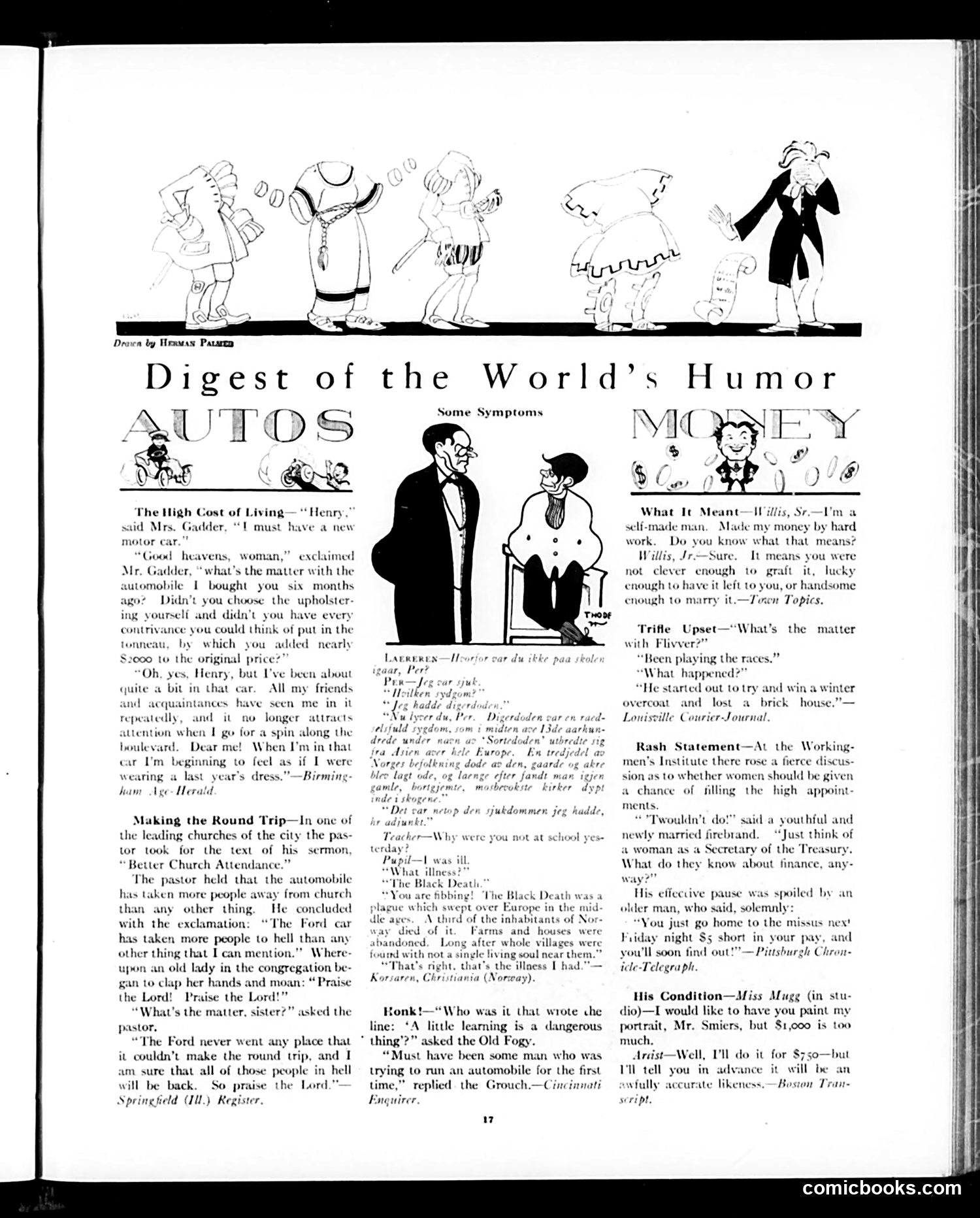
This page collects humorous anecdotes from various publications, satirizing early 20th-century American social concerns. Key themes: **"High Cost of Living"**: Mrs. Gadder demands a new automobile because friends have seen her current one too often—mocking conspicuous consumption and status anxiety among the wealthy during a period of economic strain. **Ford/Automobile Jokes**: Multiple pieces lampoon the newly mass-produced Ford automobile, treating it as both a symbol of modern life's disruptions (church attendance declining) and comedy fodder for accidents and poor driving. **Gender and Class Commentary**: "What It Meant" ridicules self-made men; "Rash Statement" implies women's financial incompetence while suggesting working-class wives control household budgets. These reflect contemporary debates about women's economic and political roles. **General Satire**: Jokes about fashion obsolescence, automobile dangers, and social pretension characterize Judge's typical content—middle-class anxieties presented as universal humor for the magazine's educated readership.
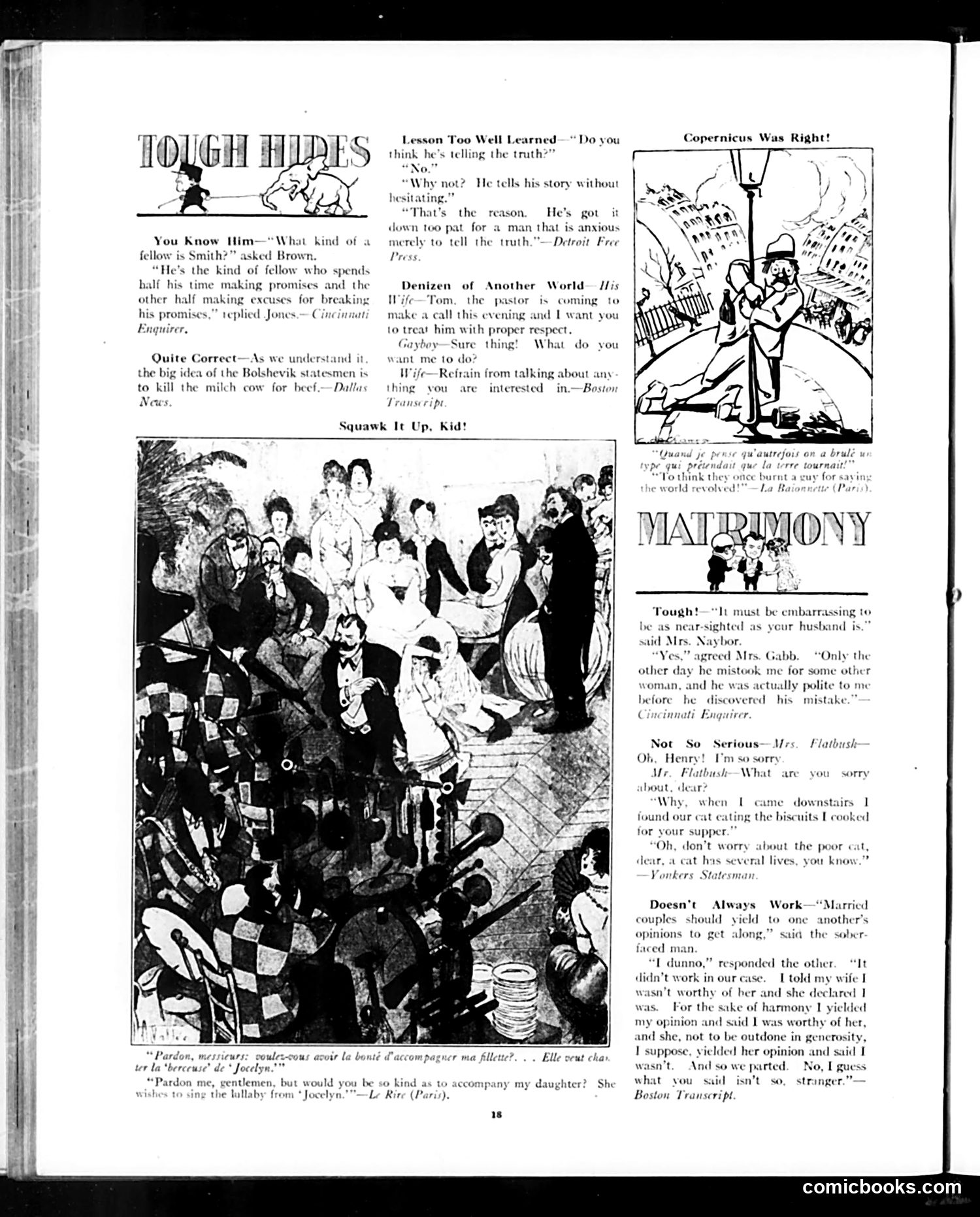
This page contains several brief humorous anecdotes satirizing early 20th-century American social life and politics: **Political References:** - "Quite Correct" section mocks Bolshevik ideology, comparing their goal of killing "the milch cow for beef" to destroying productive assets—a common American critique of Soviet communism. **Social Satire:** - "You Know Him" ridicules a type of man who breaks promises while making excuses. - "Lesson Too Well Learned" jokes that someone telling a story *too* smoothly must be lying—authentic truth-telling is hesitant. - Multiple marriage anecdotes mock domestic disagreements and miscommunication between husbands and wives. - "Copernicus Was Right" appears to reference someone being burned for claiming Earth revolves (inverting Galileo history for humor). **Tone:** Gentle, domestic comedy targeting middle-class foibles rather than sharp political satire. The Bolshevik reference is the only overtly political content, reflecting post-WWI American anxiety about communism.
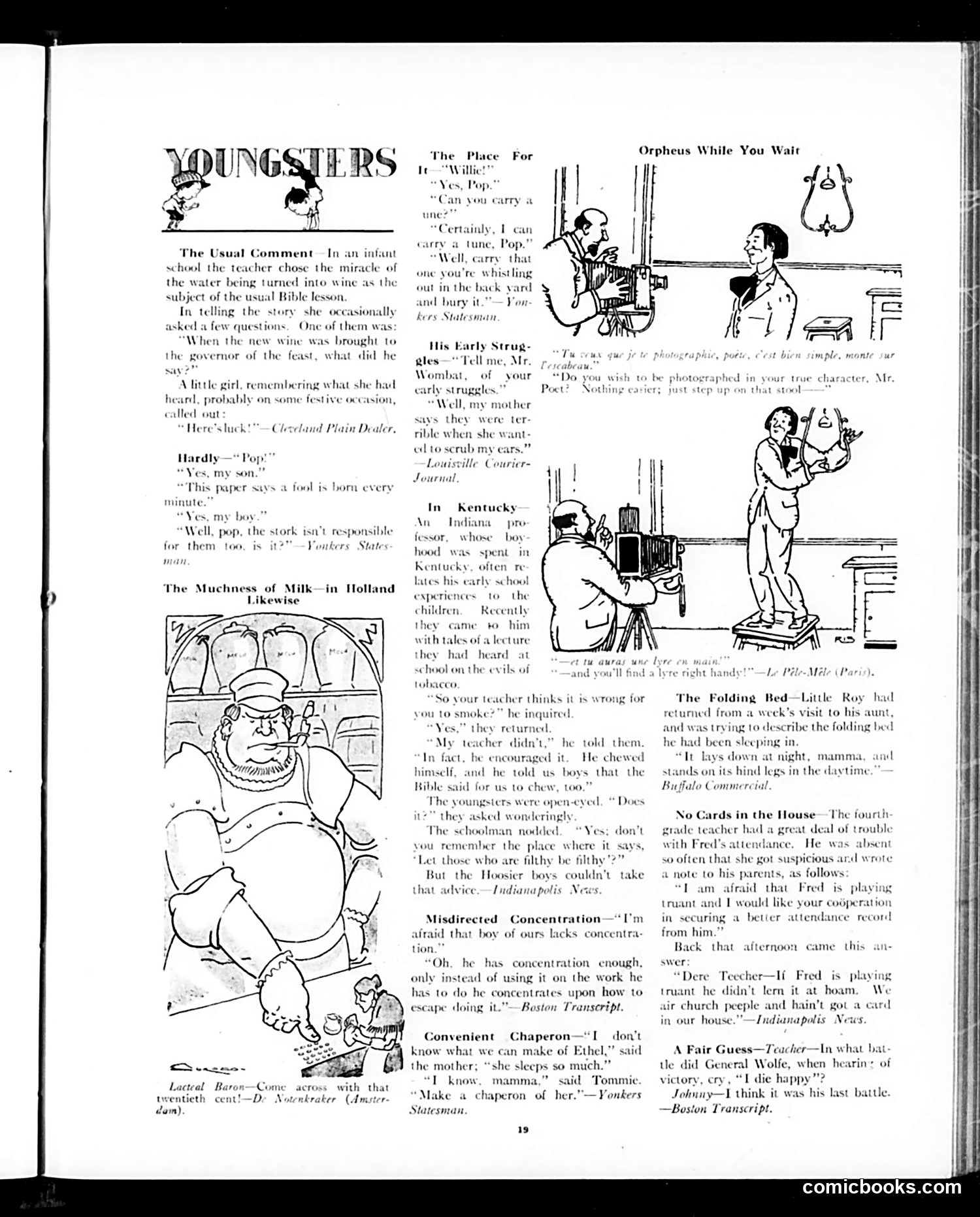
This page from *Judge* contains humorous anecdotes about children and education, typical of the magazine's "Youngsters" humor column. **Main Content:** A series of short jokes depicting children's literal interpretations and innocent misunderstandings: - A child confuses the biblical "miracle of water into wine" with turning it "into as the subject" - A boy thinks "carrying a tune" means physically transporting it - Indiana professor's son reports his teacher encouraged chewing tobacco, citing biblical scripture - A child describes a folding bed's nighttime mechanics with innocent confusion - A teacher struggles with a student's truancy; parents reply they have "no cards in the house" (implying poverty or misunderstanding) **The Satire:** These pieces mock both children's logic and adult obtuseness—particularly educators and parents who either fail to communicate clearly or demonstrate questionable judgment. **Left Illustration:** "Lacteal Baron" shows an exaggerated, rotund Dutch figure, satirizing Holland's association with dairy/milk production—a common ethnic stereotype of the era. The humor relies on period-appropriate stereotypes and child psychology that modern readers would recognize as dated but historically representative of early 20th-century American magazine humor.
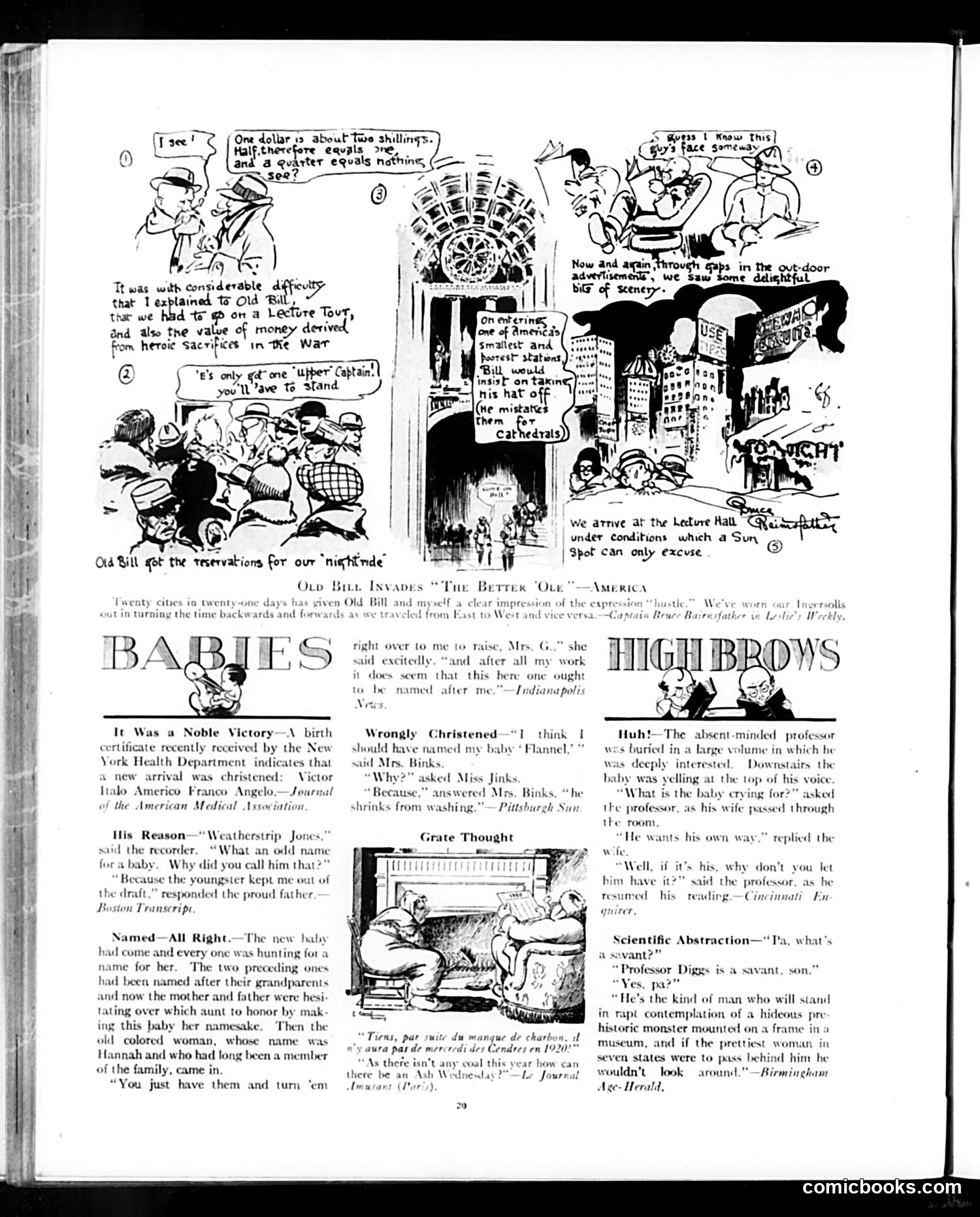
This Judge magazine page (circa WWI era) contains several satirical pieces mocking American society: **"Old Bill Invades America"** (top comic strip): A British soldier visits America on a lecture tour. The satire targets American confusion about currency exchange and social pretension—Americans struggle to understand British monetary values, and the lecture tour itself is mocked as a money-making scheme exploiting wartime sentiment. **"Babies" and "High Brows" sections**: These humorous anecdotes satirize American naming conventions and intellectual pretension. Notable: the "Wrongly Christened" joke about Mrs. Binks naming her baby "Flannel" because he "shrinks from washing"—a pun mocking both poor parenting and cleanliness concerns. The "High Brows" section ridicules absent-minded professors—intellectuals so absorbed in abstract pursuits they ignore obvious realities (a baby's crying, an attractive woman). The overall tone mocks both working-class sentimentality and upper-class pretension typical of Judge's satirical approach during the 1910s-20s.
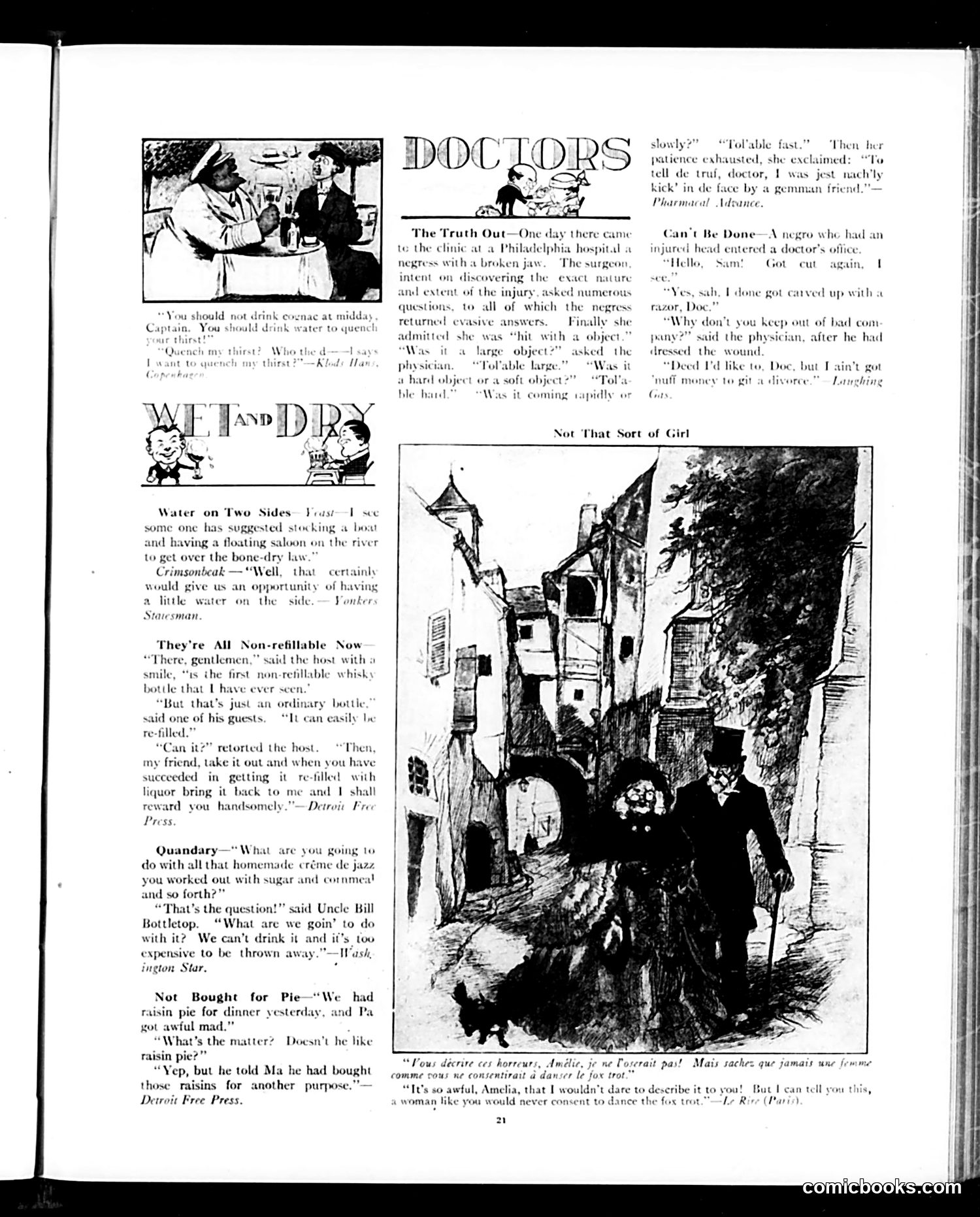
This page from *Judge* satirizes Prohibition-era America through several brief comic anecdotes: **"Water on Two Sides"** jokes about the "bone-dry law" (Prohibition enforcement). Characters discuss placing a floating saloon on a river to evade dry-land restrictions—mocking the absurdity of enforcement gaps. **"They're All Non-refillable Now"** lampoons non-refillable bottles as a Prohibition workaround. The host claims his bottle can't be refilled, then bets no one can refill it with liquor—satirizing attempts to circumvent alcohol bans. **"Quandary"** references homemade "crème de jazz" (likely bootleg alcohol made with cornmeal and sugar), highlighting how ordinary citizens illegally produced spirits during Prohibition. The medical anecdotes ("Doctors" section) employ racial stereotypes common to the era, depicting Black patients in condescending dialect. The French caption appears to mock women's social restrictions regarding dancing the "fox trot," contrasting European attitudes with American prudishness. Overall, the page satirizes Prohibition's unpopular enforcement and the public's creative resistance to it.
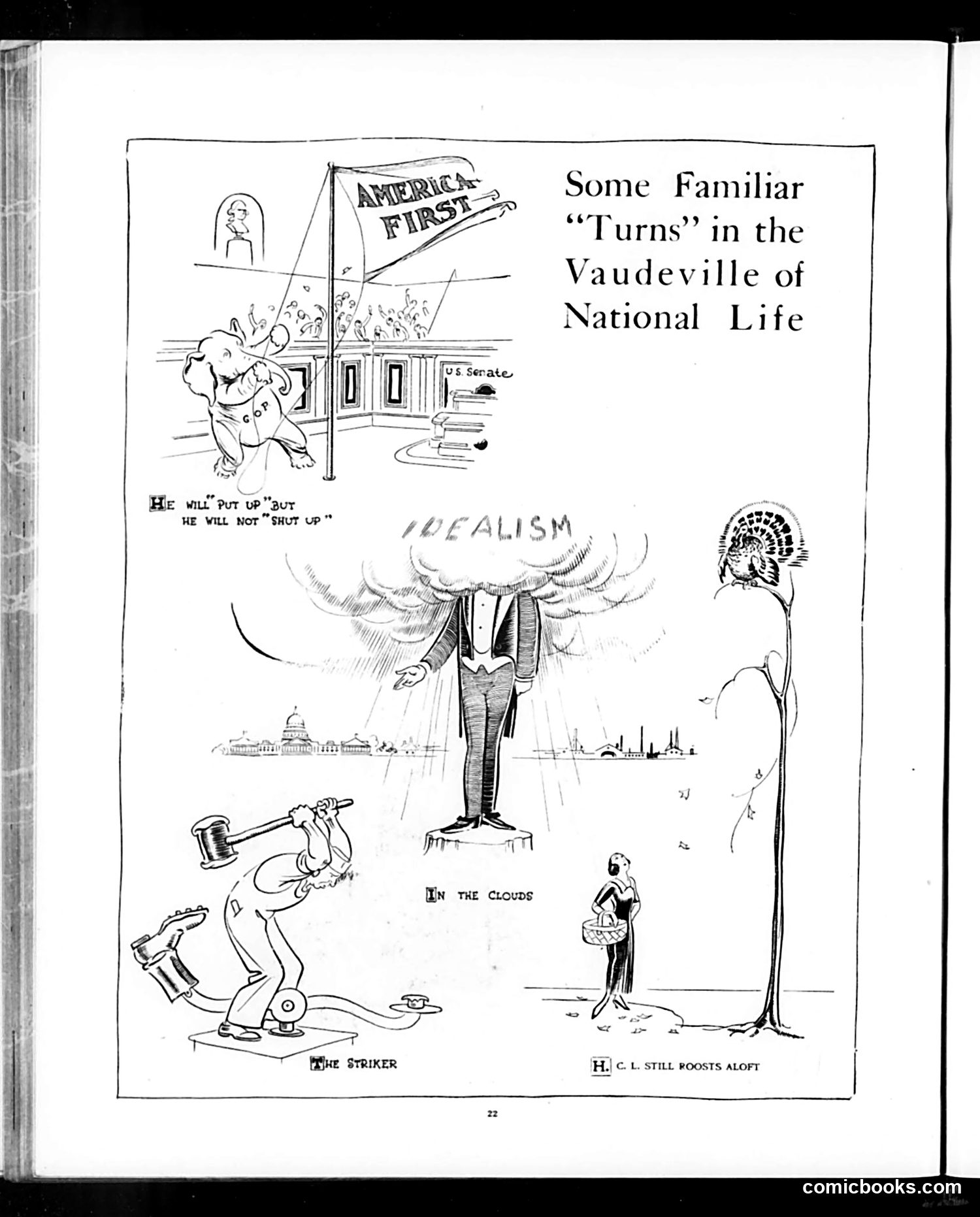
This page presents four satirical cartoons critiquing American political and social figures circa the early 20th century: 1. **Top left**: A figure labeled "America First" on a ship, with text "He will put up 'bout / He will not shut up"—likely mocking isolationist or nationalist rhetoric. 2. **Center**: "Idealism" depicted as a figure with angel wings hovering above clouds, suggesting criticism of impractical idealism in politics or governance. 3. **Bottom left**: "The Striker"—a caricatured figure with a hammer, representing labor activism or union organizing. 4. **Bottom right**: "He still roosts aloft"—a figure on stilts above ground level, unclear reference without additional context. The title frames these as familiar "vaudeville turns" (theatrical acts), suggesting these political phenomena are repetitive entertainments rather than substantive issues.
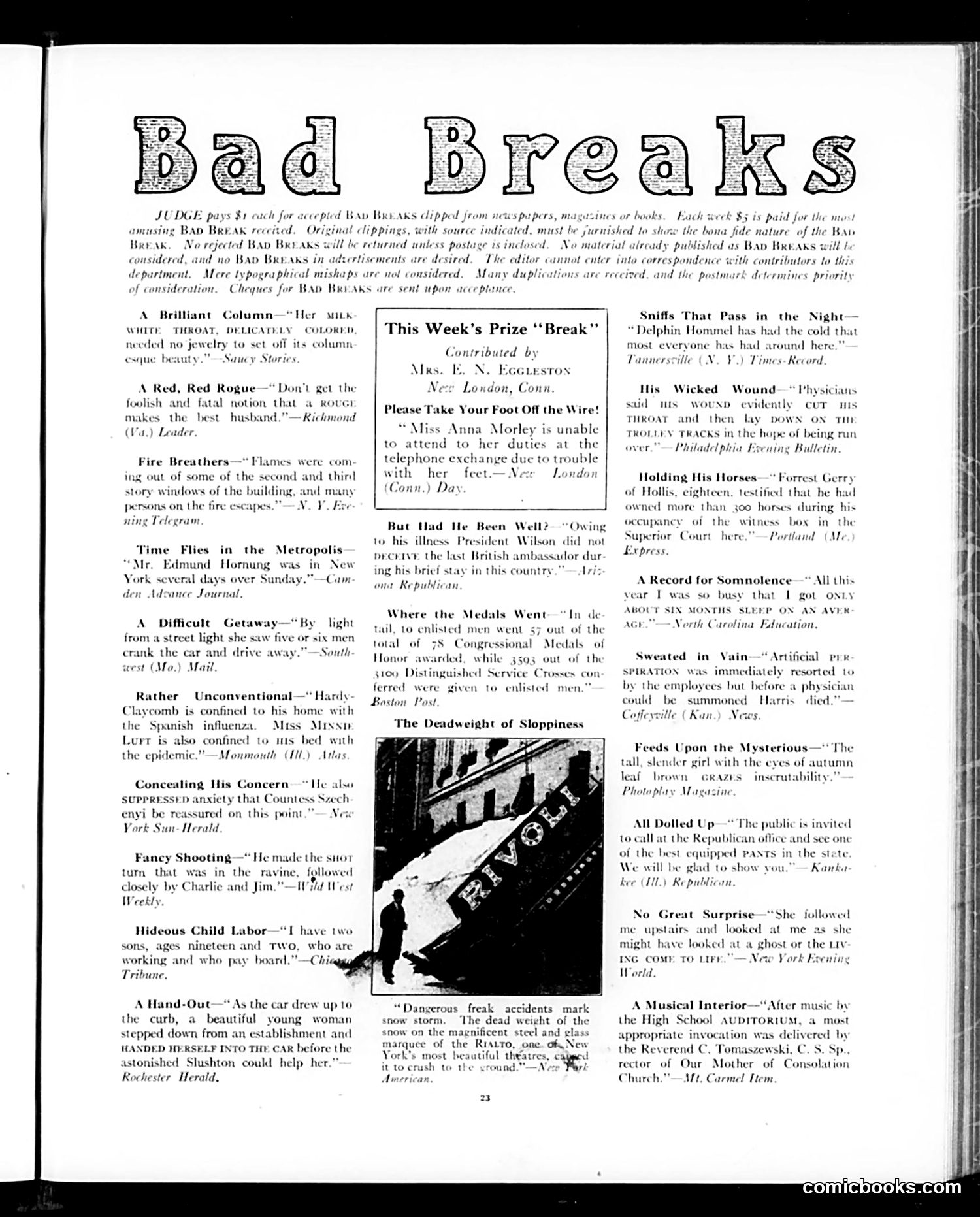
This page showcases "Bad Breaks"—unintentional comedic errors from newspapers and magazines that Judge paid readers $1 to submit. The featured cartoon depicts a snow-laden marquee crushing under weight, illustrating the column's theme of absurd real-world mishaps. The humor derives from published sentences that contain accidental double meanings or logical absurdities. Examples include: a woman "handed herself into the car" (suggesting impropriety), a man's wound was made by lying "on the trolley tracks in hope of being run over" (implying suicide attempt), and a testimony claiming someone "owned more than 300 horses" during a brief courtroom appearance (mathematically impossible). This reflects early 20th-century American journalism's frequent typographical and editorial errors. The feature mocked both the carelessness of competing newspapers and readers' wit in catching such mistakes—a form of lighthearted editorial humor typical of Judge's satirical approach.
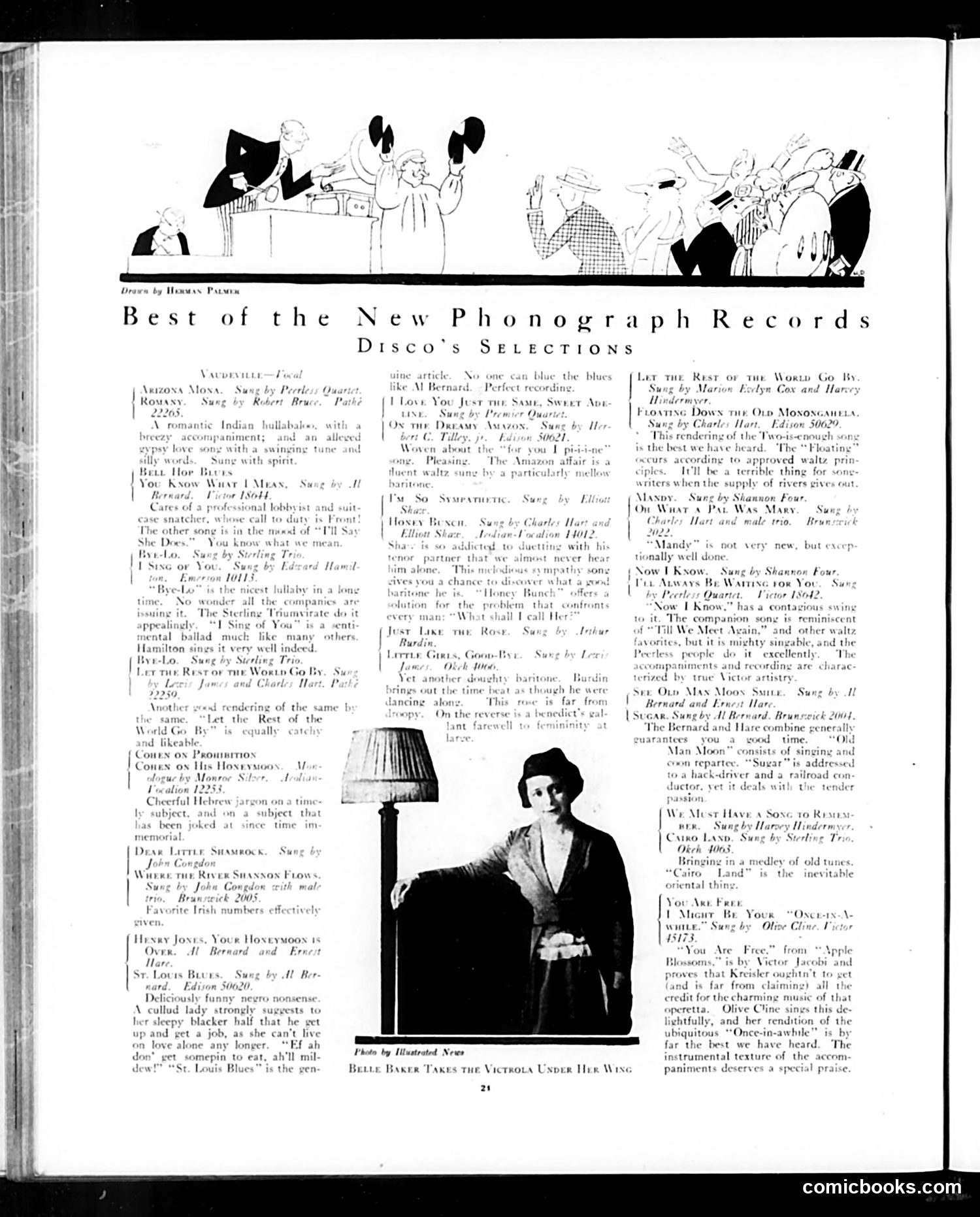
This page is **not a political cartoon** but rather a **music review section** titled "Best of the New Phonograph Records: Disco's Selections." It evaluates recent phonograph (early record player) releases. The illustrated header shows a social gathering where people are listening to recorded music—a relatively novel entertainment form in this era. The drawing by Herman Pfeifer depicts the excitement around this new technology. The bulk of the content consists of brief reviews of recordings by popular performers like Belle Baker (pictured), Charles Hart, and others, evaluating the quality of vocal performances and recording clarity. References to "Victor," "Edison," and "Brunswick" indicate competing phonograph manufacturers and record labels. The photograph of Belle Baker with a victrola (a brand of phonograph) illustrates the era's fascination with this technology. The reviews assess both artistic merit and technical recording quality—a significant concern when phonograph fidelity was still developing. This reflects early 1920s American popular culture and entertainment consumption.
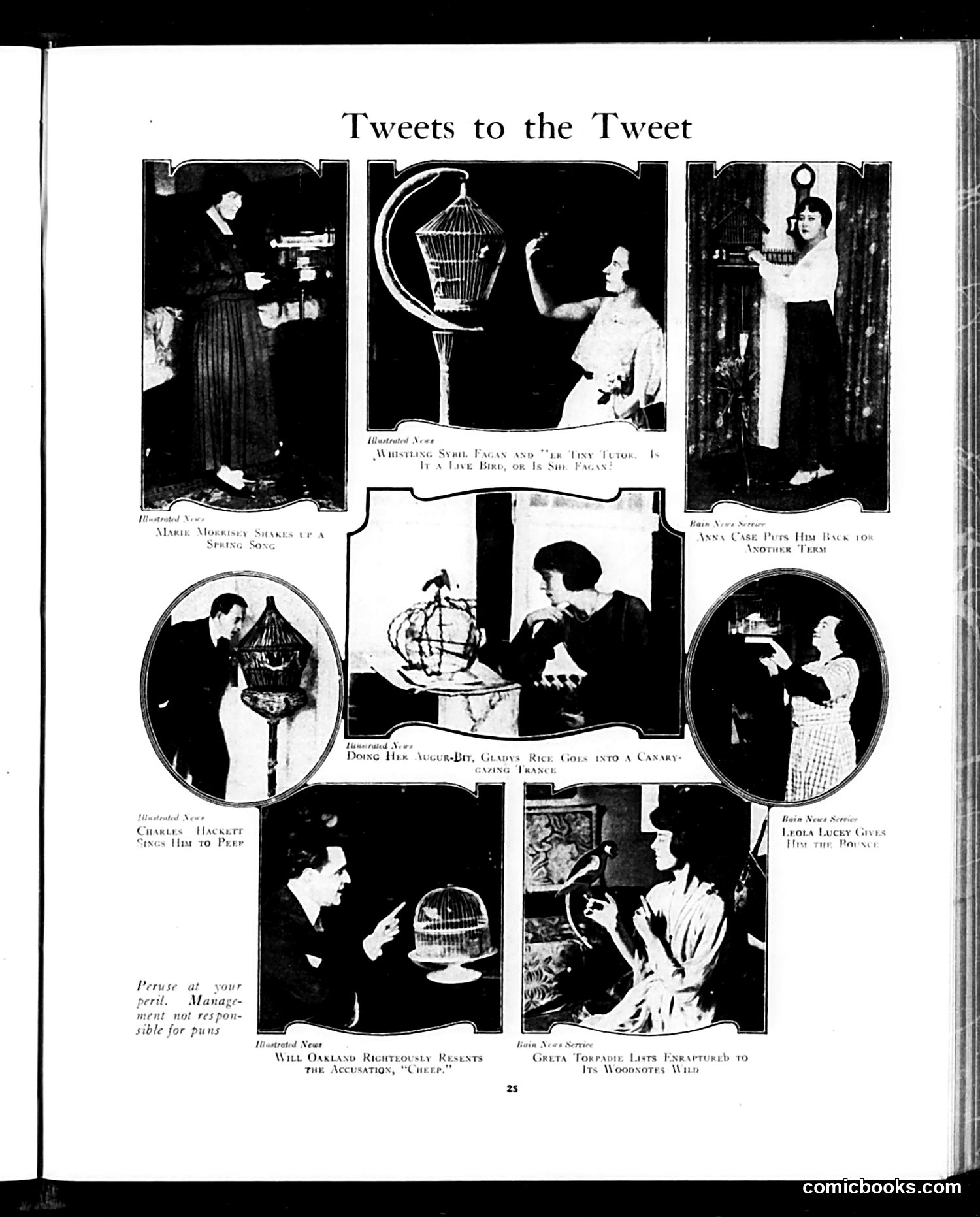
This Judge magazine page presents silent-film comedy sketches featuring birdcages as comedic props. The title puns on "tweets" (bird sounds) with contemporary film stars. The sketches showcase popular silent-film actresses and actors of the era (names visible include Marie Morrissey, Anna Case, Charles Hackett, and Leola Lane) in humorous scenarios involving caged birds. The recurring visual gag centers on birdcages—characters sing to them, get hypnotized by them, resist accusations about them, and have them escape into their homes. This represents early 1920s entertainment journalism: Judge magazine documented and satirized current films and theatrical performances for its readers. The humor relies on slapstick situations and the juxtaposition of refined performers with domestic bird-related chaos—typical of silent-film comedy conventions of the period.
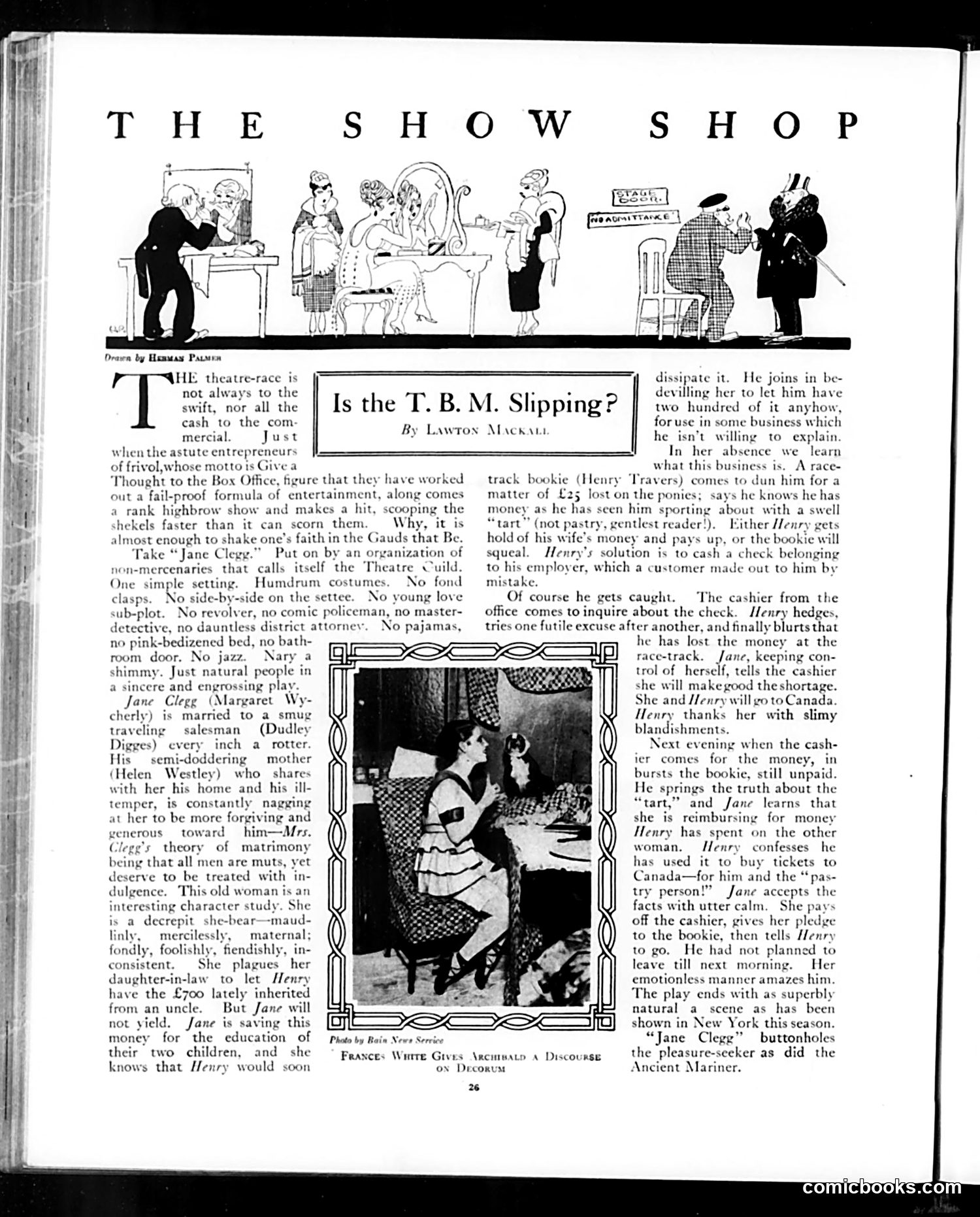
This column reviews "Jane Clegg," a Theatre Guild production that defies commercial theatrical formulas. The critic notes the show's surprising success despite lacking typical crowd-pleasers: no love subplot, no comedic relief, no spectacle—just "natural people in a sincere and engrossing play." The plot concerns Jane, a working-class wife whose gambling, unfaithful husband Henry loses money on horses and embezzles from his employer. When Jane discovers he's spent funds on another woman (called a "tart"), she calmly leaves him for Canada rather than emotionally confronting him. The satire mocks theatrical entrepreneurs' assumptions that audiences want frivolous entertainment. Instead, this "highbrow" production about ordinary domestic tragedy succeeds commercially—shaking faith in profit-driven formulas. The title "T.B.M. Slipping?" likely refers to Broadway's theatrical establishment ("The Big Machine") losing its grip on audience tastes.
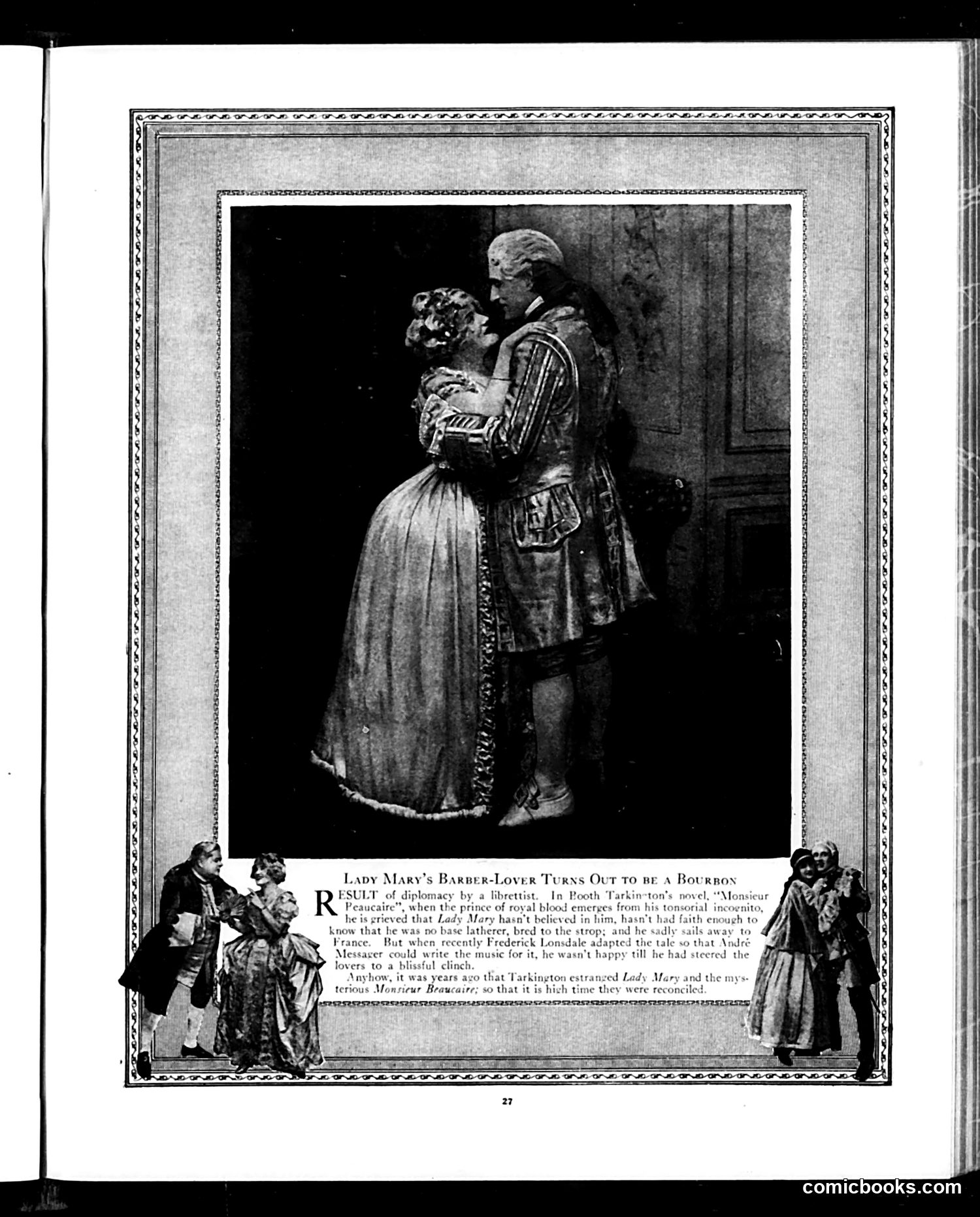
This page from *Judge* magazine depicts a theatrical scene titled "Lady Mary's Barber-Lover Turns Out to be a Bourbon." The illustration shows a man in aristocratic 18th-century military dress embracing a woman in period costume. The text references a plot involving diplomatic intrigue, royalty, and a romantic entanglement with someone of noble (Bourbon) lineage. The narrative appears to satirize European aristocratic society and romantic complications involving hidden identities or social class—a common subject for *Judge's* humor. The specific historical or theatrical reference is unclear from the visible text, though it seems to mock elaborate romantic plotlines and the pretensions of titled nobility. The accompanying smaller figures at the page's borders likely provide comedic commentary on the main scene.
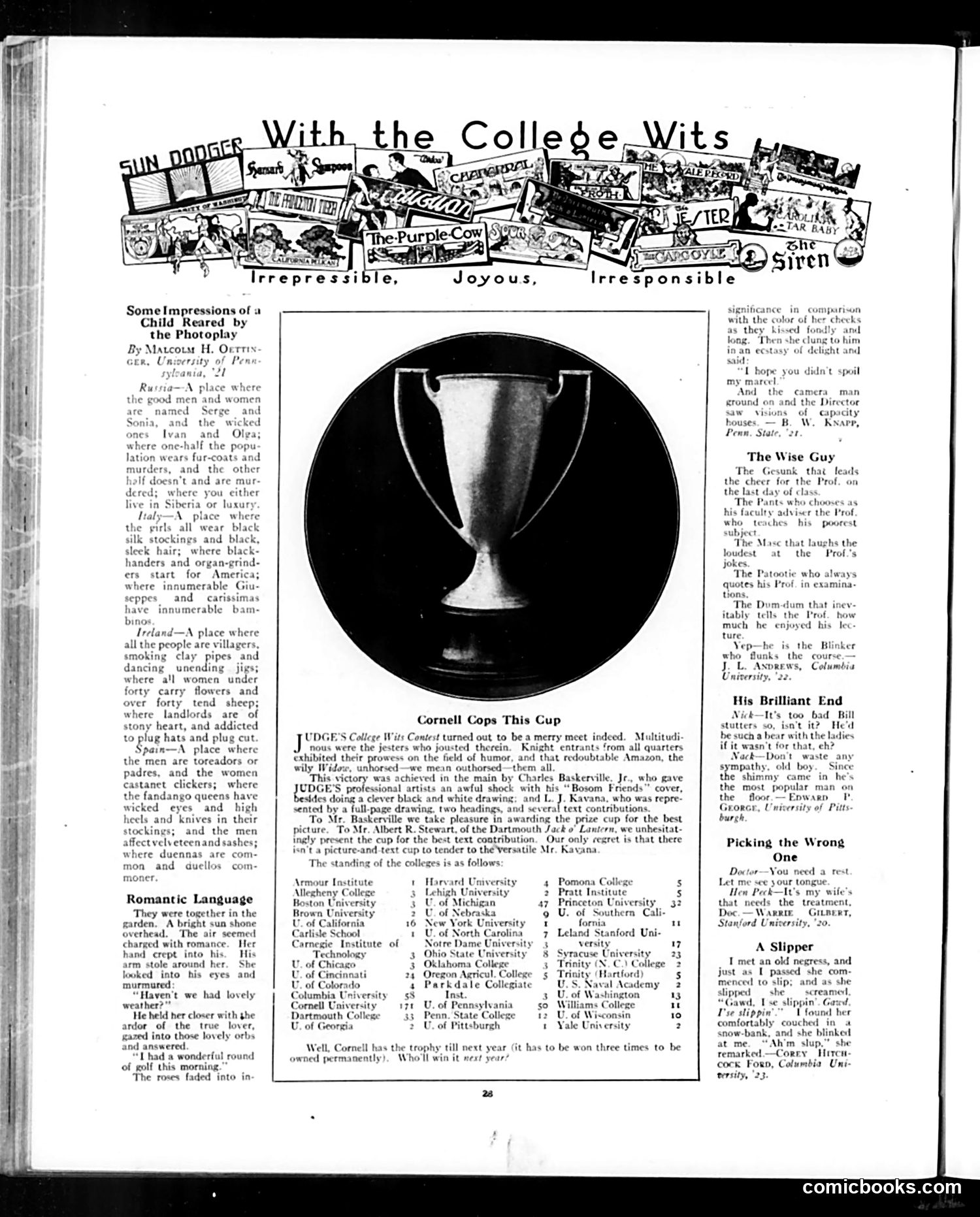
This page announces results of Judge magazine's college humor competition, centered on a trophy cup labeled "Cornell Cops This Cup." The contest invited humorous contributions from students nationwide. **The Main Content:** The cup award went to Charles Baskerville Jr. (Dartmouth) for best picture/drawing, and Albert R. Stewart (also Dartmouth) for best text. The page lists standings from participating colleges, with Notre Dame leading significantly. **The Surrounding Humor Pieces:** Short comedic sketches mock college stereotypes: "The Wise Guy" (professor's pet), "His Brilliant End" (a stuttering student popular with girls), "Picking the Wrong One" (a doctor joke), and "A Slipper" (a flirtation mishap). **Historical Context:** This reflects 1920s college culture and Judge's role celebrating collegiate wit and humor. The extensive college participation shows universities' active engagement with satirical magazines during this era.
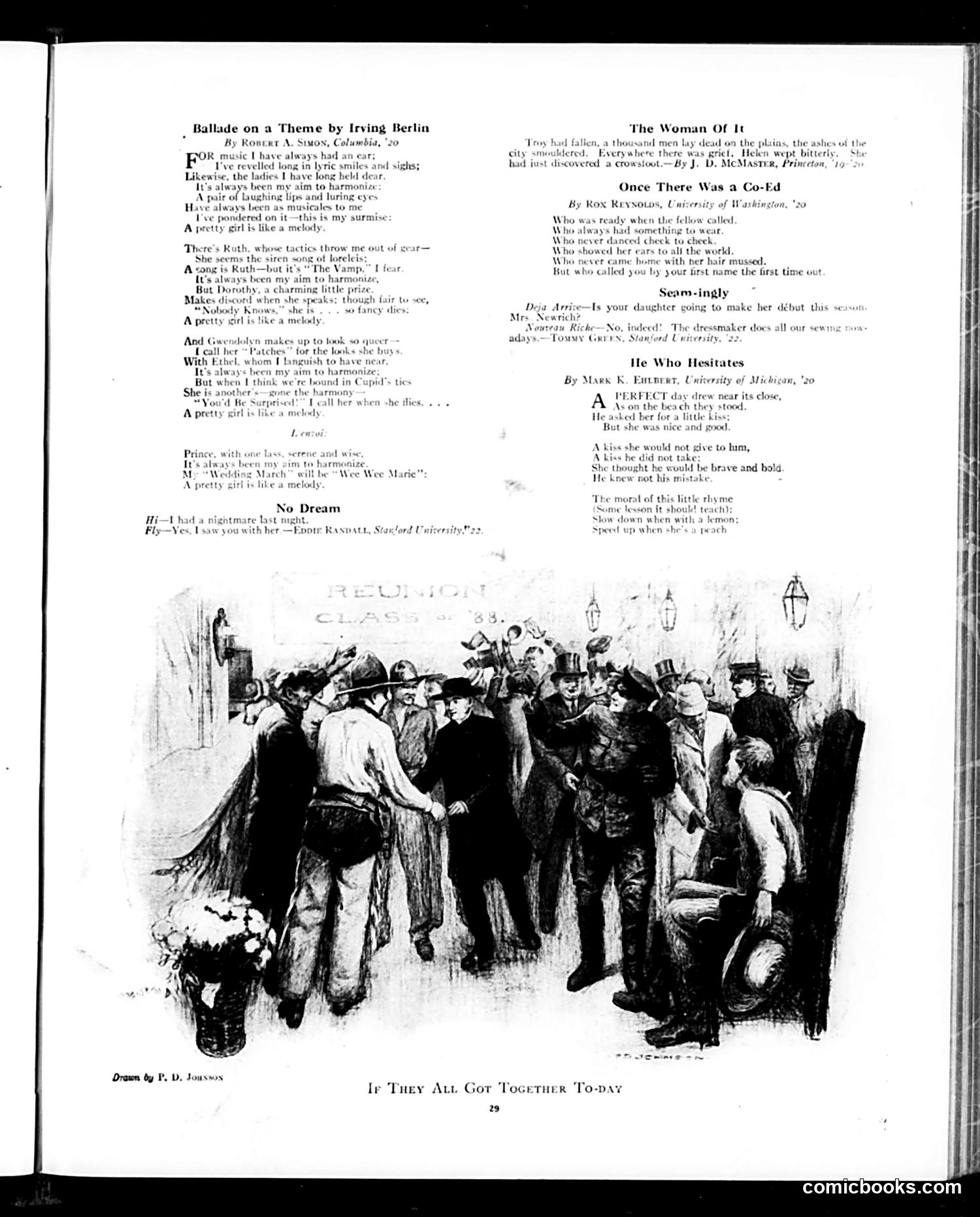
This page contains several humorous poems and sketches satirizing early 20th-century courtship and gender roles: **"Ballade on a Theme by Irving Berlin"** parodies Berlin's famous song "A Pretty Girl Is Like a Melody," listing predictable romantic clichés about women that the speaker claims to have "long held dear." **"Once There Was a Co-Ed"** humorously catalogs the ideal college girl—someone always ready, properly dressed, modest in behavior. The humor lies in listing these impossibly perfect traits as if describing an actual person. **"He Who Hesitates"** presents a sentimental beach scene where a timid man fails to kiss a "nice and good" woman, then regrets his passivity. The moral warns men to be bolder in romance. The large **P.D. Johnson illustration** depicts a crowded street scene—"If They All Got Together To-day"—showing many couples or groups mingling, likely satirizing urban social mixing or some contemporary trend. These pieces collectively mock both sentimental romantic ideals and awkward courtship conventions of the era, with gentle humor rather than biting satire.
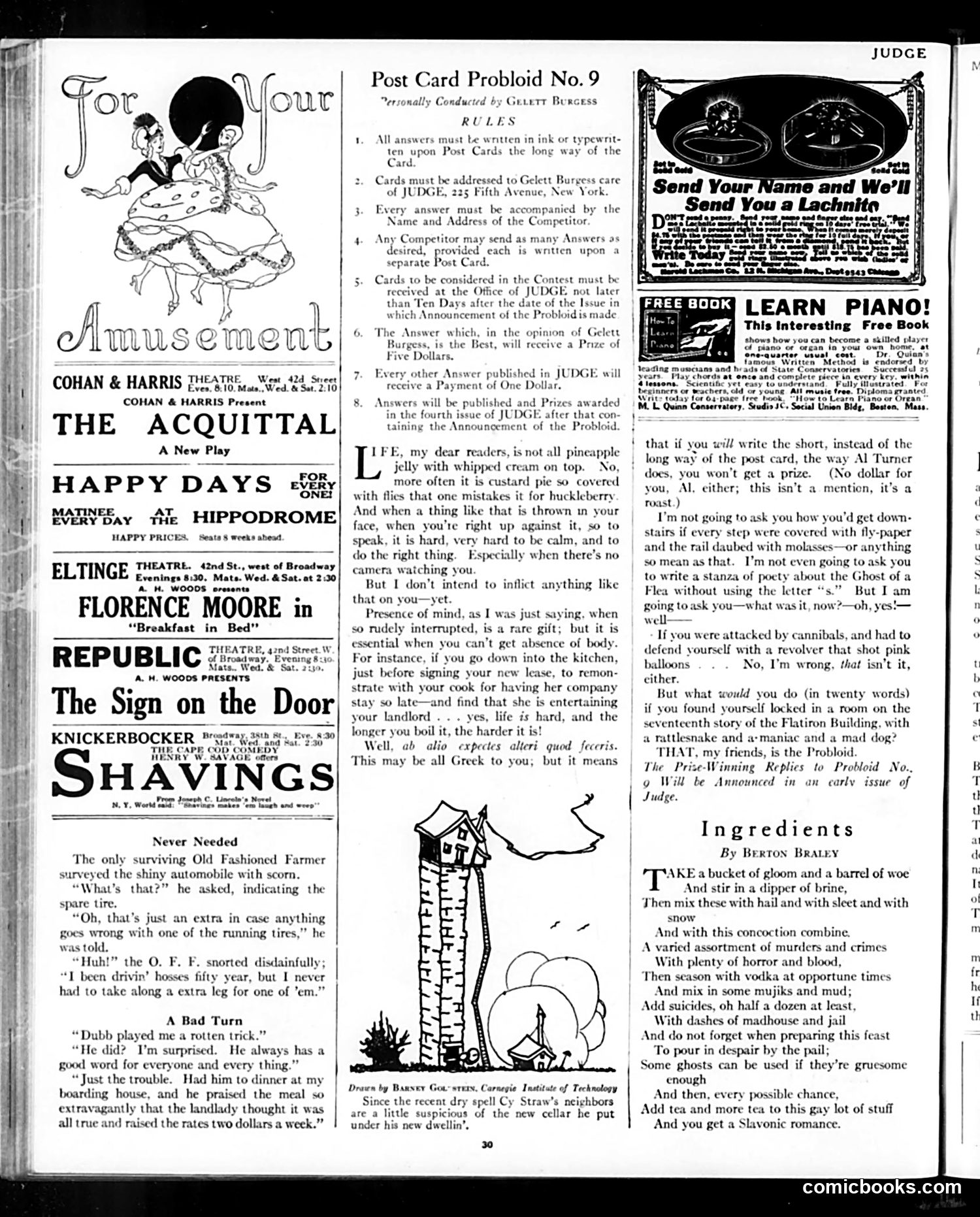
This page is primarily **advertising and contest material**, not political satire. The main content includes: **Contest**: "Post Card Probloid No. 9" by Gelett Burgess—a writing competition where readers submit short answers to puzzles for cash prizes (up to $5). **Humor pieces**: Two brief anecdotes—"Never Needed" (an old farmer dismisses the spare tire as unnecessary, unlike extra horse legs) and "A Bad Turn" (a man's polite dinner compliment backfires when his landlady raises rent). Both mock rural ignorance and unintended consequences. **Illustrations**: A cartoon showing someone dumping waste into a cellar, captioned about suspicious neighbors during a drought. **Theater advertisements**: Multiple Broadway shows and entertainment listings. **Music lesson advertisement**: Promoting piano instruction. The page reflects early 20th-century magazine format: light humor, commercial contests, and theatrical promotions with minimal political content—essentially an entertainment/lifestyle section rather than satire.
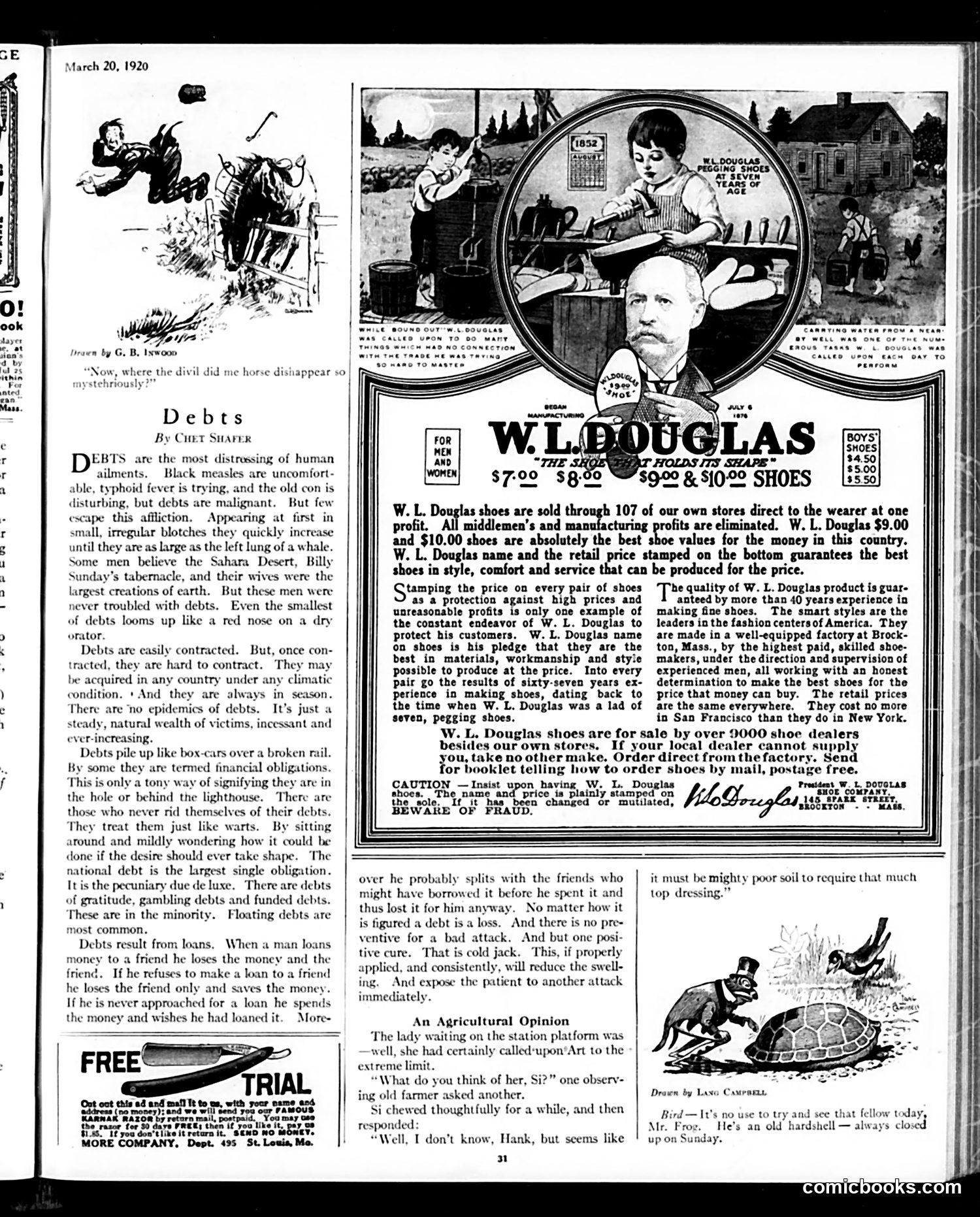
This page combines editorial content with advertising. The small cartoon at top left, drawn by G.B. Isewood, depicts an Irish figure (identifiable by dialect: "divil," "nriously") bewildered over a missing horse—likely a visual pun on financial loss, connecting to the page's main essay "Debts." The essay humorously catalogs debt as a widespread human affliction, comparing it to disease and suggesting most people cannot escape it. It distinguishes between personal debts (most common), gambling debts, and the national debt (described as "the largest single obligation"). The tone is satirical but also somewhat moralizing about financial irresponsibility. The dominant content is a large W.L. Douglas shoe advertisement featuring a portrait and circular vignette imagery—typical 1920s advertising style emphasizing direct-to-consumer sales, quality workmanship, and price transparency as virtues against middlemen and price-gouging. The page reflects post-WWI economic concerns about debt and inflation while promoting consumer purchasing power through branded goods.
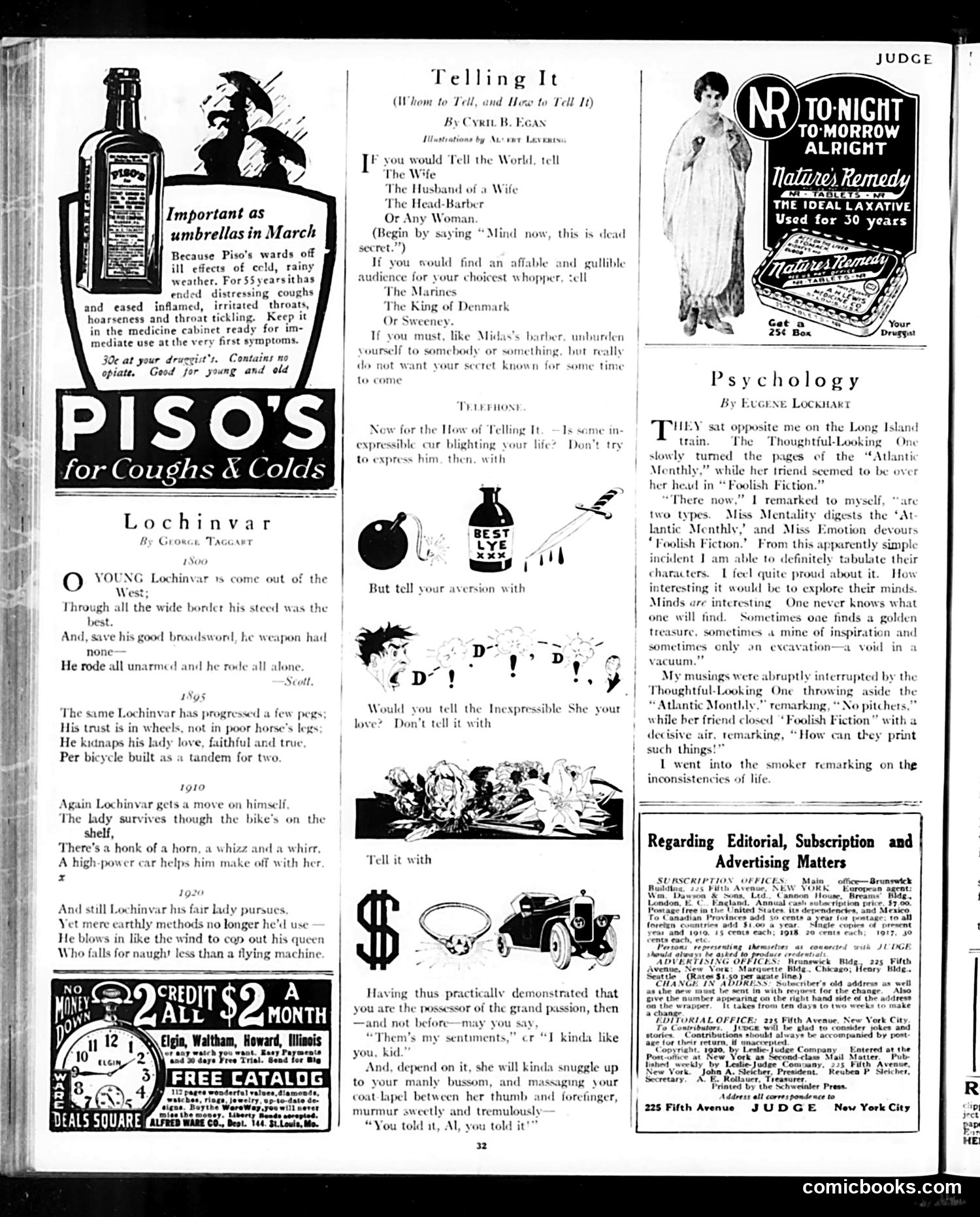
This page contains mostly **advertisements and light satirical pieces** rather than political cartoons. The main content includes: **"Lochinvar"** — a humorous poem tracking how the literary figure (from Sir Walter Scott's romantic ballad) "modernizes" across decades: from riding a horse (1803), to bicycling (1910), to driving a car, to finally using a flying machine to pursue his lady. It's gentle social satire about technological progress replacing traditional romance. **"Telling It"** — a tongue-in-cheek guide about which people to confide secrets to (wives, barbers, and women are "gullible"; marines and the King of Denmark supposedly aren't). It's mild humor about gossip and discretion. **"Psychology"** — an essay mocking superficial character judgments, describing someone who assumes a woman reading *Atlantic Monthly* is intellectual while one reading *Foolish Fiction* is emotional—then both women disappoint those assumptions. The **advertisements** (Piso's cough medicine, Nature's Remedy laxative, clock catalog) are typical early-20th-century patent medicines and mail-order goods marketed with exaggerated health claims.
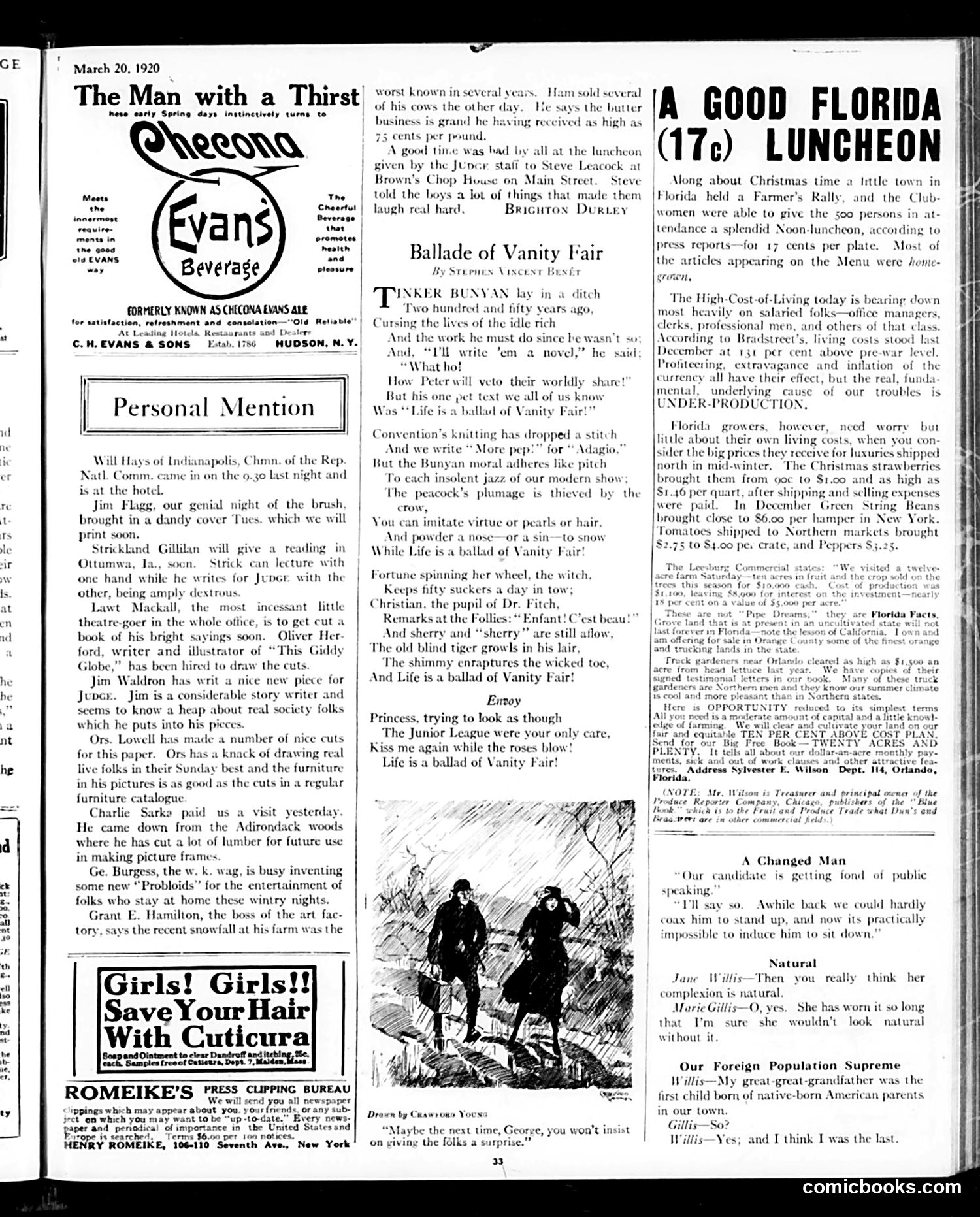
This page primarily contains **personal mentions, advertisements, and light verse** rather than political satire. The main content includes: - **"Personal Mention"**: Gossip about Judge magazine contributors and associates (Will Hays, Jim Fugg, strickland Gillilan, etc.) - **"Ballade of Vanity Fair"**: A poem by Sterness Vincent Benét using the Paul Bunyan figure to satirize social pretension—the wealthy living idle lives while workers labor, with the refrain "Life is a ballad of Vanity Fair" suggesting life is merely vanity and show - **Advertisements** for Chicona Evans Beverage, Cuticura hair products, and Romeike's clipping bureau The Benét poem's satire targets **Jazz Age excess and class hypocrisy** (1920s themes), mocking the wealthy's artificial morality versus their actual indulgence in forbidden pleasures (illegal alcohol, nightclubs). The "old blind tiger" references speakeasies during Prohibition. No major political figures or events are caricatured on this specific page.
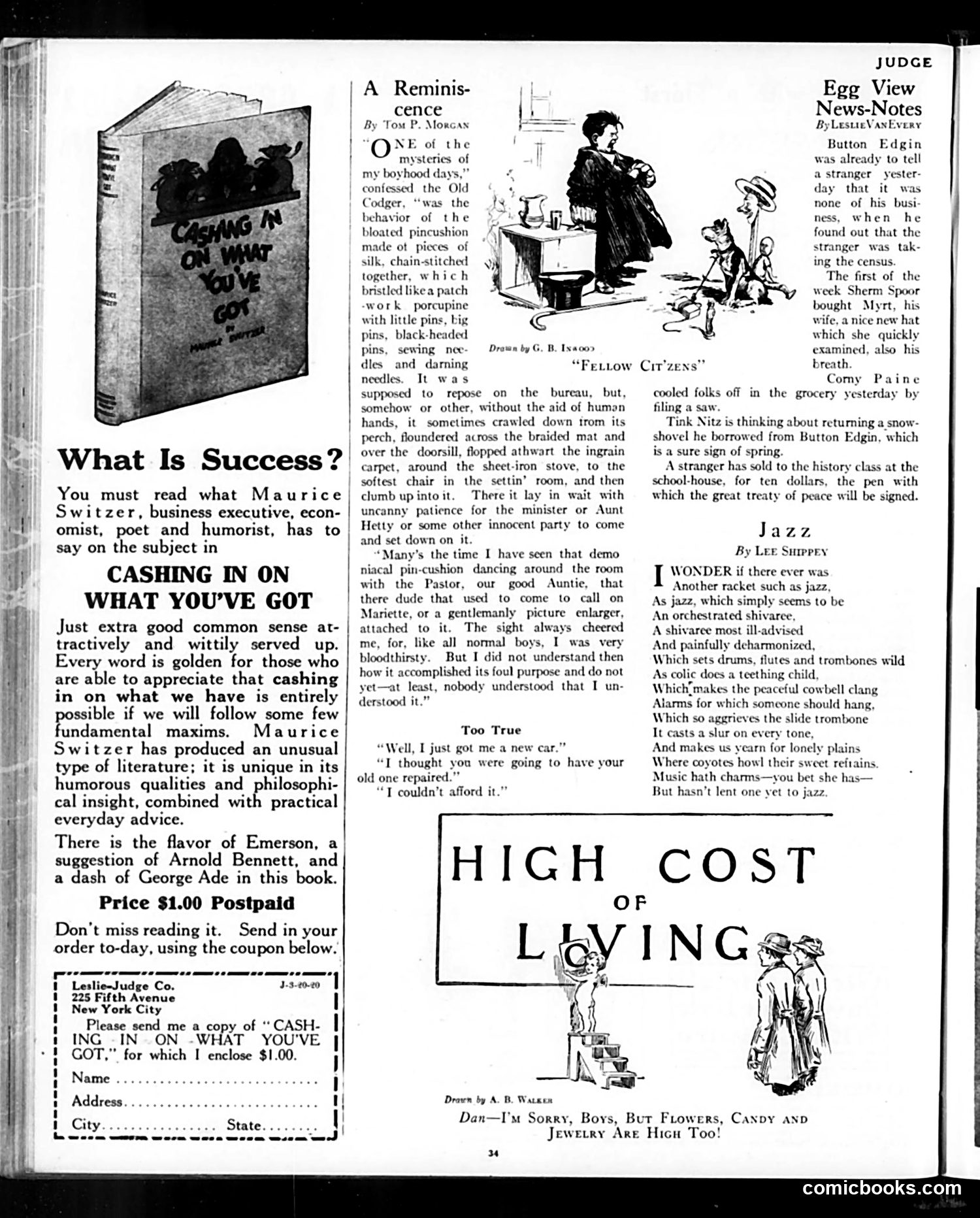
This page mixes advertising with satirical humor typical of Judge magazine. The main content includes: **"A Reminiscence"** — A nostalgic sketch about a mischievous pincushion that mysteriously migrates around a Victorian home, pricking unsuspecting visitors (ministers, aunts, suitors). The joke plays on childhood memory of seemingly animate objects and the gleeful cruelty of boys witnessing adults' discomfort. **"What Is Success?"** — Advertisement for Maurice Switzer's self-help book, positioning practical wisdom as philosophy comparable to Emerson and George Ade. **"Fellow Citizens"** — A cartoon depicting what appears to be a census-taker interview, with the subject suspicious and defensive about providing information. **"Jazz"** — A poem mocking jazz music as chaotic noise—"an orchestrated shivarce" (commotion)—reflecting 1920s cultural anxiety about modern music's supposed moral degeneracy. **"High Cost of Living"** — Cartoon lamenting inflation affecting luxury goods (flowers, candy, jewelry), reflecting post-WWI economic concerns. The page reflects Jazz Age anxieties: modernization, changing social norms, and economic uncertainty.
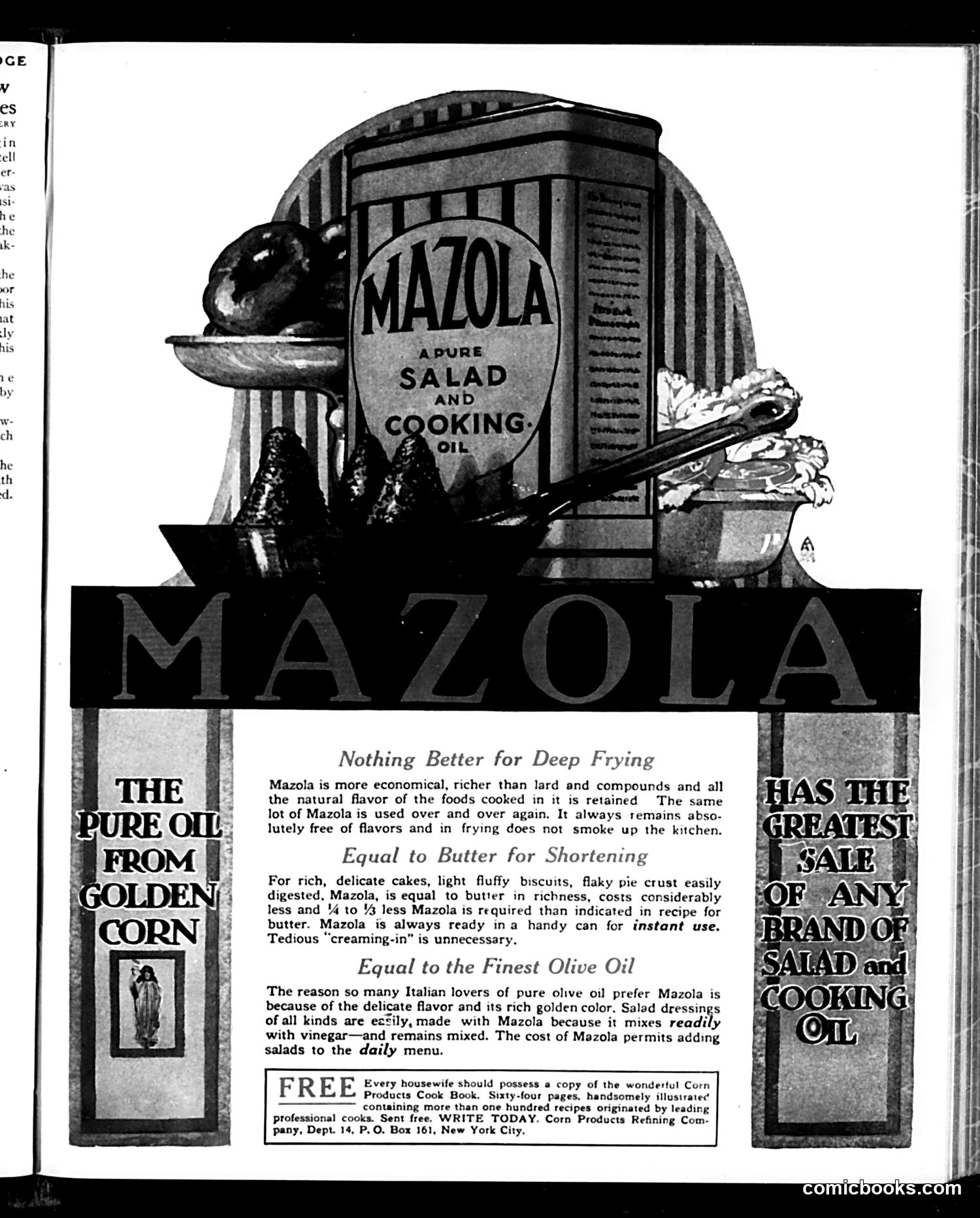
This is primarily a **Mazola cooking oil advertisement**, not political satire. The page shows a large product can labeled "Mazola: A Pure Salad and Cooking Oil" surrounded by fresh ingredients (corn, vegetables, fish). The ad's strategy targets specific cooking needs: it claims Mazola is superior for deep frying (better than lard), baking (equal to butter but cheaper), and salad dressings (comparable to olive oil). This multi-purpose positioning was the sales pitch—one product replacing three expensive alternatives. The visual references to "golden corn" emphasize the product's corn oil base. The ad includes a free offer for a cookbook with 100+ recipes. **For modern readers**: This reflects early 20th-century marketing logic, when processed vegetable oils were relatively new and positioned as economical substitutes for traditional fats. The comparison to "Italian lovers of pure olive oil" suggests marketing to immigrant communities while promoting a cheaper American alternative.
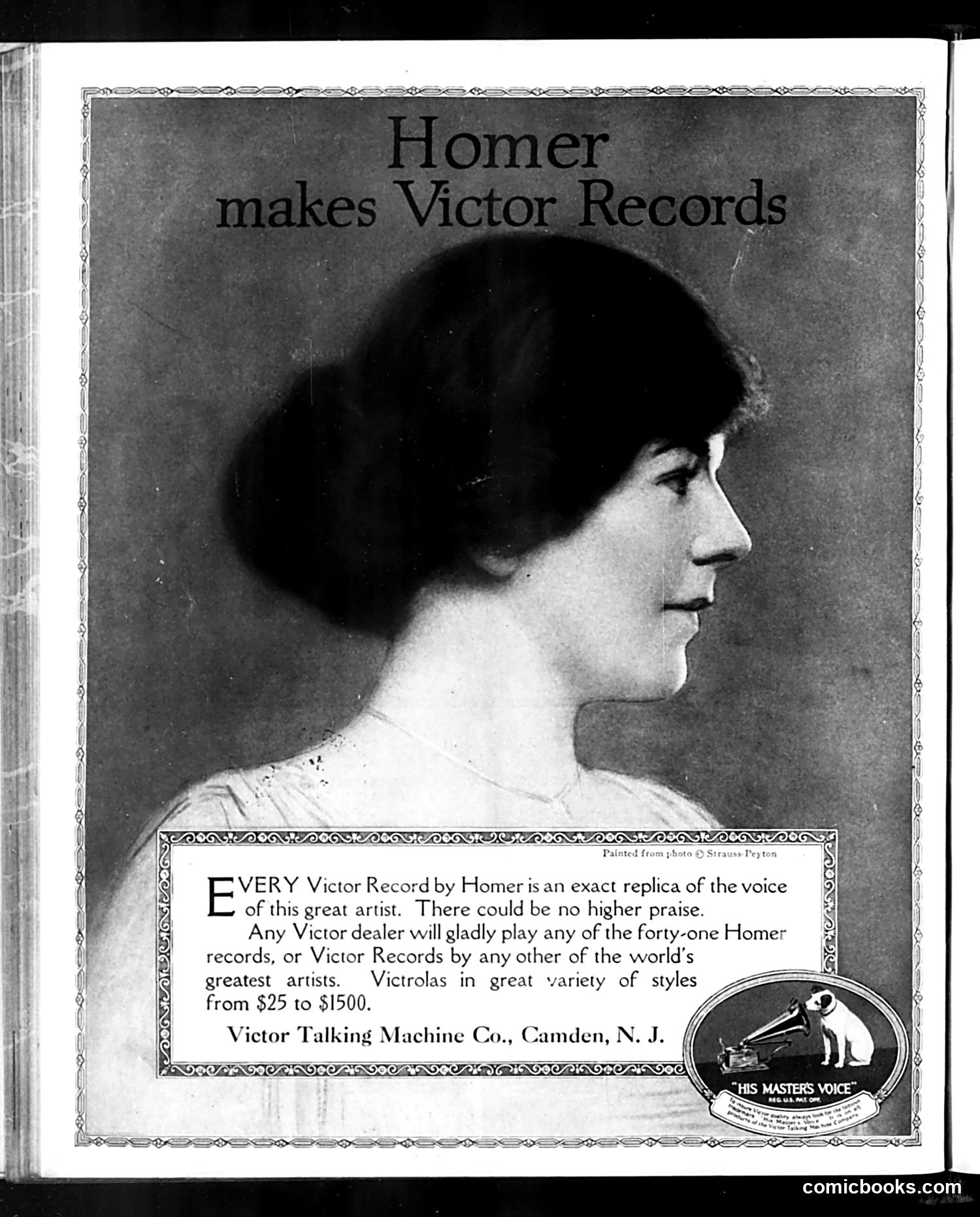
This is a **Victor Talking Machine Company advertisement**, not a political cartoon. It promotes phonograph records featuring an artist named Homer, claiming Victor Records provide exact replicas of the artist's voice. The ad emphasizes that forty-one Homer records are available, alongside recordings by other "world's greatest artists." Victrolas (Victor's phonograph models) are advertised at prices ranging $25–$1500. The "His Master's Voice" logo appears in the lower right corner. Without additional context, the specific identity of "Homer" is unclear—likely a classical or opera singer popular in this era. The page primarily serves as commercial advertising rather than satire.