
Judge, 1920-03-20 · page 6 of 36
Judge — March 20, 1920 — page 6: what you’re looking at
What you’re looking at
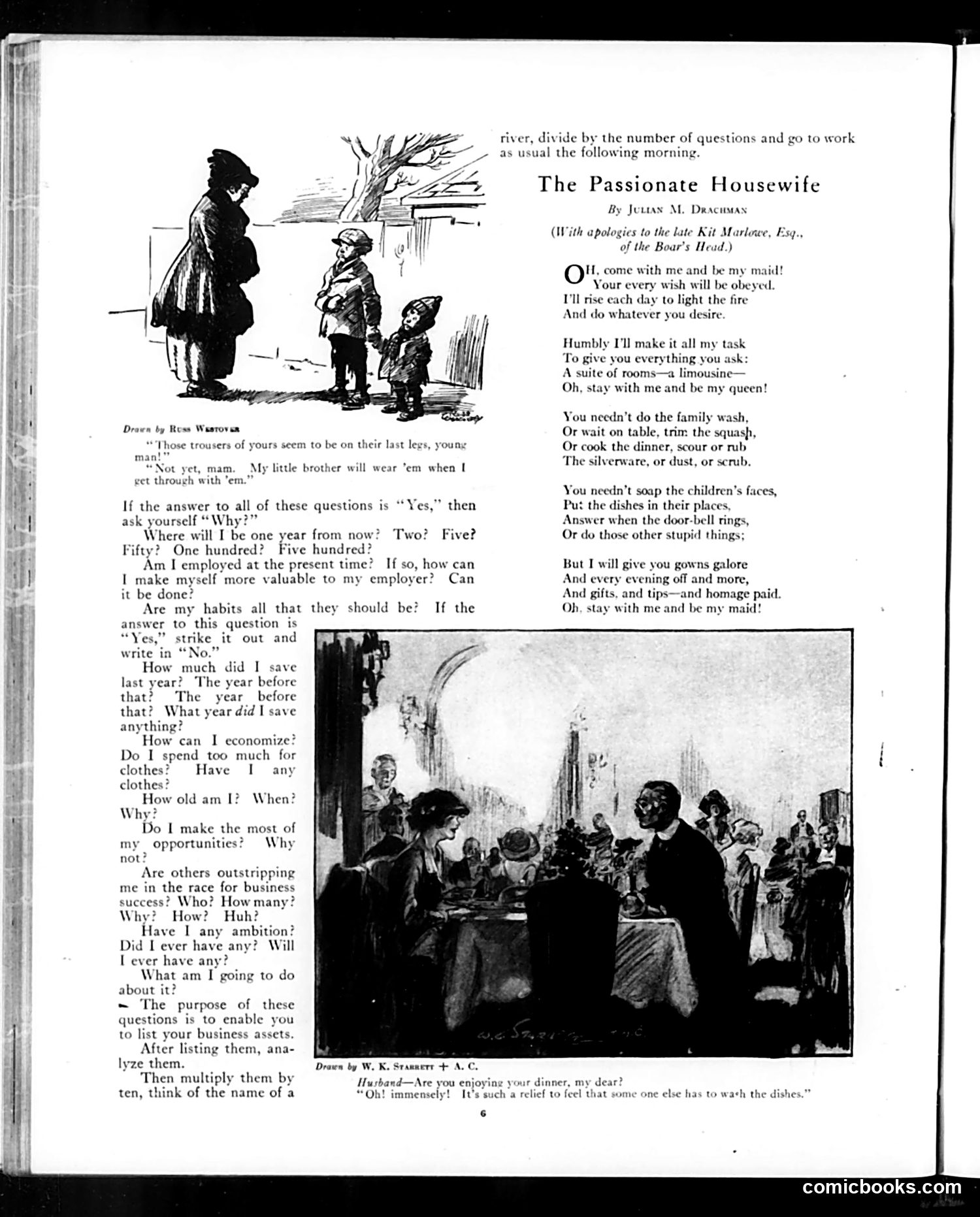
This satirical poem by Julian M. Drachman mocks the romantic fantasy of domestic service. The text presents an exaggerated suitor's promise of luxurious living ("a suite of rooms—a limousine") if a woman becomes his maid. The satire works by inverting the servant-employer relationship: the "maid" is promised everything *except* actual domestic work (no dishwashing, child-care, or cooking). This absurdity exposes the exploitation inherent in domestic labor—the poem suggests that employers dangle material rewards while demanding exhausting, unglamorous work. The accompanying illustrations show working-class domesticity: a stern employer figure with children, and a domestic dinner scene. Together, text and image critique the gap between romantic promises and the grim reality of housework, particularly for working-class women.
📄 Transcribed text from this page (OCR, searchable)
Machine-transcribed from the original scan — historical spelling and the odd misread are preserved.
\ _ river, divide by the number of questions and go to work _ as usual the following morning. The Passionate Housewife By Juutaxy M, Dracusas (With apologies to the late Kit Marlowe, Esq., of the Boar’s Head.) H, come with me and be my maid! Your every wish will be obeyed. I'll rise each day to light the fire And do whatever you desire. Humbly I'll make it all my task To give you everything you ask: A suite of rooms—a limousine— Oh, stay with me and be my queen! You needn’t do the family wash, Or wait on table, trim the squash, Or cook the dinner, scour or rub The silverware, or dust, or scrub. Drawn by Ross Wasroven hose trousers of yours seem to be on their last legs Not yet, mam. My little brother will wear ‘em when I get through with "em.” . . You needn’t soap the children’s faces, If the answer to all of these questions is “Yes,” then Put the dishes in their places, ask yourself “Why?” Answer when the door-bell rings, Where will I be one year from now? Two? Five? Or do those other stupid things; Fifty? One hundred? Five hundred Am I employed at the present time? If so, how can But I will give you gowns galore I make myself more valuable to my employer? Can And every evening off and more, it be done? And gifts, and tips—and homage paid. Are my habits all that they should be? If the Oh, stay with me and be my maid! answer to this question is “Yes,” strike it out and write in “No.” How much did I save last year? The year before The year before What year did I save Do I spend too much for clothes? Have I any clothes? How old am I? When? Why? Do I make the most of my opportunities? Why not? Are others outstripping me in the race for business success? Who? How many? Why? How? Huh? Have I any ambition? Did I ever have any? Will I ever have any? What am I going to do about it? = The purpose of these questions is to enable you to list your business assets. After listing them, ana- lyze them. Drawn by W. K. Stannerr + A.C. Then multiply them by Haka =NE goat Cakoriad pi dase tay de ten, think of the name of a “Oh! immensely! It’s such a relief to feel that some one else has to wath the dishes.” 6 comicbooks.com