
Judge, 1920-03-20 · page 26 of 36
Judge — March 20, 1920 — page 26: what you’re looking at
What you’re looking at
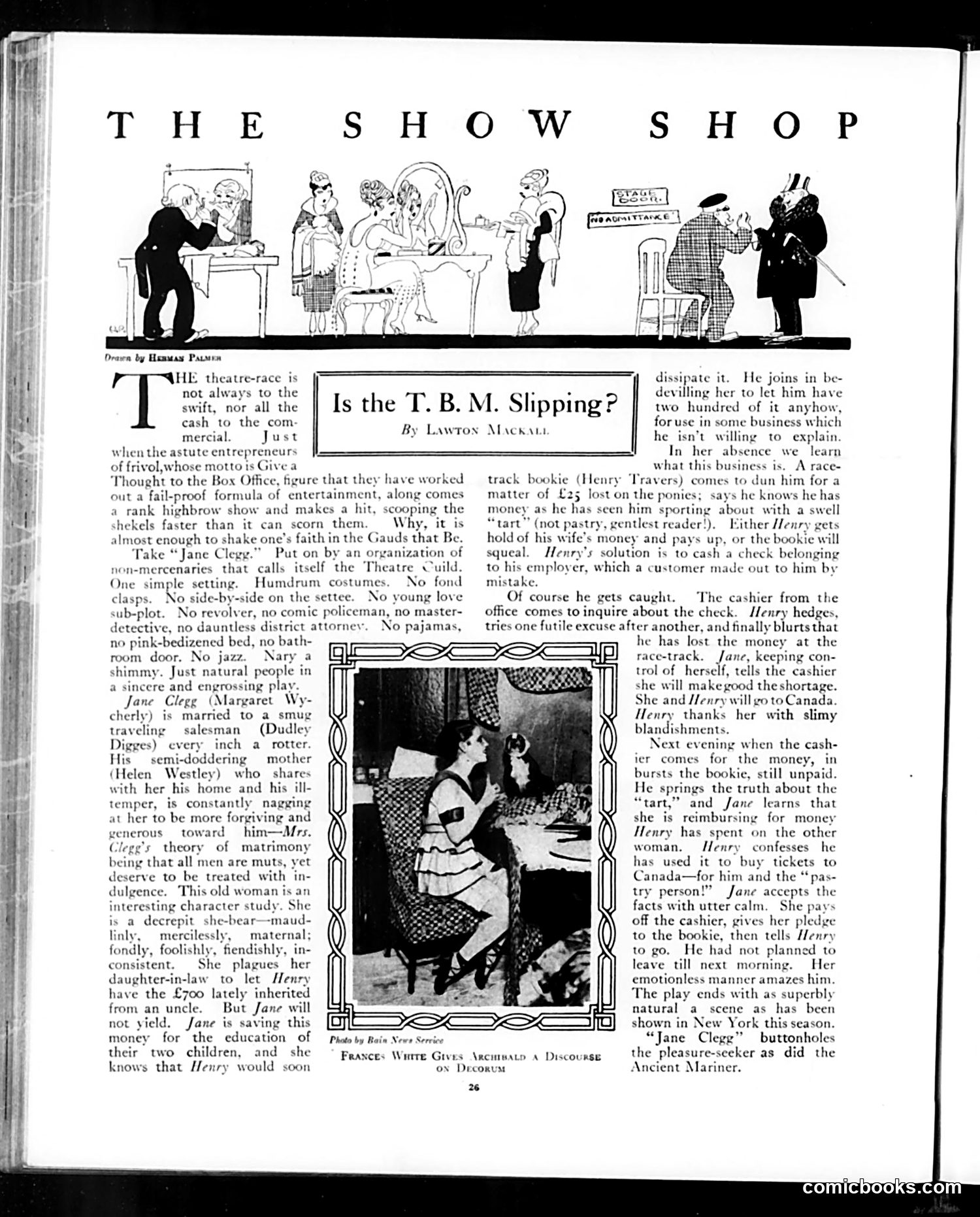
This column reviews "Jane Clegg," a Theatre Guild production that defies commercial theatrical formulas. The critic notes the show's surprising success despite lacking typical crowd-pleasers: no love subplot, no comedic relief, no spectacle—just "natural people in a sincere and engrossing play." The plot concerns Jane, a working-class wife whose gambling, unfaithful husband Henry loses money on horses and embezzles from his employer. When Jane discovers he's spent funds on another woman (called a "tart"), she calmly leaves him for Canada rather than emotionally confronting him. The satire mocks theatrical entrepreneurs' assumptions that audiences want frivolous entertainment. Instead, this "highbrow" production about ordinary domestic tragedy succeeds commercially—shaking faith in profit-driven formulas. The title "T.B.M. Slipping?" likely refers to Broadway's theatrical establishment ("The Big Machine") losing its grip on audience tastes.
📄 Transcribed text from this page (OCR, searchable)
Machine-transcribed from the original scan — historical spelling and the odd misread are preserved.
Drown by Heamas Pavwen HE theatre-race is not always to the swift, nor all the cash to the com mercial. Just when the astute entrepreneurs of frivol,whose motto ts Give a Thought to the Box Office ure that they out a fail-proof formula of entertainment, along comes a rank highbrow show and makes a hit, scooping the shekels faster than it can scorn them Why, it is have worked almost enough to shake one’s faith in the Gauds that Be. Take “Jane Clegg.” non-mer One simple setting. Put on by an organization of enaries that calls itself the Theatre Cuild. Humdrum costumes. No fond No side-by-side on the settee. No young love No revolver, no comic policeman, no master- No pajamas, sub-plot. detective, no dauntless district attorney no pink-bedizened bed, no bath- room door. No jazz. Nary shimmy. Just natural people in a sincere and engrossing play. Jan lege (Margaret Wy cherly) married to a smu traveling salesman (Dudley Digges) every inch a rotter. His semi-doddering — mother (Helen Westley) who shares with her his home and his ill- temper, is constantly nagging at her to be more forgiving and generous toward him—Mrs. Clegg’s theory of matrimony being that all men are muts, yet deserve to be treated with in- dulgence. This old woman is an interesting character study. She is a decrepit she-bear—maud- linly, mercilessly, | maternal; fondly, foolishly, fiendishly, in- consistent. She plagues her daughter-in-law to let Henry have the £700 lately inherited from an uncl But Jane will not yield. Jane is saving this money for the education of their two children, and she knows that Henry would soon Phato by Bain News Service Frances Ware Gives ON Is the T. B. M. Slipping? By Lawtox Myewatt \rcitmato 4 Discourse Decorus 26 dissipate it. He joins in be- devilling her to let him have two hundred of it anyhow, for use in some business which he isn’t willing to explain. In her absence we learn what this business is. A race- track bookie (Henry Travers) comes to dun him for a matter of £25 lost on the ponies; says he knows he has money as he has seen him sporting about with a swell “tart” (not pastry, gentlest reader!). Either /enry gets hold of his wife’s money and pays up, or the bookie will squeal. Henry's solution is to cash a check belonging to his employer, which a customer made out to him by mistake. Of course he gets caught. The cashier from the office comes to inquire about the check. //enry hedges, tries one futile excuse after another, and finally blurts that he has lost the money at the race-track. Jane, keeping con- trol of herself, tells the cashier she will make good the shortage. She and /enry will go to Canada. Henry thanks her with slimy blandishments. Next evening when the cash- ier comes for the money, in bursts the bookie, still unpaid. He springs the truth about the “tart,” and Jane learns that she is reimbursing for money Henry has spent on the other woman. TIenry confesses he has used it to buy tickets to Canada—for him and the “pas- try person Jane accepts the facts with utter calm. She pays off the cashier, gives her pledge to the bookie, then tells Henry to go. He had not planned to leave till next morning. Her emotionless manner amazes him. The play ends with as superbly natural a_ scene as has been shown in New York this season. “Jane Clegg” buttonholes the pleasure-seeker as did the ‘nt Mariner.