
Judge, 1920-03-20 · page 13 of 36
Judge — March 20, 1920 — page 13: what you’re looking at
What you’re looking at
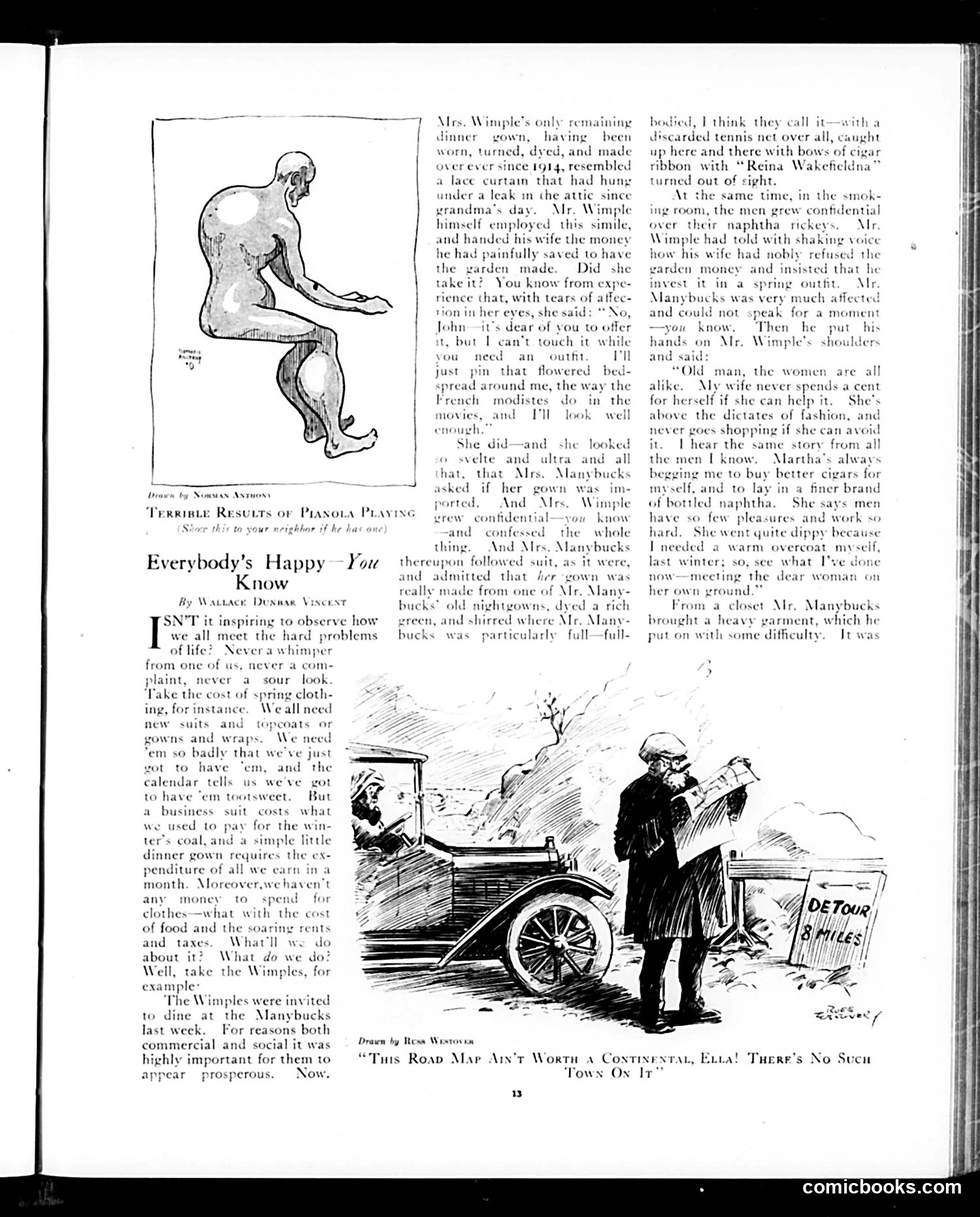
This page contains two satirical pieces about economic hardship during what appears to be the early 1920s. **"Terrible Results of Pianola Playing"** (top illustration): A crude drawing depicting the physical consequences of mechanical piano use—a woman grotesquely contorted, suggesting that automated music-playing devices are physically damaging or morally corrupting. **"Everybody's Happy—You Know"** (main story): A social satire about middle-class couples pretending prosperity while secretly struggling financially. The Wimples attend a dinner party where Mrs. Wimple wears a gown made from a repurposed bedsheet, which Mrs. Manybucks admires. Rather than reveal the truth, both couples confess their financial deceptions to each other in separate rooms, discovering they share identical economic anxieties—high clothing costs, soaring rents and taxes, insufficient income. The satire's point: Americans maintain cheerful facades about financial hardship while secretly making do with makeshift solutions. The "happy" title is ironic; everyone suffers silently, assuming others are prosperous. **"This Road Map Ain't Worth a Continental, Ella!"** (bottom): A couple lost on a rural detour, suggesting travel frustrations.
📄 Transcribed text from this page (OCR, searchable)
Machine-transcribed from the original scan — historical spelling and the odd misread are preserved.
, > > Resucts oF PIANOLA PLAYING Grew confidentia Everybody’s Happy ~ You now By Wattace, Dunwan Vincest it inspiring to observe how I we all meet the hard problems of life? Never a whimper from one of us, never a com- plaint, never a sour look ‘Take the cost of spring cloth- ing, for instance. Weall ne new suits and ywns and wraps “em so badly that we've just got to have ‘em, and the calendar tells us we've got to have “em tootsweet. But a business suit costs what we used to pay for the win- ter’s coal, and a simple little dinner gown requires the ex- penditure of all we earn in a month. Moreover,we en't any money to spe for clothes—what with the cost of food and the soaring rents and taxes. What'll we do about it?) What do we do? Well, take the Wimples, for example: ‘The Wimples were invited to dine at the Manybucks last week. For reasons both commercial and social it was highly important for them to prosperous. Now. appear Mrs. Wimple’s only remaining dinner gown, having been | worn, turned, dyed, and made over ever since 1914, resembled a lace curtain that had hung under a leak i the attic since grandma’s day. Mr. Wimple himself employed this simile, and handed his wife the money he had painfully saved to have the garden made. Did she | take You know from expe- rience chat, with tears of atfec- tion in her eyes, she said: No, John it’s dear of you to offer t, but [can’t touch it while you need an outfit vil | just pin that flowered bed- spread around me, the way the j French modistes do in the nd Tl look well enou novies, gh She did—and she look } so svelte and ultra and all hat, that Mrs. Manybucks ~ asked if her gown was im- ported, And) Mrs. Wimple confessed the whole thing. And Mrs. Manybucks thereupon followed suit, as it were, and admitted that fer gown was really made from one of Mr. Man bucks’ ok higowns, dyed a rich green, and shirred where Mr. Many- bucks was particularly full—fuil- Drawn by Ness Westovin “Tuts Roan Map Aix’t Wortn a Contixenran, Evia! Tuere’s No Sucu bodied, T think they call it—with a discarded tennis net over all, caught up here and there with bows of c ribbon with “Reina Wakefieldna™ turned out of sight. \t the same time, in the si ing room, the men grew confidential over their naphtha rickeys. Mr Wimple had told with shaking voice how his wife had nobly refused the garden moncy and insisted that he avest it in a spring outfit. Mr Manybucks was very much affected and could not speak for a moment know. ‘Then he put his on Mr. Wimple’s: shou and said: “Old man, the women alike. My wife never spends a c for herself if she can help it. She above the dictates of fashion, anc never goes shopping if she can d it. | hear the same story f the men I know. Martha's alw begging me to buy better cigars for myself, and to lay in a finer brand of bottled naphtha. She says men have so few pleasures and work so hard. She went quite dippy because I needed a warm overcoat myself, last winter; so, see what I’ve : ar woma now—meeting the d her own yround.”* From a closet Mr. Manybucks brought a heavy garment, which he put on with some difficulty. It was ‘Town On It” 3 re i comicbooks.com