
Judge, 1920-03-20 · page 12 of 36
Judge — March 20, 1920 — page 12: what you’re looking at
What you’re looking at
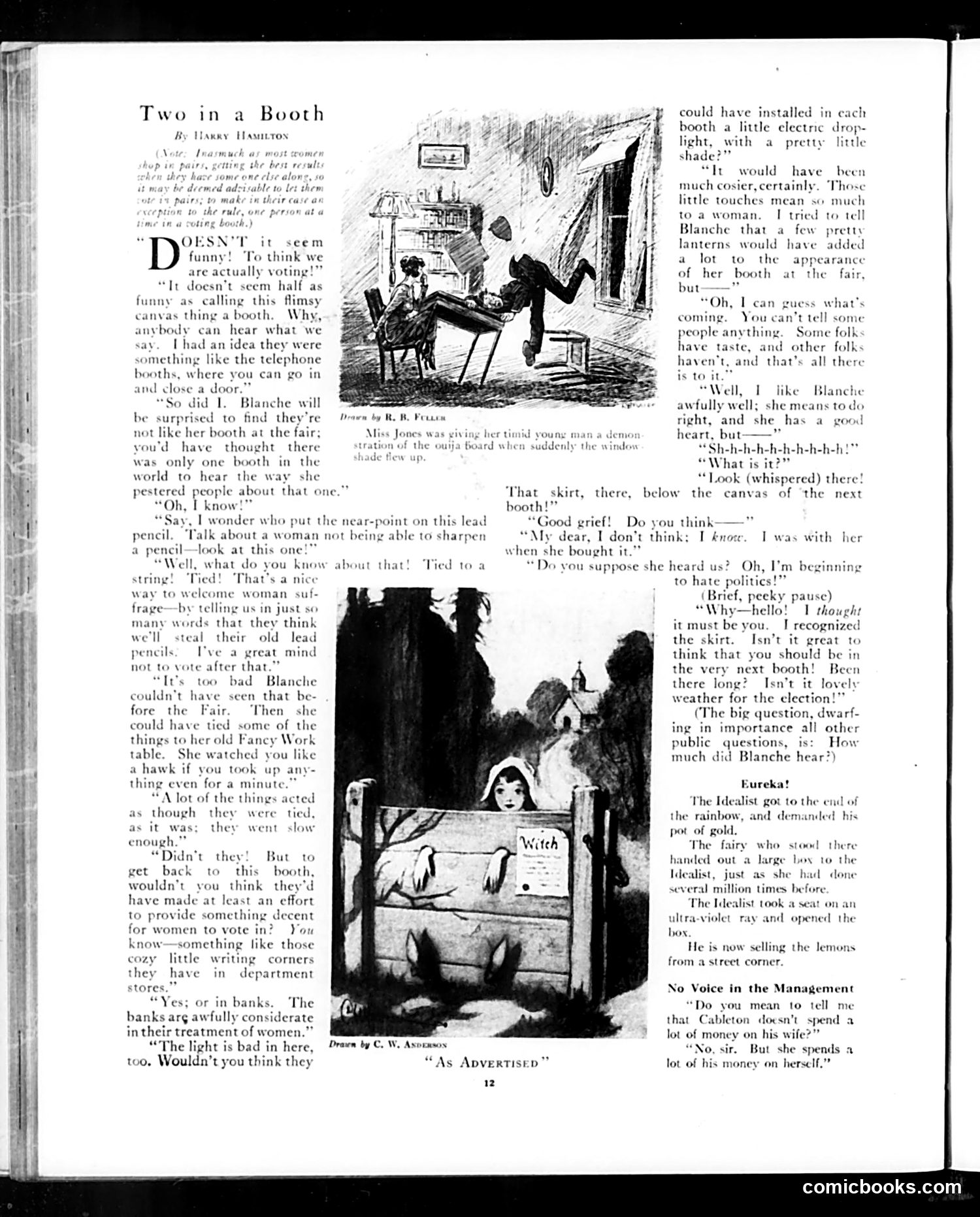
This page satirizes early women's suffrage and the poor conditions provided for female voters. Two women discuss voting in a makeshift polling booth—essentially a flimsy canvas enclosure offering no privacy (anyone can hear them) and no amenities (bad lighting, no writing surface, a pencil tied to prevent theft). The satire cuts multiple ways: it mocks election officials for treating women voters as untrustworthy (the tied pencil suggests women will steal), while also gently ribbing the women for their concern with comfort and aesthetics. One woman complains they're being welcomed to voting with condescension and distrust. The cartoon reflects the tension around women's suffrage (likely early 1900s, pre-1920), showing how women experienced voting as second-class citizens. The additional short stories below ("Eureka!" and "No Voice in the Management") continue gender-based humor about women's economic dependence on men.
📄 Transcribed text from this page (OCR, searchable)
Machine-transcribed from the original scan — historical spelling and the odd misread are preserved.
| i Two in a Booth xy EDasunton # OESN funny! think w are actually voting!” “Tt doesn’t seem half as funny as calling this flimsy canvas thing a booth. Wh anybody can hear what we say. [had an idea they were rething like the telephone oths, where you can go in be ind close a door.” “So did I. Bla be surprised to fin you'd have tho was only one booth in the world to hear th “Oh, I know! “Say, | wonder who put t pencil. ‘Talk about a woman a pencil—look at this one!” “Well, what do you k string! Tied! That's a nice way to welcome woman suf- frage—by telling us in just so many words that they think we'll steal their old lead pencils. I've a great mind not to vote after that.” “It’s too bad Blanche couldn't ha seen that be- fore the r. Then she could have tied some of the things to her old Fancy Work table. She watched you like a hawk if you took up thing even for a minute.” “A lot of the things acted as though they were tied, as it was; they went slow y- enough.” “Didn't they But to get back to this booth, wouldn't you think they'd have made at least an effort to provide something decent for women to vote in? You know—something like those cozy little writing corne they have in department stores.” “Yes; or in banks. The banks arg awfully considerate in their treatment of women.” “The light is bad in here, too. Wouldn’t you think they it seem ache will { they're not like her booth at the fair; ght. there vem by RB, Feenew way she ered people about that one.” below the canvas of ‘the he near-point on this lead “Good grief! able to sharpe Drawn by C. W. Asprxsos “As ADVERTISED” could have installed in each booth a little electric dre light, with a pretty li shade?” “It would have been much cosier, certainly. Those little touches mean so much to a woman. I tried to tell Blanche that a few pretty lanterns would have added a lot to the appearance of her booth at the fa but " “Oh, I can ¢g what's coming. You can’t tell some people anything. Some folk have taste, and other fol haven't, a that’s all th is to it. “Well, 1 like Blane awfully well; she means to ¢ right, and she has a_ goc heart, but : “Sh-h-h-h-h “What is i “Look (whispered) th Do you think— “My dear, I don’t think: T knoe. 1 was with her when she bought it.” “Do you suppose she heard us? Oh, I’m beginning to hate politics!” Brief, peeky pause) “Why—hello! 1 though it must be you. I recognized the skirt. Isn’t it great to think that you should be in the very next booth! Been there long? Isn't it lovely weather for the election!” (The big question, dwarf- ing in importance all other public questions, is: How much did Blanche hear?) Eureka! The Idealist got to the end of the rainbow, and demanded his gold. The fairy who handed out a large bey 10 the Idealist, just as she had « pot « one several million times be The Idealist took @ seat on an ultra-violet ray and opened the wre box He is now selling the lem from a street corner. No Voice in the Management “Do you mean to tell me that Cableton doesn’t spend a lot of money on his wife?” “No, sir. But she spends a lot of his money on herself. comicbooks.com