
A complete issue · 36 pages · 1920
Judge — March 6, 1920
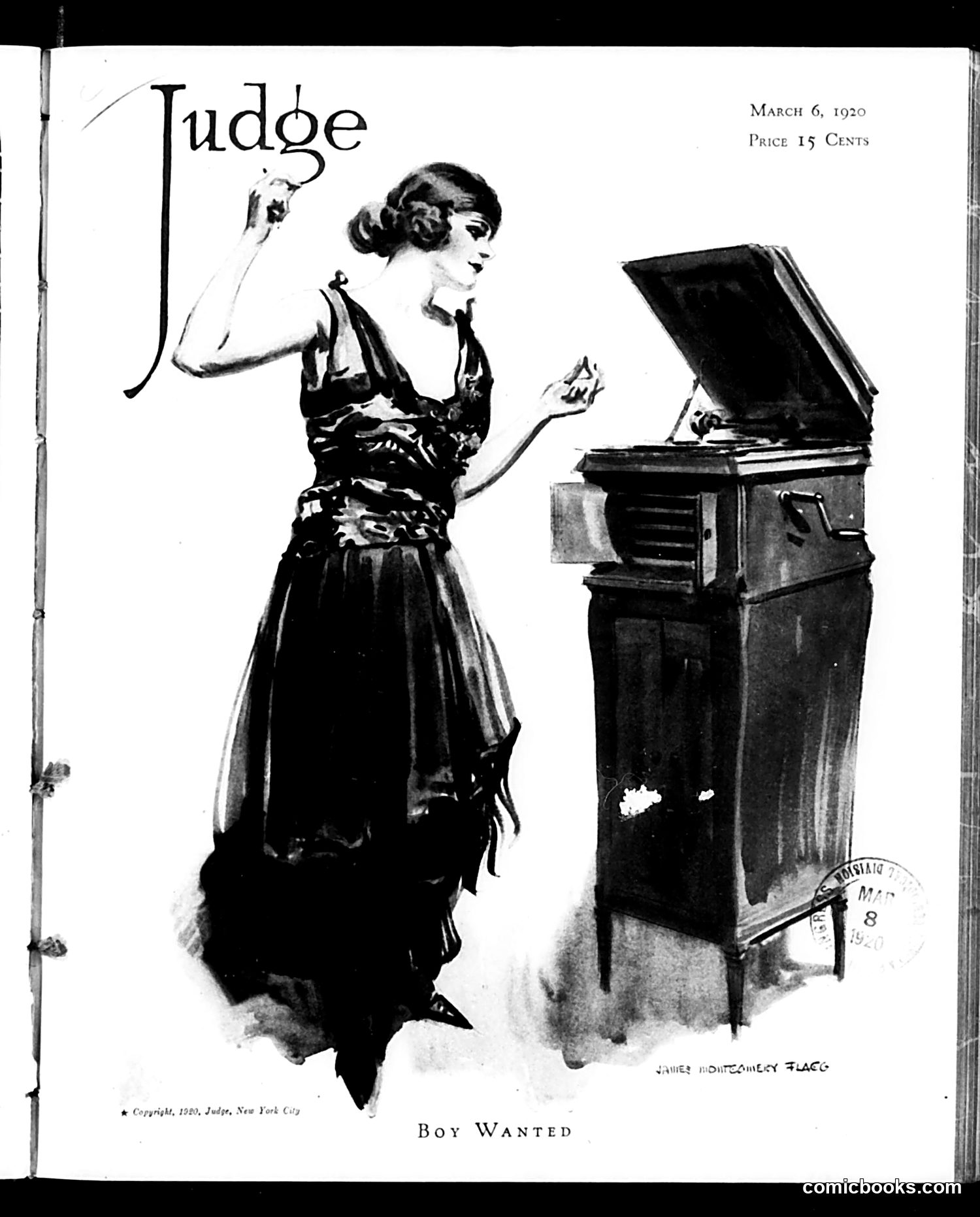
This illustration depicts a fashionable 1920s woman operating a phonograph (early record player). The caption "Boy Wanted" suggests satirical commentary on post-WWI social dynamics. The likely meaning: the young woman represents the "modern" flapper emerging in the 1920s—independent, entertainment-focused, and perhaps indifferent to traditional courtship. Her animated pose suggests she's absorbed in the phonograph's music rather than seeking male companionship, contradicting the caption's claim that she "wants a boy." The satire probably mocks either changing gender relations, women's newfound independence after the war, or the disconnect between what modern women claimed to want versus their actual behavior and interests. The phonograph—a cutting-edge technology—emphasizes the modernity of this new female type.
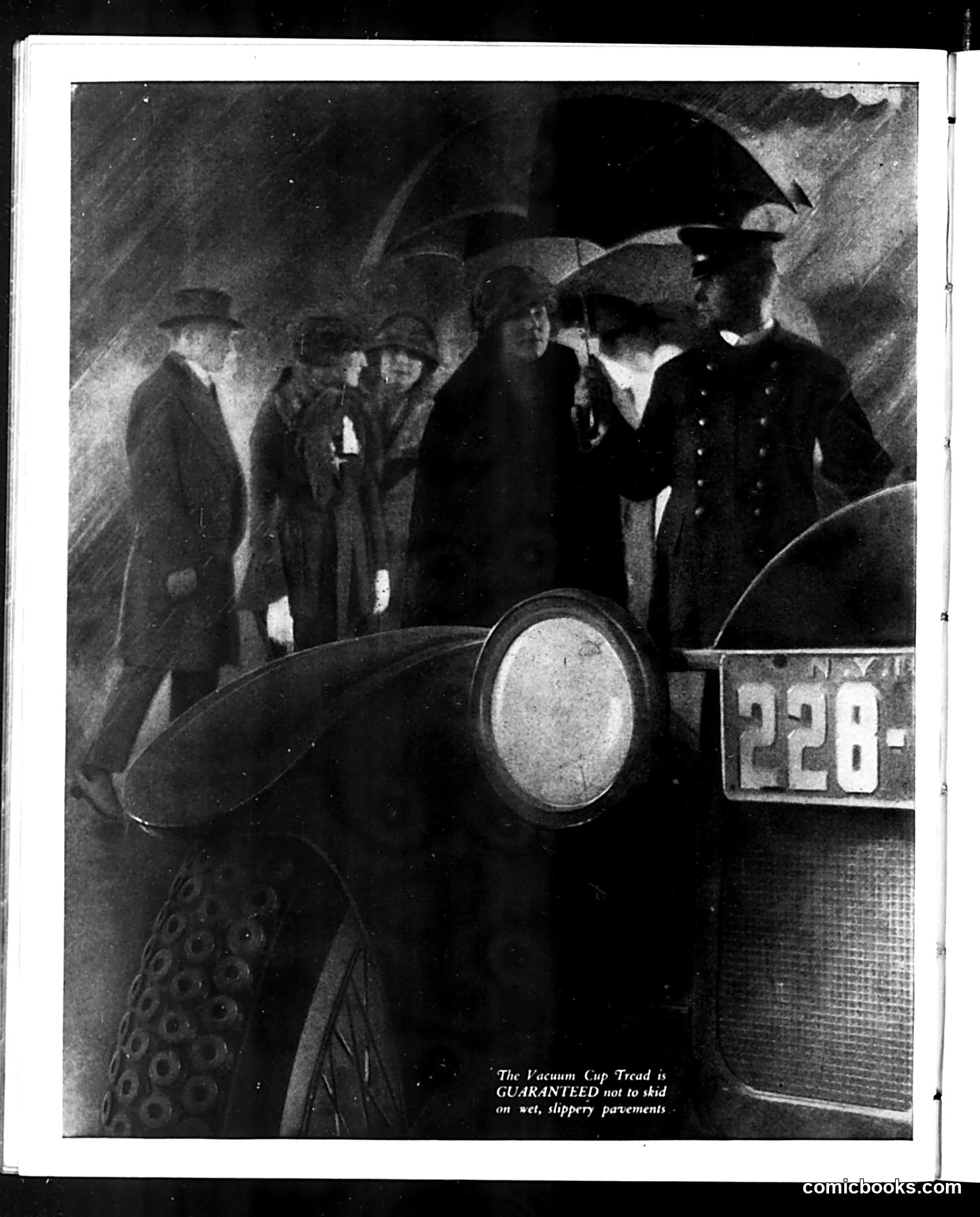
This appears to be a **product advertisement** for "Vacuum Cup Tread" tires rather than a political cartoon. The black-and-white photograph shows well-dressed men in formal attire and hats (appearing to be from the early 20th century) examining or gathered around a large tire displaying the product name and number "228." The caption reads: "The Vacuum Cup Tread is GUARANTEED not to skid on wet, slippery pavements." The image functions as marketing—showcasing the tire's safety feature through what looks like a formal demonstration or inspection by authoritative figures. This was typical Judge magazine advertising: using serious-looking scenes to emphasize product reliability and quality, appealing to readers' desire for safe, dependable automobiles during this era's growing automotive market.
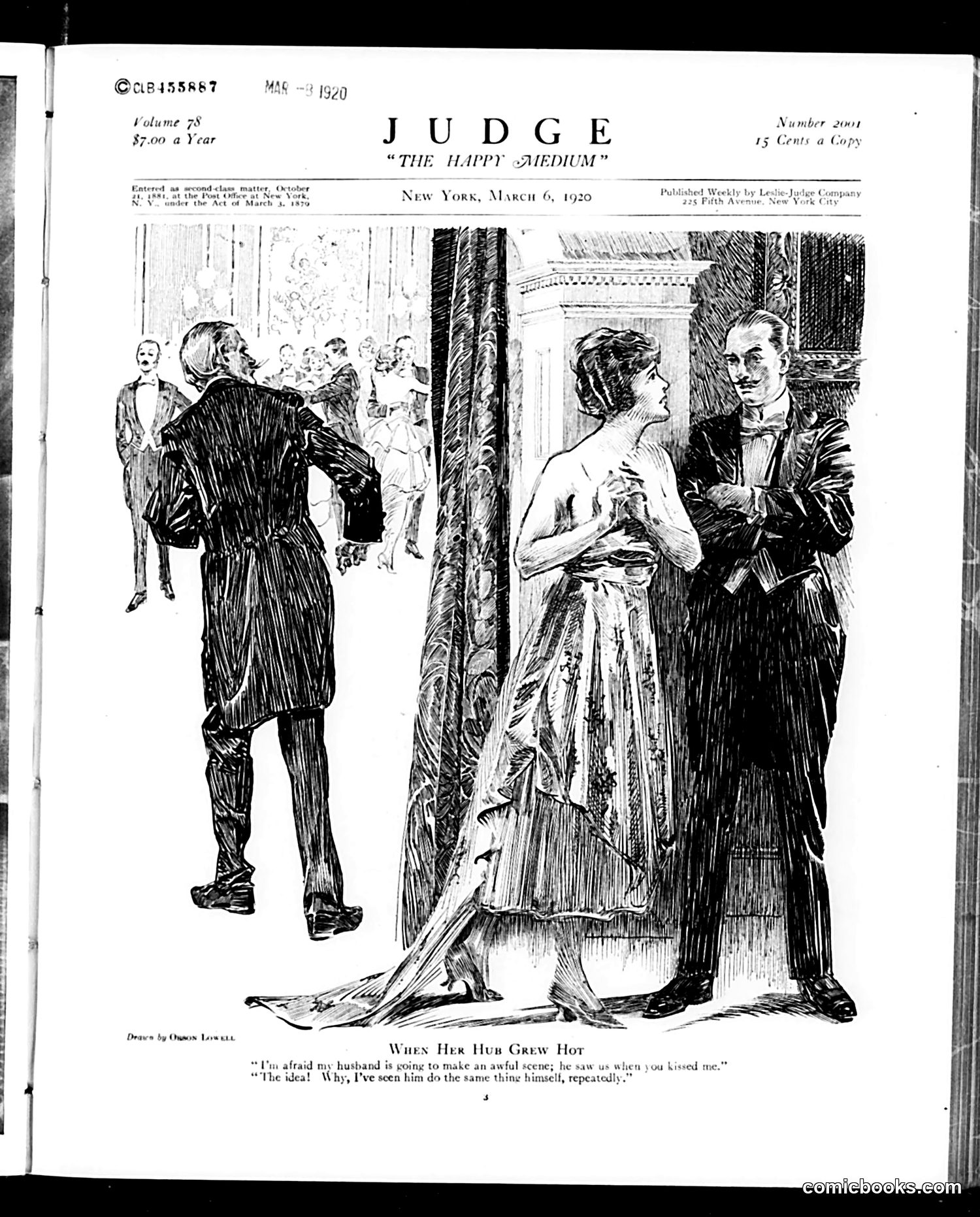
This 1920 Judge magazine cartoon depicts a domestic scene with social commentary on marital behavior. The illustration shows a woman in an evening gown confronting a man in formal attire, while another man observes from the background at what appears to be a social gathering. The caption reads: "I'm afraid my husband is going to make an awful scene; he saw us when you kissed me." The woman's response—"The idea! Why, I've seen him do the same thing himself, repeatedly"—suggests satire about hypocrisy in marriage and double standards regarding infidelity. The cartoon likely critiques upper-class social morality of the 1920s era, humorously highlighting the contradiction between wives condemning husbands' indiscretions while engaging in similar behavior themselves. It reflects post-WWI attitudes toward changing gender relations and marital propriety.
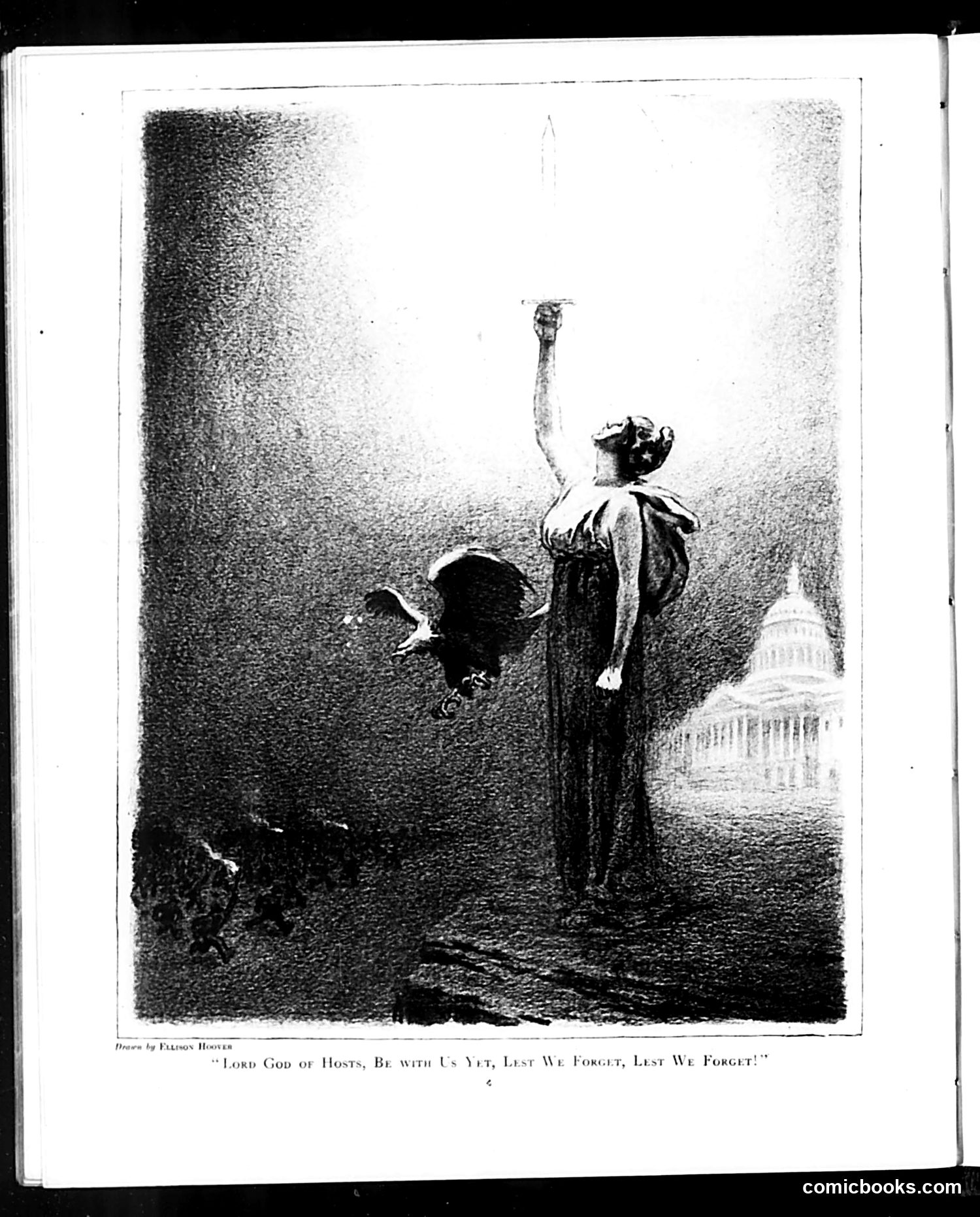
**Title:** "Lord God of Hosts, Be with Us Yet, Lest We Forget, Lest We Forget!" **Artist:** Drawn by Kemble Hoover **Content:** This allegorical drawing depicts a robed female figure (likely representing America or Liberty) with raised arm and torch, standing before the U.S. Capitol building visible in the background. A shadowy figure on the left appears to represent a threat or opposing force. The caption invokes religious language—a plea for divine protection—suggesting anxiety about a serious national threat or crisis. Without dating information visible, the exact historical context is unclear, but the composition implies concern about preserving American democracy or values against some perceived danger. The theatrical, dramatic style typifies Judge magazine's approach to serious political commentary.
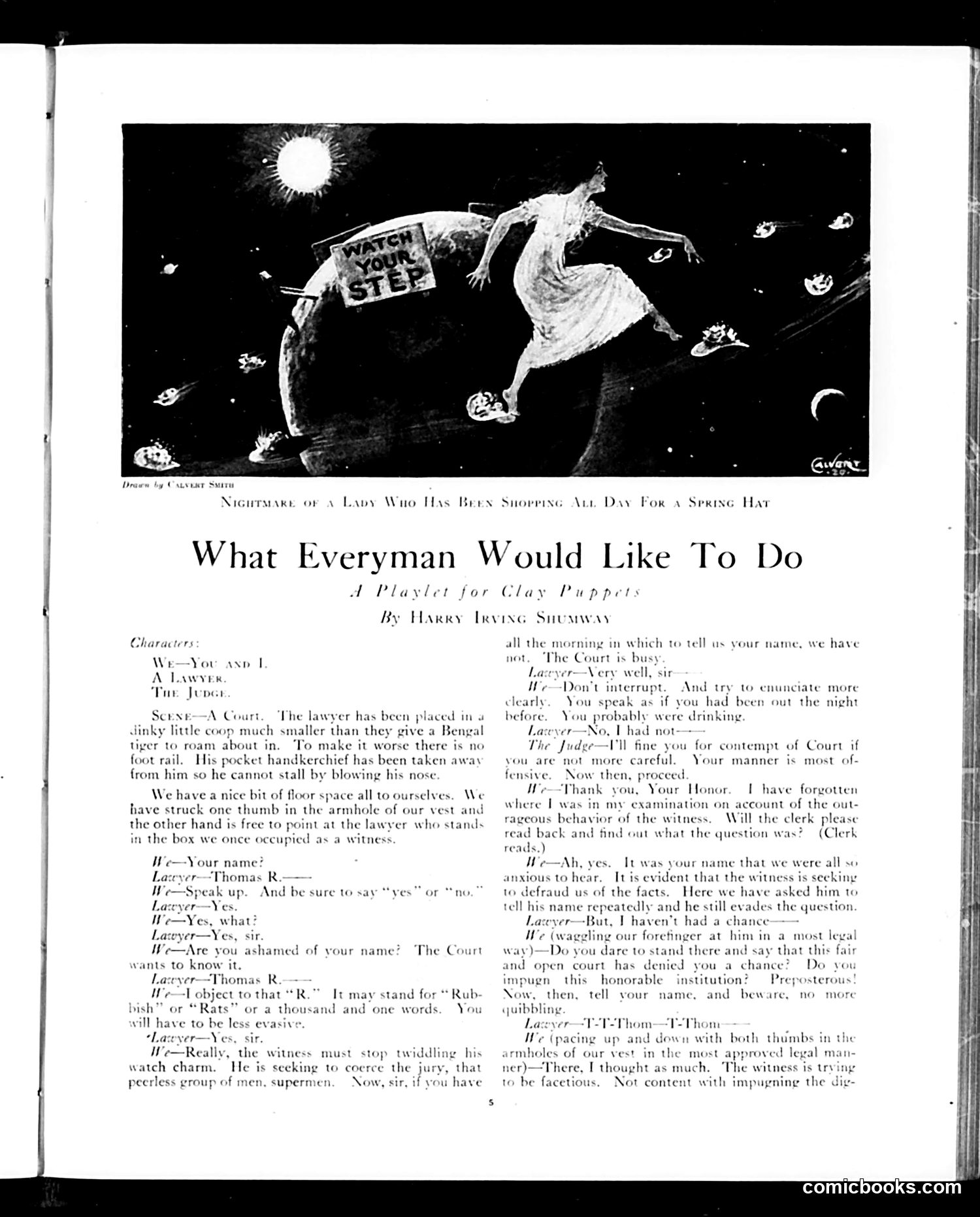
The illustration depicts a surreal nightmare scene of a woman in a nightgown fleeing across a nighttime landscape, pursued by an enormous boot labeled "WATCH YOUR STEP." The cartoon satirizes women's fashion anxiety—specifically the social pressure women faced regarding spring hat selection. The accompanying text is a comedic playlet titled "What Everyman Would Like To Do," which appears to be an unrelated satirical sketch about courtroom proceedings, featuring a witness being interrogated by a lawyer about his name and testimony. The cartoon's humor relies on exaggerating female shopping anxiety into a Gothic nightmare, reflecting early 20th-century attitudes treating women's fashion concerns as frivolous and amusing. The "watch your step" warning adds a cautionary dimension, though its exact meaning remains somewhat unclear from context alone.
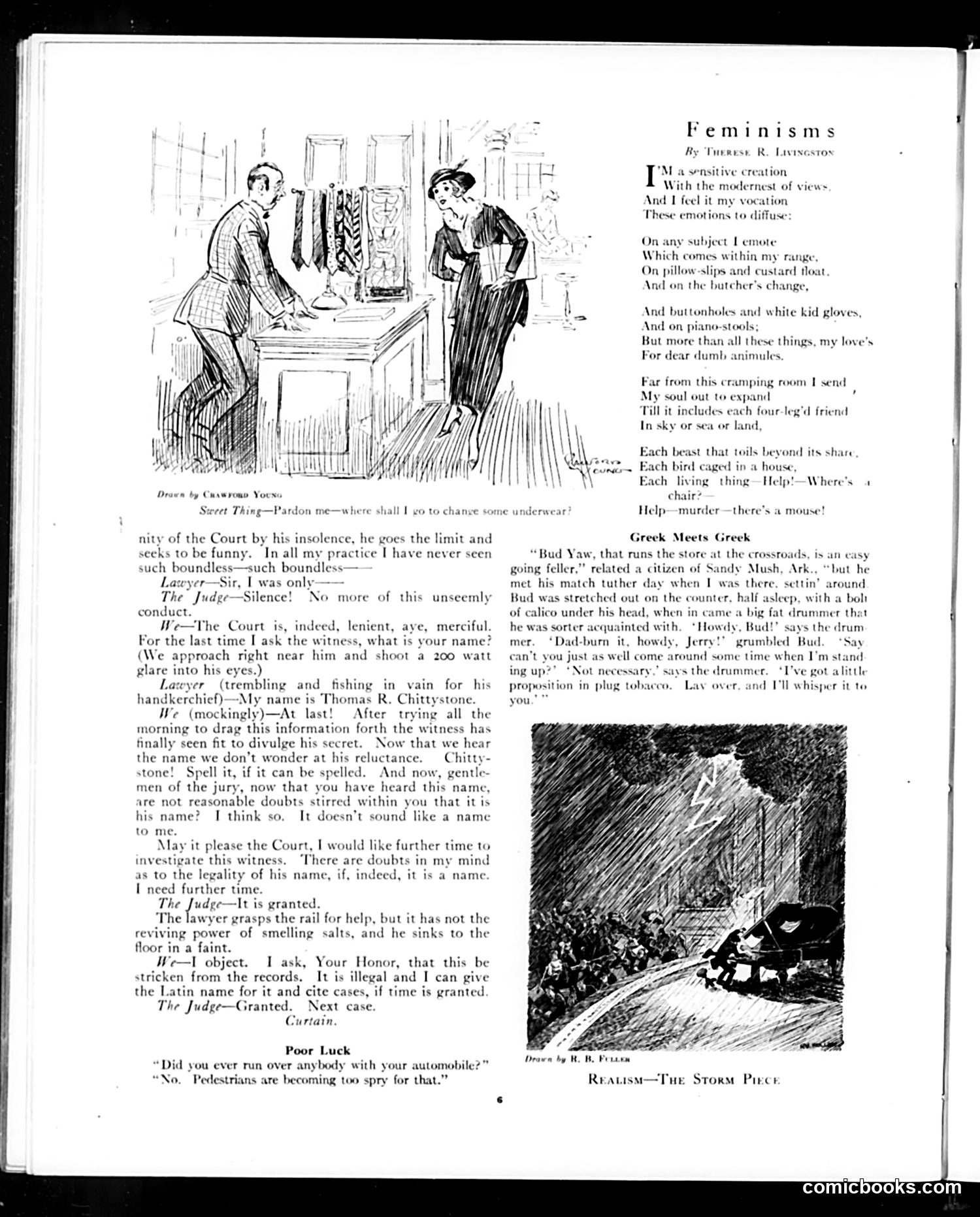
This page contains several distinct pieces: **"Feminisms"** (top): A poem by Therese R. Livingston mocking women's suffrage and feminist activism, sarcastically listing trivial domestic concerns ("buttonholes and white kid gloves") women allegedly prioritize while claiming to champion larger causes. **Courtroom scene** (left): A satirical legal exchange where a judge grows exasperated with a witness's implausible name—"Thomas R. Chittystone"—questioning its legitimacy. The humor relies on the absurdity and the judge's skepticism. **"Greek Meets Greek"** (center): A humorous anecdote about a man named "Bud Vaw" from Sandy Mush, Arkansas, meeting his match in a drummer—two folksy characters in a comedic misunderstanding about standing tobacco. **"Poor Luck"** and **"Realism—The Storm Piece"** (bottom): Brief jokes and an illustration about automobile accidents and nature respectively. The overall tone reflects early 20th-century conservative satire targeting women's rights movements.
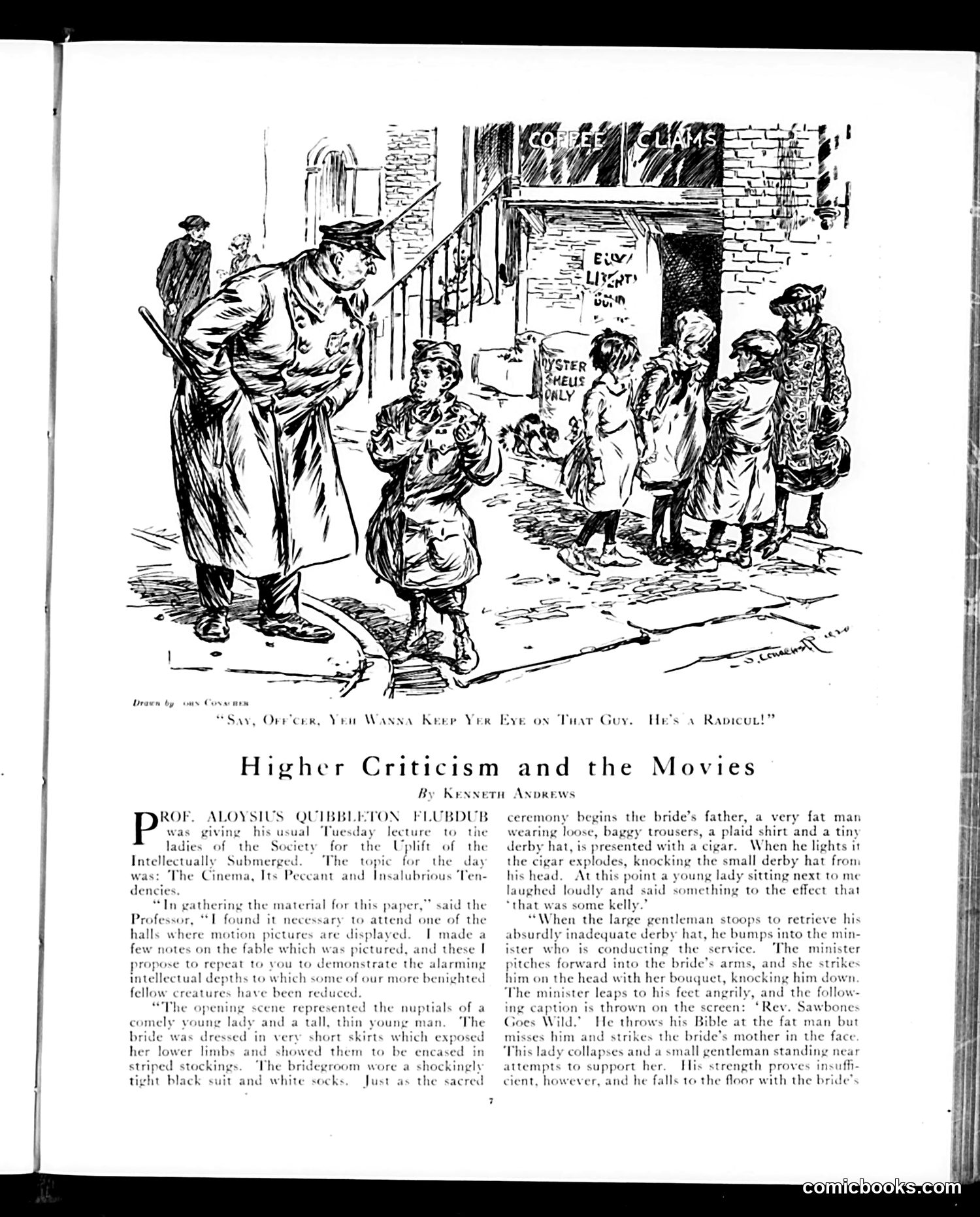
This 1910s Judge magazine page satirizes both "higher criticism" (intellectual analysis of cinema) and early slapstick films themselves. The cartoon illustrates Professor Flubdub's pompous lecture to an intellectual society about movies' degrading influence. He describes attending a wedding scene film—which devolves into physical comedy: an exploding cigar, collisions, a minister knocked down, a Bible thrown, people fainting. The satire cuts two ways: First, it mocks pretentious intellectuals who condemn movies as lowbrow while missing their entertainment value (a young woman laughs at the chaos, calling it "some kelly"—slang for fun). Second, it satirizes the chaotic, violent slapstick itself—the absurd escalation where one accident triggers cascading disasters. The contrast between Flubdub's solemn disapproval and the actual silly mayhem is the joke: movies are ridiculous *and* harmless fun, not the moral threat intellectuals claimed.
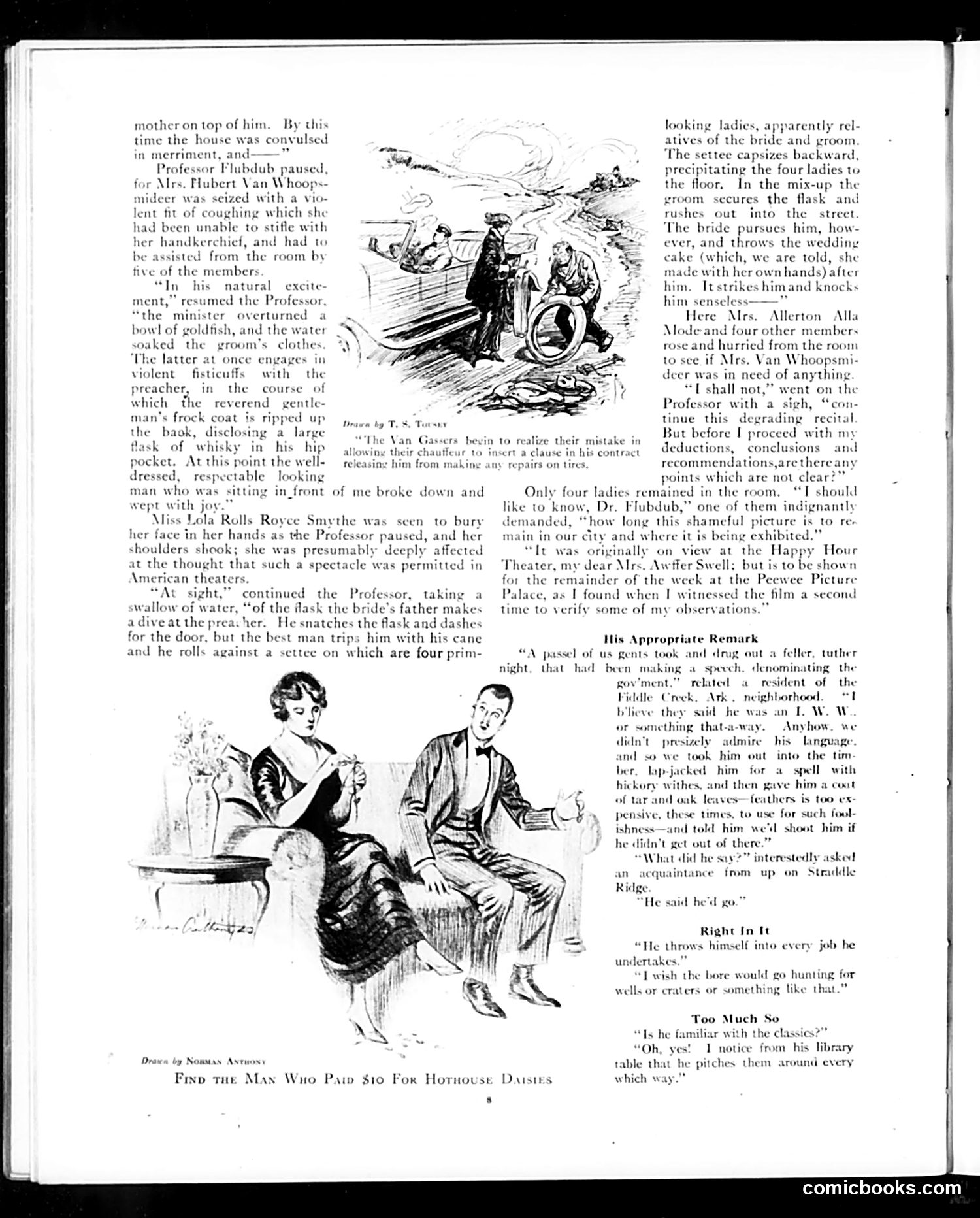
This page from *Judge* magazine contains humorous anecdotes satirizing early 20th-century American social pretensions and behavior. The main cartoon depicts "The Man Who Paid $10 for Hothouse Daisies"—mocking wealthy people's conspicuous consumption and status-seeking through expensive flowers. The text features Professor Flubdub recounting a chaotic wedding reception where a preacher is revealed to be secretly drinking (flask hidden in his coat), leading to violent brawling and scandal. The satire targets the hypocrisy of respectable-looking clergy and the absurdity of theatrical melodrama being presented as serious entertainment. The additional anecdotes mock rural dialect speakers and intellectual pretension. One story ridicules an Arkansas man's violent response to political speech; another jokes about someone overeager in all endeavors. The overall theme: satirizing class anxieties, religious hypocrisy, and the gap between respectable appearance and actual behavior—common *Judge* magazine targets during the Progressive Era.
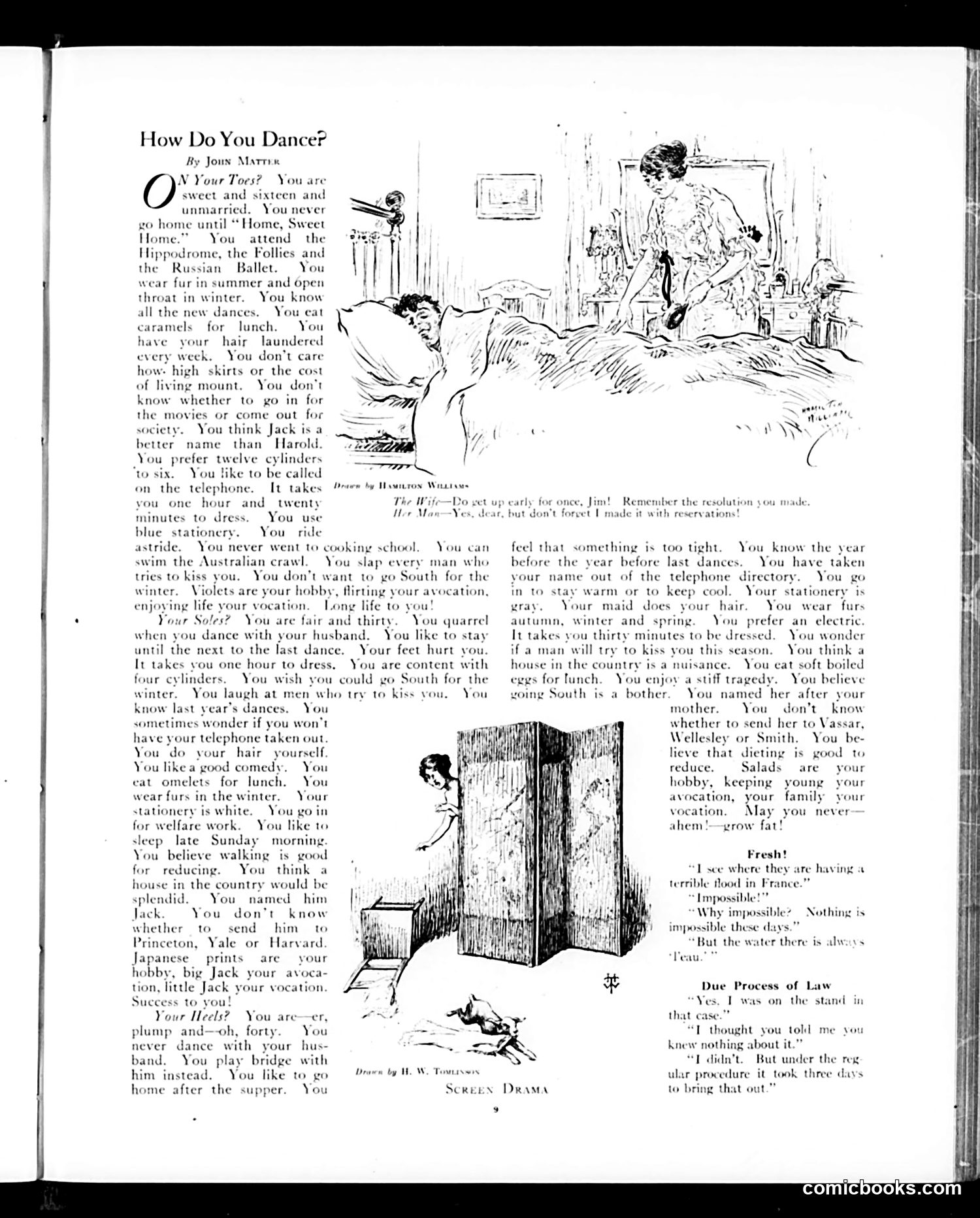
This article by John Matte satirizes the new "modern woman" of the 1920s by categorizing female dancers into three types based on how they dance: on their toes, soles, or heels. Each category humorously catalogs contradictory traits and lifestyle choices. **The satire targets:** - Young, unmarried "flappers" who attend theaters, wear fashionable fur, and obsess over telephones and automobiles - Middle-aged married women who've abandoned their husbands for bridge games and social climbing - Older women who worry about dieting, social status, and their daughters' futures The humor derives from exposing the superficiality and self-contradictions of women pursuing independence and leisure during the Jazz Age—attending the Follies, eating caramels instead of cooking, preferring twelve-cylinder cars, and constantly changing their preferences. The accompanying sketches by Hamilton Williams and H.W. Thompson visually reinforce these stereotypes through exaggerated poses and expressions.
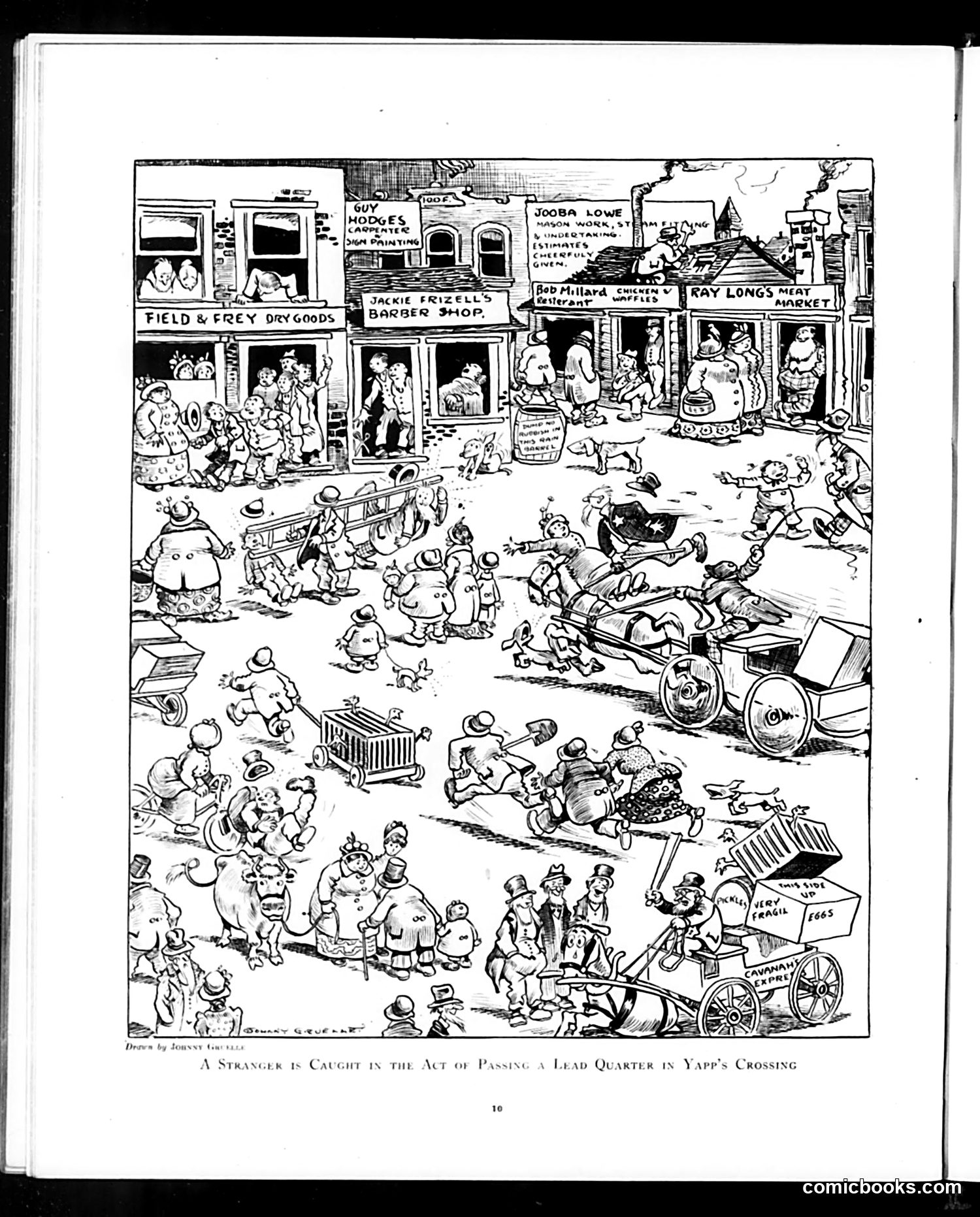
This is a single large satirical illustration titled "A Stranger Is Caught in the Act of Passing a Lead Quarter in Yapp's Crossing." The cartoon depicts a chaotic street scene with numerous figures engaged in various activities around storefronts (Field & Frey Drygoods, Jackie Frizell's Barber Shop, Bob Mallard's restaurant, Ray Long's Meat Market). The central joke concerns someone attempting to pass counterfeit currency—specifically a "lead quarter"—in this crowded marketplace. The pandemonium shown (people running, vehicles overturned, general disorder) illustrates the social disruption caused by this petty fraud attempt. This reflects early 20th-century anxieties about counterfeiting and street crime in American towns, treating the incident as a humorous but serious disruption to everyday commerce and community order.
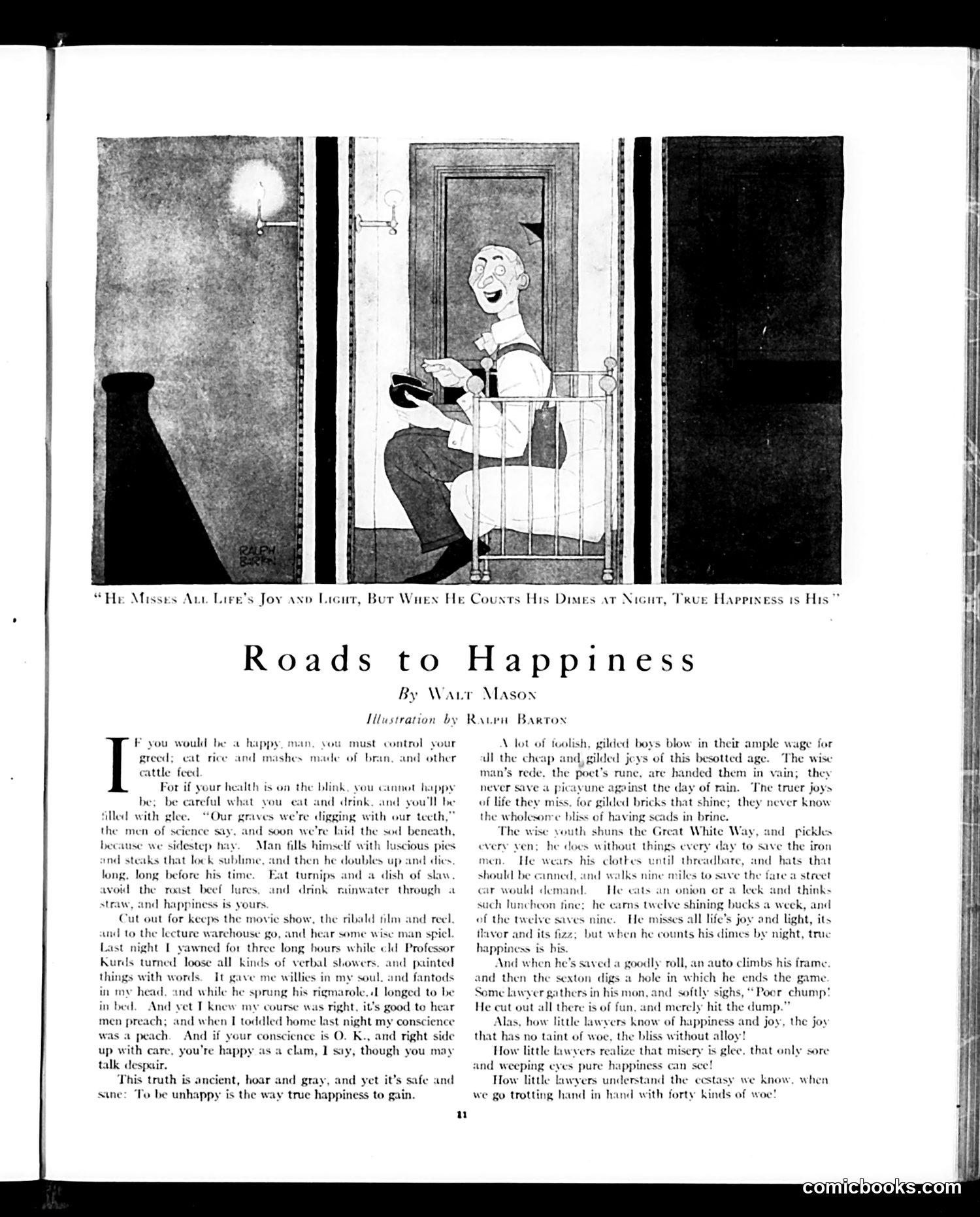
This illustrated essay by Walt Mason (with Ralph Barton's cartoon) presents satirical advice on achieving happiness through financial restraint and self-denial—a common morality-tale genre in early 20th-century magazines. The cartoon depicts a man in a cell-like room, gleefully counting coins by lamplight, embodying the essay's central irony: true happiness supposedly comes from *denying* life's pleasures. Mason's text mocks two types of men: wealthy "gilded boys" who squander money on movies, entertainment, and "the Great White Way" (Broadway); and miserly savers who count dimes nightly, missing "all life's joy and light." The punchline—that lawyers don't understand happiness comes from "weeping eyes" and "forty kinds of woe"—suggests the essay itself is tongue-in-cheek mockery of puritanical self-denial philosophy. The satire targets both hedonism and excessive penny-pinching, suggesting neither path brings genuine contentment.
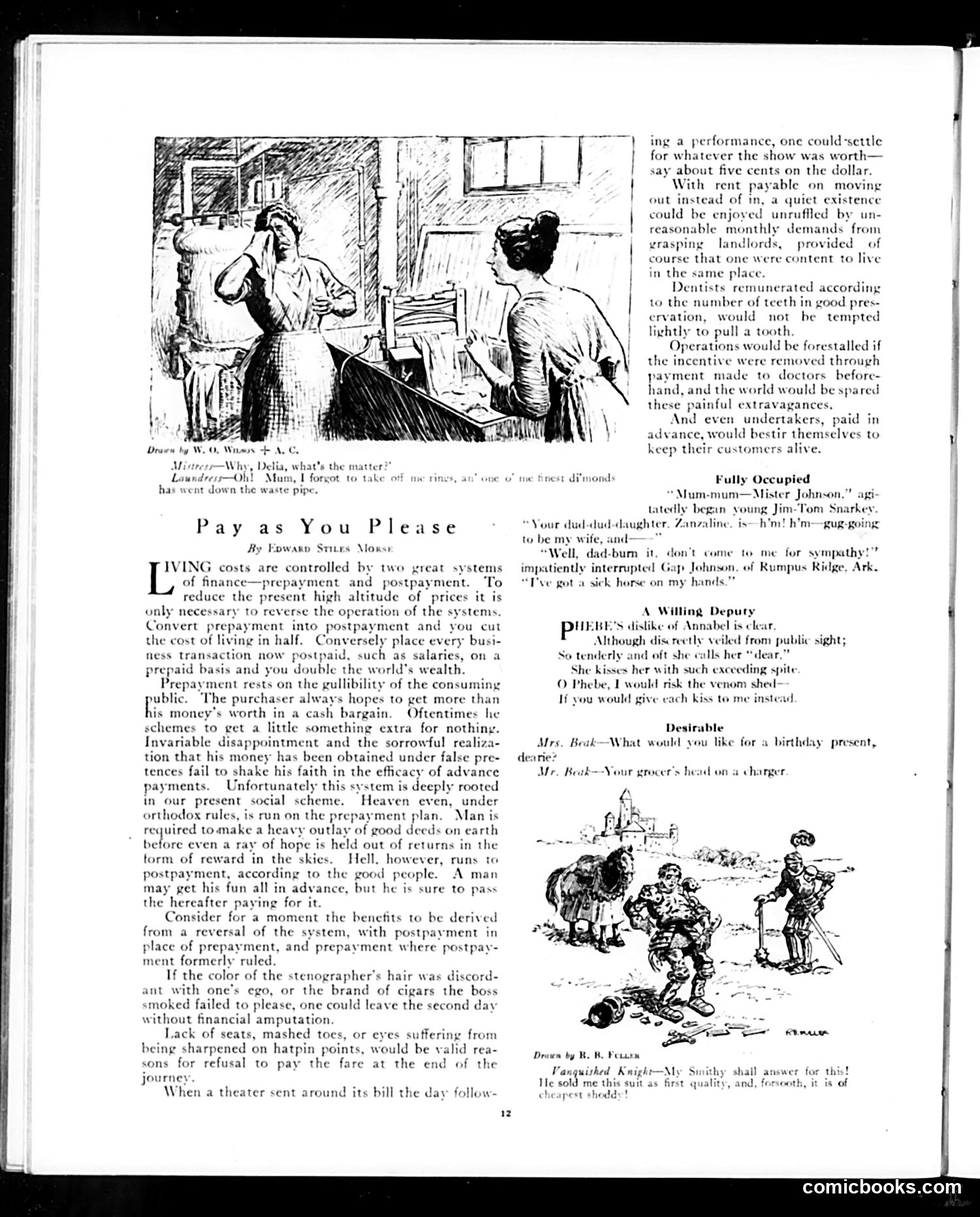
This page contains several satirical pieces mocking early 20th-century American social and economic practices. **"Pay as You Please"** is the main essay, arguing that reversing payment systems—making advance payments postpaid instead—would benefit consumers. It satirizes how people accept unfavorable financial arrangements (prepayment for rent, theater tickets, dental work) while hoping for bargains. The author humorously notes that even Hell operates on postpayment, implying advance payment is an earthly burden. The smaller cartoons are social humor: - **"Fully Occupied"** mocks a man's stutter and his indifference to his daughter's engagement announcement, prioritizing his sick horse - **"A Willing Deputy"** uses double entendre about false affection between women - **"Desirable"** shows a wife wanting her grocer's head as a birthday gift—satirizing dissatisfaction with credit practices The illustration shows a laundress and domestic worker, reflecting working-class perspectives on these financial struggles. The satire targets both consumer gullibility and exploitative merchant/landlord practices common to the era.
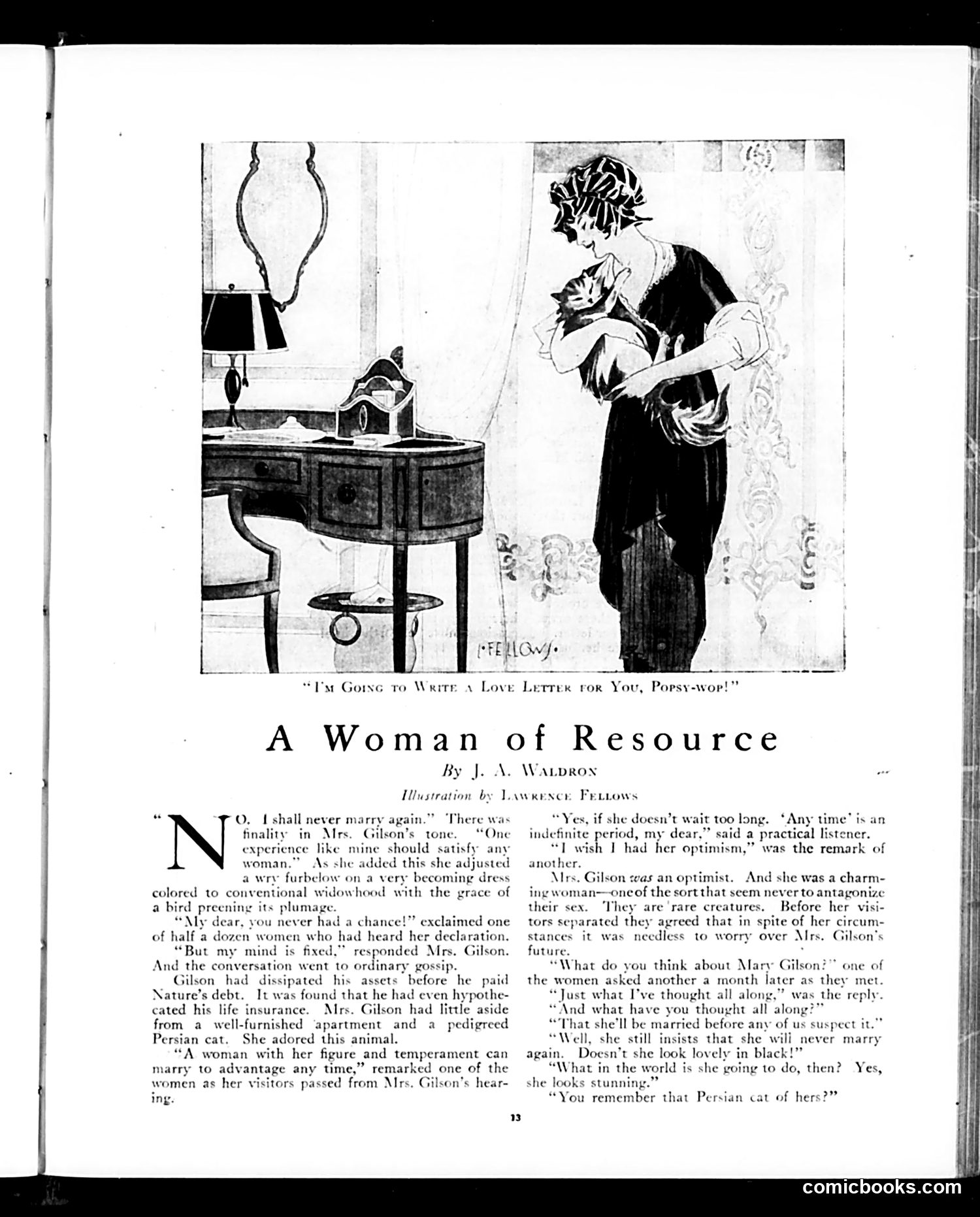
This is a short story illustration from *Judge* magazine depicting social commentary on women's independence and financial vulnerability in the early 20th century. **The Setup:** Mrs. Gilson, a widow, declares she'll never remarry after her late husband squandered their assets and even mortgaged his life insurance. Despite her financial hardship, she maintains an attractive appearance and optimistic demeanor. **The Satire:** The story mocks both the impracticality of her vow and the social pressure on women. Female visitors gossip that she *will* marry again despite her protestations—because an attractive, charming woman "can marry to advantage any time." The title "A Woman of Resource" appears ironic: her only real "resource" for survival is her ability to attract a husband. **The Joke:** The illustration caption hints at her resourcefulness—she'll use a love letter (about her cat) to secure a husband, suggesting women must use manipulation or deception to survive financially, since marriage was their primary economic option. This reflects historical reality: women had extremely limited earning capacity and independence; remarriage was often economic necessity disguised as romance.
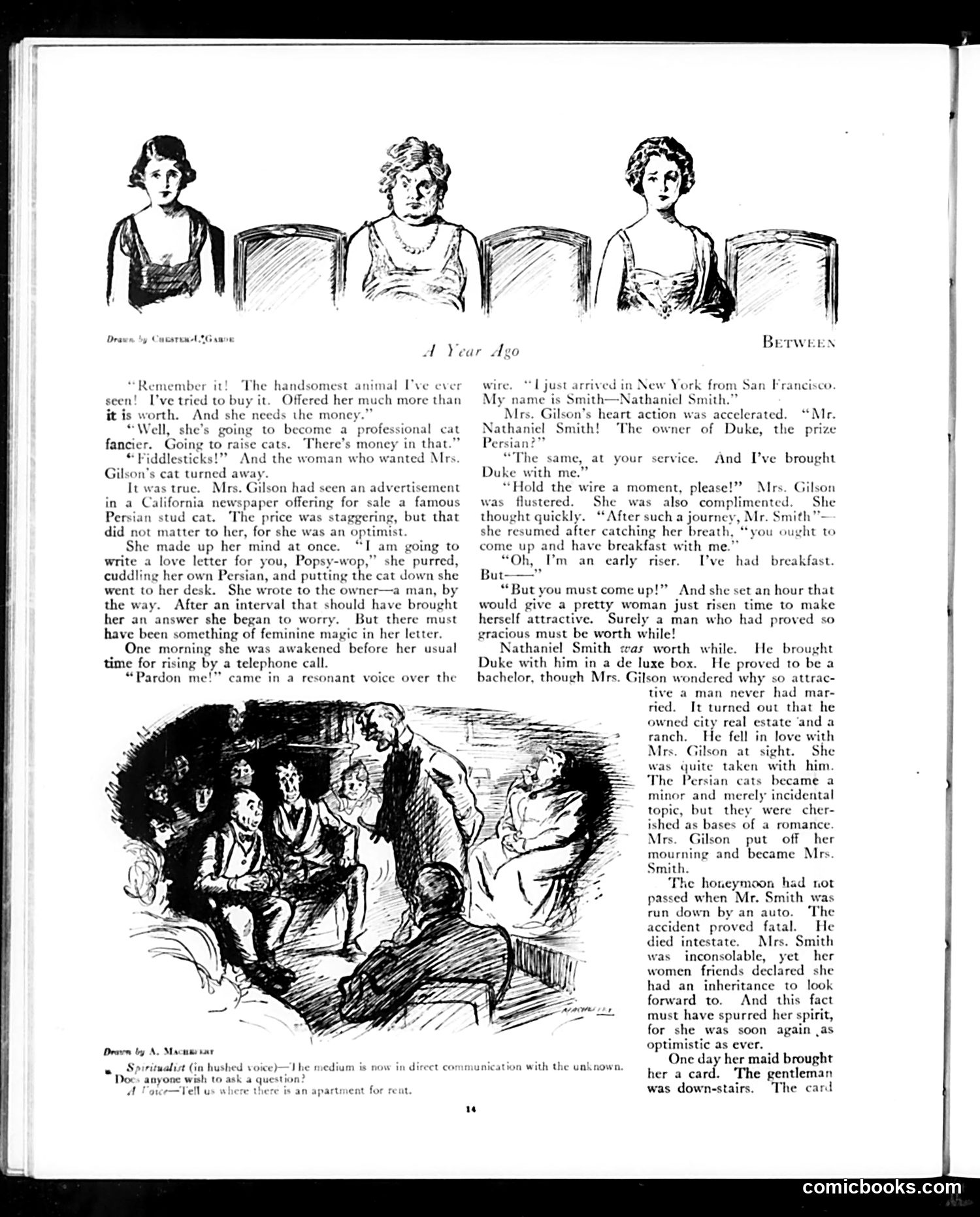
This page tells a serialized romantic story illustrated with sketches. The narrative describes Mrs. Gilson, a widow, who purchases a prize Persian cat through correspondence with a wealthy bachelor named Nathaniel Smith. When he arrives in New York with the cat, they meet and quickly fall in love—the cat serving as mere pretext. Smith proves wealthy (owns real estate and a ranch) and unmarried. They marry, but tragedy strikes when an auto accident kills him intestate. The story's satirical point appears to target female optimism and opportunism: Mrs. Gilson's friends cynically note she has "an inheritance to look forward to," suggesting her sudden remarriage and quick recovery from mourning are suspiciously convenient. The bottom illustration depicts a séance, possibly hinting Mrs. Gilson now contacts her late husband spiritually—a contemporary period reference to spiritualism's popularity among wealthy widows.
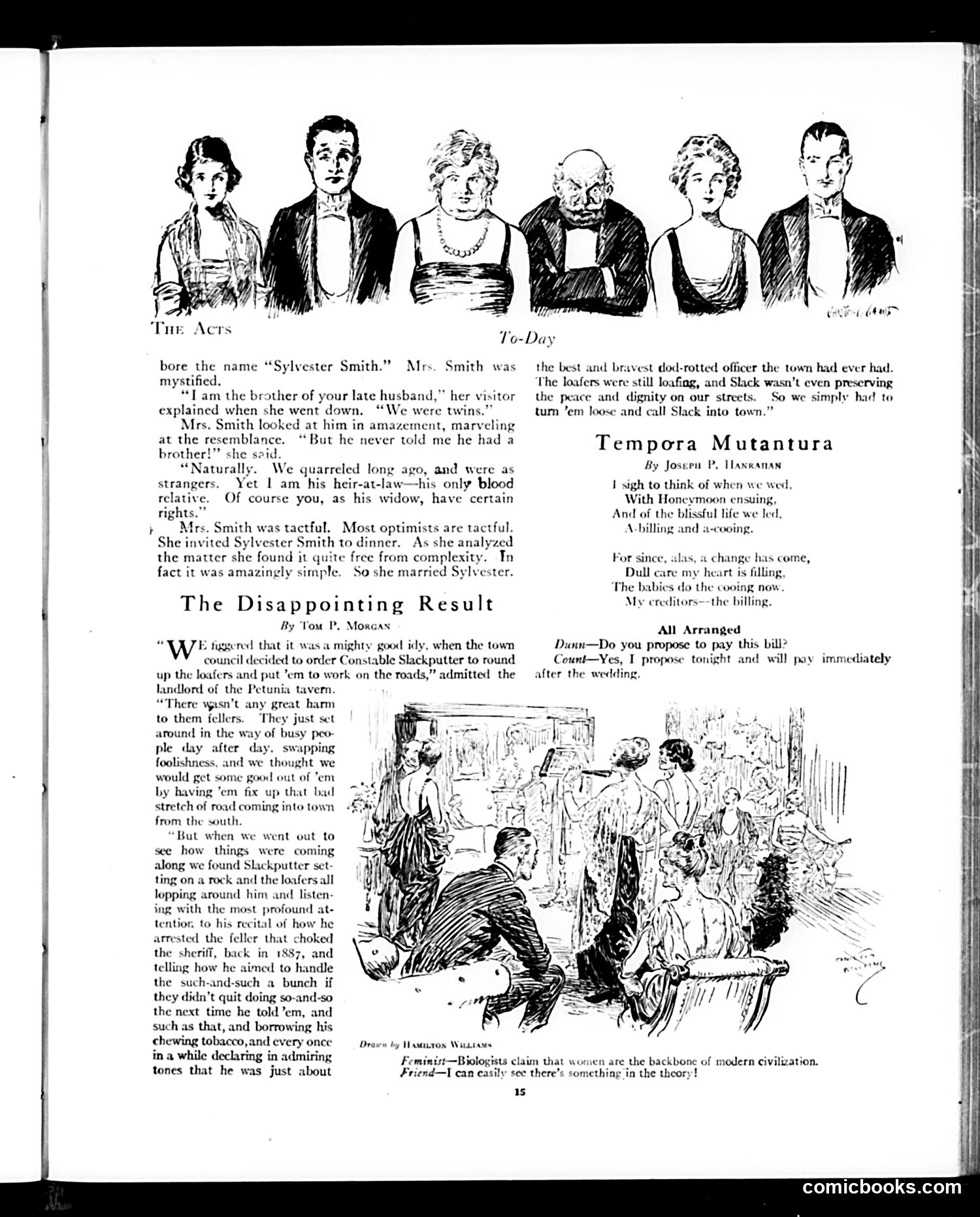
This page contains three distinct pieces of social satire: **"The Acts"** presents a con-artist scheme: a widow is approached by a man claiming to be her late husband's twin brother (and thus heir-at-law). She marries him to secure her inheritance rights—a satirical commentary on women's limited legal and financial independence in this era, where marriage was sometimes a practical necessity. **"The Disappointing Result"** mocks poor municipal governance. A small town hires a constable to round up unemployed loafers for road work, but the constable becomes so charmed by his own storytelling that he merely entertains them instead of supervising labor. The satire targets both ineffectual law enforcement and the futility of "solutions" to homelessness or idleness. **The feminist cartoon** jokes that women are civilization's backbone—but observes that a man can "easily see" this because women literally carry (support) men. All three pieces satirize social hierarchies and economic anxieties of the era through humor rather than advocacy.
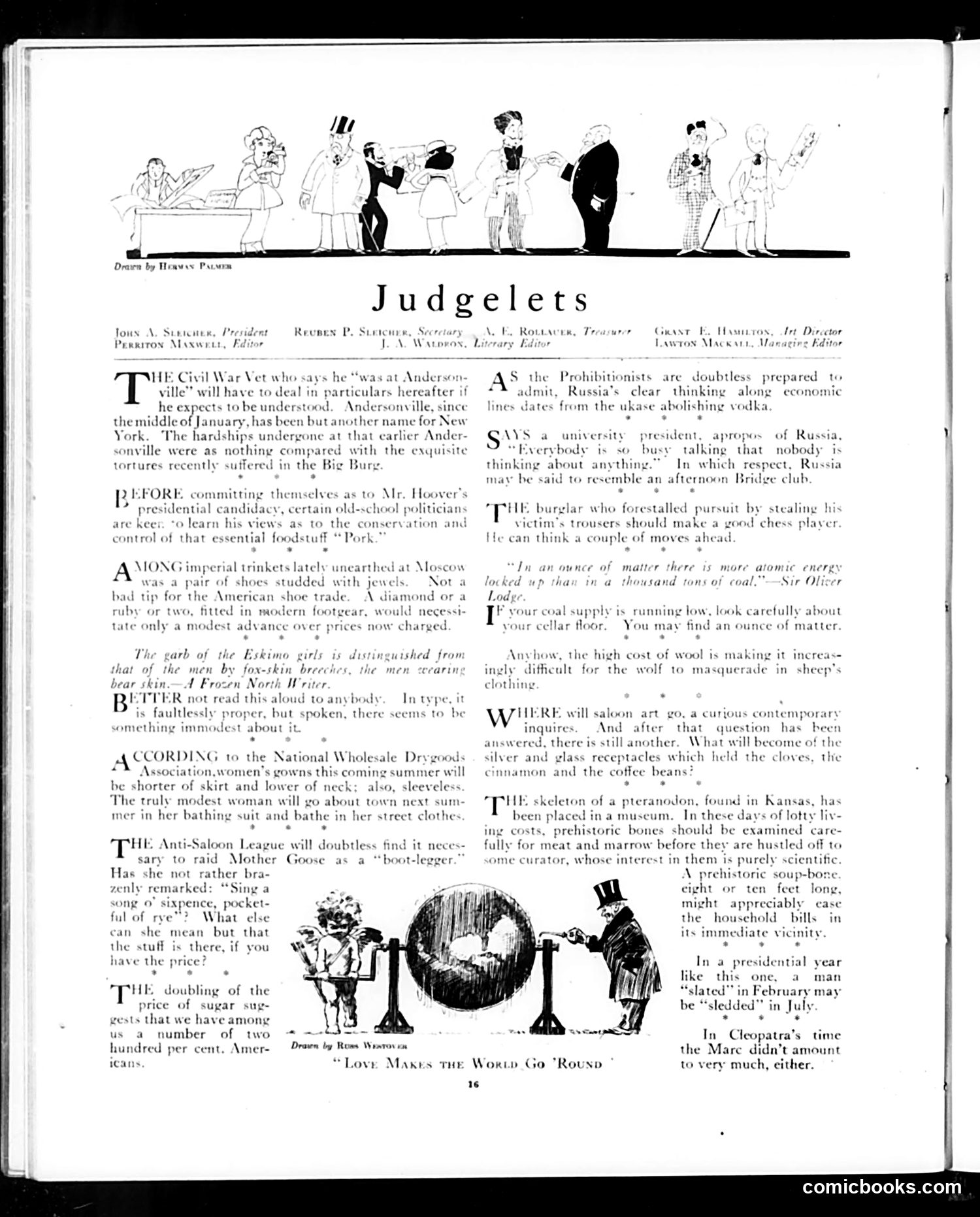
This "Judgelets" column contains brief satirical comments on contemporary issues, circa 1920s. Key targets include: **Prohibition**: Mocking the Anti-Saloon League's push to censor even Mother Goose nursery rhymes for alcohol references, and attacking Russia's vodka ban as economically misguided. **Presidential Politics**: Skepticism toward Herbert Hoover's candidacy and politicians' vague positions on "Pork" (likely political patronage). **Post-WWI Economics**: Criticism of profiteering (sugar prices doubled, "200 per cent Americans"), inflation, and wool shortages affecting clothing. **Fashion Absurdities**: Deriding women's increasingly revealing bathing suits and shorter skirts as violations of modesty standards. **Random Observations**: Humorous asides on everything from Eskimo fashion to prehistoric fossils being examined for meat value rather than scientific merit. The cartoon at bottom by Ross Wetmore depicts "Love Makes the World Go Round"—a couple on a giant globe, likely satirizing romantic naiveté amid economic chaos.
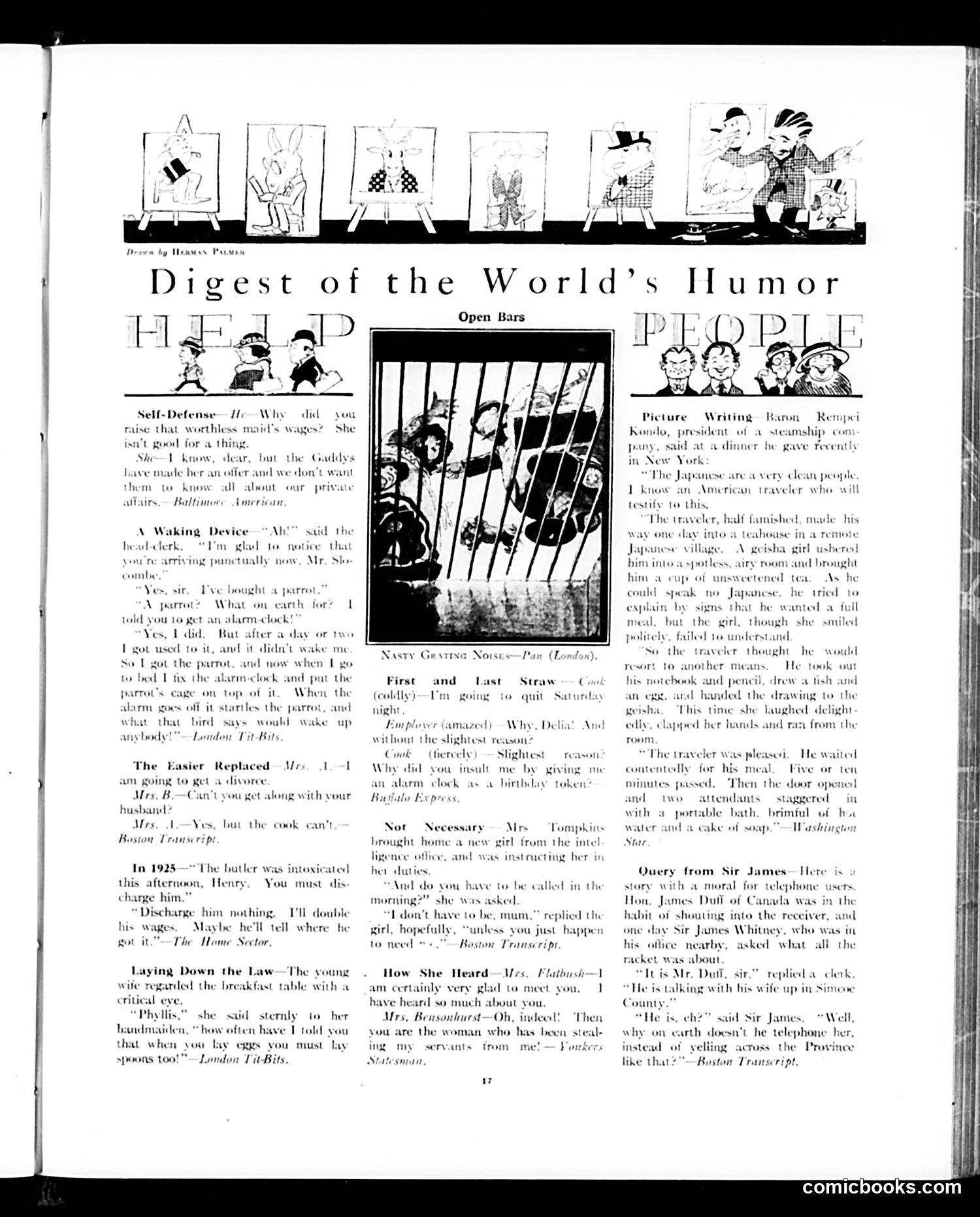
This page collects brief humorous anecdotes organized into sections: "Head People" (left) and "People" (right), with an "Open Bars" illustration in the center. The jokes rely on period-specific domestic and workplace scenarios: servants' wages and privacy, alarm clocks, employer-employee dynamics, and telephone etiquette. A recurring theme is the servant problem—middle-class anxiety about hiring and retaining domestic help, referenced in multiple jokes about maids, cooks, and butlers. The center illustration depicts crowded "open bars," likely referencing Prohibition-era speakeasies or the popular social trend of unregulated drinking establishments. The final anecdote about Sir James Whitney and telephone use humorously contrasts modern telephone technology with older communication methods—the implication being that shouting across a province seems absurd compared to using a telephone, yet the character does it anyway. These are workplace and domestic satire aimed at middle-class readers familiar with servant-keeping and contemporary conveniences.
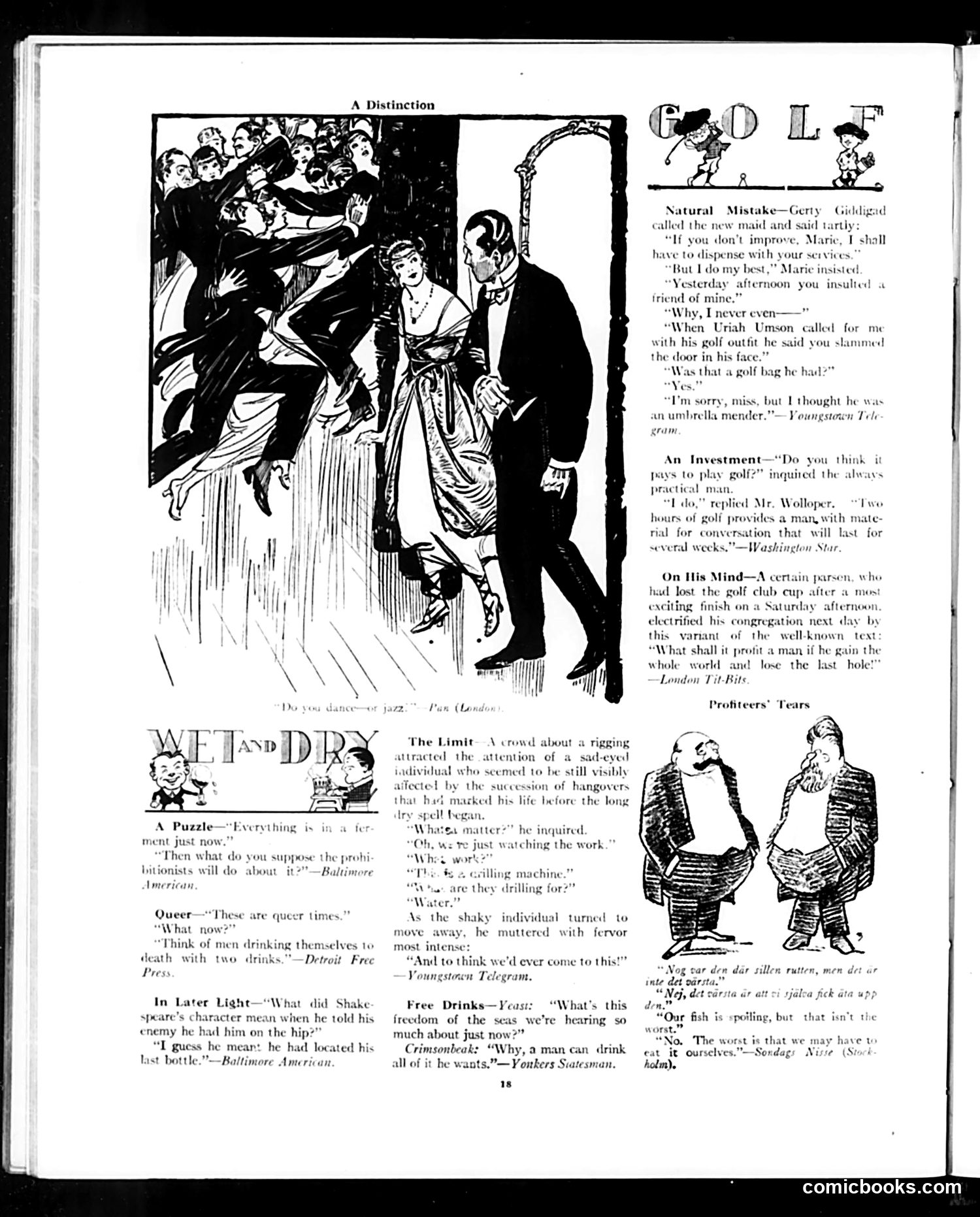
This Judge magazine page collects short humorous anecdotes satirizing early 20th-century American life, primarily focused on **Prohibition and drinking culture**. The main cartoon depicts a chaotic scene—likely showing the contrast between social pretense and reality during Prohibition era enforcement. The caption "Do you dance—or jazz?" suggests mockery of changing social standards. The text jokes repeatedly reference: - **Prohibition's absurdity**: Men drinking themselves to death on "two drinks" (likely bootleg liquor quality) - **Golf culture**: Multiple jokes use golf as a metaphor for middle-class concerns and conversation - **Class distinctions**: A maid misidentifies a golf bag as an umbrella, satirizing servant/employer relationships - **Profiteers**: The bottom cartoon shows what appears to be foreign characters discussing spoiling fish—likely critiquing wartime or post-war profiteering and food shortages The overall message mocks Prohibition's ineffectiveness, middle-class pretensions, and wartime economic disruption. The satire assumes readers' familiarity with these contemporary social upheavals.
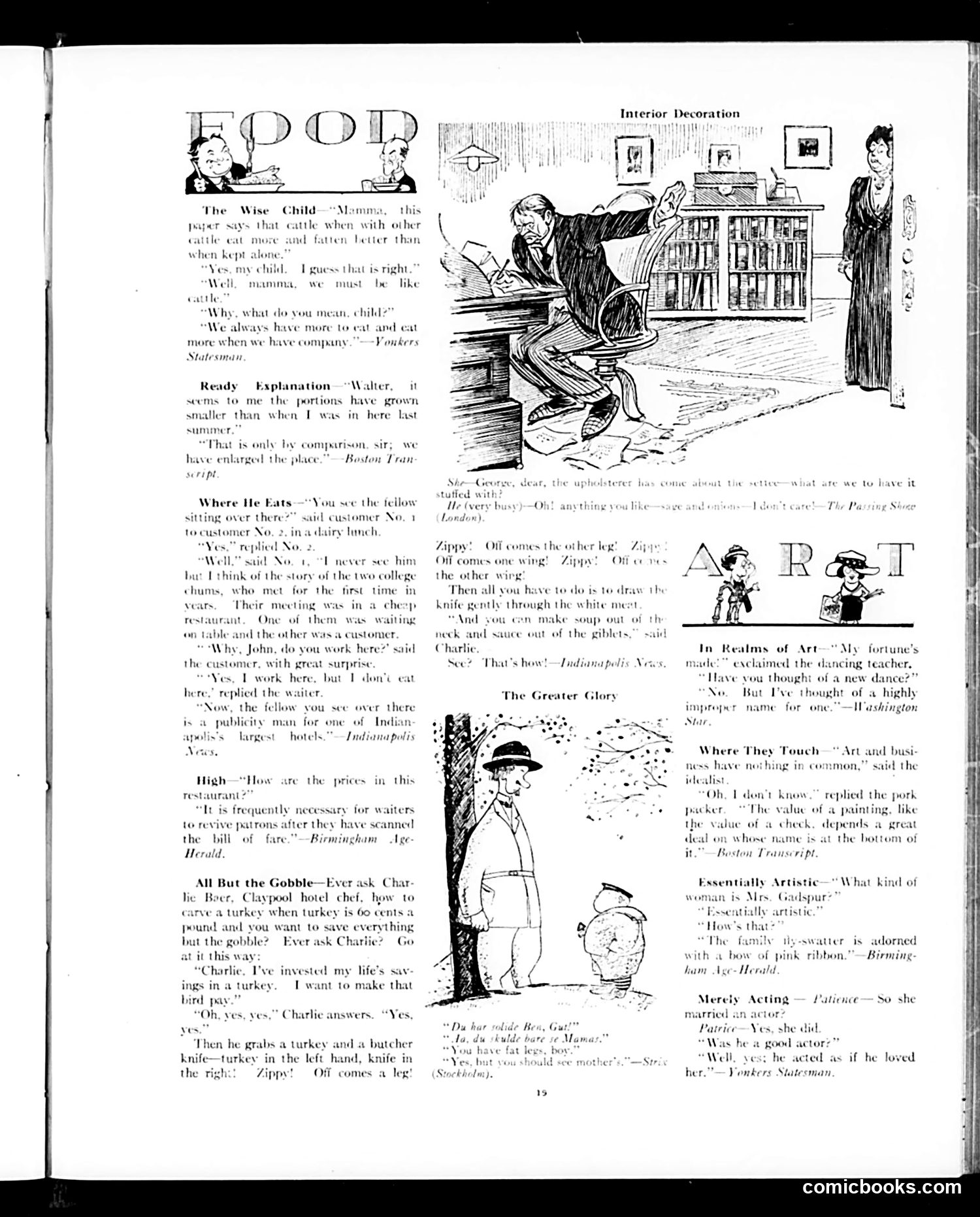
This page from the satirical magazine *Judge* contains multiple short humorous pieces satirizing early 20th-century American social and economic life. **Main cartoons/jokes:** 1. **"The Wise Child"** — A mother-child dialogue mocking how people eat more and gain weight when dining with others, comparing humans to cattle. 2. **"Where He Eats"** — A waiter at a cheap restaurant doesn't eat where he works, contrasted with a hotel publicist who similarly maintains distance from his workplace—satirizing class divisions and professional pretense. 3. **"All But the Gobble"** — Chef Charlie Boer demonstrates carving a 60-cent turkey to maximize profit by using every part, mocking Depression-era food economy and waste. 4. **"Interior Decoration"** — A couple discusses upholstery stuffing, with the husband's indifferent response satirizing domestic decision-making. The remaining brief jokes mock art pretension, business ethics, and theatrical acting—typical *Judge* fare targeting middle-class American vanities and economic anxieties of the era.
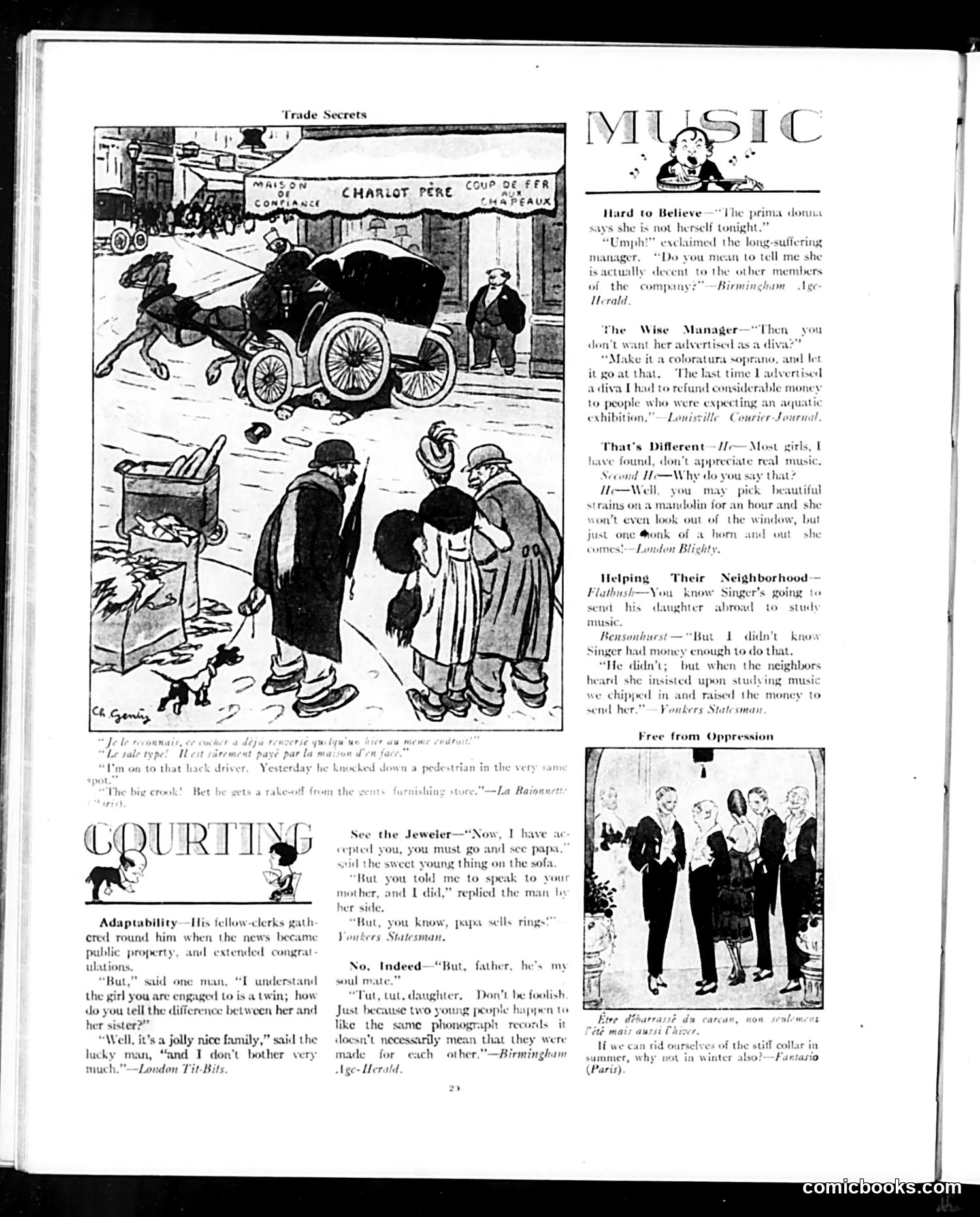
This page contains several short humor pieces typical of early 20th-century American satirical magazines. **"Trade Secrets" (top cartoon):** Shows a street scene with a man discussing his engagement to a twin sister. The joke satirizes male indifference—he admits he can't tell his fiancée from her identical sister and doesn't bother trying, mocking both his lack of discernment and casual attitude toward marriage. **"Courting" section:** Three brief anecdotes mock romantic and courtship conventions: - A man's adaptability to confusing twins - A jewelry shopkeeper demanding the suitor speak to the father (who sells rings, hinting at financial interest) - A father dismissing young love as mere phonograph-record compatibility **"Music" section:** Jokes about prima donnas' temperamental behavior and the gap between musical appreciation and actual talent. **"Free from Oppression" (photograph):** Caption about Parisians suggesting winter fashion alternatives—unclear without fuller context, but appears to be contemporary lifestyle commentary. The overall tone mocks courtship rituals, class pretensions, and gender stereotypes common to the era.
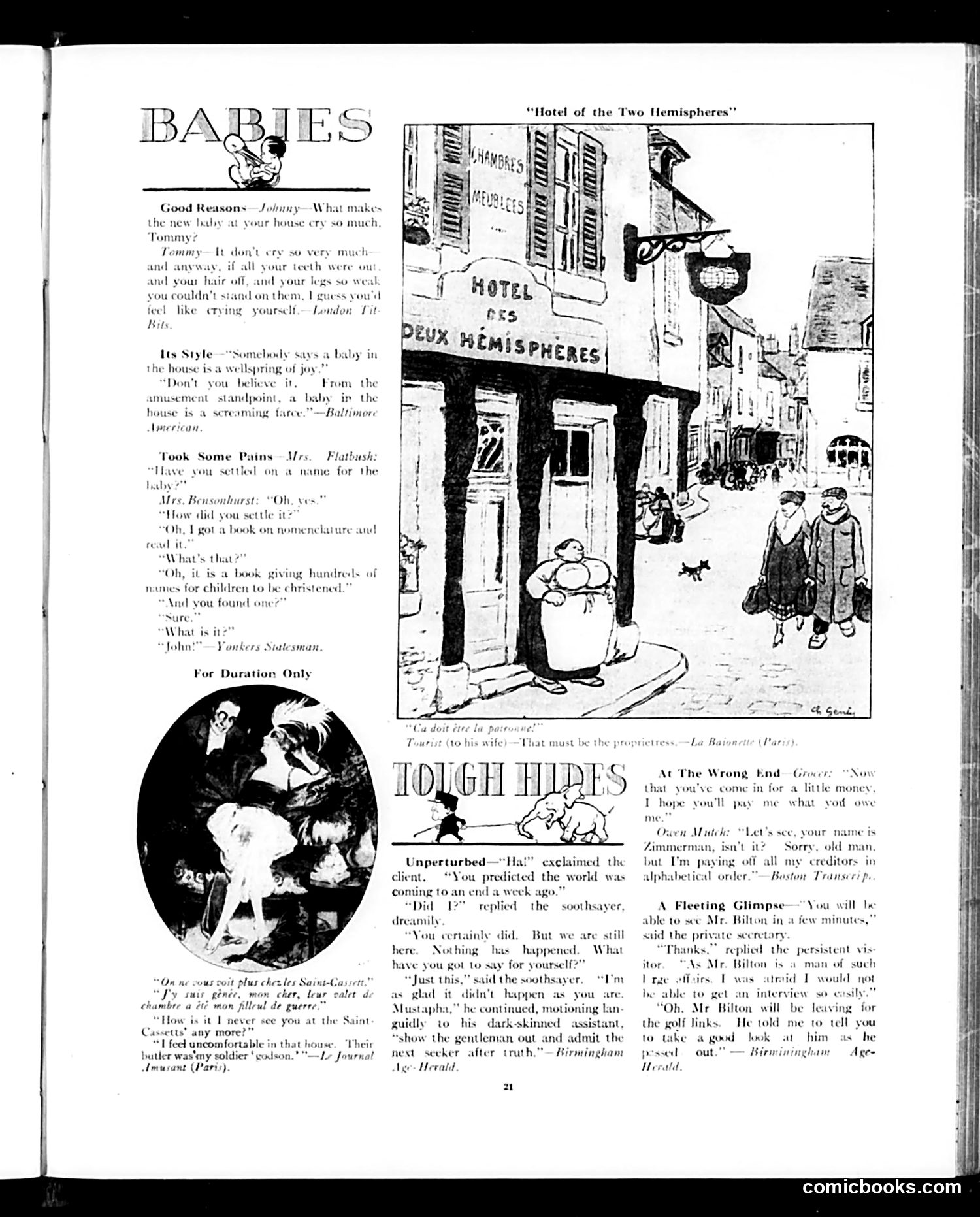
This page contains three separate humorous anecdotes satirizing early 20th-century social life: **"Good Reasons"** mocks new parenthood through a child's brutal honesty about why babies cry—a relatable domestic joke. **"Took Some Pains"** satirizes the pretentiousness of naming books and upper-middle-class affectation, with Mrs. Bensonhurst consulting a nomenclature guide only to select the common name "John." **"Hotel of the Two Hemispheres"** (illustrated cartoon) appears to be a French location joke, showing a humble Parisian boarding house where tourists stay. The remaining three brief anecdotes—"Unperturbed" (a fortune-teller unfazed by failed predictions), "At The Wrong End" (a debtor using alphabetical ordering as an excuse), and "A Fleeting Glimpse" (a busy businessman prioritizing golf)—target human hypocrisy, financial irresponsibility, and misplaced priorities. The humor relies on character types and social observation rather than political commentary.
This is the title page for Judge magazine's "Bad Breaks" humor column. It showcases **unintentional errors from newspapers**—typographical mistakes and bizarre editorial mishaps that create unintended meanings. The column's appeal lies in highlighting **absurd contradictions** created by missing words or garbled text. Examples include: - A judge ordering a man to support his "invalid chair" (likely "invalid wife") - A father who "woke up dead" - An "administration's cat" causing coal-strike controversy - A woman arriving home via subway with "thousands of others" These are real newspaper clippings where careless editing produced laughable results. The satire targets **journalistic incompetence**—the irony that newspapers, meant to inform the public accurately, instead create confusion through sloppy proofreading. The column pays readers $5 weekly for submissions, making it participatory humor dependent on catching newspapers' mistakes. It's essentially early-20th-century media criticism disguised as comedy.
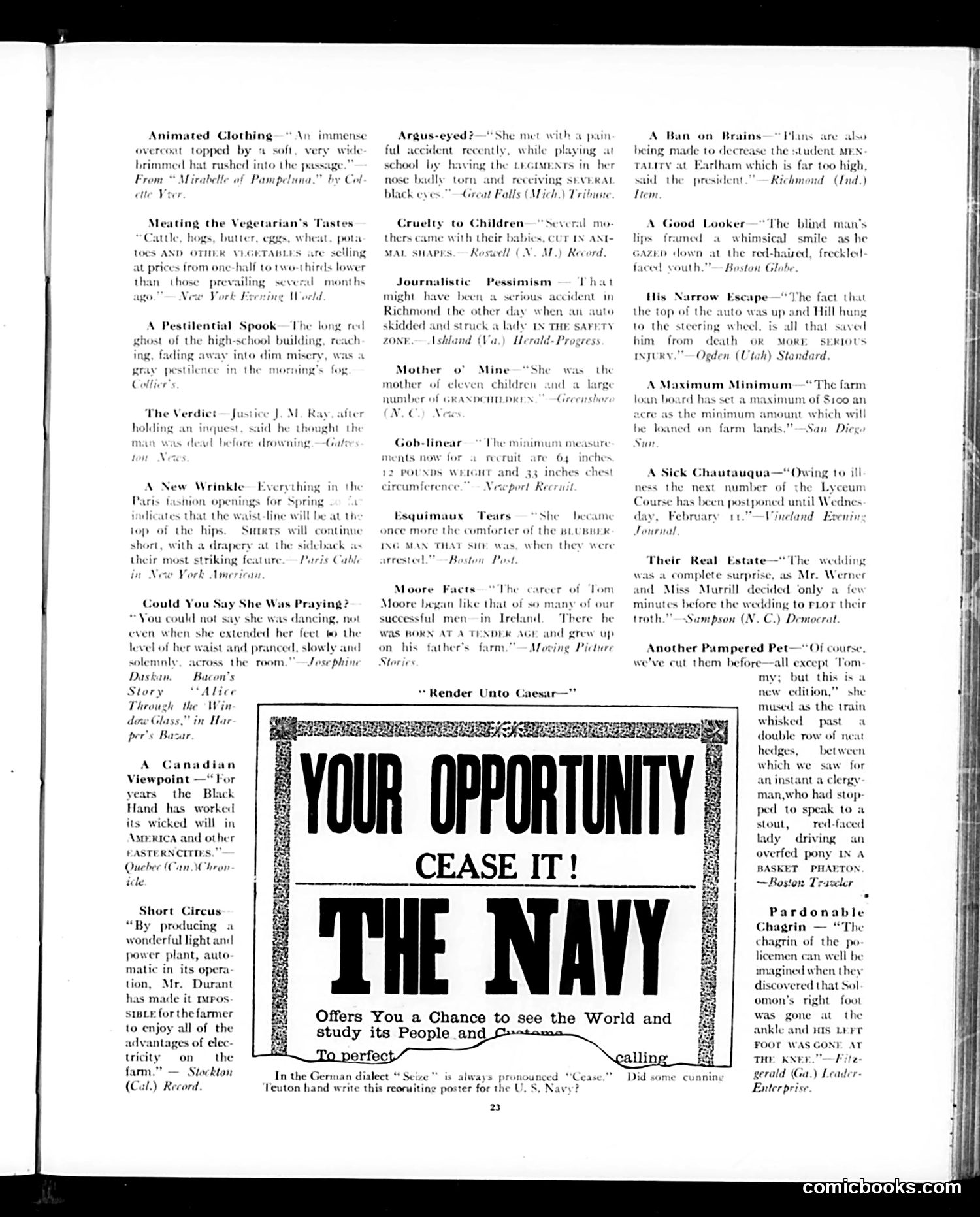
This page is primarily a **collection of brief satirical news items** ("Periscope" section) mocking absurdities from American newspapers, plus one major advertisement. ## The Main Advertisement The large centered box promotes **U.S. Navy recruitment**, using the slogan "YOUR OPPORTUNITY CEASE IT!" The phrase plays on a German-dialect recruiting poster ("Seize" = "Cease"), suggesting American recruiters should adopt similar aggressive tactics. It offers adventure ("see the World and study its People"). ## The Satirical Items The surrounding text snippets mock various newspaper reports: - Fashion absurdities (waistlines at hips) - Overzealous reporting (describing children as "animal shapes") - Contradictory bureaucratic policies (loan maximums that are also minimums) - Humorous misquotes and malapropisms from regional papers The page's humor relies on readers recognizing these as *real* published statements, finding them ridiculous. The Navy ad placement amid these absurdities may itself be subtle satire—Judge was a satirical publication that often questioned authority and social institutions.
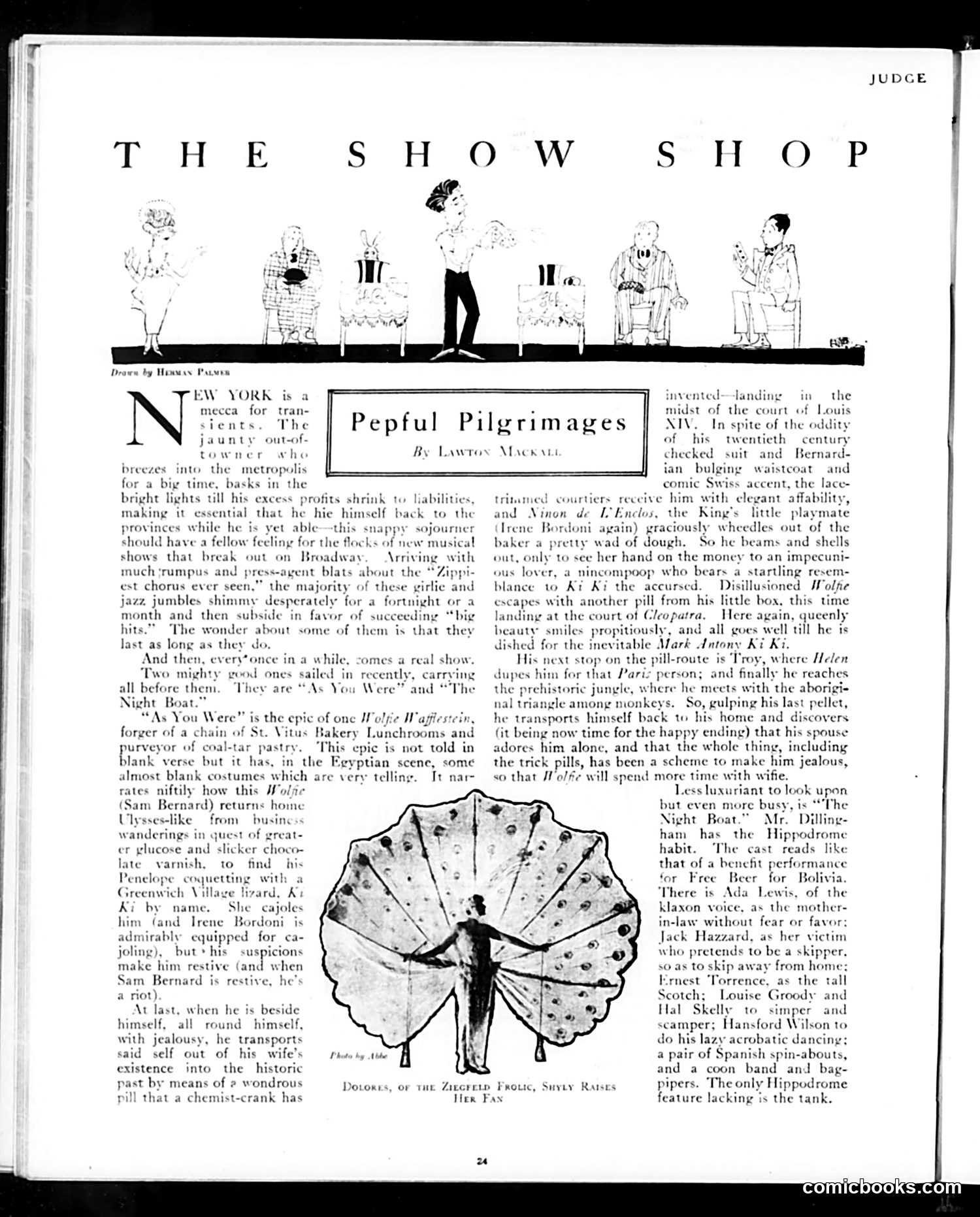
This page reviews two Broadway musicals through satirical theater criticism. The main article discusses "As You Were" and "The Night Boat." **"As You Were"** stars Sam Bernard as Wolsie Wagstein, a coal-tar pastry magnate who returns home to find his wife (Irene Bordoni) flirting with a Greenwich Village character named "Ax Ki." Jealous, Bernard's character uses magical pills to travel through history—encountering figures like Ninon de l'Enclos (Louis XIV's mistress) and Cleopatra—only to discover each woman repeating the same romantic betrayal. The satire mocks both the plot's absurdity and the era's obsession with elaborate musical-comedy spectacles that substitute extravagant sets for coherent storytelling. **"The Night Boat,"** produced by Dillingham, receives gentler mockery for its bloated Hippodrome-style cast assembled like a benefit show, featuring numerous comedians and specialty acts. The illustration at top shows various fashionable theater-goers, typical of Judge's visual commentary on New York society. The central image depicts a performer in an elaborate peacock-fan costume, exemplifying the gaudy excess the review critiques.
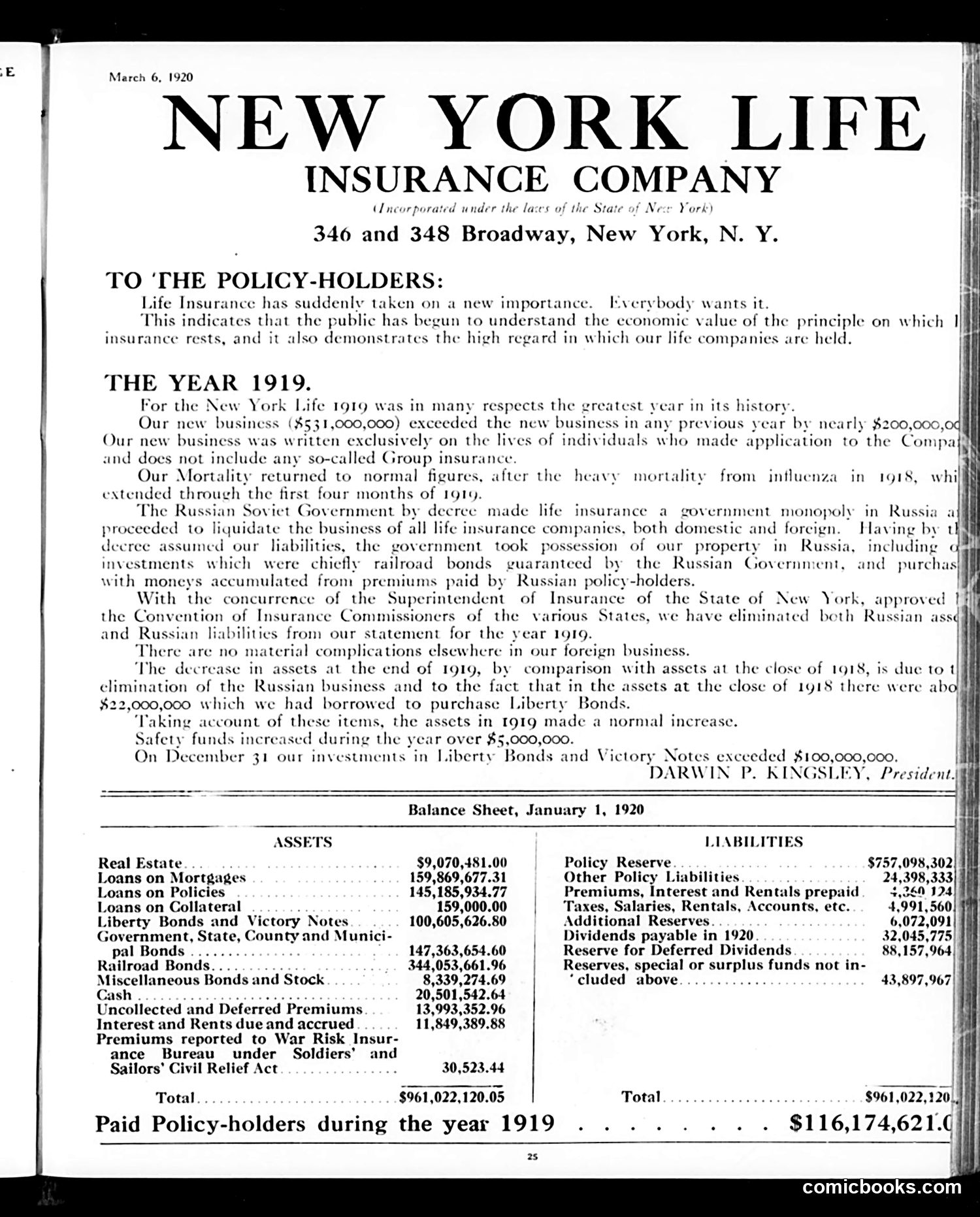
This is **not a cartoon or satirical content**—it's a corporate financial statement from New York Life Insurance Company, published March 6, 1920. The page addresses policyholders about the company's exceptional 1919 performance: new business of $531 million (up nearly $200 million from prior years) and $116 million paid to policyholders. The significant historical reference is the **Russian Soviet seizure** of the company's Russian assets and business. The Bolshevik government declared life insurance a state monopoly, confiscated company property (including railroad bonds), and assumed liabilities. New York Life eliminated all Russian assets and liabilities from its 1919 statement—a major geopolitical event reflecting post-WWI communist nationalization. The page also notes the 1918 influenza pandemic's impact on mortality rates and celebrates heavy investments in Liberty Bonds and Victory Notes (WWI war financing). This appears in *Judge* likely because insurance was considered newsworthy to the magazine's readership.
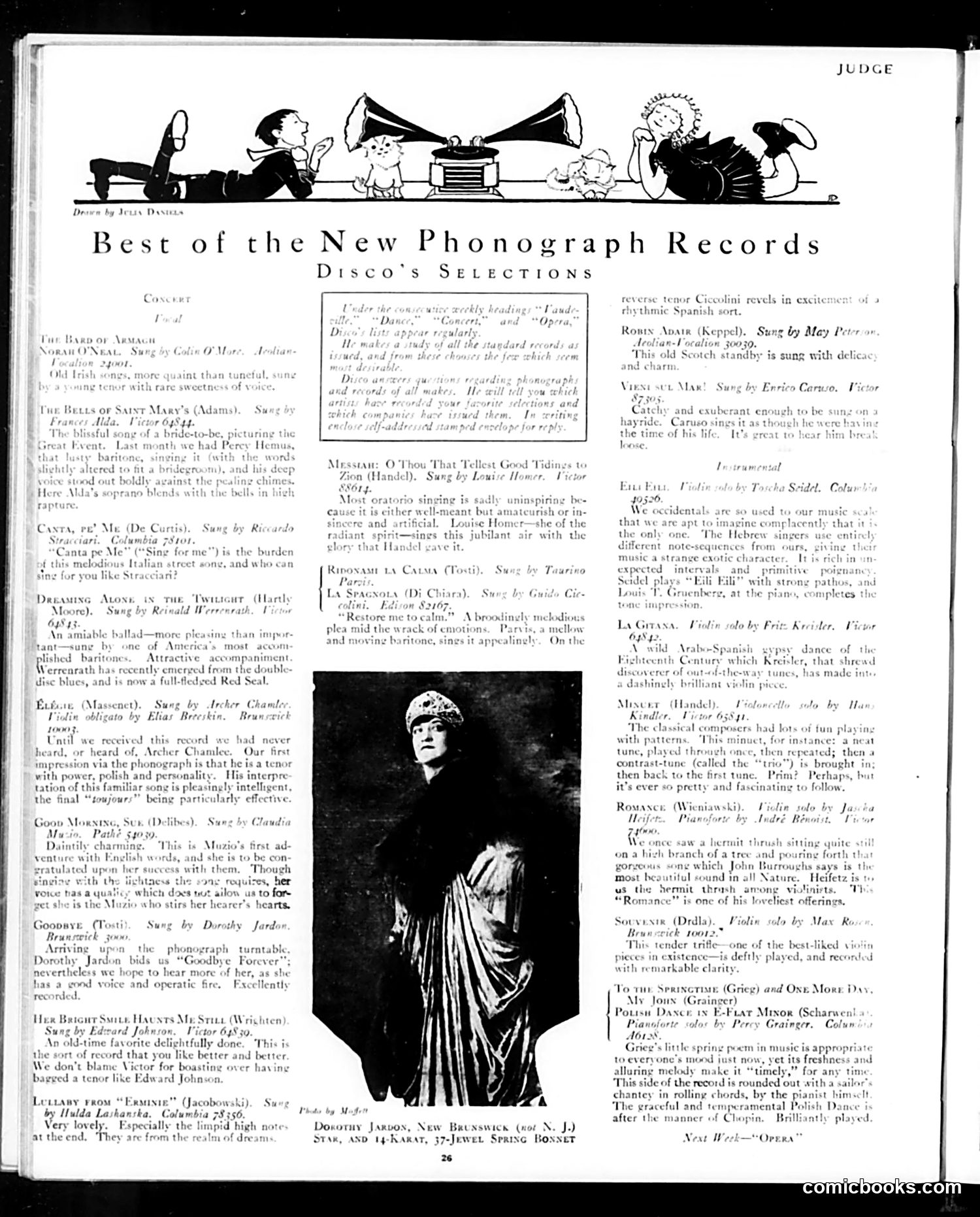
This is **not a political cartoon** but rather a **record review column** from *Judge* magazine. The decorative header illustration by Jules Guérin shows whimsical figures with phonographs, but it's purely decorative—not satirical commentary. The page reviews phonograph recordings (78 rpm records), listing vocal and instrumental selections with brief critical assessments. Artists mentioned include baritone baritones, tenors, and violinists performing classical and operatic pieces—this was cutting-edge entertainment technology of the era. The centered photograph shows soprano **Dorothy Jardon** (identified in the caption), illustrating one of the featured recording artists. The satire, if any, is mild: the column gently mocks record-buyers' preferences and performers' choices, but this is **music criticism, not political satire**. This page represents *Judge's* cultural coverage rather than its satirical mission.
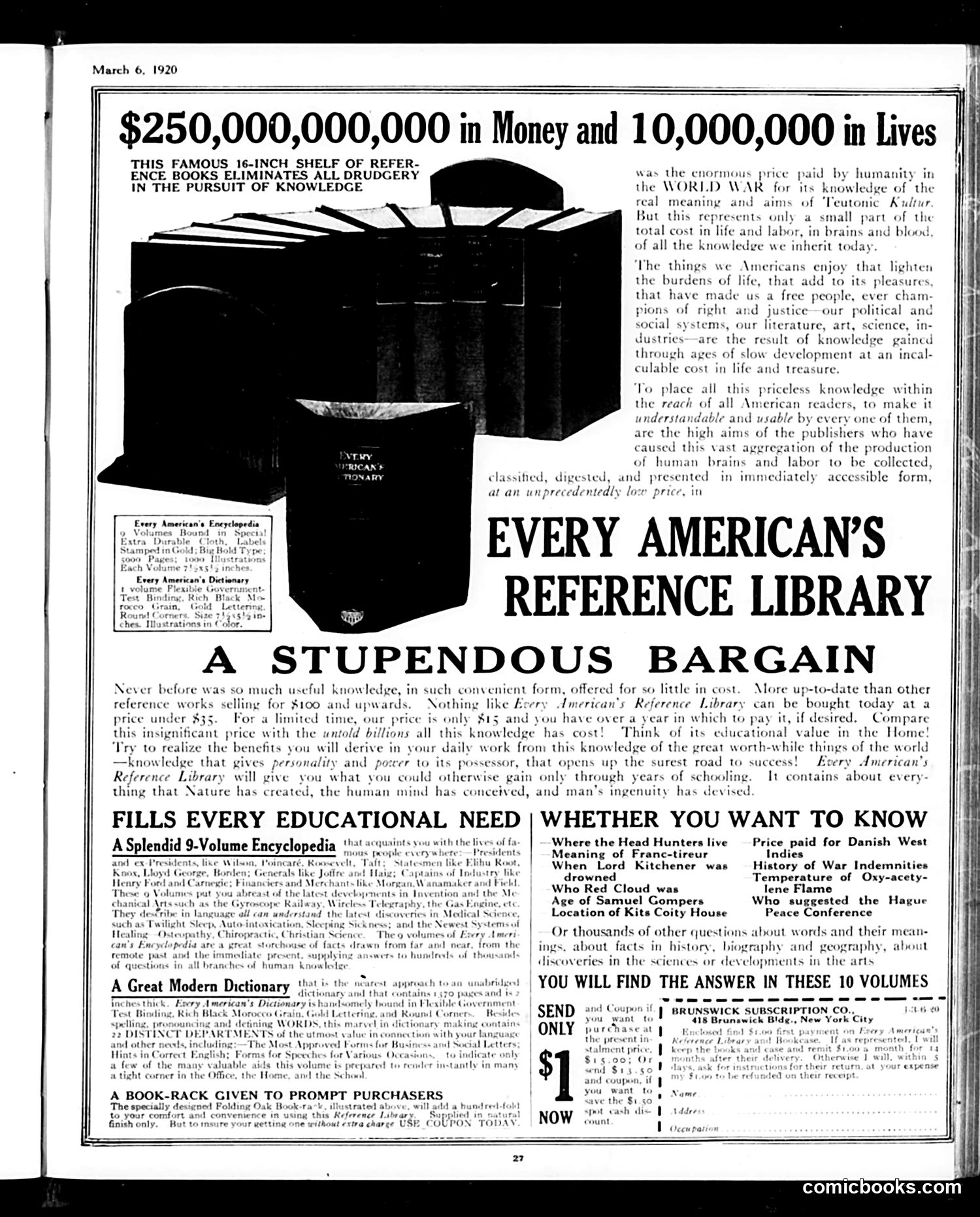
This is primarily a **full-page advertisement** (not a political cartoon) from *Judge* magazine, March 6, 1920, promoting a 10-volume encyclopedia set. The ad employs patriotic and aspirational messaging typical of the era. It references **World War I** ("the WORLD WAR"), framing knowledge as humanity's costly achievement gained through sacrifice in blood and treasure. The copy argues that Americans' freedoms and cultural achievements stem from accumulated knowledge. The central visual—a large reference book shelf—positions the product as democratizing education, making expensive knowledge ($100+ elsewhere) accessible to average Americans for $13, payable over a year. The appeal is explicitly **classless and populist**: "Every American's Reference Library" promises to serve all readers, from families seeking homework help to those pursuing self-improvement. Sample questions listed ("Where the Head Hunters live," "Age of Samuel Gompers") suggest breadth across geography, history, labor, and science. **Context modern readers miss**: In 1920, before widespread public libraries and before internet access, physical encyclopedias represented a major educational investment and aspirational purchase for middle-class homes.
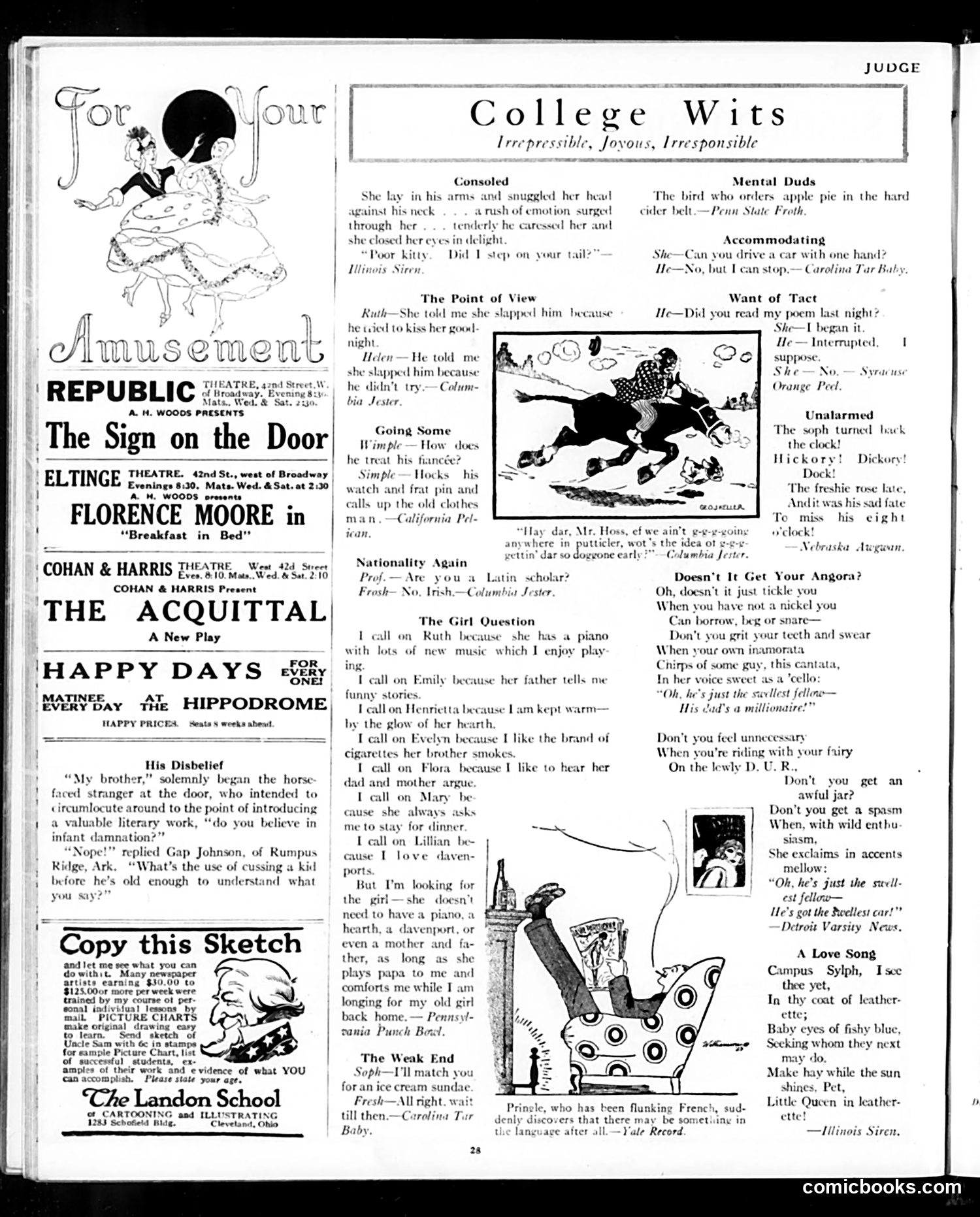
This page from *Judge* magazine features humorous college anecdotes and advertising rather than political satire. The "College Wits" section collects brief jokes and witticisms attributed to various college publications, organized by category: "Consoled," "The Point of View," "Going Some," "Nationality Again," and "The Girl Question." The humor targets typical college life: romantic confusion (a girl who slaps a boy regardless of whether he tries to kiss her), dating rituals (calling on girls for various reasons—pianos, father's stories, warm hearths, cigarettes), and academic struggles (a French student suddenly appreciating the language). There's also social commentary on practical concerns like borrowing money and missing classes. The cartoons depict domestic romance and youthful misadventure in understated pen-and-ink style. The surrounding advertisements promote theatrical productions and a correspondence school for cartooning. This page reflects 1920s college culture humor with no apparent political commentary—purely entertainment focused on student dating, academic life, and adolescent sensibilities.
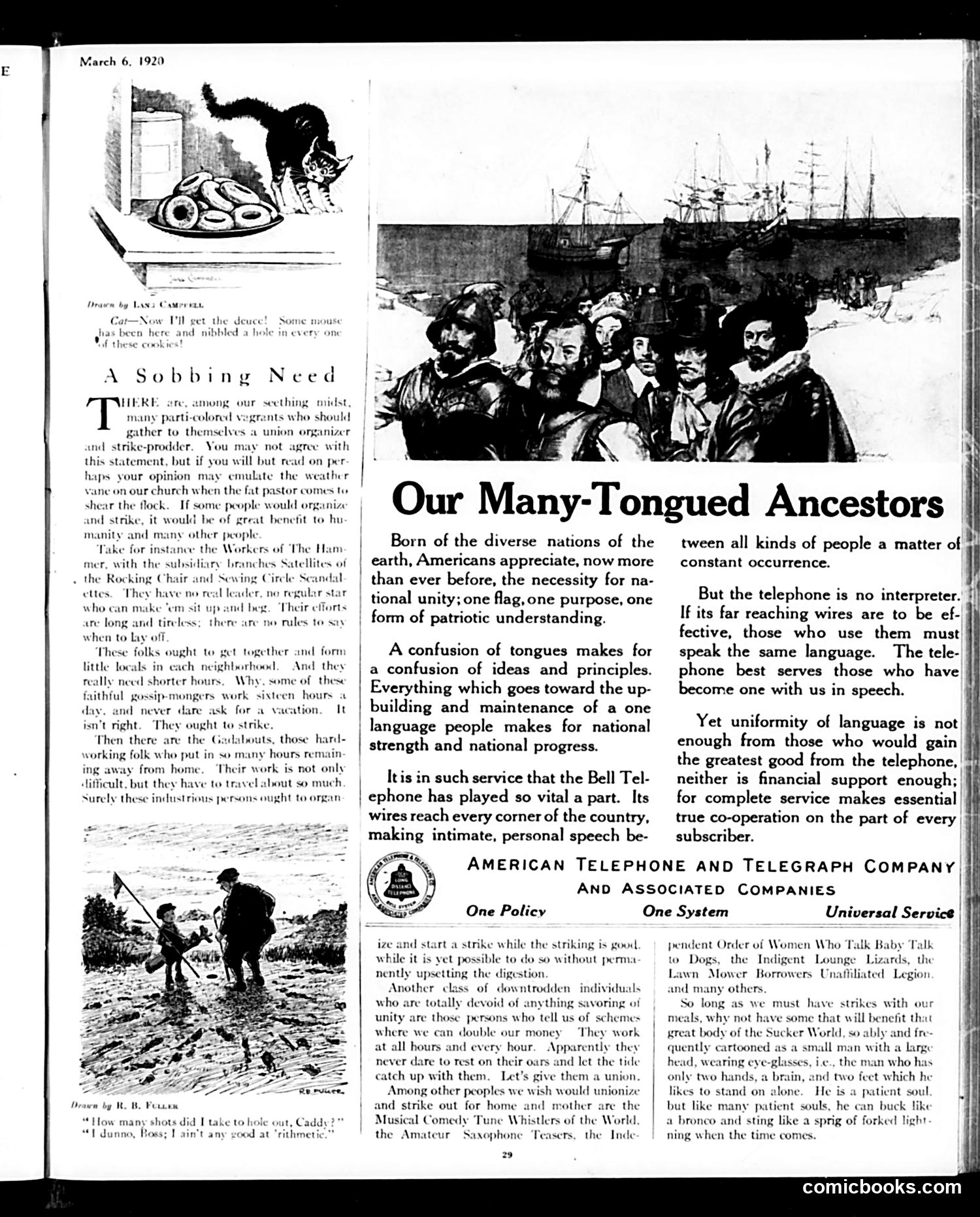
This page contains two distinct pieces from Judge magazine (March 6, 1920): **"A Sobbing Need"** (left): Satirical commentary on labor strikes. The author mockingly suggests that various non-industrial groups—household workers, gossips, traveling salesmen, get-rich-quick schemers, and amateur musicians—should unionize and strike for shorter hours. The satire targets both labor activism (by suggesting its logic is absurd when applied to everyday nuisances) and the groups themselves (portrayed as burdensome to society). The cartoon shows a cat stealing food, illustrating one of these "sobbing needs." **"Our Many-Tongued Ancestors"** (right): A Bell Telephone advertisement dressed as civic messaging. It argues that America's strength depends on linguistic uniformity—that immigrants and diverse peoples must speak English to achieve national unity and progress. The accompanying photograph shows immigrants arriving by ship. This reflects 1920s assimilationist ideology: the implicit message is that non-English speakers create confusion and hinder national development. The phone company positions itself as essential infrastructure for enforcing this linguistic conformity. Both pieces reflect post-WWI anxieties about labor, immigration, and national cohesion.
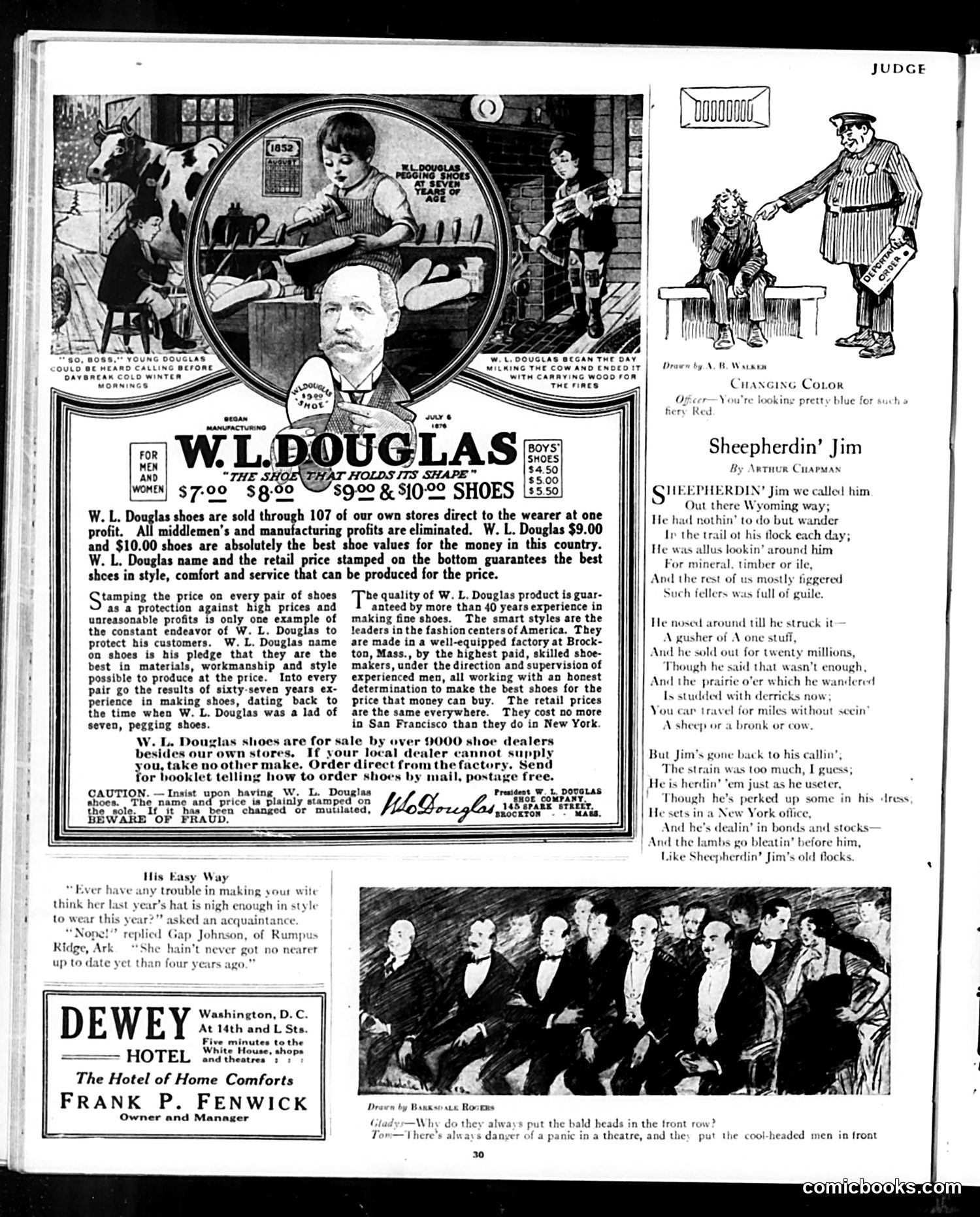
This page combines advertising (W.L. Douglas shoes) with satirical content. The main literary piece is a poem about a Wyoming shepherd who discovers oil, becomes wealthy selling for "twenty millions," then returns to herding despite his riches. The satire targets the newly wealthy from oil booms: Jim abandons pastoral simplicity for New York finance (bonds, stocks) yet psychologically returns to his humble roots—he still mentally "herds" in his office work. The joke reflects early 20th-century anxiety about sudden wealth transforming rural Americans into speculators. Despite money and status, Jim cannot escape his origins; the "lambs bleating before him" represent the financial instruments he now manipulates, paralleling his former literal flocks. The cartoons on the page (top right) appear to be separate social humor unrelated to Jim's narrative.
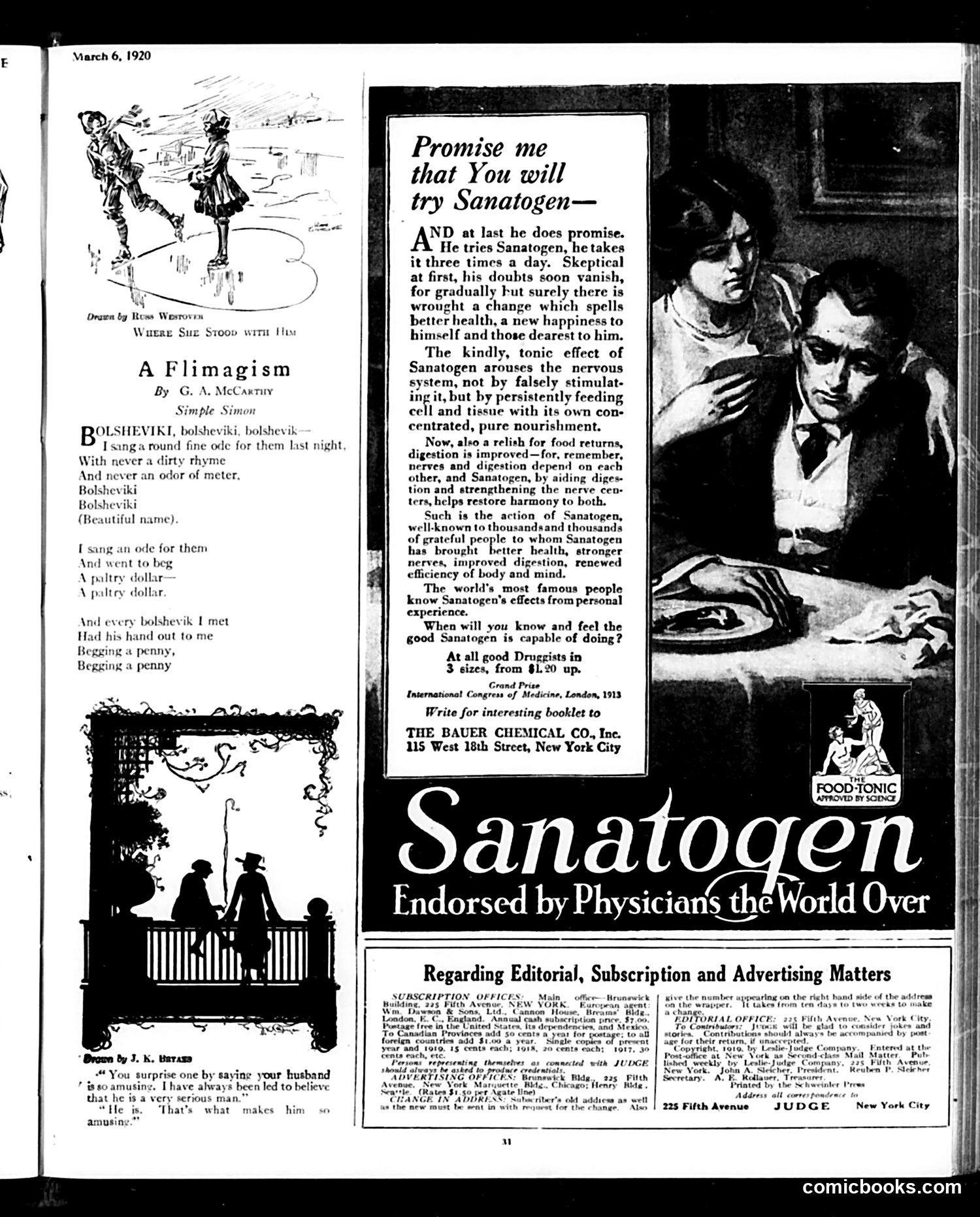
This page contains a political poem and advertisements rather than traditional political cartoons. **The Poem "A Flimagism"** by G.A. McCarthy satirizes Bolsheviks (Russian communists) through the nursery rhyme structure of "Simple Simon." The poem mocks communist ideology by depicting Bolsheviks as perpetually begging for money—"And every bolshevik I met / Had his hand out to me / Begging a penny." This reflects 1920s American anti-communist sentiment, suggesting Bolsheviks are hypocritical parasites despite their revolutionary rhetoric about wealth redistribution. The title "Flimagism" appears to be wordplay on "flimflam" (con game), emphasizing the perceived dishonesty. **The cartoon illustration** (by J.K. Hubbard, bottom left) shows a couple on a balcony; the caption jokes that a husband's serious demeanor is actually amusing—a mild domestic humor piece unrelated to the Bolshevik satire. **The Sanatogen advertisement** dominates the right side, promoting a medicinal tonic with testimonials about health improvement.
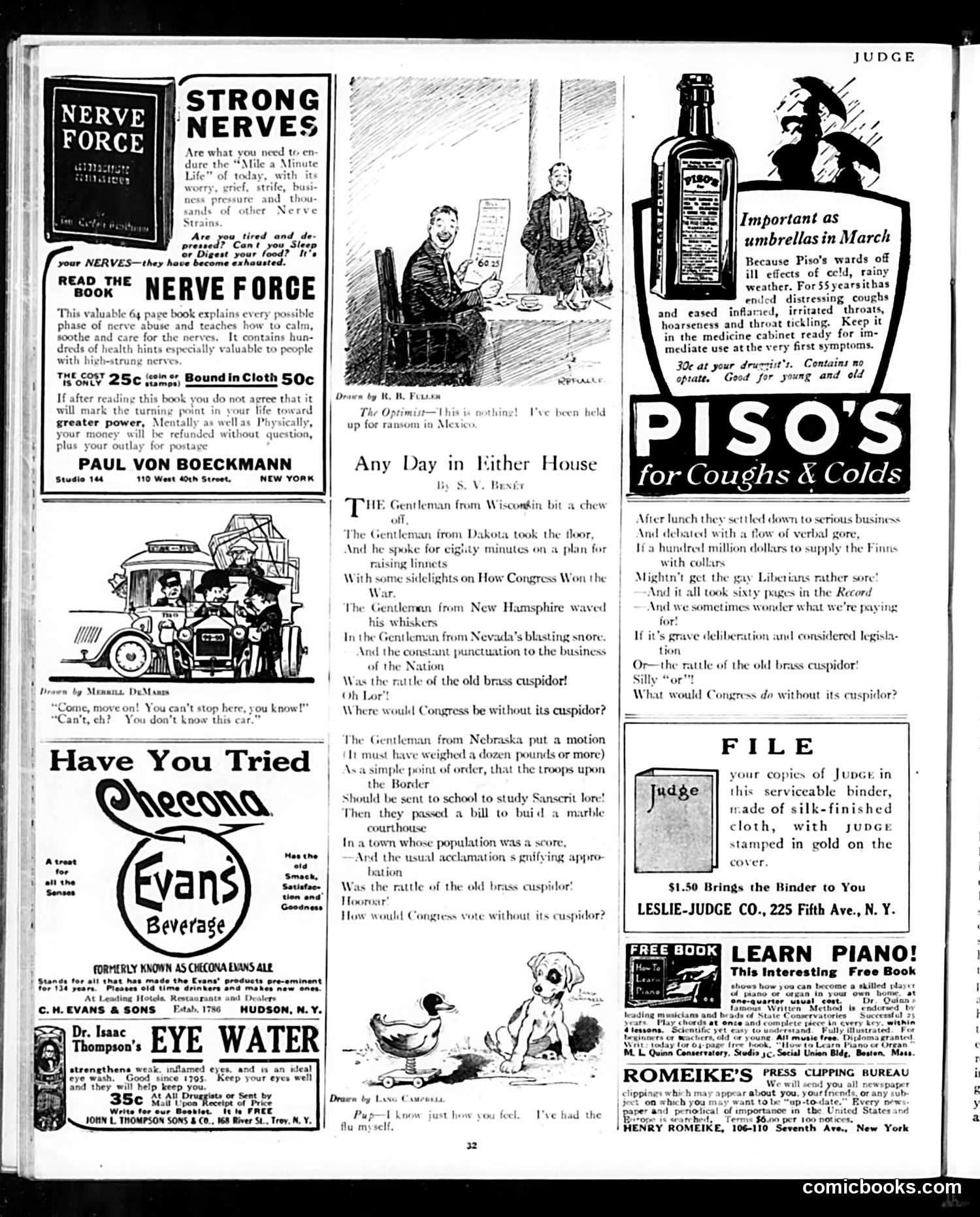
The main cartoon on this page is a poem titled "Any Day in Either House" by S.V. Benet, satirizing Congressional inefficiency. It depicts various gentlemen (congressmen) from different states—Wisconsin, Dakota, New Hampshire, Nevada, and Nebraska—engaging in endless, pointless debate and legislative theater. The satire's target: members of Congress wasting time on trivial matters (raising linnets, building a marble courthouse in a town of twenty people, debating whether to supply Finns with collars) while claiming to address serious post-WWI issues. The poem's running joke—"the rattle of the old brass cuspidor"—represents the spittoon, a common fixture in legislative chambers. This recurring image suggests Congress accomplishes nothing but the sound of spitting into brass spittoons: empty noise masking legislative inertia and absurdity. The satire critiques both Congressional vanity (lengthy speeches, "sixty pages in the Record") and the public's gullible acceptance of performative legislation.
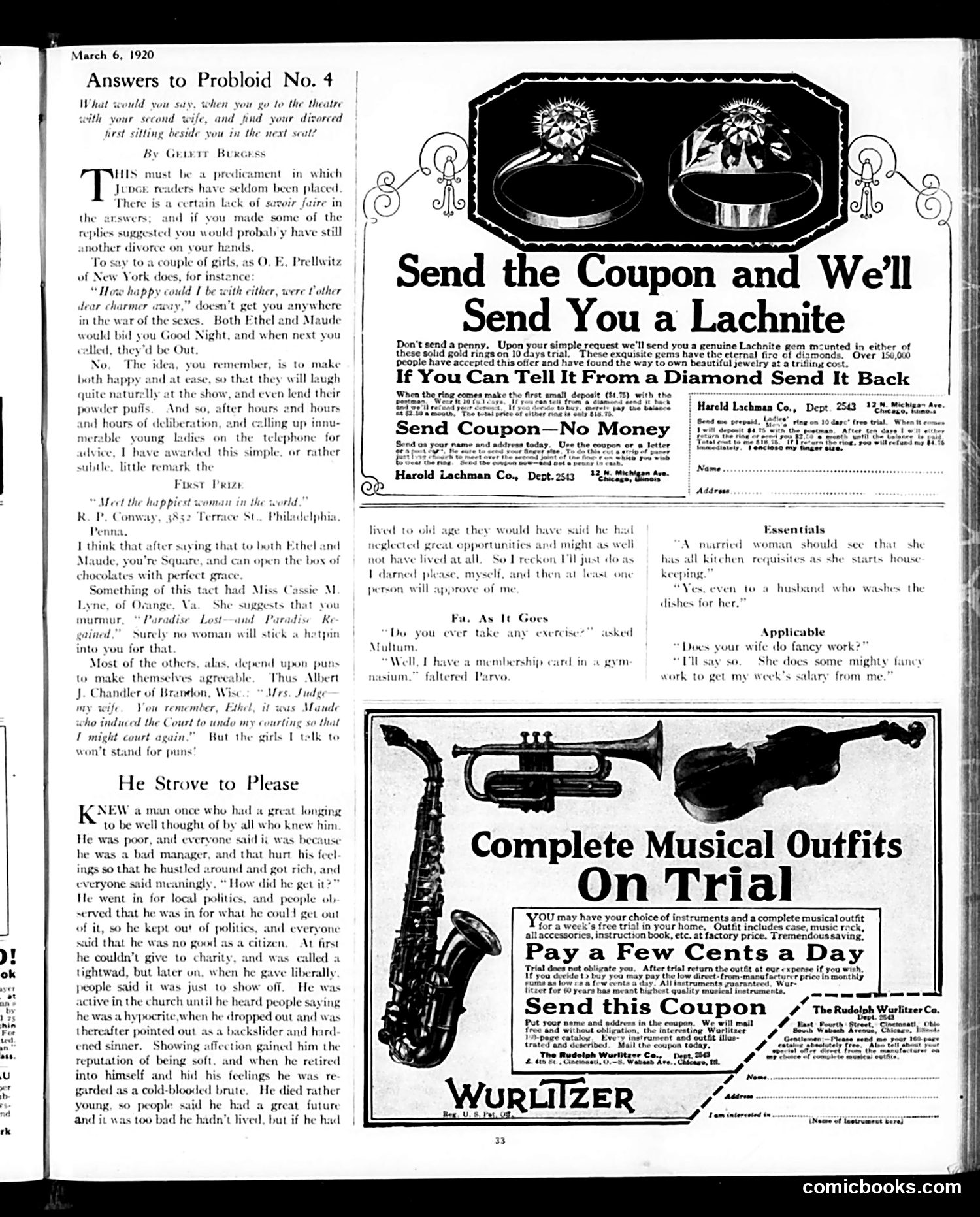
This page mixes editorial content with advertising. The main article "Answers to Probloid No. 4" addresses a social etiquette dilemma: what to say when encountering your ex-spouse (with their new partner) while attending a theater with your current wife. The column treats this as a genuine modern problem, suggesting the high divorce rate of the era created awkward social situations. The "winning" answer emphasizes tact and restraint—murmuring something neutral so both parties can enjoy the show without conflict. The subsequent humorous anecdotes illustrate broader marriage dynamics: wives controlling husbands' social behavior, women strategically managing household finances, and spouses using various tactics to gain advantage in domestic life. The advertisements (Lachnite rings, musical instruments) are period-typical, offering payment plans to working-class readers. Overall, the page reflects 1920s concerns about marriage, divorce, and changing gender relations in post-war America.
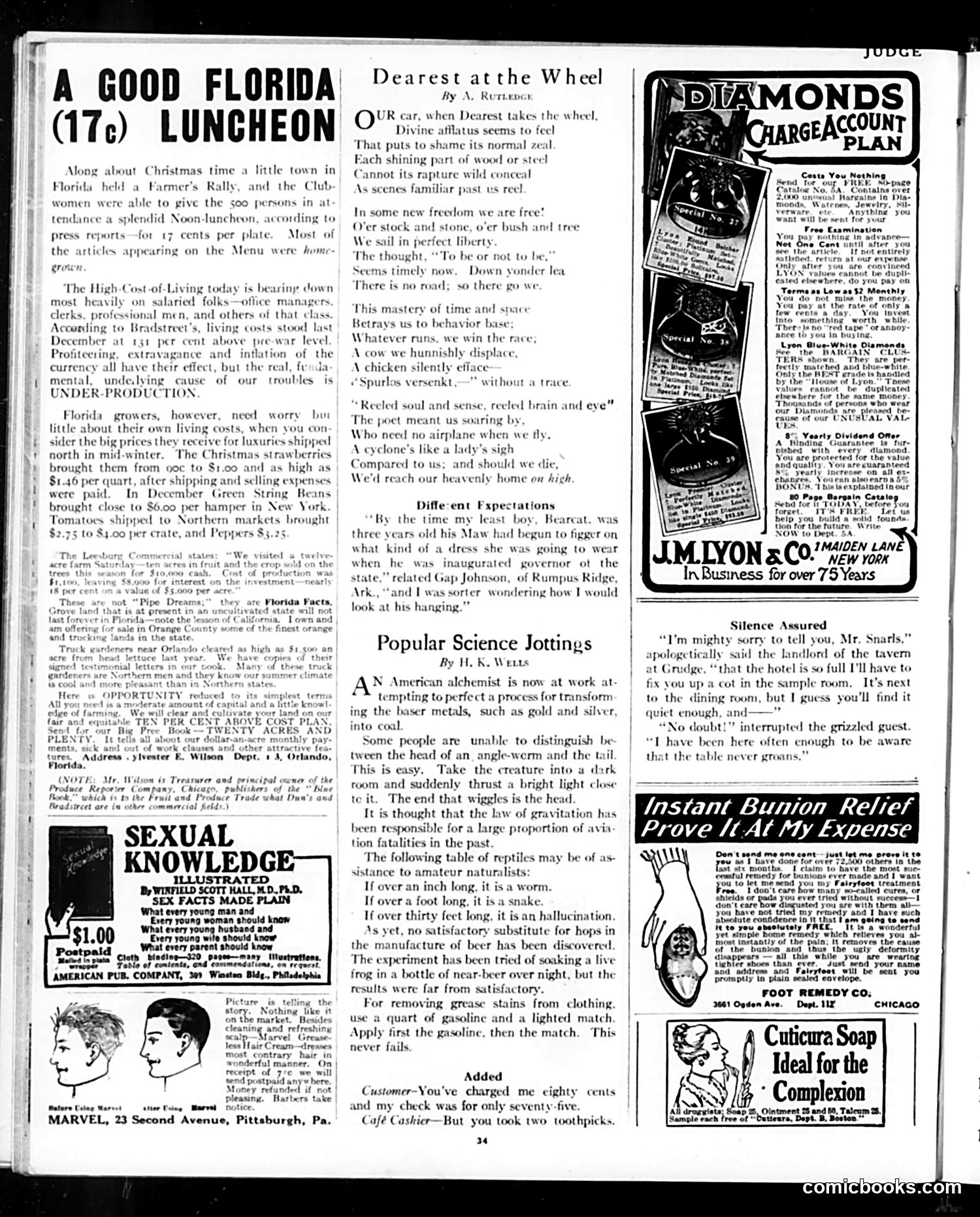
This page contains several distinct sections: **"A Good Florida Luncheon"** reports that a Florida farming rally fed 500 people lunch for 17 cents per plate during the post-WWI inflation crisis. The article notes Florida growers profited enormously from winter produce shipped north—strawberries sold for $1-$1.46 per quart, beans for $6 per hamper. The satire criticizes urban workers facing high living costs while agricultural producers grew wealthy. **"Dearest at the Wheel"** is a humorous poem about a man's wife driving their car recklessly and dangerously, with his romanticized but terrified observations of her wild driving. It's gentle satire on women drivers (then relatively novel) and automotive culture. **"Popular Science Jottings"** offers pseudo-scientific humor: an alchemist trying to turn metals into coal, difficulty distinguishing angle-worm heads from tails, and gravity causing aviation deaths—all presented as genuine scientific observations, mocking popular science writing's dubious claims. The remaining content is mostly advertisements for books and remedies.

This is **not satire or political commentary**—it's a straightforward cigarette advertisement placed in *Judge* magazine. The page features a large map of the United States with Camel cigarette packages emerging from it, accompanied by marketing copy from R.J. Reynolds Tobacco Co. The ad emphasizes Camel's "expert blend of choice Turkish and choice Domestic tobaccos," claims of smoothness, mildness, lack of aftertaste, and distinctive flavor. It directly challenges consumers to compare Camels "puff-by-puff with any cigarette in the world at any price." By modern standards, this represents an era when **tobacco advertising was completely unrestricted and unregulated**—making health claims and targeting all consumers without disclaimer. The confident, aspirational tone treats cigarette smoking as an unquestionable good associated with quality and sophistication.
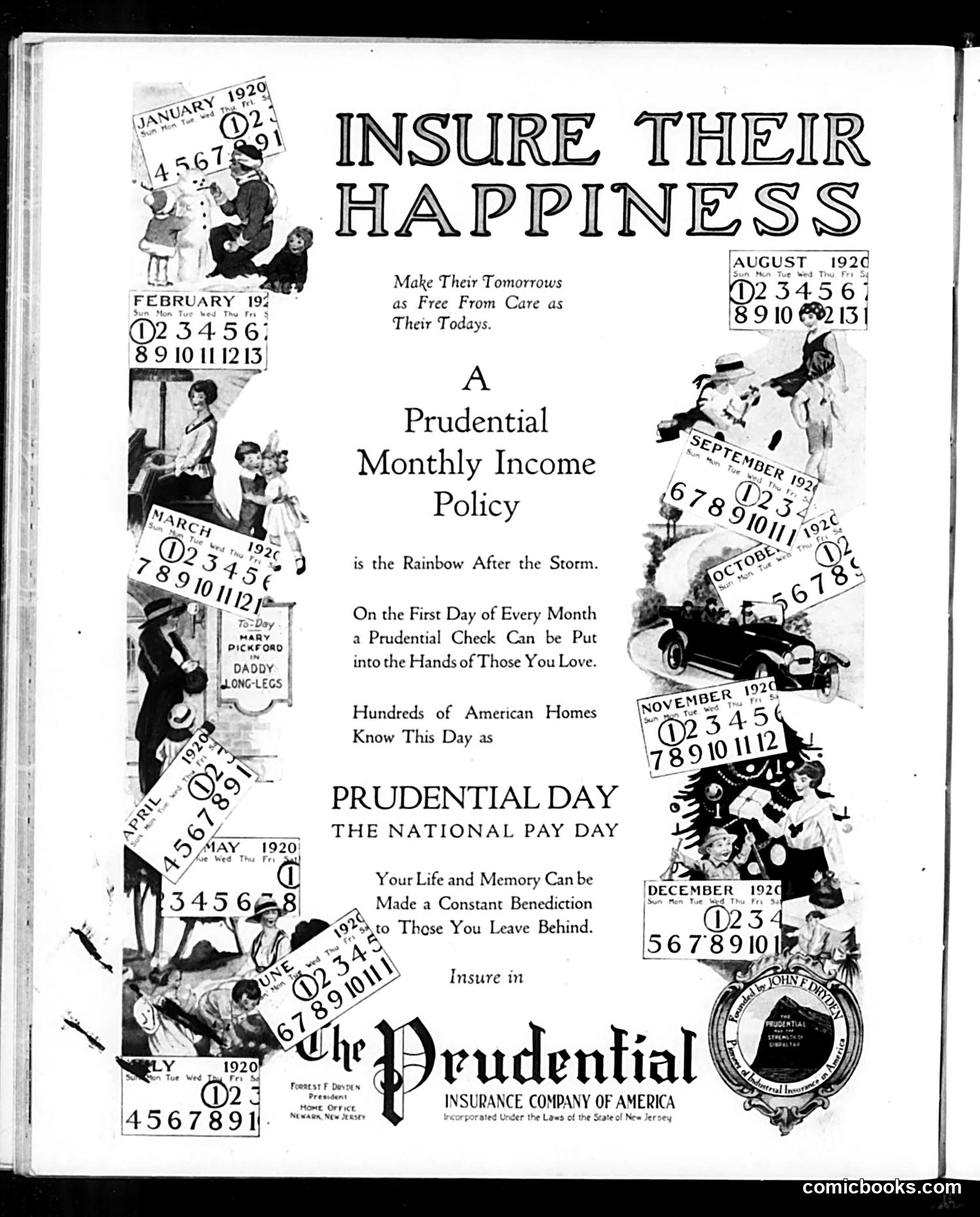
This is primarily a **Prudential Insurance advertisement**, not political satire. The page uses calendar imagery from 1920 with illustrated scenes of family life to promote the company's "Monthly Income Policy." The central message frames life insurance as a financial security tool: monthly payouts ensure dependents are cared for after the policyholder's death. The tagline "Prudential Day—The National Pay Day" positions insurance as equivalent to regular wages—a financial responsibility comparable to earning a paycheck. The illustrated vignettes (showing families, leisure activities, and domestic scenes) suggest that insurance enables happiness and security for loved ones left behind. The repeated calendar layouts reinforce the idea of reliable, recurring monthly protection. This reflects early-20th-century marketing that legitimized life insurance not as morbid but as practical family planning—a significant cultural shift in how Americans viewed financial planning and mortality.