
Judge, 1920-03-06 · page 25 of 36
Judge — March 6, 1920 — page 25: what you’re looking at
What you’re looking at
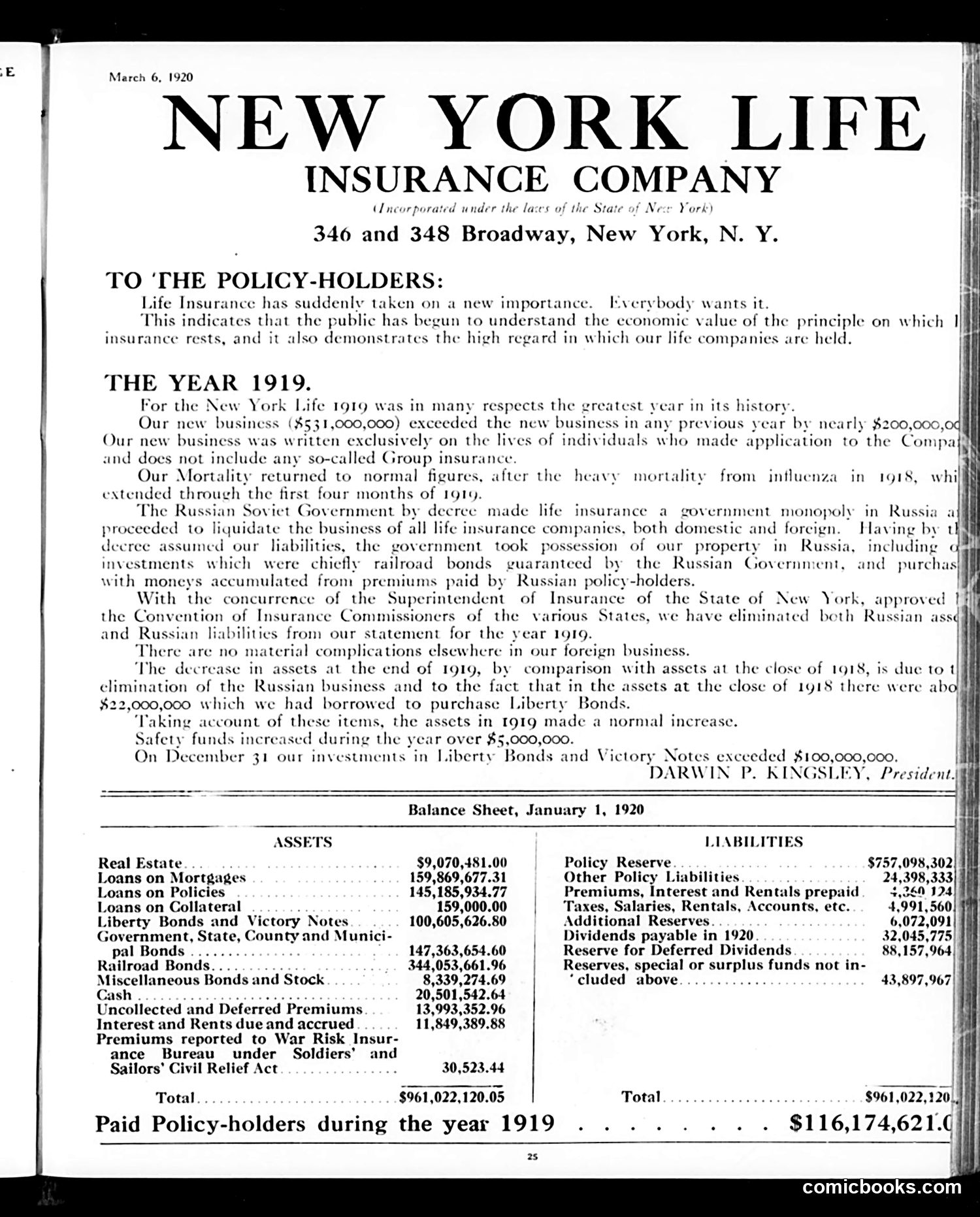
This is **not a cartoon or satirical content**—it's a corporate financial statement from New York Life Insurance Company, published March 6, 1920. The page addresses policyholders about the company's exceptional 1919 performance: new business of $531 million (up nearly $200 million from prior years) and $116 million paid to policyholders. The significant historical reference is the **Russian Soviet seizure** of the company's Russian assets and business. The Bolshevik government declared life insurance a state monopoly, confiscated company property (including railroad bonds), and assumed liabilities. New York Life eliminated all Russian assets and liabilities from its 1919 statement—a major geopolitical event reflecting post-WWI communist nationalization. The page also notes the 1918 influenza pandemic's impact on mortality rates and celebrates heavy investments in Liberty Bonds and Victory Notes (WWI war financing). This appears in *Judge* likely because insurance was considered newsworthy to the magazine's readership.
📄 Transcribed text from this page (OCR, searchable)
Machine-transcribed from the original scan — historical spelling and the odd misread are preserved.
March 6, 1920 NEW YORK LIFE INSURANCE COMPANY (neorporated under the laces of the State of Nee York) 346 and 348 Broadway, New York, N. Y. TO ‘THE POLICY- HOLDERS: ance has suddenly taken on a new importance. Everybody wants it. es that the public has begun to understand the economic value of the principle on which I insurance rests, and it also demonstrates the high regard in which our life companies are held. THE YEAR 1919. For the New York Life 1919 was in many respects the greatest year in its history. Our new business (4531 ,000,000) exceeded the new business in any previous year by nearly $200,000,0q Our new business was written exclusively on the lives of individuals who made application to the Compay, and does not include any so-called Group insurance. Our Mortality returned to normal figures, after the heavy mortality from influenza in 1918, whi extended through the first four months of 1919. The Russian Soviet Government by decree made life insurance a government monopoly in Russia a proceeded to liquidate the business of all life insurance companies, both domestic and foreign. Having by t deeree assumed our liabilitics, the government took possession of our property in Russia, including « investments which were chiefly railroad bonds guaranteed by the Russian Government, and purchas) with moneys accumulated from premiums paid by Russian policy-holders. With the concurrence of the Superintendent of Insurance of the State of New York, approved | the Convention of Insurance Commissioners of the various States, we have eliminated both Russian as and Russian liabilities from our statement for the year 1919. There are no material complications elsewhere in our foreign business. The decrease in assets at the end of 1919, by comparison with assets at the close of tg18, is due to tii elimination of the Russian business and to the fact that in the assets at the close of 1918 there were abo I $22,000,000 which we had borrowed to purchase Liberty Bonds. Taking account of these items, the assets in 1919 made a normal increase. Safety funds increased during the year over $5,000,000. On December 31 our investments in Liberty Bonds and Victory Notes exceeded $100,000,000. DARWIN P. KINGSLEY, Preside Balance Sheet, January 1, 1920 LIABILITIES Real Estate ‘ $9,070,481.00 Policy Reserve $757,098,302 Loans on Mortgages 159,869,677.31 Other Policy Liabilities 24,398,333, I s on Policies 145,185,934.77 Premiums, Interest and Rentals prepaid 4,360 124 Loans on Collateral 159,000.00 Taxes, Salaries, Rentals, Accounts, etc. 4,991,560. Liberty Bonds and Victory Notes 100,605,626.80 Additional Reserves. 6,072,091 Government, State, County and Munici- Dividends payable in 1920. 32,045,775) pal Bonds ......... x 147,363,654.60 Reserve for Deferred Dividends 88,157,964) Railroad Bonds. . 344,053,661.96 Reserves, special or surplus funds not in- Miscellaneous Bonds and. Stock 8,339,274.69 ‘cluded above...... 43,897,967) Cc 20,501 ,542.64 | sh . | Uncollected and Deferred Premiums 13,993,352.96 Interest and Rents due and accrued 11,849,389.88 a Premiums reported to War Risk Insur- ance Bureau under Soldiers’ and Sailors’ Civil Relief Act er 30,523.44 Total... $961,022,120.05 . $61,022,120 Paid Policy-holders during the year 1919 ; $116,174,621. | 2s comicbooks.com