
Judge, 1920-03-06 · page 5 of 36
Judge — March 6, 1920 — page 5: what you’re looking at
What you’re looking at
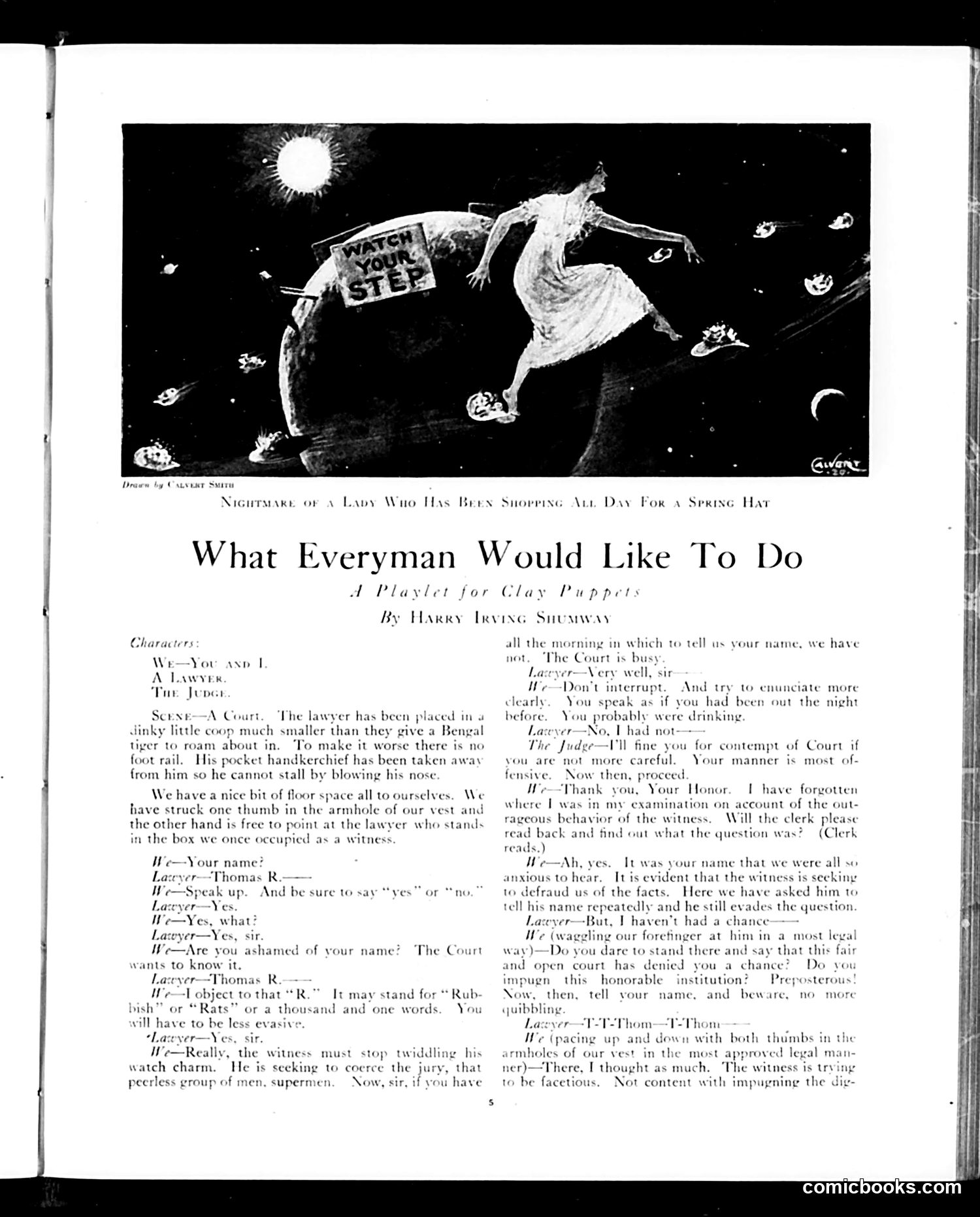
The illustration depicts a surreal nightmare scene of a woman in a nightgown fleeing across a nighttime landscape, pursued by an enormous boot labeled "WATCH YOUR STEP." The cartoon satirizes women's fashion anxiety—specifically the social pressure women faced regarding spring hat selection. The accompanying text is a comedic playlet titled "What Everyman Would Like To Do," which appears to be an unrelated satirical sketch about courtroom proceedings, featuring a witness being interrogated by a lawyer about his name and testimony. The cartoon's humor relies on exaggerating female shopping anxiety into a Gothic nightmare, reflecting early 20th-century attitudes treating women's fashion concerns as frivolous and amusing. The "watch your step" warning adds a cautionary dimension, though its exact meaning remains somewhat unclear from context alone.
📄 Transcribed text from this page (OCR, searchable)
Machine-transcribed from the original scan — historical spelling and the odd misread are preserved.
Nicuraarke or x Lavy Wao Tas Bees Siovrixc Ati Day For a Spring Hat What Everyman Would Like To Do A Playlet for By Harry Irving Siumwas Characters We—Yov axp | A Lawyer Tne Jeper Scexe—A Court. ‘The lawyer has been placed in a dinky little coop much smaller than they give a Bengal tiger to roam about in. make it worse there is no foot rail. His pocket handkerchief has been taken awas from him so he cannot stall by blowing his nose We have a nice bit of floor space all to ourselves. We have struck one thumb in the armhole of our vest and the other hand is free to point at the lawyer who stands in the box we once occupied as a witness We—Your name? Lazeyer—Thomas R.— We—Speak up. And be sure to say “yes” or “no. Lazeyer—Y es We—Yes, what? La’ —Yes, sir. We—Are you ashamed of your name? The Court wants to know it. Laceyer—Thomas R.-— We—I object to that *R.” Tt may stand for * Rub: bish” or “Rats” or a thousand and one words. You vill have to be less evasive *Laceyver—Y es, sir We—Really, the witness must stop twiddling his watch charm. He is seeking to coerce the jury, that peerless group of men, supermen. Now, sir, if you have all the mor in which to tell us your name, we have vot. “The Court is busy Laceyer—Very well, sir We—Don't interru And try to enunciate more clearly. You speak as if you had been out the night before. You probably were drinking Lazeyer—No, | had not- The Judge—VIl fine you for contempt of Court if you are not more careful. Your manner is most of- fensive. Now then, proceed We—TVhank you, Your Honor. [have forgotten nination on account of the out- 1 where | was in my ex ous behavior of the witness. Will the clerk d back and find out what the question was? (C reads.) We—Ah, yes. It was your nat anxious to hear. [tis evident that the witness is seckiny to defraud us of the facts. Here we have asked him to tell his name repeatedly and he still evades the question Laceyer—But, | haven't had a chance We (w ling our forefinger at him in a most | way)—Do you dare to stand there and say that this and open court has denied you a chance? Do you gen this honorable institution? — Preposterous that we were all so fair Now, then, tell vour name, and beware, no more quibblin Laceyer ‘Thom ‘Thom We (pacing up and down with both thumbs in ti rmholes of our vest the most approved legal man- ner)- nere, | though much. The witness is t to be facetious. Not content with impugning the « comicbooks.com