
A complete issue · 36 pages · 1920
Judge — January 24, 1920
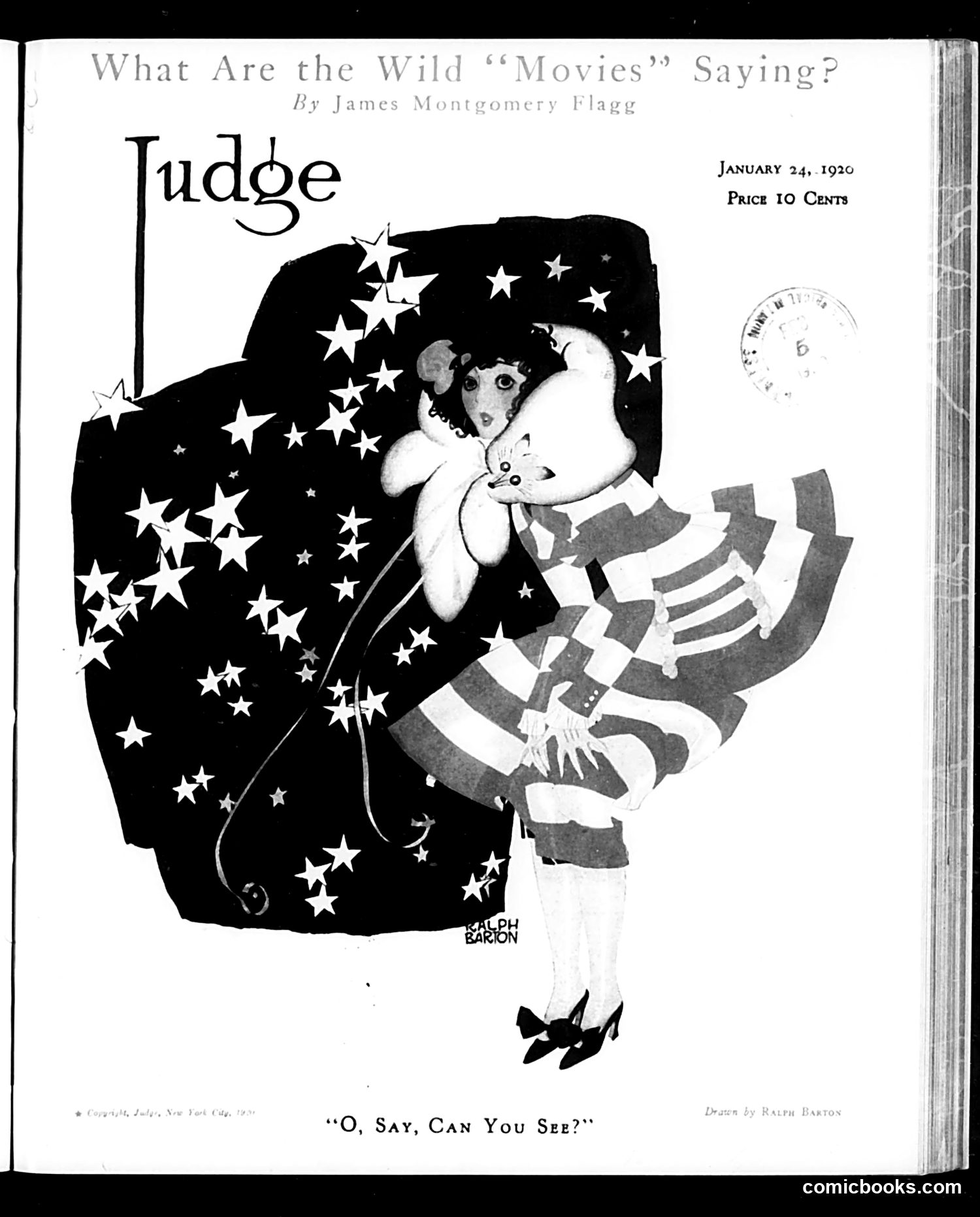
This cover illustrates the article "What Are the Wild 'Movies' Saying?" by James Montgomery Flagg. The illustration by Ralph Barton depicts a woman in a patriotic stars-and-stripes dress holding what appears to be a small dog or cherub figure against a starry night background. The caption reads "O, Say, Can You See?"—a reference to "The Star-Spangled Banner." The satire appears to critique American cinema of the early 1920s, specifically how films were communicating messages to the public during the post-WWI period. The patriotic imagery suggests the cartoon questions whether movies were promoting appropriate American values or controversial ideas. The date coincides with significant social upheaval and debates about cinema's cultural influence during this era.
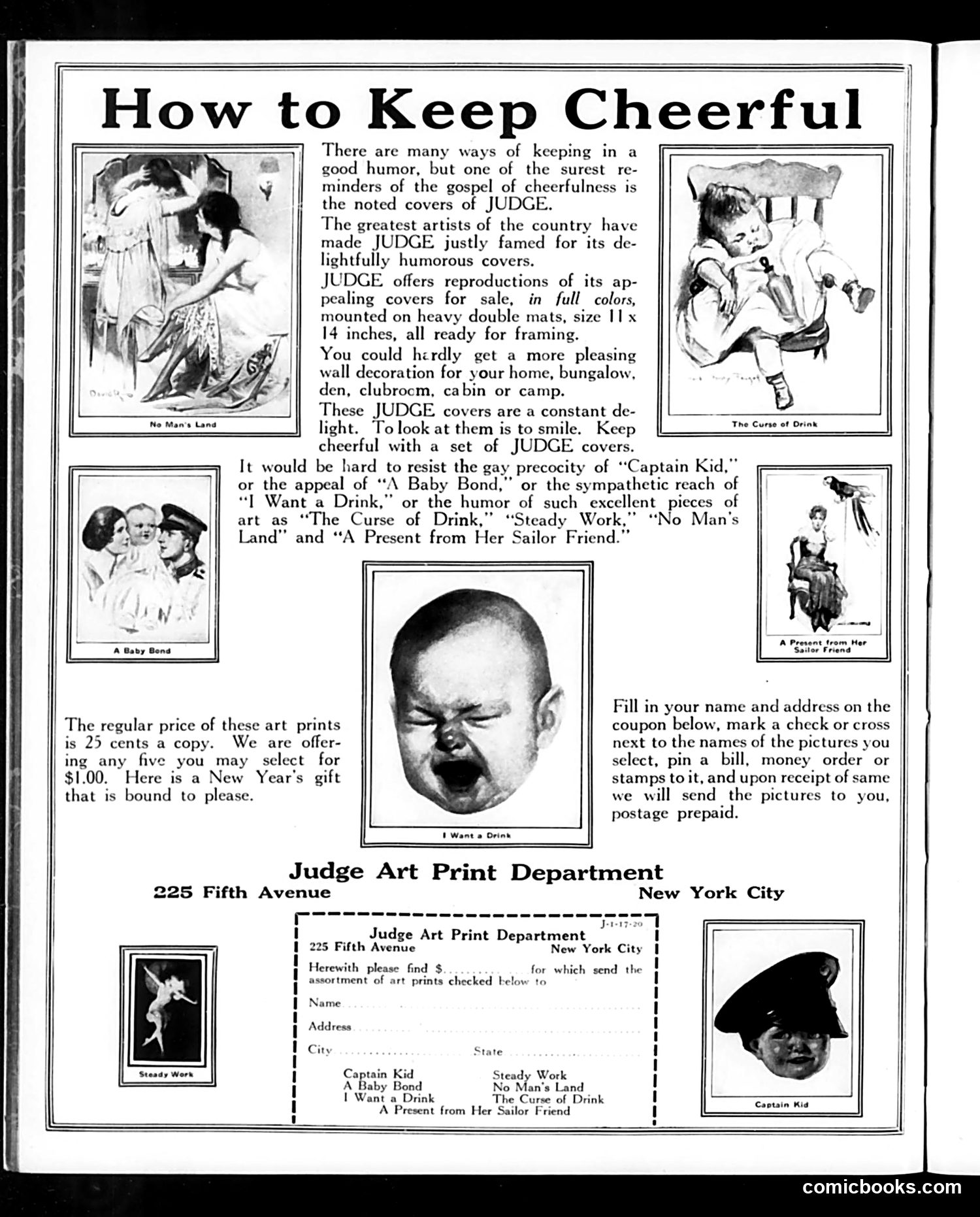
This page is primarily **advertising** for Judge magazine's art print department rather than satirical content. The heading "How to Keep Cheerful" promotes humorous art prints available for purchase from Judge's archives. The six illustrated cartoons shown—"No Man's Land," "The Curse of Drink," "Captain Kid," "A Baby Bond," "A Present from Her Sailor Friend," and "Steady Work"—appear to be representative examples of Judge's satirical covers, likely from the early 20th century. The titles suggest social commentary on topics like war, alcohol, relationships, and labor, though specific historical references are unclear without additional context. The advertisement encourages readers to order these prints (25 cents each or $1 for five) for home decoration, positioning humor as a form of household cheer.
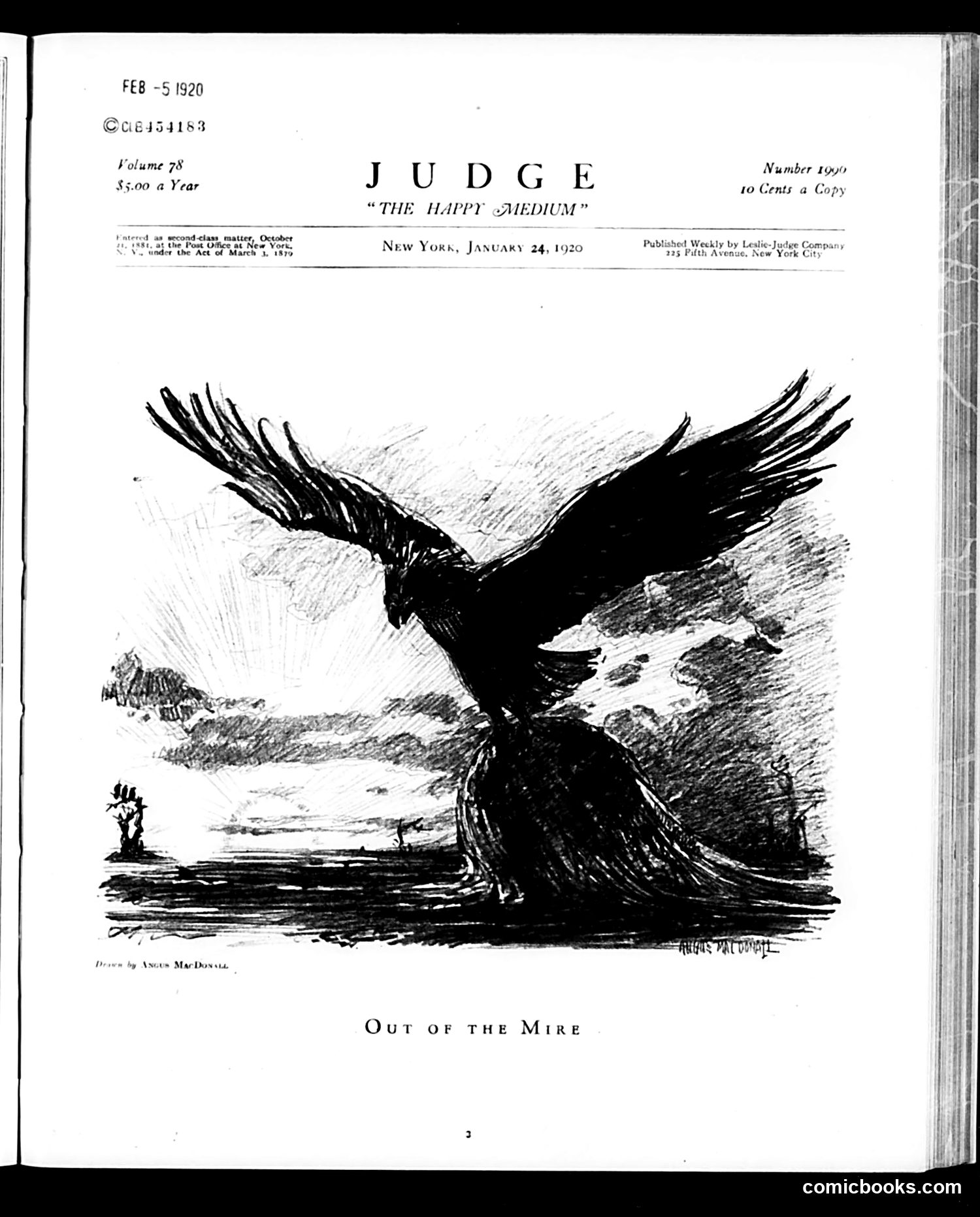
This political cartoon depicts a large bird (likely an eagle, symbolizing America) struggling to lift itself from muddy, mired ground. The drawing is titled "Out of the Mire," suggesting America's difficulty escaping a troubled situation. Given the January 1920 date, this almost certainly references post-World War I America—the nation's struggle to recover from the war's aftermath, economic upheaval, and social turmoil including labor unrest and the first Red Scare. The "mire" represents these interconnected crises threatening national stability. The straining bird suggests optimism about eventual escape from these problems, though the effort required is depicted as considerable and difficult.
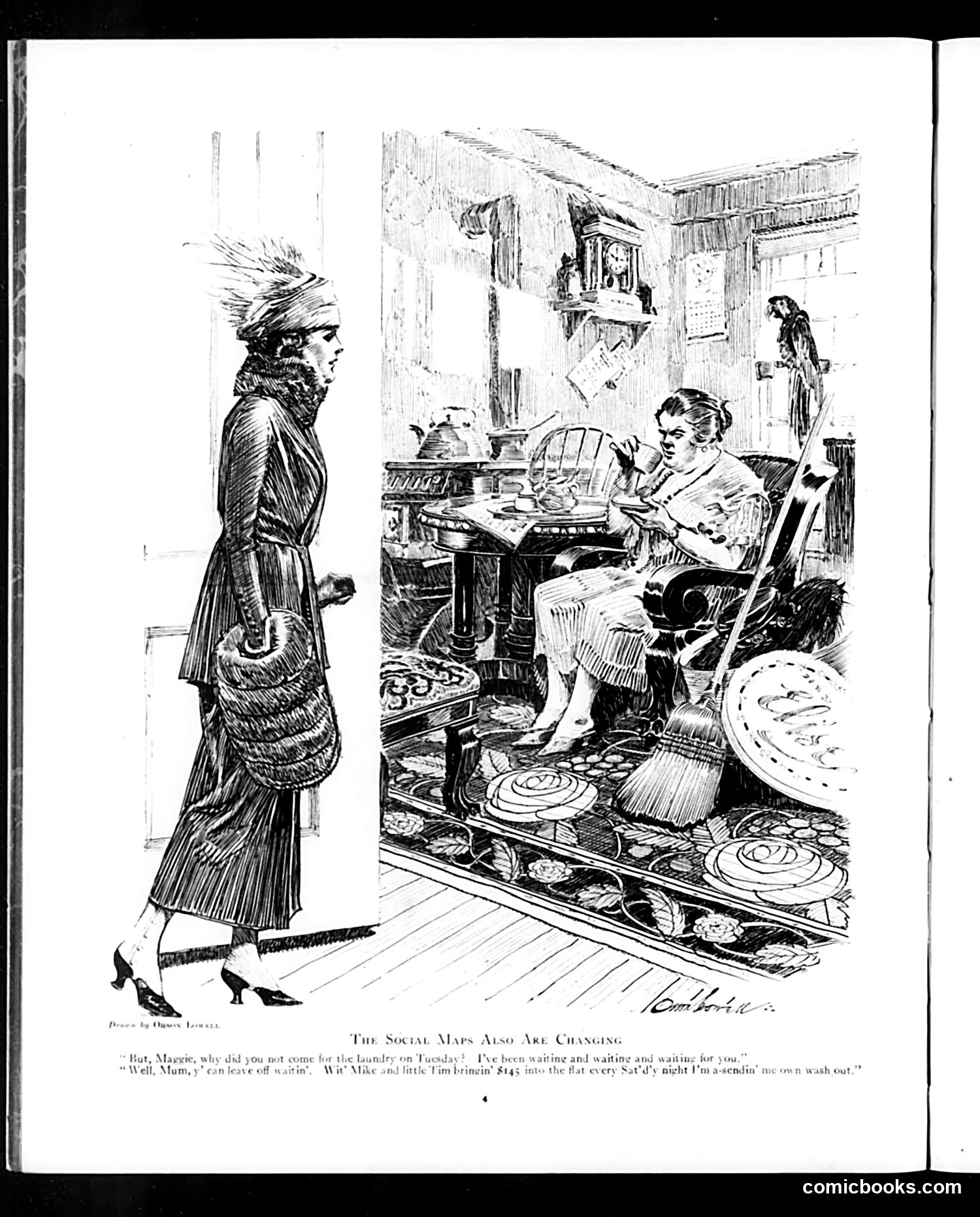
This cartoon satirizes changing social class dynamics and women's labor. A well-dressed woman stands outside a domestic interior, confronting a maid about missing laundry pickup on Tuesday. The maid responds that she's been "waiting and waiting" for pay, then states she can "leave off waitin'" because "We Make and little Tim bringin' $14 into the flat every Sat'dy night I'm a-sendin' me own wash out." The satire critiques shifting economic power: a working-class maid now earns enough household income (from family members' wages) to outsource her own laundry—reversing traditional servant-employer relationships. The title suggests social hierarchies are reorganizing through industrialization and women's economic participation, threatening genteel domestic arrangements.
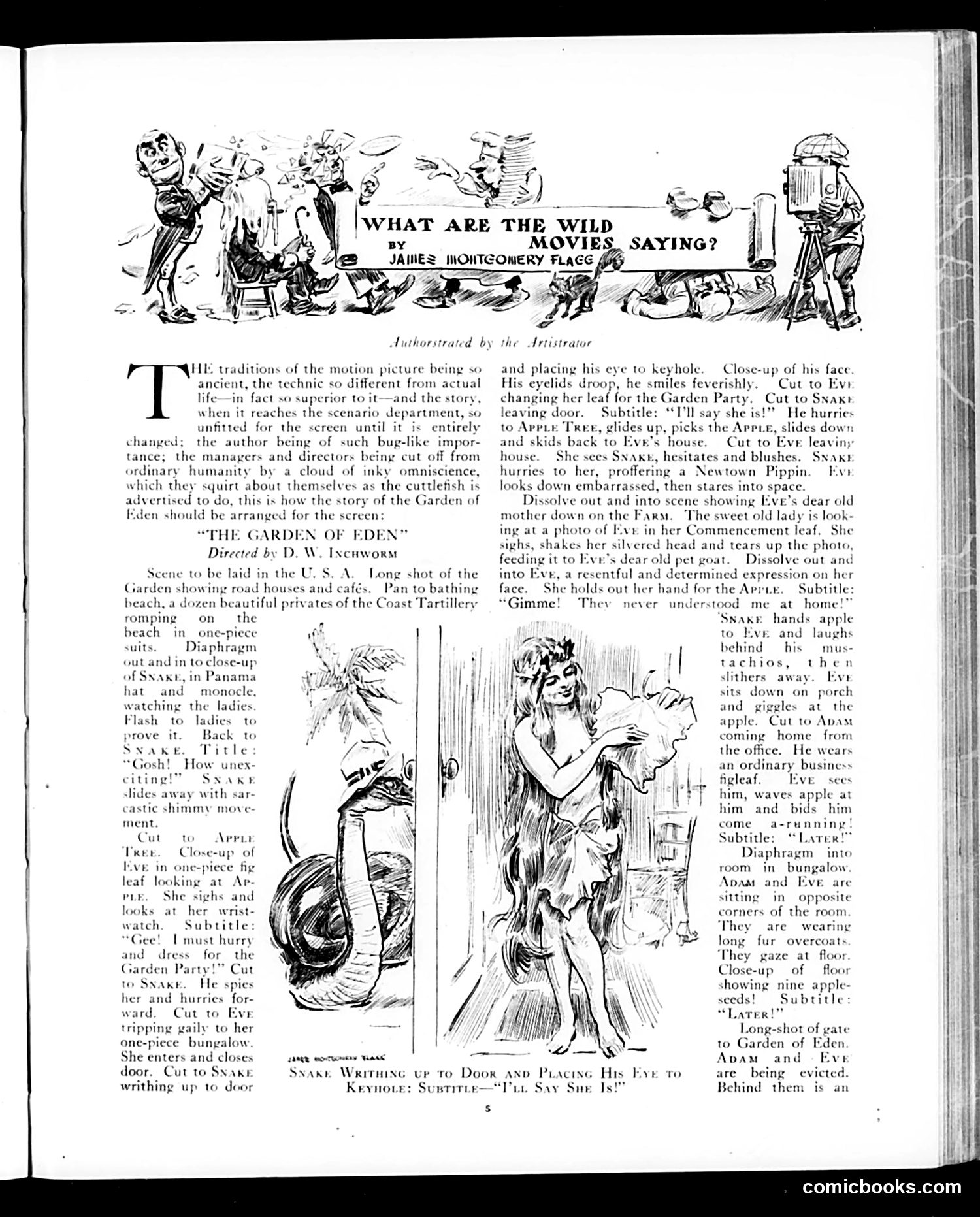
This page satirizes silent film conventions of the 1920s era. James Montgomery Flagg critiques how filmmakers adapt literary classics like "The Garden of Eden" for screen, claiming the cinema distorts the original story through exaggerated visual gags and intertitles. The sketches show how a simple narrative becomes melodramatic on film—a character picking an apple becomes slapstick comedy, meaningful glances turn into overwrought pantomime. The satirical point: silent movies, dependent on physical comedy and obvious subtitles, cannot capture subtle literary nuance. The cartoon mocks cinema's tendency toward sensationalism and broad humor when adapting serious source material, a common artistic complaint about early filmmaking.
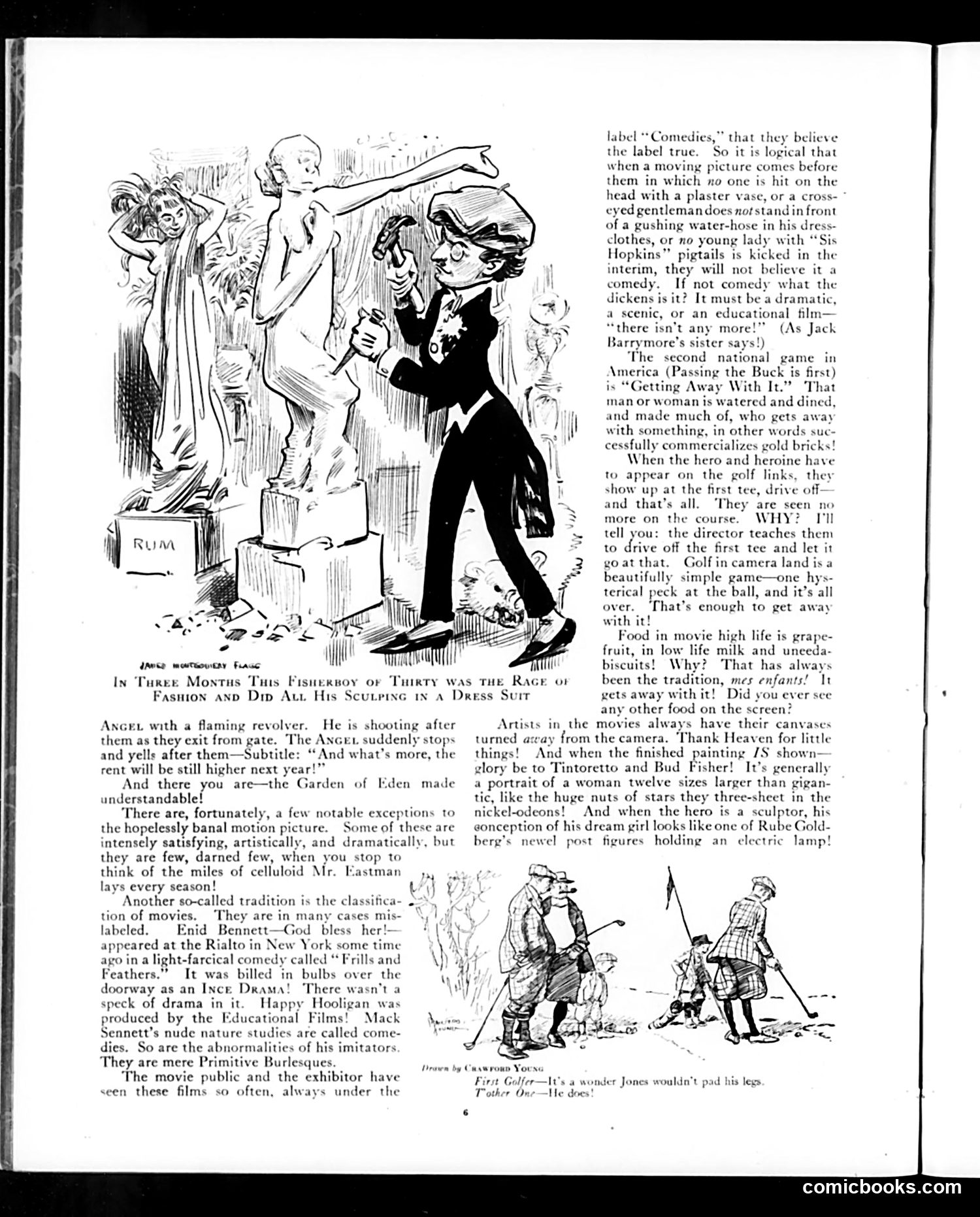
This page critiques silent film conventions and their absurdities. The main cartoon depicts a nearly-nude male statue labeled "RUM" being dressed by a woman in formal attire—satirizing how filmmakers add clothes to classical sculptures to avoid censorship while depicting nudity elsewhere. The article mocks Hollywood's hypocritical standards: films show violence, drunkenness, and scantily-clad women, yet censor classical art. It ridicules specific movie tropes—heroes and heroines appearing only at golf's first tee, exaggerated proportions in paintings, unrealistic food scenes (grapefruit, milk, biscuits). The bottom illustration shows golfers, illustrating the text's point about golf-course scenes being oddly common in films. The satire targets Hollywood's arbitrary moral standards and lazy, repetitive filmmaking formulas.
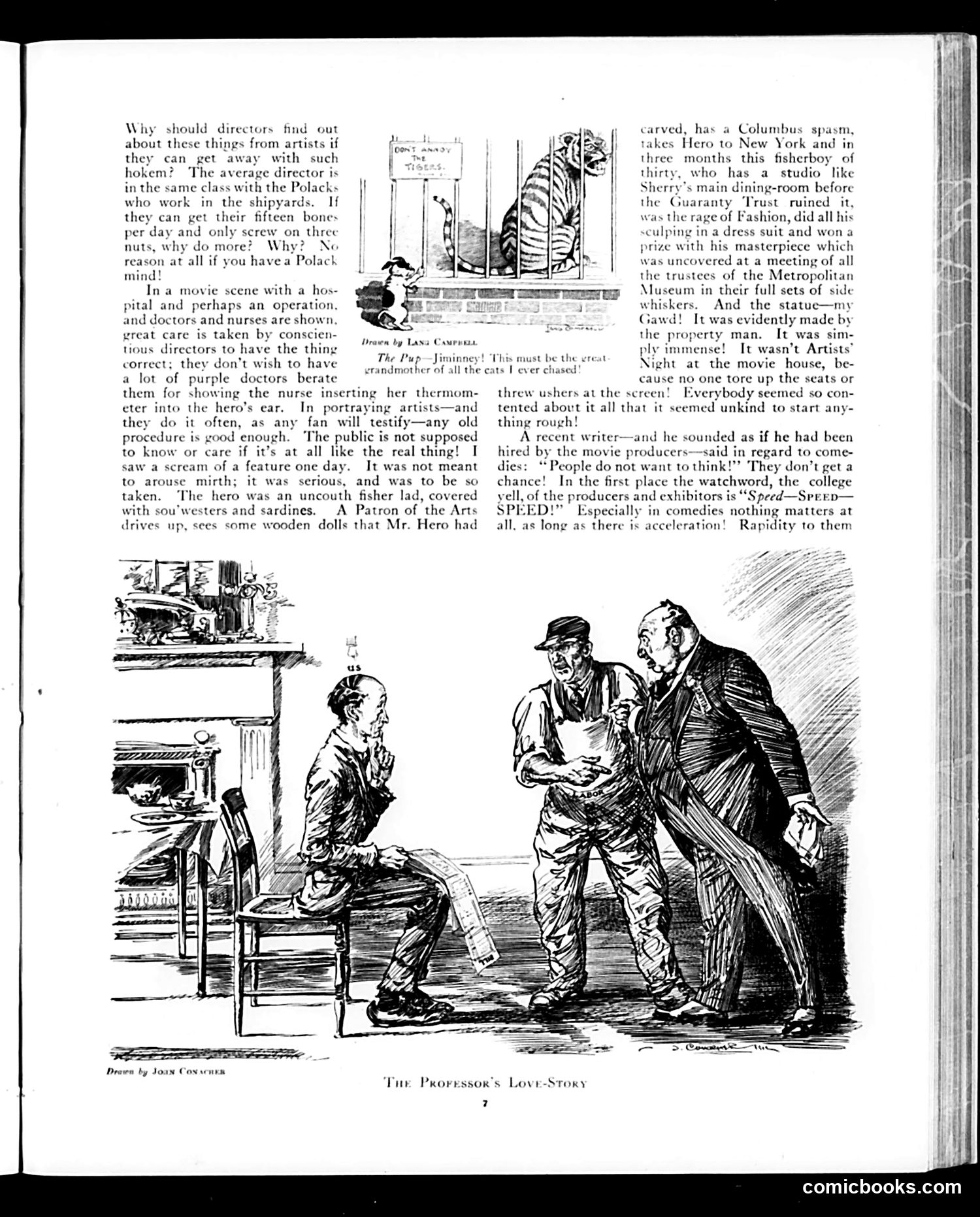
This page critiques Hollywood directors' lazy portrayal of artists in films. The text argues that while directors meticulously research medical scenes to avoid criticism from doctors, they carelessly depict artists because audiences supposedly don't notice or care about accuracy. The example given: a poor fisherman's crude wooden dolls are discovered by a wealthy "Patron of the Arts," who brings him to New York. Within three months, this uncouth thirty-year-old becomes fashionable, sculpts in a tuxedo, and wins Metropolitan Museum recognition—despite his statue being obviously amateurish ("made by the property man"). The satire targets: (1) movie producers' contempt for audience intelligence; (2) the absurdity of overnight artistic success based on patronage rather than talent; (3) filmmakers' indifference to authenticity when depicting artists versus other professions. The "Polack" ethnic slur reflects the era's casual prejudice. The cartoon "The Professor's Love-Story" (bottom) appears unrelated to the main article's theme.
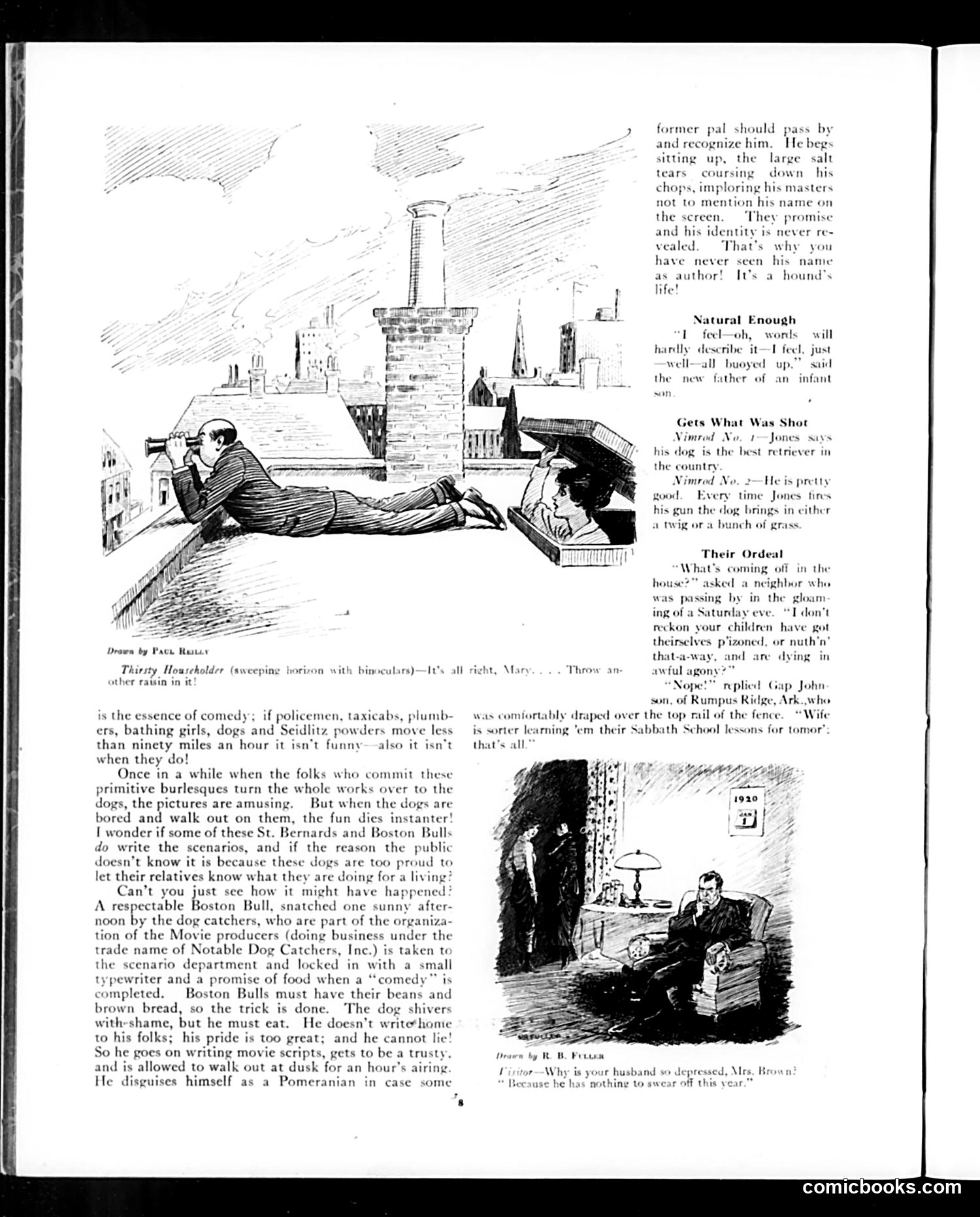
This page contains satirical commentary on early cinema, particularly dog-themed comedies that were popular in silent film. The main article (credited to Pace Bailey) mocks low-quality movie comedies featuring dogs. It sarcastically suggests that respectable Boston Bulls and St. Bernards are actually writing these film scenarios—but out of shame, they hide their involvement and disguise themselves as Pomeranians to avoid recognition. The joke critiques both the poor quality of these animal-based comedies and the absurdity that dogs themselves wouldn't want credit for them. The surrounding captioned cartoons offer lighter humor: "Thirsty Householder" jokes about perspective, while the hunting anecdotes mock incompetent sportsmen whose dogs retrieve useless objects instead of game. "Their Ordeal" depicts rural parents forcing children to study Sunday School lessons. The overall point: satire of lowbrow entertainment and the proliferation of poorly-made dog comedies in early cinema, presented with Judge magazine's characteristic irreverent humor.
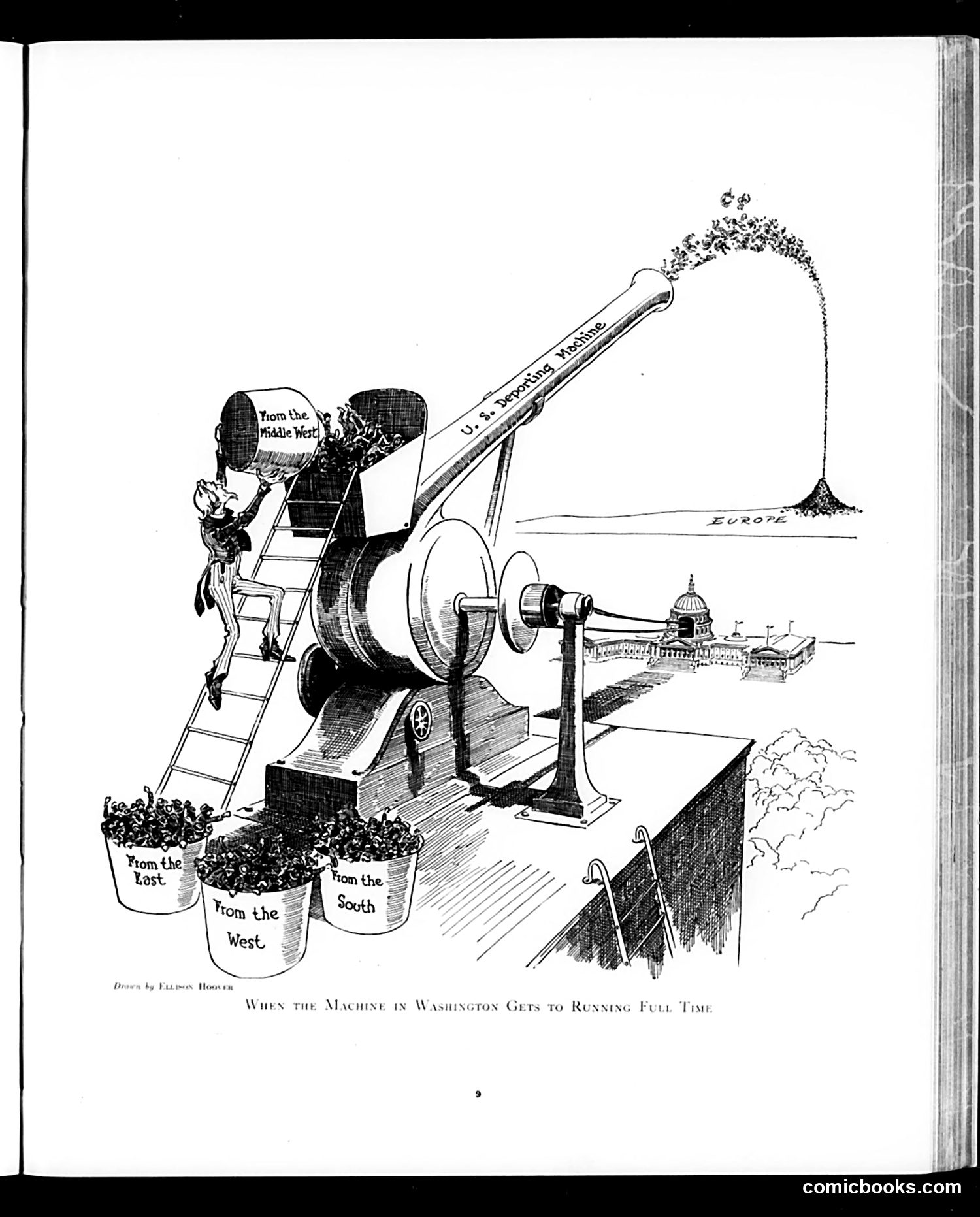
This cartoon depicts a giant machine in Washington dispensing materials from different U.S. regions ("From the Middle West," "From the Lost," "From the South," "From the West") into buckets labeled as such. The machine shoots these combined resources toward Europe. The satire criticizes American foreign aid or military support to Europe, suggesting Washington is mechanically funneling America's regional resources to benefit European interests. The figure climbing the machine appears to represent a politician or government official operating this system. The cartoon likely critiques U.S. interventionism or aid policy—suggesting resources extracted from American regions are being redistributed abroad rather than kept domestic. The "machine" metaphor implies this is an impersonal, automatic government process operating without consideration for American needs.
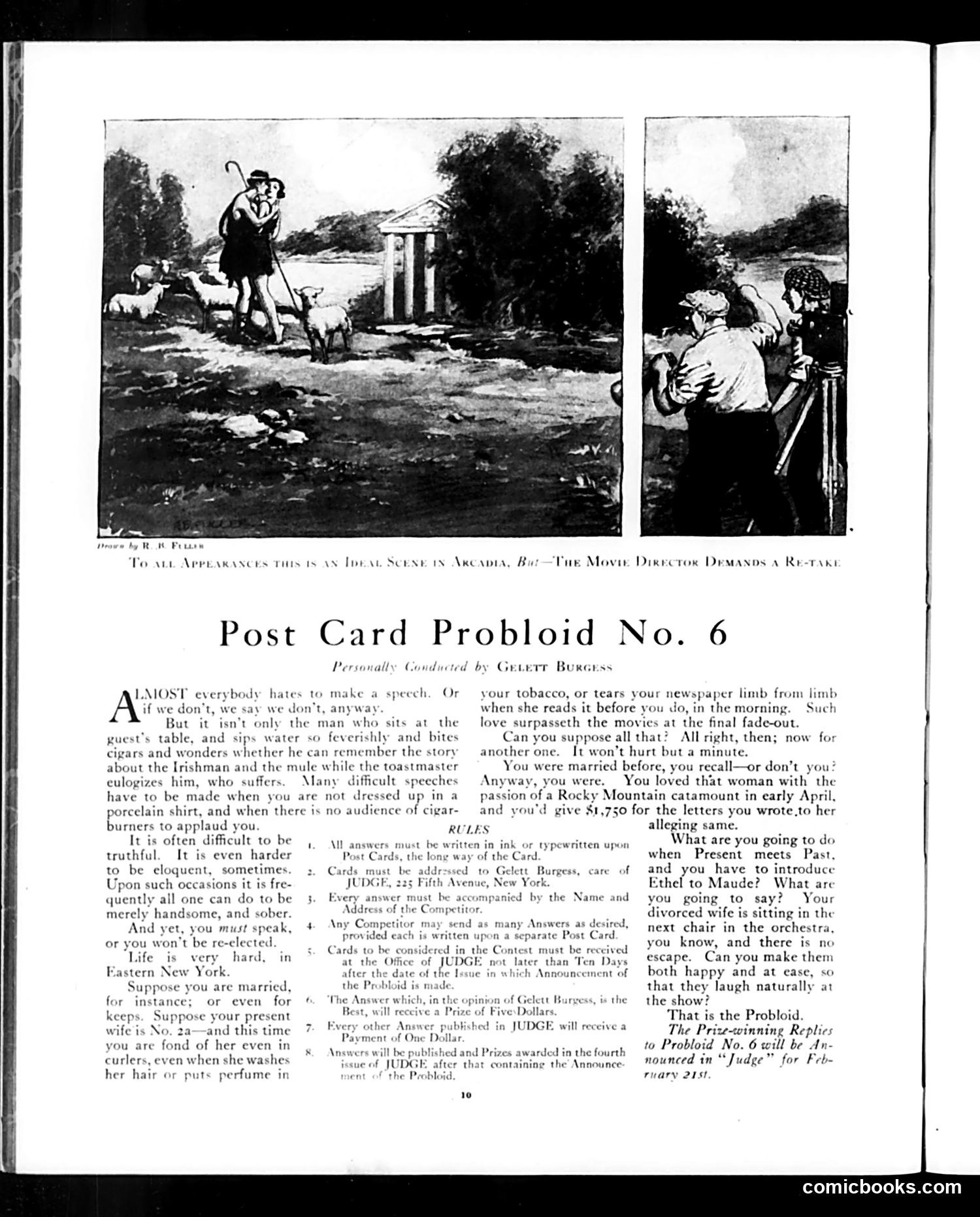
This page presents a satirical "Probloid"—a social dilemma contest—by humorist Gelett Burgess. The scenario involves a divorced man attending a theater where his current wife (No. 2) sits nearby, and his ex-wife unexpectedly appears. The joke targets the awkwardness of modern social situations where etiquette fails. The two small photographs show a movie director demanding retakes of an "ideal scene" in Arcadia—likely satirizing how cinema manufactures artificial perfection, contrasting with real life's messy complications. The satire mocks upper-class anxiety about propriety and public appearances. The solution (readers could submit answers for prizes) exposes how people navigate embarrassing social encounters through manufactured politeness. This reflects early-20th-century concerns about divorce's social stigma and the tension between authentic feeling and performative civility in public settings.
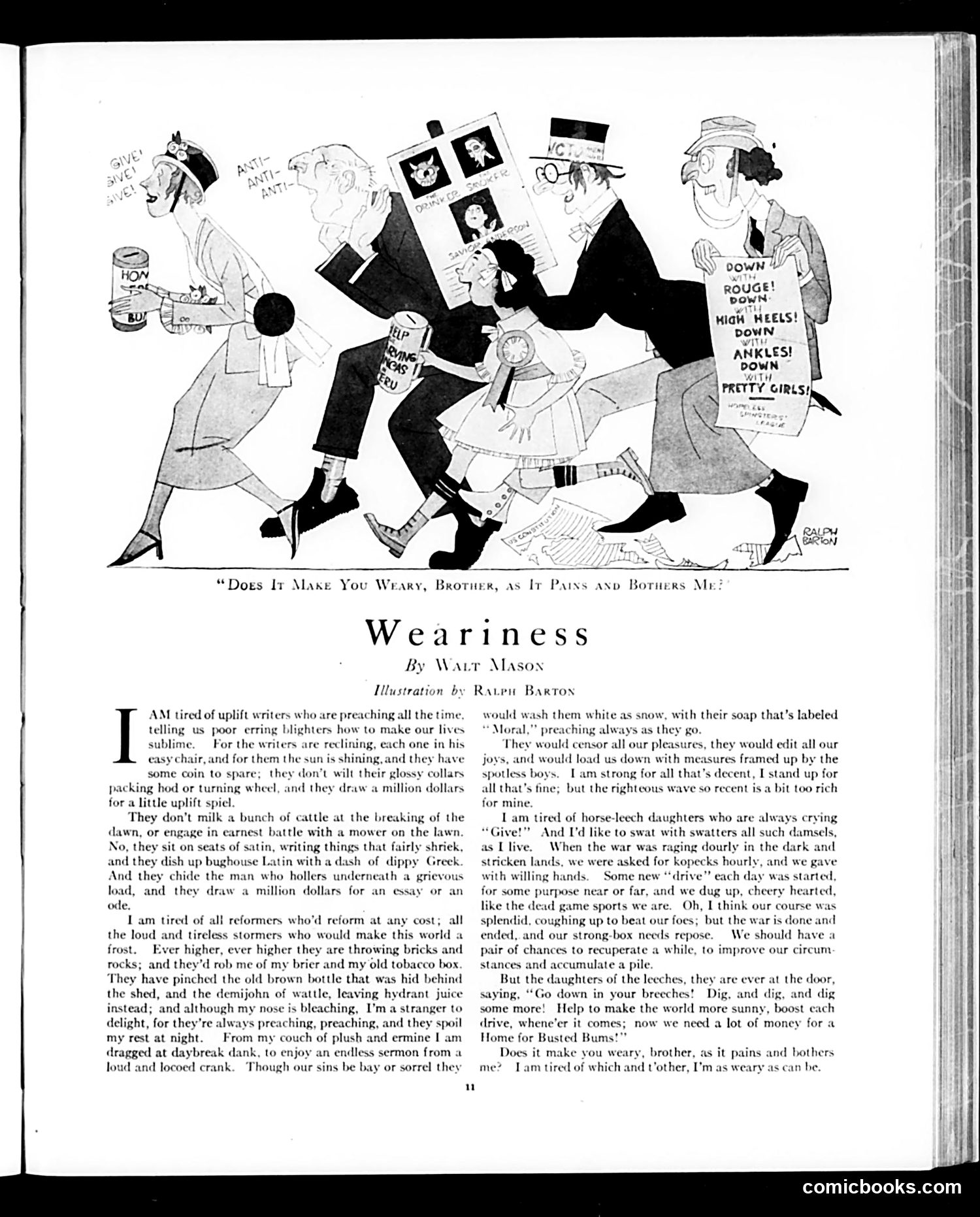
This satirical piece attacks reform movements and uplift campaigns of the early 20th century. Mason's narrator—representing the common working man—complains about: 1. **Uplift writers and reformers** who preach morality from comfortable positions while doing no actual labor, yet earn substantial fees for their sermons. 2. **Prohibition advocates** (the "brown bottle" and "hydrant juice" references) who strip away pleasures like tobacco and alcohol in the name of moral improvement. 3. **Charity solicitors** ("horse-leech daughters") who endlessly demand donations for various causes and "drives," especially after people already sacrificed during wartime. The cartoon illustrates these targets: preachy figures bombarding citizens with moral demands and charity appeals. Mason argues that the righteous have exhausted the public's goodwill through constant hectoring and financial extraction. The central complaint: tired people deserve rest, not endless exhortations to give more money or live more morally.
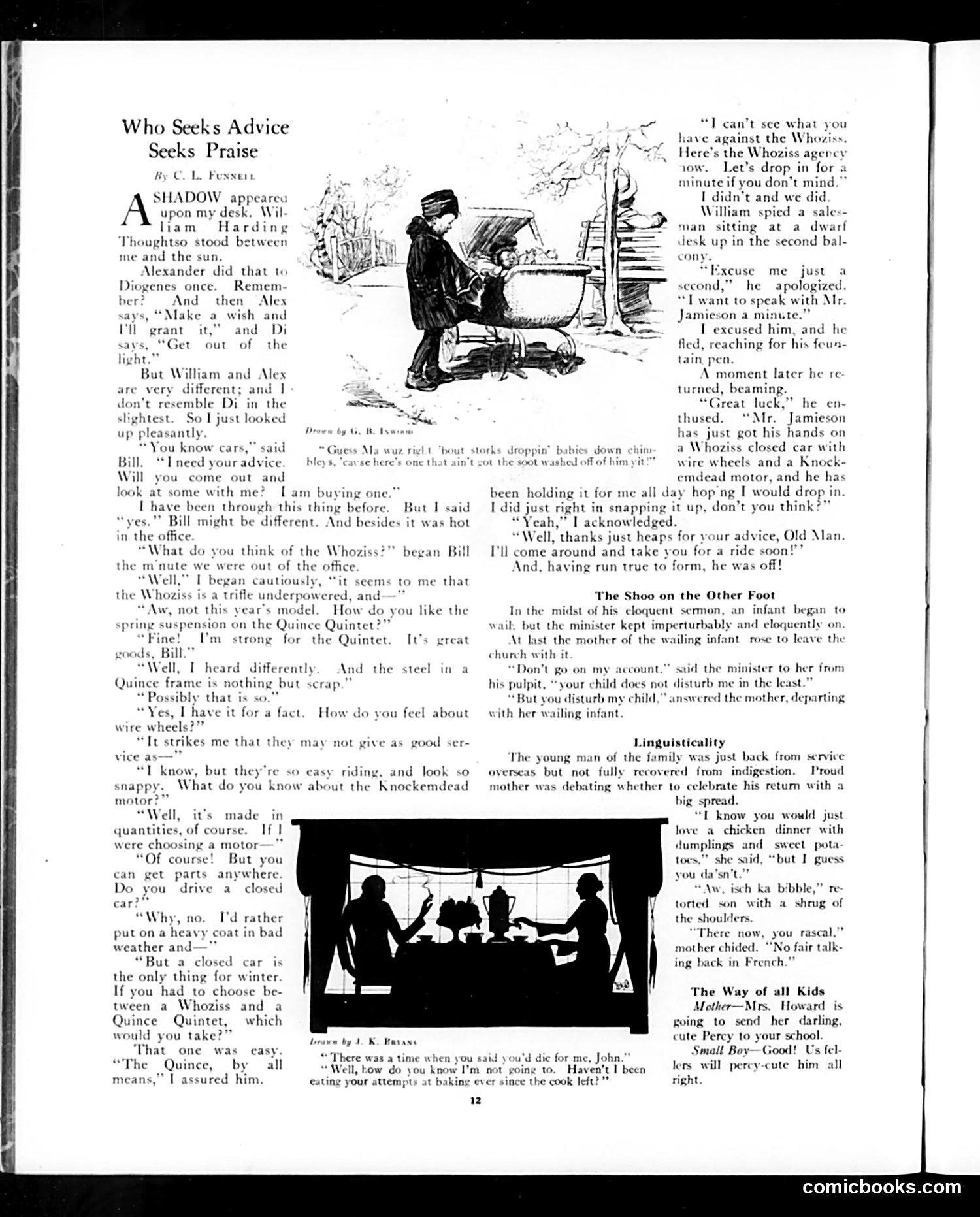
This page from Judge magazine contains three separate humorous stories satirizing American social behavior circa the 1920s-30s. **"Who Seeks Advice Seeks Praise"** (main story): A man visits the office seeking car advice from the narrator. The satire exposes how people don't actually want honest opinions—they want validation. William systematically dismisses each counterargument, ultimately buying a Whoziss car and crediting the narrator's "advice," when the narrator never actually recommended it. The joke: advice-seekers use advisors as props to justify pre-made decisions. **"The Shoo on the Other Foot"**: A minister won't ask a mother to leave during her baby's crying, claiming it doesn't disturb him. She replies that *he* disturbs the child. The reversal mocks sanctimonious self-sacrifice. **"Linguisticality"**: A returning WWI soldier uses Yiddish slang ("isch ka bibble"—roughly "I don't care"), frustrating his mother's attempts at a fancy homecoming dinner. This satirizes generational/cultural divide and changing American identity post-war. All three stories mock pretense and self-deception in everyday life.
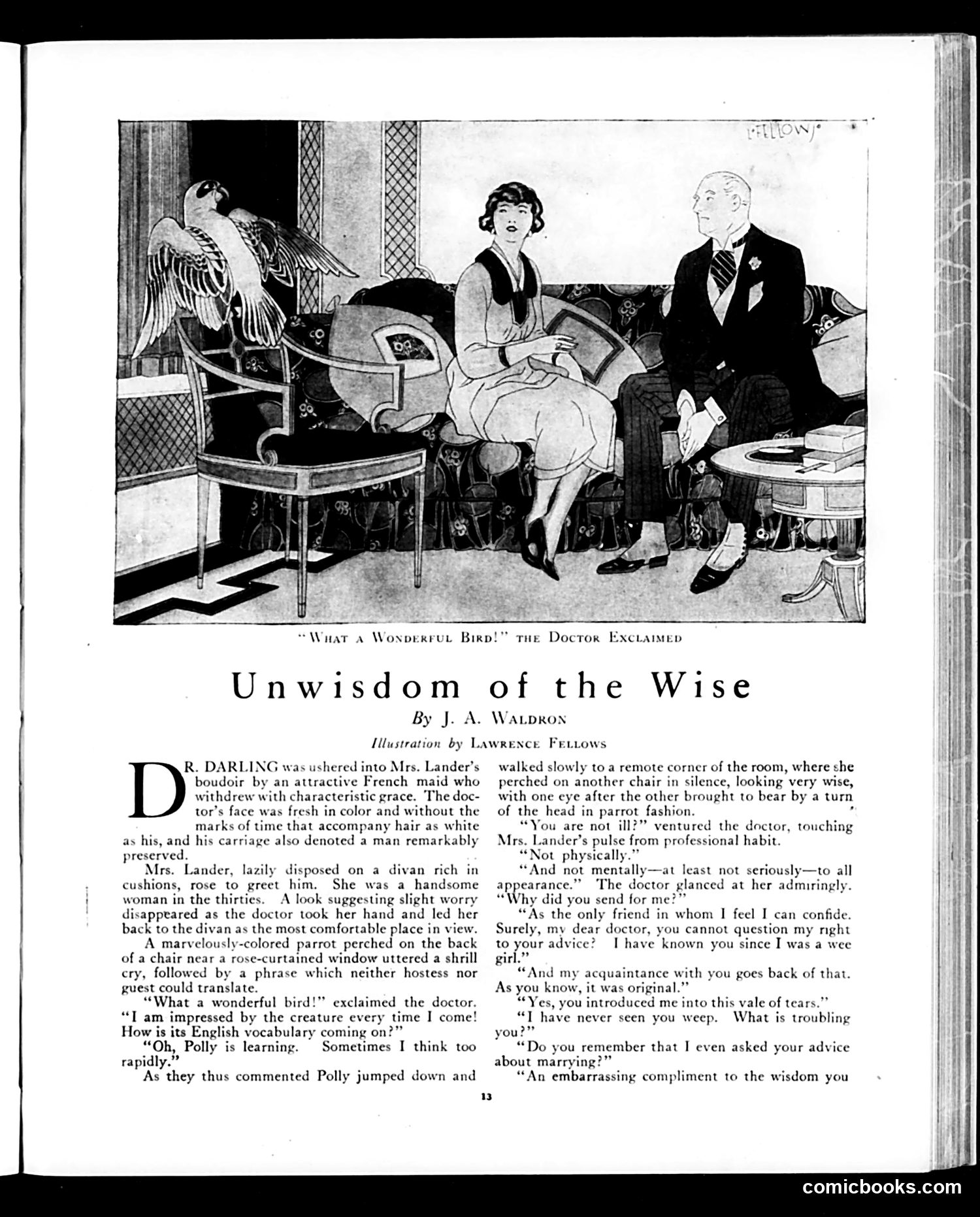
This is the opening of a serialized short story rather than political satire. The illustration shows a doctor visiting an elegant woman (Mrs. Lander) in her boudoir, with a notably intelligent parrot present. The "joke" in the title suggests irony: despite the doctor's wisdom and long acquaintance with Mrs. Lander since her birth, his actual advice—particularly regarding her marriage—proved embarrassing or misguided. The parrot, described as learning English "sometimes too rapidly," appears to symbolize observation and wisdom, perhaps outmatching the human characters. The story appears to explore romantic or marital complications through the lens of professional medical consultation. The satirical point likely critiques doctors overstepping into personal advice, or the gap between perceived wisdom and actual judgment in matters of the heart. Without subsequent pages, the full resolution remains unclear.
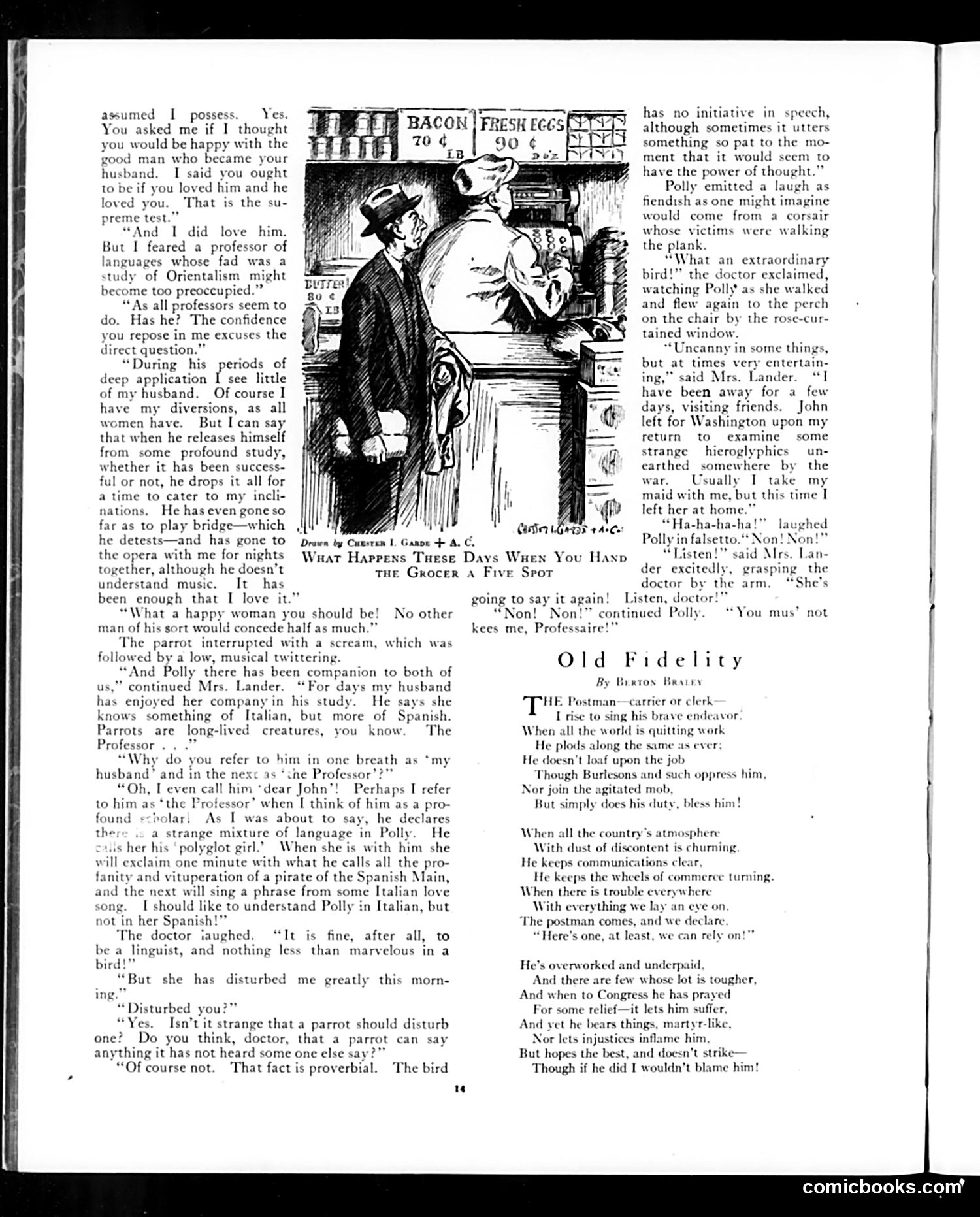
This page contains a short story with an embedded illustration titled "What Happens These Days When You Hand the Grocer a Five Spot." **The Cartoon:** The illustration shows a woman at a grocery store counter with a grocer. Price signs visible include "Bacon 70¢ LB" and "Fresh Eggs 90¢"—clearly inflated wartime or postwar prices. The woman appears shocked or dismayed, presumably at the cost of groceries. **The Satire:** The title's joke is visual-verbal: handing a grocer five dollars (significant money at the time) buys remarkably little due to price inflation. This satirizes the economic hardship ordinary Americans faced post-WWI, when grocery prices had skyrocketed. The humor targets the painful reality that a modest sum now purchases barely any food. **Context:** This reflects genuine public frustration with inflation during the 1920s, a period of economic instability. Judge magazine frequently mocked the gap between wages and rapidly rising costs of living, which affected household budgets significantly.
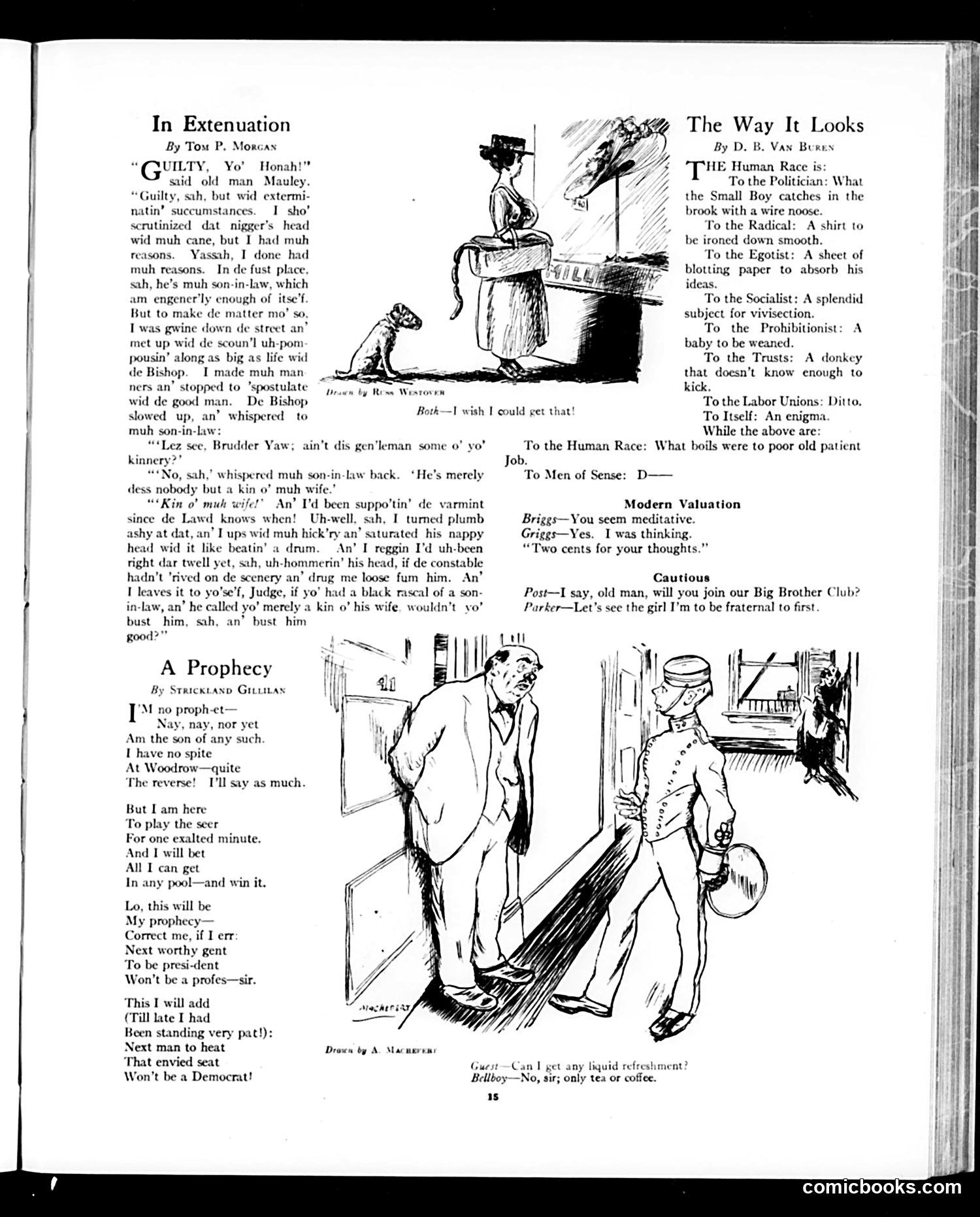
This page contains three satirical pieces reflecting early 20th-century American attitudes: **"In Extenuation"** presents a Southern dialect monologue where a man defends beating his son-in-law, using racist language and Southern vernacular stereotypes. The satire targets both racial prejudice and the absurdity of justifying violence through family grievances. **"A Prophecy"** by Strickland Gillilan mocks President Woodrow Wilson (the "exalted" figure referenced), predicting the next president will be neither a professor nor a Democrat—a jab at Wilson's academic background and Democratic affiliation. **"The Way It Looks"** offers cynical definitions of "the Human Race" from various political/social perspectives (politicians, radicals, socialists, trusts, labor unions), satirizing how different ideologies instrumentalize humanity for their agendas. The remaining brief jokes ("Modern Valuation," "Cautious") offer light social commentary on meditation and courtship customs. The page employs period-typical caricature and dialect humor that reflects Judge's satirical approach to politics and social criticism.
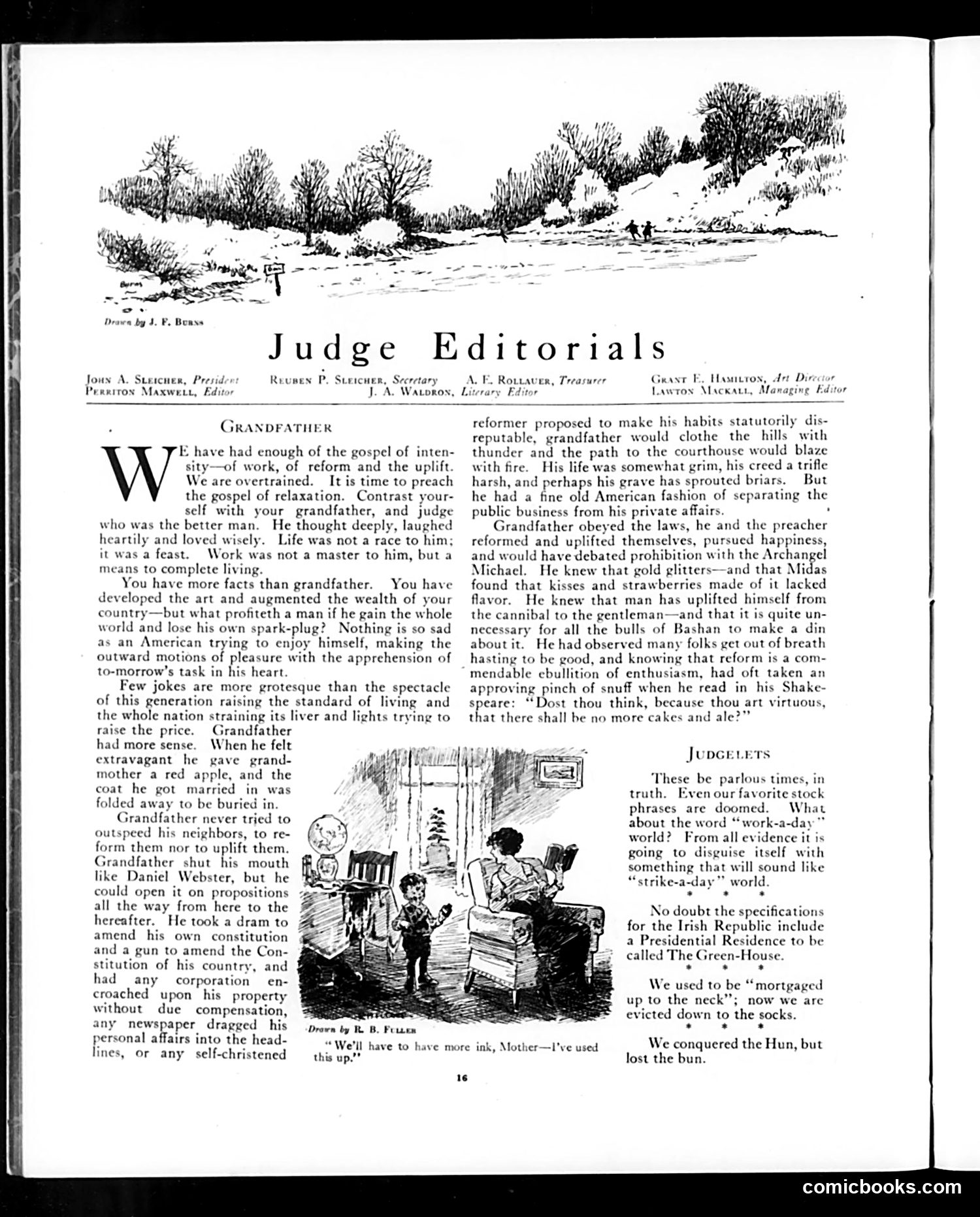
This editorial attacks modern American "intensity" culture by romanticizing an idealized grandfather figure. The piece contrasts the grandfather's relaxed, self-directed life—enjoying simple pleasures, respecting boundaries between public and private affairs—with contemporary America's obsession with work, reform, and constant self-improvement. The satire targets Progressive Era reformism and the culture of uplift that dominated early 20th-century America. References to "reform," "uplift," and raising living standards mock activists who Judge's editors saw as joyless busybodies imposing their values on others. The accompanying cartoon (drawn by R.B. Fuller) shows a woman telling her child, "We'll have to have more ink, Mother—I've used this up," satirizing excessive writing/moralizing. The "Judgelets" section includes topical jabs: references to the Irish Republic, economic hardship ("mortgaged up to the neck"), and post-WWI disappointment ("conquered the Hun, but lost the bun")—suggesting this is post-1918. The overall message: Stop reforming and enjoy life like grandfather did.
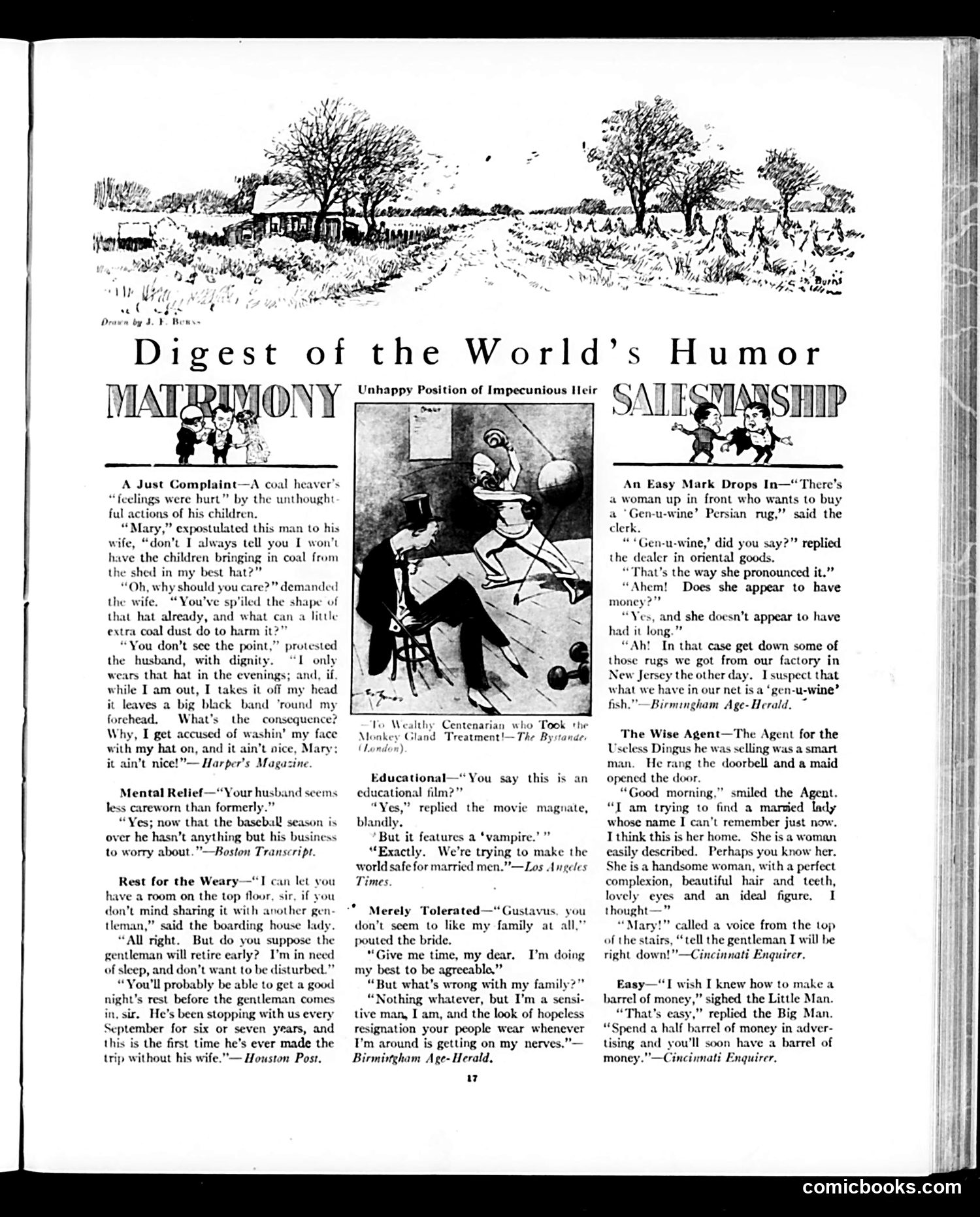
This page collects brief humorous anecdotes rather than political cartoons. The jokes target domestic life and social pretense of the early 20th century: **"A Just Complaint"** mocks working-class dignity—a coal heaver objects to children using his best hat as a coal scuttle because it leaves a mark suggesting poor hygiene. **"Mental Relief"** plays on the obsessive nature of American baseball fandom. **"An Easy Mark Drops In"** satirizes dishonest rug merchants selling fake "Persian" rugs (actually from New Jersey factories) to gullible wealthy women. **"The Wise Agent"** depicts a con man exploiting a housewife's vanity by flattering her appearance to gain access. **"Easy"** offers ironic financial advice: spend money to make money. The page reflects period anxieties about commercial deception, class performance, and consumerism, with humor aimed at both the foolish and the deceitful.
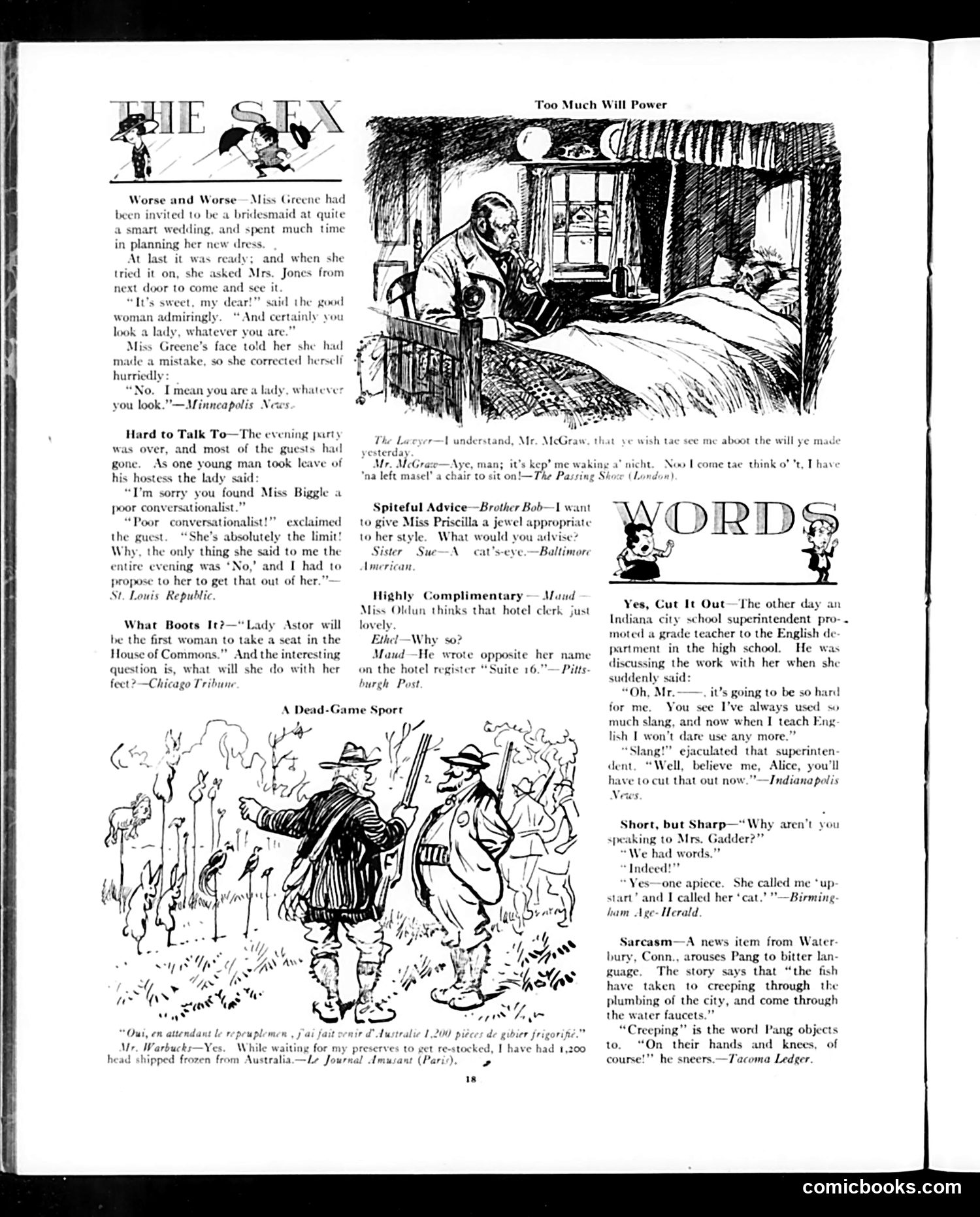
This page from *Judge* contains six brief humorous anecdotes typical of early 20th-century American humor magazines. **Key items:** The "Worse and Worse" anecdote plays on class anxiety—a working-class woman accidentally insults Miss Greene by saying she "looks a lady," implying she doesn't naturally appear to be one, then scrambles to correct herself. "Hard to Talk To" uses the joke that a taciturn woman (Miss Biggle) only said "No" all evening, forcing a man to propose just to get her to speak—satirizing both difficult female conversationalists and desperate male suitors. "What Boots It?" references Lady Astor's recent election as the first woman in the House of Commons (1919), sarcastically questioning what she'll do with her feet—a dismissive jab at women in politics. The remaining items are lightweight domestic humor about hotel clerks, wealth, and marital spats. The cartoons accompanying these anecdotes are simple pen sketches. Overall, the page reflects period attitudes toward women, class, and courtship through gentle ridicule.
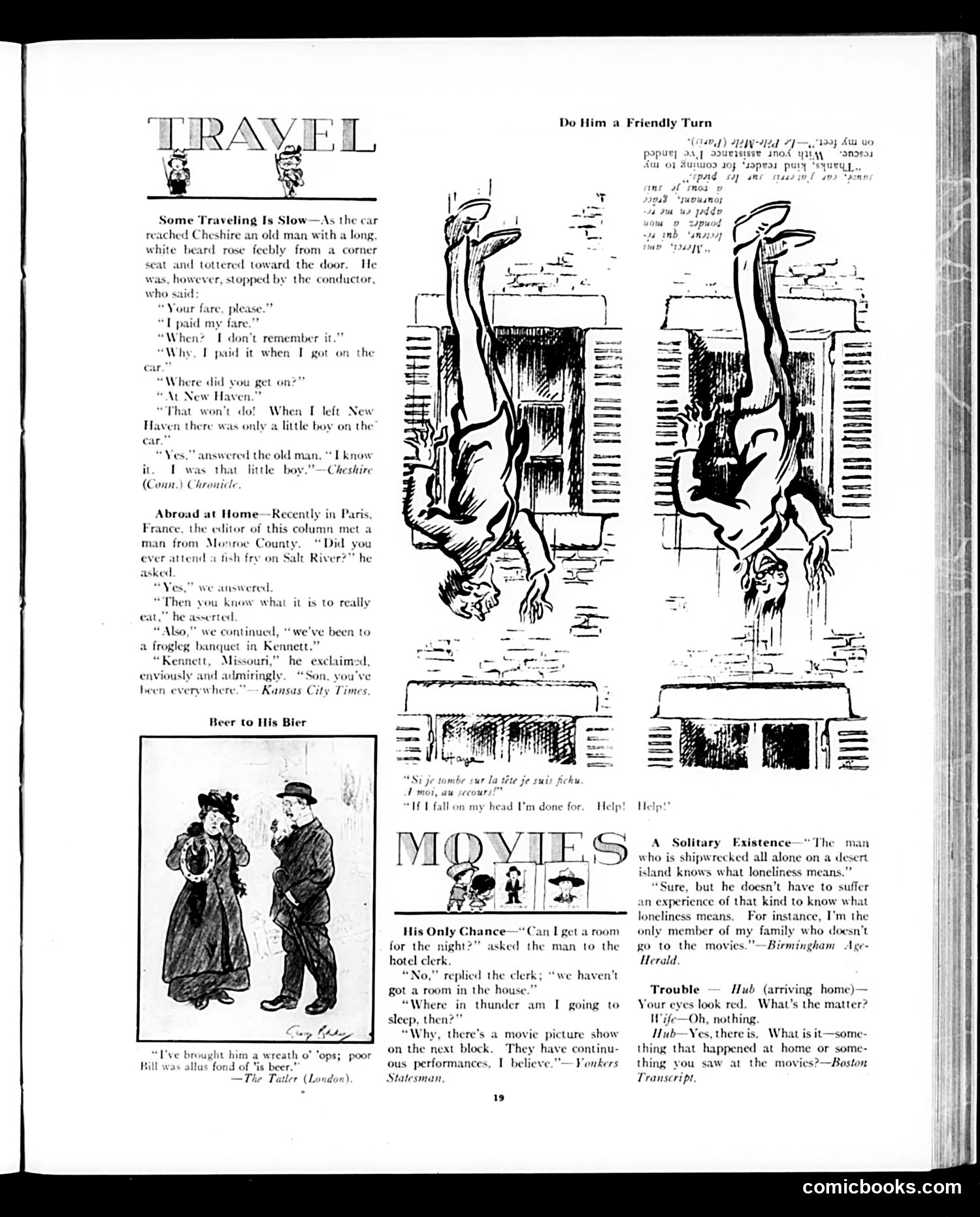
This page contains several brief humorous anecdotes satirizing early 20th-century American life: **"Some Traveling Is Slow"** mocks an elderly passenger's implausible claim of boarding a train in New Haven and remaining unnoticed until Cheshire—the conductor implies the man is either lying or senile. **"Abroad at Home"** gently ridicules provincial pride: a Missouri man boasts of attending a "fish fry on Salt River" and a frog-leg banquet in Kennett, Missouri, treating these modest local events as cosmopolitan achievements comparable to Paris. **"Beer to His Bier"** is a brief epitaph joke about a man's devotion to beer. **"His Only Chance"** satirizes the era's ubiquitous movie theaters—a hotel clerk suggests a homeless man sleep in a continuously-running cinema instead of renting a room. **"A Solitary Existence"** and **"Trouble"** joke about movies' cultural dominance: one character notes only he avoids cinema; another's wife admits movies are her primary emotional outlet. The recurring theme: movies' overwhelming cultural penetration in 1920s American life.
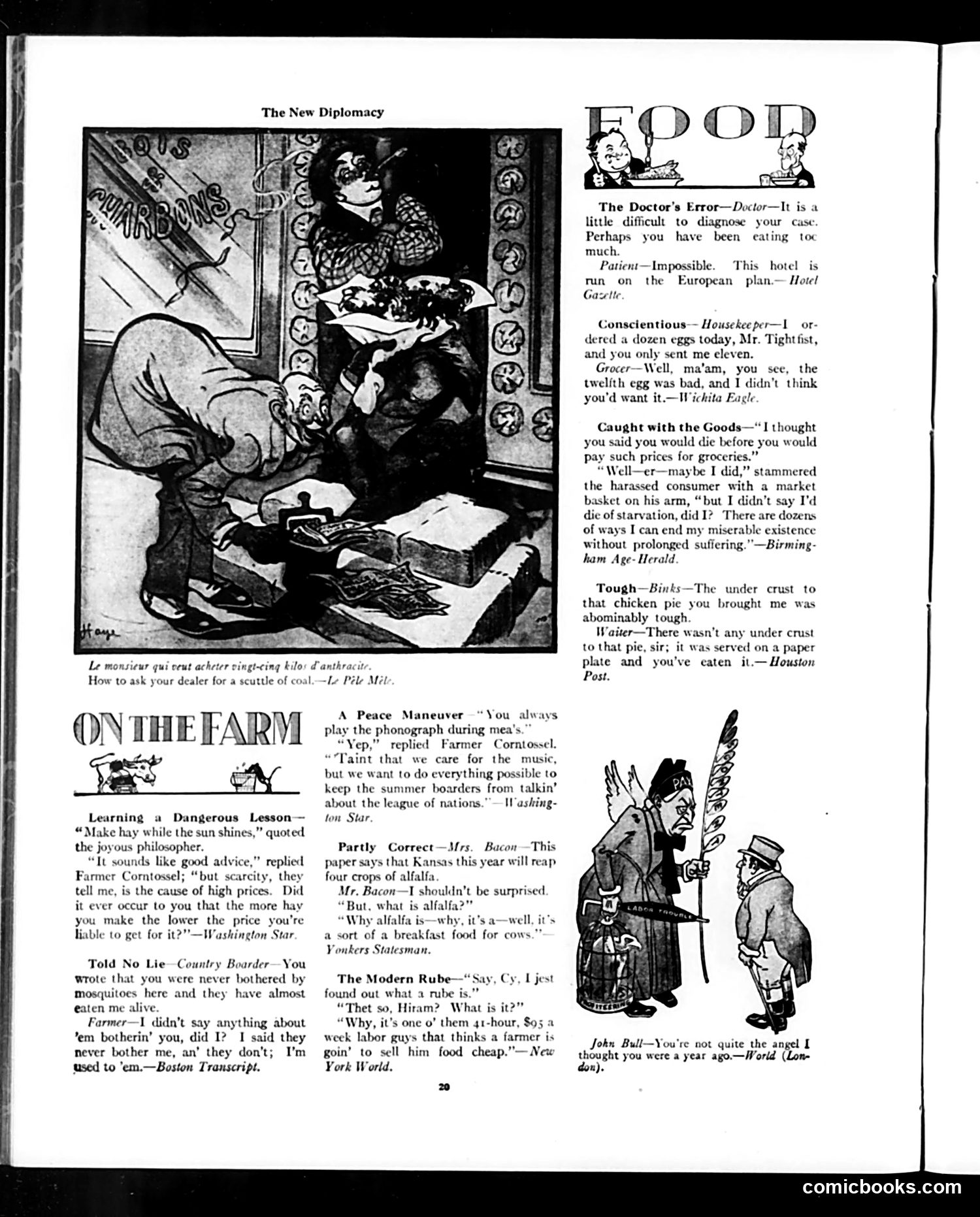
This page collects brief satirical jokes and cartoons addressing post-World War I American anxieties, particularly food scarcity and inflation. **"The New Diplomacy"** cartoon depicts a Frenchman struggling to ask for coal in English, satirizing diplomatic complications and the difficulty of post-war international communication. **"On the Farm"** section includes multiple rural humor pieces mocking farmers' shrewd dealings and summer boarders' naïveté. One joke references the "league of nations"—the newly-formed League of Nations (1920)—suggesting even rural America was preoccupied with this contemporary political institution. The recurring themes are **wartime/post-war scarcity and high prices**: consumers complain about expensive groceries and tough food; farmers exploit food shortages; and a laborer cannot afford farmers' prices despite earning $95 weekly. These jokes reflect genuine 1920s inflation and supply-chain disruption following World War I, presenting class conflict between rural producers and urban consumers as comic material.
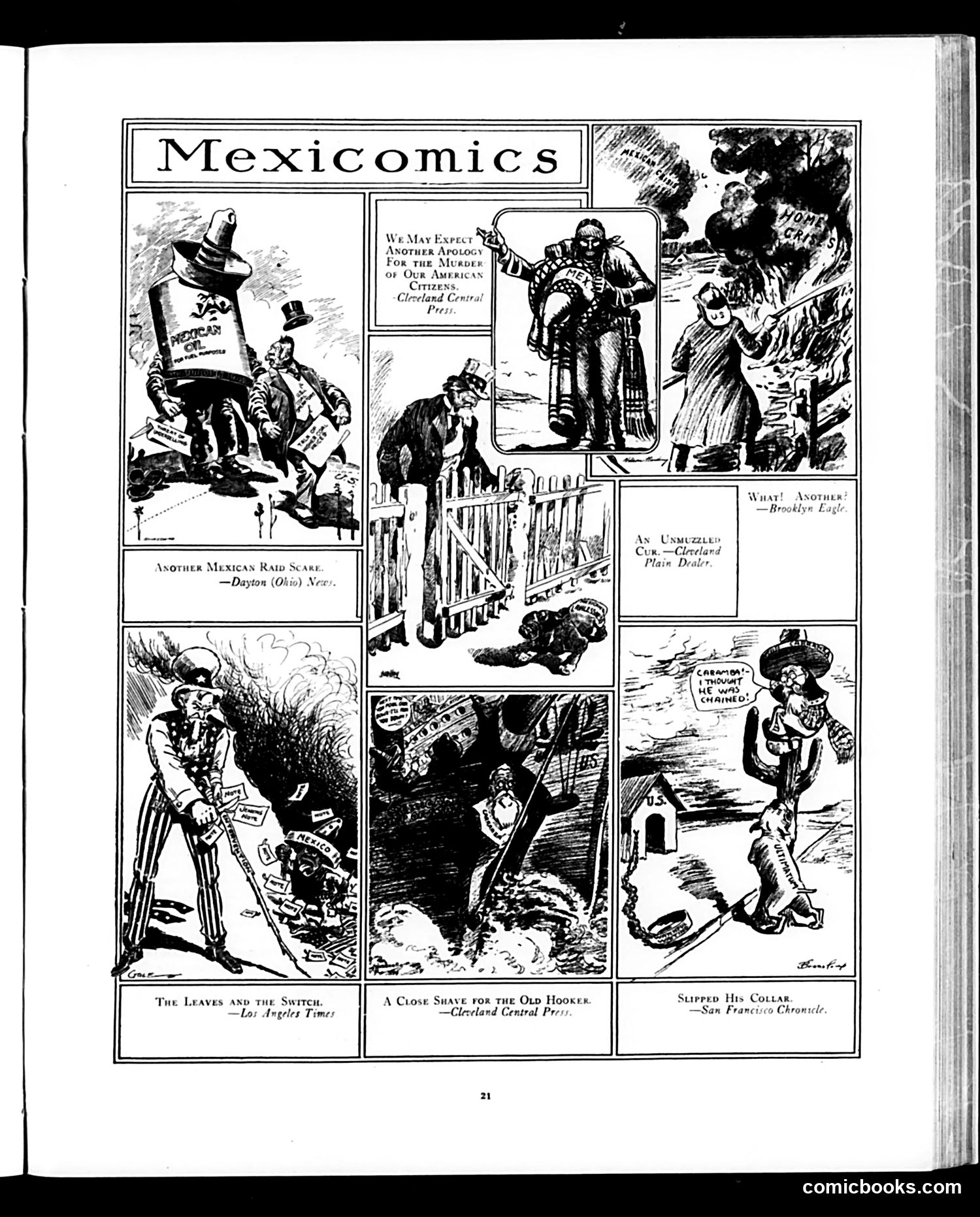
This page collects political cartoons from American newspapers satirizing Mexican raids and violence along the U.S.-Mexico border. The recurring character appears to be **Uncle Sam** (representing America), depicted as threatened or victimized by Mexican aggression. The cartoons mock American anxiety about cross-border violence through exaggerated imagery: an explosive "Mexican" device, armed raiders, and desperate defensive measures. Captions reference real newspapers (Cleveland, Los Angeles, San Francisco), suggesting these raids were contemporary news concerns. The satire targets both Mexican instability and American panic. Phrases like "An Unmuzzled Cur" suggest Mexico is portrayed as an uncontrolled threat requiring firm handling. The cartoons reflect early-20th-century border tensions and American jingoism regarding Mexico, likely from the Mexican Revolution era (1910-1920) when cross-border violence was genuinely occurring.
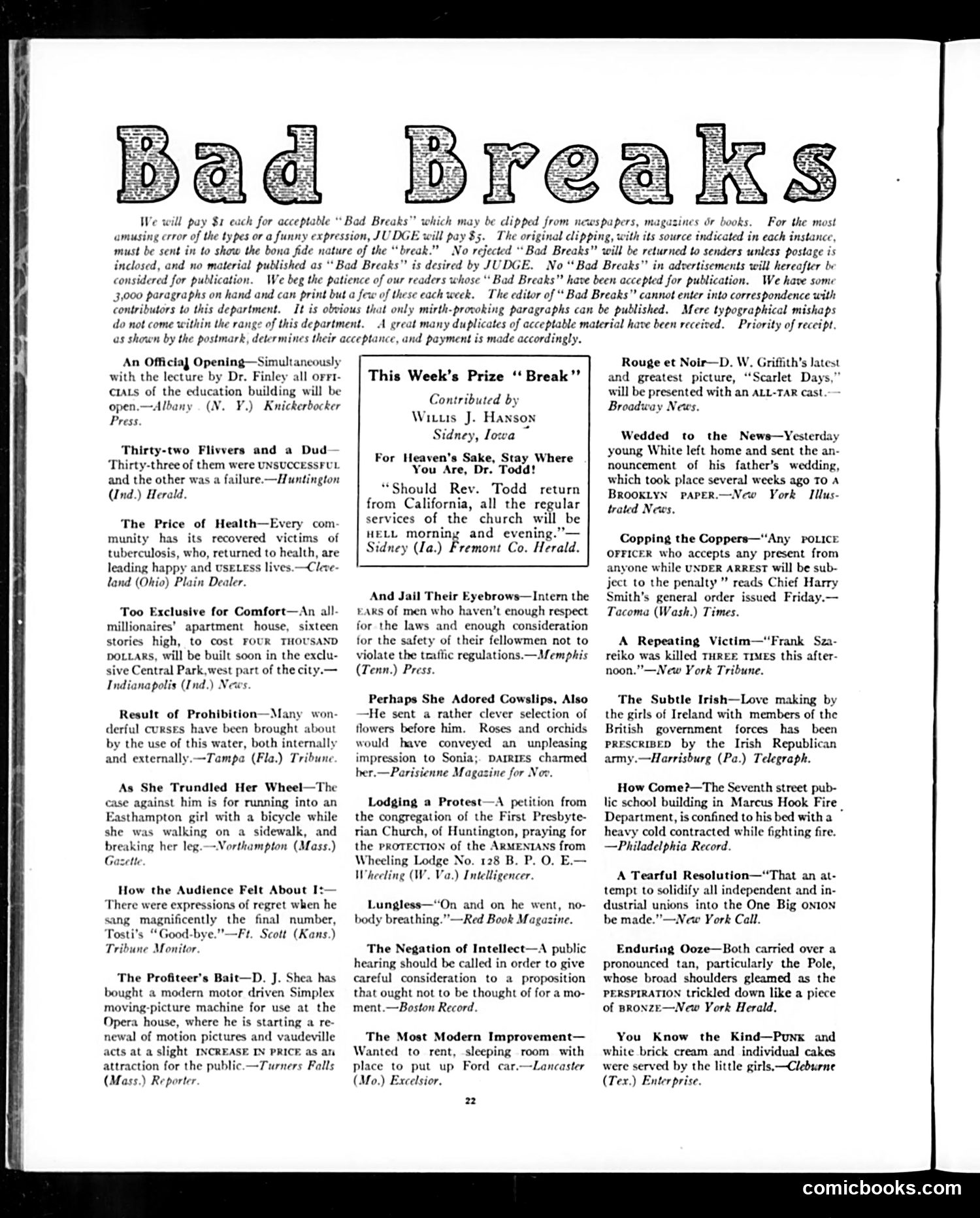
This is a *Judge* humor column showcasing unintentionally funny typographical errors and awkward phrasings from newspapers. The magazine paid $1 per published error, incentivizing readers to submit them. The "breaks" satirize careless journalism through absurd results: - A church announcement promising "HELL morning and evening" services (missing "HOLD") - A real-estate ad offering a sleeping room "with place to put up Ford car" - A prohibition piece crediting water with causing "wonderful curses" - A proposal to "INTERN the EARS" of traffic violators The humor relies on readers recognizing these as obvious printing mistakes that create ridiculous meanings. The column's popularity reflects early-20th-century amusement at newspapers' sloppiness—and the public's growing engagement with print media's quirks. This was participatory humor, rewarding readers who spotted and reported errors.
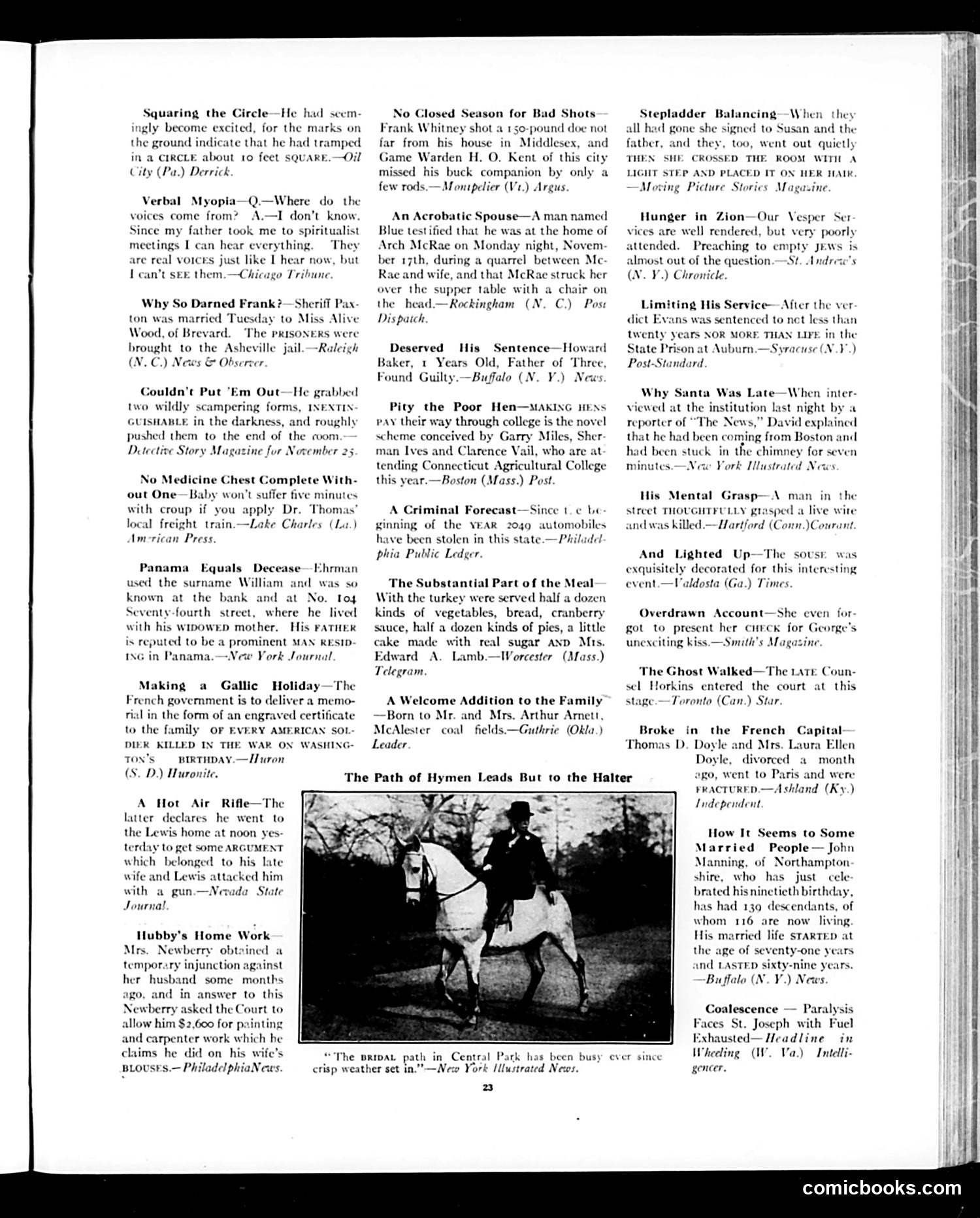
This page collects humorous newspaper **misquotes and typographical errors** from American regional papers—Judge's running feature mining local journalism for unintentional comedy. The jokes exploit how **careless editing or unfortunate word choice** creates absurd meanings. Examples: a sheriff's arrest report becomes oddly frank about prisoner transport; a real-estate ad accidentally equates a surname ("Panama") with death; a domestic violence story is headlined about a woman's "deserved" sentence without clarifying she's the victim; a Thanksgiving meal description inexplicably ends by listing "Mrs. Edward A. Lamb" as food. The cartoon (centered) shows a couple on horseback in Central Park with caption joking that the "bridal path" has been busy—a pun on "bridle" path, with sexual innuendo about honeymoon activity. This represents **early 20th-century satirical humor** targeting small-town journalism's incompetence and double entendres that emerge through careless composition—gentle mockery of provincial American newspapers.
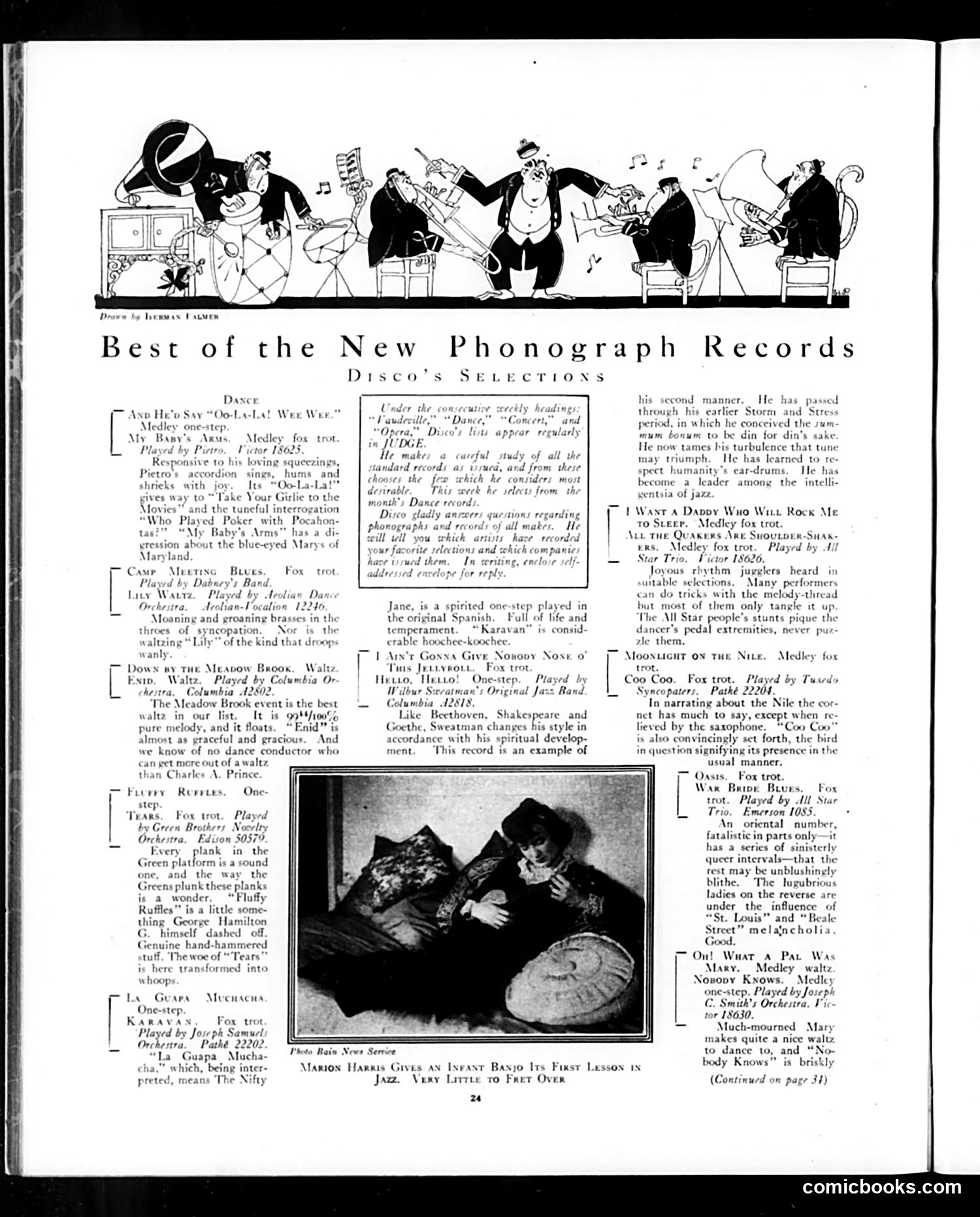
This is primarily a **record review section**, not political satire. The page showcases "Best of the New Phonograph Records" — Disco's selections of jazz and popular music releases from the early 1920s. The **cartoon header** (drawn by Hermon Palmer) depicts a jazz band performing — musicians with instruments seated in a row, with musical notes floating above, establishing the jazz theme visually. The **reviews themselves** are lighthearted critiques of fox trots, waltzes, and one-steps. They reference contemporary recordings and orchestras (Columbia, Victor, Pathé labels). The tone is playful—describing rhythm as "joyous" and commenting on orchestral technique and melody. The **photograph** shows Marion Harris receiving a banjo lesson, illustrating jazz's growing cultural presence. This reflects **1920s American culture**: the jazz age was in full swing, phonograph records were the primary medium for music consumption, and publications like *Judge* covered entertainment alongside political humor. For modern readers, this documents how jazz was transitioning from novelty to mainstream entertainment.
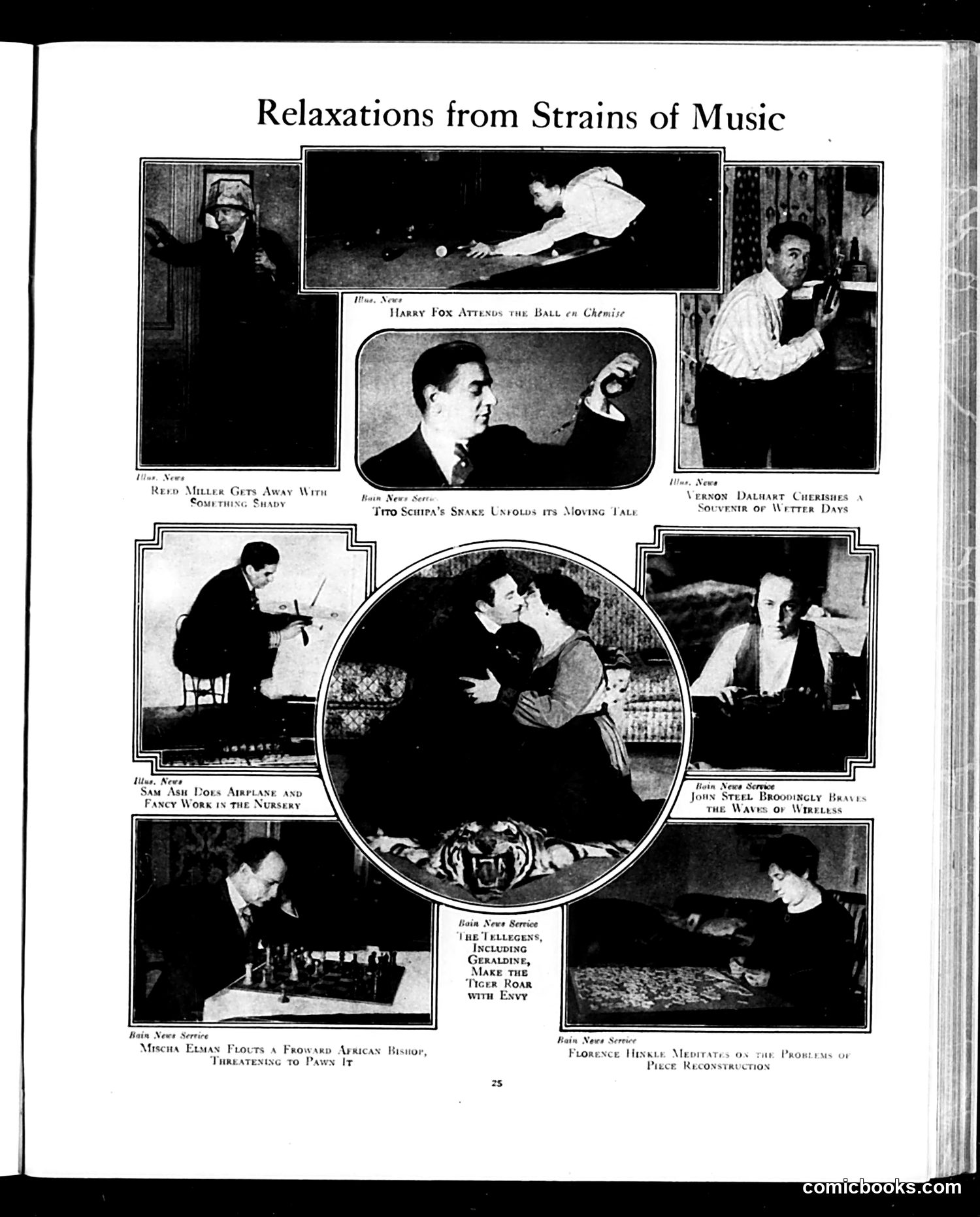
This page showcases humorous film stills from silent movies, captioned to create comedic scenarios. The layout presents contemporary entertainment figures and their cinematic escapades as "relaxation" from musical performances—the title's ironic joke being that these scenes depict chaos rather than calm. Notable references include Harry Fox (a performer of the era), Vernon Dalhart (a recording artist), and Tito Schipa (an opera singer). The captions create absurdist humor: a character "gets away with something shady," a snake "unfolds its moving tail," someone does "airplane and fancy work in the nursery," and an actress "threatens to pawn" something. The central circular image appears to be the page's anchor scene. This is essentially an entertainment gossip/humor feature typical of *Judge* magazine—mixing celebrity culture with slapstick film comedy to amuse readers familiar with these performers and movies.
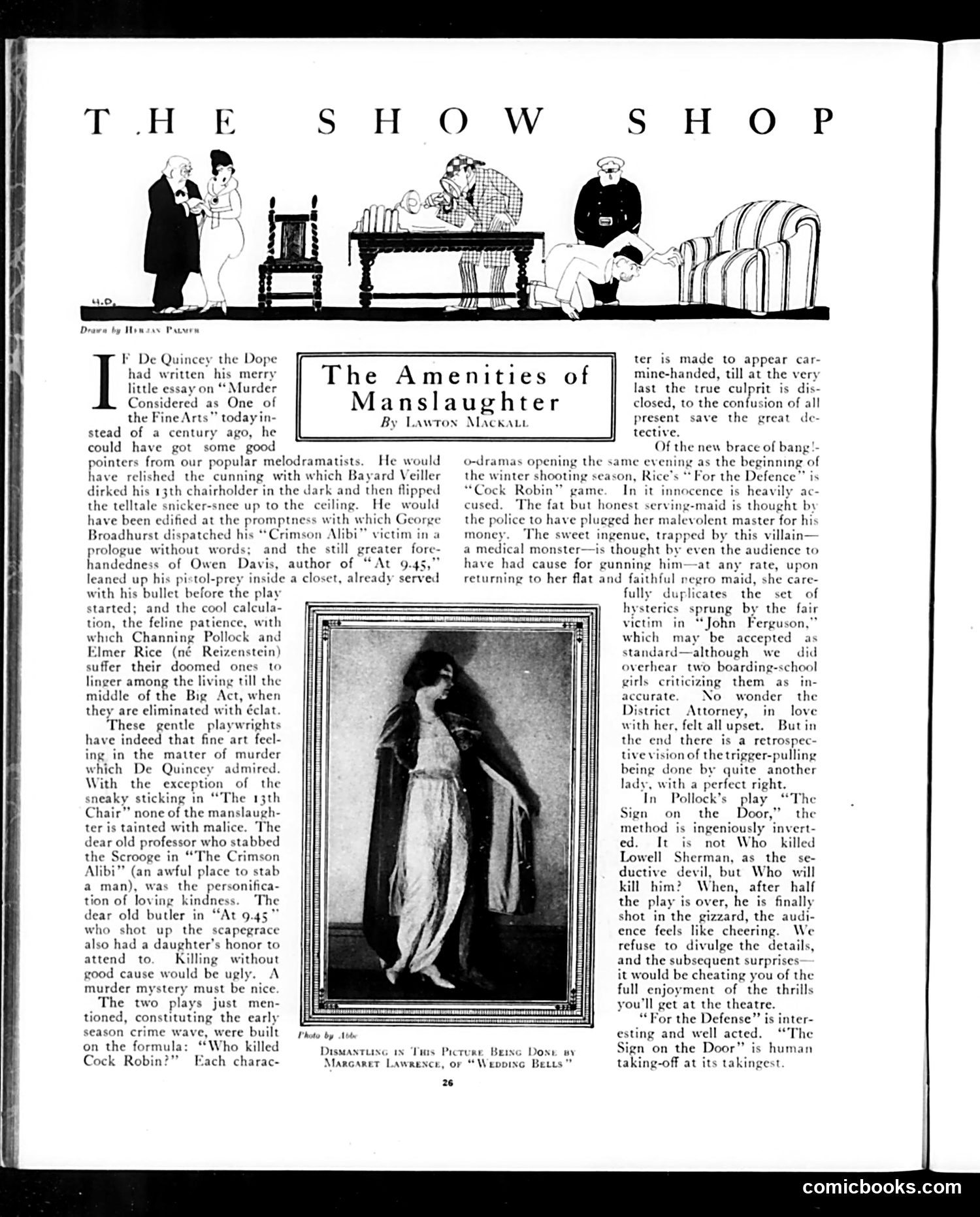
This article satirizes contemporary Broadway murder-mystery plays by Bayard Veiller, George Broadhurst, Owen Davis, Elmer Rice, and Channing Pollock. The author mocks how these playwrights treat murder as an elegant art form—borrowing the phrase from De Quincey's classical essay—rather than depicting it as genuinely morally corrupt. The satire notes the "cunning" and "feline patience" with which these dramatists stage killings, and observes that murderers in these plays are sympathetic (a butler protecting his daughter's honor, a professor motivated by kindness). The author suggests modern playwrights have perfected theatrical murder in ways that would impress De Quincey himself, while gently mocking the moral cleanliness these narratives impose on inherently ugly acts. The illustration shows Margaret Lawrence in a dramatic theatrical pose, presumably from one of these plays.
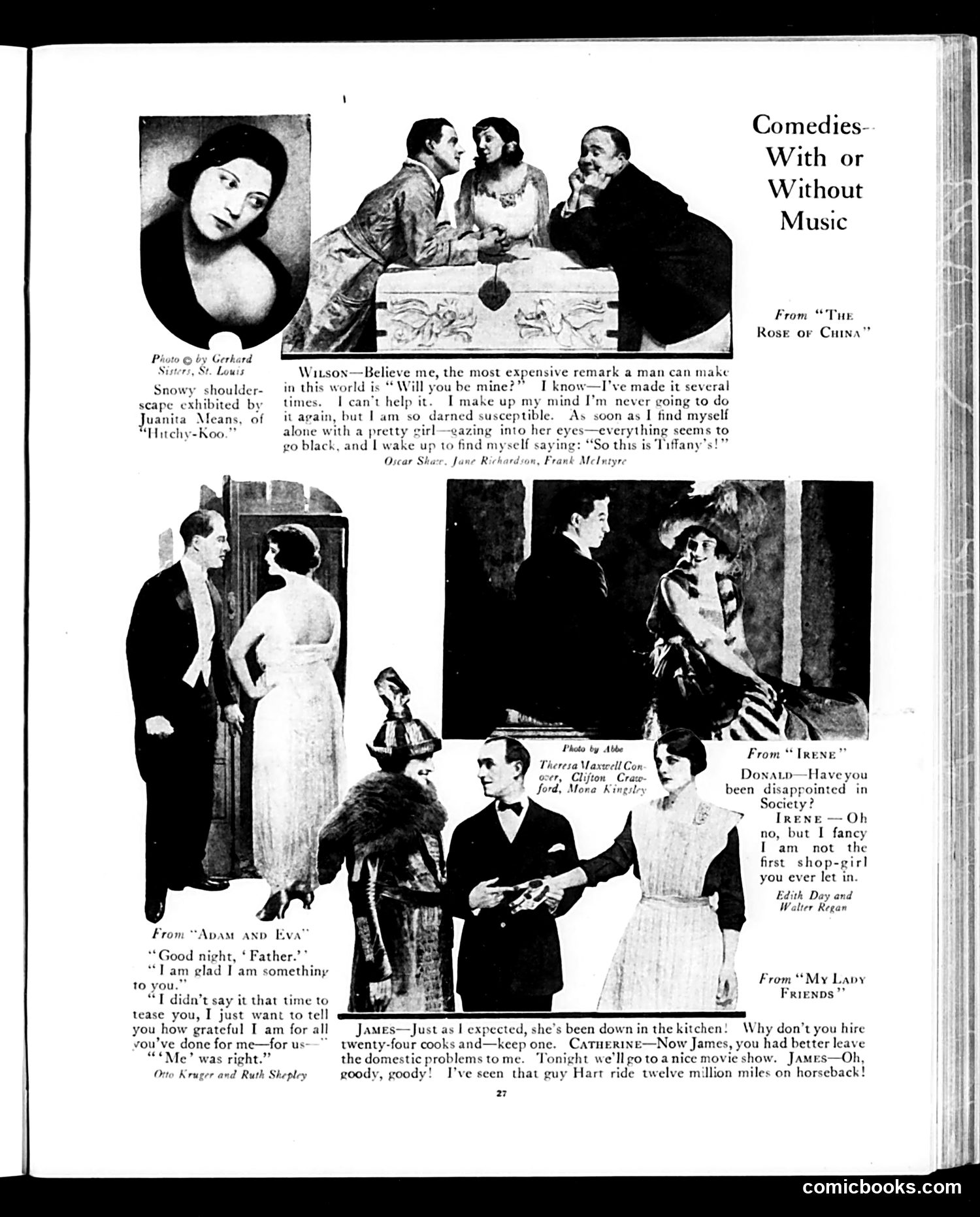
This page showcases comedic dialogue excerpts from contemporary Broadway theatrical productions (circa 1910s-1920s based on styling). Rather than political satire, it presents humorous moments from popular plays. The recurring joke involves **romantic/marital predicaments**: Wilson's compulsive marriage proposals despite good intentions; a shop-girl's sardonic response to being seduced; a husband's domestic complaints contrasted with entertainment escape; a father-daughter moment about gratitude. The satire targets **middle-class social anxieties**—particularly male susceptibility to romance, the gap between stated intentions and behavior, and domestic tedium solved through cinema. The reference to "that guy Hart" (likely actor William S. Hart, famous for Western films) makes a joke about movie excess. The photographs show actors in period dress performing these scenes. This is essentially a **theater/entertainment gossip page** advertising popular stage productions through witty dialogue snippets, aimed at readers familiar with these Broadway shows.
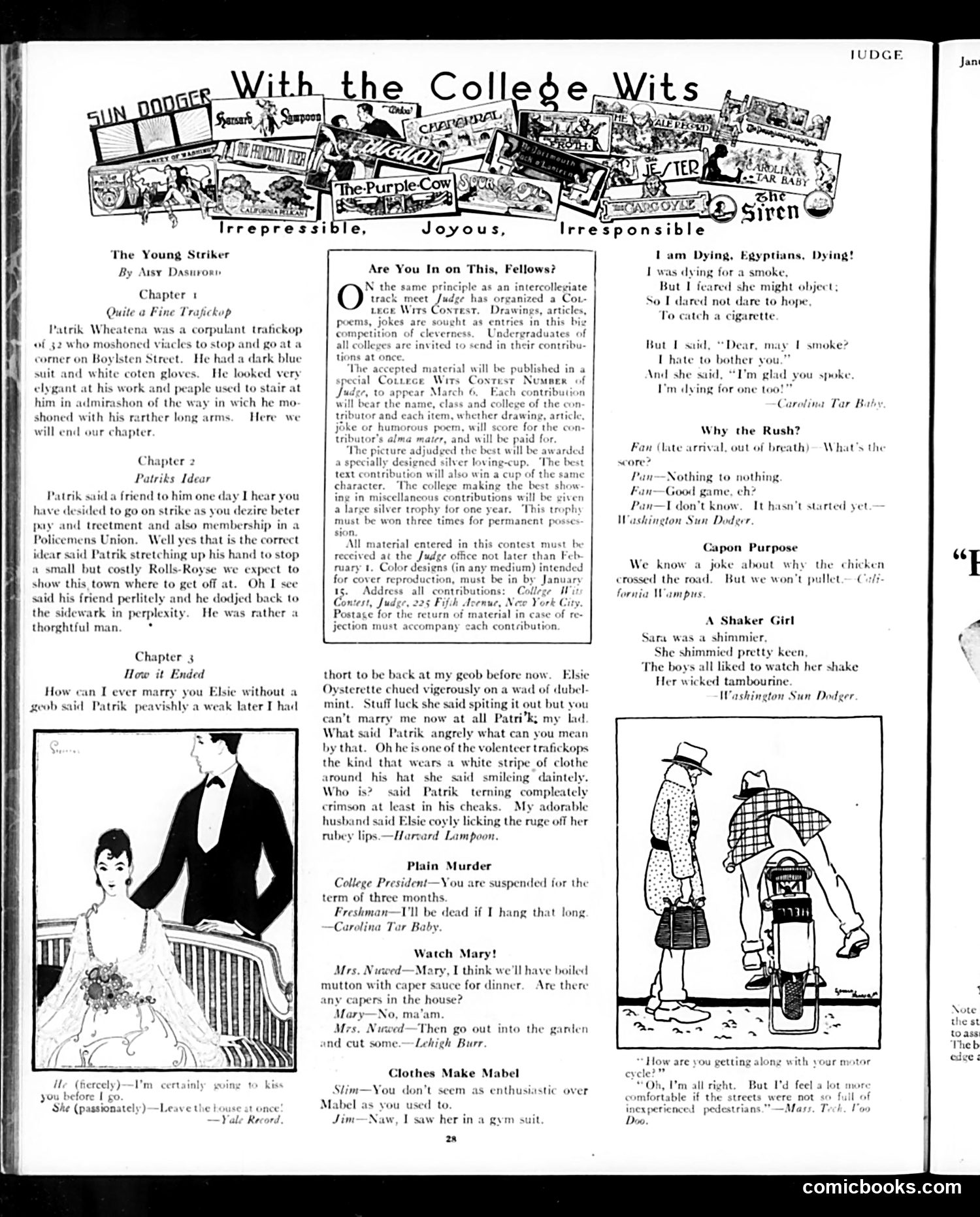
This page from Judge magazine contains satirical fiction and humor pieces targeting college life and contemporary social customs circa 1910s-1920s. **"The Young Striker"** is a serialized story mocking labor activism. Patrick, a traffic policeman, plans a strike for better pay and union membership, but loses his fiancée Elsie to a volunteer (scab) traffic officer wearing a distinctive white stripe. The satire ridicules both strikers' aspirations and the vulnerability of their positions. **"College Wits Contest"** announces Judge's competition soliciting contributions from undergraduates, offering publication and a silver trophy—satirizing collegiate pretensions to literary cleverness. The remaining humor pieces mock everyday absurdities: miscommunication about "capers," a girl's changed appearance in gym clothes, late arrival at a scoreless game, and casual smoking etiquette. The overall tone is dismissive toward labor organizing and gently mocking toward college culture and dating conventions, reflecting the magazine's satirical stance toward contemporary American society.
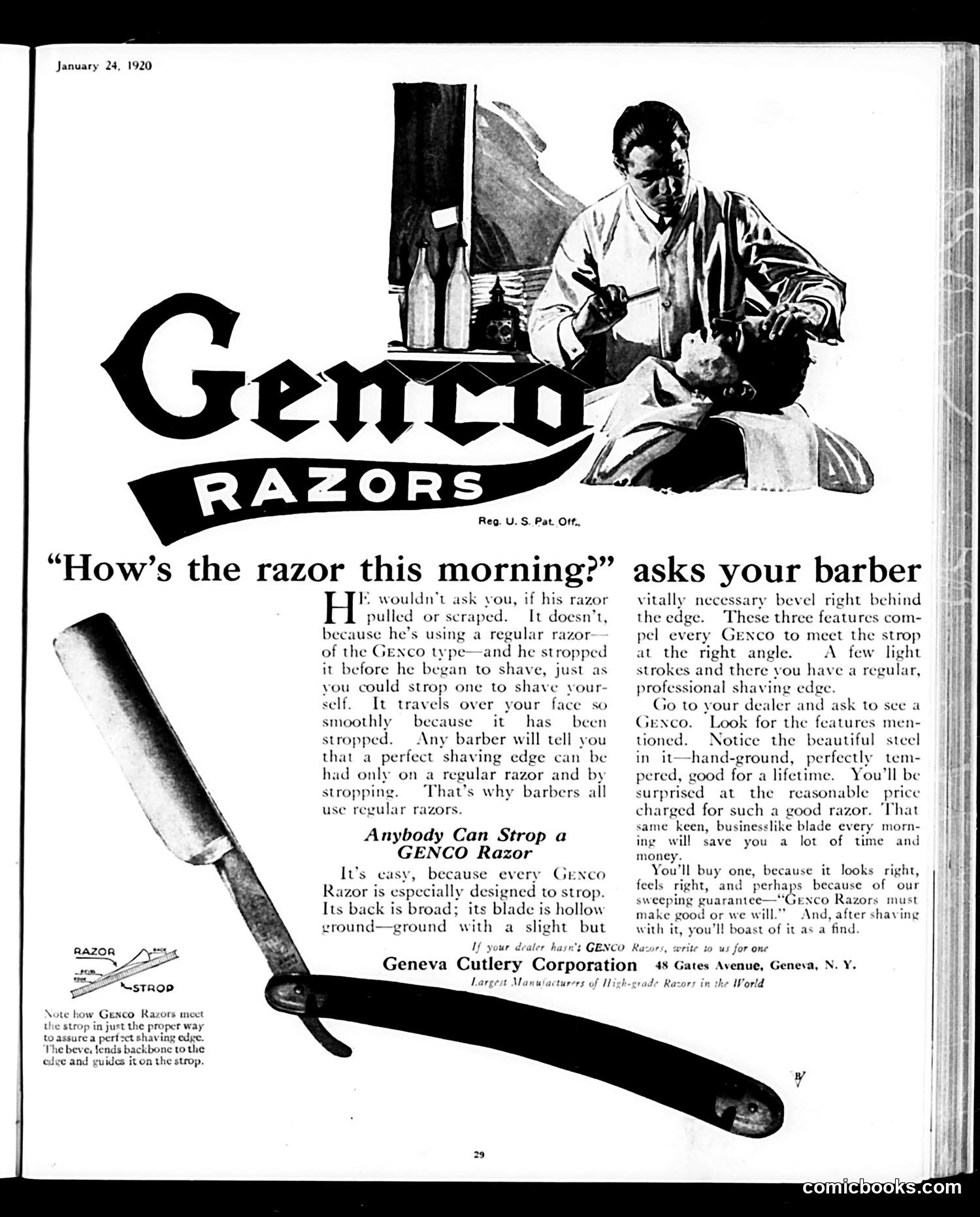
This is **not a political cartoon or satire**—it's a straightforward **product advertisement** for Genco razors, published in Judge magazine on January 24, 1920. The page features an illustrated barber using a Genco razor on a customer, accompanied by detailed sales copy explaining the razor's technical features: its hollow-ground blade, broad back, and compatibility with stropping (sharpening on a leather strop). The accompanying diagram shows how the razor meets the strop correctly. The "joke" in the headline—"How's the razor this morning?"—is a gentle play on a barber's typical question, used here to transition into advertising copy about why a properly-stropped Genco razor performs smoothly without pulling or scraping. This reflects early-20th-century advertising strategy: placing product ads in humor magazines to reach affluent male readers. There is no political commentary or satire intended on this page.
This page from *Judge* contains mostly **theatrical advertisements and light verse**, not political satire. The main content includes: - **Theater listings** for Broadway shows (*The Sign on the Door*, *The Girl in the Limousine*, *The Acquittal*) - **Eugene Lockhart's poem "Wall Street"** — a cynical portrait of the financial district as a place of extremes ("To the Winner—Heaven / To the Loser—Hell") - **"Flimagism" by J.R. McCarthy** — a satirical poem about an artist arrested by police (six Irishmen, two Jews, a Welshman) for possessing explosives, receiving six months in jail. The poem mocks anarchist violence and police overreaction with dark humor - **Light verse** on modernization, economics, and contemporary life - **Patent medicine advertisements** (cough drops, truss devices) The page reflects early 20th-century concerns: labor unrest, immigrant stereotypes, industrial change, and consumer remedies marketed to the middle class. The humor is primarily social observation rather than partisan politics.
This page contains primarily **short humorous poems and jokes** reflecting post-WWI American life, plus advertisements. The main piece, "What Did She Mean?" depicts a **returning soldier (ex-Corporal)** puzzled by his wife's remark that she can support him "in the style you've been accustomed to." The joke plays on **gender role reversal**: the wife now earns income while the husband was away at war, and her comment—innocent on surface—hints she may be the primary breadwinner. This satirizes the unexpected economic independence women gained during WWI when they entered the workforce. Other brief jokes reference **military life** ("The Doting Doughboy" about an enthusiastic soldier) and typical domestic/honeymoon scenarios. The advertisements—Egyptian Deities cigarettes, Dewey Hotel, piano lessons—are period standard. Nothing explicitly political appears; the satire targets social adjustment and gender dynamics in the immediate post-war period rather than political events.
This page from the satirical magazine *Judge* contains several period pieces reflecting early 20th-century American attitudes. **"Not According to Schedule"** presents a racial stereotype joke about a Black man ("Sam") requesting his dead brother's name engraved on a cane's gold head, then changing his mind because the brother has "escaped"—meaning fled or run away. The humor relies on dehumanizing dialect and stereotypes. **"Diplomacy"** satirizes rural ignorance, featuring a farmer ("Cornsilk") who fears automobiles. The salesman cleverly reframes car parts as horse equipment (the pedal becomes "reins," the tank a "feed bag") to overcome the farmer's resistance. The satire mocks rural technological resistance while celebrating urban sophistication. **"Are You There?"** adapts Einstein's Theory of Relativity into verse, suggesting starlight bends en route to Earth, so stars aren't where they appear. This popular-science humor reflects 1920s fascination with Einstein's theories and attempts to make complex physics accessible through whimsy. The page also features advertisements for phonograph devices, self-defense pistols, and marriage advice books—typical period content.
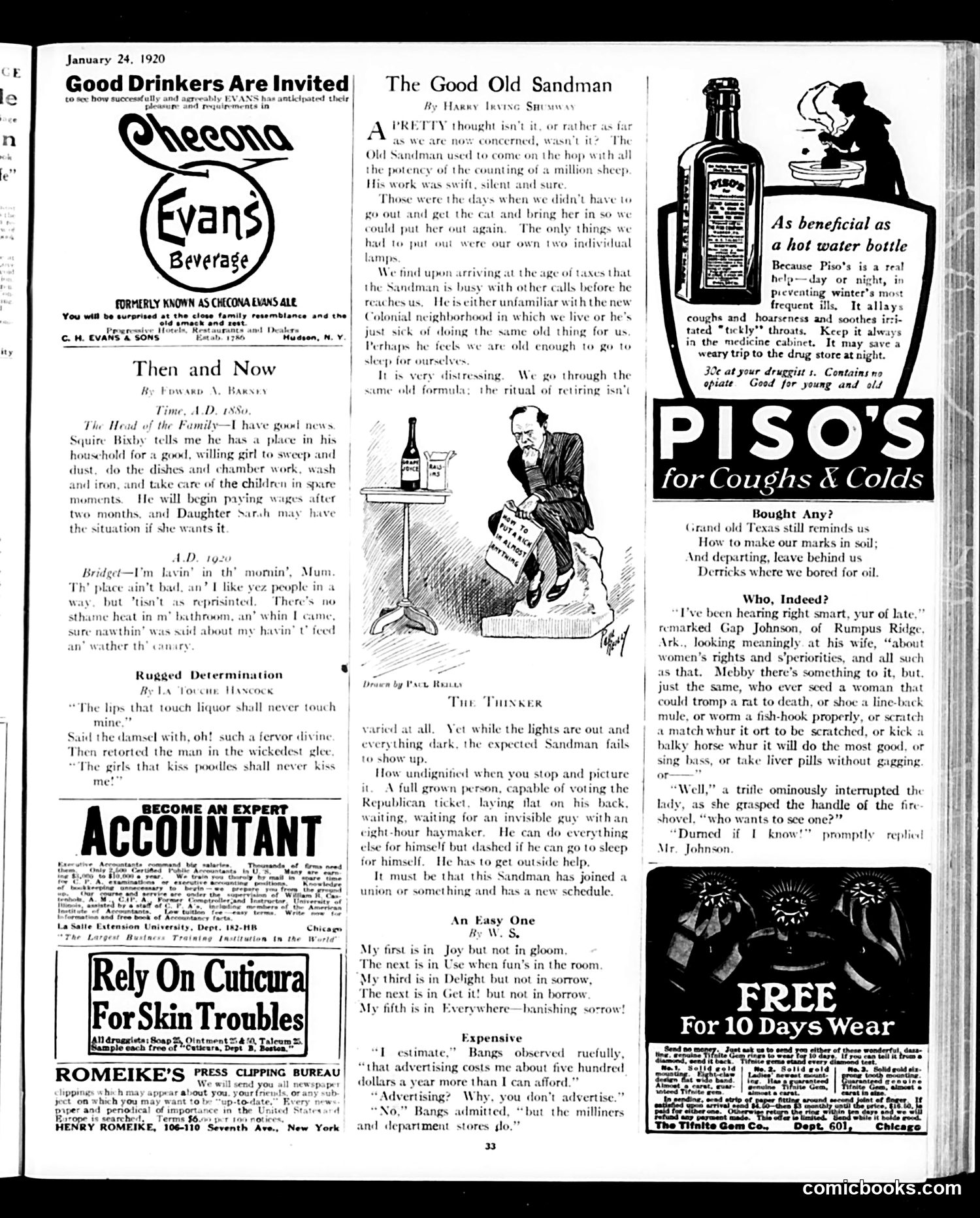
This is primarily a **satirical humor and advice page** from January 1920, with several distinct pieces: **"Then and Now"** contrasts servant employment expectations between 1880 and 1920. In 1880, a maid accepts a low-wage position with minimal amenities. By 1920 ("A.D. 1920"), the same maid—now named Bridget—demands hot water, bathroom access, and questions unfulfilled promises. The satire critiques how working-class expectations have shifted post-WWI, frustrating employers accustomed to exploitative labor conditions. **"The Good Old Sandman"** nostalgically laments lost childhood sleep aids. The author reflects that the mythical "Sandman" once reliably induced sleep in children, but modern adults must struggle to sleep unaided—a commentary on contemporary anxiety and stress. **"The Thinker"** satirizes a man waiting passively for sleep, too dependent on external help despite being a voting adult capable of self-sufficiency—mocking adult helplessness. The remaining content consists of period **advertisements and light verse**. The page reflects post-war social anxieties about changing labor dynamics and modern life's complications.
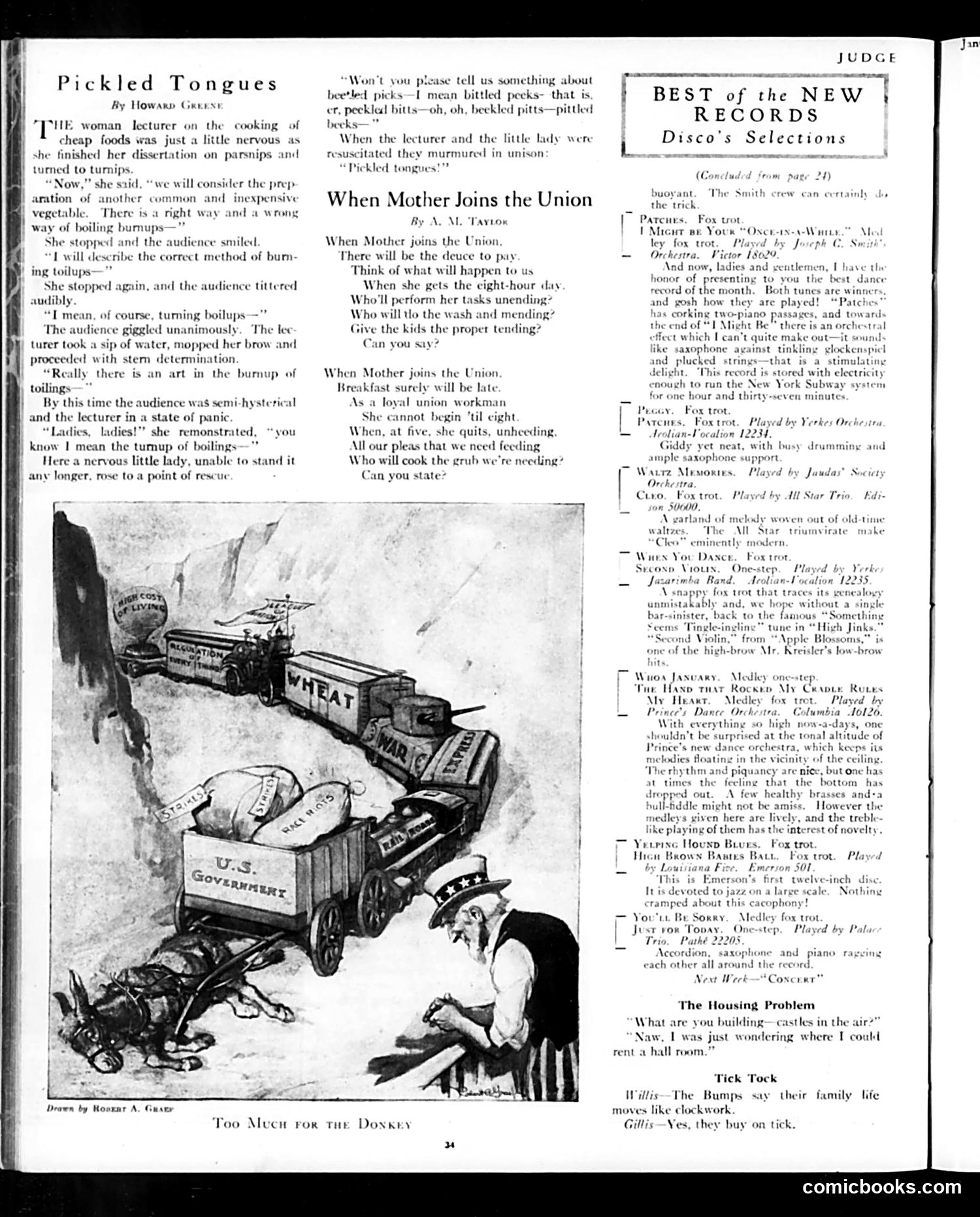
This cartoon satirizes labor unions' impact on working-class families, specifically targeting the union movement's demand for an eight-hour workday. The illustration depicts a overburdened donkey (representing the working man) struggling under excessive loads labeled "Government," "Wheat," and other commodities—symbolizing the economic burdens workers face. The accompanying poem "When Mother Joins the Union" expresses middle-class anxiety about women entering the labor movement. It mocks the prospect of mothers working eight-hour shifts, sarcastically asking who will handle domestic duties: cooking breakfast, doing laundry, and childcare. The humor relies on the assumption that mothers' union participation would create household chaos—a common anti-labor argument of the era. Together, these pieces represent Judge magazine's conservative editorial stance against organized labor, portraying unions as adding financial strain to workers while threatening traditional family structures.
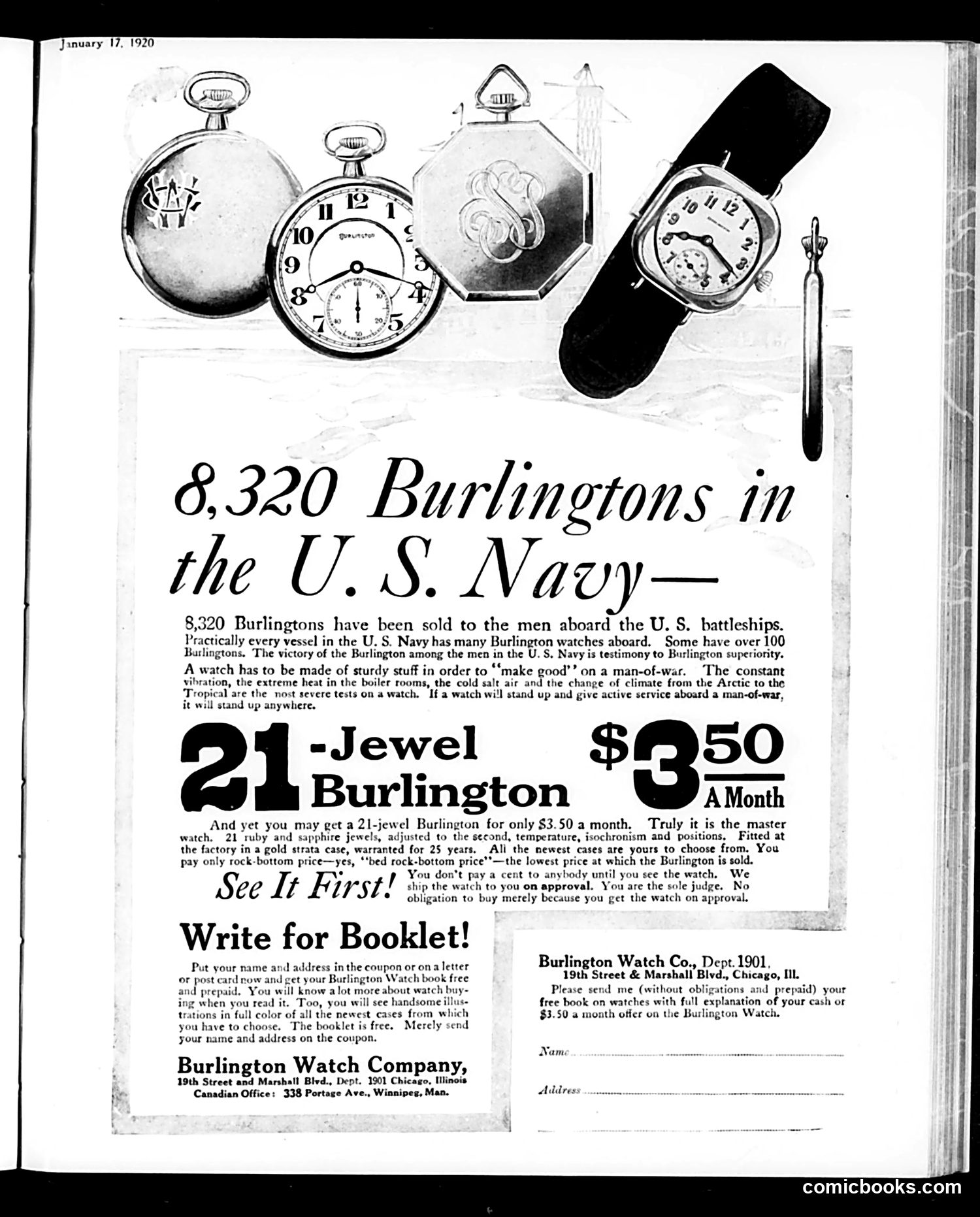
This is primarily a **commercial advertisement**, not a political cartoon. It promotes Burlington watches by marketing them to U.S. Navy servicemen. The ad's strategy exploits patriotic sentiment following World War I (which ended November 1918). It claims 8,320 Burlington watches are already aboard Navy battleships, using this as proof of superior durability. The copy argues that if a watch survives extreme conditions aboard warships—"constant vibration," boiler room heat, "cold salt air"—it will perform anywhere. The pricing ($3.50/month, no payment until approval) targets working-class sailors. The text emphasizes affordability despite the product's quality: a 21-jewel watch with sapphire jewels, gold case, and 25-year warranty. There is **no satire or political commentary visible**. This appears to be a straightforward mail-order advertisement capitalizing on post-war military pride and sailors' purchasing power.
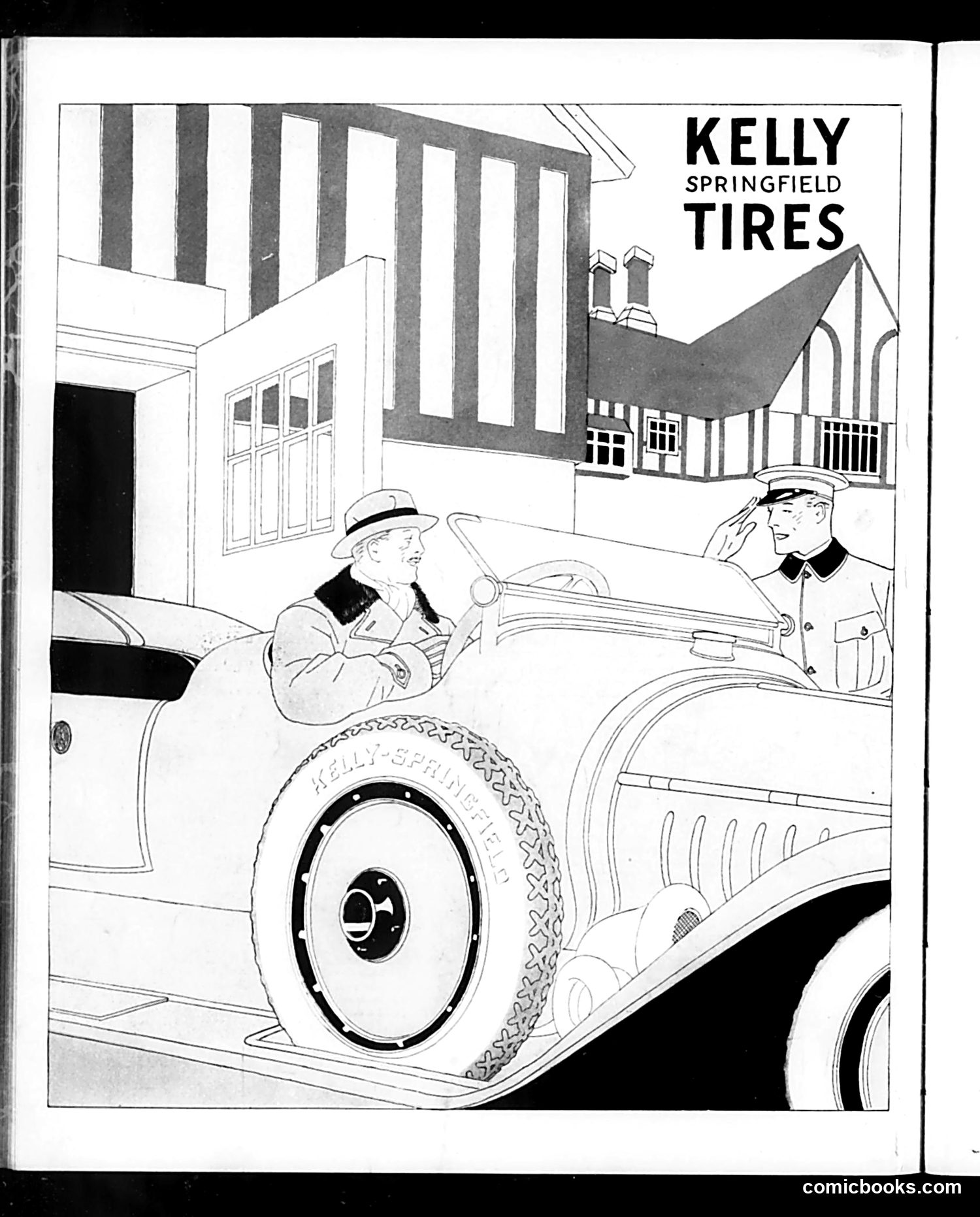
This is a commercial advertisement for Kelly Springfield Tires, not political satire. The illustration shows two men in 1920s-30s attire examining a car tire prominently labeled "KELLY-SPRINGFIELD." One man wears a flat cap and work clothes, while the other wears a uniform suggesting he's a mechanic or service attendant. They're positioned beside a vintage automobile in front of period architecture. The ad's purpose is to showcase the tire's durability and quality through a casual scene of professional inspection. The visible tread pattern on the tire emphasizes its construction. This represents typical early automotive advertising that stressed reliability and expert approval to potential buyers during the early automobile era.