
Judge, 1920-01-24 · page 7 of 36
Judge — January 24, 1920 — page 7: what you’re looking at
What you’re looking at
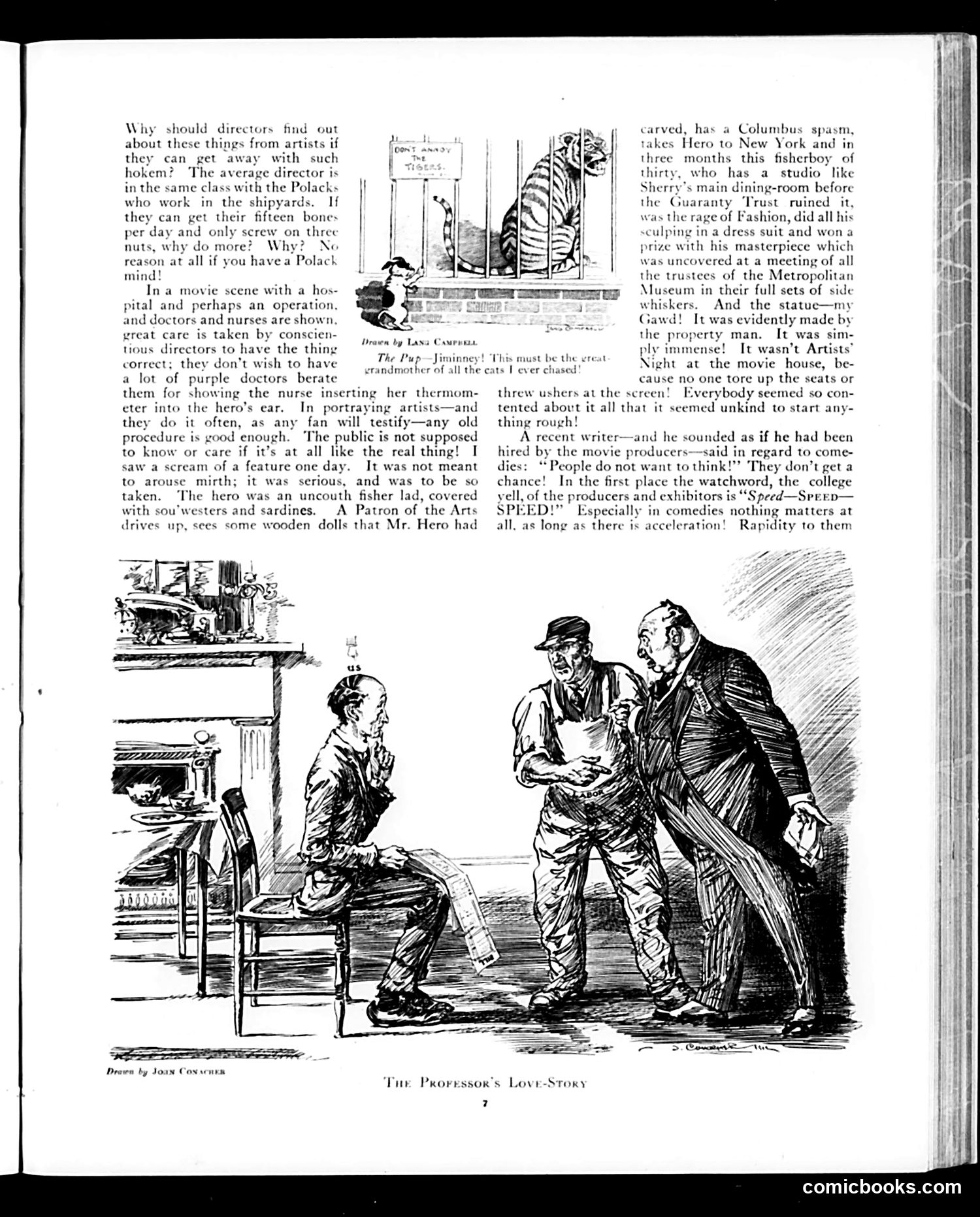
This page critiques Hollywood directors' lazy portrayal of artists in films. The text argues that while directors meticulously research medical scenes to avoid criticism from doctors, they carelessly depict artists because audiences supposedly don't notice or care about accuracy. The example given: a poor fisherman's crude wooden dolls are discovered by a wealthy "Patron of the Arts," who brings him to New York. Within three months, this uncouth thirty-year-old becomes fashionable, sculpts in a tuxedo, and wins Metropolitan Museum recognition—despite his statue being obviously amateurish ("made by the property man"). The satire targets: (1) movie producers' contempt for audience intelligence; (2) the absurdity of overnight artistic success based on patronage rather than talent; (3) filmmakers' indifference to authenticity when depicting artists versus other professions. The "Polack" ethnic slur reflects the era's casual prejudice. The cartoon "The Professor's Love-Story" (bottom) appears unrelated to the main article's theme.
📄 Transcribed text from this page (OCR, searchable)
Machine-transcribed from the original scan — historical spelling and the odd misread are preserved.
Why should directors find out about these things from artists if they can get away with such hokem? The average director is in the same class with the Polacks who work in the shipyards. If they can get their fifteen bones per day and only screw on three nuts, why do more? Why? Nc reason at all if you havea Polack mind! In a movie scene with a hos- pital and perhaps an operation, and doctors and nurses are shown, yreat care is taken by conscien- tious directors to have the thing correct; they don’t wish to have a lot of purple doctors berate them for showing the nurse inserting her thermom- eter into the hero’s ear. In portraying artists—and they do it often, as any fan will testify—any old procedure is good enough. ‘The public is not supposed to know or care if it’s at all like the real thing! I saw a scream of a feature one day. It was not meant to arouse mirth; it was serious, and was to be so taken. ‘The hero was an uncouth fisher lad, covered with sou’westers and sardines. A Patron of the Arts drives up, sees some wooden dolls that Mr. Hero had The Pup —Jirvi erandmother of all the 7 carved, has a Columbus spasm, takes Hero to New York and in three months this fisherboy of thirty, who has a_ studio like Sherry’s main dining-room before the Guaranty ‘Trust ruined it, was the rage of Fashion, did all his sculping in a dress suit and won a prize with his masterpiece which was uncovered at a meeting of all the trustees of the Metropolitan Museum in their full sets of side whiskers. And the statue—my Gawd! It was evidently made by the property man. It was sim- ply immense! It wasn’t Artists’ Night at the movie house, be- cause no one tore up the seats or threw ushers at the screen! Everybody seemed so con- tented about it all that it seemed unkind to start any- thing rough! A recent writer—and he sounded as if he had been hired by the movie producers—said in regard to come- dies: ‘People do not want to think!” They don’t get a ! In the first place the watchword, the college f the producers and exhibitors is “Speed—Srpeev— ED!" Especially in comedies nothing te long as there is acceleration! Rapidity to them must be the great s I ever chased! all, Proressor’s Love-Story comicbooks.com