
Judge, 1920-01-24 · page 26 of 36
Judge — January 24, 1920 — page 26: what you’re looking at
What you’re looking at
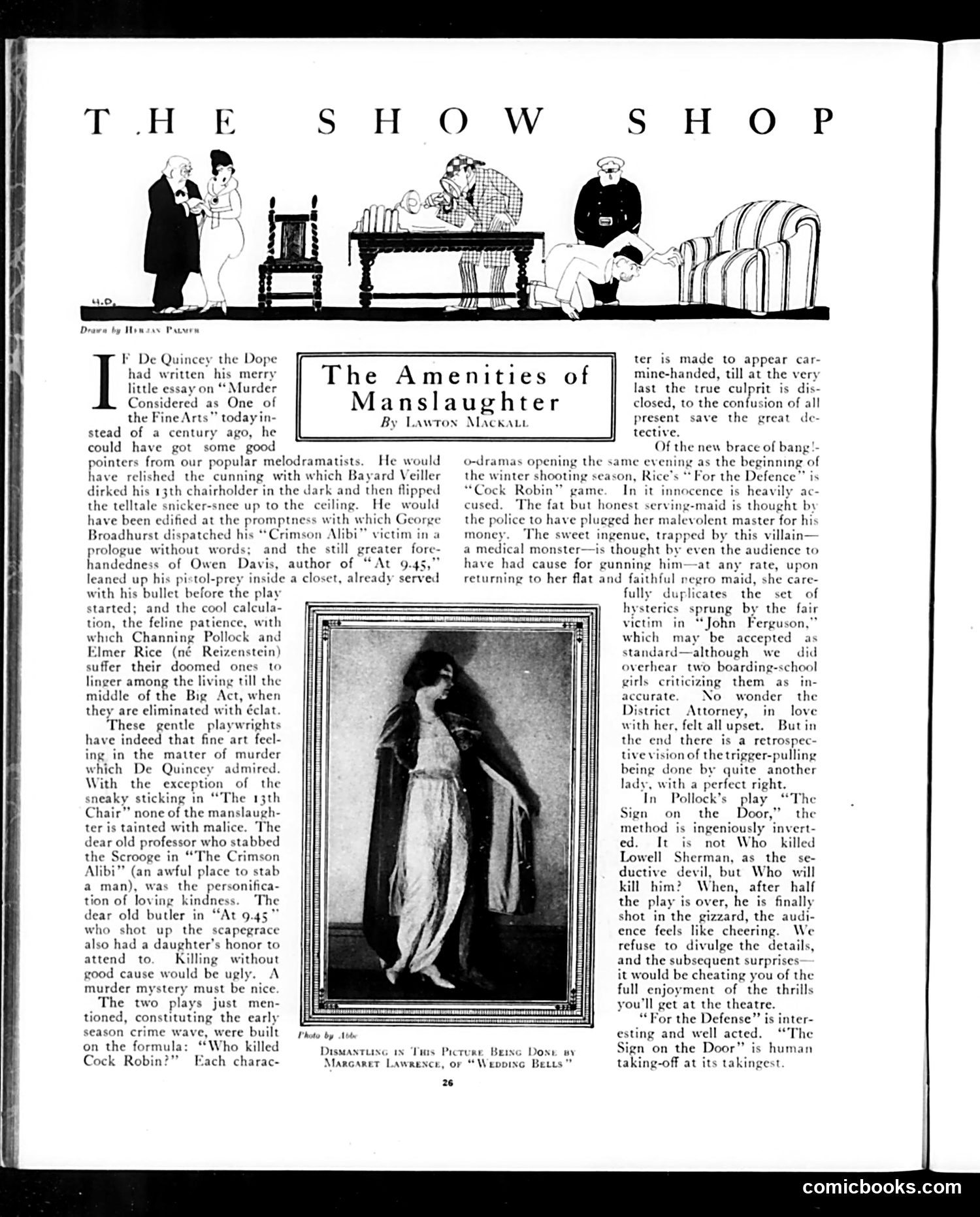
This article satirizes contemporary Broadway murder-mystery plays by Bayard Veiller, George Broadhurst, Owen Davis, Elmer Rice, and Channing Pollock. The author mocks how these playwrights treat murder as an elegant art form—borrowing the phrase from De Quincey's classical essay—rather than depicting it as genuinely morally corrupt. The satire notes the "cunning" and "feline patience" with which these dramatists stage killings, and observes that murderers in these plays are sympathetic (a butler protecting his daughter's honor, a professor motivated by kindness). The author suggests modern playwrights have perfected theatrical murder in ways that would impress De Quincey himself, while gently mocking the moral cleanliness these narratives impose on inherently ugly acts. The illustration shows Margaret Lawrence in a dramatic theatrical pose, presumably from one of these plays.
📄 Transcribed text from this page (OCR, searchable)
Machine-transcribed from the original scan — historical spelling and the odd misread are preserved.
a by Howsay Parwen F De Quincey the Dope had written his merry little essay on “ Murder Considered as One of the F Arts” today in- stead of a century ago, he could have got some good pointers from our popular melodramatists. He would have relished the cunning with which Bayard Veiller dirked his 13th chairholder in the dark and then flipped the telltale snicker-snee up to the ceiling. He would have been edified at the promptness with which George Broadhurst dispatched his “Crimson Alibi” victim in a prologue without words; and the still greater for handedness of Owen Davis, author of “At 9.45," leaned up his pistol-prey inside a closet, already served with his bullet before the play The Amenities of Manslaughter By Lawrox Mackaut ter is made to appear car- mine-handed, till at the very last the true culprit is dis- closed, to the confusion of all present save the great de- tective. Of the new brace of bang!- o-dramas opening the same evening as the beginning of the winter shooting season, Rice’s ** For the Defence ‘ock Robin” game. In it innocence is heavily ac- cused. The fat but honest serving-maid is thought by the police to have plugged her malevolent master for his money. The sweet ingenue, trapped by this villain— a medical monster—is thought by even the audience to have had cause for gunning him—at any rate, upon returning to her flat and faithful negro maid, she care- fully duplicates the set of hysterics sprung by the fair started; and the cool calcula- tion, the feline patience, with victim in ‘John Ferguson,” which Channing Pollock and Elmer Rice (né Reizenstein) suffer their doomed ones to linger among the living till the middle of the Big Act, when they are eliminated with éclat. These gentle playwrights have indeed that fine art fecl- ing in the matter of murder which De Quincey admired With the exception of the sneaky sticking in “The 13th Chair” none of the manslaugh- ter is tainted with malice. The dear old professor who stabbed the Scrooge in “The Crimson Alibi” (an awful place to stab a man), was the personifica- tion of loving kindness. The dear old butler in “At 9.45” who shot up the scapegrace also had a daughter's honor to attend to. Killing without good cause would be ugly. A murder mystery must be nice The two plays just men- tioned, constituting the early which may be accepted standard—although we overhear two boarding-school girls criticizing them as in- accurate. No wonder the District. Attorney, in love with her, felt all upset. Butin the end there is a retrospec- tive vision of the trigger-pulling being done by quite another lady, with a perfect right In Pollock’s play “The Sign on the Door,” the method is ingeniously invert- ed. It is not Who killed Lowell Sherman, as the s ductive devil, but Who will kill him?) When, after half the play is over, he is finally shot in the gizzard, the audi- ence feels like cheering. We refuse to divulge the details, and the subsequent surprises it would be cheating you of the full enjoyment of the thrills you'll get at the theatre. “For the Defense” is inter- did season crime wave, were built on the formula: “Who killed Cock Robin?” Each charac- Photo by Abbe DISMANTLING IN Tus Picture Marcaret Lawrence, or “Weppixc Betts” 26 esting and well acted. ‘The ign on the Door” is human Beixc Dont n ! . taking-off at its takingest By comicbooks.com