
A complete issue · 36 pages · 1919
Judge — October 25, 1919
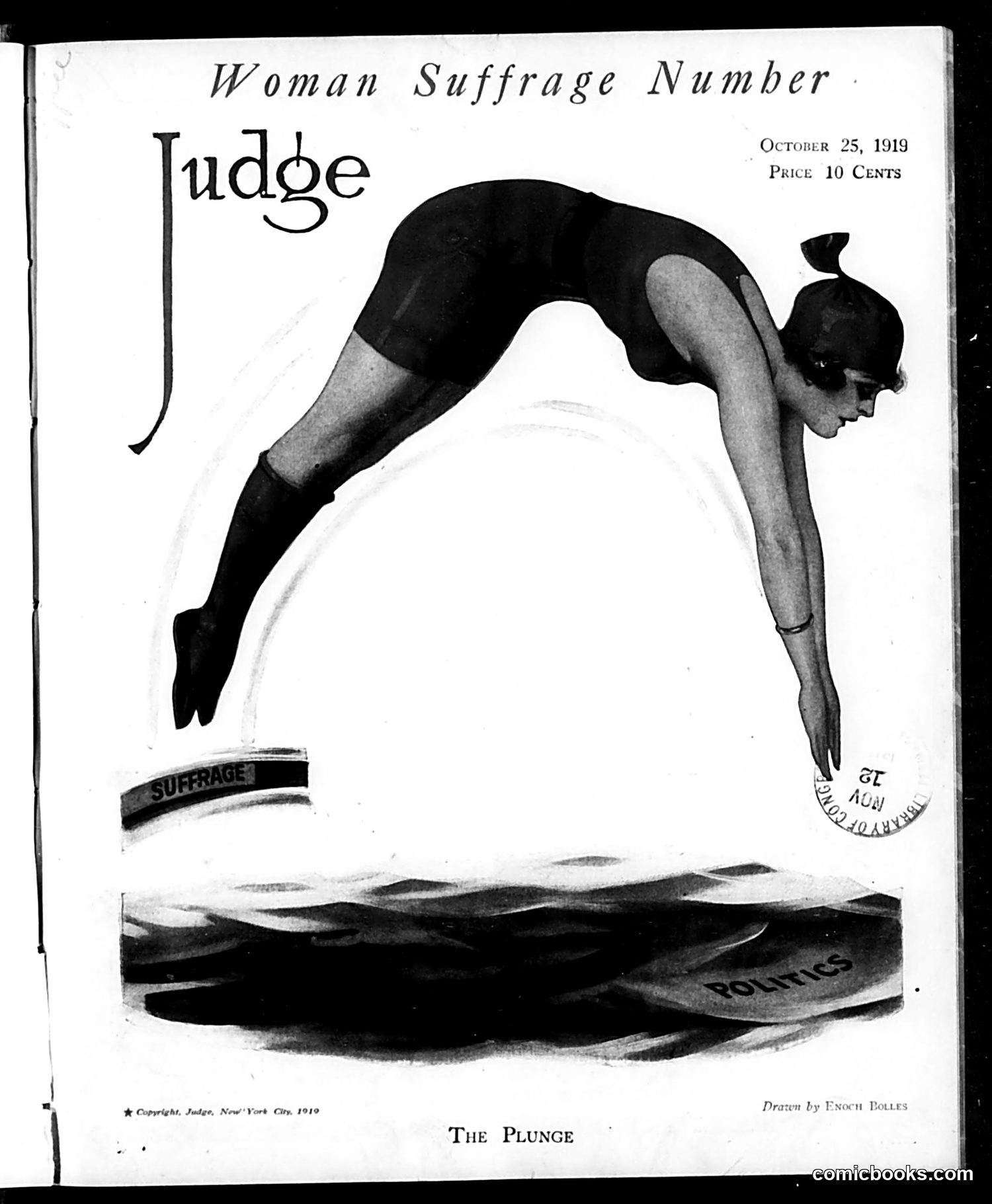
This is the cover of Judge magazine's Woman Suffrage special issue from October 25, 1919. The illustration shows a woman diving headfirst into water labeled "POLITICS," while "SUFFRAGE" appears on the wave's surface. The satire plays on the double meaning of "plunge"—both a diving motion and taking a risky action. The cartoon depicts women's entry into political participation through voting as a dramatic, potentially perilous dive into unfamiliar territory. The composition suggests uncertainty about whether this "plunge" will be successful or catastrophic. This was published shortly before the 19th Amendment's ratification (August 1920), when women's political participation remained controversial and satirical magazines frequently mocked the suffrage movement by portraying women's political involvement as dangerous or foolish.
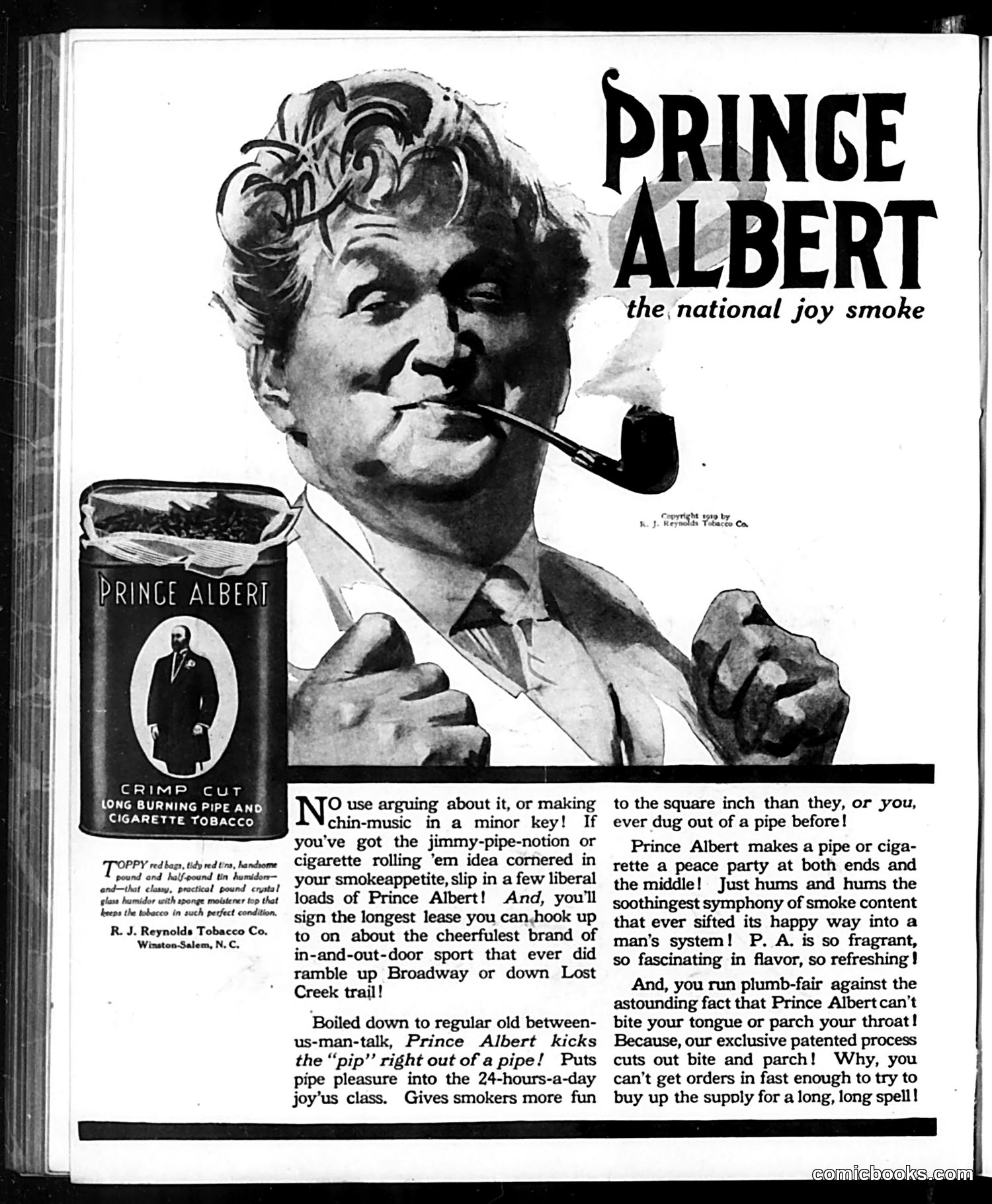
This page is primarily a **commercial advertisement**, not political satire. It promotes Prince Albert brand pipe and cigarette tobacco, manufactured by R.J. Reynolds Tobacco Company (Winston-Salem, N.C.). The ad features a man smoking a pipe, emphasizing the product's appeal to casual smokers. The tagline "the national joy smoke" and text like "kicks the 'pip' right out of a pipe" use colloquial, friendly language to market the tobacco. Notably, the ad makes health claims typical of early 20th-century tobacco marketing—asserting the product "can't bite your tongue or parch your throat" due to a "patented process." This reflects pre-regulation advertising standards, before tobacco health risks were widely acknowledged or regulated.
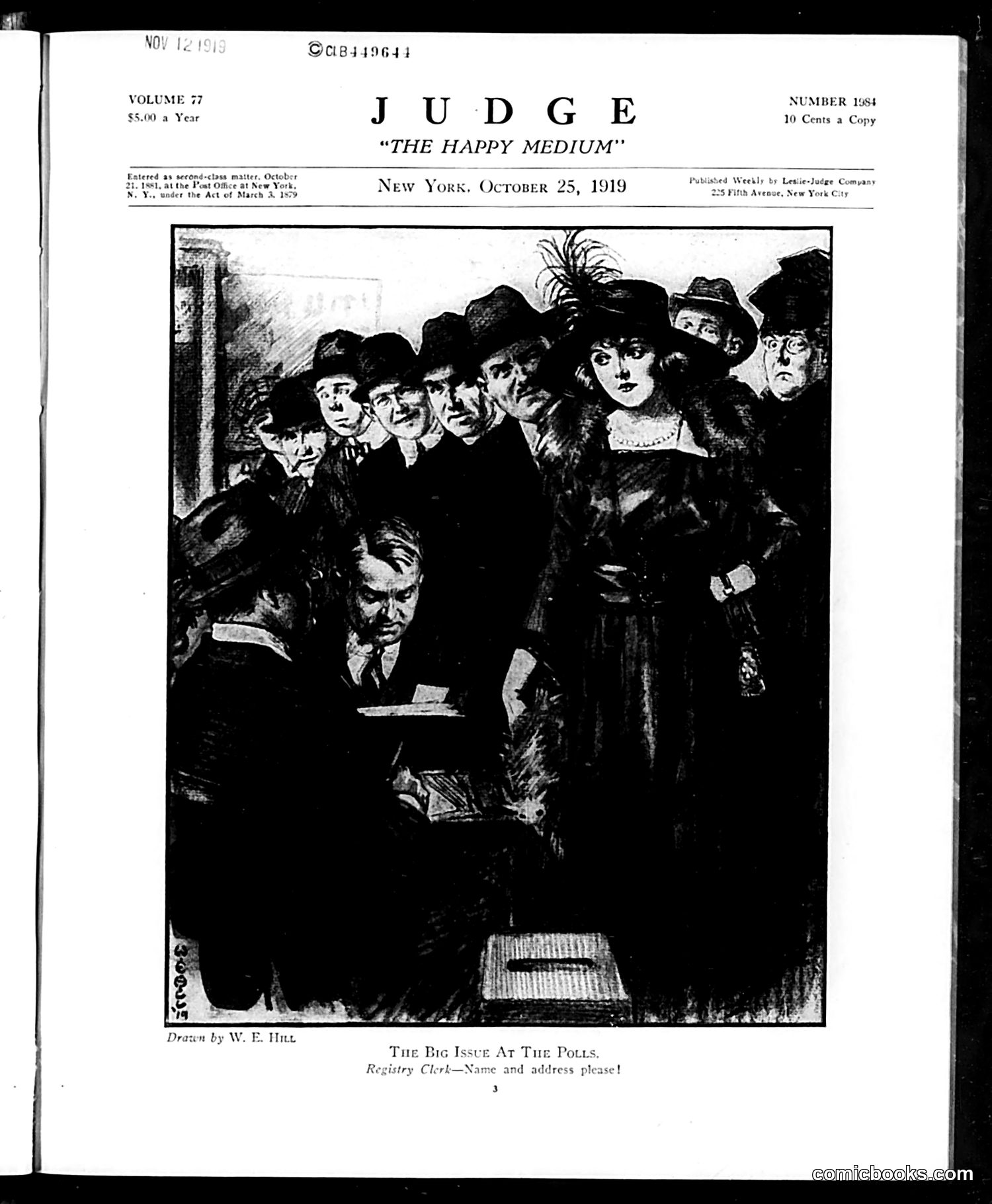
This cartoon from Judge magazine (October 25, 1919) depicts a voting scene titled "The Big Issue At The Polls," drawn by W.E. Hill. It shows a crowd of citizens at a voter registration booth, with a registry clerk requesting "Name and address please!" The cartoon appears to satirize voter registration procedures or voting participation during this period. The heavy, dark illustration style emphasizes the serious nature of voting. Given the 1919 date, this likely references post-WWI voting concerns, possibly related to women's suffrage (ratified that year) or debates about voter eligibility and registration processes. The exact political "issue" being satirized remains somewhat unclear from the image alone, though the crowded, somewhat chaotic scene suggests commentary on the voting process itself.
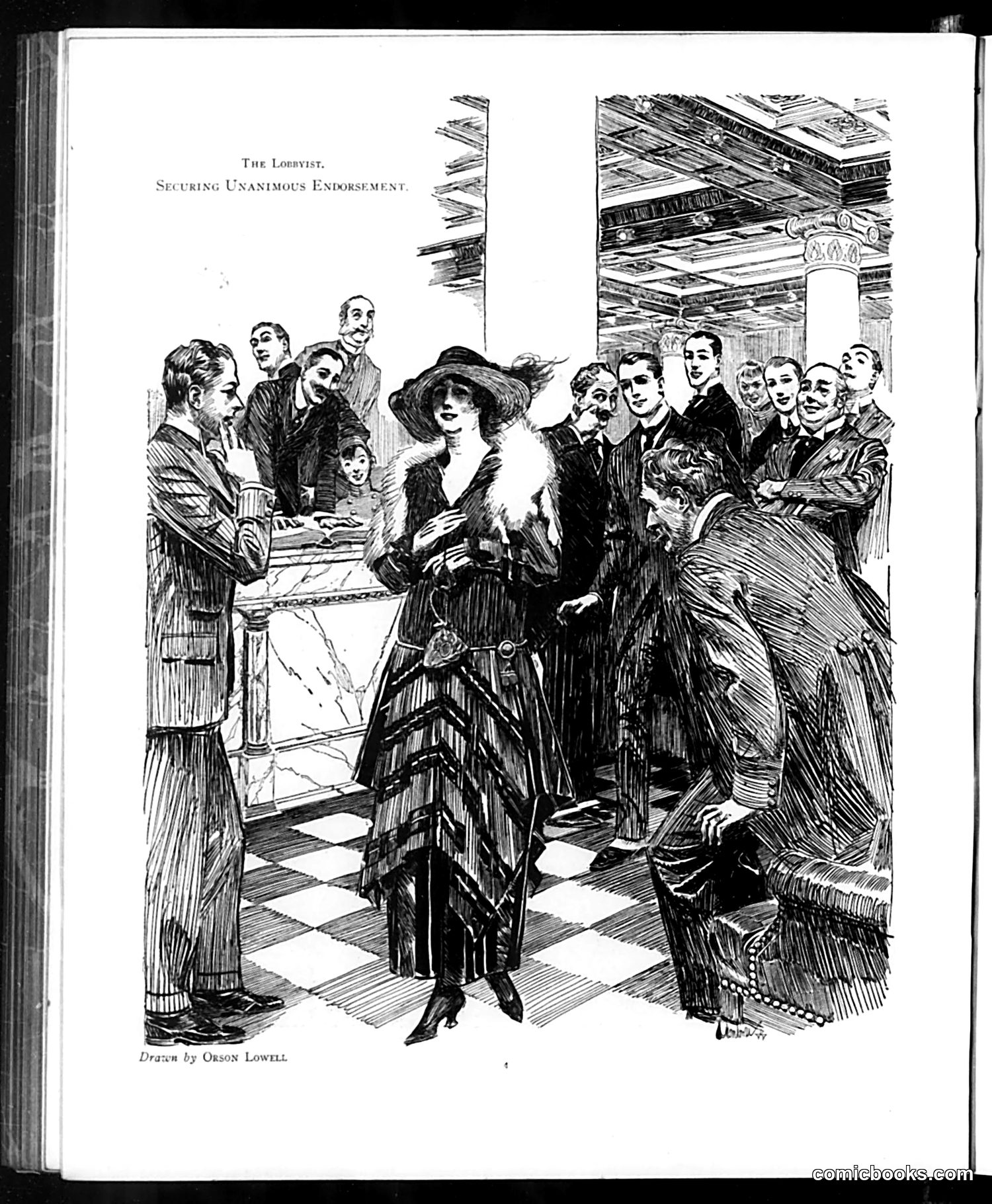
This political cartoon by Orson Lowell satirizes lobbying practices. A woman in fashionable dress and a large hat stands at a table signing what appears to be a petition or endorsement document, surrounded by a crowd of men in suits who watch her intently. The title's irony is key: the "lobbyist" (the woman) appears to be securing signatures through her personal charm and social status rather than through legitimate political argument. The gathered men seem eager to endorse whatever she supports, suggesting that lobbyists manipulated public opinion through influence and persuasion rather than reasoned debate. The cartoon critiques how special interests used social pressure and influential figures to manufacture political consensus.
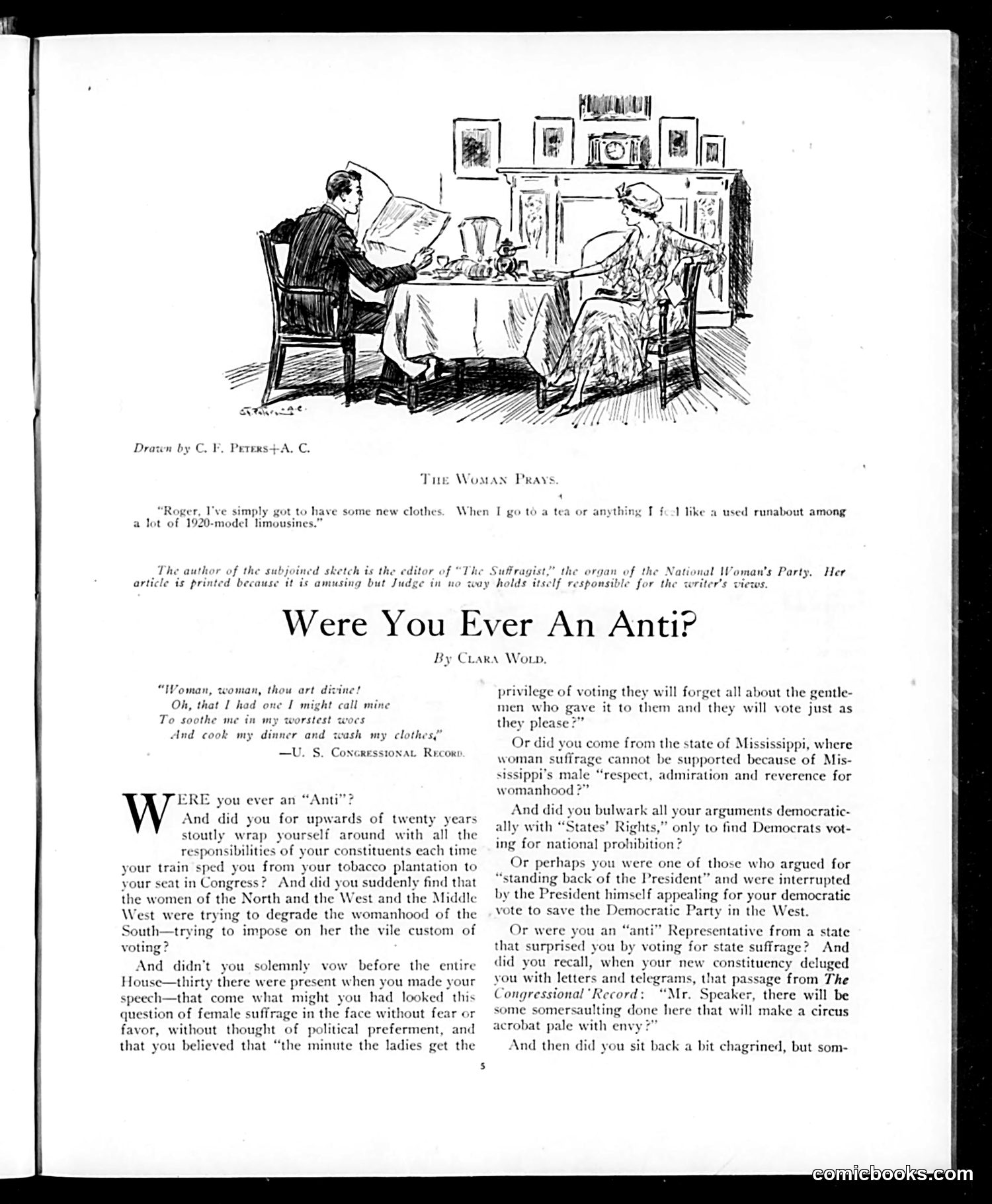
**The Cartoon "The Woman Prays":** A woman requests new clothes, claiming she feels out of place at social events among "1920-model limousines." The joke satirizes women's materialism and social climbing during the prosperous 1920s. **The Article "Were You Ever An Anti?":** Written by Clara Wold, this piece addresses former opponents of women's suffrage. It sarcastically asks whether these "Antis" (anti-suffragists) are now embarrassed by their past positions opposing voting rights. The article references Congressional Record speeches and regional resistance, particularly from the South, which opposed women's voting on grounds of tradition and states' rights. The satire mocks the futility of their opposition, given that women's suffrage was achieved (the 19th Amendment passed in 1920).
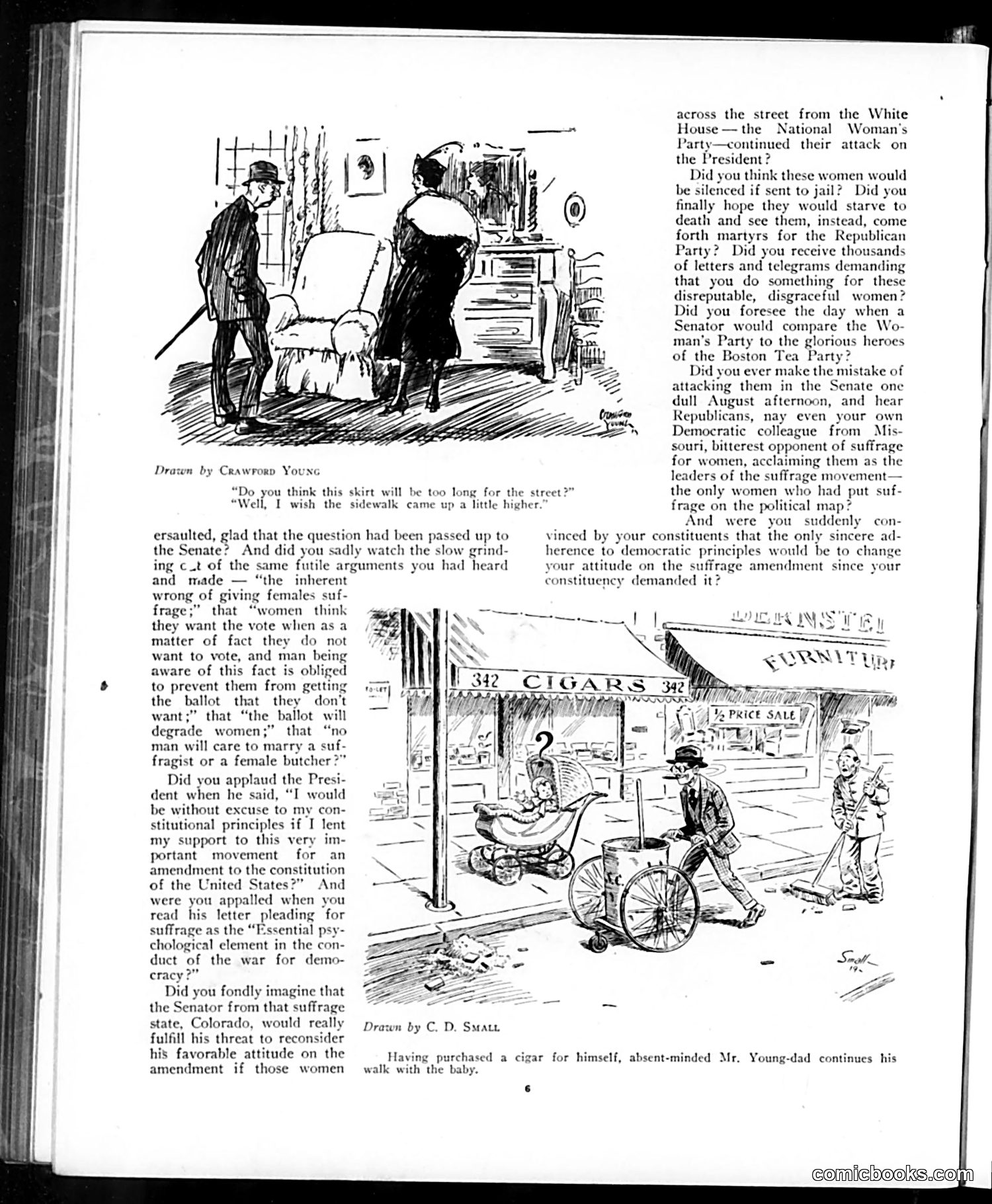
This Judge magazine page attacks suffragists through two cartoons and accompanying editorial text. The top cartoon by Crawford Young shows a woman concerned her skirt will be "too long for the street," with a man wishing sidewalks were higher—mocking suffragists as vain and frivolous. The lower cartoon by C.D. Small depicts an absent-minded father losing track of a baby while purchasing cigars, satirizing male negligence as worse than female activism. The dense text criticizes a Republican senator from Colorado for opposing women's suffrage despite his state's support for it. The piece uses sarcasm to condemn anti-suffrage hypocrisy, suggesting opponents' arguments about women's "nature" are merely pretexts. The satire defends the suffrage movement against dismissive stereotypes.
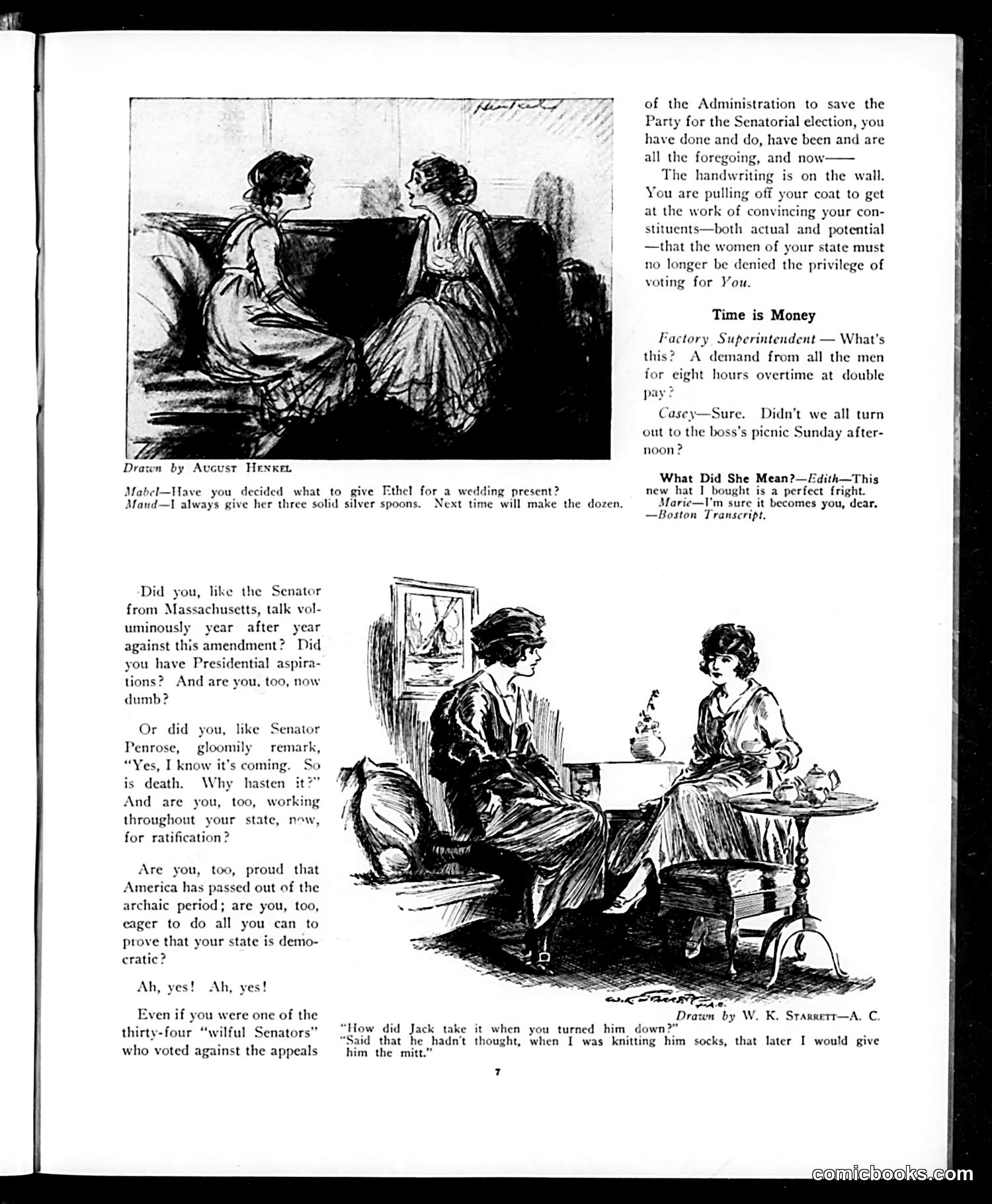
This Judge magazine page satirizes **women's suffrage ratification**, likely from around 1920 when the 19th Amendment was being debated state-by-state. The main text mocks politicians—specifically referencing a Massachusetts Senator and Senator Penrose—who publicly opposed women's voting rights but are now scrambling to support ratification to save their political careers. The satire's point: these hypocrites who argued *against* suffrage for years now pretend they championed it all along, coaching constituents to vote for them based on false support for women's rights. The "handwriting is on the wall" phrase suggests ratification is inevitable, forcing cynical politicians to perform sudden conversion. The three comic vignettes below are unrelated domestic humor about wedding gifts, labor demands, and romantic rejection—typical Judge filler material. The satire targets political opportunism and hypocrisy rather than endorsing or opposing suffrage itself.
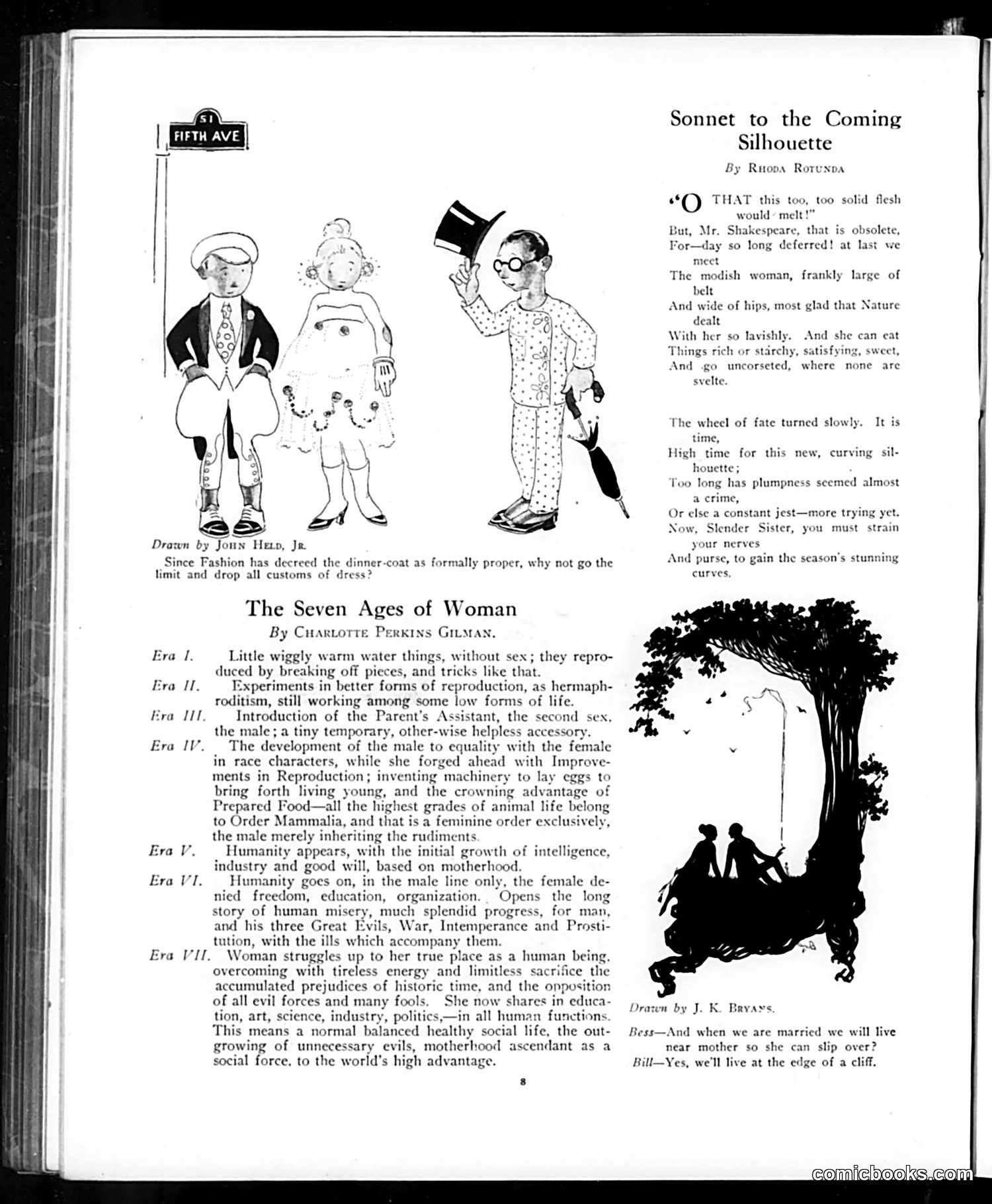
**Top Cartoon - "Sonnet to the Coming Silhouette":** This satirizes changing fashion standards for women's bodies. The sonnet mocks the shift from Victorian corseted thinness to acceptance of fuller figures and curves. It references Shakespeare to emphasize how "obsolete" the old ideal has become. The three figures illustrate the transformation: the old constrained silhouette versus the new "modish woman" with a larger belt and hips. The joke targets both the rigidity of past fashion demands and the equally rigid new standards replacing them—women must now "strain your nerves" to achieve the opposite body type. **Bottom - "The Seven Ages of Woman":** This Gilman piece (the author was a prominent feminist) traces female evolution from single-celled organisms through human history. Eras I-IV emphasize women's biological reproductive superiority. Era VI-VII critique male dominance: women historically denied education and freedom while advancing civilization, now finally achieving equality in all human functions. The closing joke about living "at the edge of a cliff" appears sarcastic commentary on marriage dynamics.
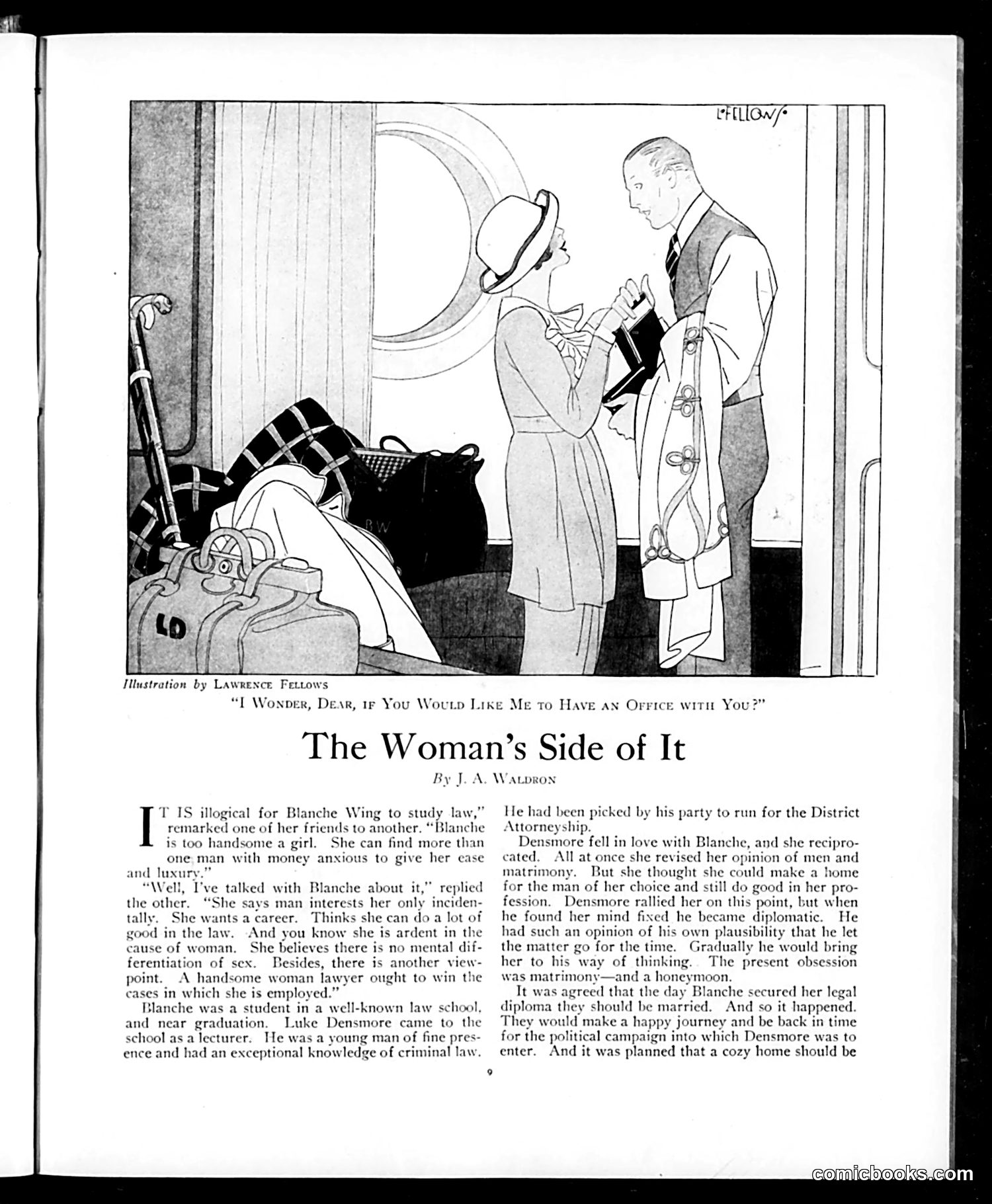
This illustration satirizes early 20th-century debates about women's professional ambitions versus marriage expectations. Blanche Wing, an ambitious law student, initially rejects marriage to pursue a legal career—rejecting a suitor's offer of an office partnership. However, she falls for Luke Densmore, a charming law lecturer and aspiring District Attorney candidate. The satire lies in the ironic outcome: despite her passionate arguments for women's intellectual equality and independence, Blanche ultimately abandons her career ambitions for matrimony. The story suggests that even career-minded women succumb to romantic persuasion and domesticity. The caption "I Wonder, Dear, if You Would Like Me to Have an Office with You?" shows Densmore diplomatically offering the office partnership—suggesting he'll gradually persuade her away from professional ambitions through charm rather than argument. The satire critiques both women's inconsistency and men's manipulative tactics.
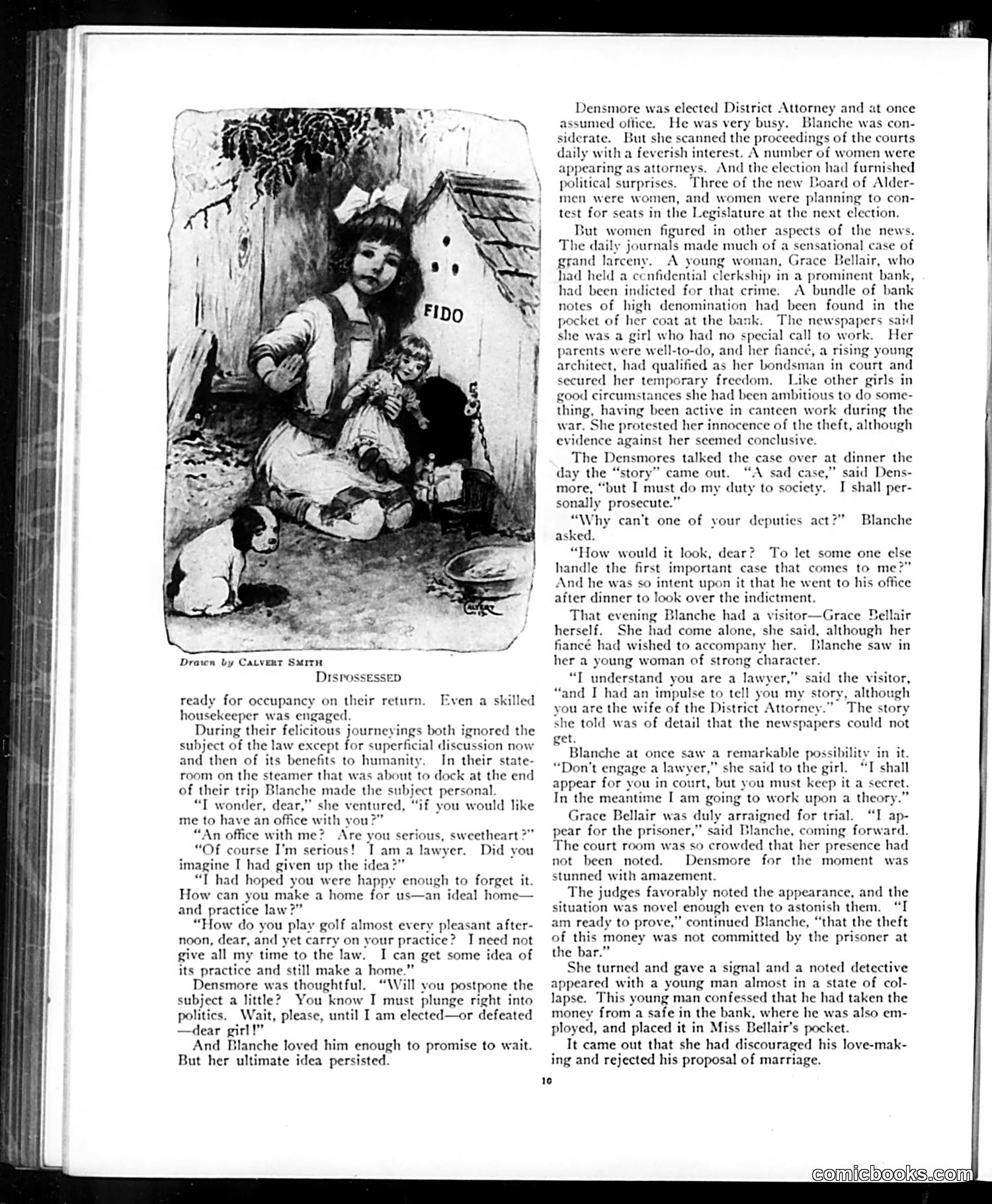
This page depicts a **feminist satire from the early 20th century** about a woman lawyer navigating professional ambition against marital expectations. **The cartoon** (titled "Dispossessed") shows a woman with children and a dog outside a modest dwelling—illustrating the domestic life Blanche is expected to maintain. **The plot:** Blanche, a qualified lawyer, wants to practice law alongside her new husband, District Attorney Densmore. He asks her to postpone this ambition until after his election. When a sensational case of grand larceny involving a young woman (Grace Bellair) emerges, Densmore insists on prosecuting personally. Blanche secretly meets with the accused, sees "a remarkable possibility," and decides to defend her in court—secretly—creating obvious dramatic irony: the prosecutor's wife will oppose him. **The satire's point:** The tension between women's professional capability and societal pressure to prioritize homemaking and spousal support. The "remarkable possibility" Blanche sees likely involves exonerating evidence, positioning her as morally superior to her husband's rigid duty-bound approach.
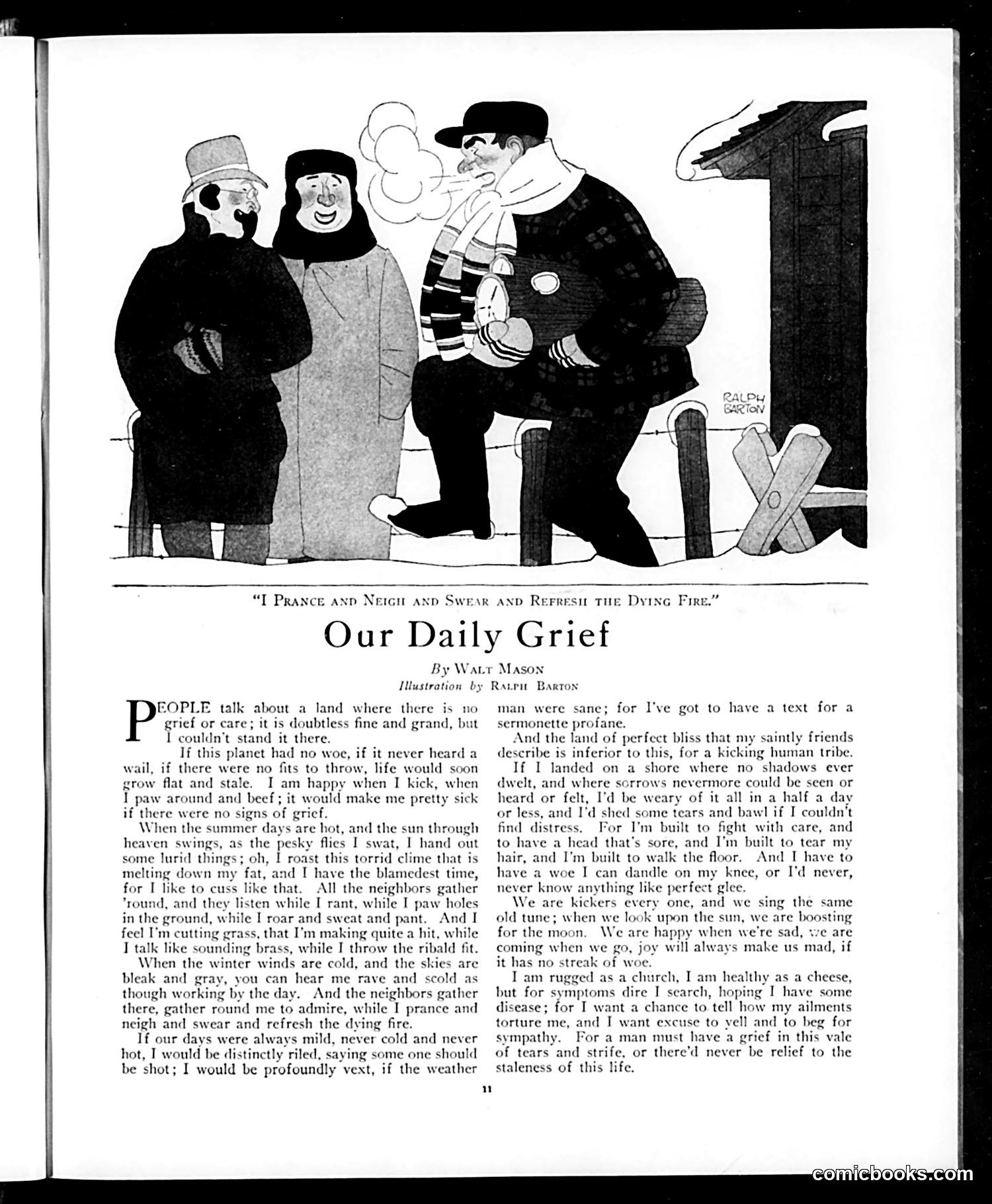
This is a humorous essay-illustration about human nature's need for complaint and hardship. The cartoon shows four figures gathered around what appears to be a dying fire in winter—the visual reference to the text's opening: "I prance and neigh and swear and refresh the dying fire." The piece satirizes the human condition by arguing that people *require* discomfort to feel alive. Mason's narrator claims he enjoys complaining about summer heat, winter cold, and various ailments—and that neighbors actually gather to watch his theatrical displays of grief and frustration. The satire is that perfect contentment would be insufferable; we need problems to gripe about to feel purposeful. The illustration by Ralph Barton depicts ordinary men in winter clothes—recognizable types rather than specific political figures—embodying this universal human tendency toward discontent. The satire targets no particular group but rather human nature itself: we're happier being unhappy.
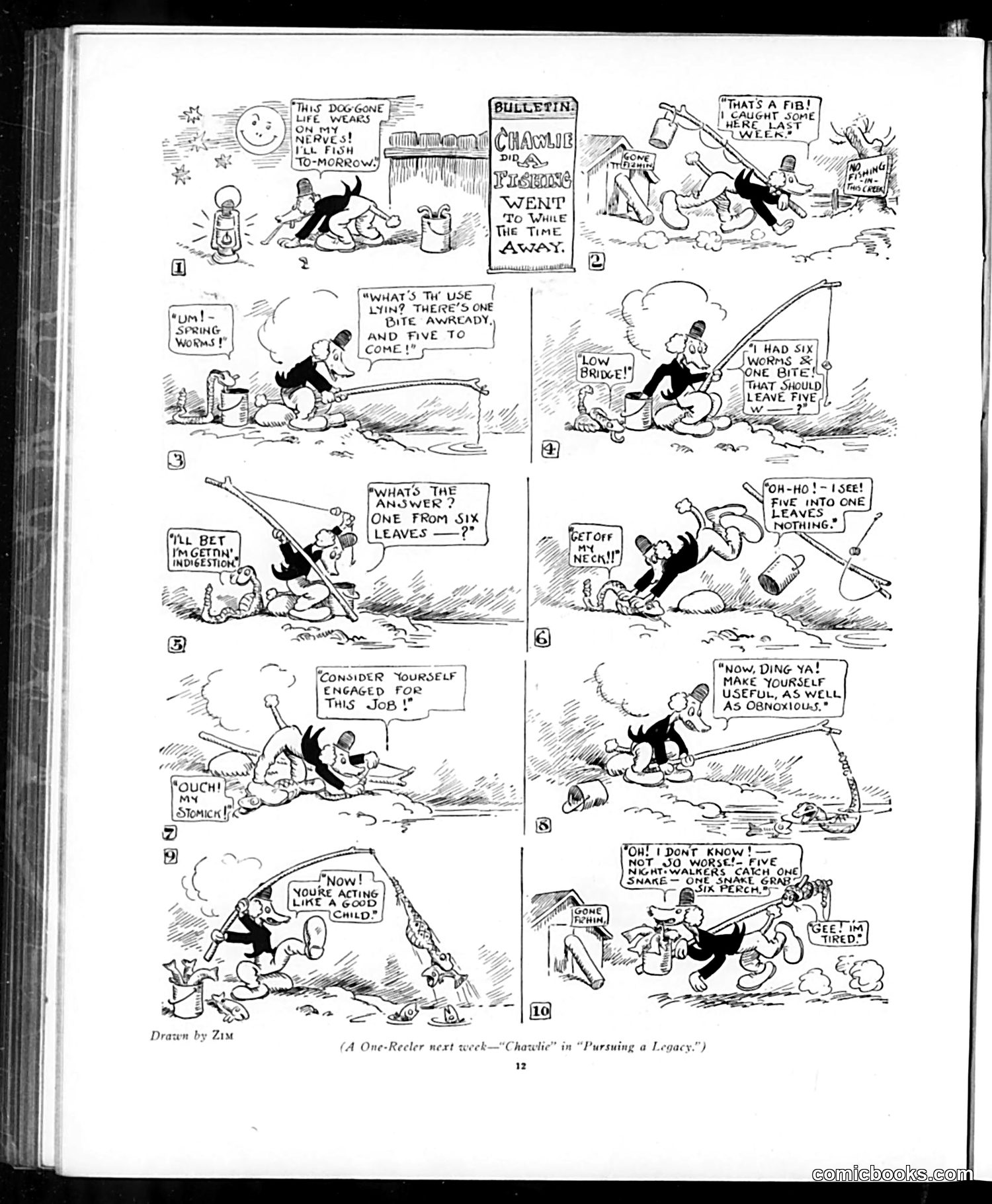
This is a humorous one-panel comic strip (or series) featuring a character named "Chawlie" going fishing. The humor relies on wordplay and pratfalls rather than political satire. The joke centers on a mathematical riddle: if one worm is eaten by a fish, leaving five worms, the answer to "one from six leaves—?" should be five. However, Chawlie misinterprets this as a statement about the actual worms remaining, leading to physical comedy and confusion. The strip shows escalating mishaps—failed fishing attempts, miscalculations, and Chawlie's frustration—culminating in him being hired for a job despite (or because of) his incompetence. This appears to be character-driven comedy typical of early 20th-century Judge magazine, emphasizing slapstick humor and dialectical speech patterns rather than contemporary events or political commentary.
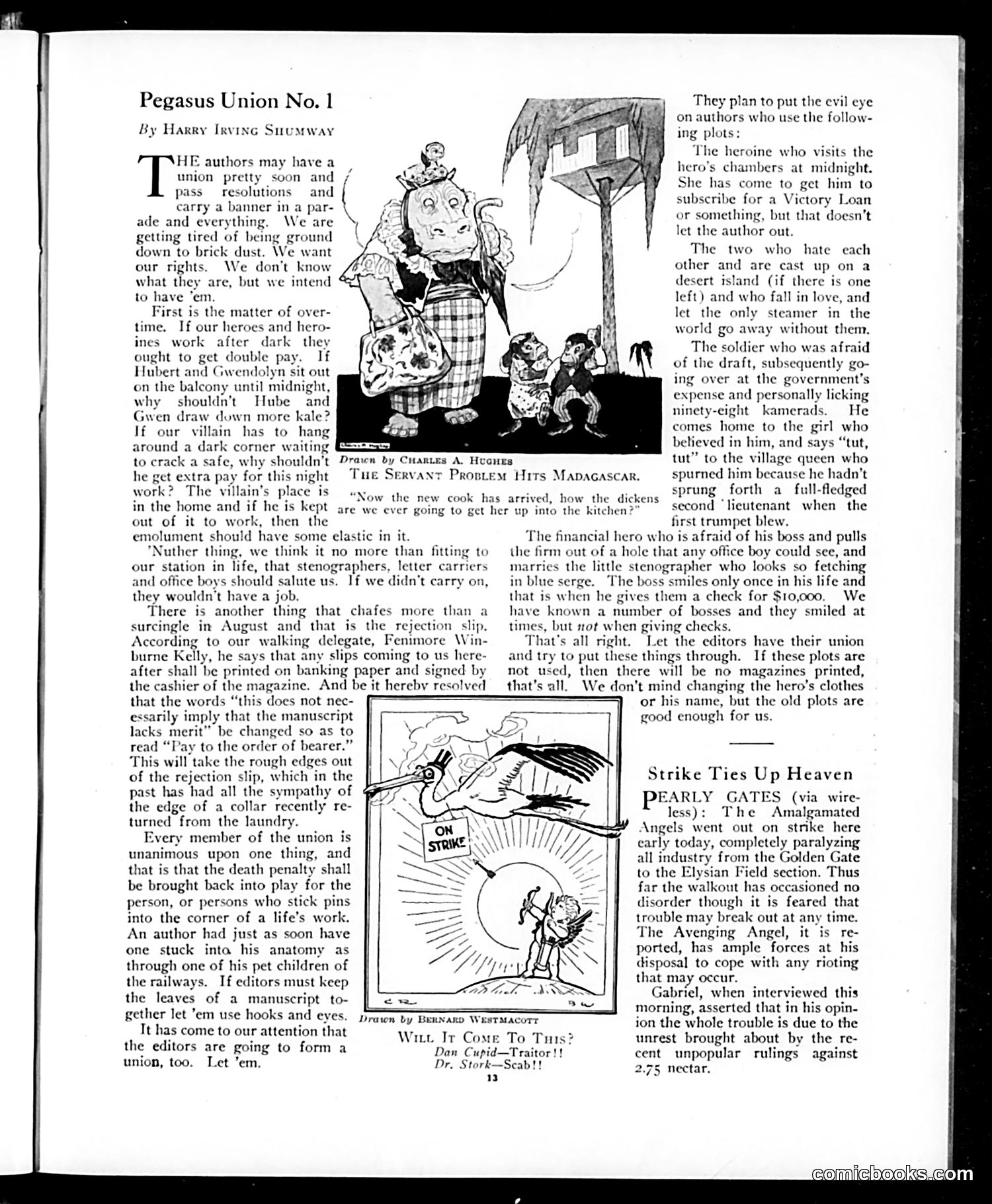
This 1918 satirical piece mocks authors' complaints about editorial treatment by imagining a "Pegasus Union" (Pegasus being the mythological muse). The article humorously presents authors' grievances: demanding overtime pay for characters working after dark, requiring editors to salute them, and reforming rejection slip language. The satire's target becomes clear in the right column: the author lists hackneyed plot devices he claims editors will "put the evil eye on"—clichéd romance and war narratives (midnight bedroom visits, desert island romance, drafted soldiers returning as heroes). The joke inverts: the author sarcastically suggests if editors ban these tired plots, no magazines will be printed at all, implying authors *rely* on such conventions precisely because they're commercially reliable, not artistically meritorious. The piece mocks both editorial gatekeeping and authors' lazy dependence on formula—neither group should pretend superiority.
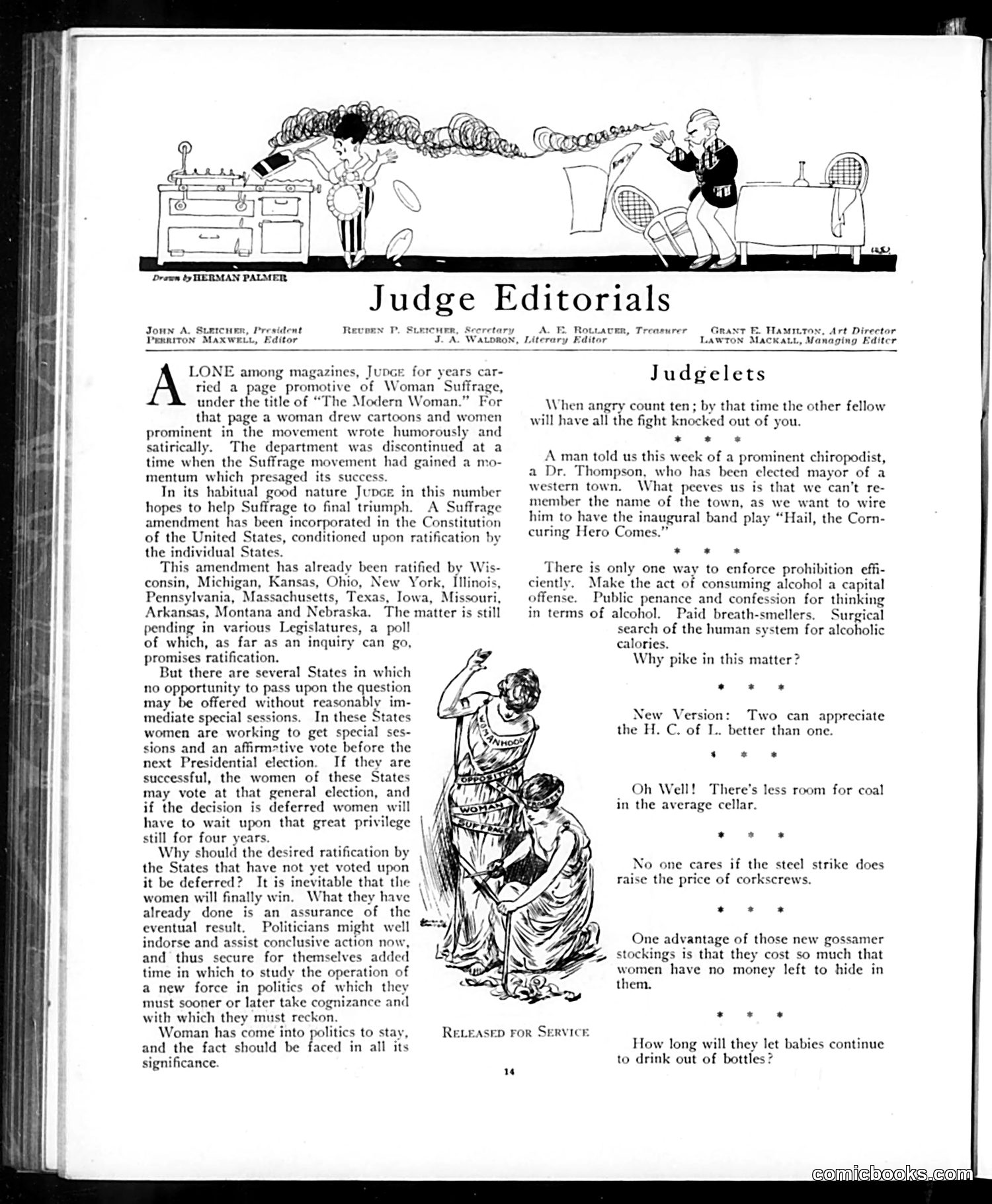
This page from *Judge* magazine addresses women's suffrage ratification, which had recently been incorporated into the U.S. Constitution (the 19th Amendment, ratified in 1920). The main editorial urges immediate ratification by remaining states, arguing politicians should support women's voting rights now rather than delay. The top cartoon by Herman Palmer humorously depicts domestic chaos—a woman juggling household tasks while a man plays tennis, satirizing gender roles and suggesting women's entry into politics represents a significant social upheaval men must "reckon with." The "Judgelets" section offers satirical one-liners on contemporary issues: Prohibition enforcement, rising costs (H.C. of L. = High Cost of Living), coal shortages, labor strikes, and women's fashion. These quips mock both social reformers and everyday consumer problems, reflecting post-WWI America's anxieties about social change and economic disruption.
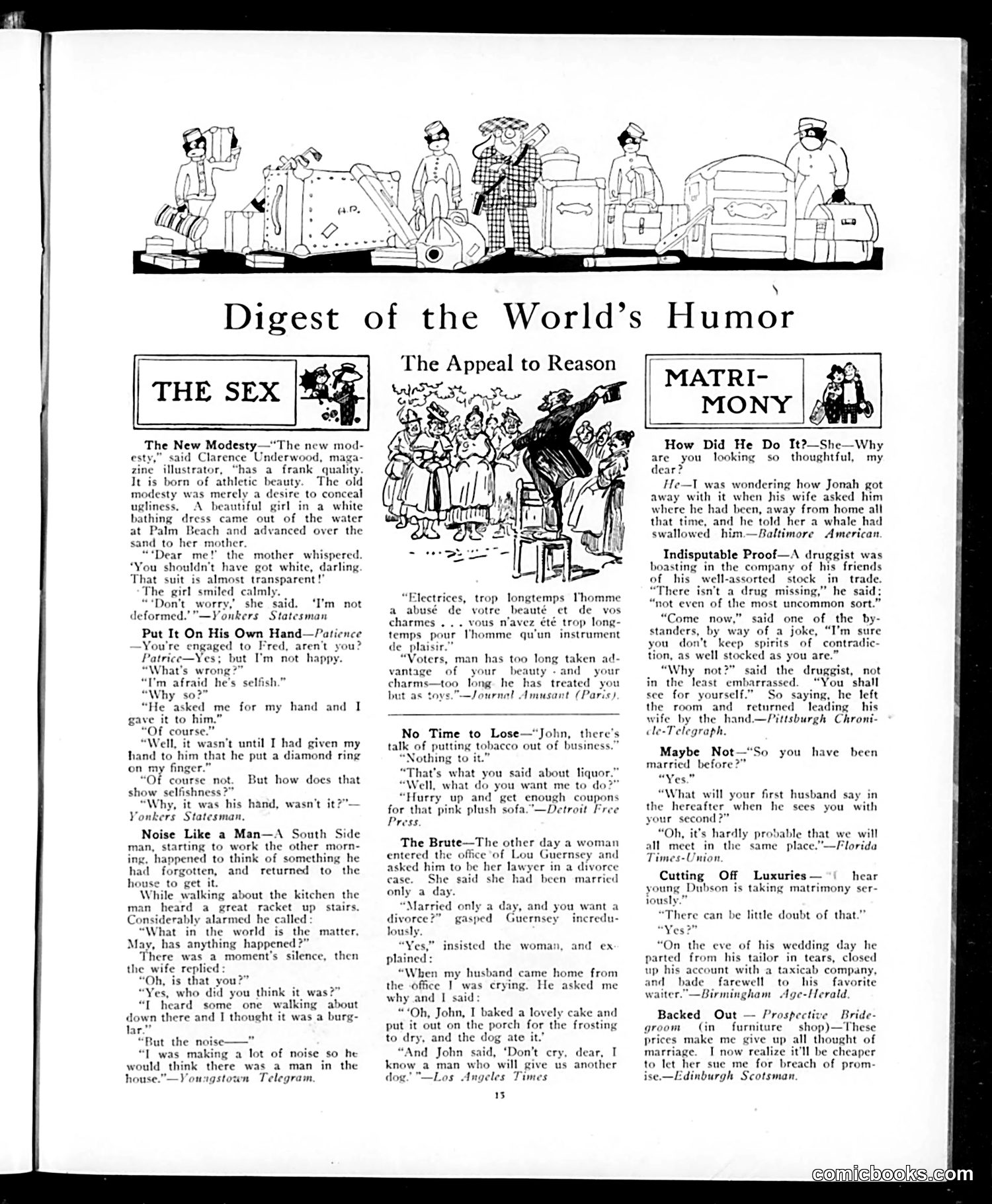
This page from *Judge* magazine collects brief satirical anecdotes organized by theme. The humor relies on wordplay and social commentary typical of early 20th-century American satire. **Key sections:** - **"The Sex"**: Jokes about modern attitudes toward women's bodies and courtship, reflecting anxieties about changing gender relations and "new modesty." - **"The Appeal to Reason"**: A French-language section satirizing men's traditional exploitation of women's beauty, likely commentary on suffrage debates. - **"Matrimony"**: Multiple jokes about marriage's disappointments—wives' supposed irrationality, husbands' selfishness, and divorce—reflecting contemporary marital discord. - **"The Brute"**: Mocks a lawyer's incredulity at a one-day marriage ending in divorce, suggesting such quick dissolutions were shocking. The overall tone treats women, marriage, and relationships as subjects for ridicule, with humor directed at both sexes but particularly at women's perceived illogic and vanity.
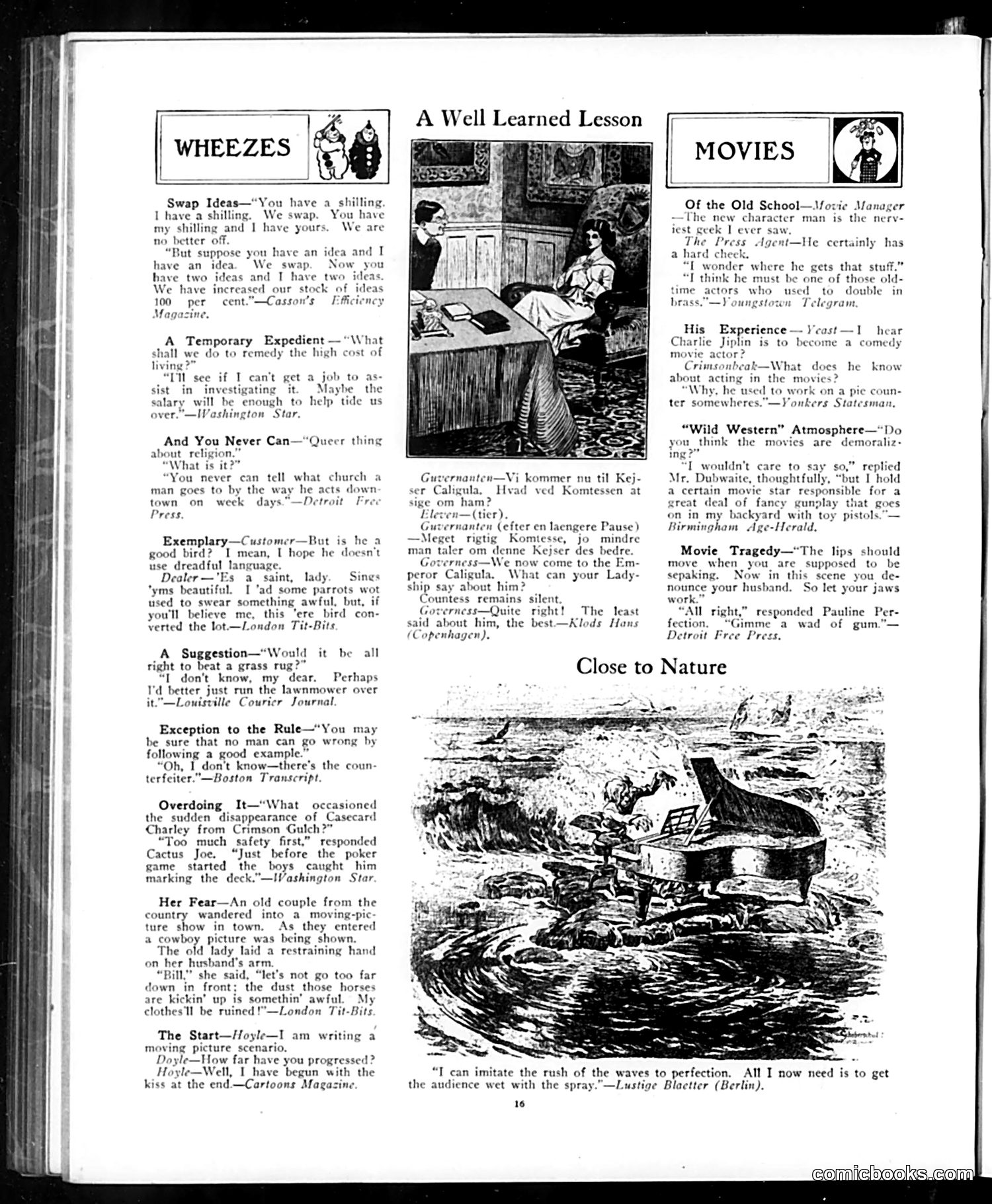
This page from *Judge* contains humor shorts and film commentary typical of early 20th-century satirical magazines. **"Wheezes" section (left):** Brief joke anecdotes satirizing everyday life—cost-of-living complaints, religious hypocrisy, and overzealous safety measures. One joke mocks a card player caught cheating who claims he was only "marking the deck" for safety. **"Movies" section (right):** Film industry commentary. References include early movie conventions (character actors, Western pictures, silent film acting challenges). A joke about "Charlie Jiplin" becoming a comedy actor plays on Charlie Chaplin's emerging fame. Comments critique overly dramatic acting and the artificiality of silent film performances. **"Close to Nature" (bottom):** A cartoon showing someone creating wave sound effects, joking about needing actual spray to complete the illusion—commentary on the disconnect between movie realism and theatrical fakery. The page reflects early cinema's novelty and the entertainment industry's growing cultural presence, while poking fun at actors' pretensions and technical limitations of silent film.
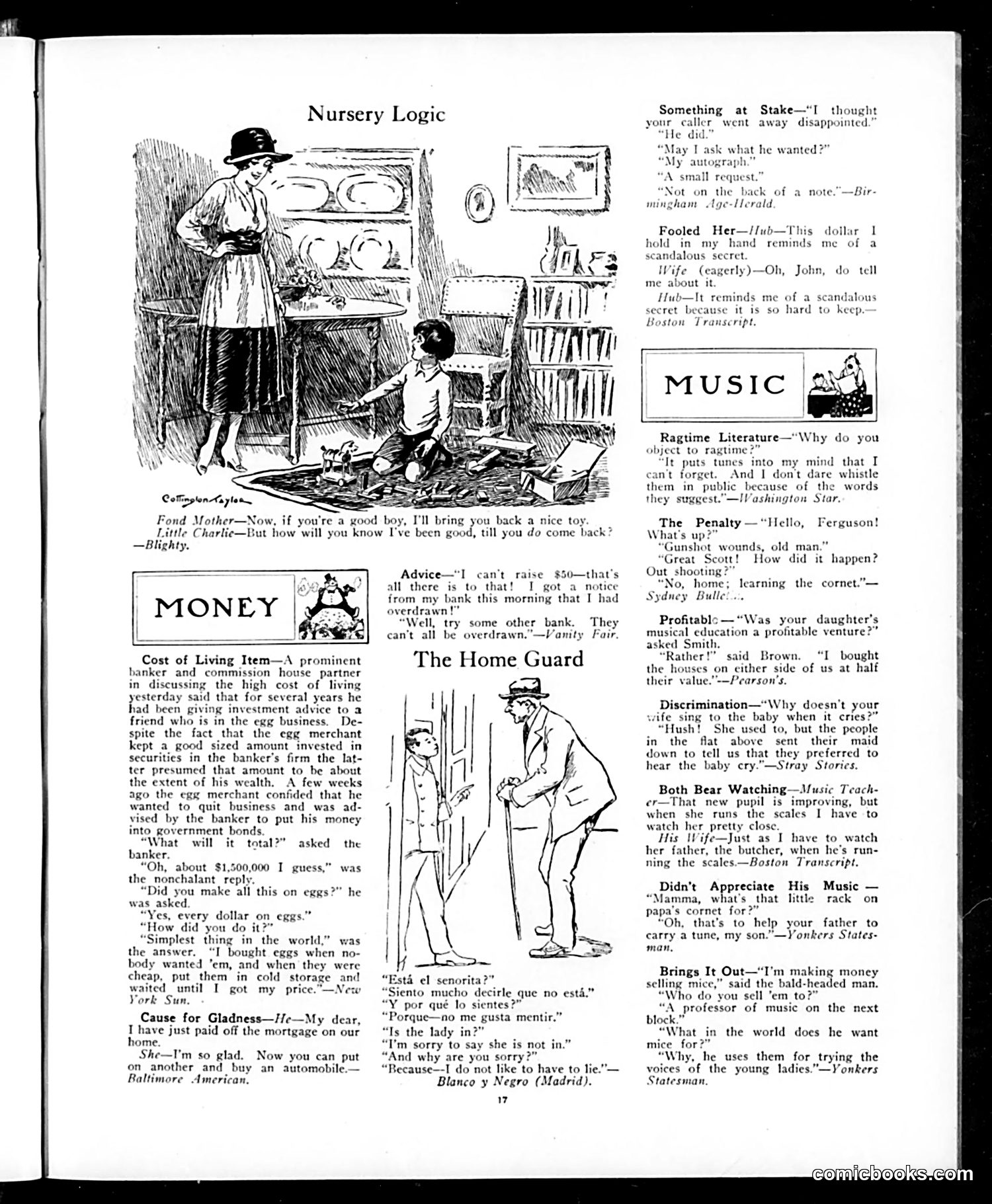
This page from *Judge* magazine (undated but early 20th century, given references to "Blighty" and period concerns) contains satirical humor organized by topic rather than continuous narratives. **Key Sections:** **"Nursery Logic"** — A mother promises a reward if her boy behaves, but the child logically points out she'll never know if he was good while she was away. The satire mocks parental reasoning. **"Cost of Living Item"** — Satirizes economic disparity. An egg merchant, assumed poor by his banker advisor, reveals he's made $1.5 million by stockpiling eggs during low prices. The joke exposes how professionals underestimate working-class wealth. **"The Home Guard"** — Shows a servant refusing to lie about the lady being "not in," then admitting the dishonesty of that polite fiction. **"Music" section** — Multiple jokes about ragtime music's invasiveness, musical education's dubious value, and absurdist humor (a music professor buying mice to test young ladies' voices). The satire targets class assumptions, consumer culture anxieties, and social pretense typical of Judge's editorial voice.
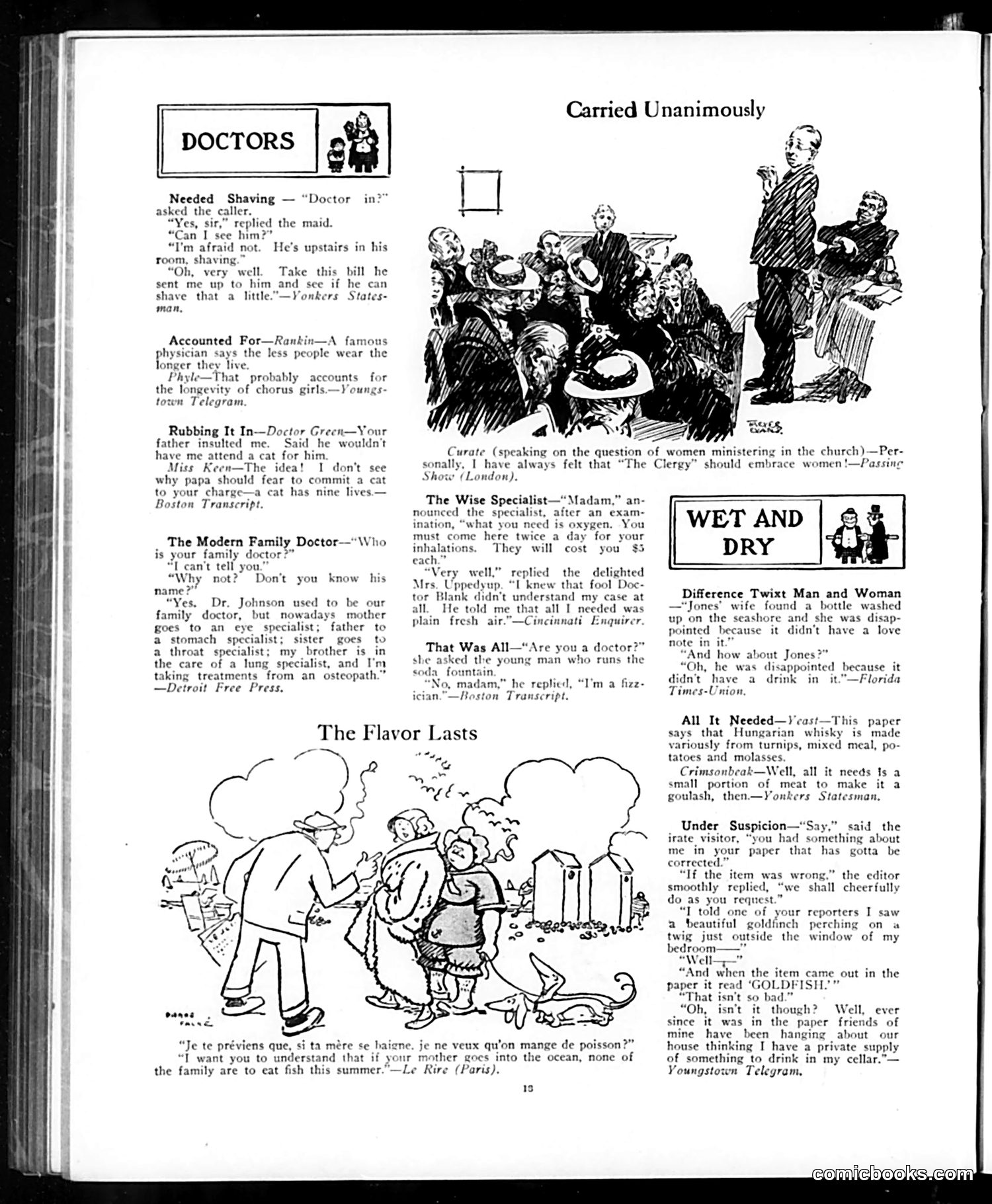
This page from *Judge* contains several short humorous anecdotes about doctors, reflecting early 20th-century social attitudes. **The "Doctors" section** satirizes medical specialization's absurdity—a family now requires separate specialists for eyes, stomach, throat, and lungs rather than one family physician. The jokes mock both doctors' pretensions and patients' gullibility: a "specialist" prescribes expensive oxygen inhalations when fresh air suffices; a soda fountain attendant calls himself a "fizz-ician." **"The Flavor Lasts"** is a French cartoon about a mother's ocean safety rule, implying humorous concern about contamination. **"Wet and Dry"** contrasts male and female disappointment: a wife finds a bottle without a love note; her husband regrets it lacks alcohol—a commentary on gender stereotypes and Prohibition-era attitudes. **"Under Suspicion"** jokes about newspaper accuracy: a man complains a reported goldfinch sighting caused friends to suspect he secretly hoards liquor—satirizing both press errors and Prohibition-era social suspicion. The overall tone reflects popular humor priorities: medical system inefficiency, gender differences, and Prohibition anxieties.
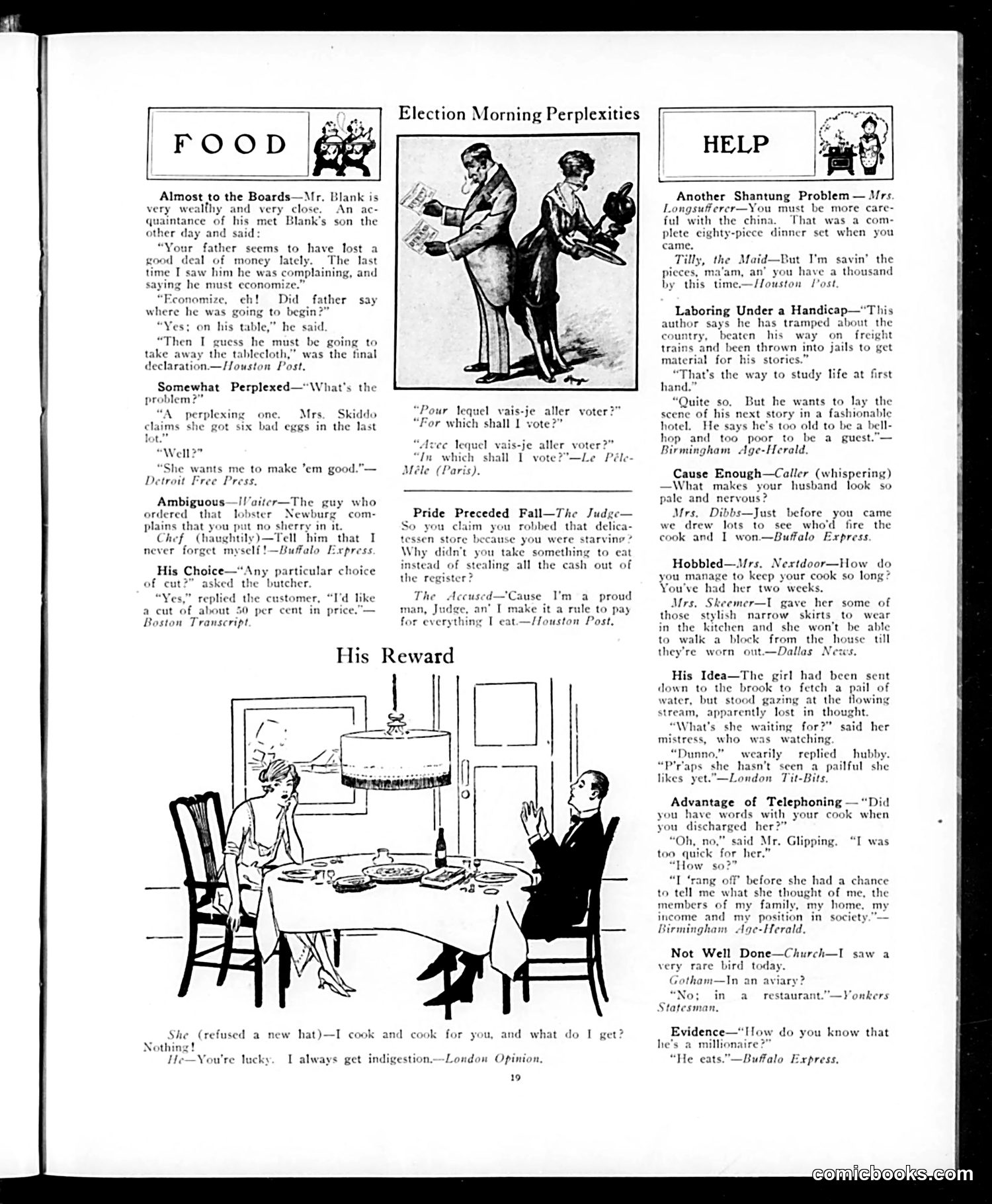
This Judge magazine page collects brief humorous anecdotes organized into "FOOD" and "HELP" sections, with an illustration titled "His Reward" depicting a couple at dinner. **Key Content:** The cartoons mock domestic life: a stingy wealthy man who economizes on his table; a wife with spoiled eggs; a butcher misunderstanding a customer's price request. "His Reward" shows a husband appearing content while his wife serves dinner—the caption sarcastically notes she got "nothing" after cooking, yet claims "always get indigestion," suggesting marital discord over domestic labor. **Social Commentary:** The humor targets penny-pinching husbands, incompetent servants ("Hobbled" jokes about keeping cooks), spoiled middle-class households, and the perennial servant problem. References to "Shantung" (likely chinaware) and repeated cook-firing reflect period anxieties about domestic help and household management. **Context:** These are genteel, class-conscious jokes from American periodicals (Houston Post, Buffalo Express, London Opinion quoted), reflecting early 20th-century middle-class preoccupations with servants, food quality, and marital dynamics—topics largely obsolete today.
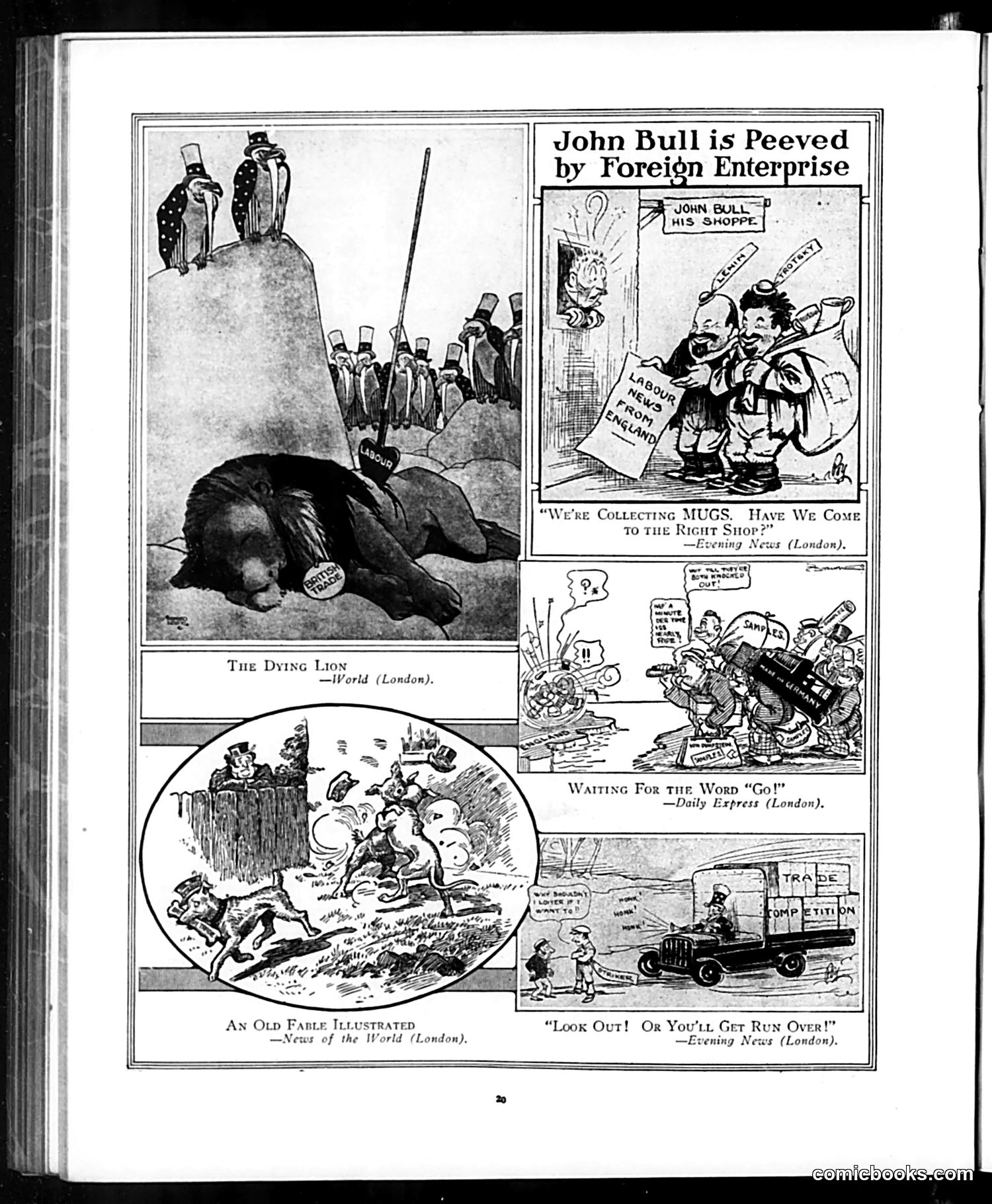
This Judge page satirizes British anxieties during wartime (likely WWI or post-war period). "John Bull" is the personified symbol of Britain, shown as a dying lion being preyed upon by foreign powers represented by caricatured figures at the top left. The right panel mocks British industrial/trade concerns: foreign agents collect "mugs" (duping British merchants), while satirical scenes show chaos in British commerce and competition—one cartoon warns of being "run over" by foreign trade threats. The bottom illustrations reference classic fables to suggest Britain's decline relative to aggressive foreign enterprise. The overall message critiques how foreign business interests are exploiting or outmaneuvering Britain's traditional commercial dominance, portraying this as a national humiliation symbolized by the dying lion metaphor.
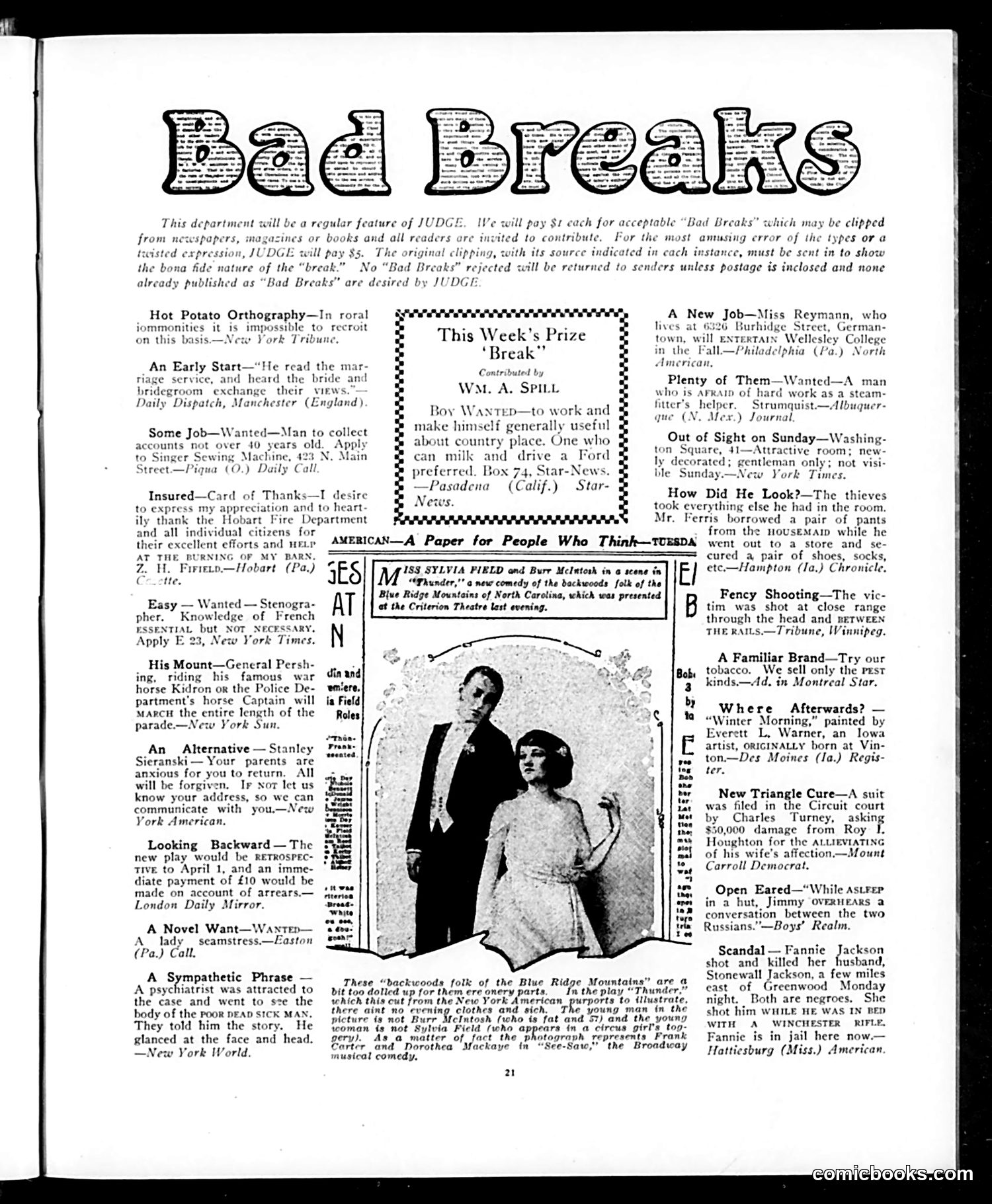
This page features Judge's "Bad Breaks" department—a humor section paying readers $1 for typographical and editorial errors clipped from newspapers. The featured prize-winning error comes from a Pasadena newspaper: "Boy Wanted—to work and make himself generally useful about country place. One who can milk and drive a Ford preferred." The accompanying cartoon criticizes a misleading photograph caption in the New York American. The publication ran a photo claiming to show actors from the play "Thunder," featuring backwoods characters from North Carolina's Blue Ridge Mountains. However, the actual image shows Miss Sylvia Field and Burr McIntosh—dressed in evening clothes, appearing urban and refined—contradicting the supposed "backwoods folk" depicted in the play. The satire mocks the newspaper's careless or dishonest misrepresentation of the photograph's actual content.
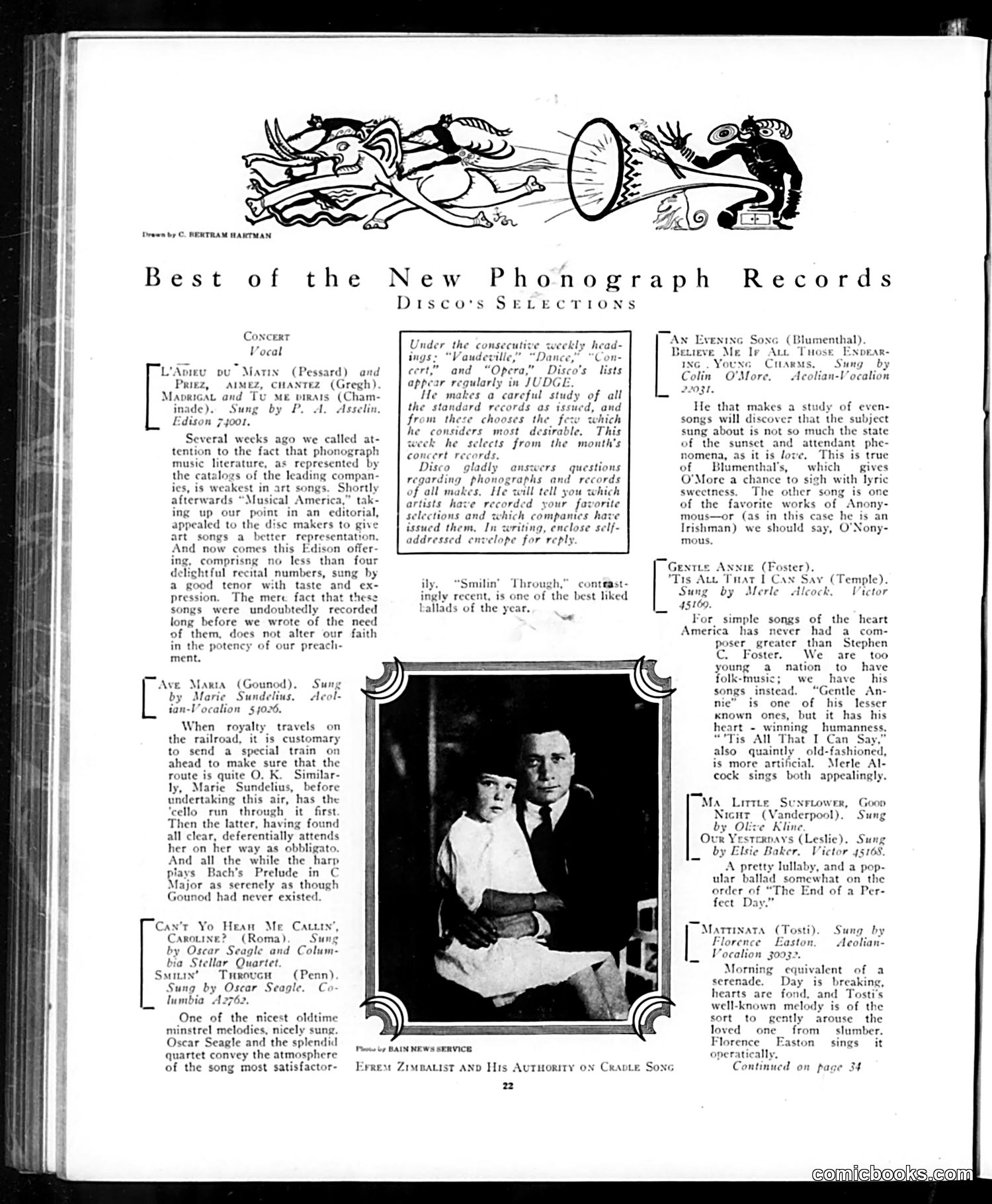
This page reviews Edison phonograph recordings, featuring a decorative header with cherubs and a gramophone. The content is straightforward music criticism rather than political satire. The page discusses vocal recordings by performers like Marie Sundelius and Oscar Seagle, evaluating their artistic merit. One anecdote notes that when royalty travels by train, a special train runs ahead to ensure the route is safe—Sundelius apparently does the same with her cello, having it "run through" concert halls first before performing there herself, with the harp accompanying Bach's Prelude. The reviews are earnest assessments of song quality and performer interpretation. The photograph shows **Efrem Zimbalist and His Authority on Cradle Song**, suggesting a notable musician of the era. This appears to be a regular feature in Judge magazine, mixing entertainment coverage with the magazine's typical satirical content elsewhere.
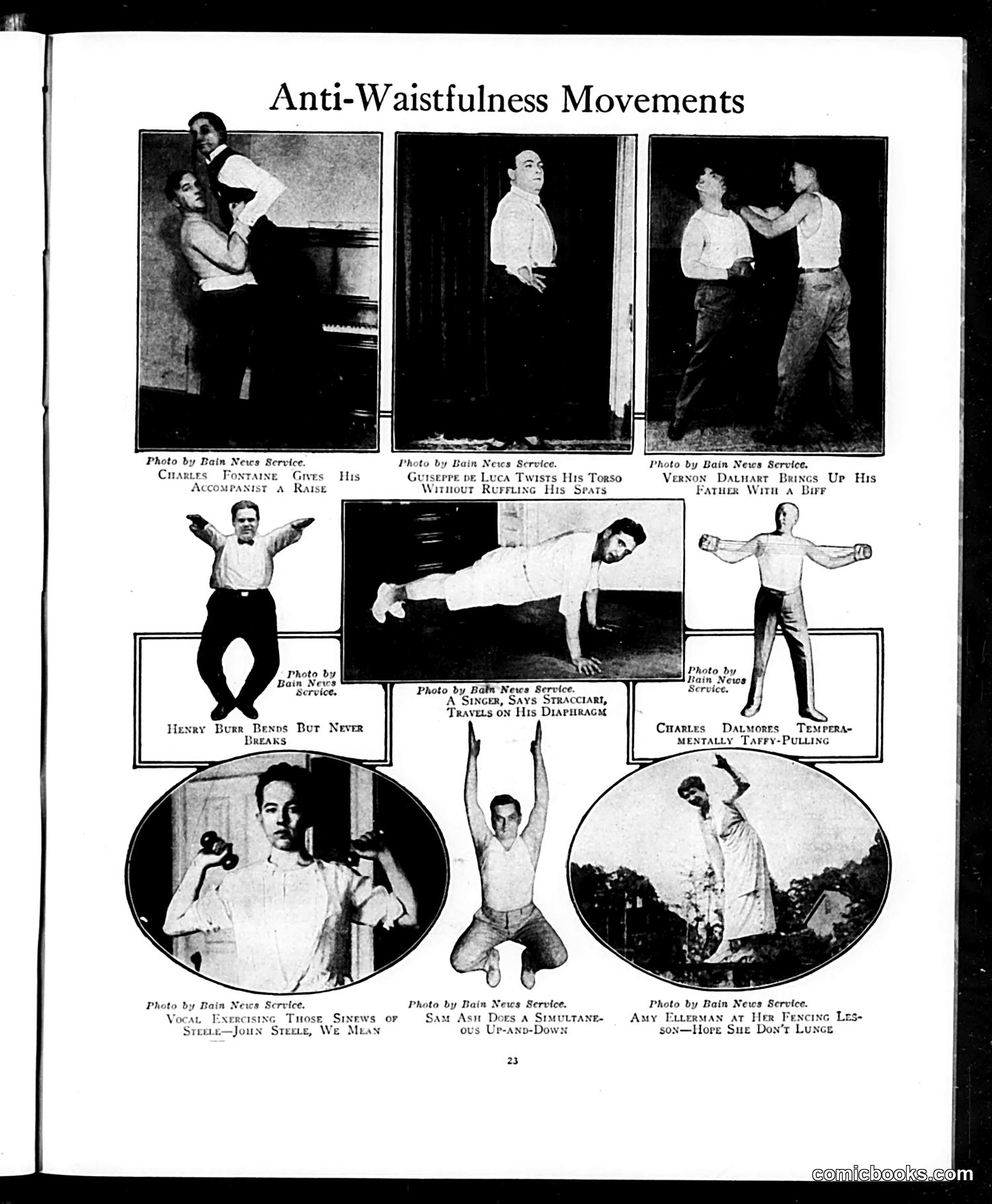
This page satirizes the early 20th-century anti-corset movement by showing performers and public figures demonstrating physical exercises and movements supposedly designed to reduce waist size without restrictive clothing. The title plays on "wastefulness"—suggesting corsets were wasteful of women's health and freedom. The photographs feature named entertainers (Charles Fontaine, Henry Burr, John Steele, Giuseppe de Luca, Sam Ash, Vernon Dalhart, Charles Dalmores, and Amy Ellerman) performing exaggerated physical contortions—bending, stretching, twisting, holding weights—presented as fashionable "anti-waist" exercises. The satire mocks both the anti-corset crusade's earnestness and these celebrities' willingness to publicly perform undignified movements for the cause. The humor lies in the absurdity of the exercises themselves and the celebrities' participation in this health trend.
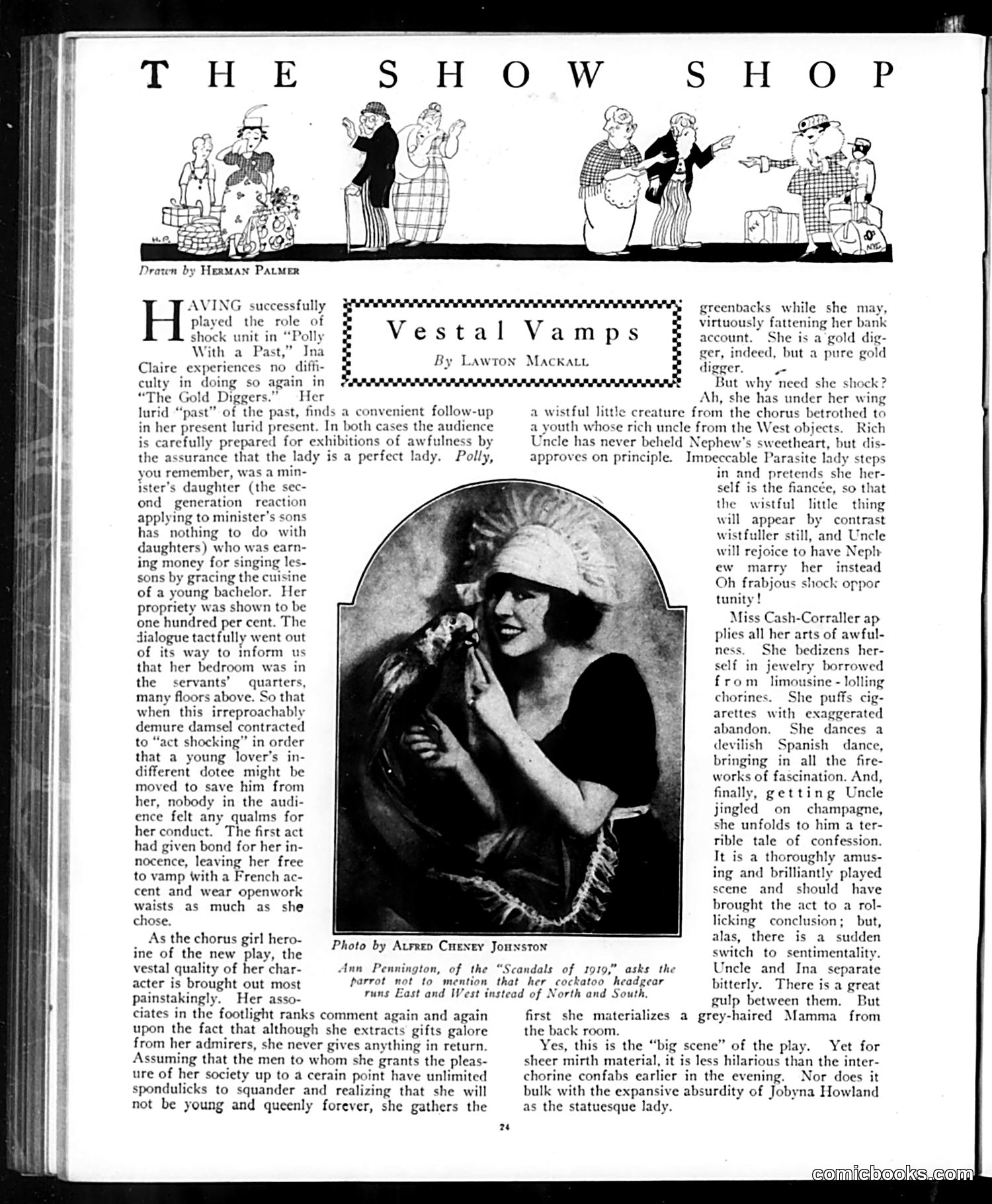
This is a theater review of "The Gold Diggers" starring actress Ina Claire. The critic discusses how Claire plays a "gold digger"—a woman who extracts money from wealthy men while maintaining a facade of respectability. The satire targets the theatrical convention of establishing a character's moral purity before allowing her to behave scandalously. Claire's character is presented as virtuous (her bedroom is strategically in the servants' quarters), which supposedly justifies her subsequent seductive behavior toward a rich uncle to help a young woman's romance. The reviewer finds this dramatic sleight-of-hand amusing but notes the play undermines its own comedy by switching to sentimentality, particularly when the character's "grey-haired Mamma" appears. The illustration shows Ann Pennington, a contemporary chorus girl, demonstrating the exaggerated styling ("cockatoo headgear") typical of these theatrical gold-digger roles.
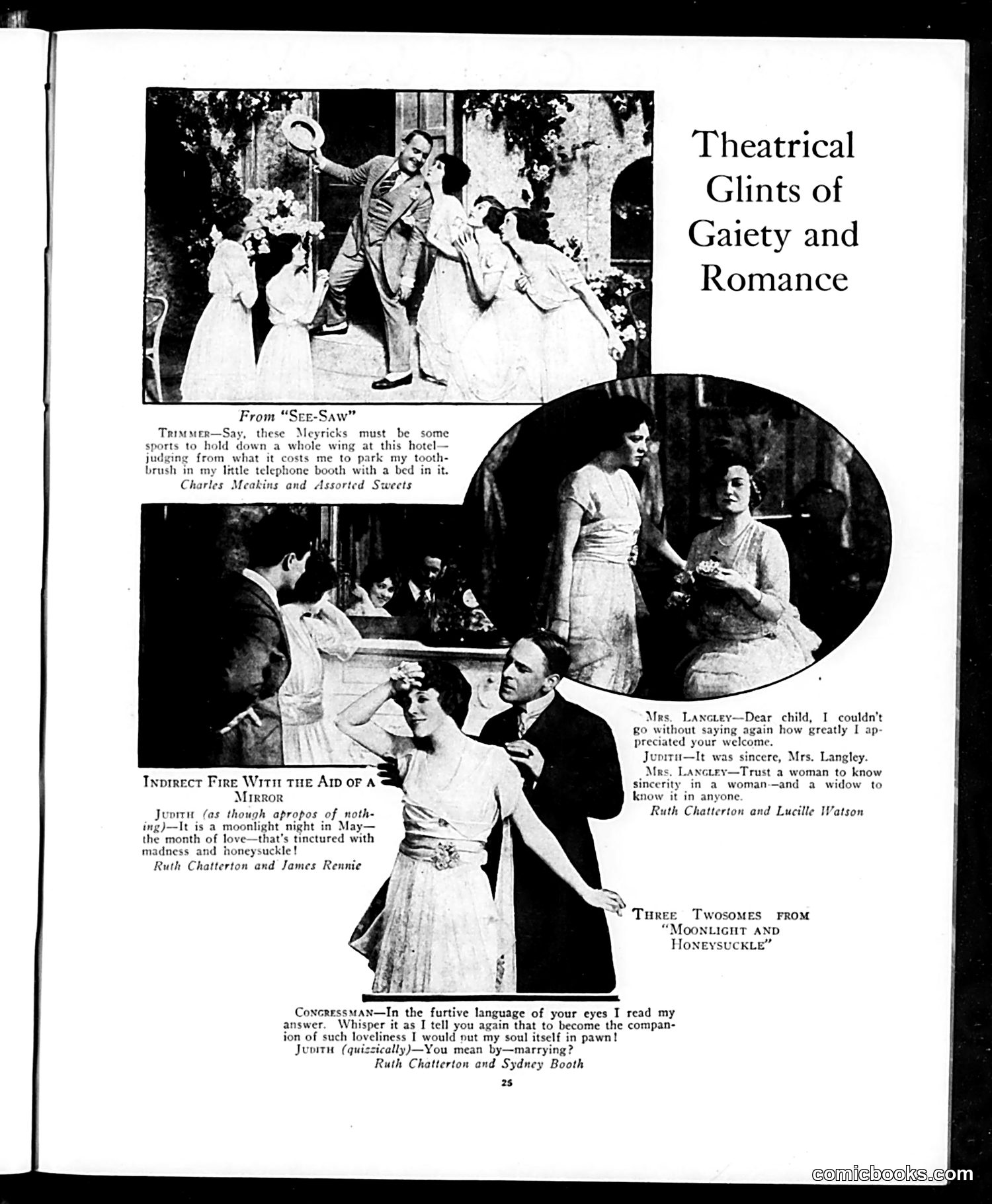
This page showcases scenes from contemporary theatrical productions, likely from early 1920s Broadway. It's not satirical but rather a entertainment feature displaying romantic comedies and dramatic moments. The page presents three separate theatrical scenes featuring actors Ruth Chatterton, James Rennie, Lucille Watson, and Sydney Booth in dialogue-driven vignettes. The humor relies on romantic misunderstandings and witty repartee typical of period comedies—characters flirting, discussing love, and playfully misinterpreting declarations of affection. The final joke involves a Congressman making an overwrought romantic declaration ("put my soul itself in pawn"), which the female character comically deflates by asking if he means marriage—implying his flowery language masks an unspoken proposal. These are essentially theater reviews or advertisements presented as light entertainment, celebrating the "gaiety and romance" of contemporary stage productions for Judge's readership.
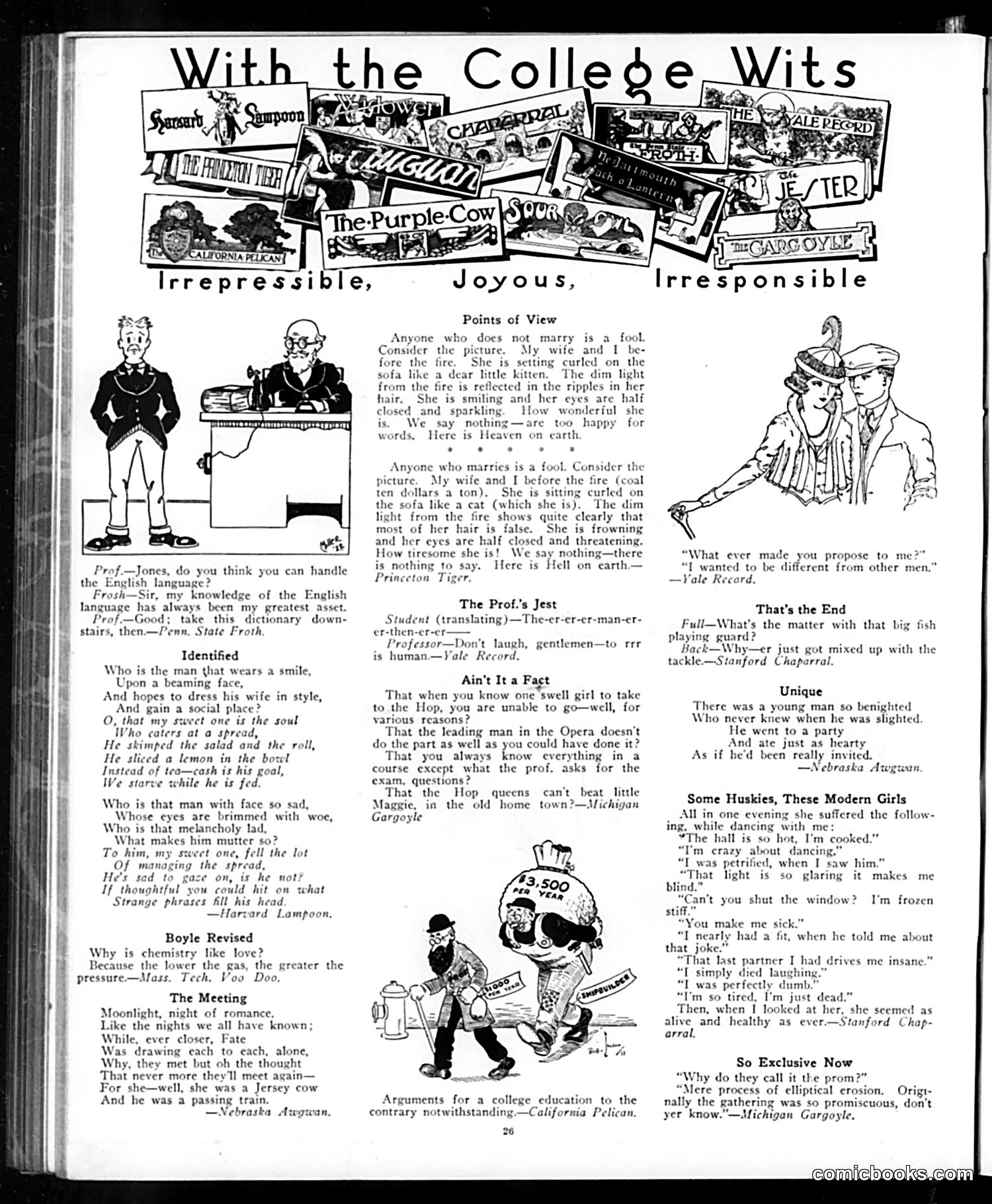
This page from *Judge* magazine collects humorous pieces and cartoons from various college publications, satirizing undergraduate life and romantic relationships. **Key content:** - **"Points of View"**: Two contradictory perspectives on marriage—one bachelor sees bliss ("Heaven on earth"), the married man sees torment ("Hell on earth"). The satire mocks both romantic idealization and marital disillusionment. - **"Some Huskies, These Modern Girls"**: Catalogs a young woman's constant complaints during an evening of dancing—heat, exhaustion, fear, bright lights, cold—yet she appears "alive and healthy as ever" afterward. This satirizes the perceived melodrama and exaggeration of 1920s flapper-era women. - **Various college jokes**: Poke fun at academic life (professors, exams, social events like "the Hop"), using material from Harvard Lampoon, Yale Record, Stanford Chaparral, and other campus humor publications. The overall tone is lighthearted mockery of college romance, gender dynamics, and youthful pretension typical of early 20th-century American collegiate humor.
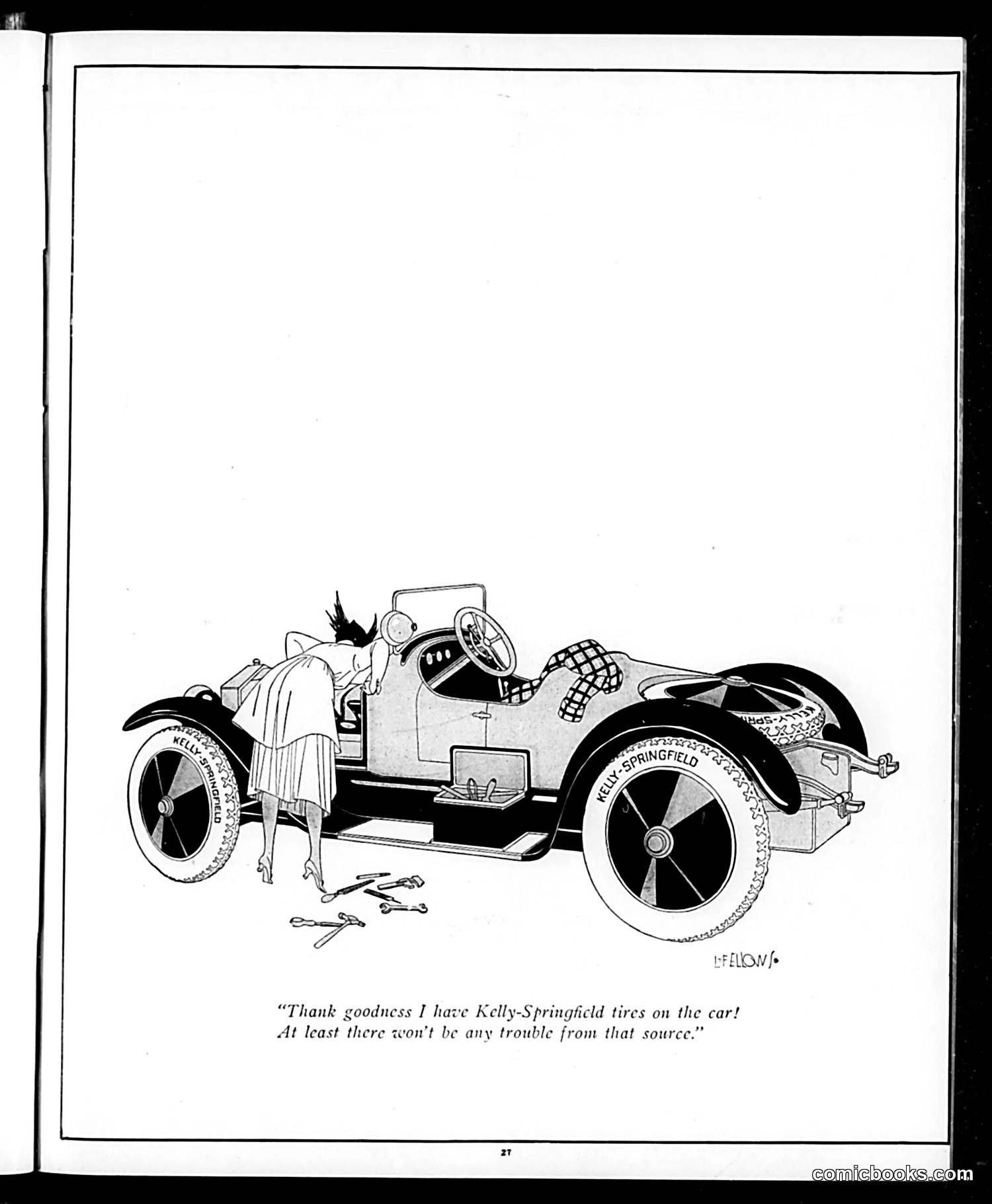
This is a vintage advertisement disguised as humor from *Judge* magazine. The cartoon depicts a woman standing beside a broken-down car surrounded by scattered tools and mechanical debris, suggesting multiple mechanical failures. Her caption expresses relief that at least the **Kelly-Springfield tires** won't cause problems—implying all her other car troubles stem from inferior components. The satire works by acknowledging the car's general unreliability while promoting Kelly-Springfield as the one trustworthy brand. It's a testimonial ad playing on early automotive anxiety: cars of this era were notoriously temperamental, and tire failure was a common hazard. By having the woman reassure herself about tires specifically, the ad suggests Kelly-Springfield's superior quality compared to competitors' tires and other vehicle parts.
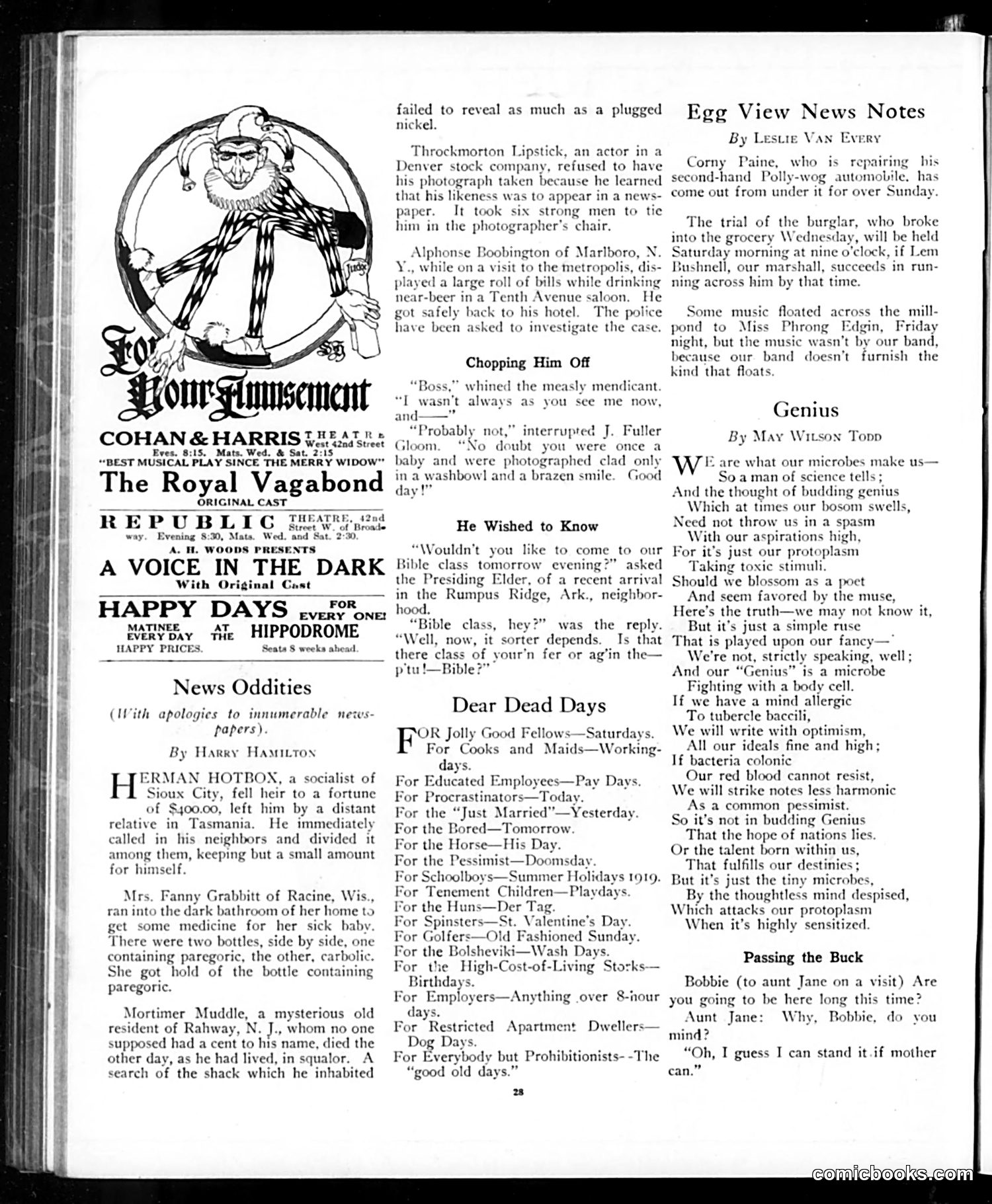
This page from Judge magazine is primarily **advertising and humor columns**, not political satire. The top section features theatrical advertisements for Broadway shows ("The Royal Vagabond," "A Voice in the Dark," "Happy Days"). The content includes three humor columns: 1. **"News Oddities"** — Absurdist anecdotes mocking newspaper reporting conventions. Examples: a socialist unexpectedly inherits money, a woman accidentally grabs carbolic acid instead of medicine, a poor man dies with nothing. The humor relies on ironic reversals of expectations. 2. **"Dear Dead Days"** — A satirical list matching groups to their "special days" (maids get "working-days," the bored get "tomorrow," prohibitionists don't get "the good old days"). This likely references Prohibition-era tensions. 3. **"Genius"** — A poem about microbes determining human potential, mixed with light mockery of pseudo-scientific thinking popular in the 1920s. The overall tone is lighthearted satire of everyday life and common attitudes, rather than serious political commentary.
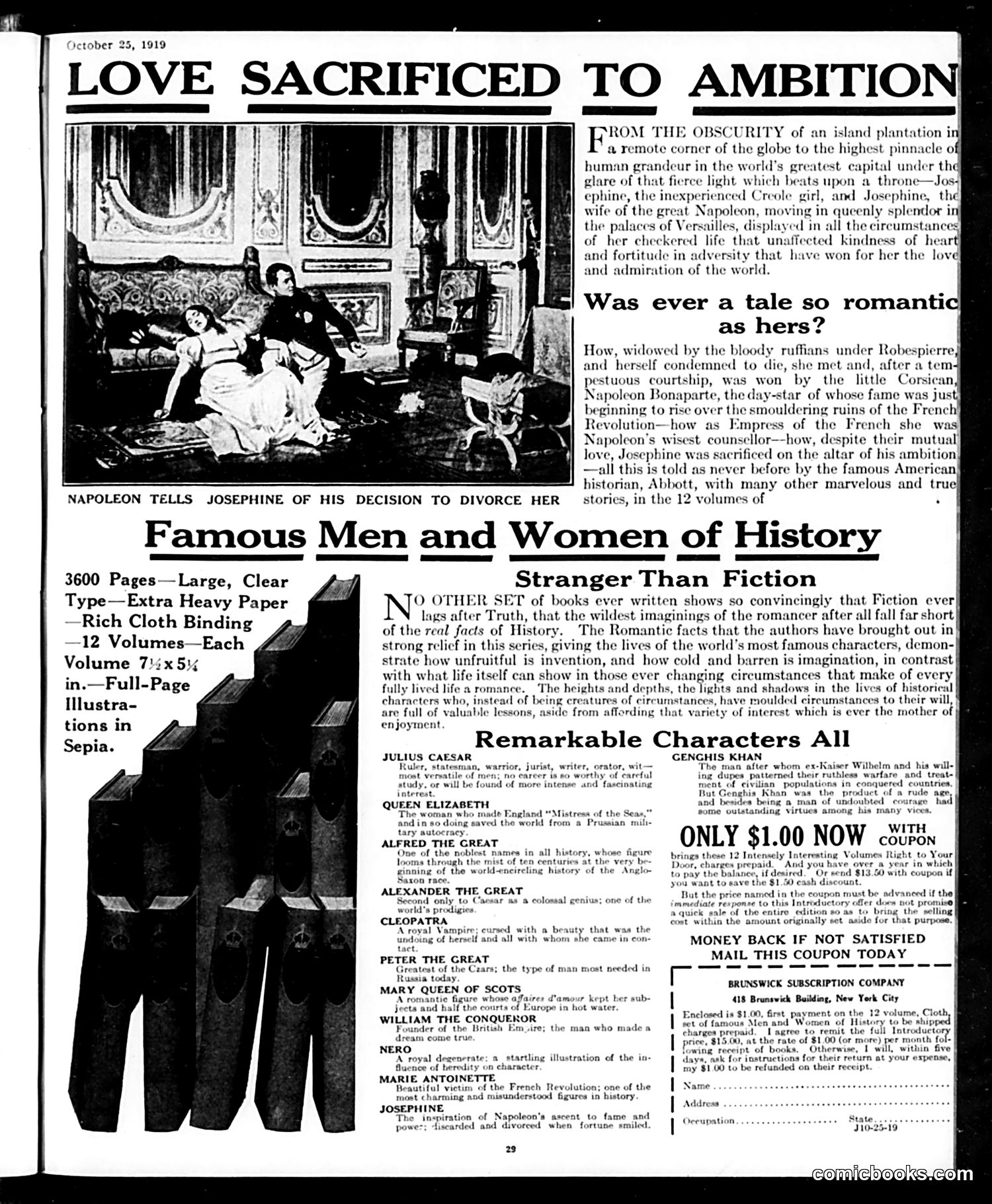
This page combines a romantic historical narrative with book advertising. The main image depicts **Napoleon informing Josephine of his decision to divorce her**—a real historical event from 1810. The article frames this as tragedy: Josephine, a Creole woman from obscurity who rose to become Empress of France through her marriage to Napoleon, was ultimately cast aside. The headline's phrase "love sacrificed to ambition" captures the narrative's point—that Napoleon's political and dynastic ambitions (he needed to marry for an heir) outweighed his affection for Josephine. The accompanying text emphasizes the "romantic" nature of her life story, presenting her as a sympathetic figure whose "kindness of heart" and "fortitude in adversity" won public admiration despite her abandonment. The page uses this dramatic historical moment to advertise a 12-volume encyclopedia of famous historical figures, arguing that real history surpasses fiction in dramatic power.
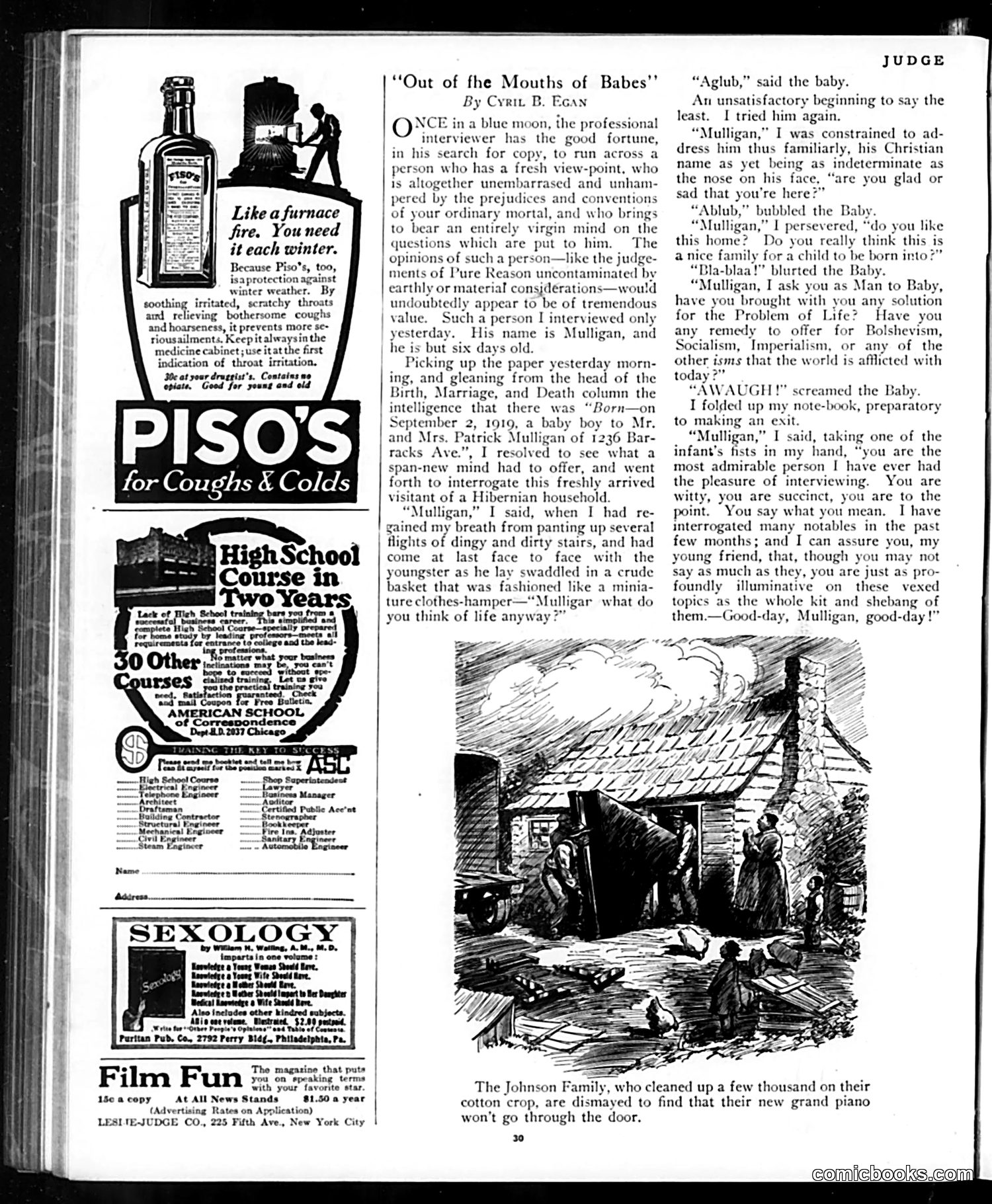
This piece satirizes the pretensions of professional journalists and intellectuals of 1919. A reporter seeks out a newborn baby named Mulligan, believing that an "uncontaminated" mind untouched by worldly prejudices will offer profound wisdom on life's great questions—Bolshevism, Socialism, Imperialism, and other pressing issues of the post-WWI era. The joke is that the baby responds only with nonsense ("Aglub," "Ablub," "Bla-blaa," "AWAUGH!")—yet the reporter praises the infant as "the most admirable person" he's interviewed, claiming the baby is witty, succinct, and "profoundly illuminative." The satire mocks both intellectuals who chase pure, untainted perspectives and the vapid public discourse of the era: if an incoherent baby's utterances seem as meaningful as expert opinions on serious political questions, perhaps those opinions deserve no more credence.
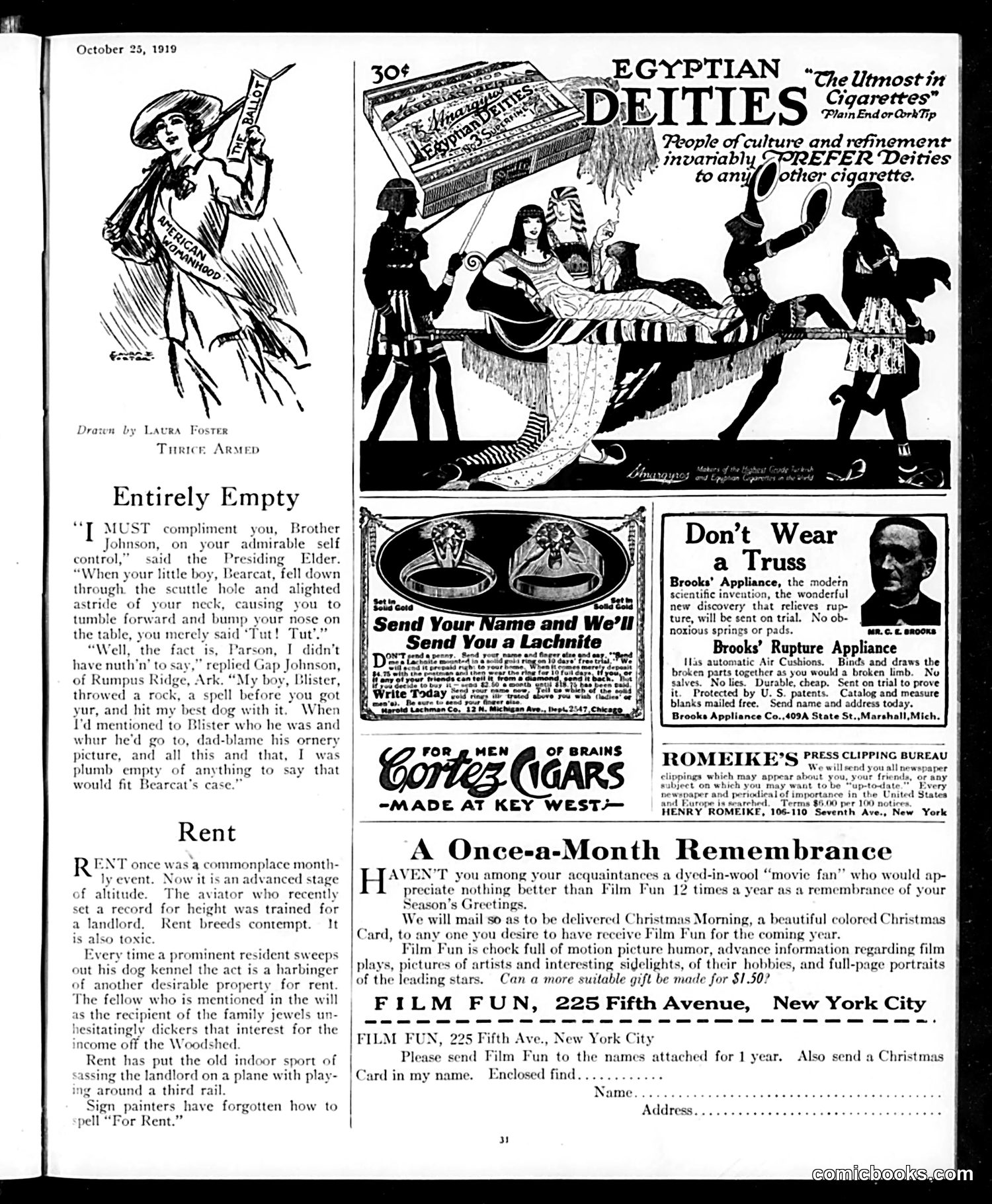
This page consists primarily of **advertisements and light humor pieces** rather than political satire. ## Main Content: **"Entirely Empty"** (top left): A brief comic anecdote drawn by Laura Foster about self-control. A minister compliments a man (Johnson) for restraint after his son causes mishaps, but Johnson reveals he was actually speechless with rage after his dog was hit—he had "nothing to say." **"Rent"** (bottom left): Social commentary (not satire) about how rental housing has become unaffordable and difficult post-WWI. It uses exaggeration to suggest landlord-tenant relations have become as dangerous as "playing around a third rail." ## Advertisements: The page is dominated by product ads: Egyptian Deities cigarettes, Brooks' Rupture Appliance (a medical device), Cortez Cigars, and Film Fun magazine subscriptions—typical 1919 periodical content. **No significant political figures or satire are present.** The page reflects ordinary post-war American commercial culture and mild domestic humor rather than satirical commentary.
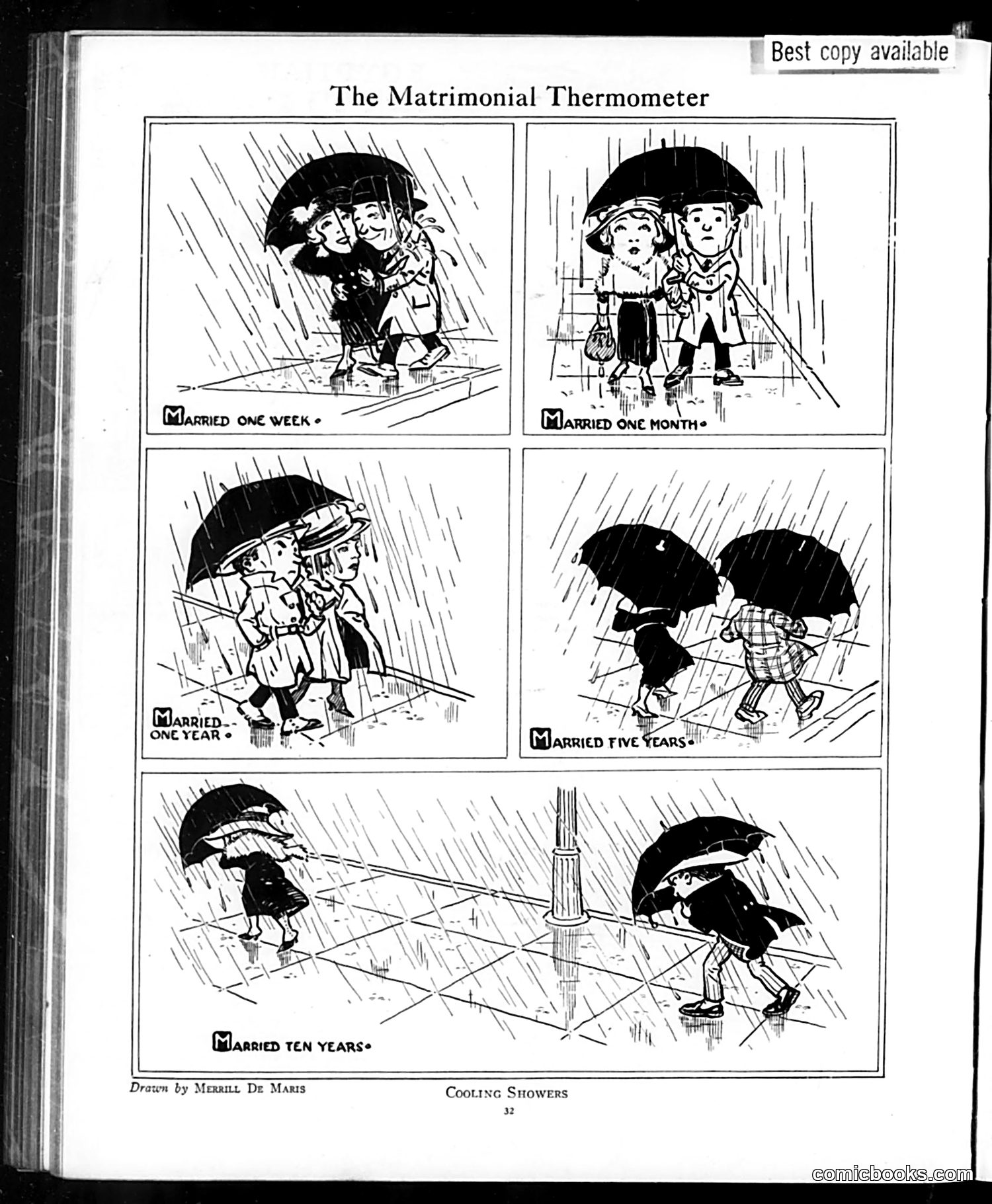
This comic strip by Merrell De Maris satirizes how married couples' affection changes over time. The "thermometer" tracks emotional temperature through rain scenes: - **Married one week**: Couple shares one umbrella, huddled close and romantic - **Married one month**: Still together under umbrella, noticeably less intimate - **Married one year**: Both under umbrella but clearly distant - **Married five years**: Each holds separate umbrella, completely disconnected - **Married ten years**: Two figures far apart in heavy rain, indifferent to each other The joke satirizes the common belief that marital passion and togetherness inevitably decline with time. Rain symbolizes life's challenges, which the couple initially faces together but eventually endures separately. It's a cynical commentary on marriage expectations versus reality—a recurring theme in early-20th-century satirical magazines like *Judge*.
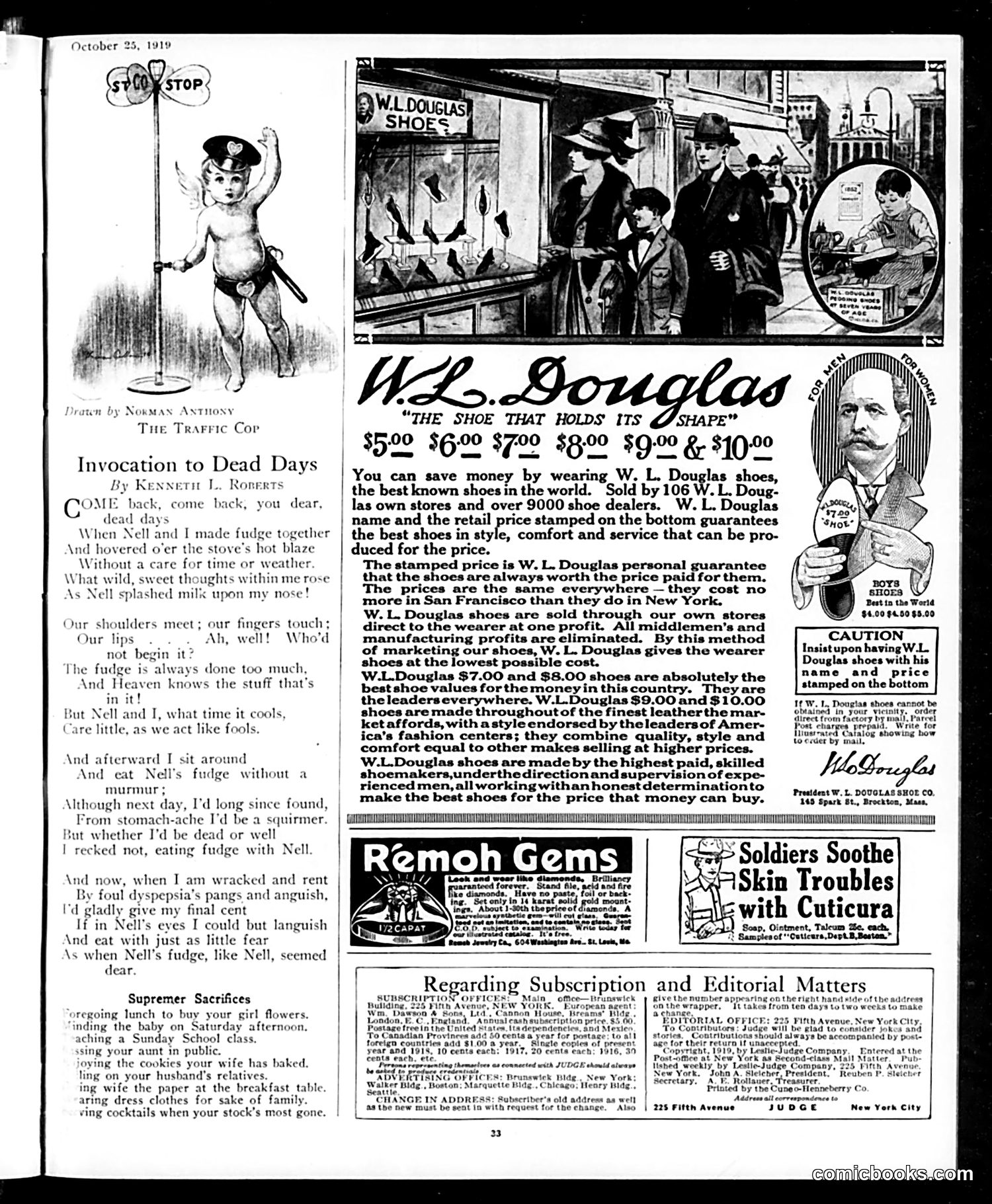
The left side features a satirical cartoon by Norman Anthony titled "The Traffic Cop," depicting a cherub-like baby figure holding a "Stop" sign—likely a comment on wartime or postwar rationing and control. Below is a sentimental poem by Kenneth L. Roberts titled "Invocation to Dead Days," nostalgically recounting making fudge with a woman named Nell before marriage, reflecting pre-war romance. The poem's tone shifts from sweetness to ironic regret, as the narrator now suffers dyspepsia from those same indulgences, longing for simpler times. This appears to capture post-WWI American sentiment: yearning for pre-war innocence and domestic pleasures, tempered by the physical and emotional consequences of time's passage and modern life's complications. The page is primarily filled with W.L. Douglas shoe advertisements and other commercial notices.
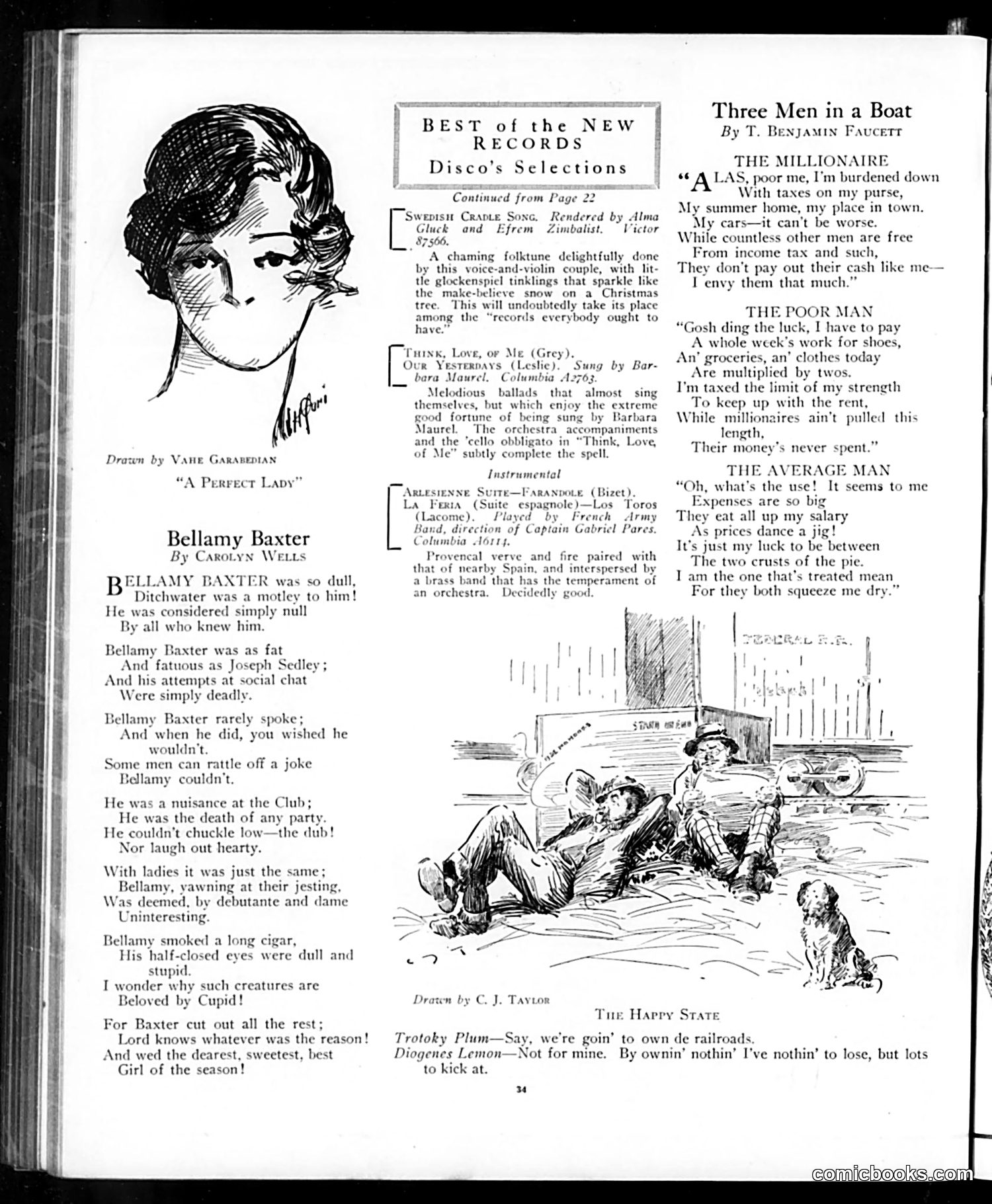
This page contains two distinct pieces of social commentary: **"Three Men in a Boat"** is a cartoon satirizing class anxiety during a period of economic inequality and taxation (likely post-WWI America). It presents three figures representing different economic classes—a millionaire complaining about taxes on multiple properties, a poor man struggling with basic necessities, and a middle-class man squeezed between both extremes. The satire suggests that regardless of class position, everyone feels financially burdened, though the middle-class figure's complaint rings most sympathetic: he bears the tax burden without the millionaire's wealth cushion or the poor man's exemption from certain obligations. **"Bellamy Baxter"** is a humorous poem by Carolyn Wells about a dull, overweight, socially incompetent man who inexplicably wins the affection of the season's most desirable woman. The joke rests on the paradox that this unremarkable fellow succeeds where more charming men fail—suggesting either luck operates mysteriously in romance or that women's taste defies logical explanation.
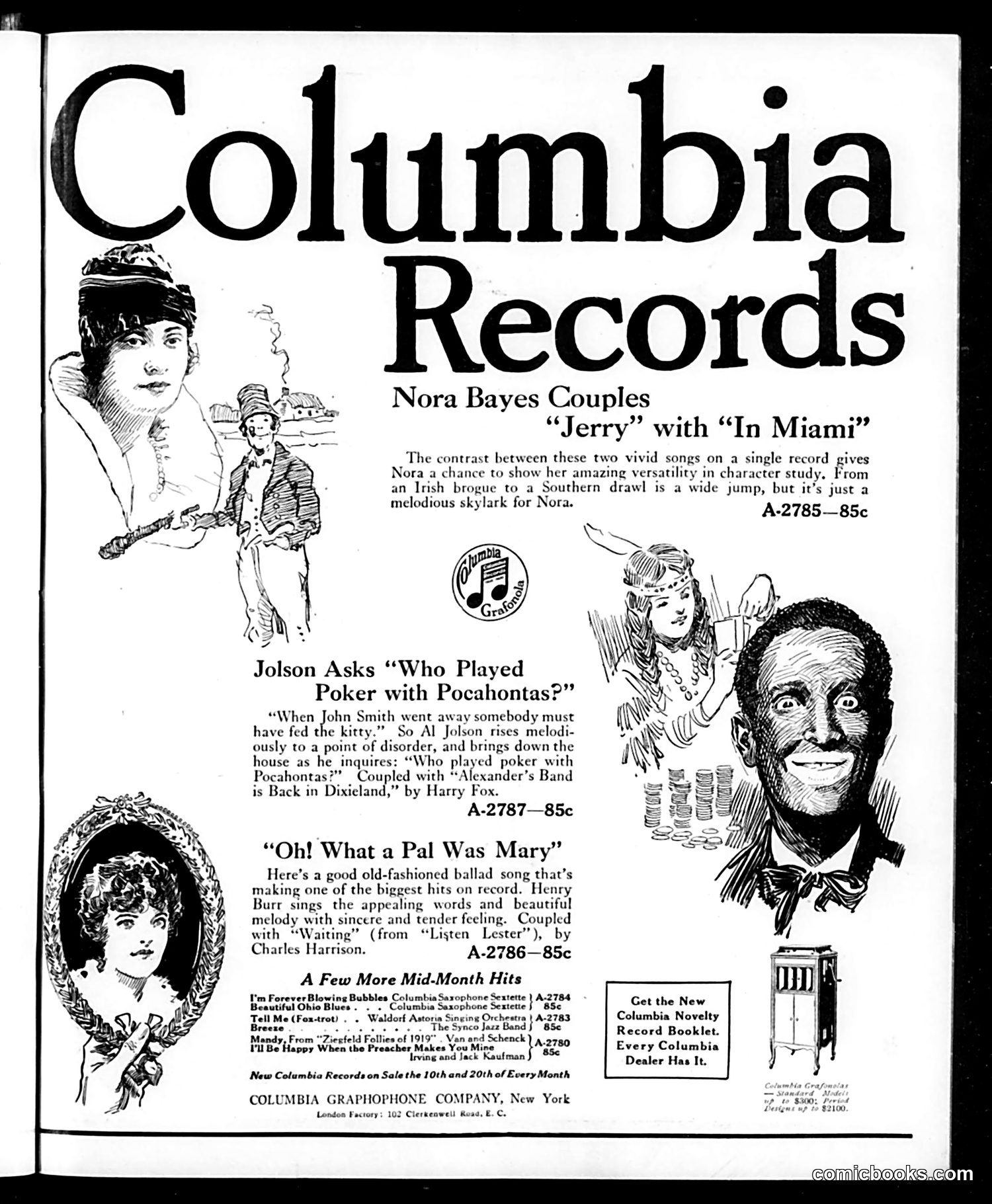
This is primarily a **record label advertisement** for Columbia Records, not political satire. It promotes popular songs and artists from approximately 1919-1920. The page features recordings by prominent entertainers of the era: **Nora Bayes** (known for character songs with dialect), **Al Jolson** (famous for vaudeville comedy and songs), and **Henry Burr** (ballad singer). The humor is mild and commercial rather than satirical. Jolson's song "Who Played Poker with Pocahontas?" appears to be a novelty number making a crude historical joke. The advertisements emphasize these artists' "versatility" and emotional appeal to sell records at 85 cents each. The page reflects early 20th-century popular entertainment tastes and the nascent recorded music industry, with Columbia competing for consumers through celebrity endorsements and variety listings.
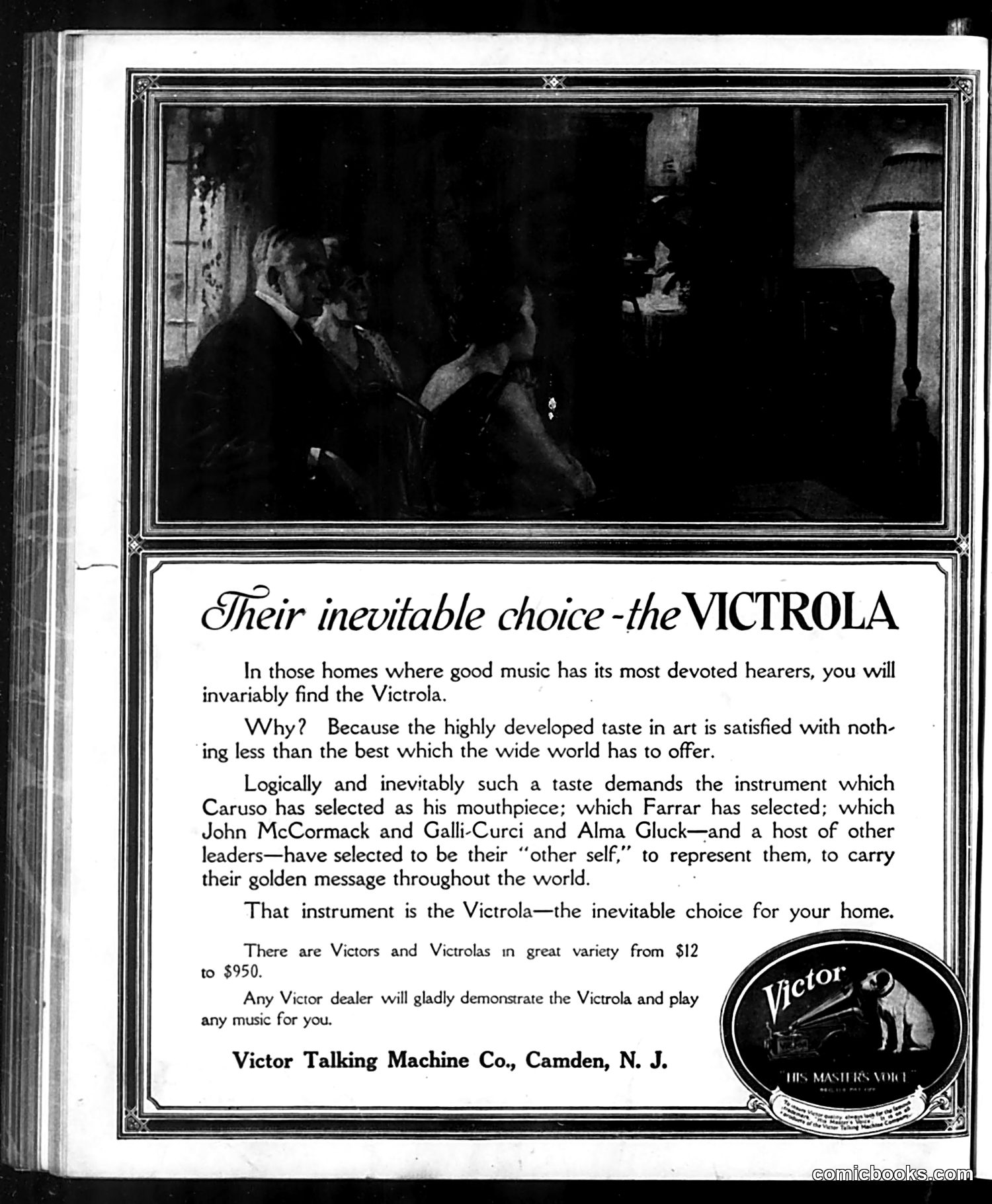
This is a **Victrola phonograph advertisement**, not political satire. The page promotes the Victor Talking Machine Company's gramophone to affluent consumers. The ad uses **celebrity endorsement** as its primary sales tactic, name-dropping famous opera singers and performers of the era (Caruso, Farrar, John McCormack, Galli-Curci, Alma Gluck) who allegedly chose Victrolas as their preferred playback device. The tagline "His Master's Voice" appears in the logo—the famous image of a dog listening to a gramophone. The strategy targets **wealthy, cultured audiences** by arguing that refined musical taste "inevitably" leads to owning a Victrola. The price range ($12–$950) reflects luxury positioning for the 1920s era. The photograph shows what appears to be a **social gathering** where the Victrola serves as entertainment, reinforcing the product as a status symbol for homes of "good music" enthusiasts.