
Judge, 1919-10-25 · page 5 of 36
Judge — October 25, 1919 — page 5: what you’re looking at
What you’re looking at
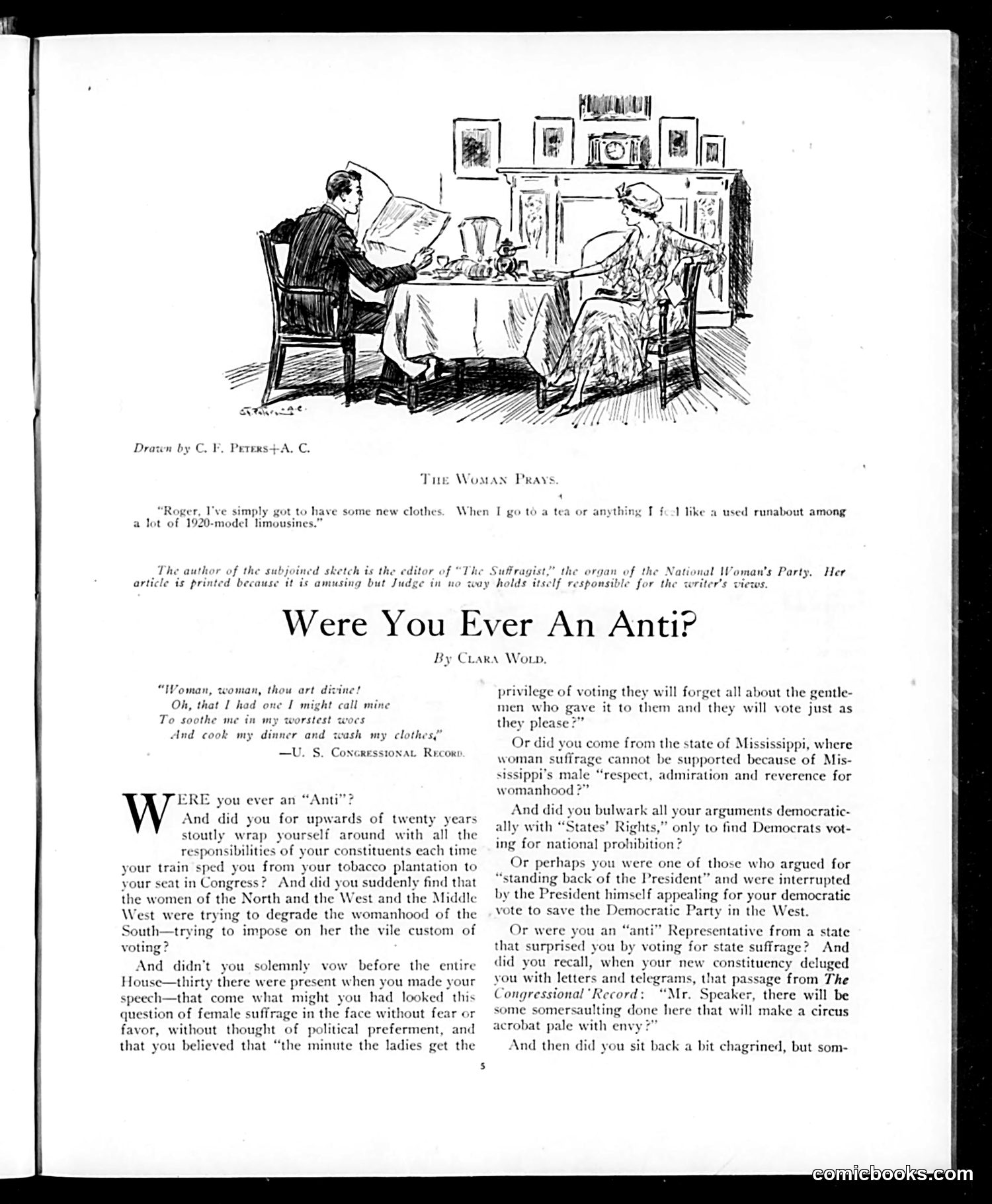
**The Cartoon "The Woman Prays":** A woman requests new clothes, claiming she feels out of place at social events among "1920-model limousines." The joke satirizes women's materialism and social climbing during the prosperous 1920s. **The Article "Were You Ever An Anti?":** Written by Clara Wold, this piece addresses former opponents of women's suffrage. It sarcastically asks whether these "Antis" (anti-suffragists) are now embarrassed by their past positions opposing voting rights. The article references Congressional Record speeches and regional resistance, particularly from the South, which opposed women's voting on grounds of tradition and states' rights. The satire mocks the futility of their opposition, given that women's suffrage was achieved (the 19th Amendment passed in 1920).
📄 Transcribed text from this page (OCR, searchable)
Machine-transcribed from the original scan — historical spelling and the odd misread are preserved.
Drawn by C.1 Tue “Roger, I've simply got to have some new clothes a lot of 1920-model limousines.” The author of the subjoined sketch is the edi article is printed because tt is amusing but Jud, When I go to a tea or anything Tf flat Woman Prays 1 like a used runabout among mal Woman's Party, Her Were You Ever nm Anti? By Crarxx Wor. woman, thou art divine! ne 1 might call mine “Woman, Oh, that I had c To soothe me in my And cook my dinner and worstes: mes wash my clothes?” —U. S. Concresstonat Recorr \ , 7 ERE you ever an “Anti”? And did you for upwards of twenty years stoutly wrap yourself around with all the responsibilities of your constituents each time your train sped you from your tobacco plantation to your seat in Congress? And did you suddenly find that the women of the North and the West and the Middle West were trying to degrade the womanhood of the South—trying to impose on her the vile custom of voting ? And didn’t you solemnly vow before the entire House—thirty there were present when you made your speech—that come what might you had looked this question of female suffrage in the face without fear or favor, without thought of political preferment, and that you believed that “the minute the ladies get the privilege of voting they will forget all about the gentle- men who gave it to them and they will vote just as they please?” Or did you come from the state of Mississippi, where woman suffrage cannot be supported because of Mis- sissippi’s male “respect, admiration and reverence for womanhood ?” And did you bulwark all your arguments democratic- ally with “States’ Rights,” only to find Democrats vot- ing for national prohibition? Or perhaps you were one of those who argued for “standing back of the President” and were interrupted by the President himself appealing for your democratic vote to save the Democratic Party in the West. Or were you an “anti Represe' ntative from a state that surprised you by voting for state suffrage? And did you recall, when your new constituency deluged you with letters and telegrams, that passage from The Congressional ‘Record : “Mr. Speak thee will be some somersaulting done here that will make a circus acrobat pale with env And then did you sit back a bit chagrined, but som-