
Judge, 1919-10-25 · page 24 of 36
Judge — October 25, 1919 — page 24: what you’re looking at
What you’re looking at
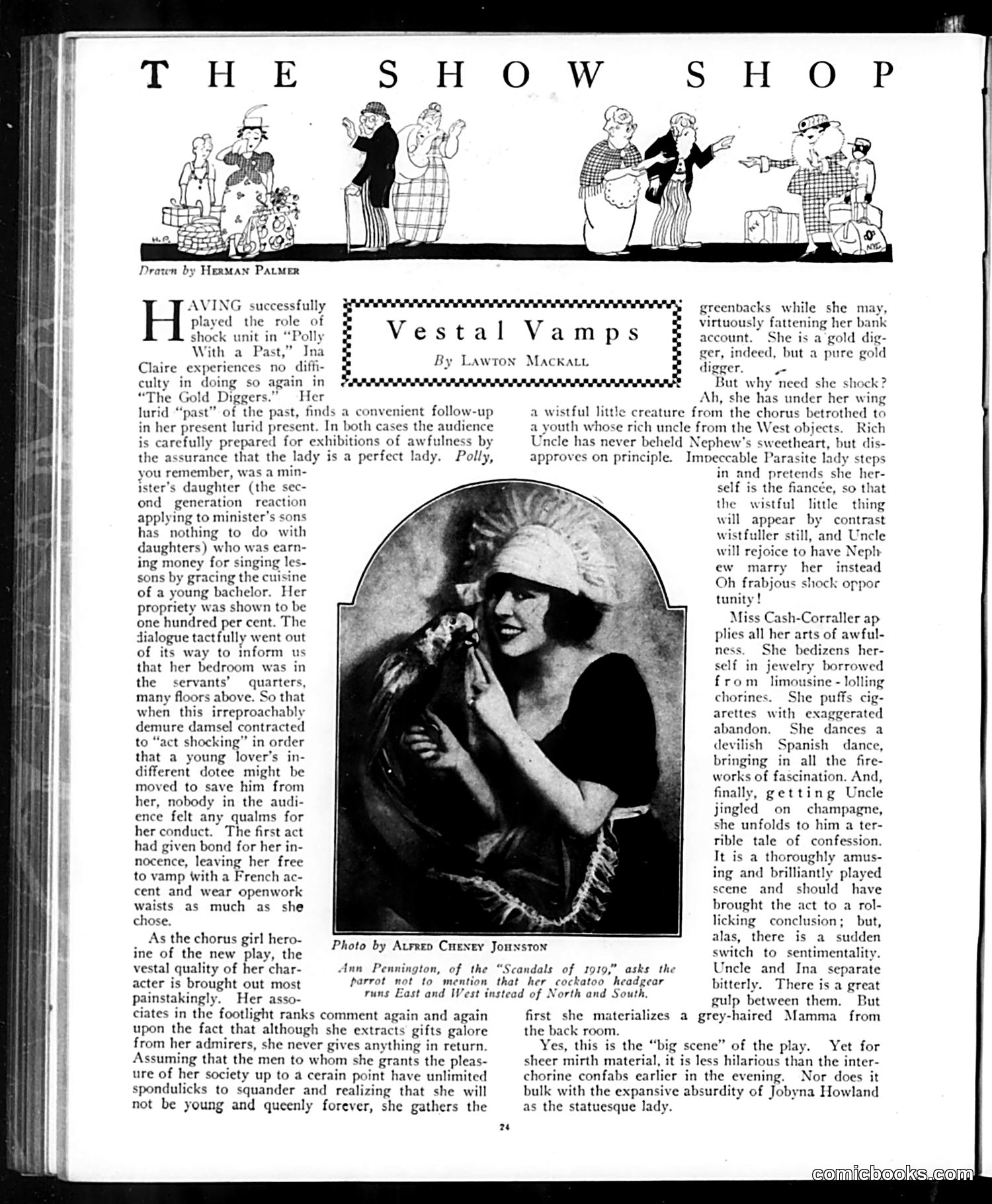
This is a theater review of "The Gold Diggers" starring actress Ina Claire. The critic discusses how Claire plays a "gold digger"—a woman who extracts money from wealthy men while maintaining a facade of respectability. The satire targets the theatrical convention of establishing a character's moral purity before allowing her to behave scandalously. Claire's character is presented as virtuous (her bedroom is strategically in the servants' quarters), which supposedly justifies her subsequent seductive behavior toward a rich uncle to help a young woman's romance. The reviewer finds this dramatic sleight-of-hand amusing but notes the play undermines its own comedy by switching to sentimentality, particularly when the character's "grey-haired Mamma" appears. The illustration shows Ann Pennington, a contemporary chorus girl, demonstrating the exaggerated styling ("cockatoo headgear") typical of these theatrical gold-digger roles.
📄 Transcribed text from this page (OCR, searchable)
Machine-transcribed from the original scan — historical spelling and the odd misread are preserved.
Drawn by Herman Parmer Hes successfully played the role of ; shock unit in “Polly Vestal Vamps With a Past,” Ina Claire experiences no diffi- culty in doing so again in ?¢ “The Gold Diggers.” Her lurid “past” of the past, finds a convenient follow-up in her present lurid present. In both cases the audience is carefully prepared for exhibitions of awfulness by the assurance that the lady is a perfect lady. Polly, you remember, was a min- ister’s daughter (the sec- ond generation reaction applying to minister's sons has nothing to do with daughters) who was earn- ing money for singing les- sons by gracing the cuisine of a young bachelor. Her propriety was shown to be one hundred per cent. The dialogue tactfully went out of its way to inform us that her bedroom was in the servants’ quarters, many floors above. So that when this irreproachably demure damsel contracted to “act shocking” in order that a young lover's in- different dotee might be moved to save him from her, nobody in the audi- ence felt any qualms for her conduct. The first act had given bond for her in- nocence, leaving her free to vamp with a French ac- cent and wear openwork waists as much as she chose. As the chorus girl hero- Photo by Aurmp Cu ine of the new play, the By Lawton Mackatt greenbacks while she may, virtuously fattening her bank account. She is a gold dig- ger, indeed, but a pure gold digger. r But why need she shock? Ah, she has under her wing a wistful little creature from the chorus betrothed to a youth whose rich uncle from the West objects. Rich Uncle has never beheld Nephew’s sweetheart, but dis- approves on principle. Impeccable Parasite lady steps vestal quality of her char- Ann Pennington, of the “Scandals of 1919,” asks the acter is brought out most parrot \not to ‘meni painstakingly. Her asso- ciates in the footlight ranks comment again and again upon the fact that although she extracts gifts galore from her admirers, she never gives anything in return. Assuming that the men to whom she grants the pleas- ure of her society up to a cerain point have unlimited spondulicks to squander and realizing that she will not be young and queenly forever, she gathers the that her cockatoo headgear runs East and West instead of North and South. in and pretends she her- self is the fiancée, so that the wistful little thing will appear by contrast wistfuller still, and Uncle will rejoice to have Neph ew marry her instead Oh frabjous shock oppor tunity! Miss Cash-Corraller ap plies all her arts of awful- ness. She bedizens her- self in jewelry borrowed from limousine - lolling chorines. She puffs cig- arettes with exaggerated abandon. She dances a devilish Spanish dance, bringing in all the fire- works of fascination. And, finally, getting Uncle jingled on champagne, she unfolds to him a ter- rible tale of confession. It is a thoroughly amus- ing and brilliantly played scene and should have brought the act to a rol- licking conclusion; but, alas, there is a sudden switch to sentimentality. Uncle and Ina separate bitterly. There is a great gulp between them. But first she materializes a grey-haired Mamma from the back room. Yes, this is the “bi; scene” of the play. Yet for sheer mirth material, it is less hilarious than the inter- chorine confabs earlier in the evening. Nor does it bulk with the expansive absurdity of Jobyna Howland as the statuesque lady.