
Judge, 1919-10-25 · page 13 of 36
Judge — October 25, 1919 — page 13: what you’re looking at
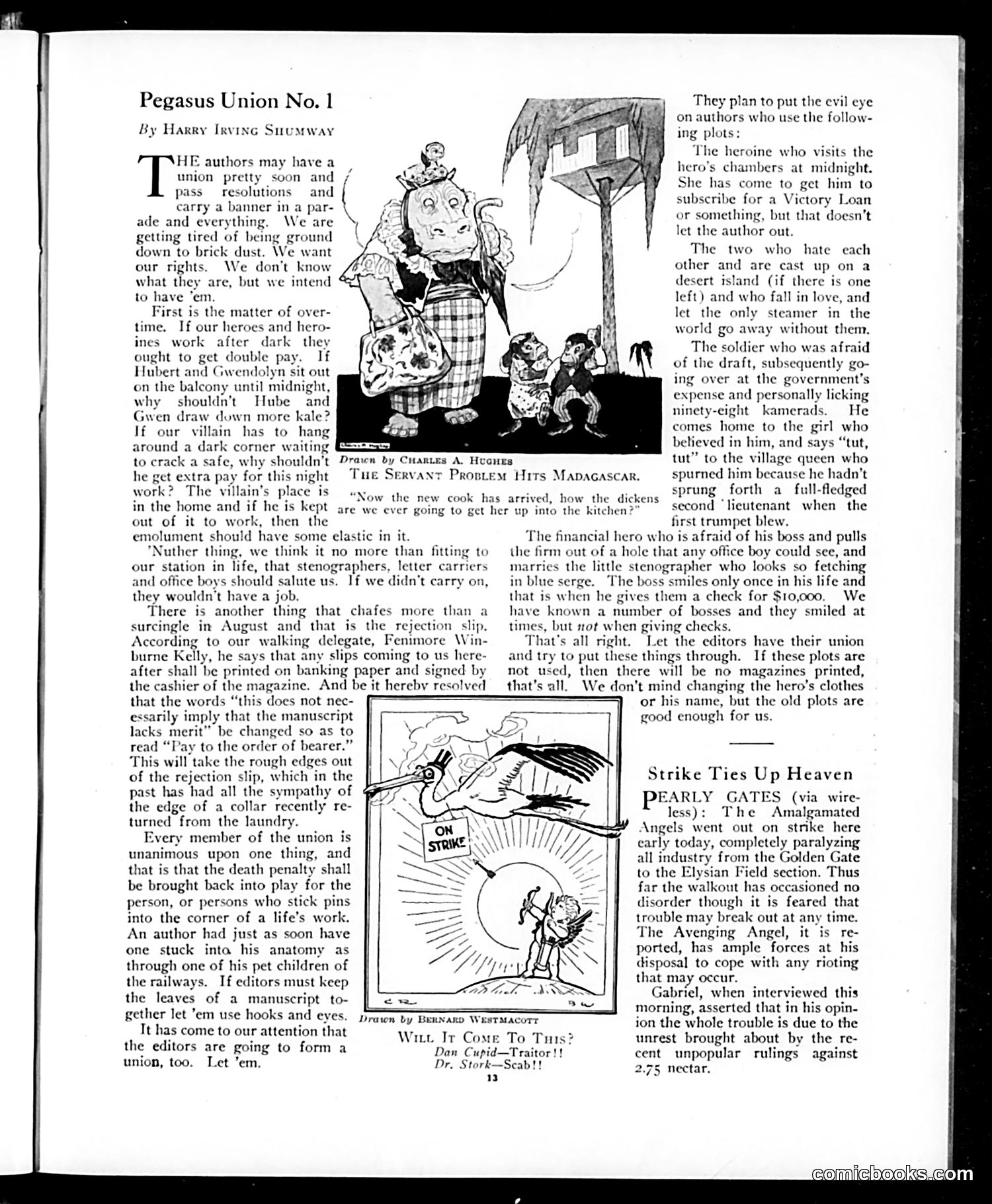
What you’re looking at
This 1918 satirical piece mocks authors' complaints about editorial treatment by imagining a "Pegasus Union" (Pegasus being the mythological muse). The article humorously presents authors' grievances: demanding overtime pay for characters working after dark, requiring editors to salute them, and reforming rejection slip language. The satire's target becomes clear in the right column: the author lists hackneyed plot devices he claims editors will "put the evil eye on"—clichéd romance and war narratives (midnight bedroom visits, desert island romance, drafted soldiers returning as heroes). The joke inverts: the author sarcastically suggests if editors ban these tired plots, no magazines will be printed at all, implying authors *rely* on such conventions precisely because they're commercially reliable, not artistically meritorious. The piece mocks both editorial gatekeeping and authors' lazy dependence on formula—neither group should pretend superiority.
📄 Transcribed text from this page (OCR, searchable)
Machine-transcribed from the original scan — historical spelling and the odd misread are preserved.
Pegasus Union No. 1 By Harry Irving Suumway HE authors may have a union pretty soon and / pass resolutions and carry a banner ir ade and everything. We are getting tired of being ground down to brick dust. We want our rights. We don’t know what they are, but we intend to have ‘em. First is the matter of over- time. If our heroes and hero- ines work after dark they ought to get double pay. If Hubert and Gwendolyn sit out on the balcony until midnight, why shouldn’t Hube and Gwen draw down more kale? If our villain has to hang around a dark corner waiting to crack a safe, why shouldn't he get extra pay for this night work? The villain’s place is in the home and if he is kept out of it to work, then the emolument should have some elastic in it. ’Nuther thing, we think it no more than fitting to our station in life, that stenographers, letter carriers and office boys should salute us. If we didn’t carry on, they wouldn't have a job. There is another thing that chafes more than a surcingle in August and that is the rejection slip. According to our walking delegate, Fenimore Win- burne Kelly, he s: ips coming to us here- after shall be printed on banking paper and signed by the cashier of the magazine. And be it hereby resolved that the words “this does not nec- Drawn by Cuaries A. Heanes Tue Servant Prostem Hits Mapacascar. »w the new cook has arrived, how the di are we ever going to get her up into the kitchen They plan to put the evil eye on authors who use the follow- ing plots: The heroine who visits the hero’s chambers at midnight. She come to get him to subscribe for a Victory Loan or something, but that doesn’t let the author out. The two who hate each other and are cast up on a desert island (if there is one left) and who fall in love, and let the only steamer in the world go av without them. The soldier who was afraid of the draft, subsequently go- ing over at the government's expense and personally licking ninety-eight kamerads. He comes home to the girl who believed in him, and says “tut, tut” to the village queen who spurned him because he hadn't sprung forth a full-fledged second ‘lieutenant when the first trumpet blew. The financial hero who is afraid of his boss and pulls the firm out of a hole that any office boy could see, and marries the little stenographer who looks so fetching in blue serge. The boss smiles only once in his life and that is when he gives them a check for $10,000, We have known a number of bosses and they smiled at times, but sot when giving check That's all right. Let the editors have their union and try to put these things through. If these plots are not used, then there will be no magazines printed, that’s all. We don’t mind changing the hero's clothes or his name, but the old plots are essarily imply that the manuscript lacks merit” be changed so as to read “Day to the order of bearer.” This will take the rough edges out of the rejection slip, which in the past has had all the sympathy of the edge of a collar recently re- turned from the laundry. Every member of the union is unanimous upon one thing, and that is that the death penalty shall be brought back into play for the person, or persons who stick pins into the corner of a life's work. An author had just as soon have one stuck inta his anatomy as through one of his pet children of the railways. If editors must keep the leaves of a manuscript to- gether let em use hooks and eyes. It has come to our attention that the editors are going to form a union, too. Let ’em. Drawn by Ber <ARD WESTMACOTT Witt It Come To Tis? Dan Cupid—Traitor!! Dr, Stork—Scab!! 13 good enough for us. Strike Ties Up Heaven RLY GATES (via wire- less): The Amalgamated Angels went out on strike here carly today, completely paralyzing all industry from the Golden Gate ysian Field section. Thus far the walkout has occasioned no disorder though it is feared that trouble may break out at any time. The Avenging Angel, it is re- ported, has ample forces at his disposal to cope with any rioting that may occur. Gabriel, when interviewed this morning, asserted that in his opin- ion the whole trouble is due to the unrest brought about by the re- cent unpopular rulings against 2.75 nectar.