
Judge, 1919-10-25 · page 8 of 36
Judge — October 25, 1919 — page 8: what you’re looking at
What you’re looking at
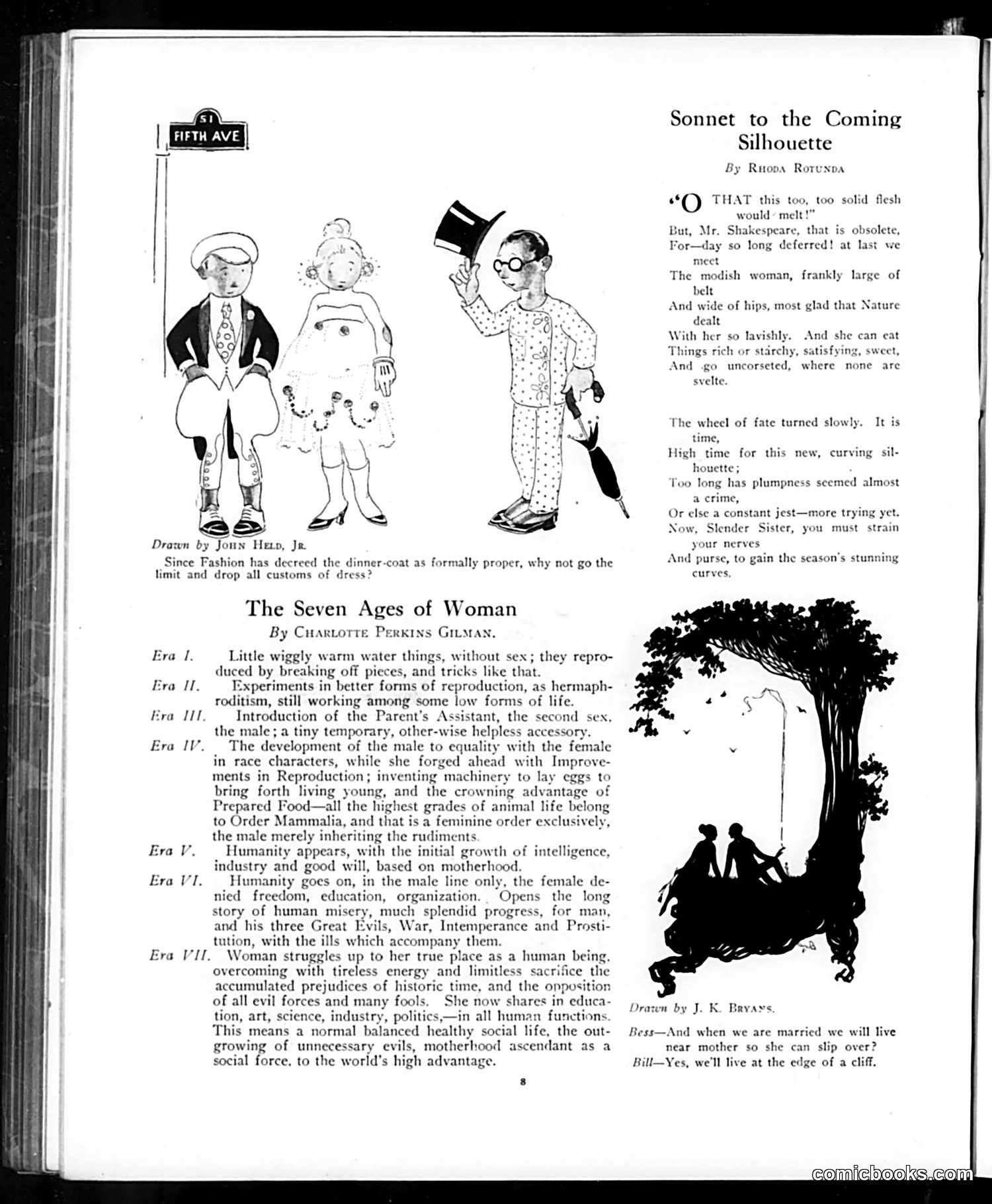
**Top Cartoon - "Sonnet to the Coming Silhouette":** This satirizes changing fashion standards for women's bodies. The sonnet mocks the shift from Victorian corseted thinness to acceptance of fuller figures and curves. It references Shakespeare to emphasize how "obsolete" the old ideal has become. The three figures illustrate the transformation: the old constrained silhouette versus the new "modish woman" with a larger belt and hips. The joke targets both the rigidity of past fashion demands and the equally rigid new standards replacing them—women must now "strain your nerves" to achieve the opposite body type. **Bottom - "The Seven Ages of Woman":** This Gilman piece (the author was a prominent feminist) traces female evolution from single-celled organisms through human history. Eras I-IV emphasize women's biological reproductive superiority. Era VI-VII critique male dominance: women historically denied education and freedom while advancing civilization, now finally achieving equality in all human functions. The closing joke about living "at the edge of a cliff" appears sarcastic commentary on marriage dynamics.
📄 Transcribed text from this page (OCR, searchable)
Machine-transcribed from the original scan — historical spelling and the odd misread are preserved.
Sonnet to the Coming Silhouette By Ruopa Rotuxpa O THAT this too, too solid flesh would’ melt But, Mr. Shakespeare, that is obsolete, For—day so long deferred! at last we meet The modish woman, frankly large of belt And wide of hips, most glad that Nature dealt With her so lavishly. And she can eat Things rich or starchy, satisfying, sweet, And .go uncorseted, where none are svelte. The wheel of fate turned slowly. It is time, High time for this new, curving sil- houette; Too long has plumpness seemed almost a crime, Or else a constant jest—more trying yet. > : Now, Slender Sister, you must. strain Drawn by Joux Hex, Je your nerves Since Fashion has decreed the dinner-coat as formally proper, why not go the And purse, to gain the season's stunning limit and drop all customs of dress? curves. The Seven Ages of Woman By Cuarcorte Perkins GILMAN, Era 1. Little wiggly warm water things, without sex; they repro- duced by breaking off pieces, and tricks like that. Era Il, Experiments in better forms of reproduction, as hermaph- roditism, still working among some low forms of life. Era IT Introduction of the Parent's Assistant, the second sex, the male; a tiny temporary, other-wise helpless accessory. Era IV, The development of the male to equality with the female in race characters, while she forged ahead with Improve- ments in Reproduction; inventing machinery to lay eggs to bring forth living young, and the crowning advantage of Prepared Food—all the highest grades of animal life belong to Order Mammalia, and that is a feminine order exclusively, the male merely inheriting the rudiments. Humanity appears, with the initial growth of intelligence, industry and good will, based on motherhood. Humanity goes on, in the male line only, the female de- nied freedom, education, organization. Opens the long story of human misery, much splendid progress, for man, and his three Great I War, Intemperance and Prosti- tution, with the ills which accompany them. Era VII, Woman struggles up to her true place as a human being, overcoming with tireless energy and limitless sacrifice the accumulated prejudices of historic time, and the opposition of all evil forces and many fools. She now shares in educa- tion, art, science, industry, politics,—in all human functions. This means a normal balanced healthy social life, the out- Bess—And when we are married we will live growing of unnecessary evils, motherhood ascendant as a near mother so she can slip over? social force, to the world’s high advantage. Bill—Yes, we'll live at the edge of a cliff. Drawn by J. K. Bryays