
A complete issue · 32 pages · 1919
Judge — April 26, 1919
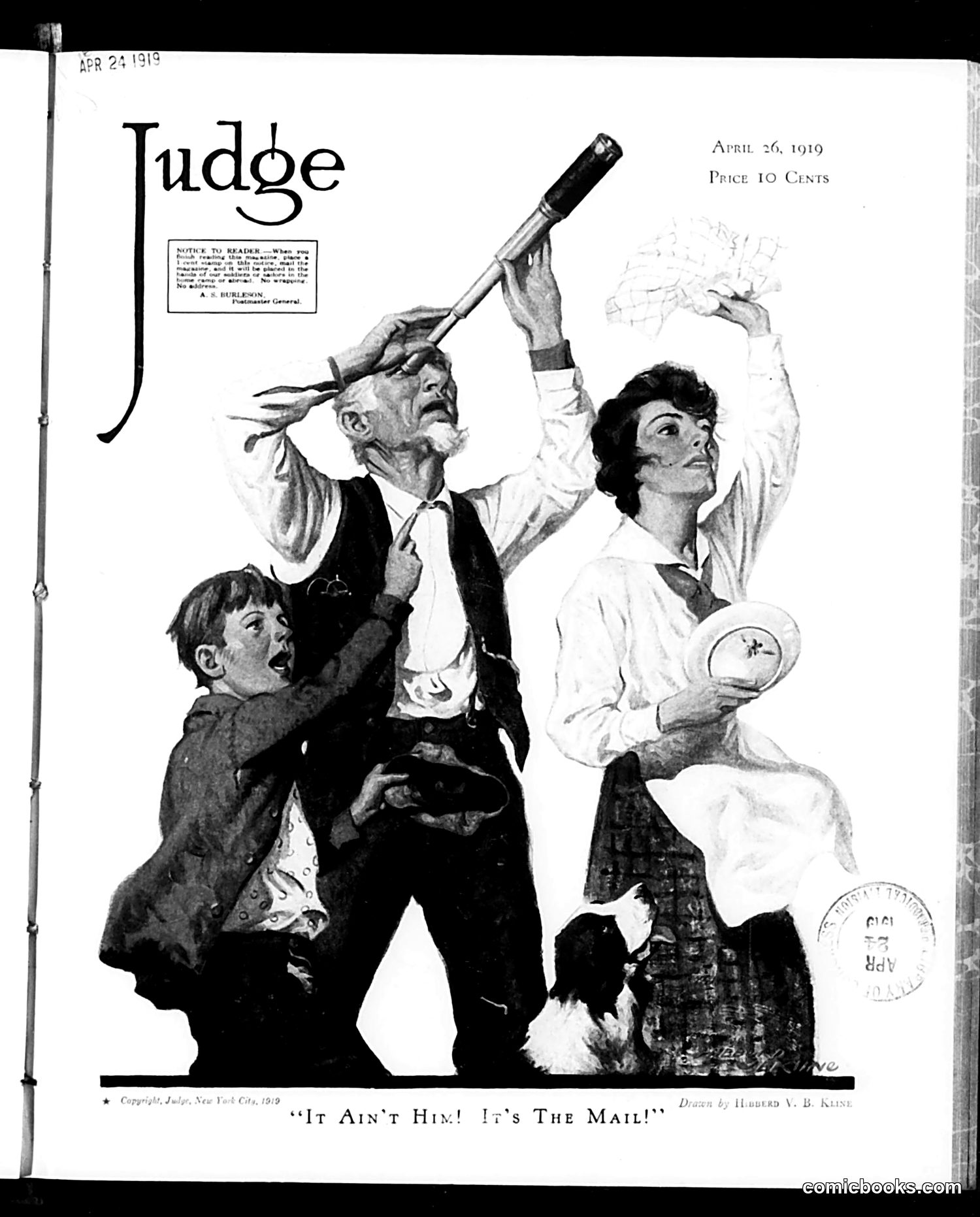
This cartoon satirizes postal delivery during the immediate post-WWI period. An elderly man with a telescope peers skyward while a woman and child look upward excitedly. The caption suggests they're watching the sky, expecting something—likely an airplane or aircraft. The joke appears to reference either: 1. Early airmail experiments (the U.S. Post Office began experimental airmail service in May 1918) 2. Anxiety about receiving mail during postal service disruptions common in 1919 The family's excitement and the man's vigilance with a telescope suggest they're desperately awaiting mail delivery via an unconventional method, humorously implying that standard postal service had become so unreliable that sky-watching seemed necessary. The satire targets postal inefficiency of the era.
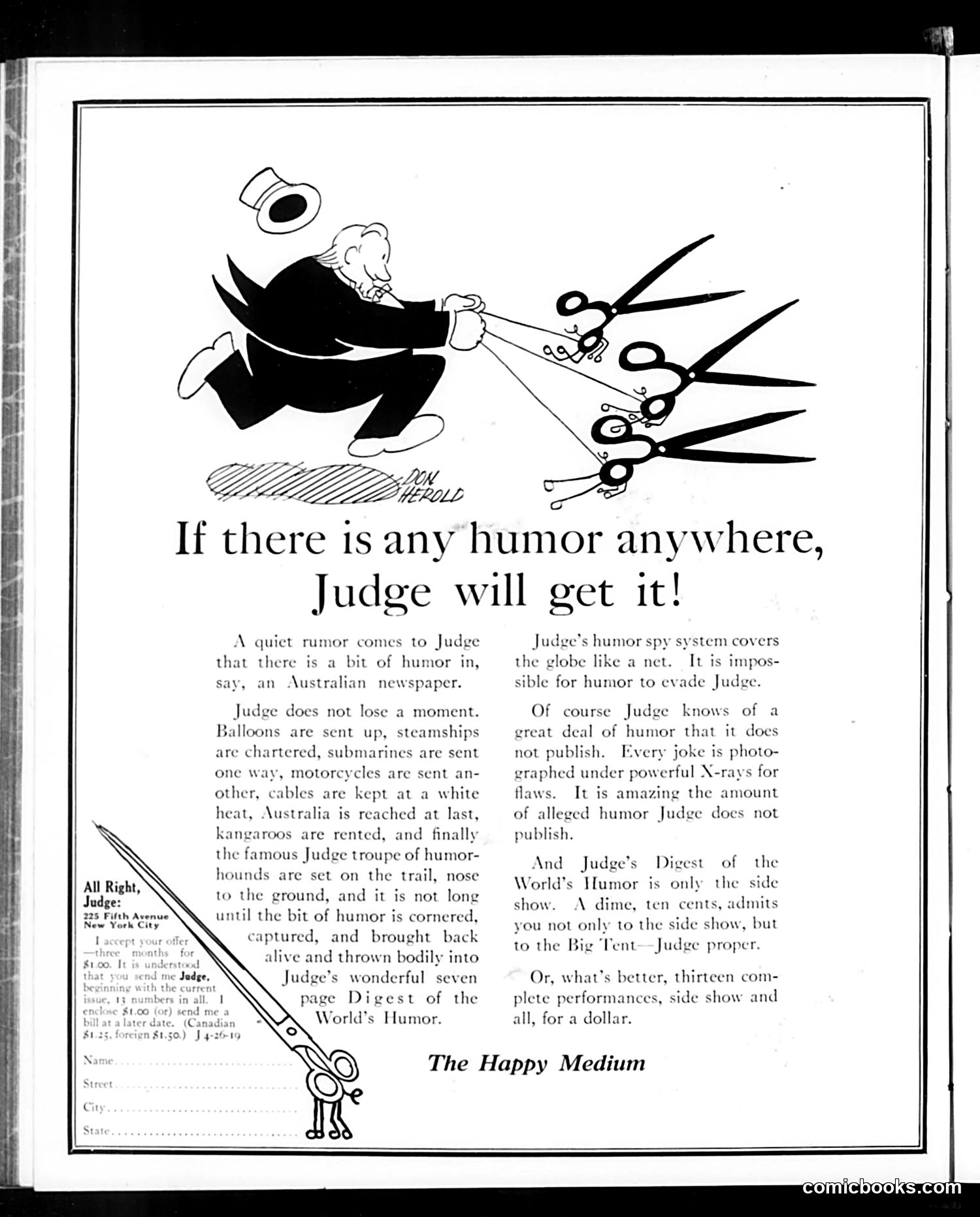
This appears to be a **Judge magazine advertisement** for "Judge's Digest of the World's Humor" rather than a political cartoon. The illustration shows a man in formal dress wielding oversized scissors, "cutting out" multiple pairs of smaller scissors—a visual metaphor for Judge's editorial filtering process. The text humorously claims Judge has a sophisticated "humor spy system" that catches jokes worldwide, including humor that never gets published elsewhere. It positions Judge as the arbiter of quality comedy, publishing only the best jokes while filtering out flawed material. The ad promotes Judge's humor digest and invites subscription, emphasizing Judge's unique access to unpublished humor and comedic content. "The Happy Medium" appears to be the publication's tagline.
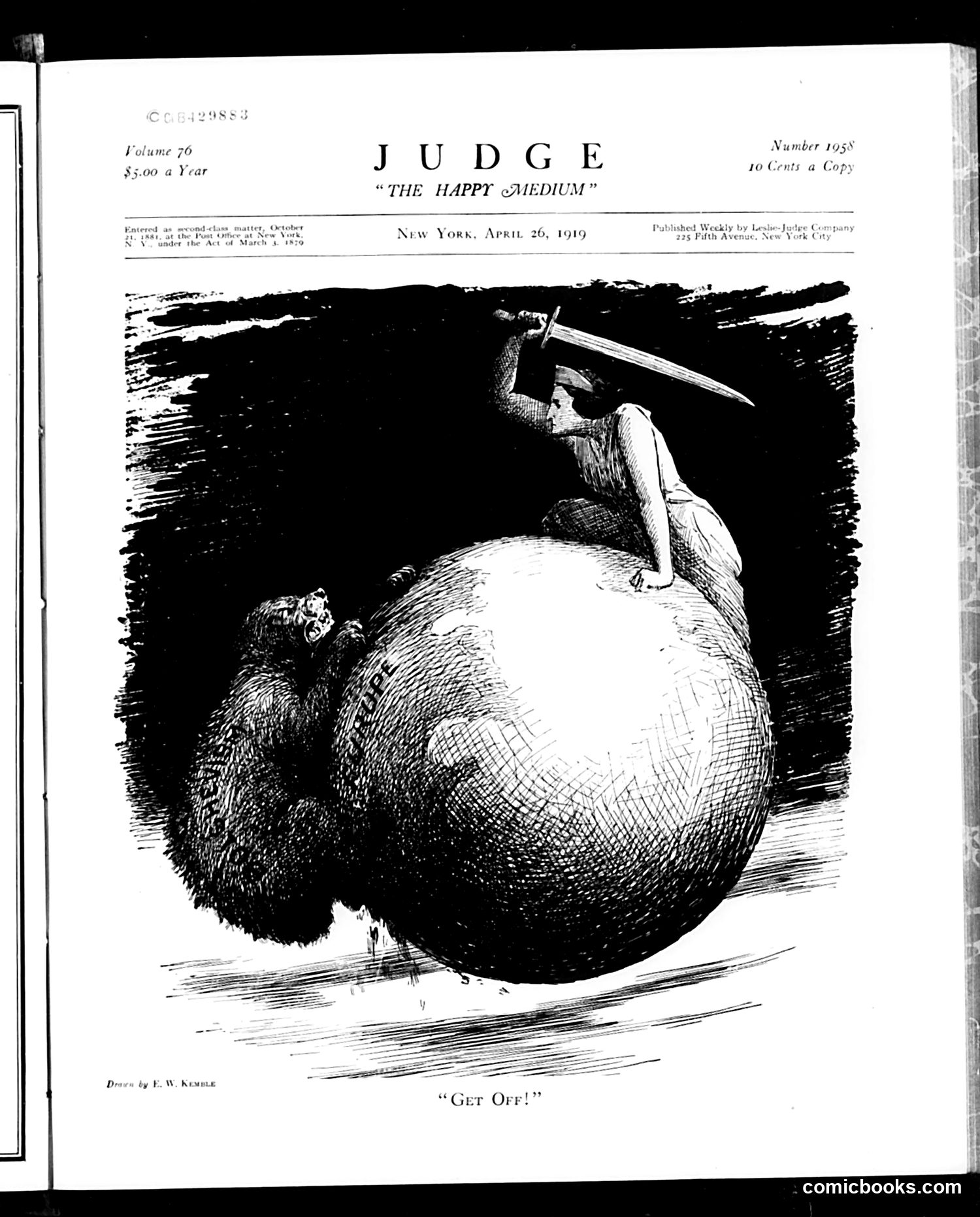
This cartoon, drawn by E. W. Kemble, depicts a woman wielding a large sword, standing atop an enormous spherical bomb or explosive device. A dark figure (possibly representing a threat or adversary) clings to or approaches the sphere. The title "Get Off!" suggests the woman is defending against an unwanted intrusion. Given the April 1919 date—just after World War I's November 1918 armistice—this likely references post-war anxieties: either the "Red Scare" (fear of Bolshevism spreading from Russia) or labor unrest that was erupting in America at this time. The woman may represent America or American interests defending against radical threats, with the bomb symbolizing the danger she's protecting against.
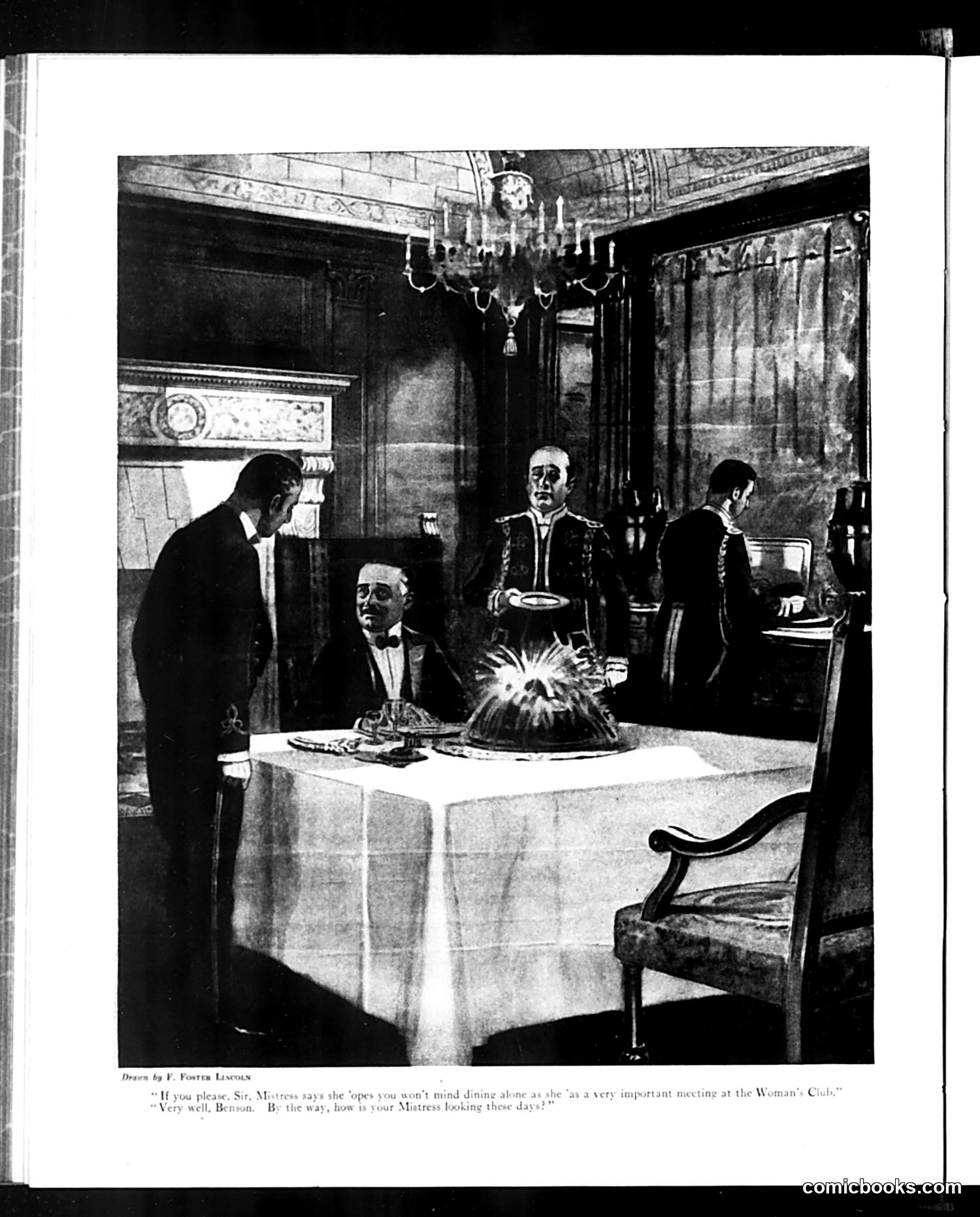
This drawing by F. Forain Lincoim depicts a domestic scene centered on a formal dinner table. Two men in evening wear converse while a military officer in dress uniform stands nearby; other figures occupy the background. The caption references "Mistress" saying the speaker "won't mind dining alone" at the Woman's Club, with a response about the Mistress's current appearance or condition ("how is your Mistress looking these days?"). The satire appears to target **upper-class social conventions and marriage dynamics** of the era—specifically the tension between wives attending women's clubs (a growing phenomenon of female independence) and husbands' expectations about domestic duties and appearances. The joke relies on the awkwardness of discussing one's wife's activities and condition in formal company. The specific historical context remains unclear without additional publication date information.
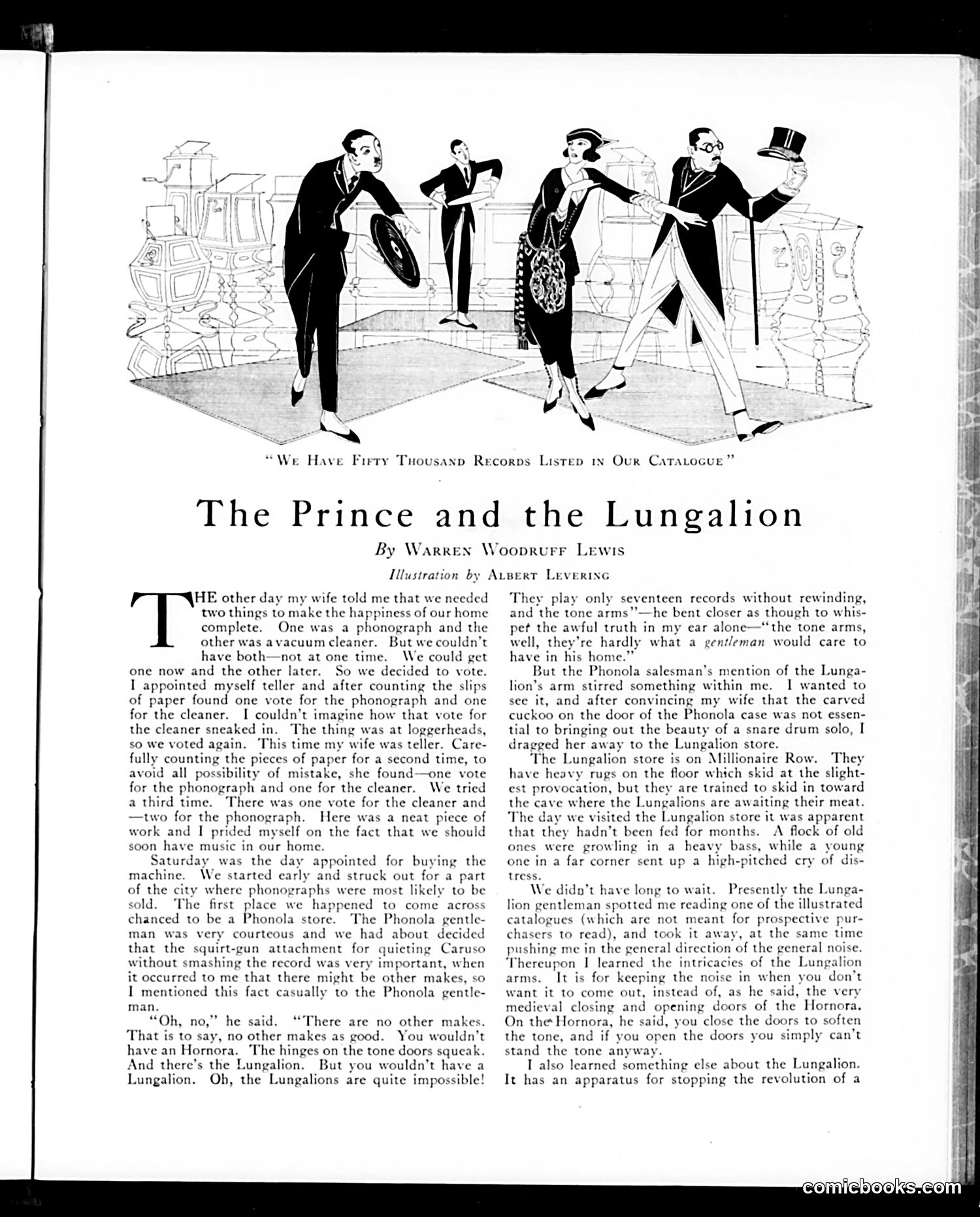
This is a humorous short story by Warren Woodruff Lewis, illustrated by Albert Levering. The cartoon heading shows well-dressed men in a record store examining phonographs and gramophones. The story satirizes early 20th-century consumer culture and phonograph marketing. The narrator and his wife debate purchasing a phonograph or vacuum cleaner—both new luxury items. They visit "Phonola" and "Lungalion" shops to comparison-shop. The satire centers on aggressive salesmen hawking expensive devices with dubious mechanical features (the "Lungalion" has a complex "tone arm" mechanism). The joke appears to mock both the inflated claims manufacturers made about phonograph quality and consumers' gullible fascination with new technology they barely understood.
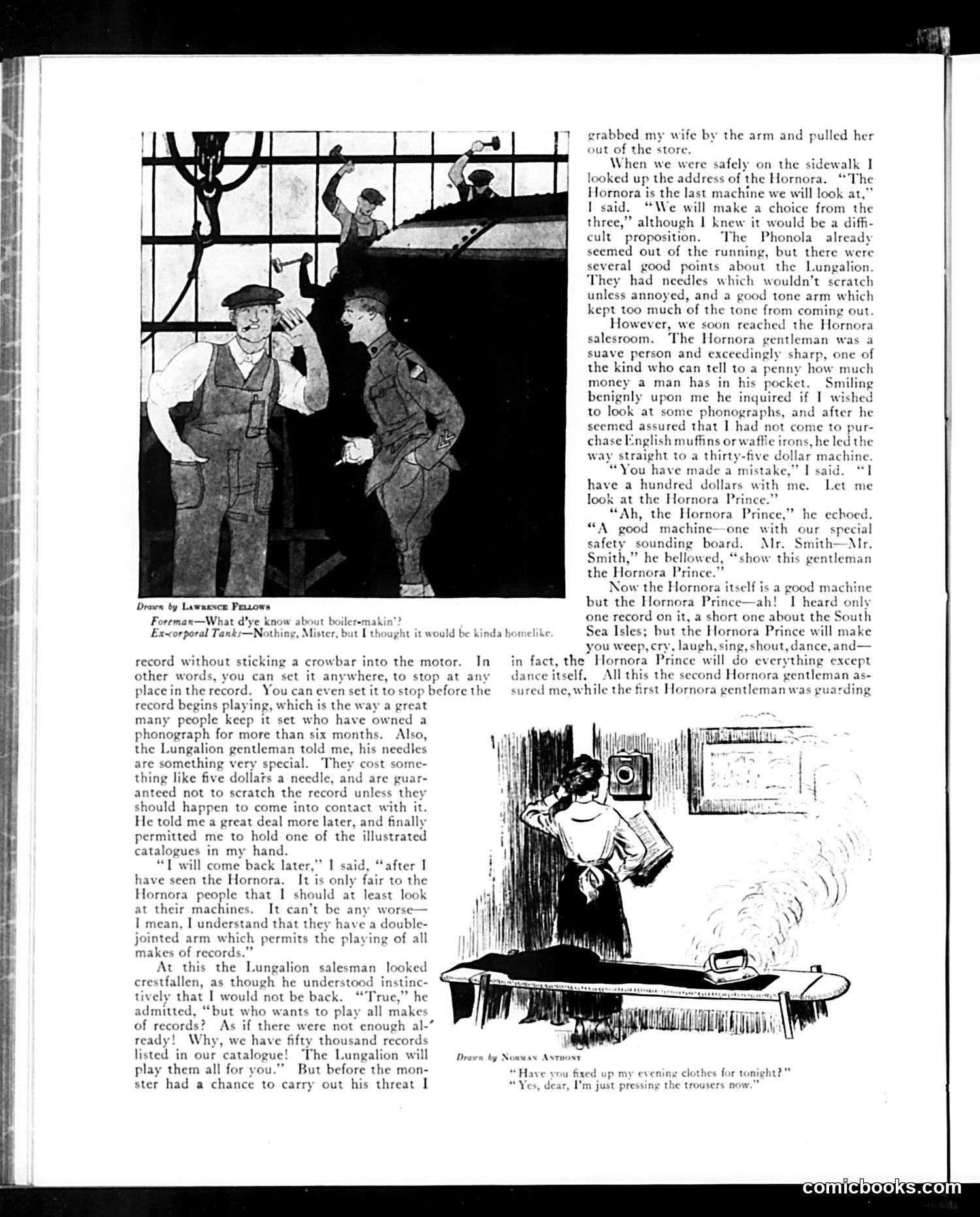
This page contains two separate illustrated stories about phonograph purchases, not political cartoons. The upper illustration (by Lawrence Fellows) shows a salesman at a "Hornora" phonograph store persuading customers to buy an expensive model by emphasizing its special features—needles that don't scratch records, superior tone quality, and an extensive catalog of 50,000 records. The lower illustration (by Norman Anthony) depicts a domestic scene where a woman asks her husband if he's prepared his evening clothes, to which he responds he's busy pressing trousers. These appear to be humorous consumer-focused vignettes reflecting early 20th-century attitudes toward emerging technology (phonographs) and traditional gender roles in household management. The satire targets both aggressive sales tactics and domestic dynamics rather than political issues.
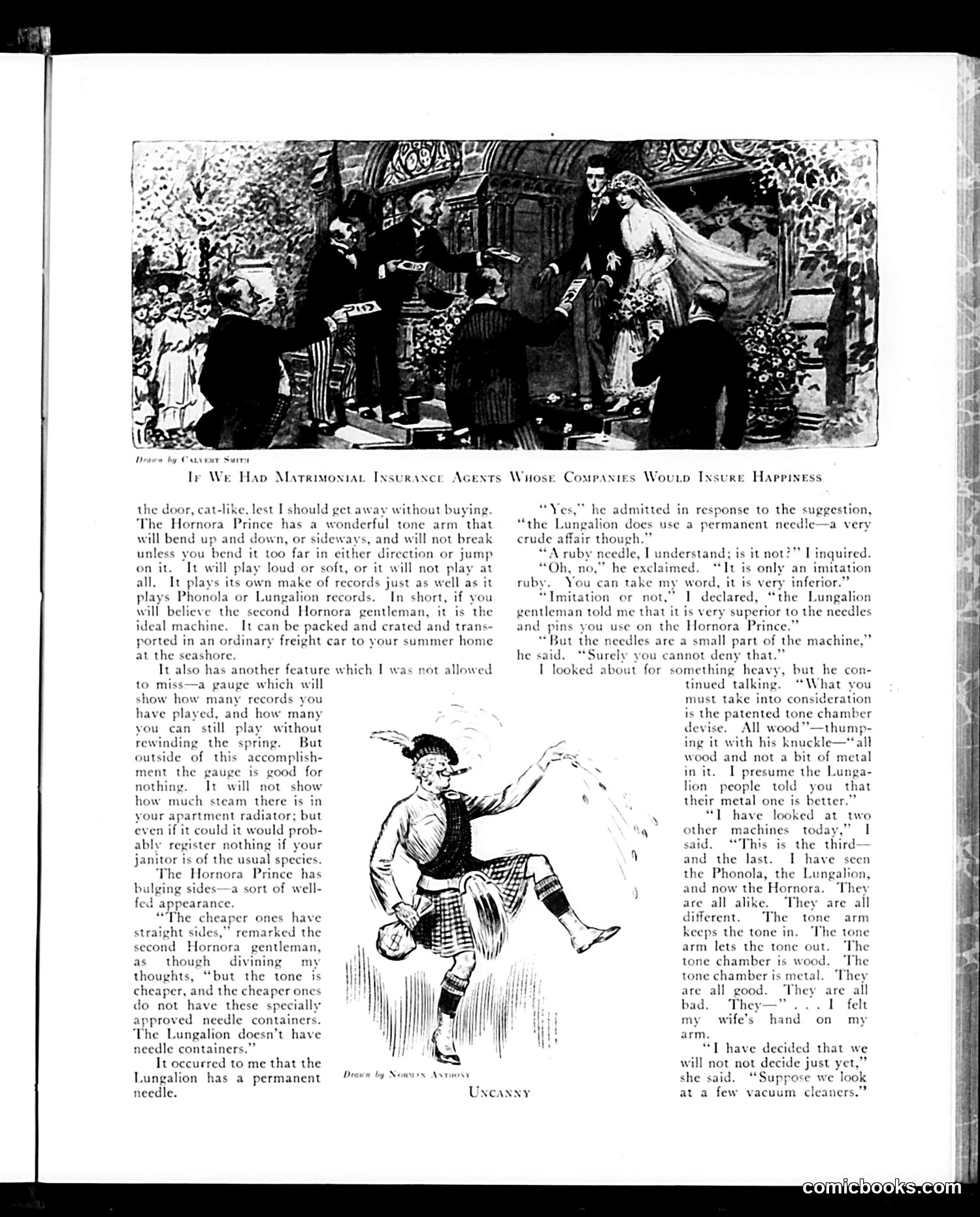
This page satirizes **aggressive door-to-door phonograph salesmen** of the early 20th century. The top illustration shows a wedding scene where a salesman appears to be making his pitch—even at intimate moments. The main text is a humorous monologue about a man being cornered by a Hornora Prince phonograph salesman who uses manipulative tactics: praising his own product while denigrating competitors (Phonola, Lungalion brands). The salesman makes contradictory claims—saying cheaper models have inferior tone while simultaneously praising his own features. The joke's point: the man is overwhelmed by **contradictory marketing claims**. Every competitor supposedly told him their machine was superior; every salesman dismisses rivals as crude or inferior. By the end, his exasperated wife suggests looking at **vacuum cleaners instead**—implying she'd rather shop for anything else than endure more phonograph sales pitches. The satire mocks both aggressive 1920s-era sales tactics and consumer confusion created by competing product claims with no objective way to verify superiority.
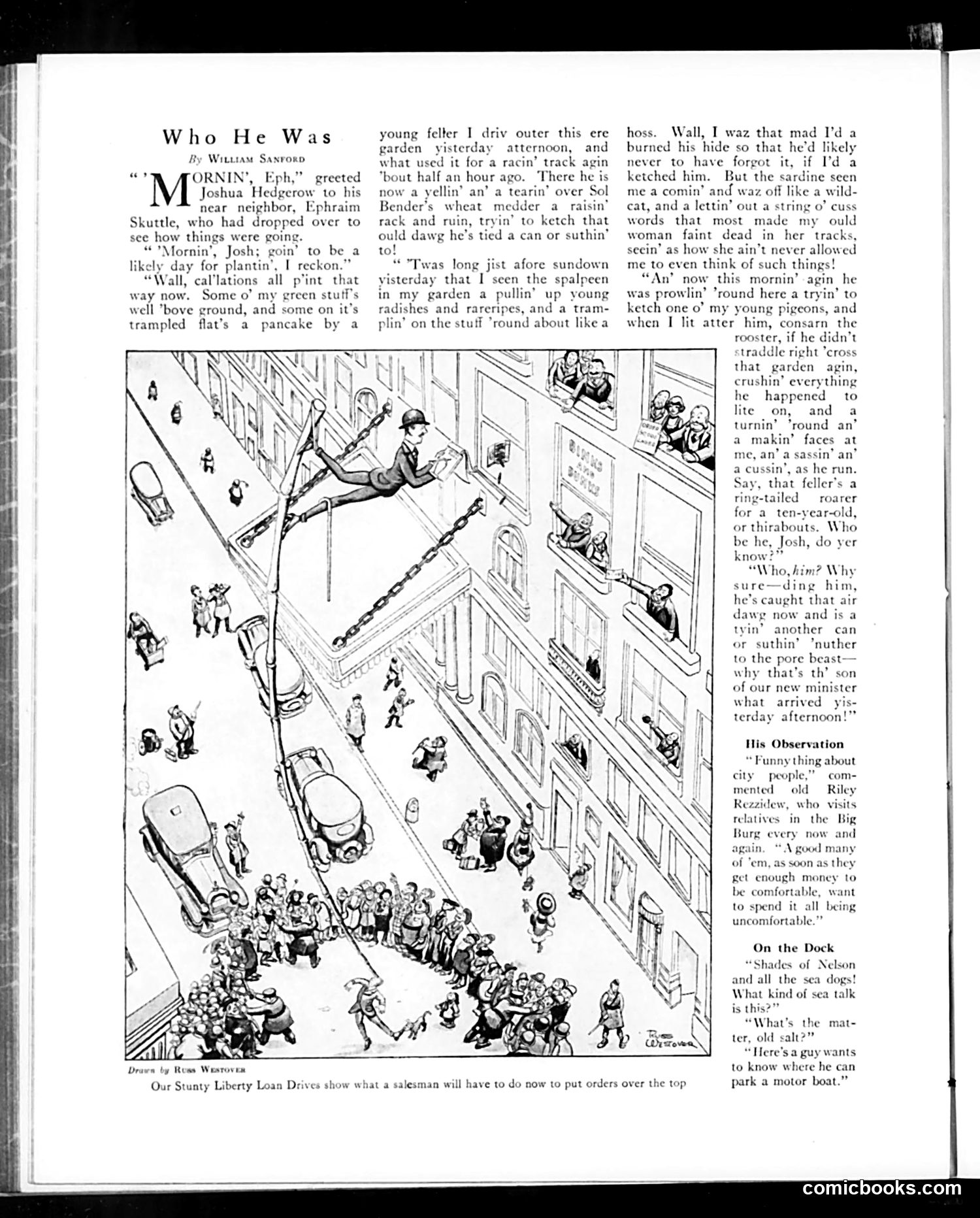
This page contains a rural dialect story and a cartoon about wartime salesmanship. The main illustration, captioned "Our Stunty Liberty Loan Drives," depicts a salesman performing acrobatic stunts above a city street to attract attention and sell Liberty Bonds—the government's WWI fundraising tool. The exaggerated visual humor suggests the extreme measures salesmen now must employ to make sales pitches heard in crowded urban environments. The text story "Who He Was" is a comedic rural anecdote featuring two farmers discussing a destructive, mischievous boy wreaking havoc in gardens and chasing animals. The punchline reveals he's the newly-arrived minister's son—an ironic contrast between expected respectability and actual behavior. The two shorter vignettes ("His Observation" and "On the Dock") offer brief satirical observations about city dwellers and modern inconveniences, typical of Judge's satirical style of the era.
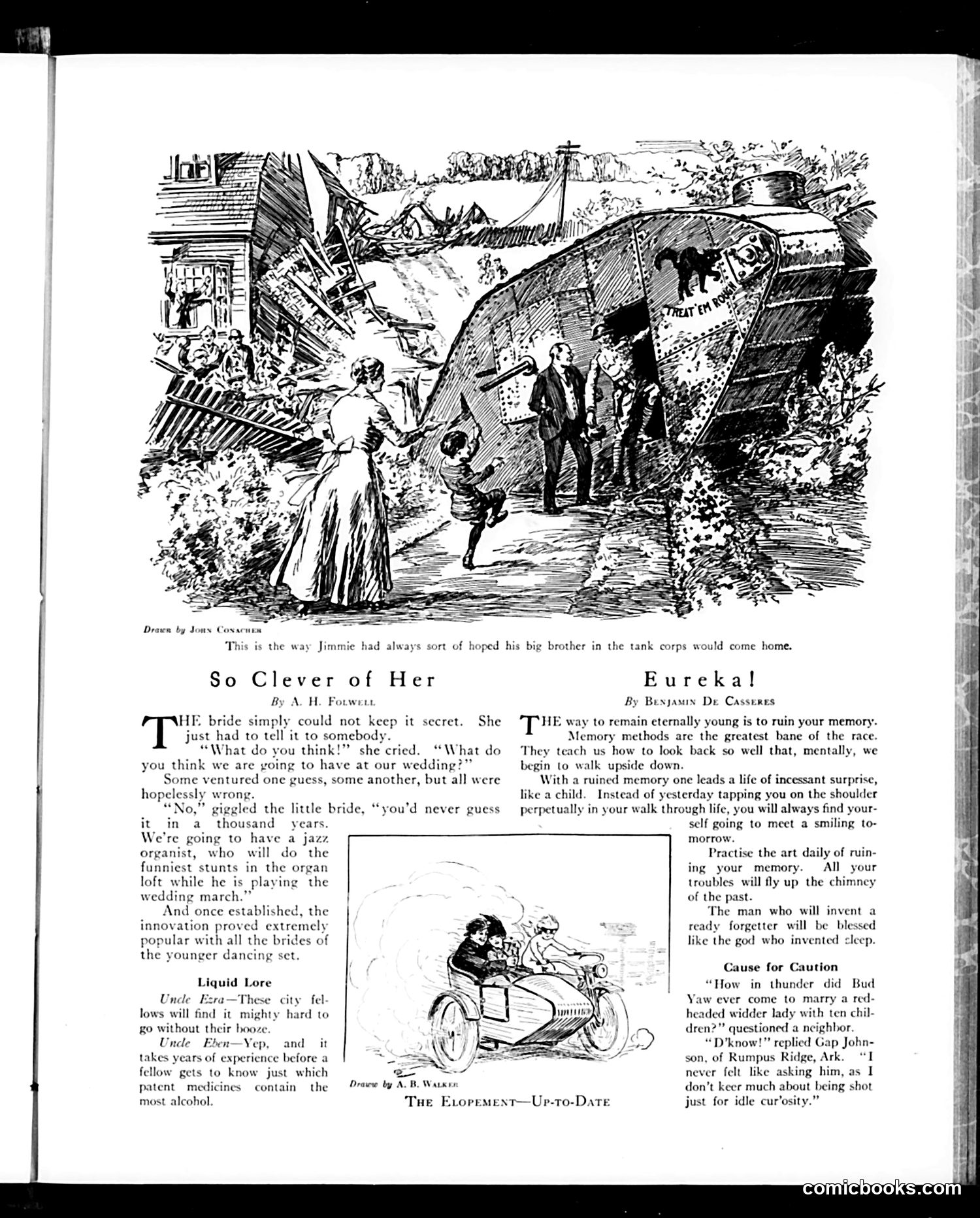
This Judge magazine page contains three separate satirical pieces: **"So Clever of Her"** mocks early 20th-century wedding trends. A bride excitedly reveals her "shocking" innovation: hiring a jazz organist to play humorous stunts during the organ wedding march. The satire targets how younger couples treated even minor novelties as revolutionary, and how eager they were to share trivial social gossip. **"Eureka!"** philosophizes about memory as a burden to happiness. It argues that forgetting troubles brings perpetual contentment like childhood innocence, satirizing both self-help memory-improvement fads and overly earnest philosophical advice literature popular in the era. **"Liquid Lore"** and **"Cause for Caution"** are brief humorous vignettes. The first jokes about Prohibition-era workarounds—city men discovering patent medicines contained alcohol. The second presents rural dialect humor about a man marrying a widow with ten children, joking he won't ask why for fear of being shot. The motorcycle illustration shows a couple eloping, captioned as the "up-to-date" elopement method.
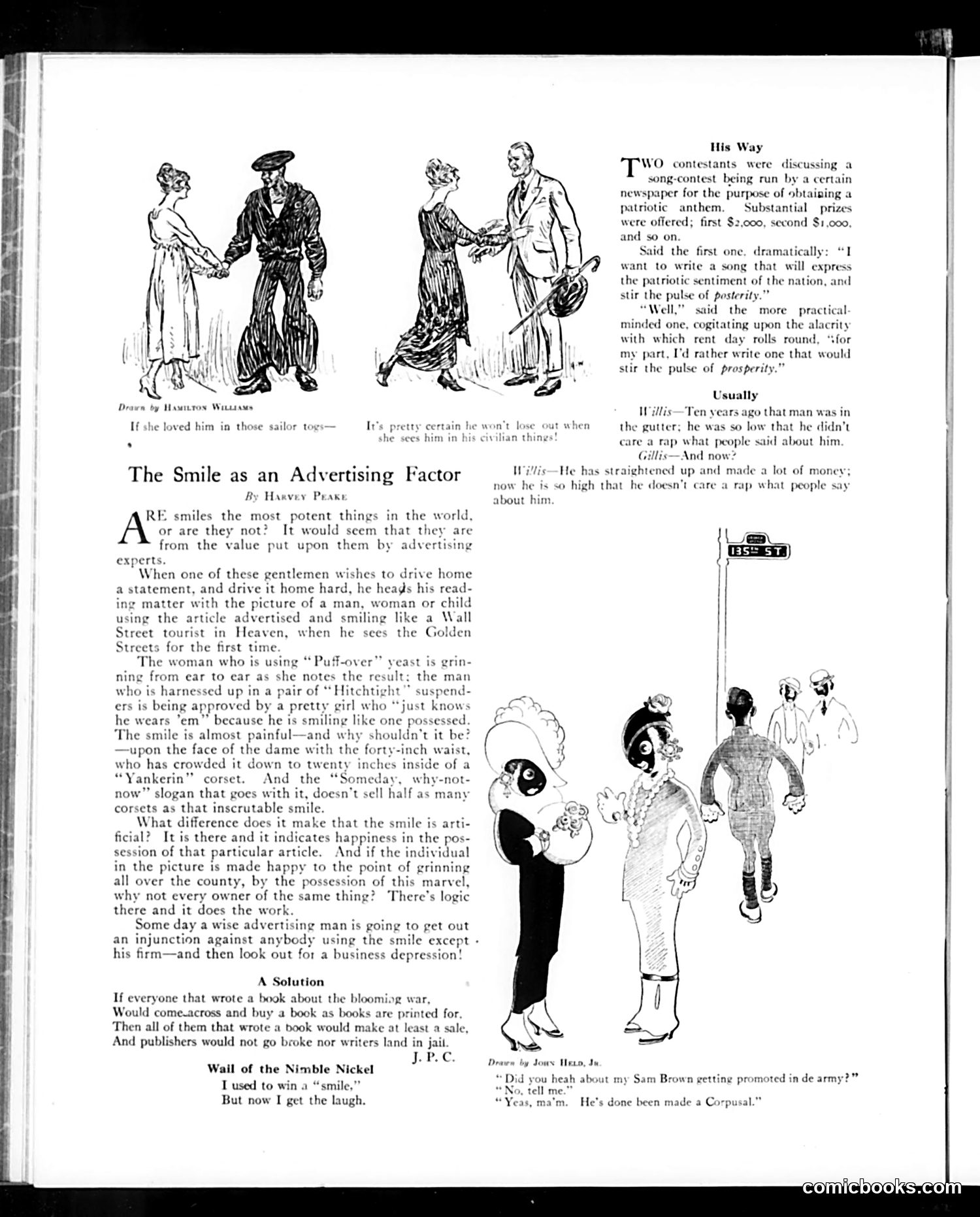
This page contains several satirical pieces typical of early 20th-century Judge magazine: **"The Smile as an Advertising Factor"** (main article): Critiques the widespread advertising practice of showing smiling people using products—yeast, suspenders, corsets—to suggest the user will be happy if they buy the item. The author observes this artificial happiness is transparently manipulative yet effective, and jokes that advertisers should be enjoined from using smiles, as banning them would cause economic collapse. **"His Way"** (dialogue): Two songwriters competing for prize money in a newspaper patriotic anthem contest—one wants to stir "posterity," the other pragmatically wants to stir "prosperity" (rent day concerns). **"Usually"** (brief dialogue): A man has risen from poverty to wealth; he didn't care what people said when poor, and still doesn't now that he's rich—suggesting indifference persists regardless of circumstance. **Bottom cartoon**: Appears to reference military promotion ("Sam Brown"—likely a military figure or uniform reference). The page satirizes advertising manipulation, artistic pretension versus practical concerns, and social mobility.
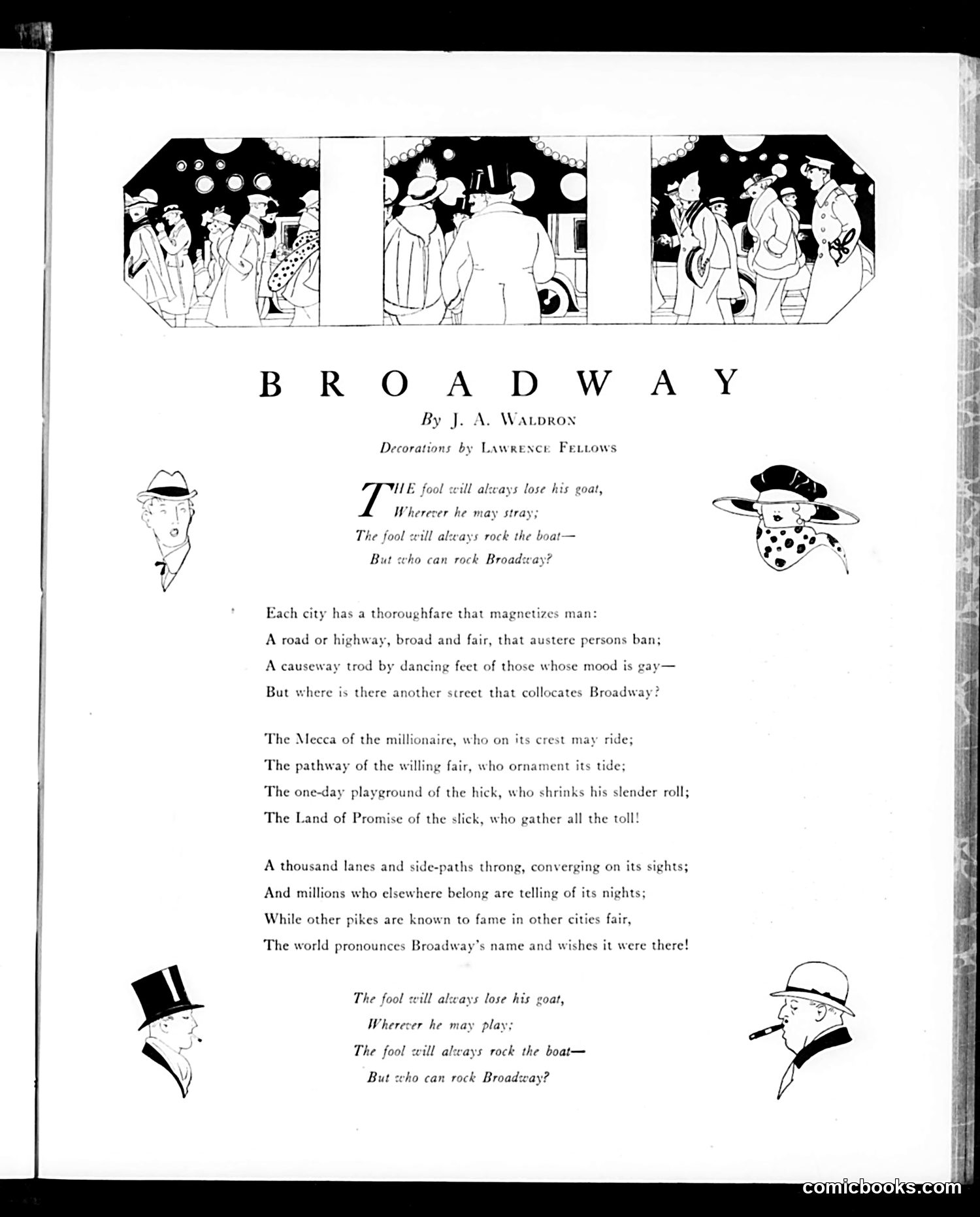
This is a celebratory poem about Broadway, New York's famous theater district, decorated with period illustrations of well-dressed urban characters. The poem romanticizes Broadway as an irresistible attraction drawing all social classes—millionaires, "willing fair" women, rural visitors ("hicks"), and con artists ("the slick"). It depicts Broadway as uniquely magnetic compared to other cities' entertainment districts, with "a thousand lanes" converging on its sights and millions worldwide wishing they were there. The refrain, "The fool will always lose his goat / But who can rock Broadway?" suggests Broadway's power is unshakeable—while foolish individuals may lose their way or money elsewhere, no one can disrupt Broadway's dominance as America's premier entertainment destination. The decorative illustrations show fashionably dressed figures in early 20th-century attire, reinforcing the glamorous, cosmopolitan image. This is essentially promotional verse celebrating Broadway's cultural supremacy.
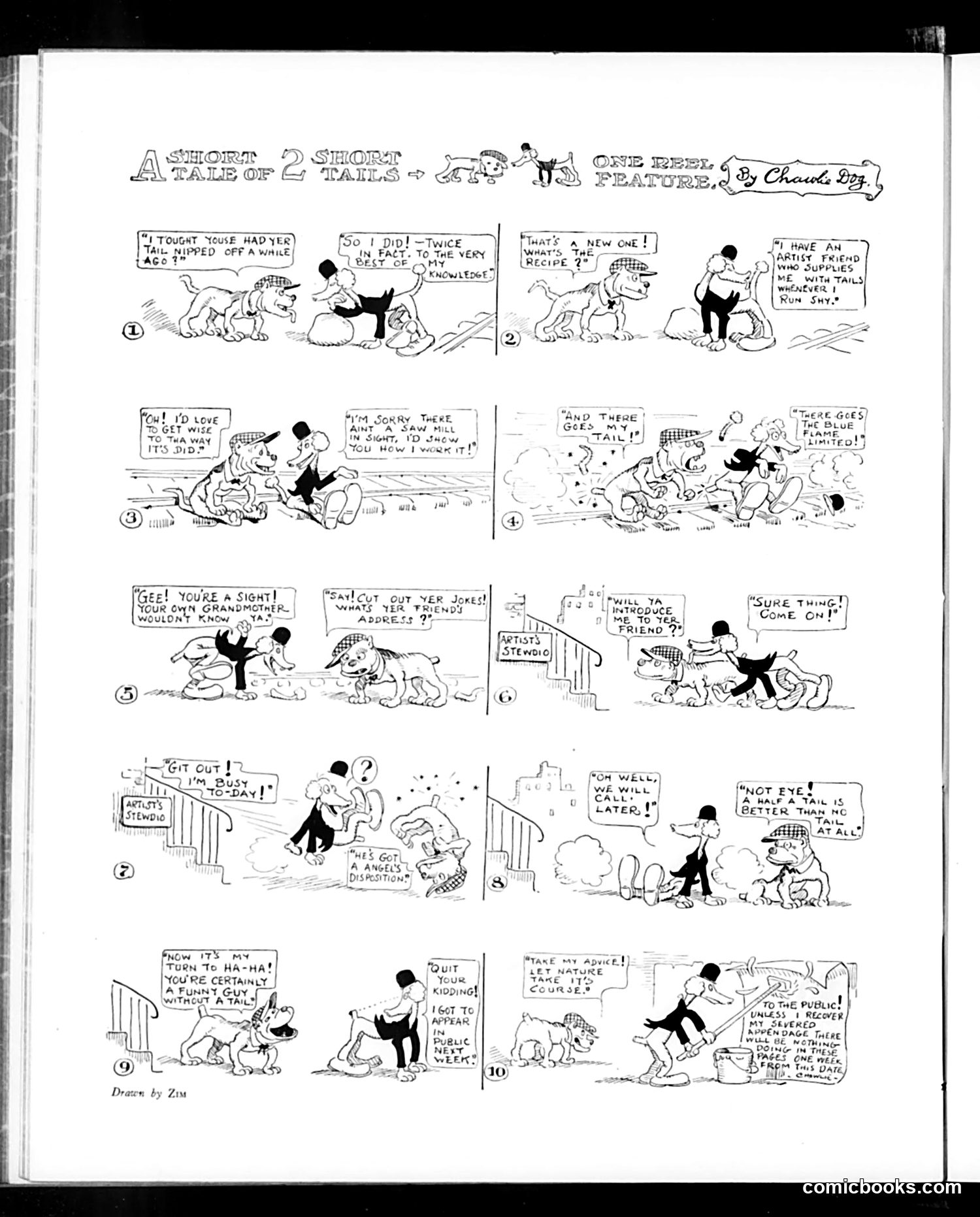
This is a humorous animal comic strip about a dog whose tail has been docked (surgically shortened or removed). The narrative follows the dog's attempts to hide this embarrassment from his owner's artistic friend who supplies materials. The joke turns on Victorian-era social pretension: the dog is so ashamed of his altered appearance that he tries to conceal it, even going to comedic extremes like hiding or making excuses. The friend repeatedly notices the missing tail, and the dog's desperate denials and increasingly absurd explanations form the humor. The satire gently mocks both the vanity of keeping up appearances and the social anxiety of being visibly "imperfect" in front of refined company. The recurring phrase about the "blue flame" and the artist's studio references upper-class artistic circles, suggesting the target audience was educated readers familiar with pretentious social circles. The strip's title emphasizes the duality: two short tales about one short tail.
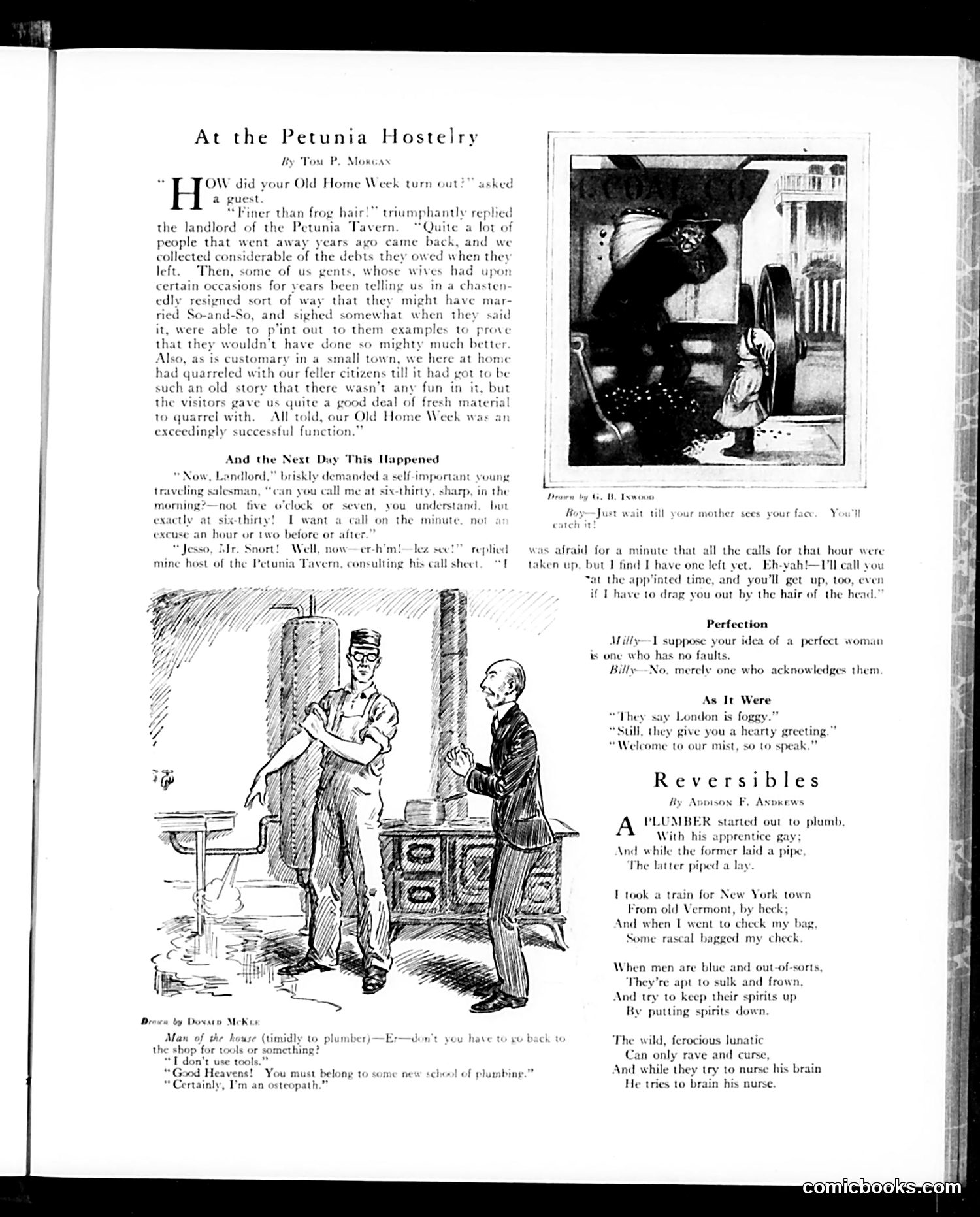
This page satirizes small-town American social dynamics, particularly around "Old Home Week" celebrations (a real early-1900s phenomenon where former residents returned to their hometowns). The main story mocks how nostalgic homecomings reveal petty truths: returning visitors prove they haven't done better elsewhere, old debts resurface, and the town revives forgotten grudges. The landlord ironically calls it a "successful function." The follow-up cartoon shows a demanding young traveling salesman (typical of the era) insisting on precise 6:30 AM service—a joke about urban pretension meeting rural practicality. The innkeeper humorously suggests the man must be an "osteopath" (implying he's overly fussy about details). The page also includes lighter jokes about marital "perfection" and wordplay poems ("Reversibles") playing on double meanings of words like "check" and "pipe." Overall: satirical critique of small-town gossip, nostalgia, and class differences between provincial and urban America.
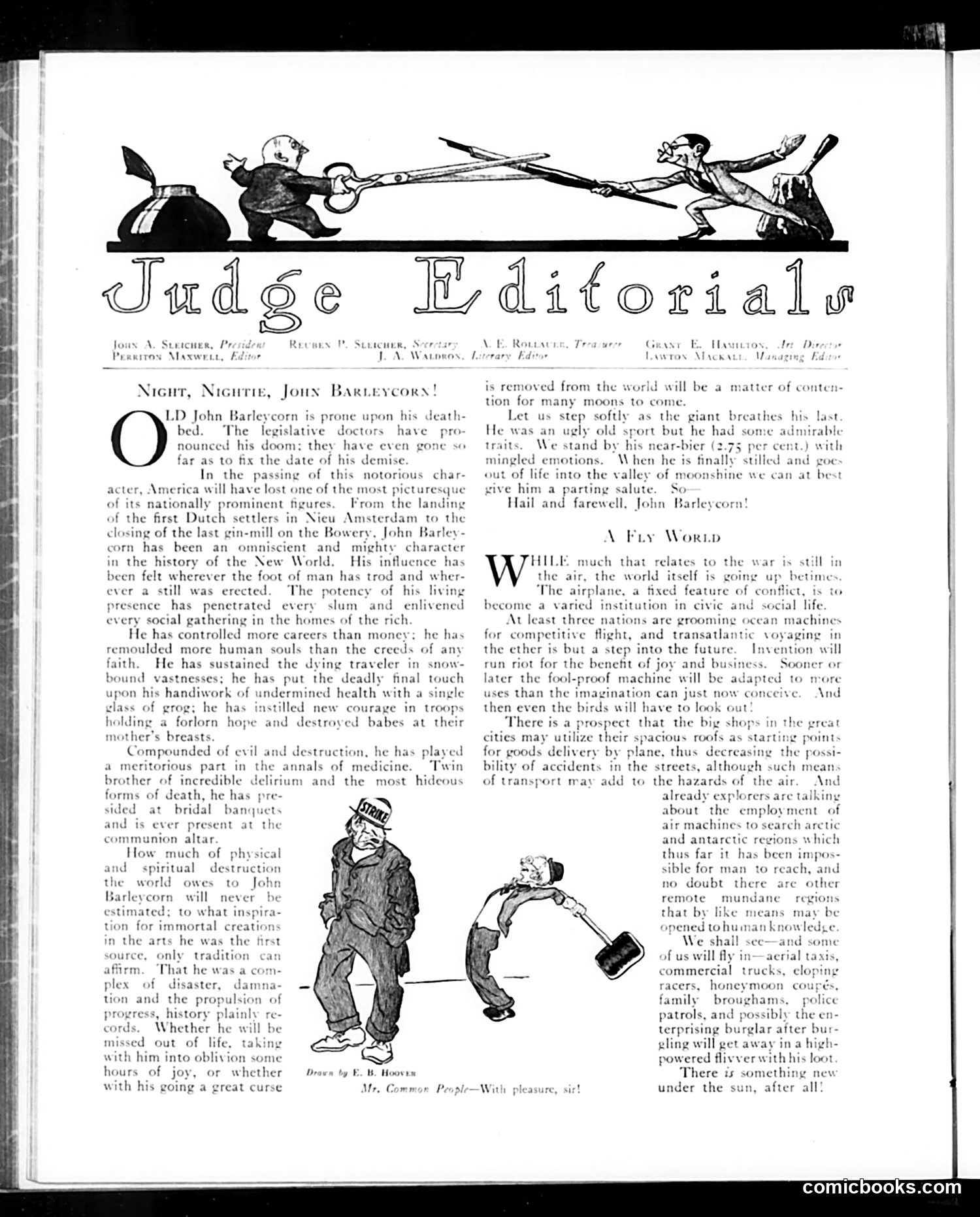
This page commemorates the death of **John Barleycorn**—a personified metaphor for alcohol itself. The left article is an mock-obituary celebrating the passing of drinking culture, likely written around Prohibition's enactment (1920). The editorial mourns alcohol's demise while sarcastically cataloging its destructive legacy: ruined careers, broken health, destroyed families, and social decay. Yet it grudgingly acknowledges alcohol's cultural prevalence and role in art and medicine. The tone is darkly comic—treating booze as a deceased public figure worthy of eulogistic farewell ("Hail and farewell, John Barleycorn!"). The cartoon illustration (by E.B. Hooves, per caption) appears to show two figures interacting, likely representing the relationship between alcohol and society. The right section, "A Fly World," shifts to aviation—discussing wartime airplane development and speculating on civilian uses like cargo delivery and arctic exploration. This represents forward-looking optimism about technology's future applications. Together, the page contrasts America's rejection of one vice with enthusiasm for technological progress.
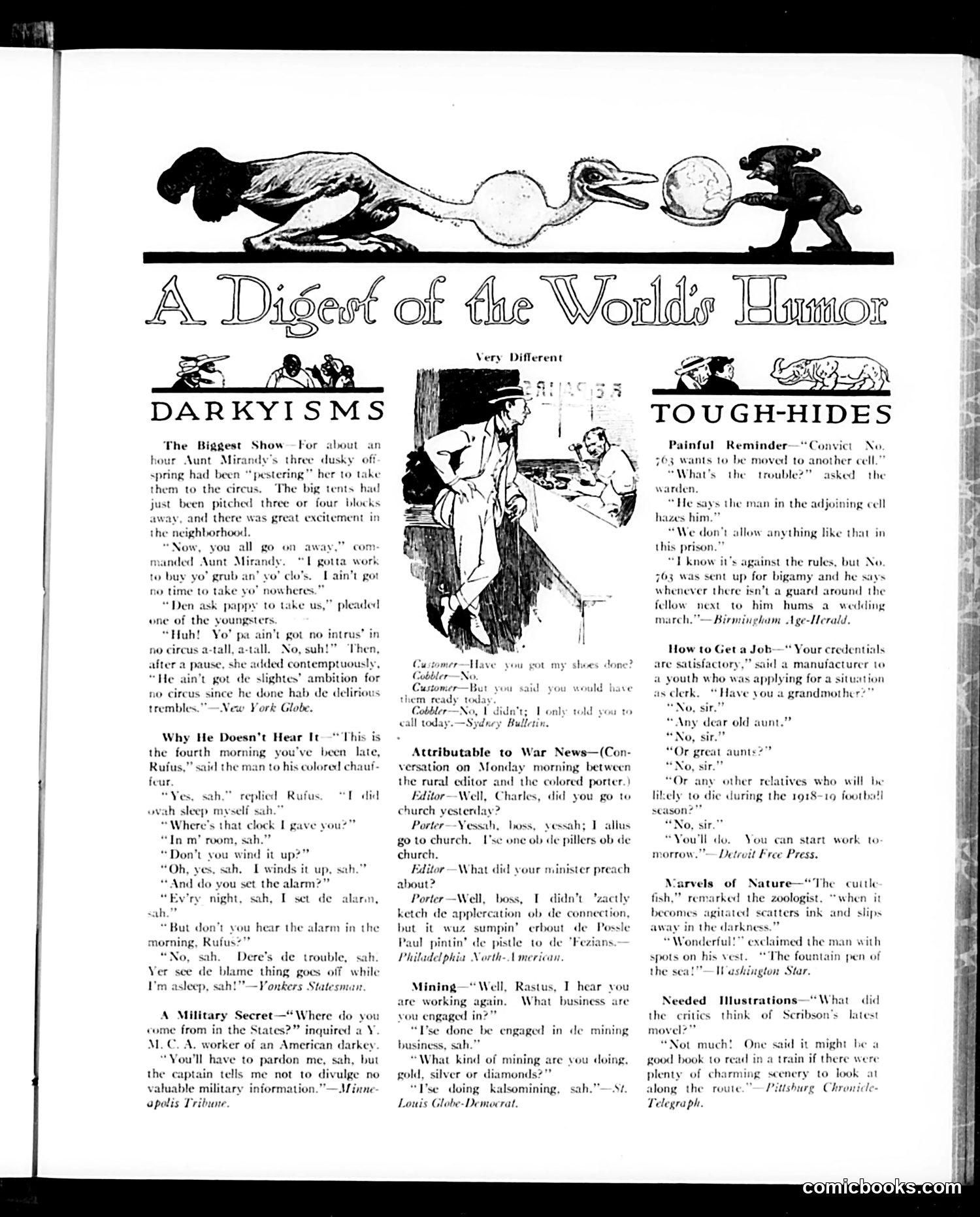
This page collects brief humorous anecdotes organized by category. The content relies heavily on **racist dialect humor** common to early 20th-century American publications, depicting Black characters ("Aunt Mirandy," "Rufus," "Rastus," "Charles") through demeaning stereotypes and exaggerated speech patterns. The jokes typically show Black workers or servants in situations emphasizing laziness, ignorance, or comic misunderstanding—for example, Rufus the chauffeur can't wake to his alarm because it goes off "while I'm asleep," or the church porter garbles biblical references. A section titled "DARKYISMS" explicitly brands this content. Other segments mock other groups: immigrants, rural folk, and modern inconveniences (alarm clocks, fountain pens). The "TOUGH-HIDES" section's convict joke uses casual racism for shock value. By modern standards, this represents deeply offensive minstrelsy-era humor that reinforced harmful racial stereotypes as entertainment for white audiences.
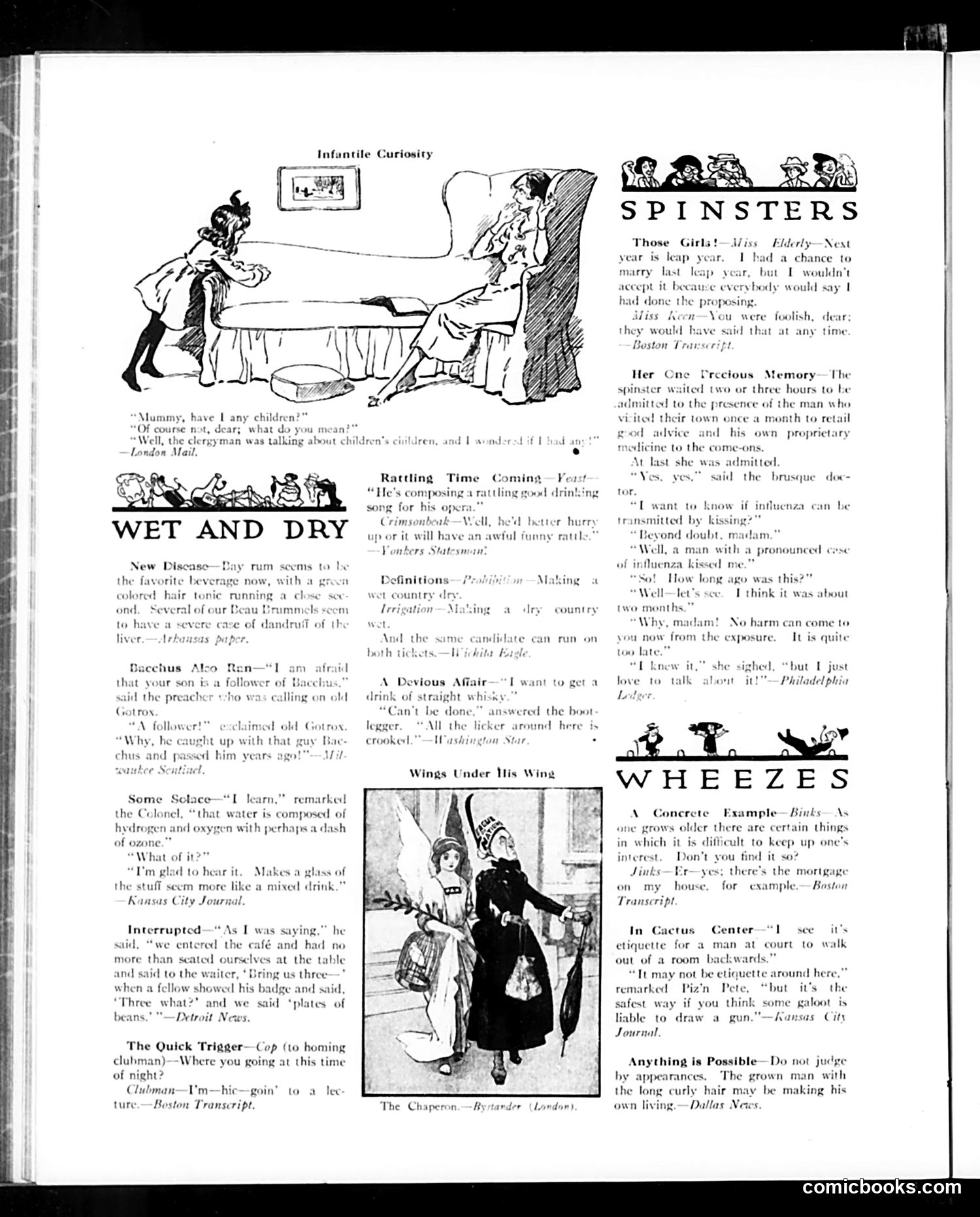
This page from the satirical magazine **Judge** contains humor columns and light jokes typical of early 20th-century American wit, rather than sharp political cartoons. **"Infantile Curiosity"** depicts a child asking a mother about children, with the mother's bewildered response. The humor relies on innocent misunderstanding. **"Wet and Dry"** section includes brief jokes: one about a new disease (dandruff) affecting "colored" hair, and another mocking temperance debates over whether water can be made "dry" (a reference to Prohibition-era arguments). **"Spinsters"** features three anecdotes about unmarried women, including one about a woman asking if influenza spreads by kissing—playing on common anxieties about contagious illness. **"Wheezes"** (meaning jokes) includes absurdist humor about mortgages, frontier etiquette, and unconventional appearances. The accompanying illustration shows two women in period dress, likely accompanying the "Spinsters" section. The overall tone is lighthearted domestic and social humor aimed at middle-class readers, with no apparent deep political content.
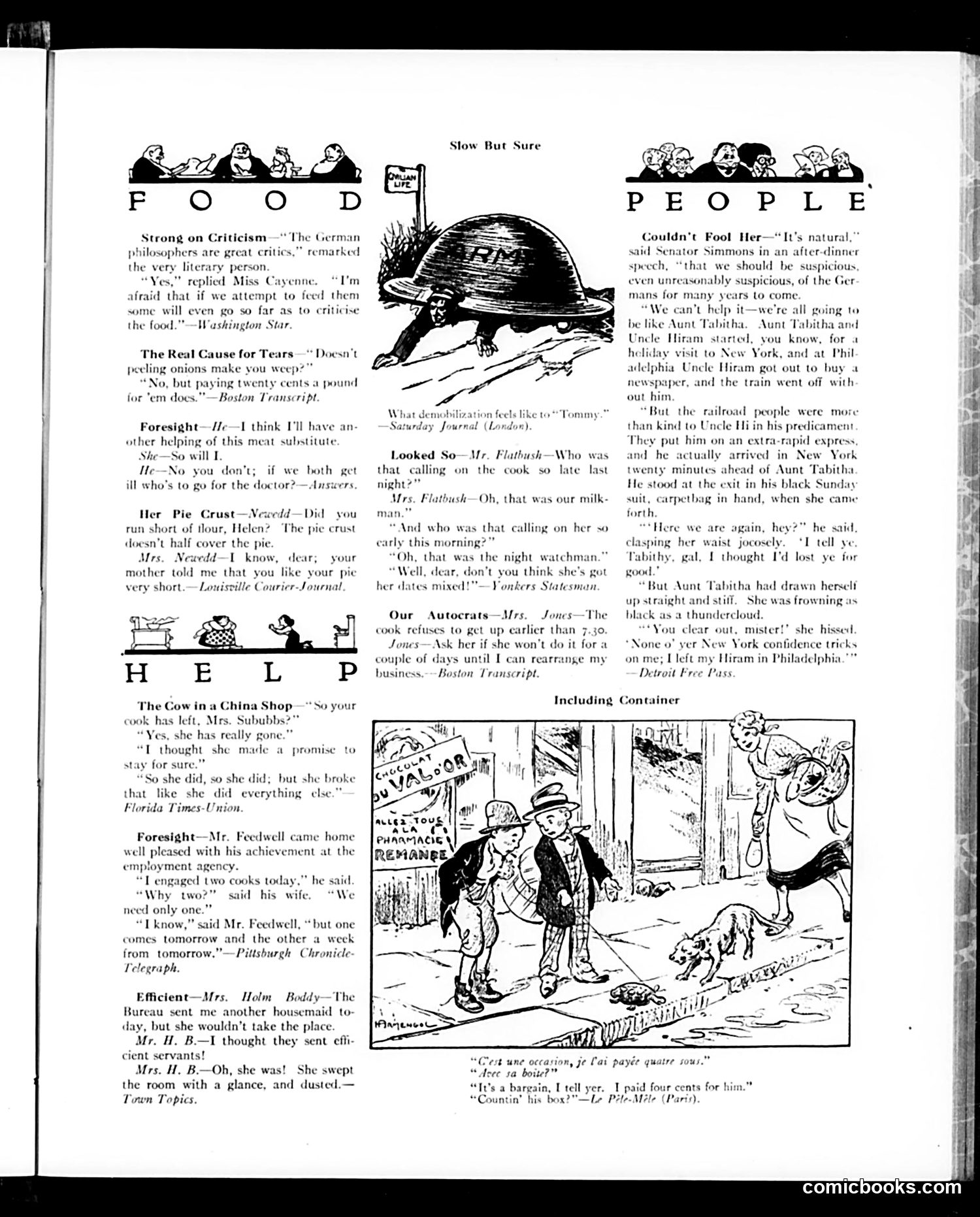
This page contains multiple short humorous anecdotes typical of early 20th-century satirical magazines, plus one political cartoon. **The Main Cartoon ("Including Container"):** Shows two men examining what appears to be a small person in a box, with French captions. This is a absurdist joke about purchasing a human being as if he were a commodity—the punchline plays on whether the "container" (box) is included in the price. It's humor based on dehumanization and treating people as goods. **Notable Content:** - "Couldn't Fool Her" presents a long anecdote about Senator Simmons warning Americans to distrust Germans post-WWI. The story uses a rural couple (Aunt Tabitha and Uncle Hiram) as comic foils, playing on class/regional stereotypes to frame wartime suspicion as natural and justified. - Other items mock domestic servants, housewives, and working-class concerns (food costs, hiring help). **Context:** This reflects post-WWI American attitudes—anti-German sentiment, class-based humor, and the servant-employment issues of the era. The heavy reliance on dialect humor and rural stereotypes was standard for the period.
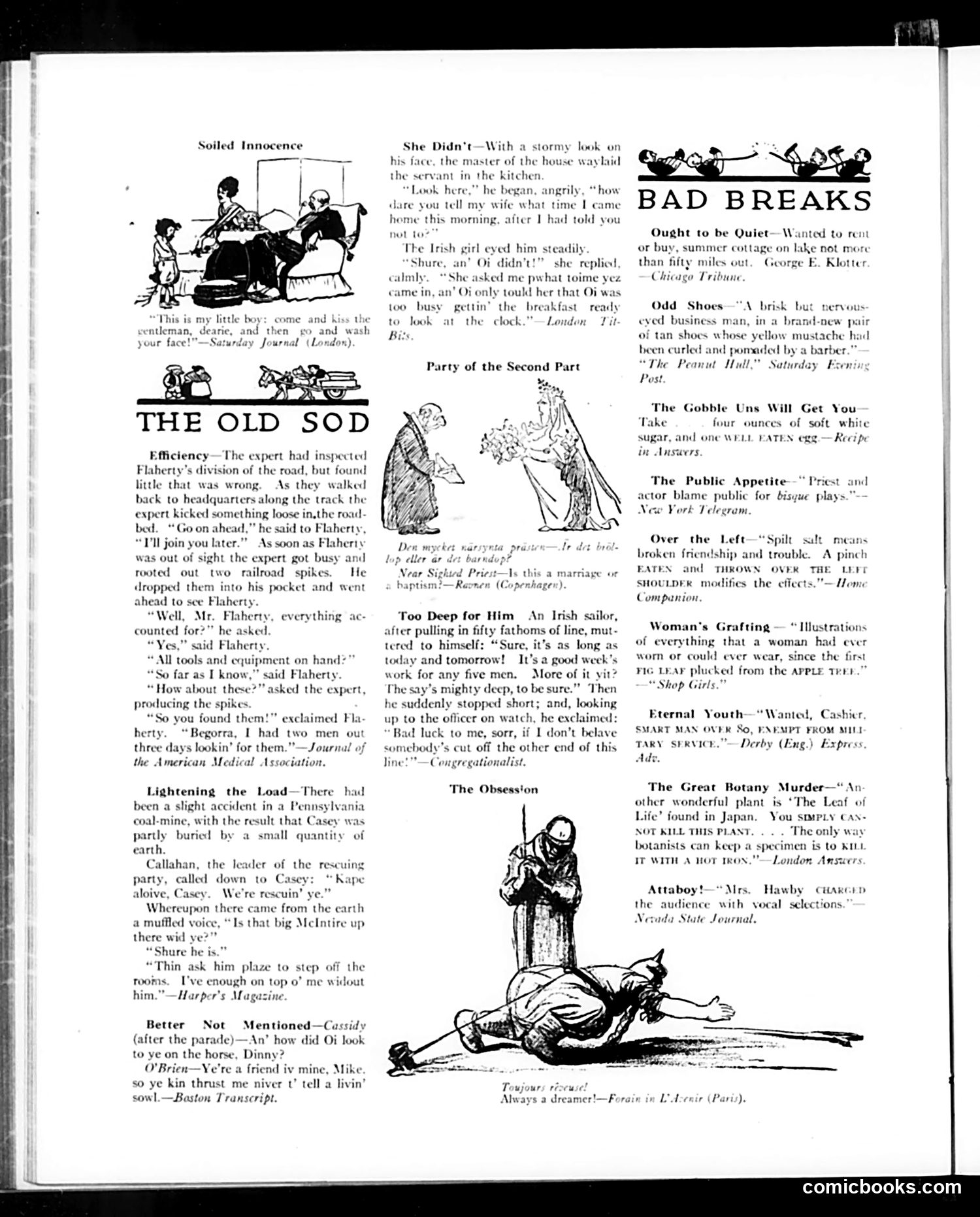
This page from the satirical magazine *Judge* contains several Irish-themed humor pieces mocking working-class Irish immigrants—a common stereotype in early 20th-century American comedy. **Main cartoons:** 1. **"Soiled Innocence"**: A mother instructs her child to kiss a gentleman, then wash—implying the gentleman is morally or physically unclean. 2. **"The Old Sod"**: An inspector sabotages a railroad worker's section by planting spikes, then blames the Irish worker Flaherty for "losing" them. The joke mocks Irish inefficiency. 3. **"Too Deep for Him"** and other Irish sailor jokes: Stereotype Irish workers as dim-witted, unable to understand simple situations (a sailor confused about fishing line length). The **"Bad Breaks"** column contains brief jokes and classified-style notices, mostly unremarkable period humor. Overall, the page reflects pervasive anti-Irish prejudice common in American media of this era, presenting Irish characters as bumbling, lazy, or foolish.
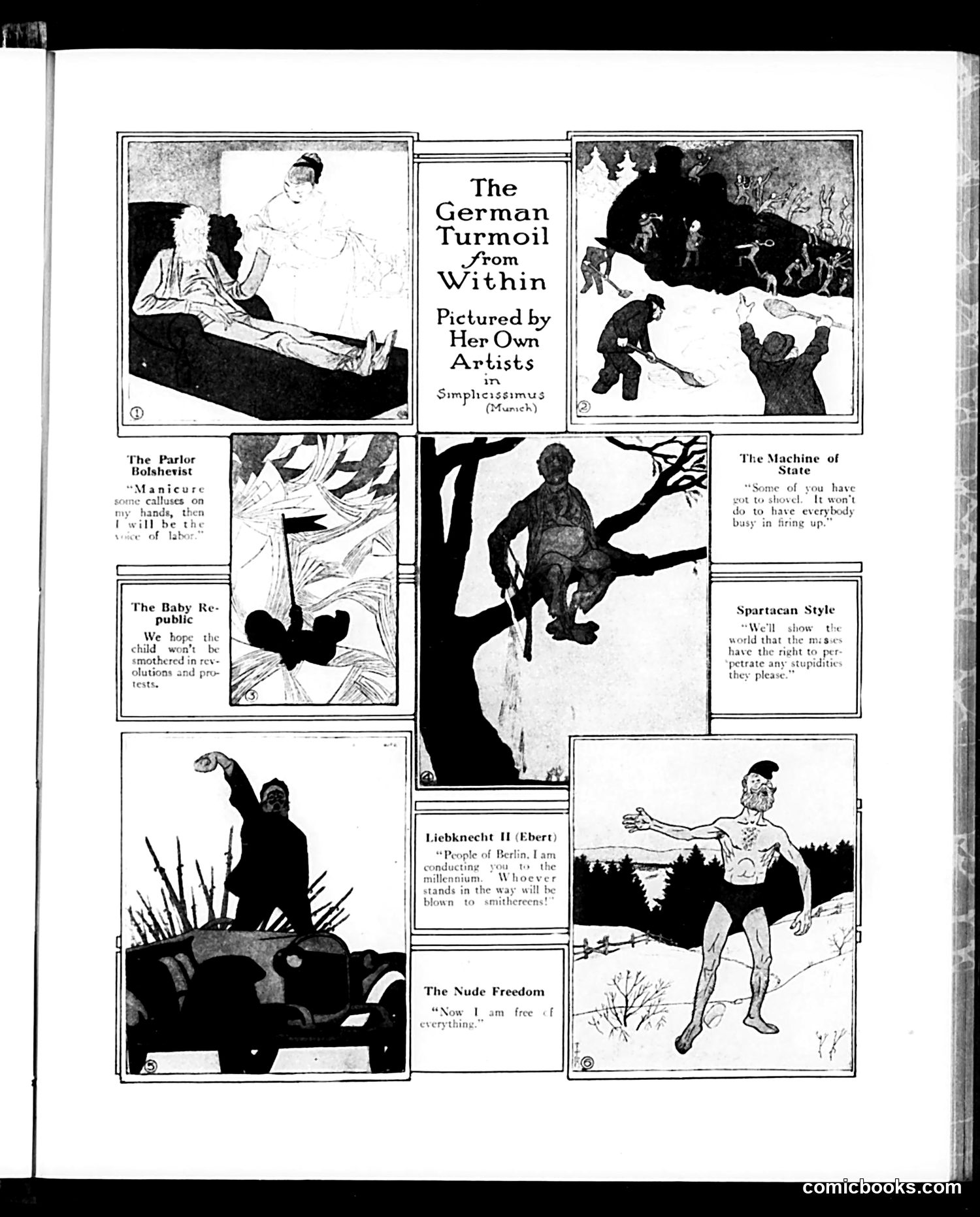
This page satirizes post-WWI German political chaos through cartoons attributed to German artists themselves ("Simplicissimus" style). Each panel mocks a different radical faction emerging in Germany circa 1918-1919: **The Parlor Bolshevist** ridicules wealthy elites flirting with communist revolution while remaining comfortable. **The Baby Republic** suggests the new Weimar government is fragile and may not survive upheaval. **The Machine of State** critiques authoritarian control—leaders demanding citizens stay "busy" serving the state. **Liebknecht II (Ebert)** references Karl Liebknecht and Friedrich Ebert, key figures in the German Revolution; the caption suggests brutal suppression of dissent. **Spartacan Style** likely alludes to the Spartacist League (communist group). **The Nude Freedom** depicts anarchistic liberation as naive or chaotic. The overall message: Germany's internal political turmoil—competing revolutionary ideologies—threatens national stability more than external enemies. The satire is deeply cynical about all factions.
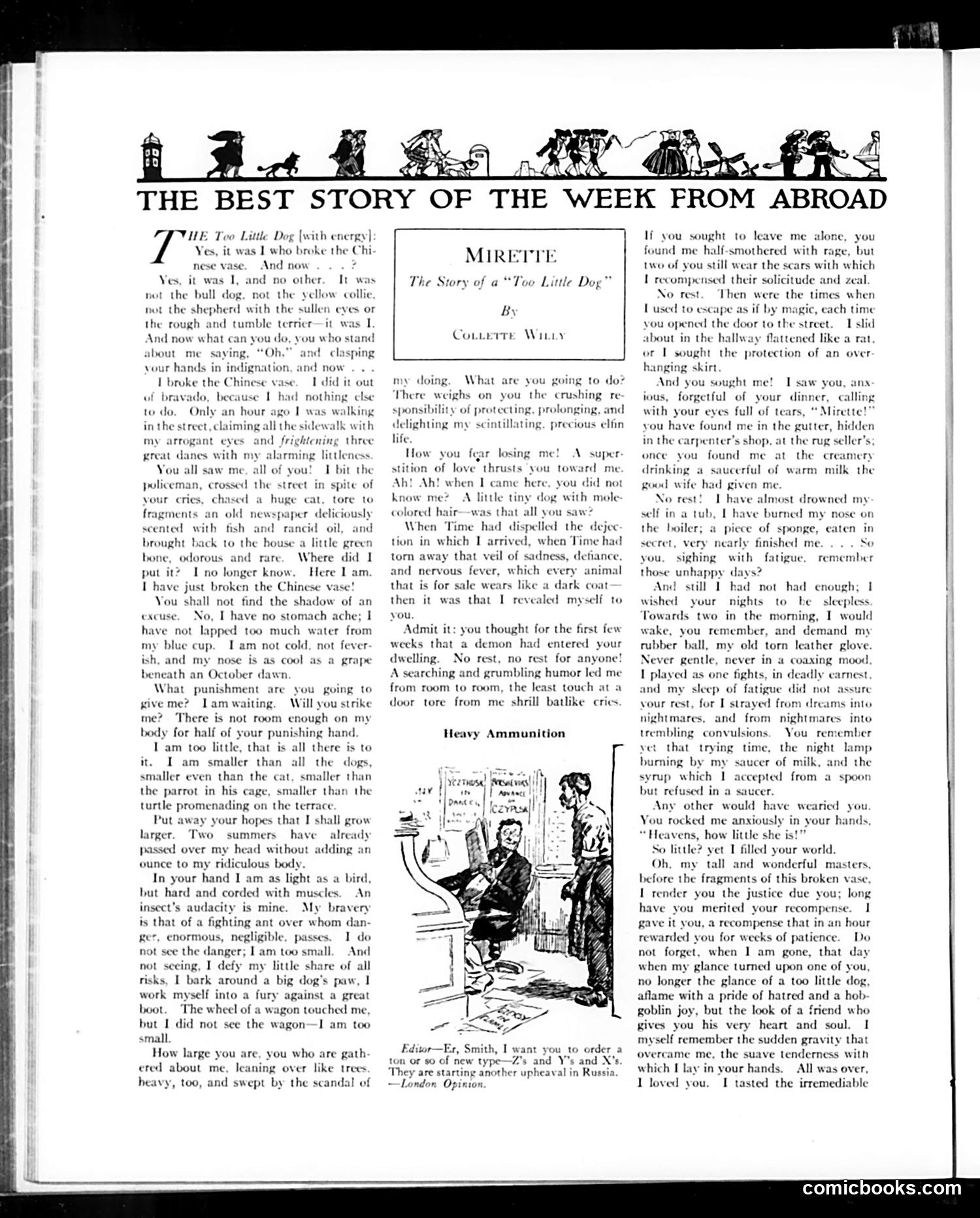
This page presents "Mirette: The Story of a 'Too Little Dog'" by Collette Willy—a sentimental fictional narrative, not political satire. The story is a monologue from a tiny dog's perspective, confessing to breaking a Chinese vase. The dog defends itself through paradox: though small and seemingly powerless, it possesses outsized audacity and emotional impact on its owners. The narrative explores themes of vulnerability, mischief, and the unexpected depth of feeling between pet and owner. The accompanying cartoon labeled "Heavy Ammunition" (bottom) shows two men in conversation, likely illustrating the story's domestic scenario, though context is limited. This appears to be a humorous literary piece rather than political commentary. The "satire" here is gentle—mocking human sentimentality toward pets and the psychology of small creatures who exploit their owners' affection. There is a brief editor's note referencing "another upheaval in Russia," suggesting the magazine's typical international coverage.
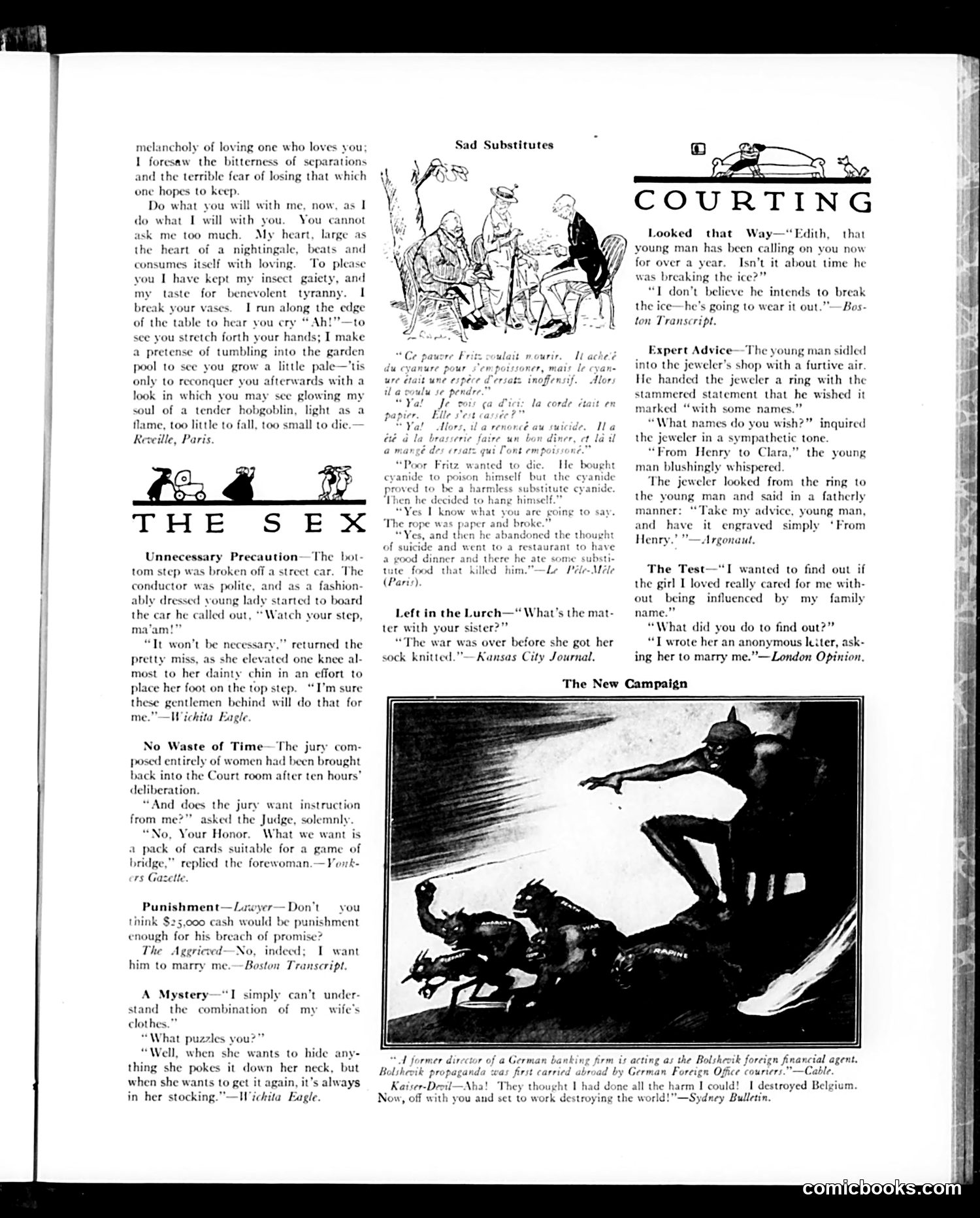
This page from Judge magazine contains several short humorous anecdotes and one political cartoon satirizing early 20th-century social conventions. **The Courting Section** features light jokes about dating and marriage customs—young men calling on women, engagement rings, and proposals. These reflect period concerns about courtship etiquette and romantic commitment. **The Political Cartoon** ("The New Campaign") depicts a figure labeled as a "former director of Bolshevik propaganda" acting as a German foreign financial agent. This references WWI-era anti-German and anti-communist sentiment, portraying alleged collaboration between German and Bolshevik forces as a threat. The grotesque figure suggests propagandistic fear-mongering about revolutionary movements and enemy cooperation. **Other Items** include jokes about women jurors prioritizing bridge over deliberation, wives' clothing storage habits, and wartime knitting efforts—reflecting contemporary anxieties about women's roles and WWI's social disruption. The overall tone is lighthearted mockery of modern life mixed with serious Cold War-era political anxiety.
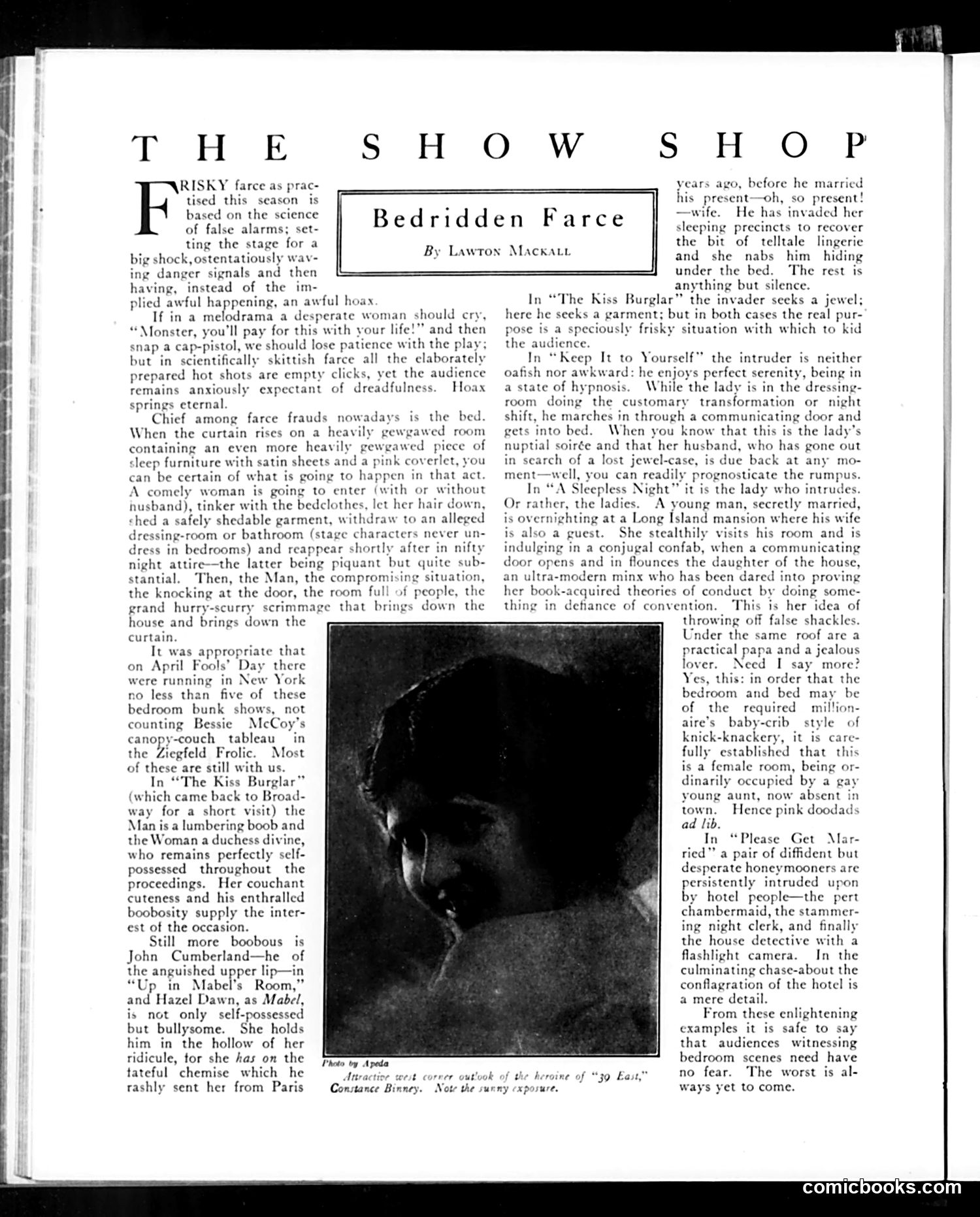
This page critiques a theatrical trend: bedroom-based farces popular in 1910s Broadway. The author (Lawton Mackall) argues these comedies rely on cheap tricks—elaborately setting up false alarms and predictable scenarios involving scantily-clad women, compromising situations, and door-knocking chaos. The photograph shows a scene from one of these plays, illustrating the "heavily gewgawed" bedroom staging the article mocks. Mackall identifies specific current productions: *"The Kiss Burglar,"* *"Up in Mabel's Room,"* and *"Keep It to Yourself."* Each follows the same formula: a woman undresses, a man unexpectedly enters (via jewel theft, hypnosis, or secret marriage complications), and mayhem ensues. The satire's point: audiences predictably expect dreadfulness but receive only "hoax"—empty shock tactics replacing genuine wit. By calling this "scientifically skittish farce," Mackall suggests the plays methodically manufacture false drama rather than deliver authentic comedy. The criticism emphasizes how formulaic and manipulative these productions are.
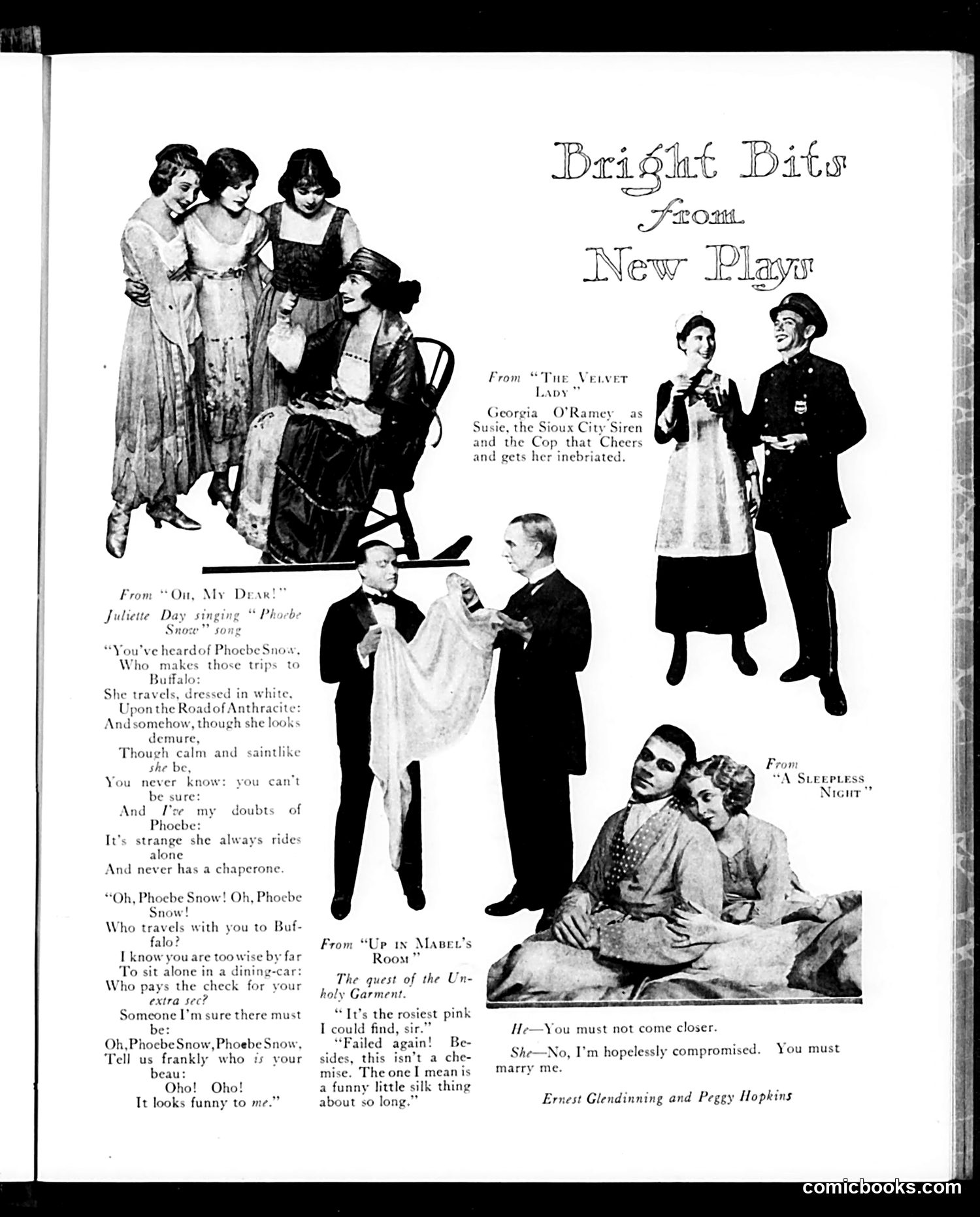
This page collects theatrical vignettes and satirical commentary on contemporary Broadway productions. The centerpiece mocks "Phoebe Snow," a famous advertising character—a woman always dressed in immaculate white who traveled the Delaware, Lackawanna & Western Railroad. The joke targets her implausible purity: the song sarcastically questions how she maintains her spotless appearance while traveling alone uncharperoned, suggesting impropriety beneath her virtuous public image. Other sketches reference theatrical plots from shows like "The Velvet Lady" and "Up in Mabel's Room," poking fun at romantic comedies and their predictable storylines about compromised women demanding marriage proposals. The satire mocks both advertising hypocrisy and theatrical clichés about female propriety and scandal.
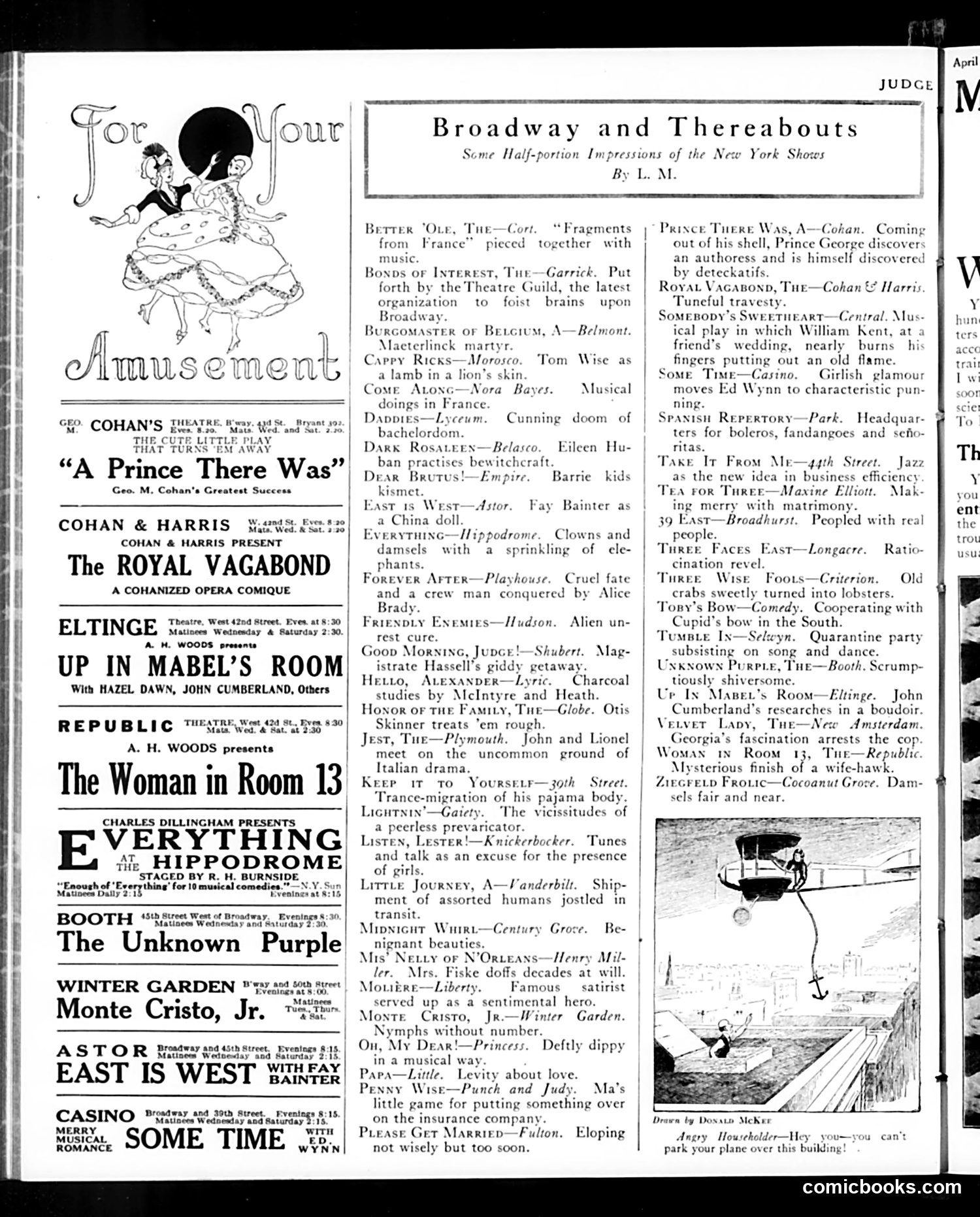
This page is primarily **theater advertising and criticism**, not political satire. It's a review section from *Judge* magazine covering New York Broadway shows circa 1918-1920. The left side lists current theatrical productions with brief, witty synopses—typical of entertainment journalism. The right column, "Broadway and Thereabouts," provides more detailed critiques of shows like "A Prince There Was" and "The Royal Vagabond," using sardonic one-liners to mock plot absurdities and performances. The illustration shows an airplane overhead with an angry spectator below—a joke about "Angry Householder: Hey you—you can't park your plane over this building!" This reflects the novelty of early aviation technology intruding on urban life, a contemporary concern for 1920s readers. The page's humor derives from theatrical mockery rather than political commentary—typical of *Judge*'s entertainment coverage during this era.
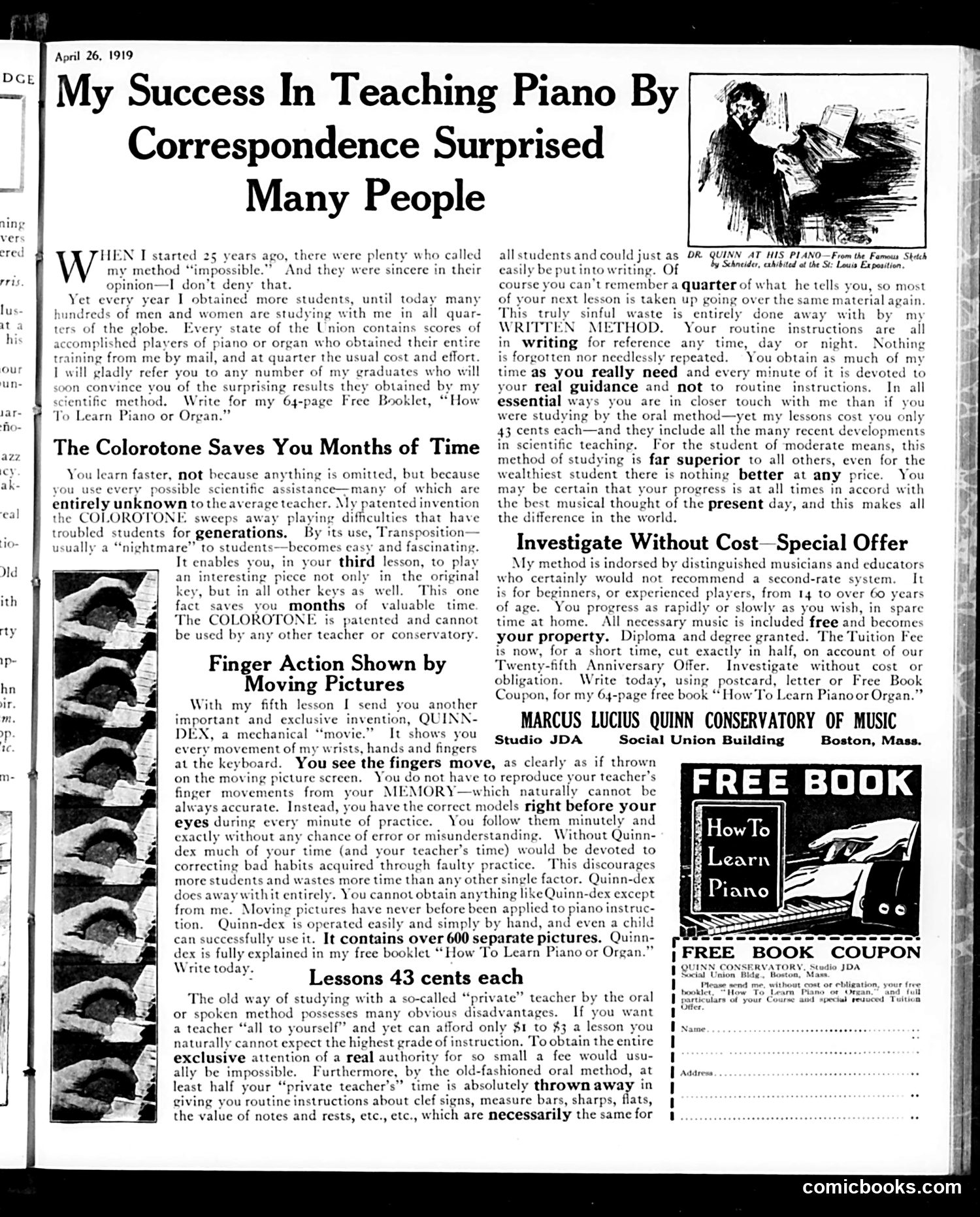
This page is primarily **advertising**, not satire. It showcases Marcus Lucius Quinn's mail-order piano conservatory (Boston, 1919), promoting his "scientific method" of correspondence-based music instruction. The content presents Quinn's pitch: his written method allegedly beats traditional oral instruction because lessons are documented and referenceable. He emphasizes affordability (43 cents per lesson), speed of learning, and proprietary teaching devices—the "Colorotone" (transposition aid) and "Quinn-Dex" (moving pictures showing finger movements). The small portrait labeled "Dr. Quinn at His Piano" authenticates the advertiser's credentials. **Historical context**: This reflects 1910s-20s enthusiasm for mail-order education and mechanical teaching aids. The repeated emphasis on "scientific method" reflects period faith in technology and systematization. **For modern readers**: This is essentially early correspondence-school marketing—the "distance learning" of its era—with the credibility-building techniques still recognizable today (testimonials, free trials, limited-time offers).
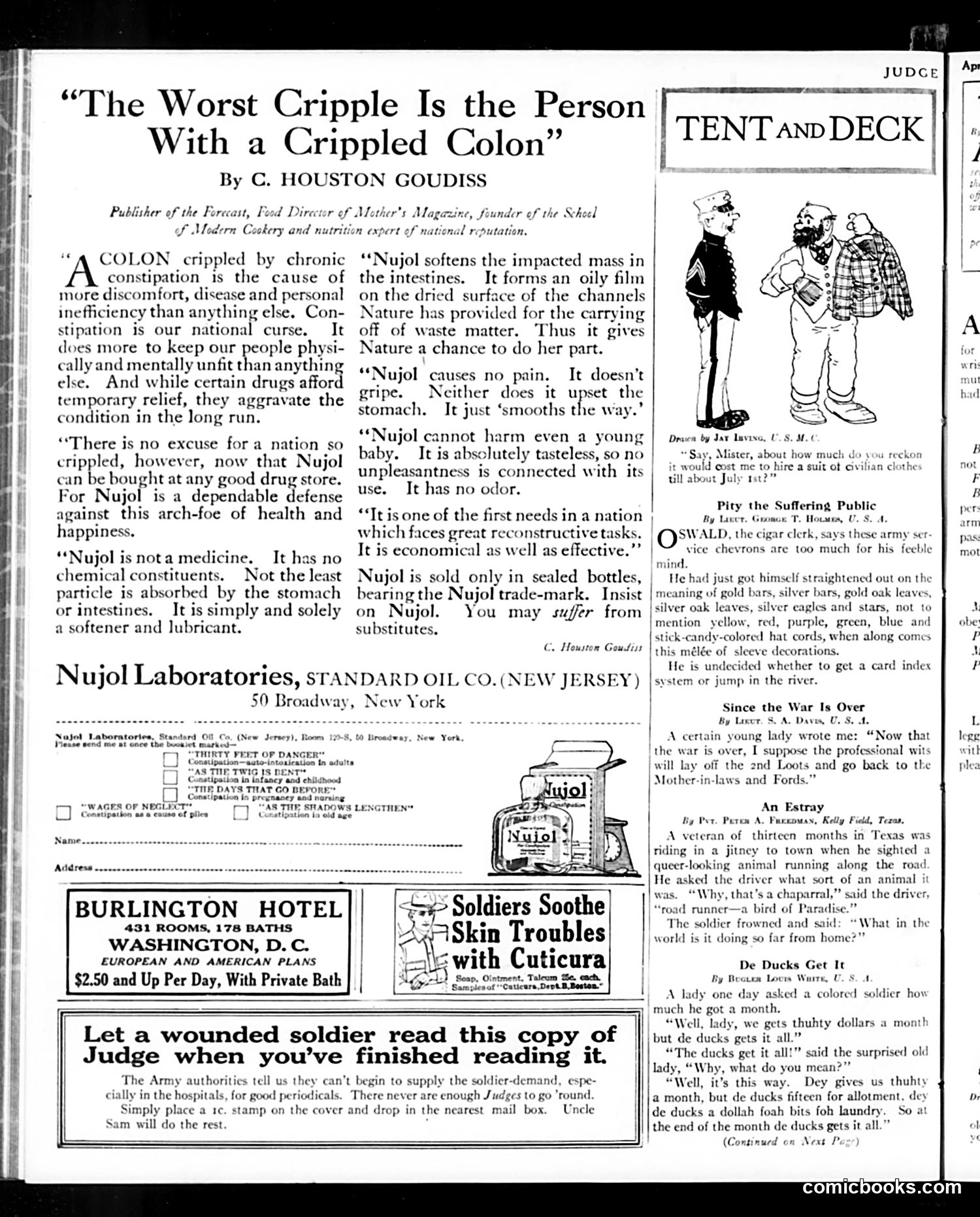
This Judge magazine page contains diverse content illustrating post-WWI America. The main article, by nutrition expert C. Houston Goudiss, advertises "Nujol," a mineral oil laxative, using nationalistic rhetoric: constipation is framed as a national weakness that weakens the citizenry for "reconstructive tasks." This reflects early 20th-century anxieties about public health tied to national strength. The cartoons, credited to artists like Jax Levine, depict soldiers adjusting to civilian life. "Tent and Deck" shows a serviceman confused about civilian clothing costs. Other sketches address demobilization humor—soldiers struggling to understand military insignia, or adjusting to post-war dating conventions. The Burlington Hotel and Cuticura ads target the soldier readership. The final section requests readers donate Judge copies to wounded soldiers in hospitals, positioning the magazine as patriotic support for servicemen. Overall, the page reflects 1918-1920 transitional period anxieties: health, military-to-civilian reintegration, and soldier welfare.
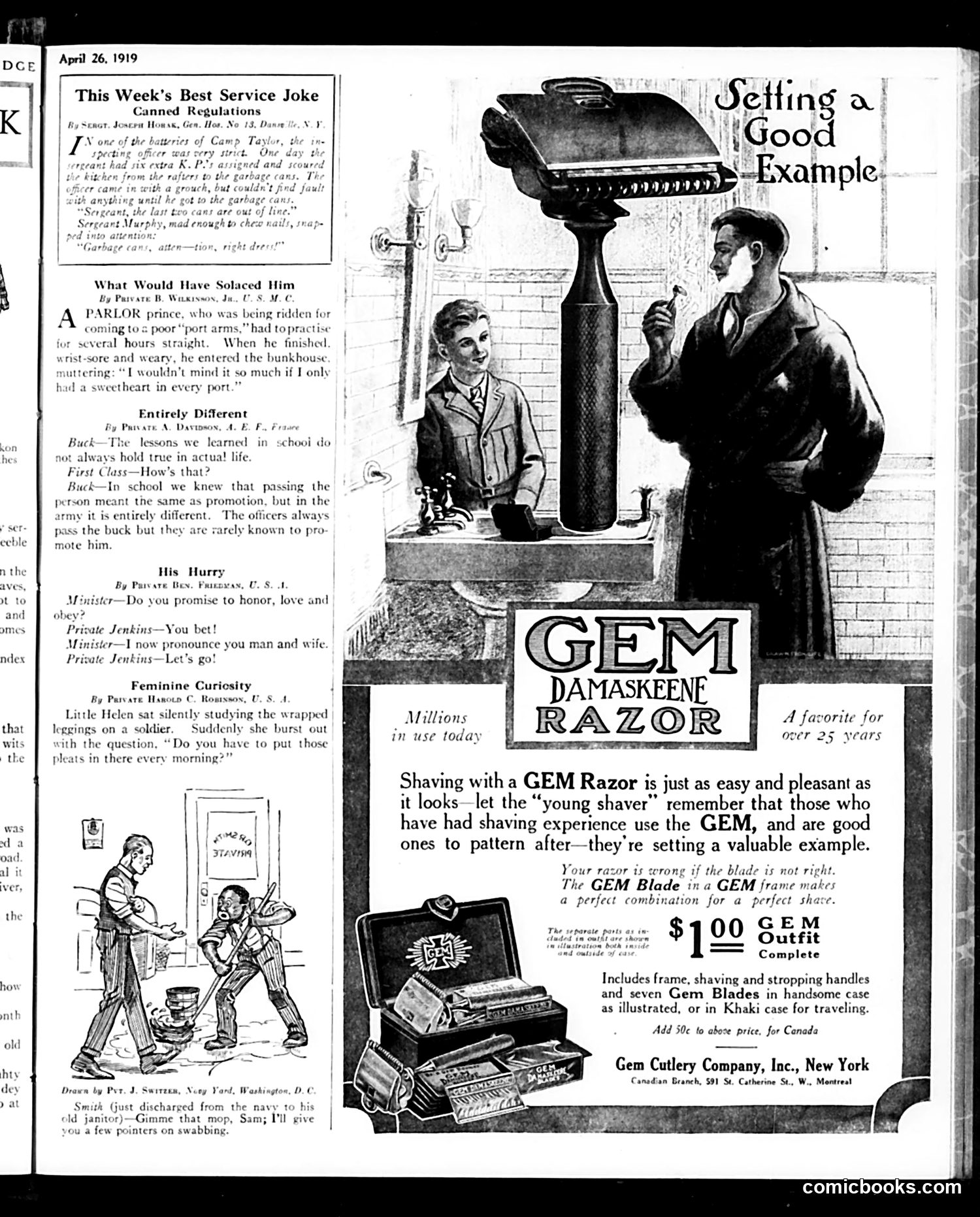
This page consists primarily of brief humorous anecdotes submitted by servicemen, likely from WWI, mixed with a GEM Razor advertisement. The jokes mock military life: one ridicules an officer forced to practice rifle drills; another jokes about military promotion being withheld despite competence ("they pass the buck but they are rarely known to promote him"); a third contains a pun about a hastily-married soldier saying "Let's go!" A cartoon depicts a child asking a soldier why he must wear leggings daily—innocent humor at soldiers' expense. The page reflects post-WWI America (dated just months after the Armistice), when servicemen's humor was commercially viable content. The GEM Razor ad co-opts this military zeitgeist, suggesting that experienced soldiers endorse their product—"they're setting a valuable example" for younger shavers. The advertisement exploits servicemen's cultural cachet to sell consumer goods.
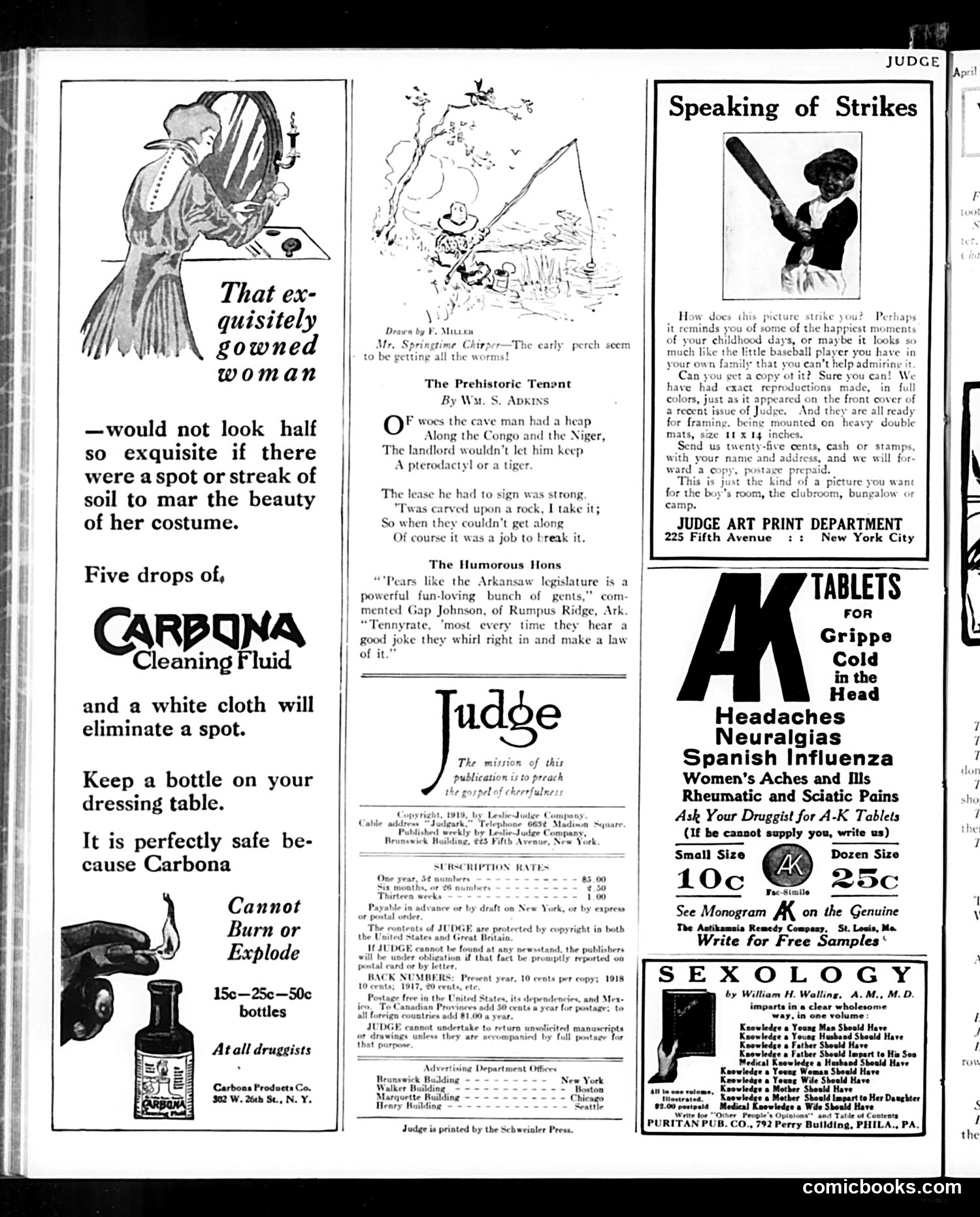
This page is primarily **advertising** rather than editorial content, typical of early-20th-century magazines. The notable satirical element is "The Prehistoric Tenant" by W.S. Adkins, a humorous poem about a cave man struggling with a landlord's strict lease terms—portrayed through the absurd image of a tenant unable to keep exotic pets like pterodactyls or tigers. The joke relies on anachronistically applying modern landlord-tenant disputes to prehistoric times, mocking overly restrictive rental agreements. The rest of the page consists of period advertisements: Carbona cleaning fluid (targeting wealthy women concerned with maintaining fine clothing), A-K Tablets for various ailments (likely containing now-banned ingredients), Sexology books, and Judge's own art print service. The "Speaking of Strikes" illustration appears to reference labor unrest, though context is unclear from this excerpt alone. Overall, this reflects early-20th-century consumer culture and social preoccupations.
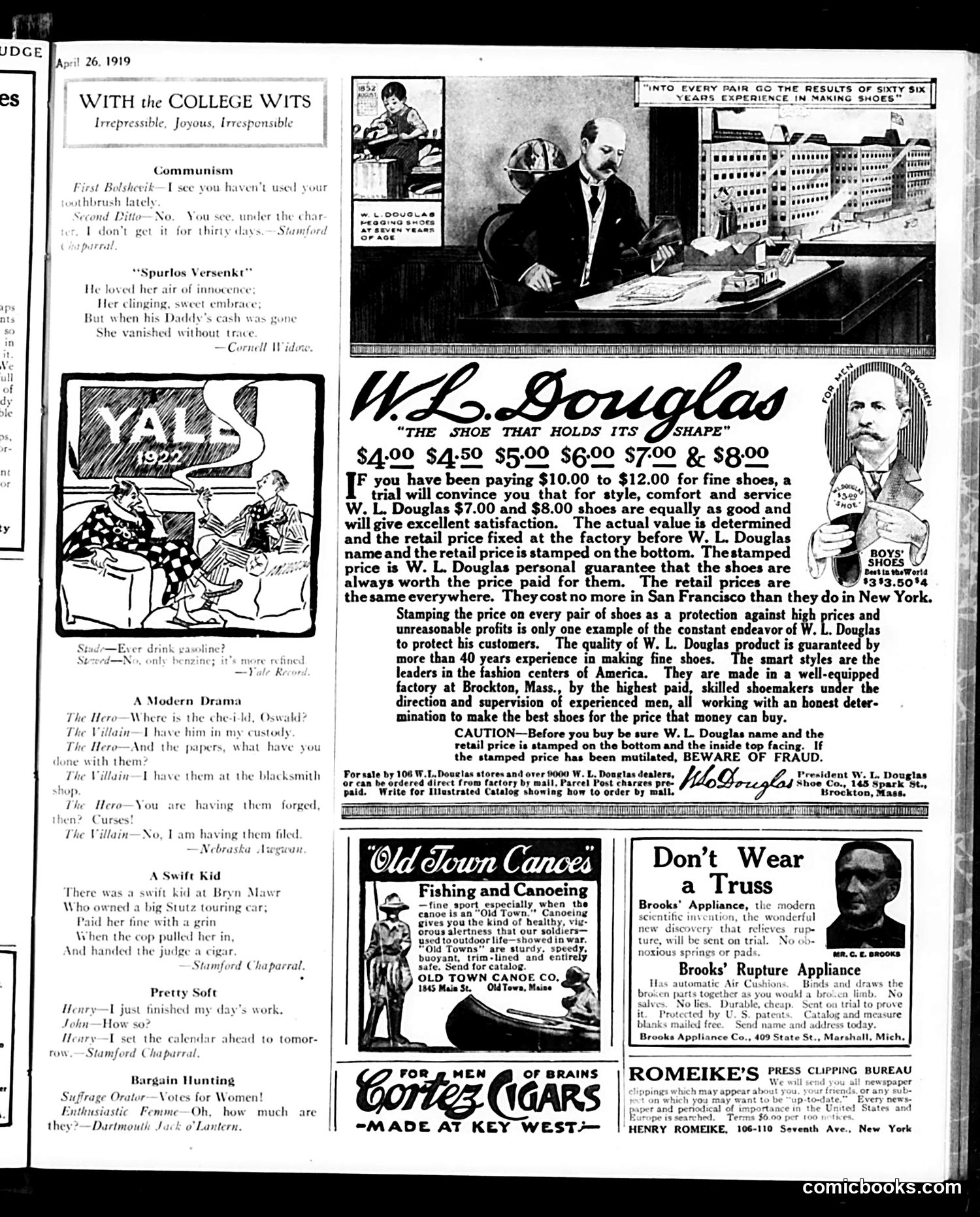
This page mixes humor columns with advertisements. The "With the College Wits" section features brief satirical jokes attributed to various college humor publications: **"Communism"** jokes about Bolsheviks and toothbrush rationing—likely referencing contemporary Red Scare anxieties following the 1917 Russian Revolution, still fresh in American minds. **"A Modern Drama"** appears to be a melodramatic sketch about forged/filed papers at a blacksmith shop—unclear what specific scandal this parodies. **"A Swift Kid"** mocks a wealthy Bryn Mawr student who bribes a judge with a cigar after a traffic violation, satirizing class privilege and judicial corruption. **"Pretty Soft"** is a simple office prank joke about manipulating calendars. **"Bargain Hunting"** makes a crude joke equating women's suffrage (recently won in 1920) with commodities being purchased—reflecting anti-feminist sentiment. The page is primarily filled with product advertisements (W.L. Douglas shoes, Old Town Canoes, Brooks' Rupture Appliance, Gorlez Cigars, and a press clipping bureau), typical of magazine revenue sources.
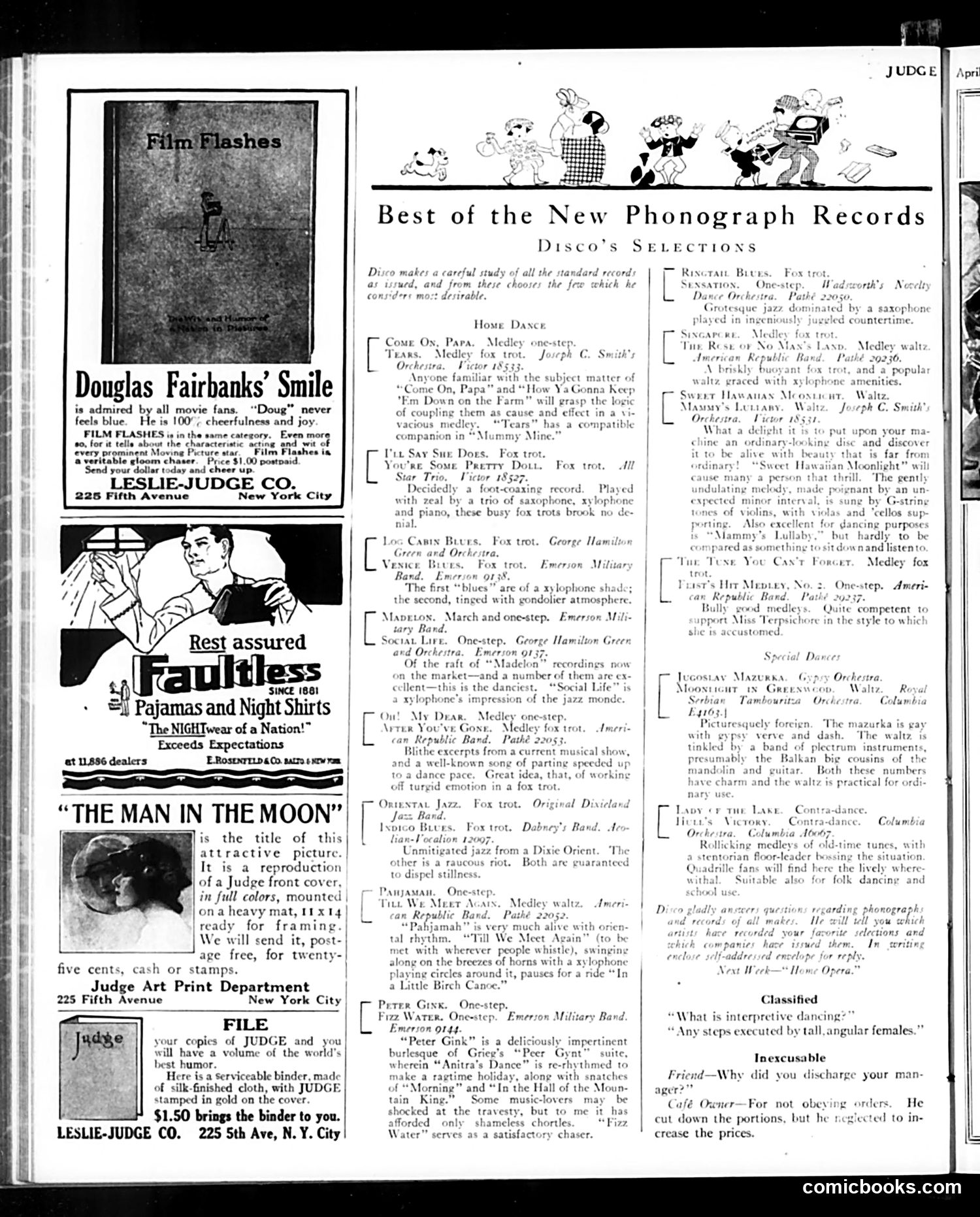
This page is primarily **advertising and product promotion**, not political satire. The main content includes: **Douglas Fairbanks advertisement**: Promotes the silent film star's cheerfulness, linking it to "Film Flashes" entertainment products. Fairbanks was a major celebrity of the era. **"The Man in the Moon"**: A Judge Art Print Department advertisement offering a reproduction of a magazine cover—a common merchandising practice. **Faultless pajamas ad**: Uses the phrase "The NIGHTwear of a Nation," typical 1920s marketing hyperbole. **Phonograph records section**: Reviews of new dance records (fox trots, waltzes, one-steps)—contemporary popular music from labels like Emerson and Pathe. **Small classified jokes**: Mild humor about interpretive dancing and a café owner cutting portions without raising prices. The page reflects 1920s consumer culture: silent film promotion, home entertainment (phonographs), sleepwear marketing, and dance-music enthusiasm. The modest "jokes" at bottom are filler, not satirical commentary.
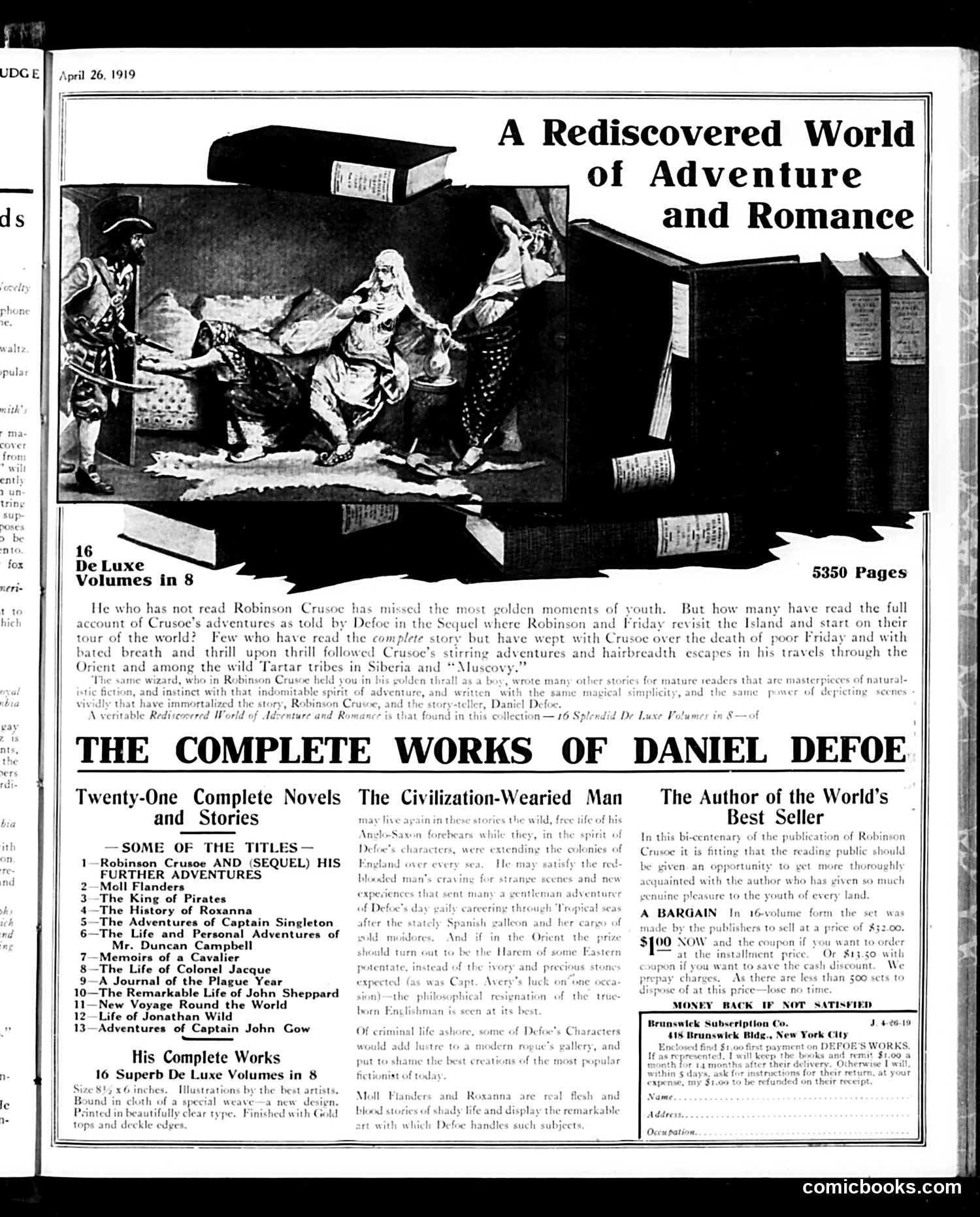
This page is primarily **advertising**, not satire or political commentary. It promotes a luxury edition of Daniel Defoe's complete works—16 de luxe volumes containing 21 novels and stories, totaling 5,350 pages. The illustration shows a dramatic scene from *Robinson Crusoe*, likely depicting Crusoe and Friday encountering other characters during their adventures. The accompanying text emphasizes Defoe's literary significance: he's positioned as "the Author of the World's Best Seller" and a foundational writer whose works modern readers should know. The marketing strategy appeals to educated audiences by suggesting that reading Defoe represents cultural completeness ("He who has not read Robinson Crusoe has missed the most golden moments of youth"). The subscription offer at bottom indicates this was sold through subscription services. The "rediscovered world of adventure and romance" framing suggests this 1919 edition aimed to revive interest in classic literature for a post-WWI audience seeking escapism.
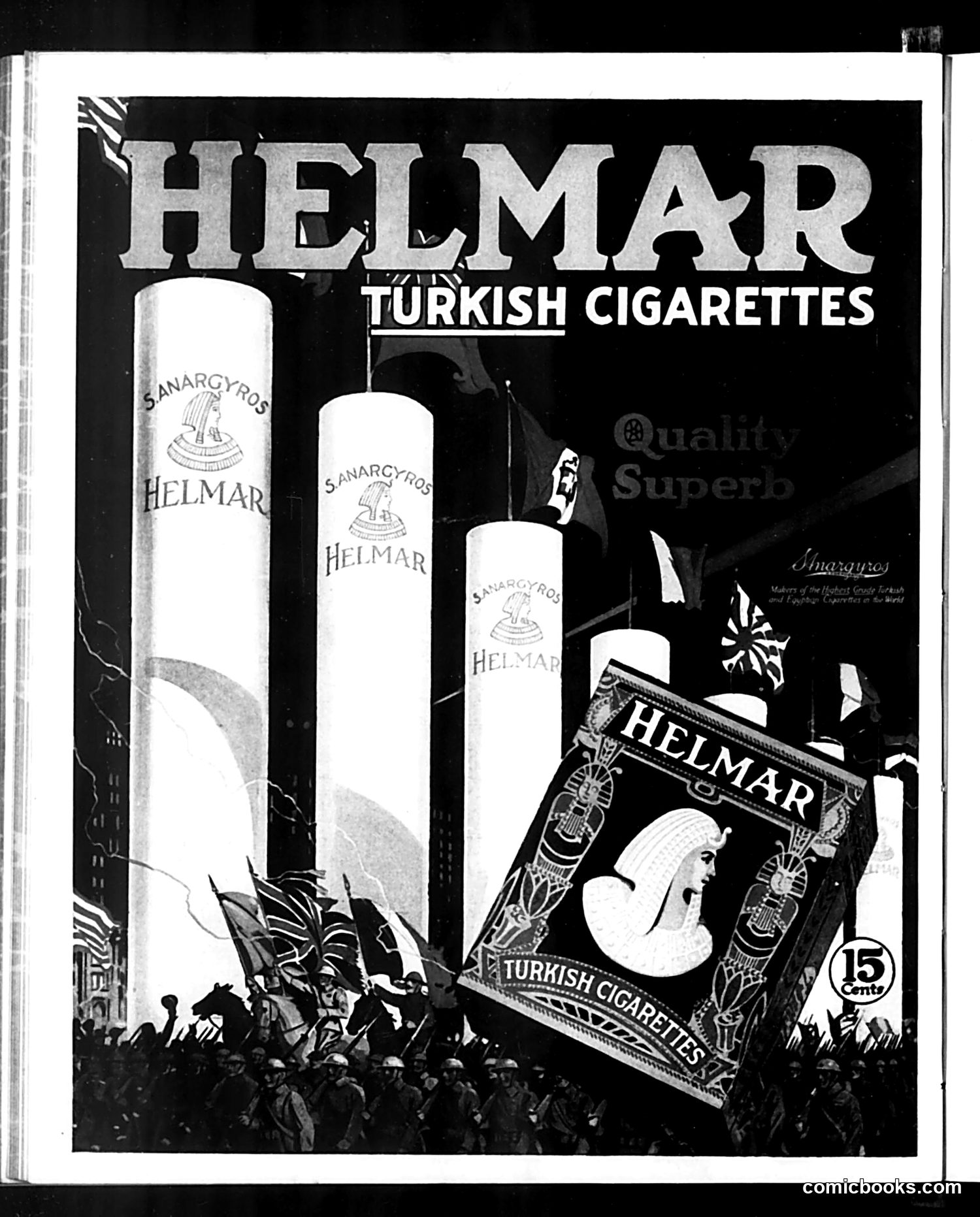
This is a **cigarette advertisement**, not political satire. The page promotes Helmar brand Turkish cigarettes at 15 cents per package. The ad displays three cigarette tubes of decreasing size and a decorative cigarette box featuring an illustrated woman's profile wearing a headscarf. Classical architectural imagery and ornamental details emphasize the "Turkish" positioning. Below the products, silhouetted figures appear to represent crowds or masses, possibly suggesting the product's mass appeal or international reach. The design uses art deco styling typical of early 20th-century advertising. There is no evident political commentary—this is straightforward commercial promotion leveraging exotic "Turkish" imagery to market cigarettes to American consumers during an era when tobacco advertising was standard magazine content.