
Judge, 1919-04-26 · page 19 of 32
Judge — April 26, 1919 — page 19: what you’re looking at
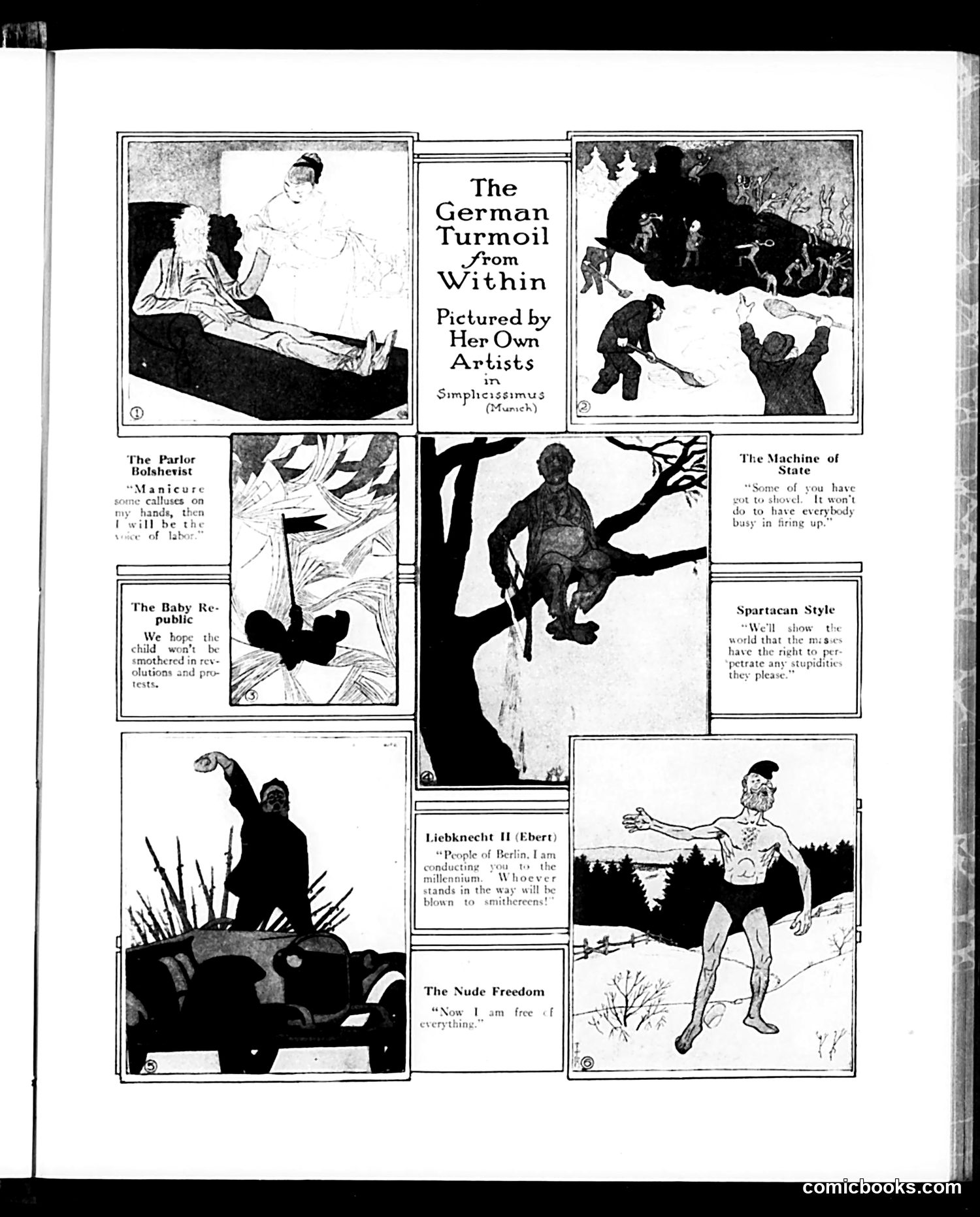
What you’re looking at
This page satirizes post-WWI German political chaos through cartoons attributed to German artists themselves ("Simplicissimus" style). Each panel mocks a different radical faction emerging in Germany circa 1918-1919: **The Parlor Bolshevist** ridicules wealthy elites flirting with communist revolution while remaining comfortable. **The Baby Republic** suggests the new Weimar government is fragile and may not survive upheaval. **The Machine of State** critiques authoritarian control—leaders demanding citizens stay "busy" serving the state. **Liebknecht II (Ebert)** references Karl Liebknecht and Friedrich Ebert, key figures in the German Revolution; the caption suggests brutal suppression of dissent. **Spartacan Style** likely alludes to the Spartacist League (communist group). **The Nude Freedom** depicts anarchistic liberation as naive or chaotic. The overall message: Germany's internal political turmoil—competing revolutionary ideologies—threatens national stability more than external enemies. The satire is deeply cynical about all factions.
📄 Transcribed text from this page (OCR, searchable)
Machine-transcribed from the original scan — historical spelling and the odd misread are preserved.
The German Turmoil rom Within Pictured by Her Own Artists Srmphrerseimus = Gene eon amt We" = ‘The Parlor / The Machine of a Bolshevist State a “Manicure me of you have € ee hovel. [te won't do to have everybody busy in firing up.” q , q The Baby Re- [\ Wee > PR Spartacan Style public : “We'll show — the 1 We hope the world that the misses child won't have the r Liebknecht II (Ebert) £ on The Nude Freedom oa 3 “Now Lam free 7 everything.” i ” Bi] a |