
Judge, 1919-04-26 · page 5 of 32
Judge — April 26, 1919 — page 5: what you’re looking at
What you’re looking at
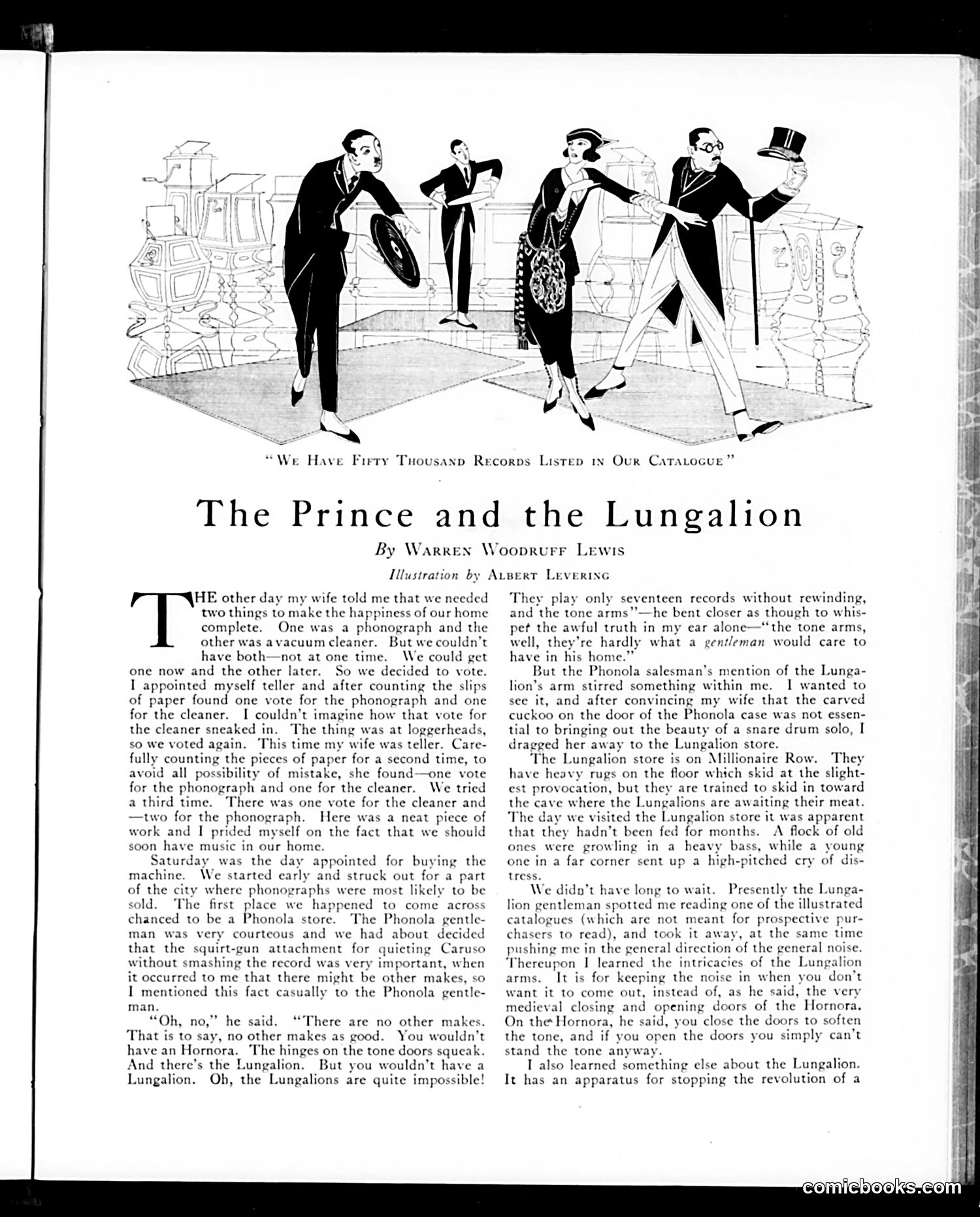
This is a humorous short story by Warren Woodruff Lewis, illustrated by Albert Levering. The cartoon heading shows well-dressed men in a record store examining phonographs and gramophones. The story satirizes early 20th-century consumer culture and phonograph marketing. The narrator and his wife debate purchasing a phonograph or vacuum cleaner—both new luxury items. They visit "Phonola" and "Lungalion" shops to comparison-shop. The satire centers on aggressive salesmen hawking expensive devices with dubious mechanical features (the "Lungalion" has a complex "tone arm" mechanism). The joke appears to mock both the inflated claims manufacturers made about phonograph quality and consumers' gullible fascination with new technology they barely understood.
📄 Transcribed text from this page (OCR, searchable)
Machine-transcribed from the original scan — historical spelling and the odd misread are preserved.
“We Have Fiery Tuousanp Recorps Listep 1x Our Catacocue” The Prince and the Lungalion By Warren Wooprurr Lewis Ilustration by HE other day my wife told me that we needed two things to make the happiness of our home complete. One was a phonograph and the other was avacuum cleaner. But we couldn't have both—not at one time. We could get one now and the other later. So we decided to vote. I appointed myself teller and after counting the slips of paper found one vote for the phonograph and one for the cleaner. I couldn't imagine how that vote for the cleaner sneaked in. The thing was at loggerheads, so we voted again. This time my wife was teller. Care- fully counting the pieces of paper for a second time, to avoid all possibility of mistake, she found—one vote for the phonograph and one for the cleaner. We tried a third time. There was one vote for the cleaner and —two for the phonograph. Here was a neat piece of work and I prided myself on the fact that we should soon have music in our home. Saturday was the day appointed for buying the machine. We started early and struck out for a part of the city where phonographs were most likely to be sold. The first place we happened to come across chanced to be a Phonola store. The Phonola gentle- man was very courteous and we had about decided that the squirt-gun attachment for quieting Caruso without smashing the record was very important, when it occurred to me that there might be other makes, so I mentioned this fact casually to the Phonola gentle- man. “Oh, no,” he said. “There are no other makes. That is to say, no other makes as good. You wouldn't have an Hornora. The hinges on the tone doors squeak. And there’s the Lungalion. But you wouldn’t have Lungalion. Oh, the Lungalions are quite impossible! Avpert Leverine They play only seventeen records without rewinding, and the tone arms”—he bent closer as though to whis- pet the awful truth in my ear alone—“the tone arms, well, they’re hardly what a gentleman would care to have in his home.” But the Phonola salesman’s mention of the Lunga- lion’s arm stirred something within me. I wanted to see it, and after convincing my wife that the carved cuckoo on the door of the Phonola case was not essen- tial to bringing out the beauty of a snare drum solo, I dragged her away to the Lungalion store. The Lungalion store is on Millionaire Row. They have heavy rugs on the floor which skid at the slight- est provocation, but they are trained to skid in toward the cave where the Lungalions are awaiting their meat. The day we visited the Lungalion store it was apparent that they hadn’t been fed for month A flock of old ones were growling in a heavy bass, while a young one in a far corner sent up a high-pitched cry of dis tress. We didn’t have long to wait. Presently the Lunga- lion gentleman spotted me reading one of the illustrated catalogues (which are not meant for prospective pur- chasers to read), and took it away, at the same time pushing me in the general direction of the general noise. Thereupon I learned the intricacies of the Lungalion arms. It is for keeping the noise in when you don’t want it to come out, instead of, as he said, the very medieval closing and opening doors of the Hornora. On the Hornora, he said, you close the doors to soften the tone, and if you open the doors you simply can’t stand the tone anyway. I also learned something else about the Lungalion. It has an apparatus for stopping the revolution of a