
Judge, 1919-04-26 · page 8 of 32
Judge — April 26, 1919 — page 8: what you’re looking at
What you’re looking at
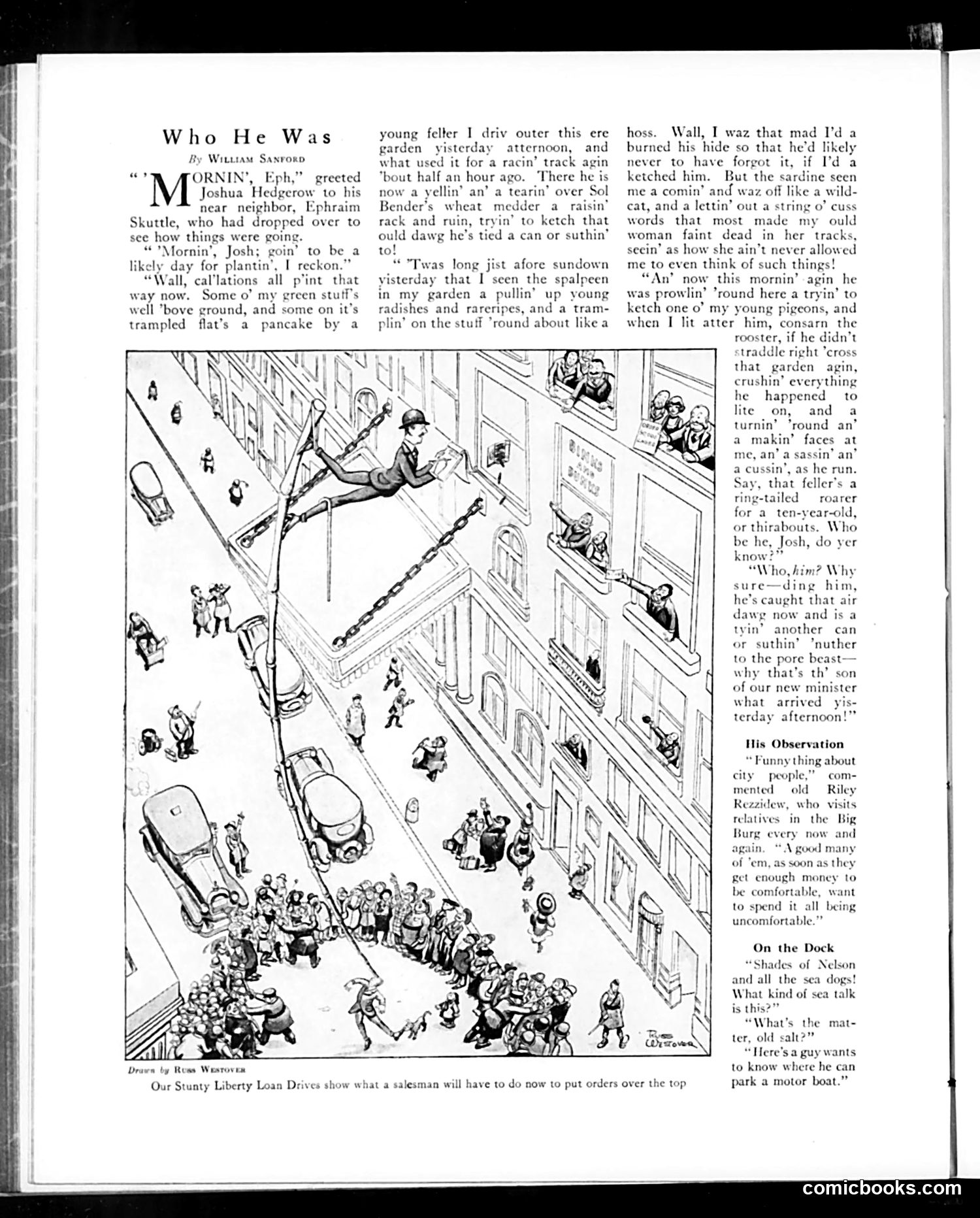
This page contains a rural dialect story and a cartoon about wartime salesmanship. The main illustration, captioned "Our Stunty Liberty Loan Drives," depicts a salesman performing acrobatic stunts above a city street to attract attention and sell Liberty Bonds—the government's WWI fundraising tool. The exaggerated visual humor suggests the extreme measures salesmen now must employ to make sales pitches heard in crowded urban environments. The text story "Who He Was" is a comedic rural anecdote featuring two farmers discussing a destructive, mischievous boy wreaking havoc in gardens and chasing animals. The punchline reveals he's the newly-arrived minister's son—an ironic contrast between expected respectability and actual behavior. The two shorter vignettes ("His Observation" and "On the Dock") offer brief satirical observations about city dwellers and modern inconveniences, typical of Judge's satirical style of the era.
📄 Transcribed text from this page (OCR, searchable)
Machine-transcribed from the original scan — historical spelling and the odd misread are preserved.
Who He Was By Witttam Saxroro es ORNIN’, Eph,” greeted Joshua Hedgerow to his near neighbor, Ephraim Skuttle, who had dropped over to see how things were going. “'Mornin’, Josh; goin’ to be a likely day for plantin’, | reckon.” “Wall, cal’lations all p’int that way now. Some o’ my green stuff’s well *bove ground, and some on it’s trampled flat’s a pancake by a Drawn by Ress Westovien Our Stunty Liberty Loan Drives show what a salesman will have to do now to put orders over the top young feller I driv outer this ere garden yisterday atternoon, and what used it for a racin’ track agin *bout half an hour ago. There he is now a yellin’ an’ a tearin’ over Sol Bender’s wheat medder a raisin’ rack and ruin, tryin’ to ketch that ould dawg he’s tied a can or suthin’ to! as long jist afore sundown visterday that I seen the spalpeen in my garden a pullin’ up young radishes and rare and a tram- plin’ on the stuff ‘round about like a hoss. Wall, I waz that mad I'd a burned his hide so that he'd likely never to have forgot it, if I'd a ketched him. But the sardine seen me a comin’ and waz off like a wild- cat, and a lettin’ out a string 0” cuss words that most made my ould woman faint dead in her tracks, seein’ as how she ain’t never allowed me to even think of such things! “An’ now this mornin’ agin he was prowlin’ ’round here a tryin’ to ketch one o’ my young pigeons, and when I lit atter him, consarn the rooster, if he didn’t traddle right ’cross that garden agin, crushin’ everything he happened to lite on, and a turnin’ ‘round an’ a makin’ faces at me, an’ a sassin’ an’ a cussin’, as he run. ay, that feller’s a ring-tailed — roarer for a ten-year-old, or thirabouts. Who be he, Josh, do yer know “Who, him? Why sure—ding him, he’s caught that air dawg now and is a tyin’ another can or suthin’ ‘nuther to the pore beast— why that’s th’ son of our new minister what arrived yi terday afternoon!” His Observation “Funny thing about city people,” com- mented old Ril Rezzidew, who vi relatives in. the Big Burg every now and in. A good many of ‘em, as soon as th get enough money to be comfortable, want to spend it all being uncomfortable.” On the Dock “Shades of Nelson and all the sea dogs! What kind of sea talk is this?” “What's the mat- ter, old salt?” “Here's a guy wants to know where he can park a motor boat.” comicbooks.com